
Most Expensive Cacti Ever Sold: How Mature Cultivated Copiapoa Reach $15,000+
All ArticlesThe most expensive cacti in collector hands are mature seed grown Copiapoa cinerea of thirty or more years of cultivation, routinely clearing $10,000 to $15,000 and crossing well above that for crested or color-variant specimens. None are trafficked. The price reflects decades of cultivation skill, not wild collection.
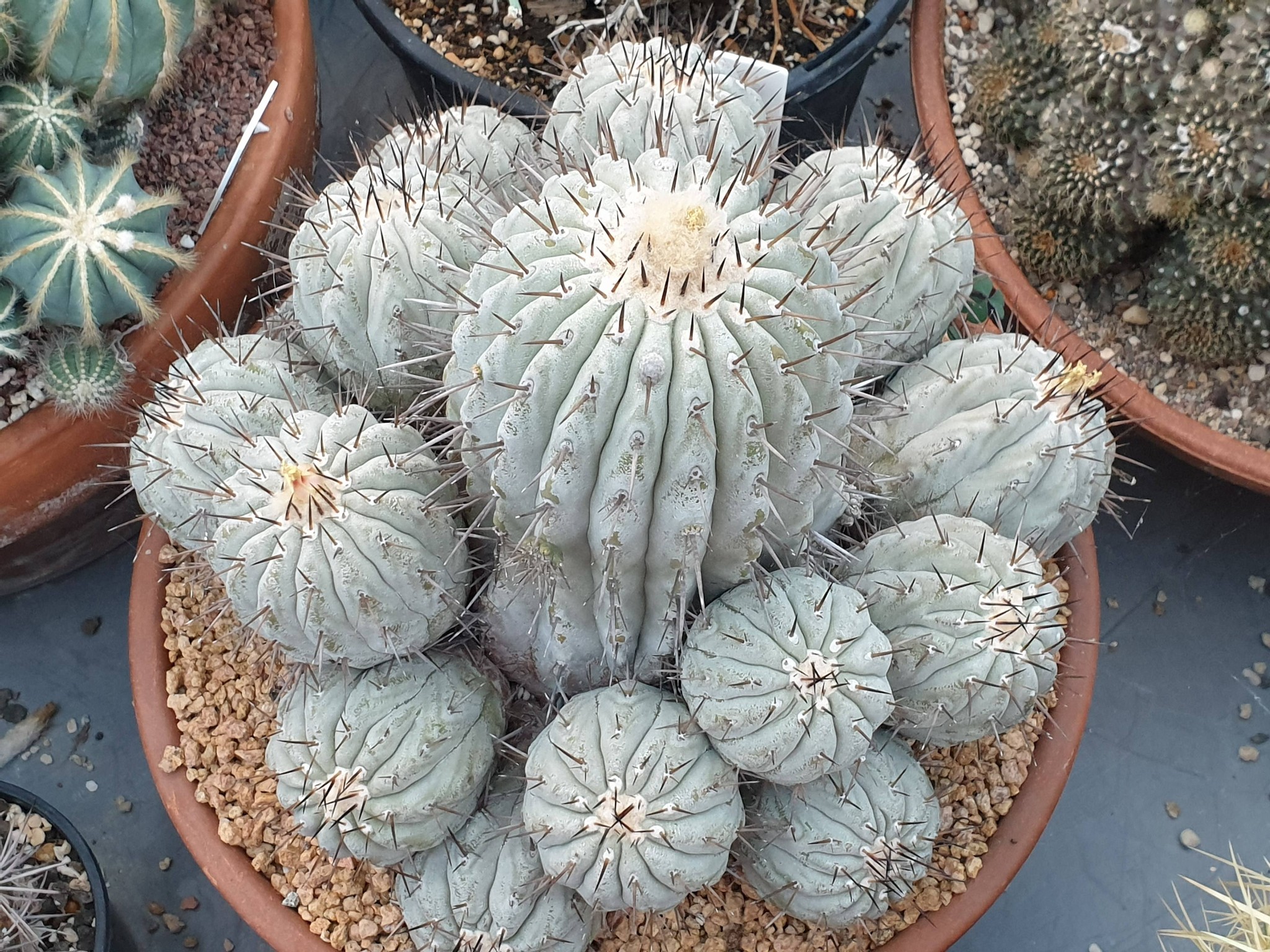
Why do decades-old cultivated cacti cost so much?
The growth math is the first explanation. Slow-growing desert cacti add roughly one millimetre of body diameter per year in habitat. In careful cultivation the rate runs three to eight millimetres per year depending on species, substrate, and grower. A 12-centimetre Copiapoa cinerea in cultivation represents fifteen to thirty years of consistent growing without a major setback. A 20-centimetre specimen with developed dome habit is thirty to fifty years of someone’s growing life. The plant is not a commodity; it is a record of decades of cultivation decisions that did not go wrong.
Seed grown matters because grafting compromises everything else. A grafted plant grows fast on the strength of its rootstock and settles into a body habit that reflects the rootstock’s vigour rather than the species’ native form. Take a grafted Copiapoa off its Trichocereus stock and the body shape stays accelerated. Seed grown plants build the slow, dense, tightly-ribbed habit collectors recognise on sight. Decades of seed grown cultivation also leave no graft scar at the base, no transition zone in the body, and a root system that supports the plant on its own anatomy.
Provenance is the third lever. Field-numbered seed (FR for Friedrich Ritter, L for Alfred Lau, SB for Steven Brack, HU for Horst and Uebelmann) attaches a documented locality to a plant. A seed grown Copiapoa cinerea with FR or HU provenance, documented in cultivation since the 1970s, is not interchangeable with an unnumbered nursery plant of the same species. The provenance carries the same weight a Steven Brack ISI accession carries in the Huntington’s catalogue. Buyers pay for the documentation as much as for the plant.
What does a 30-year mature Copiapoa cinerea actually sell for?
Copiapoa cinerea is the headline number in the cultivated market for three reasons stacked on each other. The species is exceptionally slow even by Cactaceae standards (decades to a display-size body). The native habitat in the coastal Atacama fog belt has become culturally iconic since the 1990s Schulz-and-Kapitany photographic transect, which means the demand side is not abating. And the 2024 IUCN reassessment placed 82% of the genus in a threatened category, which has concentrated buyer attention on legitimately cultivated material as the only ethical option.
Specimen pricing tracks age and form, in that order. A 10-centimetre seed grown plant of fifteen years cultivation trades at $300 to $700 in the specialty nursery market. A 15-centimetre plant of twenty-plus years runs $1,500 to $4,000. A 20-centimetre dome-habit specimen of thirty years or more (the plants whose body shape and chalky white pruinose surface are the reason collectors buy Copiapoa in the first place) regularly clear $10,000 to $15,000 in private collector transactions and at specialist society auctions. The market ceiling is not fixed. Cresting forms, exceptional colour variants, and decades-old field-numbered specimens cross higher. A well-documented 25-centimetre Copiapoa cinerea with FR or HU provenance and documented cultivation history sits at the upper end of the cultivated market; transactions at that level happen privately and rarely appear in public price data.
Subspecies premiums apply within the species complex. C. cinerea subsp. krainziana, the long curving cream-white spine form Ritter named in 1963, commands a price ceiling above the type because the spine character takes a decade longer to develop fully. C. cinerea subsp. haseltoniana (massive body habit) and the older columna-alba name now subsumed in subsp. cinerea are similar premium calls. The Plants of the World Online treatment now lumps these as ecotypes of one morphologically plastic species, but the cultivation market has not adjusted; specialist collectors still pay for the subspecies labels because the plants look different and developed those differences over a long time.
The species also resists shortcuts. Mass-propagation pipelines that broke the price of Mammillaria luethyi (rediscovered 1996, $1,000+ per plant in 1998, mass-propagated in South Korea by 2002, now $10-$40) cannot replicate a thirty-year Copiapoa cinerea because the time component is non-compressible. A South Korean tissue-culture lab can flood the market with seedlings; it cannot age them faster. That is why the cultivated Copiapoa market has held its ceiling while species after species has been broken by industrial propagation.
Which other cacti legitimately reach four figures?
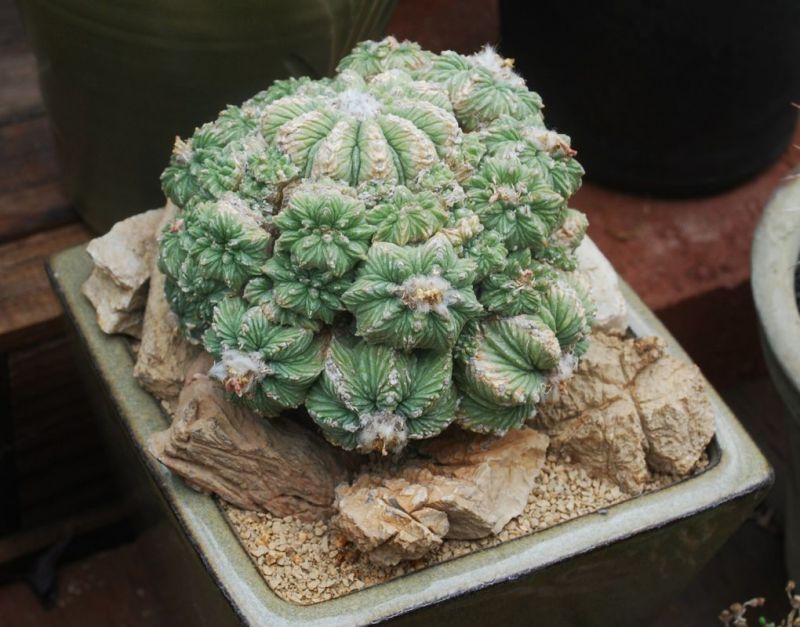
Aztekium ritteri: the slowest-growing cactus genus on Earth. A five-centimetre seed grown specimen represents thirty to fifty years of cultivation; many growers lose plants in the first decade because seedlings cannot tolerate the dry-out cycles older specimens handle. Top current eBay listings sit at £1,100 to €1,299 for seed grown specimens around 8-11 centimetres. Mature decades-old plants in private collections trade well above that, often $5,000 and beyond. A. hintonii (described 1992 from Galeana, Nuevo León) and the recently described A. valdezii occupy the same market band. Specialist EU nurseries (CactusMania, Giromagi, Botanical Archive) document grafted specimens at €78 to €430 retail, but those grafted plants are not the comparison; mature seed grown is.
Astrophytum asterias “Super Kabuto”: the Japanese cultivar line that descends from a single founder specimen Masaomi Takeo discovered in 1981 and sold to Tony Sato. Forty-five years of selective breeding for dense overlapping white trichome areoles produced today’s reference forms. Exceptional patterning specimens in the Japanese collector market regularly clear $1,000 and decades-old established plants reach $5,000 and above. The 1981 founder transaction is described in every source as “a high price” without a published figure; the cultivar story is real, the original sale price is not on the public record. Current eBay listings show the entry level at $200 to $385 for “very old” specimens, which understates the upper market.
Discocactus horstii: Pierre Braun described this species in 1970 from a tiny area of Serra do Barão in Minas Gerais, Brazil. CITES Appendix I, extremely rot-prone, depressed-globular at maturity (only 2 centimetres tall by 6 centimetres wide), with a nocturnal white scented flower emerging from a developed cephalium. Mature seed grown specimens with cephalium command $1,000 to $3,000 in specialist channels; the demand pressure is continuous because the species is difficult enough to grow that supply has never caught up. Plantae Paradise lists smaller mature plants at $277 retail; that figure is the lower end of the cultivation market, not the high end.
Mature seed grown Ariocarpus: A. retusus, A. fissuratus, A. agavoides, and A. trigonus all reach four figures legitimately when the plant carries thirty or more years of cultivation, field-number provenance, and the developed wartiness that comes only with age on roots. CactusMania documents an A. retusus SB68 (Steven Brack, Coronel Beltrán, Nuevo León) seed grown 14-centimetre specimen at €350; older specimens with documented cultivation history routinely clear $1,000 to $5,000 and beyond. The CITES Appendix I status tightens the market further. International trade in Ariocarpus is paperwork-heavy, which means the specialist channels that can navigate the regulation are the same specialist channels that command premium pricing.
Entry-Level Cultivated Market: April 2026 eBay Snapshot
The high-end cultivated market described above runs through specialist nurseries, society auctions, and private collector channels that rarely surface in public price data. The eBay tier sits below it. A current sweep of eBay and the PicClick aggregator shows what entry-level cultivated specimens are actually being asked for in April 2026. Every figure below is an active asking price, not a confirmed sale; the snapshot shows where the floor is, not the ceiling.
eBay live listings, April 2026 (top asking prices, by genus):
- Copiapoa cinerea: $481.99 for a 6.9-centimetre seed grown specimen; multiple plants in the $300-$450 range. Entry-level pricing for plants ten to fifteen years from seed.
- Aztekium ritteri (seed grown): £1,100.99 (~$1,400) for an 8-centimetre specimen; an EU listing at €1,299 for an 11-centimetre plant. The highest credible single-plant asking prices on the entire scan.
- Aztekium hintonii (seed grown): $350 for an old specimen described as never grafted.
- Ariocarpus retusus “Qingci”: $399 for a 7-centimetre specimen.
- Ariocarpus trigonus: $450 for a four-headed cluster.
- Astrophytum asterias “Super Kabuto”: $385 for a “very old” specimen; most mature plants $200-$275.
- Discocactus horstii: £399.99 (~$520) for a variegated cristate form; standard mature specimens $125-$220.
- Turbinicarpus alonsoi: $392.98 for five plants of 3-4 centimetres each (effectively $79 per plant); singles around $50-$90.
Read the snapshot as a floor reference. A £1,100 Aztekium ritteri on eBay is an 8-centimetre seed grown specimen; a $15,000 mature specimen in a private collector transaction is a twenty-centimetre clustered plant of forty years of cultivation with documented provenance. The two are different products at different scales of the same market. eBay is the discoverable surface; the high-value cultivation market is what runs underneath it.
What separates a $500 cactus from a $15,000 cactus?
Five drivers, in rough order of weight. Age is the foundation. A specimen has either been grown for decades or it has not, and no money or technique recovers the years. Seed grown status is second; specimens with no graft scar and no transition zone in the body trade at multiples of grafted equivalents, even of the same age. Body form is third: dome habit, tubercle geometry, spine character, surface pruinose all develop slowly and reflect cultivation skill. Provenance is fourth: a field-numbered or ISI-coded plant with documented cultivation history beats an unlabelled plant of identical appearance. Variation is fifth: cresting, monstrose, variegate, and exceptional colour forms add a multiplier on top of everything else, but only if the underlying plant is already in the premium tier.
What buyers pay for, in plain terms: the specimen is a record of decades of cultivation decisions that did not go wrong, documented well enough that the next steward can continue the record. Everything else (substrate brand, grafting choice, fertilizer schedule) is the rear-view-mirror story of how the plant got there.
Frequently Asked Questions
What is the most expensive cactus a collector will actually buy?
In the legitimate cultivation market, the most expensive cactus a serious collector will encounter is a mature seed grown Copiapoa cinerea of 30+ years cultivation. Specimens at that age routinely clear $10,000 to $15,000 in the specialist collector market, with exceptional plants (cresting forms, colour variants, decades-old field-numbered stock) crossing well above. The price reflects the time cost of the cultivation, not scarcity in the market for younger material; the species is propagated commercially, but no propagation pipeline can compress thirty years of growth.
Why are mature Copiapoa specimens so expensive?
Three drivers stack. The species grows at roughly 3-8 millimetres of body diameter per year in cultivation, so a 20-centimetre dome-habit plant is thirty to fifty years of consistent growing without a serious setback. The native Atacama habitat became culturally iconic in the 1990s after the Schulz-Kapitany photographic survey, sustaining demand indefinitely. The 2024 IUCN reassessment placed 82% of Copiapoa taxa in a threatened category, which has concentrated serious buyer attention on legitimately cultivated material as the only ethical option.
What makes a seed grown cactus more valuable than a grafted one?
Seed grown plants build the slow, dense, tightly-ribbed body habit collectors recognise as authentic. Grafted plants grow fast on the strength of a Trichocereus or Pereskiopsis rootstock and settle into a body shape that reflects rootstock vigour rather than the species’ native form. A seed grown specimen has no graft scar at the base, no transition zone in the body, and a root system supporting the plant on its own anatomy. For decades-old specimens, the difference is visible across a room. The market multiple between a seed grown plant and a grafted plant of identical age and species commonly runs three to five times in favour of seed grown.
Which cactus genera reach four-figure-plus prices in cultivation?
Five genera carry the bulk of high-value cultivation transactions: Copiapoa (especially C. cinerea and its subspecies, with mature seed grown specimens at $10,000 to $15,000+); Aztekium ritteri and A. hintonii (seed grown mature specimens $1,400 to $5,000+); Astrophytum asterias Super Kabuto exceptional patterning ($1,000 to $5,000+); Discocactus horstii with developed cephalium ($1,000 to $3,000+); and mature seed grown Ariocarpus with field-number provenance ($1,000 to $5,000+). Cresting, variegate, or monstrose forms in any of these species add a multiplier.
Where do these high-priced cactus sales actually happen?
Specialist nurseries (CactusMania, Mesa Garden, Botanical Archive, Kakteen-Haage), cactus society auctions (CSSA, BCSS, Deutsche Kakteengesellschaft), the Huntington’s International Succulent Introductions distribution programme (operating since 1958), and private collector-to-collector transactions. eBay and the open public market handle the entry-level tier: $50 to $500 for younger or smaller specimens. The high-end cultivation market does not transact on eBay; the plants involved would not survive the shipping process the platform optimises for, and the buyers who pay five figures are not looking on a generalist marketplace.
How do I tell if a high-priced cactus is worth the money?
Five things to evaluate. Age, by body diameter relative to the species’ growth rate (a 20-centimetre Copiapoa cinerea is decades of growth; a 20-centimetre Echinopsis is one season). Cultivation method, confirmed by inspecting the base for a graft scar or transition zone (no scar means seed grown). Body habit, compared against habitat photographs of the species (dense ribs, developed pruinose surface, characteristic spine geometry). Provenance documentation, from a field number (FR, L, SB, HU) or an ISI accession code or a paper trail from a documented nursery. Health, including root system intact (not recently degrafted) and no rot at the soil line. A seller who can answer all five with documentation is selling at the high end of the market for cause.
Schulz, R. and Kapitany, A., Copiapoa in Their Environment: Chañaral to El Cobre (privately printed, Victoria, Australia, 1996) · Guerrero, P.C. et al., Copiapoa subsection Cinerei revision, Kew Bulletin (2018) doi:10.1007/s12225-018-9780-3 · IUCN, 2024 Copiapoa reassessment (82% of taxa now in a threatened category) · Anderson, E.F., The Cactus Family (Timber Press, 2001) · Hunt, D., Taylor, N. and Charles, G. (eds.), The New Cactus Lexicon (DH Books, 2006) · Pilbeam, J., Mammillaria: The Cactus File Handbook (Cirio Publishing, 1999) · The Huntington Library, International Succulent Introductions (ISI) accession catalogues, 1958-present · Cactus and Succulent Society of America (CSSA), society show and auction records · British Cactus and Succulent Society (BCSS), society show and auction records · Deutsche Kakteengesellschaft (DKG), historical price-list archives · Mesa Garden (Steven Brack), SB field-number provenance records · CactusMania, Giromagi, Botanical Archive, and Kakteen-Haage, specialty EU nursery pricing references · PicClick eBay aggregator, April 2026 live-listing snapshot · World of Succulents and llifle.com, Astrophytum asterias Super Kabuto cultivar history · Plantae Paradise, Discocactus horstii retail pricing reference · BCSS Field Number Finder · Plants of the World Online (Royal Botanic Gardens Kew)