Peyote (Lophophora williamsii): Botany, Ecology, and Conservation of the World’s Most Protected Cactus
All ArticlesThe peyote cactus is Lophophora williamsii, a small, spineless, blue-green button cactus native to the Chihuahuan Desert and Tamaulipan thornscrub of northern Mexico and southern Texas. The visible button is the crown of a taproot more than 25 cm deep. CITES lists it on Appendix II via Cactaceae, not Appendix I; the IUCN assessed it Vulnerable in 2017.
What does peyote look like?
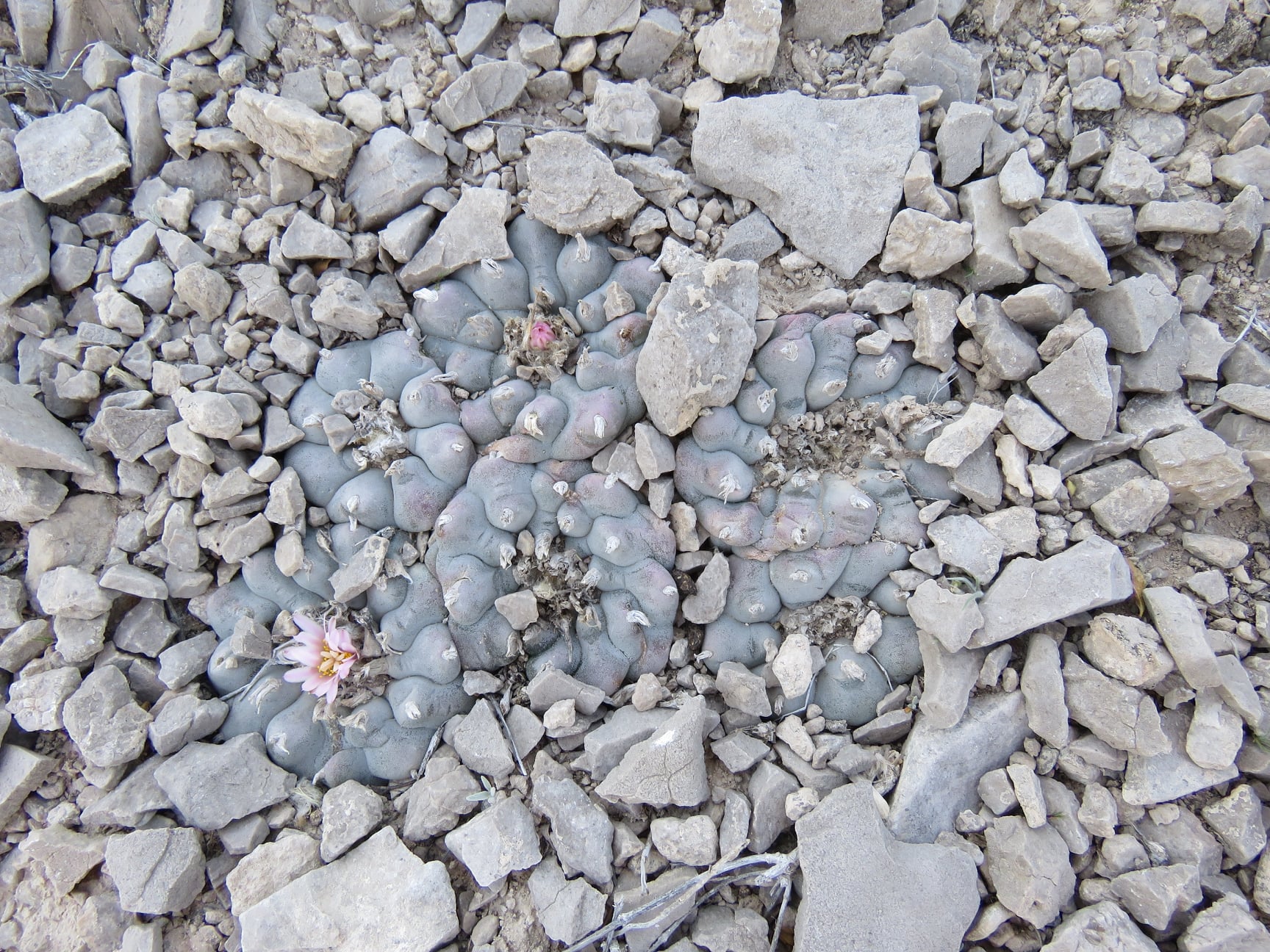
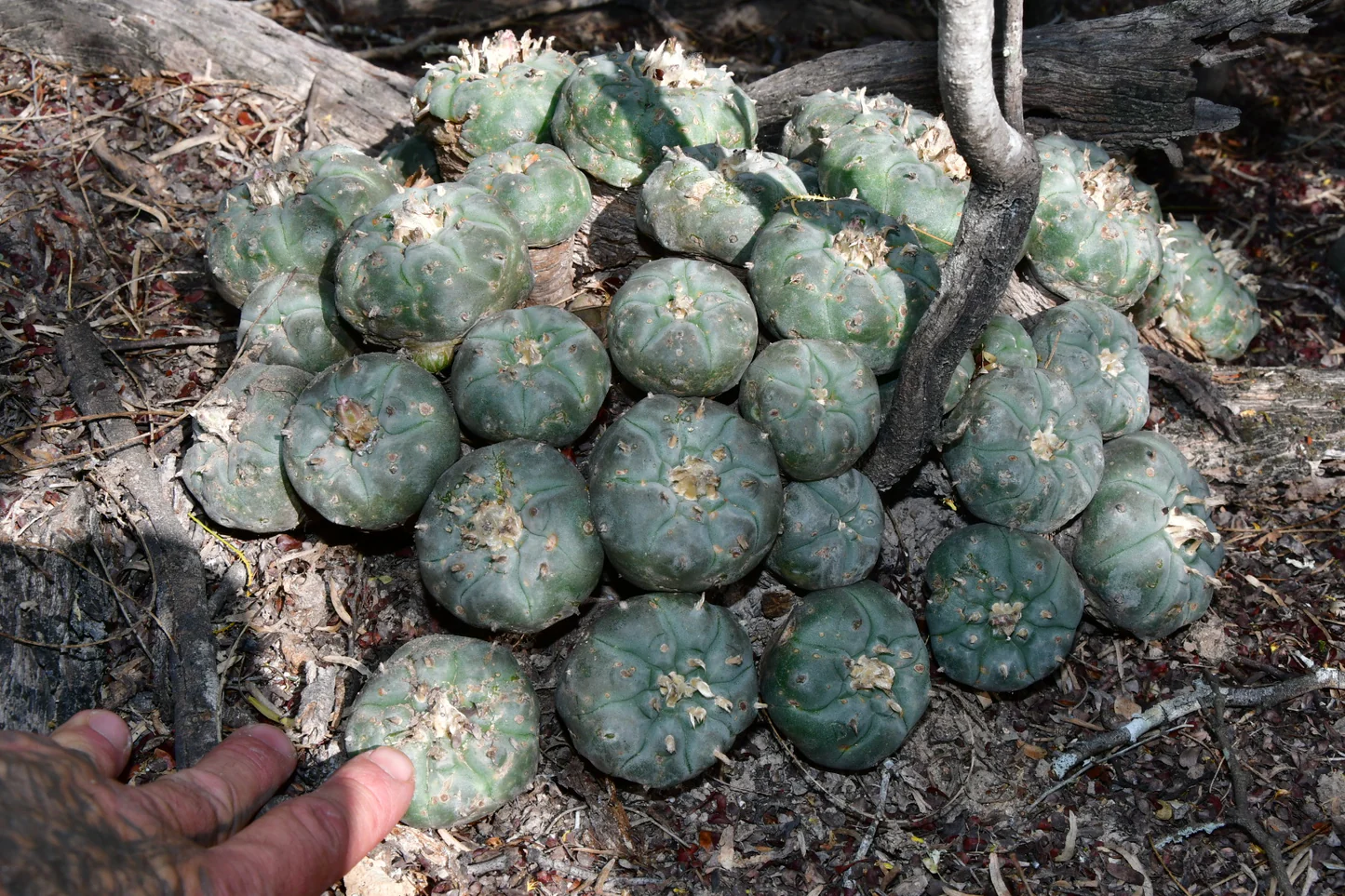
Peyote is a small, spineless, blue-green to gray-green button cactus, 4 to 12 cm wide, with broad rounded ribs, tufts of white wool where other cacti carry spines, and a single pink to white flower that opens from the woolly crown.
The body is flat-topped and disc-shaped, rarely more than 7 cm tall, with a glaucous, slightly waxy epidermis that reads blue-green in shade and gray-green in full sun. The ribs, usually 5 to 13, are low and rounded rather than sharp, divided into raised podaria, the cushion-like segments that carry the areoles. Each areole holds a tuft of fine white or yellowish wool, and there are no spines at any stage of growth. That spineless, woolly surface is the fastest way to separate peyote from almost every other cactus in its range. The flowers are small, 1 to 2.4 cm across, pink and sometimes white, and emerge one at a time from the wool at the very center of the crown.
The genus Lophophora holds only two widely recognized species, and peyote’s soft, woolly, button shape is echoed by a few unrelated desert cacti that grow alongside it. The table below covers the features that tell them apart.
| Plant | How to tell it apart from peyote |
|---|---|
| Lophophora williamsii (peyote) | Blue-green to gray-green; 5 to 13 broad, well-defined ribs; white wool tufts and no spines; a single pink to white flower from the crown; deep napiform taproot. |
| Lophophora diffusa | Yellow-green rather than blue-green; softer, flatter body; ribs poorly defined or nearly absent; flowers usually white to pale yellow. Restricted to a small area of Querétaro, Mexico. |
| Living rock (Ariocarpus) | Solid triangular tubercles arranged in a rosette instead of continuous ribs; firm, often roughened skin; wool sits in the grooves between tubercles rather than in a central crown tuft. |
| Astrophytum asterias | Body split into a fixed set of flat ribs, usually eight, separated by straight grooves; surface flecked with tiny white scale-dots; areoles in a neat row along each rib; flower yellow with a red throat. |
Is peyote on CITES Appendix I or II?
Peyote is listed on CITES Appendix II, not Appendix I, through the family-wide Cactaceae listing. This is the most-misreported fact about the plant and worth getting right at the top.
The family Cactaceae has been on CITES Appendix II since 1 July 1975. The current annotation reads: “Cactaceae spp. (Except the species included in Appendix I and except Pereskia spp., Pereskiopsis spp. and Quiabentia spp.).” That family-level Appendix II listing covers Lophophora williamsii by default.
The cacti on Appendix I are a specific list, and L. williamsii is not on it. Appendix I includes Ariocarpus spp., Astrophytum asterias, Aztekium spp., Coryphantha werdermannii, Discocactus spp., Mammillaria pectinifera, Mammillaria solisioides, four Melocactus species, Obregonia denegrii, Pachycereus militaris, Pediocactus bradyi, Pelecyphora spp., several Sclerocactus spp., Strombocactus spp., Turbinicarpus spp., and Uebelmannia spp.
What sets peyote apart is not Appendix I status. It is the layered regulatory framework: CITES Appendix II at the international level, IUCN Vulnerable in the most recent assessment, Mexican NOM-059 special protection, and Texas state-level harvest regulation. The regulatory weight is real. The Appendix I myth is not.
The United States adds a second layer of control that has nothing to do with CITES. Peyote is a federal Schedule I controlled substance because it contains mescaline, so cultivation and possession are restricted under the Controlled Substances Act. The one standing exception is religious: bona fide ceremonial use by members of the Native American Church is protected under the American Indian Religious Freedom Act, as amended in 1994. That is a different legal position from the San Pedro cactus (Trichocereus pachanoi), which is widely grown and sold as an ornamental landscape cactus across the United States. For the full legal picture, see our guide on whether it is legal to own peyote.
What habitat does peyote need to grow in the wild?
Peyote grows wild across seven states of northern Mexico and the southern tip of Texas, in two desert systems: the Chihuahuan Desert and the Tamaulipan thornscrub.
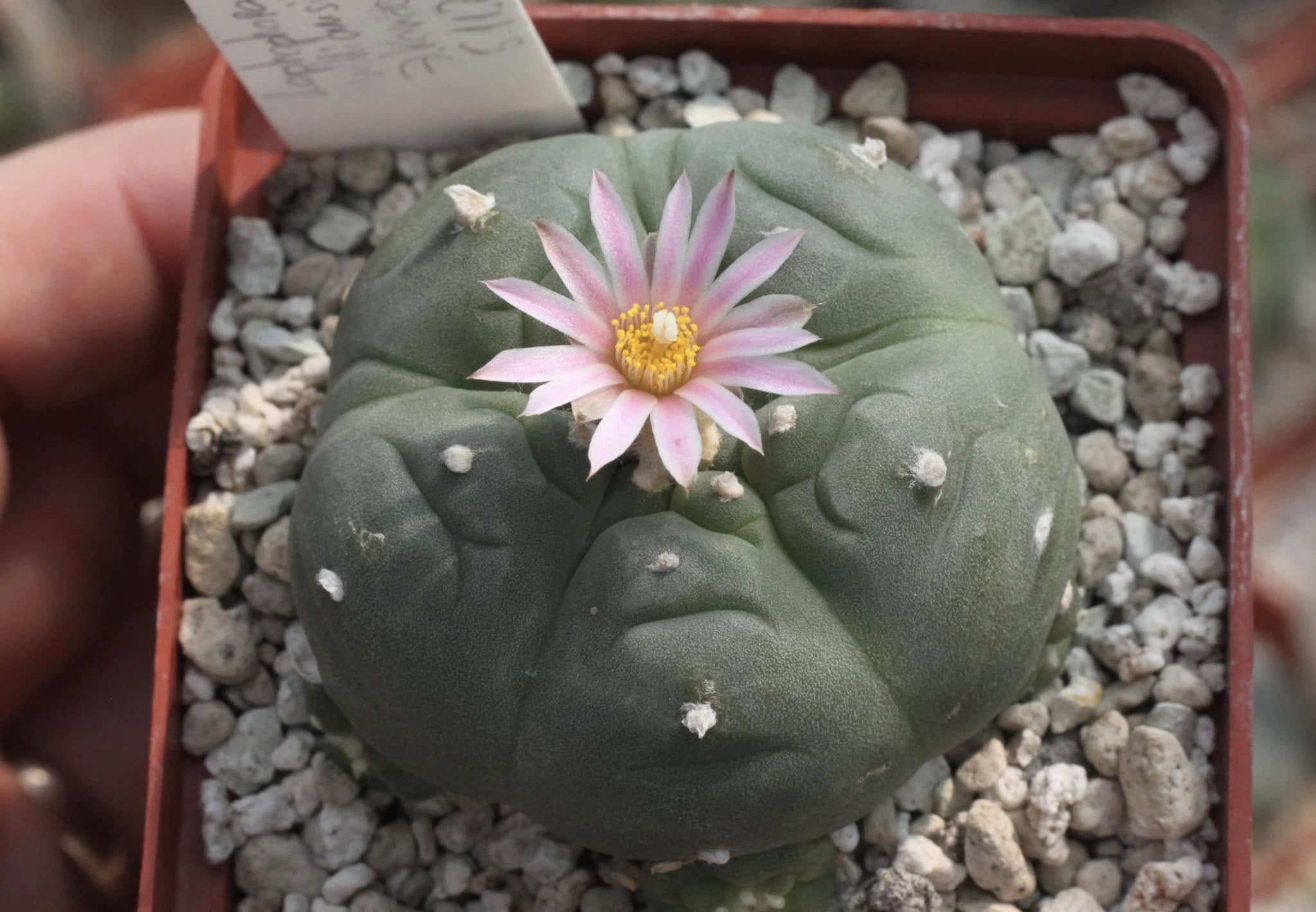
Mexican states: Chihuahua, Coahuila, Durango, Nuevo León, San Luis Potosí, Tamaulipas, Zacatecas. (Kew POWO extends the range to Jalisco, but most cactus-checklist authorities, including Hernández and Gómez-Hinostrosa’s Mapping the Cacti of Mexico, stop at Zacatecas / SLP.) US: southern Texas only, in Tamaulipan thornscrub of the lower Rio Grande Valley (Starr, Zapata, Webb, Jim Hogg, Brewster counties), with disjunct populations in West Texas Chihuahuan Desert.
Two habitat types account for almost all wild populations:
- Tamaulipan thornscrub (south Texas, Tamaulipas, Nuevo León) with Prosopis glandulosa (honey mesquite), Acacia rigidula, Cordia boissieri, and Yucca treculeana.
- Chihuahuan Desert grassland and rosetophyllous scrub with Larrea tridentata (creosote), Agave lechuguilla, Yucca filifera, Hechtia, and Jatropha dioica. Sympatric cacti include Mammillaria heyderi, Astrophytum capricorne, Ariocarpus retusus, and Echinocactus horizonthalonius.
Soil is strongly calcareous: limestone, caliche, occasionally gypsum. Coarse, stony, free-draining, alkaline pH. Plants frequently sit at the base of nurse shrubs in soil enriched with rock chip and shrub litter. The nurse-plant relationship is documented in Chihuahuan Desert ecology: peyote juveniles establish disproportionately under canopy cover of Larrea, Acacia, Jatropha, Agave lechuguilla, and Prosopis.
Elevation runs from about 50 m on the lower Rio Grande to roughly 1,900 m at the southern range edge in San Luis Potosí and Zacatecas. Most populations sit between 100 and 1,500 m. Annual rainfall is 200 to 500 mm, summer-monsoon dominated. The plant relies on episodic deep soaking events stored in the taproot rather than steady rainfall. For the full range map, elevation data, and locality-by-locality detail, see where does peyote grow.
Why does peyote grow so slowly?
Peyote grows slowly because it is a geophyte: most of its biomass and stored energy sit below ground in a turnip-shaped (napiform) taproot rather than in the small visible button.
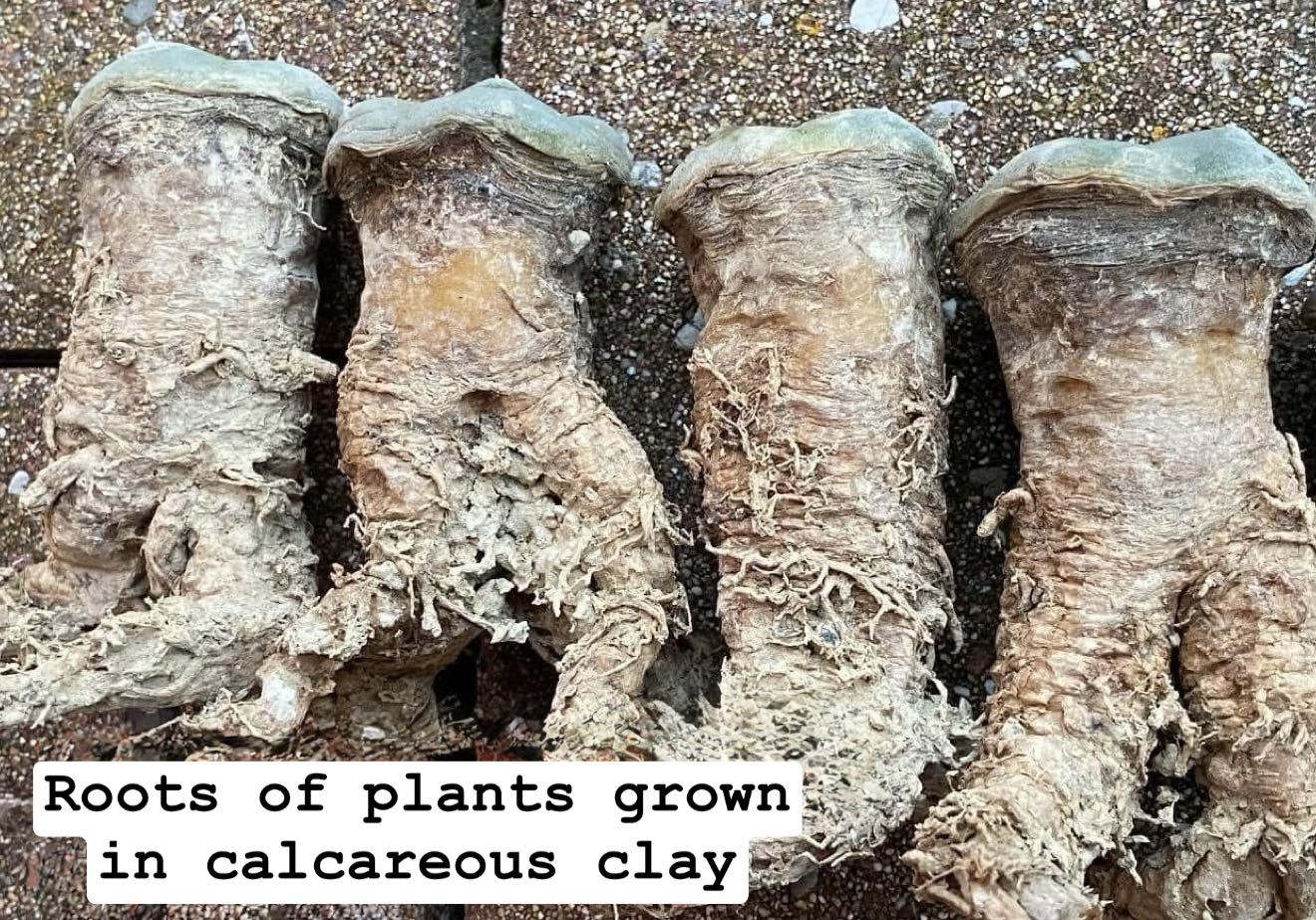
The above-ground body grows to 4-12 cm diameter and 2-7 cm tall at maturity. Flat-spherical, blue-green to gray-green, with 5-13 broad ribs and white apical wool. No spines. The taproot beneath that small button is napiform, weakly branching, with a vascular core documented at over 25 cm below the soil surface in mature specimens. The parenchymatous water-storage zone of the root holds the plant’s drought reserves.
This is why peyote grows slowly. Most photosynthate goes into the storage taproot, not the visible body. Above-ground tissue grows in short bursts during the brief Chihuahuan rainy season, then halts. Habitat plants often take 10 to 30 years to reach a flowering button. Cultivated plants under heat, sun, and a dry-then-soak watering cycle can hit flowering size in 3 to 10 years from seed; grafted plants reach the same size in months, but graft-forced growth produces an unnaturally elongated body that does not match natural proportions.
The flowers are small, pink (occasionally white), 1-2.4 cm wide, emerging from the apical wool tuft. Bloom season runs March through September, sometimes with a second flush. Fruits are pink to red club-shaped berries 1.5-2 cm long that emerge slowly from the apical wool. Seeds are black, pyriform, about 1-1.5 mm, with a tuberculate testa.
Lifespan is decades for an undisturbed plant. The “centuries” claim circulating in popular sources has no rigorous published demographic study supporting the upper end.
Who is working to conserve wild peyote?
Wild peyote conservation runs through a small network of US research, land-protection, funding, and policy organizations, with a thinner footprint in Canada. Few plants in North America are as heavily regulated as peyote, but regulation is not the same as conservation, and these are the groups actually moving the needle.
Cactus Conservation Institute (CCI) is the research arm. Founded in 2003 in South Texas by botanist Martin Terry and collaborators after the US Fish and Wildlife Service released its Recovery Plan for the star cactus Astrophytum asterias. CCI is the source of the most cited peer-reviewed work on peyote regrowth: Terry et al. published a three-paper trilogy in the Journal of the Botanical Research Institute of Texas (2011, 2012, 2014) showing that a single harvest reduces above-ground volume by roughly 80% at two years post-harvest, and that even six years is insufficient for full crown recovery. The current consensus from CCI’s data is that wild plants need at least eight years between harvests to regenerate their above-ground biomass. The current commercial harvest cadence in Texas is two years.
Indigenous Peyote Conservation Initiative (IPCI) is the land-protection counterpart. Founded in 2017 in Laredo, Texas by the National Council of Native American Churches (NCNAC), IPCI operates a 605-acre Spiritual Homesite in the Peyote Gardens of South Texas (Hebbronville area, Jim Hogg / Webb / Duval county region). Lease agreements with surrounding ranchers extend the protected and managed footprint to roughly 10,000 acres for habitat assessment, replanting, and managed harvest. IPCI runs an Indigenous-led nursery program (a half-acre adobe germination chamber), youth programs, a Pilgrimage program for NAC member churches, and the Pick Up Medicine seed-return initiative. NARF (Native American Rights Fund) and Riverstyx Foundation are documented partners. IPCI’s position is that peyote stewardship is an Indigenous responsibility and that non-ceremonial use complicates the conservation pathway.
Riverstyx Foundation is the funding bridge. A small family foundation founded in 2001 by James L. Swift, with co-directors T. Cody Swift and Miriam Volat, Riverstyx donated the 605 acres of South Texas land in October 2016 that became the IPCI Spiritual Homesite, and was the seed funder for both IPCI (2017) and the Indigenous Medicine Conservation Fund (2020). Riverstyx publicly states zero financial interest in non-Indigenous peyote and explicitly opposes peyote inclusion in psychedelic decriminalization initiatives. Annual grantmaking runs around $1.7 million; individual grants run $1,000 to $75,000.
National Council of Native American Churches (NCNAC) and NAC of North America (NACNA) are the policy voice. NCNAC is the confederation of presidents of NAC of Oklahoma, NAC of South Dakota, NAC of North America, and Azee Bee Nagaha of Dine Nation. The Native American Church formally declared the “peyote crisis” a top Church priority in 1995 and convened in Laredo in 2017 to form IPCI. NACNA has requested $5 million in federal funding for a program to compensate private landowners who convert lands to protected peyote habitat, with a federal steering committee that would include federally recognized tribes, NACNA, and state and federal agencies. That funding request is the single largest live policy ask in peyote conservation.
Thornscrub Sanctuary is the newer, grassroots entry. Established as a 501(c)(3) nonprofit in South Texas by Joey Santore (the Crime Pays But Botany Doesn’t platform), the sanctuary holds a 150-acre property in the South Texas-Northern Mexico borderlands and explicitly lists Lophophora williamsii as a protected species, alongside Mammillaria sphaerica, Echinocereus poselgeri, and Nahuatlea hypoleuca. The mission combines conservation, education, and research, including offering “spiritual respite for members of the Native American Church.” The current Preliminary Action Plan focuses on excluding feral hogs (the most acute physical threat to peyote in the Tamaulipan thornscrub), drilling a well, and building a 2,000-square-foot lab and library. Botanical surveys are in progress. Funding is via Patreon. It is small, early stage, and the kind of habitat work the conservation community needs more of ❤️.
Texas land trusts protect the underlying habitat. The Valley Land Fund (McAllen, TX) has protected over 11,000 acres of Lower Rio Grande Valley wildlife habitat through ownership and landowner partnerships. The Nature Conservancy in Texas, through its Las Estrellas Conservation Cooperative, has protected over 2,500 acres of South Texas habitat with private landowners. Neither org is peyote-specific, but both protect the Tamaulipan thornscrub ecosystem that the southern population depends on. The broader Thornforest Conservation Plan (2020) identifies more than 80,000 acres of potential thornscrub restoration sites across the Lower Rio Grande Valley, where thornforest now occupies less than 10% of its historic range.
Chacruna Institute handles the policy and education layer. Chacruna published the Peyote Harvesting Guidelines, a stewardship-focused practitioner document covering rotation of sites, harvesting intensity and frequency, replanting of disturbed seedlings and feral-hog uprooted plants, leaving seeds at the harvest site, and timing harvests after seed production. Chacruna also hosts the IPCI / NCNAC open letter to the psychedelic movement on peyote decriminalization. The guidelines are practitioner-facing rather than NAC-authored; Chacruna’s role is education and policy infrastructure, not land tenure.
Cactus and Succulent Society of America (CSSA) funds general cactus-conservation work through its Conservation Grants program, founded in 1929 in Pasadena, California. Recent funded projects include rare succulents of southern Peru and Lithops anti-poaching surveillance in southern Africa. No CSSA grant explicitly funded a Lophophora-specific project in available records. CSSA’s role for peyote is education and the broader cactus-conservation infrastructure that supports local research orgs.
Canada is the honest gap. Lophophora williamsii does not grow natively in Canada; the species range stops at southern Texas. The Native American Church of Canada (active in Saskatchewan and other prairie provinces since the early 20th century) participates in ceremonial use through cross-border supply chains, and IPCI’s mission explicitly includes “Indigenous Peyote peoples and lands of the United States, Canada, and Mexico,” but no Canada-headquartered peyote-conservation organization currently exists as a distinct sector. Canadian conservation interest flows through the continental NCNAC and IPCI structure rather than through a Canadian-domiciled body.
Mexican context is brief but real. The Wirikuta region in San Luis Potosí (Reserva Estatal Sagrado Natural Wirikuta, established 2000) is the most important protected peyote habitat zone, with cultural significance to the Wixárika (Huichol) people. Mexico’s NOM-059-SEMARNAT-2010 lists L. williamsii as “Sujeta a protección especial,” with a 2024 SEMARNAT review proposing an upgrade to “En peligro de extinción” (Endangered). A Canadian-owned mining company holds concessions overlapping Wirikuta; Wixárika communities have spent more than a decade in legal battles to block the operations.
What does the conservation outlook actually look like?
The outlook is precarious and trending down. The IUCN listed L. williamsii as Vulnerable (VU) A2acd in 2017, with a population trend of decreasing.
The arithmetic is the load-bearing fact. Licensed harvest in Texas averages roughly 1.9 million buttons per year. NAC ceremonial demand is estimated at 5 to 10 million buttons per year. The supply-demand gap drives illegal harvest and incentivizes harvesters to cut on cycles shorter than the eight years CCI’s data shows are needed for biomass recovery. Licensed distributor numbers have collapsed: 27 in the mid-1970s, 9 by the 1990s, 4 in recent reporting. The full Texas series behind those figures, thirty-one years of distributor reports from 1986 to 2016, is charted and downloadable in our peyote trade and harvest data.
Habitat loss compounds the harvest pressure. Land conversion for agriculture and ranching in south Texas (root-plowing of thornscrub, citrus and cropland conversion) and northern Mexico. Cattle grazing and feral-hog rooting. Climate change intensifying Chihuahuan Desert drought and reducing seedling recruitment. Border infrastructure development in the lower Rio Grande Valley. Illegal collection for the recreational drug market and for ornamental cactus collectors (especially crested and variegated forms).
Population density data is patchy but available. Ermakova et al. (2021) surveyed six wild populations across Texas and recorded 263 plants per hectare at one south Texas site, projecting roughly 31,000 plants on a 198-hectare property. Densities are heterogeneous between south and west Texas without a consistent regional pattern. Plants run larger in west Texas.
Frequently Asked Questions
How long does peyote take to grow from seed?
3 to 10 years from seed to flowering button under cultivation, depending on conditions. In habitat, 10 to 30 years is the typical cited range. Most photosynthate goes into the buried taproot, not the visible body, which is why above-ground growth is so slow.
Is wild peyote endangered?
IUCN listed it as Vulnerable in 2017 with a decreasing population trend. Mexico’s NOM-059 lists it as “Sujeta a protección especial” (special protection), with a 2024 SEMARNAT review proposing an upgrade to “Endangered.” At rarecactus.com we grow Lophophora only from seed and never from wild-collected stock, because illegal field collection is the documented driver of the species’ Vulnerable status.
Is peyote on CITES Appendix I or II?
Appendix II, via the family-level Cactaceae listing in force since 1975. Not Appendix I. The myth that peyote is on Appendix I is widespread but incorrect. The Cactaceae family Appendix II listing covers L. williamsii by default.
Where does wild peyote grow?
Chihuahuan Desert and Tamaulipan thornscrub of northern Mexico (Chihuahua, Coahuila, Durango, Nuevo León, San Luis Potosí, Tamaulipas, Zacatecas) and southern Texas, on calcareous limestone soils between roughly 50 and 1,900 m elevation. See where does peyote grow for the full range map and elevation data.
What does peyote look like, and how do you tell it from Lophophora diffusa?
Peyote (Lophophora williamsii) is a small, spineless, blue-green to gray-green button cactus 4 to 12 cm wide, with 5 to 13 broad rounded ribs, white wool tufts in place of spines, and a single pink to white flower from the woolly crown. Lophophora diffusa is yellow-green rather than blue-green, softer-bodied, with ribs poorly defined or nearly absent and flowers usually white to pale yellow. Spineless living rock (Ariocarpus) and Astrophytum asterias are sometimes confused with peyote but show triangular tubercles or rigid, scale-flecked ribs rather than peyote’s soft, woolly, continuous ribs.
Is peyote legal to own?
In the United States peyote is a federal Schedule I controlled substance because it contains mescaline, so cultivation and possession are restricted under the Controlled Substances Act. The standing exception is bona fide ceremonial use by members of the Native American Church, protected under the American Indian Religious Freedom Act as amended in 1994. See our full guide on whether it is legal to own peyote for the details and state-level variation.
Anderson, E.F. (2001), The Cactus Family, Timber Press · Hunt, D. (2006), The New Cactus Lexicon, dh Books · Hernández, H.M. and Gómez-Hinostrosa, C. (2011), Mapping the Cacti of Mexico · Butterworth, C.A. and Wallace, R.S. (2002), molecular phylogeny of Lophophora · Bruhn, J. et al. (2010), mescaline content and trnL/trnF sequence in Lophophora · Terry, M., Steelman, K., Guerra, T., Kalbas, R. and Trout, K. (2011), J. Bot. Res. Inst. Texas 5(2): 661-675 · Terry, M. et al. (2012, 2014), J. Bot. Res. Inst. Texas regrowth follow-up papers · Ermakova, A. et al. (2021), J. Bot. Res. Inst. Texas 15(1): 149-160, population density study · IUCN Red List, Lophophora williamsii assessment 2017 · CITES, Appendix II Cactaceae listing (1975, current annotation) · NOM-059-SEMARNAT-2010, official Mexican federal listing · Cactus Conservation Institute, cactusconservation.org · Indigenous Peyote Conservation Initiative, ipci.life · Riverstyx Foundation, riverstyxfoundation.org · Thornscrub Sanctuary, crimepaysbutbotanydoesnt.com/thornscrub-sanctuary-preliminary-action-plan · Chacruna Institute, peyote harvesting guidelines · Valley Land Fund and The Nature Conservancy in Texas (Las Estrellas Conservation Cooperative) · Kew Royal Botanic Gardens, CITES and Cacti guide and Cactaceae Checklist (3rd ed.)