Lophophora fricii
Encyclopedia · Lophophora
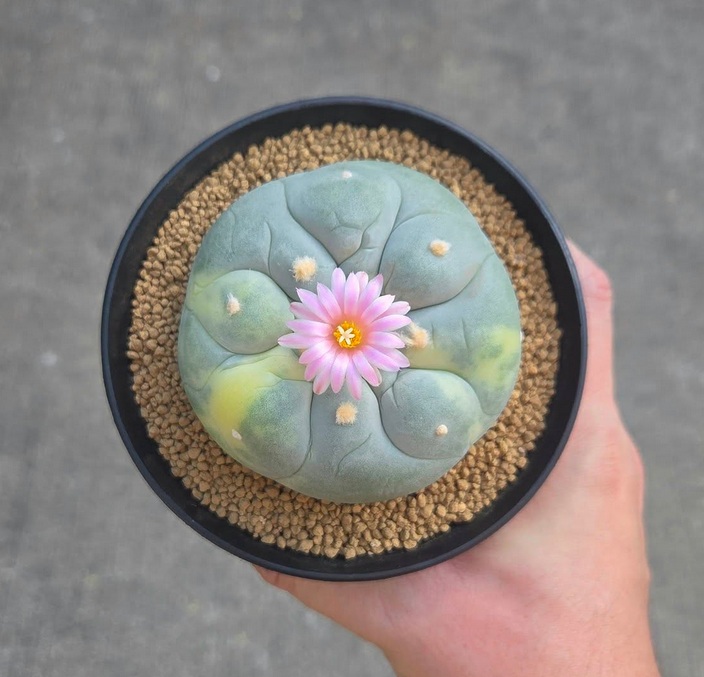
| Family | Cactaceae |
| Named by | Habermann (1975) |
| Named for | Alberto Vojtěch Frič |
| Native range | Viesca region, Coahuila, Mexico |
| Stem diameter | up to 12 cm; flattened |
| Ribs | 5–21; poorly defined |
| Flowers | Pale to dark pink; up to 4 cm across |
| Fruit | Small, clavate, pale pink |
| IUCN status | Endangered |
| CITES | Appendix II |
| Mescaline | Absent; pellotine dominant |
| Japanese trade | Ginkangyoku |
False Peyote · Ginkangyoku · Fričův Lofofora
Lophophora fricii is one of the least understood and most persistently misidentified cacti in the genus. Its range is tight, its habitat is specific, and for most of the twentieth century it spent its taxonomic life reassigned to other names before a picture of what it actually is began to come into focus. The plant grows in a small corner of southeastern Coahuila, Mexico, centred on the semi-arid lowlands around Viesca, where it occupies two different habitat types within roughly twenty kilometres of each other: limestone hill slopes and flat silt plains. These two populations look different enough that observers encountering them separately have sometimes reached for different species names. They are, in all likelihood, the same plant responding to very different ground conditions.
What makes Lophophora fricii compelling to botanists and collectors is not its scarcity alone, though its range is genuinely restricted. It is the combination of characters that set it apart from the species it most resembles. The grey-toned epidermis is visible from a distance. The large, softly swollen tubercles on the body surface are unmistakable up close. And the alkaloid profile, which genetic and chemical analysis has now confirmed in detail, places it clearly outside the chemistry of Lophophora williamsii: mescaline is absent, and pellotine dominates. That combination of restricted range, distinctive morphology, and divergent chemistry defines a species that deserves careful documentation, and this page attempts to provide it.
The misidentification story is worth understanding in full, because it shaped the scientific literature on this plant for decades and produced a body of chemical data that was published under the wrong name. The Sasaki and Aragane studies, conducted in Japan in 2009 and 2011, were working with plants sold under the Japanese trade name Ginkangyoku, the accepted commercial name for Lophophora fricii in that market. Both research groups identified their specimens using Anderson’s morphological classification, which at the time did not recognize L. fricii as a distinct species. The published results therefore describe mescaline-free Lophophora williamsii variants when the actual subject was Lophophora fricii. Those findings are central to what we know about this species’ chemistry, and placing them correctly matters.
Contents
Taxonomy & Nomenclature
The story of Lophophora fricii begins not with its formal description but with a photograph. In 1924, the Czech botanist and explorer Alberto Vojtěch Frič photographed a Lophophora population during his travels through northern Mexico, labelling the image “Anhalonium sp. flora rosea.” That photograph, published in 1925, shows plants consistent with what would later be described as L. fricii. By 1935, Frič had relabelled the photograph Lophophora williamsii, a revision that cemented the misidentification in the European literature and contributed to the prevailing view that the grey-bodied Coahuilan plants were simply a form of the common peyote. The name change is not trivial. It is where more than four decades of taxonomic confusion began.
Vlastimil Habermann formally described Lophophora fricii in 1975 in the Czech cactus journal Kaktusy, working from material collected by Denis Cowper in the vicinity of San Pedro in Coahuila. Habermann named the species in honour of Alberto Vojtěch Frič, recognising that the 1924 photographs were the earliest documented encounter with this plant and that the subsequent relabelling had obscured it. The description emphasised the grey-yellowish-green epidermis, the large and fusiform taproot, the broadly flattened depressed-globose stem reaching up to 12 centimetres across, and flowers substantially larger than those of L. williamsii, reaching 25 millimetres in both length and diameter.
Acceptance of Lophophora fricii at species level has been uneven across the literature and remains contested in some treatments. Edward Anderson, in his comprehensive work on the genus and in his later The Cactus Family, declined to accept it as distinct, folding it into L. williamsii alongside several other candidate species. This decision had consequences that extended beyond taxonomy. Because Anderson’s classification became the dominant reference in scientific circles, particularly in Japan, researchers working with L. fricii material often published their findings under Anderson’s name assignment rather than Habermann’s. The IUCN Red List, by contrast, has treated Lophophora fricii as an accepted species in its assessments, and the species receives its own entry in conservation literature. Kew’s Plants of the World Online lists it as an accepted name. The Cactus Conservation Institute also recognises it. The weight of evidence from morphology, alkaloid chemistry, and molecular genetics now supports full species status, even though complete consensus is still building.
The synonymy attached to Lophophora fricii in collector and botanical literature includes Lophophora williamsii var. fricii (Haberm.) Grym, the combination published by Rudolf Grym when treating it as a variety of L. williamsii. It also appears in some sources as Lophophora williamsii var. decipiens Croizat, a name that has been applied to grey-bodied Coahuilan peyote plants by several authors and which occasionally appears in older chemical analyses, including those cited by Habermann himself. In Japanese cultivation it was sold under the trade name Ginkangyoku, a Japanese term whose meaning connotes a silver or grey hue, an apt descriptor for the plant’s most immediately distinctive character. That trade name became the inadvertent key to identifying the Sasaki and Aragane study specimens correctly, years after those papers were published.
A note on the broader genus context. At the time Habermann described L. fricii, he also described Lophophora jourdaniana in the same year. The two descriptions appeared in the same volume of Kaktusy in 1975. Anderson rejected both, and other taxonomists have treated them very differently: L. jourdaniana remains unconfirmed as a wild species, while L. fricii has documented wild populations, confirmed morphological distinctiveness, and now molecular data to support it. Their shared publication history creates occasional confusion in older literature that cites both as Habermann 1975 without distinguishing between them.
Habitat & Native Range
Lophophora fricii has one of the most restricted natural distributions of any cactus covered on this site. Its confirmed range centres on the Viesca lagoon area in southeastern Coahuila, a semi-arid basin approximately 200 kilometres southwest of Monterrey. The total extent of the wild population, based on documented collection records and habitat surveys, spans a relatively small area, with two distinct population types occurring roughly twenty kilometres apart. That restricted footprint sets it sharply apart from Lophophora williamsii, which ranges across more than 1,500 kilometres of the Chihuahuan Desert. Lophophora fricii does not range widely. It occupies a pocket of specific conditions in a single corner of its host state, surrounded by populations of L. williamsii in the wider landscape.
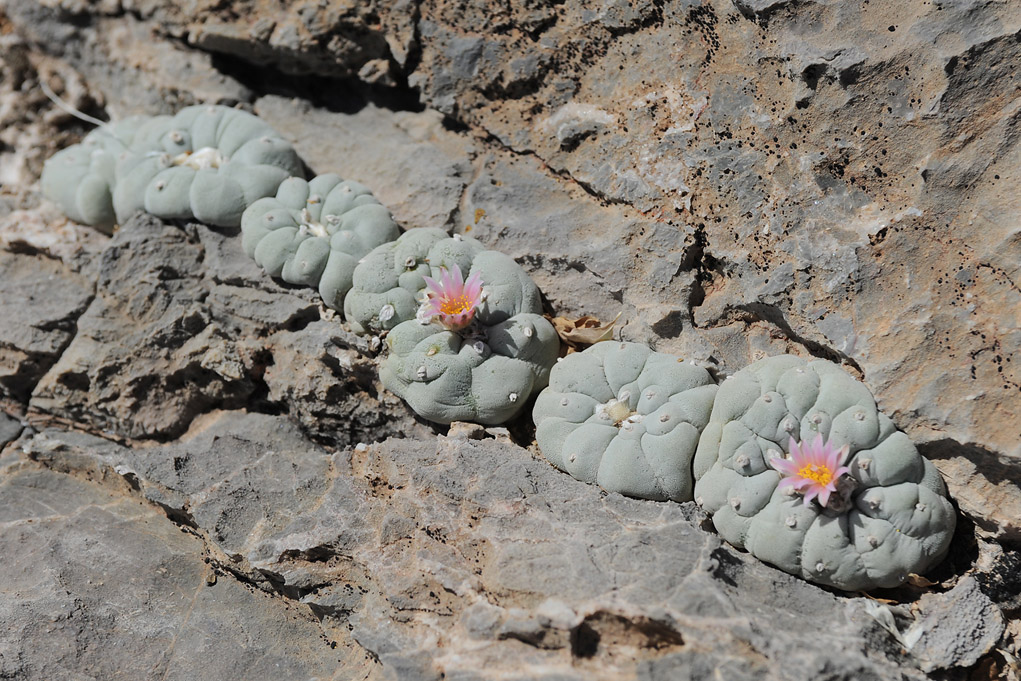
The two habitat types within the Lophophora fricii range are worth distinguishing carefully because they produce plants that look different enough to cause confusion. The first type is a montane form, occurring on limestone slopes and hill edges at slightly higher elevations within the local topography. Plants from this form are described as flatter and more strongly depressed, with fewer offsets and a look that experienced observers describe as almost melted into the ground. These plants do not form the large spreading clumps characteristic of the second population type, and their overall profile is lower and more soil-integrated. The second form grows on flat silt plains and alluvial flats, where it forms large multi-headed clusters that can reach 40 centimetres across over decades. Both forms share the fundamental characters of the species: grey epidermis, large protuberances, and the same distinctive alkaloid profile.
The plant community surrounding Lophophora fricii in both habitat types includes elements familiar from the broader Chihuahuan Desert flora. Photographic records from Cactus Conservation Institute field surveys document Agave species, Echinocereus stramineus, Jatropha dioica, Larrea tridentata (creosote), Opuntia rufida, and Prosopis species in the surrounding plant community. That composition places the habitat within the dry thornscrub and xerophyte scrub zones of the Chihuahuan Desert system, with the mesquite-agave-creosote community typical of the lower bajada and flat alluvial environments of southeastern Coahuila. The substrate in both population types is alkaline, mineral-dominant, and well-drained. The silt flat habitat differs in texture, holding less immediate runoff but remaining fast-draining in depth.
What is striking about the geographic position of Lophophora fricii is how completely it is surrounded by Lophophora williamsii populations. The broader Coahuila landscape supports a continuous and well-documented range of L. williamsii, with populations documented from Cuatro Ciénegas, Parras, Sierra de la Paila, and numerous other Coahuilan localities. The L. fricii range sits within this matrix as an isolated pocket. The molecular evidence from Sasaki and Aragane showed that the DNA signature of the Ginkangyoku plants they tested was different from all their L. williamsii specimens and closer in several dimensions to Lophophora diffusa, despite L. diffusa being geographically remote. That clustering is the most significant finding for understanding what Lophophora fricii actually represents: a species that diverged early enough to carry a different alkaloid pathway and a detectably different chloroplast sequence, despite growing within a landscape otherwise dominated by its nearest morphological relative.
Morphology
The most reliable field character for identifying Lophophora fricii is also the most immediately visible: the colour of the epidermis. Where Lophophora williamsii presents a blue-grey to grey-green body colour with a slight glaucous quality, Lophophora fricii is paler and carries a distinctly yellowish or warm grey tone that distinguishes it even at a distance. Habermann’s original description used the term “grey yellowish-green,” and that combination is a good starting point. In practice, the colour varies from pale greenish-yellow to a flat, almost dusty grey, depending on the plant’s moisture status and the growing conditions. A drought-stressed L. fricii in full sun takes on a very pale grey hue that blends into Coahuilan desert soil with considerable effectiveness.
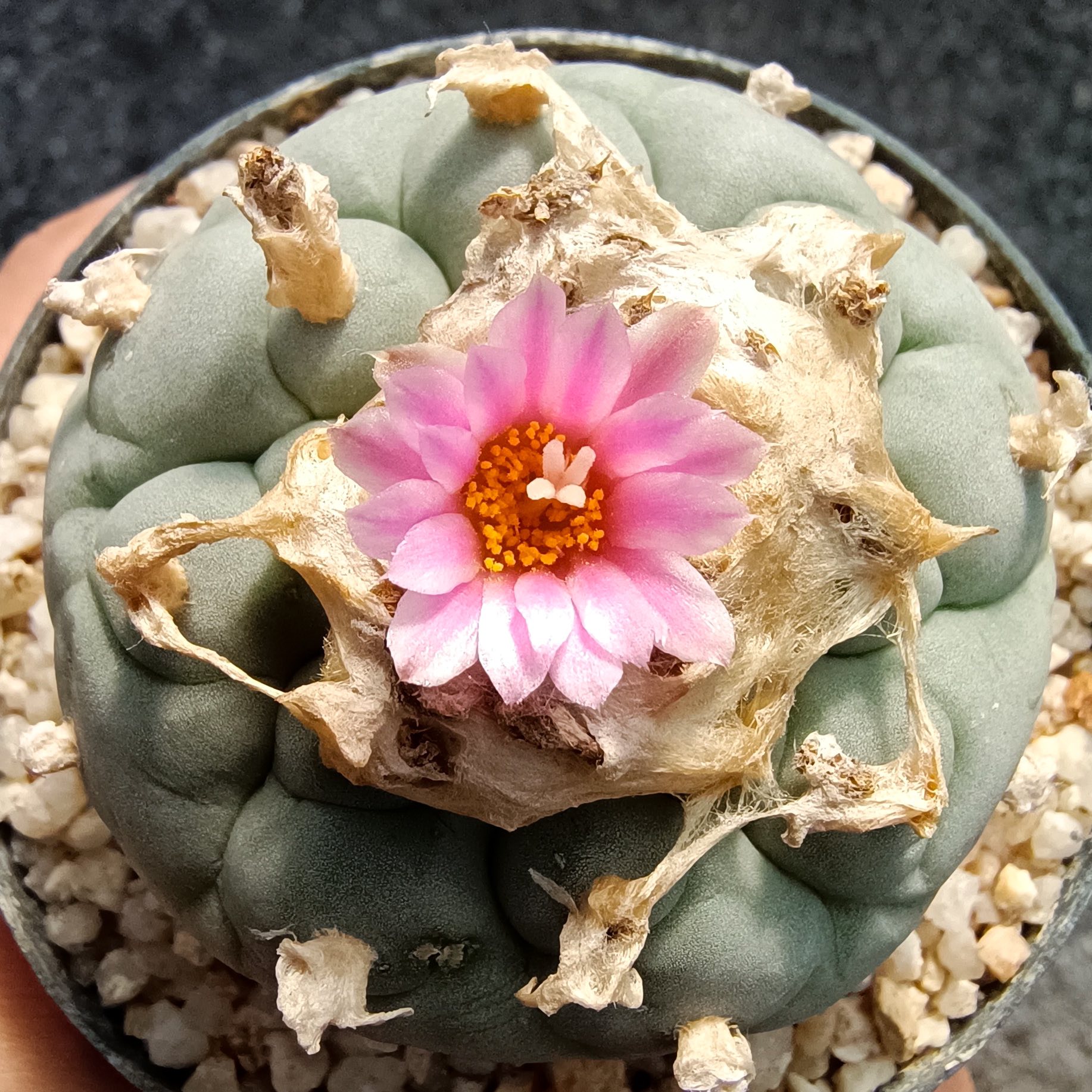
The large, softly swollen protuberances on the body surface of Lophophora fricii are the most reliable morphological character after colour. They are broader and more elevated than those seen on L. williamsii in the same region.
The second most diagnostic character is the surface texture. Lophophora fricii carries large, broad, fusiform protuberances on its body that are substantially more elevated and more prominent than the smaller surface tubercles of Lophophora williamsii. In the Aragane et al. study, the researchers noted explicitly that their Ginkangyoku specimens showed “large protuberances on the epidermis rather than small ones” as a distinguishing character from all their L. williamsii material. That character is consistent across documented wild and cultivated material. The cultivar known as cv. Marbles or cv. Big Tubercles, which appears in European cactus collections, represents an extreme expression of this tendency, with particularly well-developed and rounded protuberances making the body surface strikingly irregular in outline.
Rib definition in Lophophora fricii is notably less distinct than in Lophophora williamsii. The podaria, the raised bases of the areoles, are broad and flat or only slightly elevated in most plants, and the ribs they form are low and ill-defined rather than clearly demarcated. Rib counts of 5 to 13 are typical, but plants with up to 21 ribs have been documented in large, old specimens. The poor rib definition is partly a function of the large protuberances, which in extreme forms give the body surface an almost warty appearance that further obscures the underlying rib structure. This character also distinguishes L. fricii from L. diffusa, which tends toward a smoother, more evenly surfaced body despite sharing the pale colouration and mescaline-absent alkaloid profile.
The stem dimensions of Lophophora fricii are generous by genus standards. The species can reach 12 centimetres in diameter, larger than most L. williamsii encountered in cultivation, though specimens of that size represent many decades of growth under ideal conditions. More typical cultivated plants reach 5 to 8 centimetres. The crown is strongly depressed and flat to very slightly domed, with a sunken apex that carries the woolly areoles at its centre from which flowers emerge. The body is geophytic, meaning the plant sits at or below soil level with only the crown exposed. This characteristic, shared across the genus, makes the grey colour of L. fricii effective camouflage against the pale limestone and silt substrates of its Coahuilan habitat.
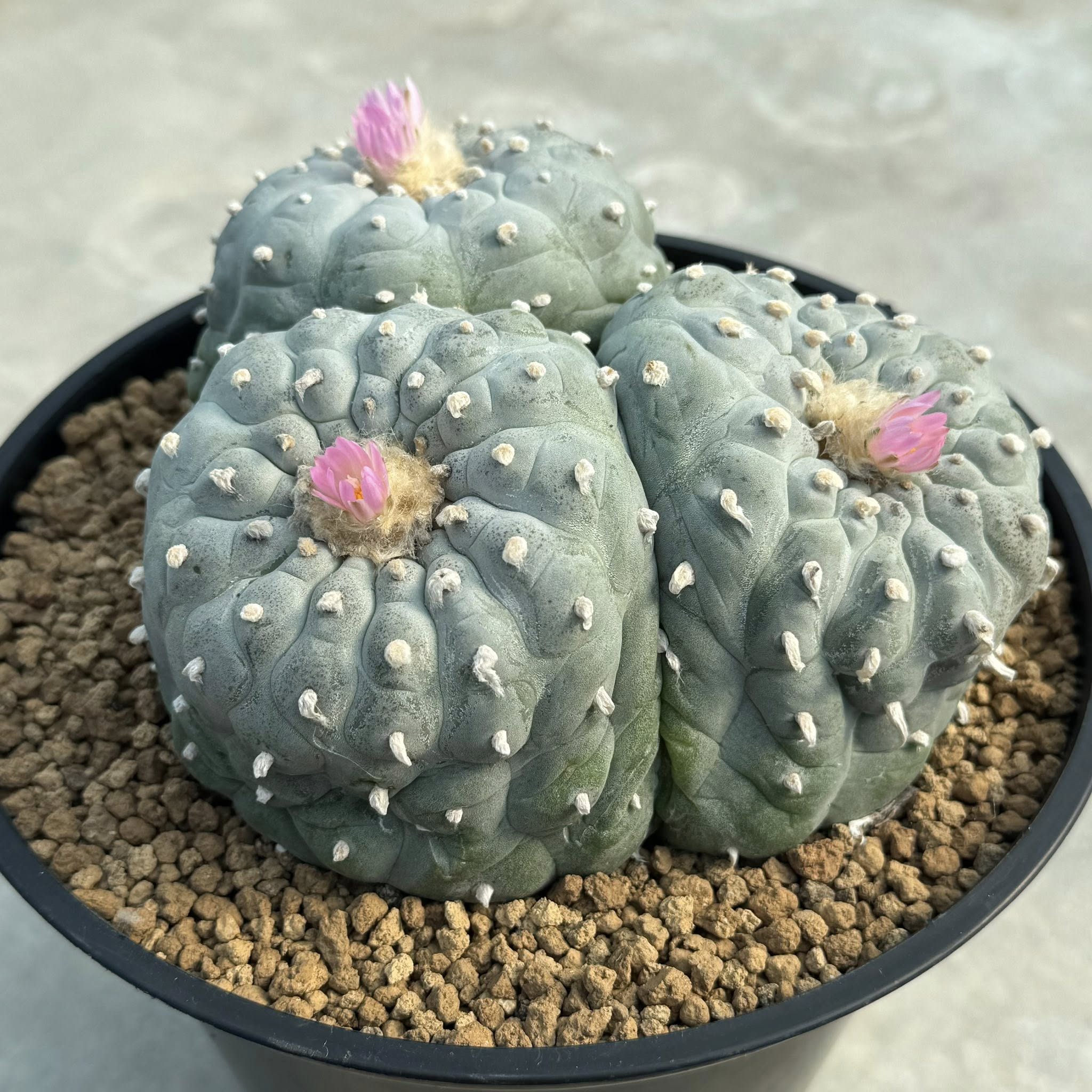
Taproot form in Lophophora fricii follows the genus pattern: large, fusiform, and substantial relative to the above-ground crown. Habermann’s original description specifically called out the large and fusiform root as a notable character. In cultivation, old own-root plants develop roots that can reach 15 centimetres or more in depth, carrying the crown above a water and nutrient reserve that defines the plant’s drought tolerance. The clumping habit of the silt-flat population type is produced by lateral branching from the base of the original stem over time, with individual crowns remaining connected to a shared root system. Large clumps of 40 centimetres or more across have been documented in wild populations, representing decades or centuries of slow growth.
Areoles carry tufted bundles of silky white to off-white wool, described by Habermann as dense and silky. They are circular in outline, 2 to 3 millimetres in diameter, and spaced 8 to 15 millimetres apart along the rib crests. No spines appear in adult plants. Juvenile seedlings carry tiny rudimentary spine primordia that disappear in the first year or two, a pattern identical to the rest of the genus. Seeds of Lophophora fricii differ from L. williamsii in a character that is useful for confirmation when other material is available for comparison: the testa is black and coarsely nodulated, and the hilum is compressed into a V shape rather than the more rounded form seen in L. williamsii seeds.
Alkaloid Chemistry: The Mescaline Question
Lophophora fricii does not produce mescaline in any functionally meaningful quantity. This is the most chemically significant thing about the species and the character that, combined with the morphological and molecular evidence, makes the case for species status most compellingly. The alkaloid profile of L. fricii is dominated by pellotine, a tetrahydroisoquinoline that was briefly explored as a sedative in the early twentieth century before being set aside. The overall alkaloid profile places L. fricii clearly outside the chemistry of Lophophora williamsii and into a chemical grouping shared with Lophophora diffusa.
The quantitative picture from Habermann’s own analysis, cited via Štarha’s compilation, shows mescaline at only 0.014 percent plus or minus 0.009 percent of dry weight in L. fricii material: a trace level representing 0.9 to 1.1 percent of total alkaloid content in the two specimens analysed. Pellotine, by contrast, accounts for approximately 65 percent of total alkaloid content in those same specimens. That is a profile as far from Lophophora williamsii as it is possible to be within the genus. In L. williamsii, mescaline accounts for roughly 30 percent of total alkaloids and pellotine is a minor component. In L. fricii, those proportions are essentially reversed, with pellotine heavily dominant and mescaline present only in traces that approach analytical noise.
The Sasaki and Aragane studies provide the most detailed recent data, though they were published under a different name. Sasaki et al. (2009) included three specimens purchased under the Japanese trade designation Ginkangyoku, labelled Lo-14, Lo-15, and Lo-16 in their dataset. Analysis of those three plants detected no mescaline by HPLC, in contrast to the 1.27 to 4.83 percent dry weight range found across their thirteen Lophophora williamsii specimens. The trnL/trnF chloroplast DNA sequence obtained from Lo-14 through Lo-16 was different from all L. williamsii sequences in their study, clustering instead with patterns closer to those of their L. diffusa specimens. Aragane et al. (2011) published the morphological observations that confirmed the identity: the specimens showed grey body colour not found in any of their L. williamsii plants, large epidermal protuberances rather than small ones, and two of the three had noticeably darker pink flowers than the L. williamsii type. The researchers noted the Ginkangyoku provenance explicitly in their supplementary material but assigned the plants to L. williamsii based on Anderson’s classification, which was the authoritative reference at the time. The result is published chemical data that is accurate and detailed, attributed to the wrong binomial.
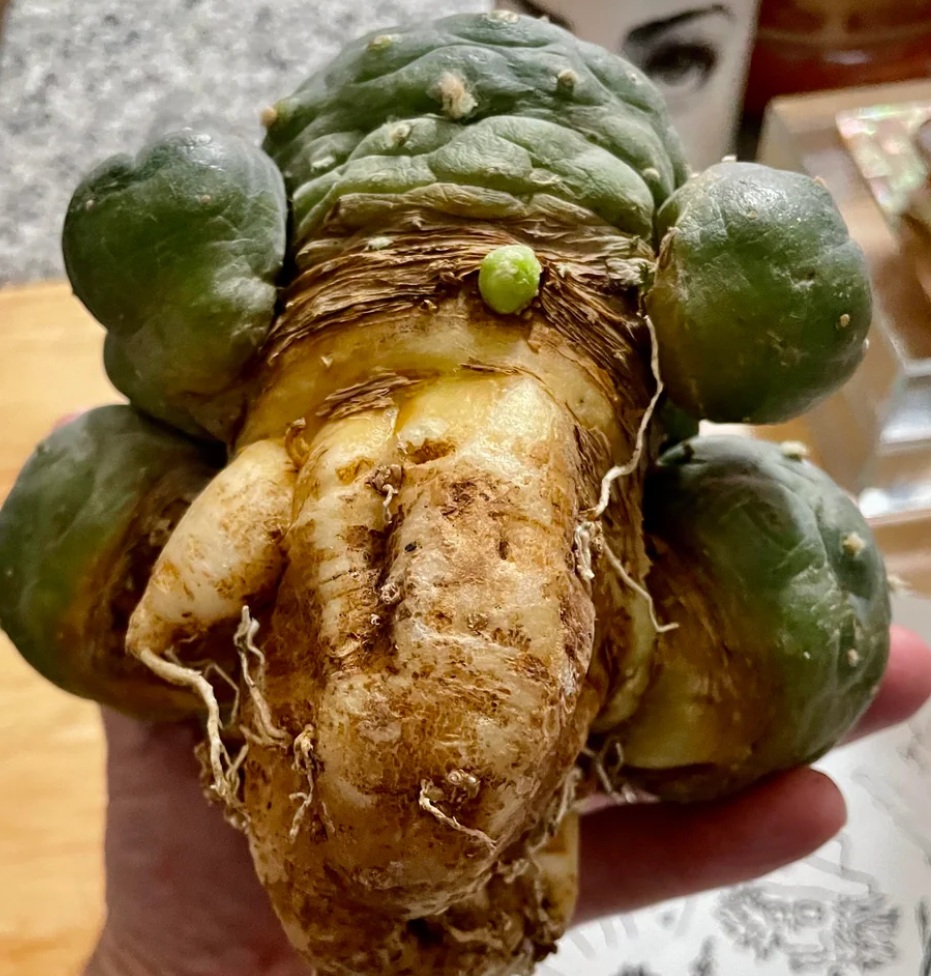
The history of mescaline detection in L. fricii material is complicated by the misidentification problem in both directions. Some early analyses that claimed to find mescaline in specimens labelled L. fricii or L. williamsii var. decipiens may have been working with actual L. williamsii collected in the same Coahuilan region and misidentified as L. fricii, since the two species share overlapping geography and the vegetative characters that distinguish them require careful examination. Conversely, some analyses of L. williamsii that found no mescaline were likely examining L. fricii material purchased under the Ginkangyoku name, as the Sasaki and Aragane work makes clear. The analytical data available is best understood by working backwards through the provenance of specimens rather than taking species designations at face value.
Beyond mescaline and pellotine, the confirmed alkaloid complement of Lophophora fricii based on Štarha and Kučhyňa (1996) and related analyses includes: tyramine, N-methyltyramine, hordenine, lophophorine, anhalinine, O-methylanhalidine, anhalidine, anhalamine, anhalonidine, anhalonine, N-methylmescaline (present only as a trace), and N-methyl-3,4-dimethoxyphenethylamine. Lophophorine accounts for approximately 0.08 percent of total alkaloid content. That compound list overlaps substantially with L. williamsii at the level of minor alkaloids, but the dominant compound and the absence of functionally significant mescaline mark the two species as chemically distinct in the characters that matter most.
Locality Data & Population Variation
The documented localities for Lophophora fricii are few compared to the dozens of named collection points recorded for Lophophora williamsii across its vastly larger range. The restricted distribution of L. fricii means that collector provenance data converges on a small geographic area, with most records pointing to the Viesca region of southeastern Coahuila and a secondary cluster around Parras de la Fuente, roughly 40 kilometres to the north. The San Pedro locality, where Habermann’s original specimens were collected by Denis Cowper, is the type locality and the reference point from which the description was written.
Documented Lophophora fricii localities & collector forms
Viesca region
- Viesca (lagoon area, silt flat population)
- Viesca (montane / limestone slope form)
- San Pedro, Coahuila (type locality)
- El Amparo, Coahuila
- Lophophora sp. Viesca RS 404 (Štarha)
Parras region
- Parras de la Fuente (flowering population)
- Parras (collector Milan Majer)
Cultivar Designations
- cv. Habermann (type form)
- cv. Marbles / cv. Big Tubercles
- f. albiflora (white-flowered form)
- f. cristata (crested form)
- f. variegata (variegated form)
- var. decipiens (Croizat) P.Hansen
Collector designations in italic represent recognised morphological forms or cultivar selections rather than distinct geographic populations. The Lophophora sp. Viesca RS 404 specimens analysed by Štarha showed alkaloid profiles very similar to confirmed L. fricii material from the same region. Provenance for the Sasaki and Aragane study specimens is the Tokyo Metropolitan Institute of Public Health medicinal plant garden and Japanese commercial sources.
The variation between and within these localities is substantial. The two wild population types near Viesca, the montane limestone form and the silt flat clumping form, produce plants different enough in habit and superficial appearance that growers encountering them separately might reach for different names. Roman Štarha analysed material from both the Viesca area and from plants designated Lophophora sp. Viesca RS 404, finding alkaloid profiles closely similar across both, which supports treating them as the same species despite the morphological variation. Parras de la Fuente, the second confirmed locality, sits north of Viesca in a somewhat different landscape context but the same general Coahuilan semi-arid belt. Documentation from that population focuses on flowering characters rather than comparative alkaloid data.
The Tarahumara name recorded for plants identified with this species in some sources is Híkuri warura seriame, or variants of that phrase. Whether that attribution applies to L. fricii specifically or to Coahuilan peyote more broadly in Tarahumara ethnobotanical use is not fully established in the published literature. It serves to document that the plant was known and named by indigenous groups in the region well before Habermann’s formal description, which is consistent with the extended and ancient human relationship with Chihuahuan Desert cacti more broadly.
Flowering & Fruit
Lophophora fricii produces some of the largest flowers in the genus. Habermann’s original description gave dimensions of 25 millimetres in length and 25 millimetres in diameter, and later sources document flowers reaching 40 millimetres across in fully open specimens, substantially larger than the 15 to 25 millimetre flowers typical of Lophophora williamsii. The flower size alone, when seen on a living plant, draws the eye. A large, established L. fricii in bloom carries flowers that seem almost disproportionate to the flat grey body beneath them.
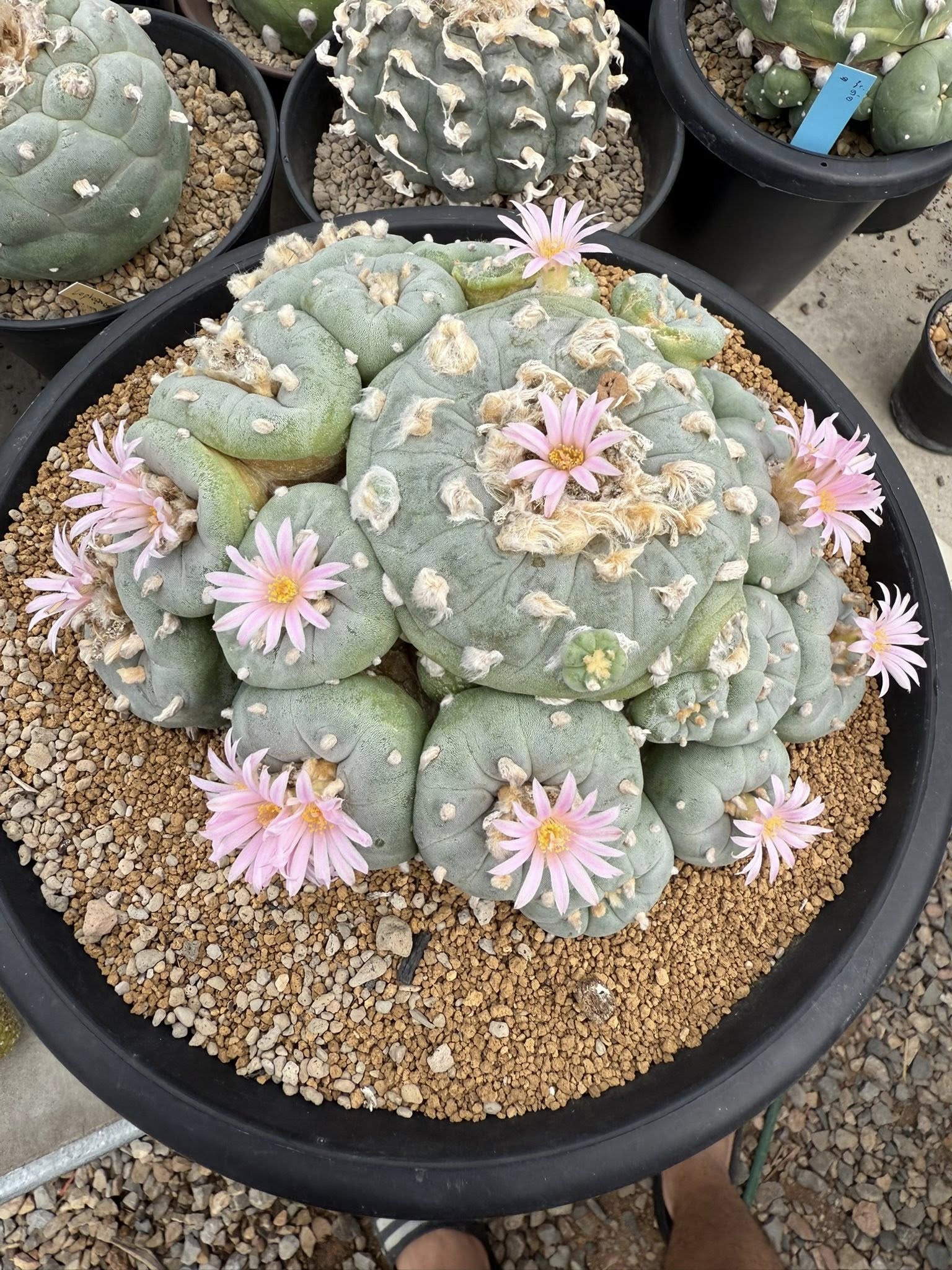
Flower colour is variable across the population but runs substantially darker than Lophophora williamsii in most plants. The type form shows petals that are a strong, saturated pink approaching carmine in some individuals. Outer segments are oblanceolate with a greenish midstripe, and inner segments are oblanceolate with entire margins, typically 3 to 4 millimetres wide. The Aragane et al. study noted that two of their three Ginkangyoku specimens had darker pink flowers than any of their L. williamsii material, confirming the flower colour character as reliable for identification when combined with the body characters. Habermann’s description used the term “funnelform, pink” for the flower overall, while observer reports from wild populations describe a range from pale to very dark pink in different individuals at the same locality, which is consistent with the broader observation that the species is highly variable in several characters within its habitat.
A white-flowered form, designated f. albiflora, has been documented from a specific location within the Viesca area and is maintained in European cultivation. It shares all vegetative characters with the standard form and produces the same grey-toned body and large protuberances, differing only in flower colour. The rarity of this form in both wild populations and established collections makes it a particular interest for specialist growers.
Flowers emerge from the youngest areoles at the centre of the woolly crown and open during daylight hours, closing at night. Duration of individual blooms is similar to L. williamsii, running two to four days per flower. A healthy established plant may produce several flowers in sequence through the growing season. Timing in the wild is governed by rainfall, with flowering concentrated through spring and into mid-autumn. In cultivation under a controlled watering regime, flowers typically appear after watering resumes following the winter rest.
The fruit is small, clavate, and pale pink to pinkish-white when ripe. Seeds are oval, approximately 1.5 millimetres long and 1.2 millimetres wide. The testa is black and coarsely nodulated, with a compressed V-shaped hilum that distinguishes L. fricii seeds from those of L. williamsii when examined closely. Seed viability follows the pattern of the genus: best when fresh, declining with storage time, particularly if conditions have been warm or humid.
From Seedling to Specimen
Lophophora fricii grows at the same unhurried pace as the rest of the genus. There is no shortcut to a mature plant from seed on its own roots, and the grower who wants one needs to be prepared for a timeline measured in decades rather than years. Understanding that from the start changes the approach: you grow L. fricii as you would any long-term investment, with attention to conditions rather than anxious monitoring of day-to-day progress.
Germination from fresh seed is reliable under warm, humid conditions. A closed propagator or sealed plastic tray over a bottom heat mat, with temperatures between 25 and 35 degrees Celsius during the day and a moderate night drop, produces visible sprouts within three to seven days from fresh seed. The emerging seedling shows the paired cotyledons and small green hypocotyl typical of the genus. The adult body colour and the characteristic large protuberances of L. fricii are not yet apparent at this stage. Young seedlings are small, round, and pale green, indistinguishable by eye from L. williamsii seedlings of the same age. Differentiation in body colour and surface texture becomes apparent as the plants develop their adult form through the first several years of growth.
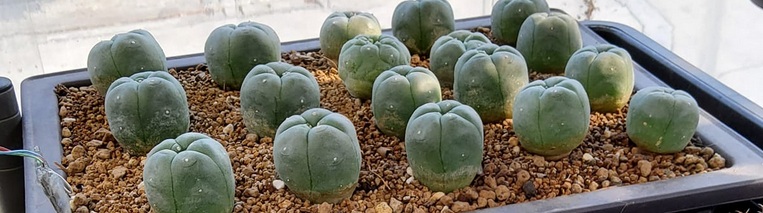
Growth in years one through three demands the most careful management. Young plants of all Lophophora species are considerably more sensitive to overwatering than adults, and L. fricii is no exception. The substrate needs to dry fully between waterings at this stage, and direct summer sun should be avoided for plants in their first two seasons. Bright indirect light during the first two growing years reduces the risk of bleaching while allowing adequate photosynthesis. From year three or four, plants can be introduced to more direct light gradually, watching for signs of distress.
Own-root plants may take fifteen to twenty years to reach flowering size under typical temperate cultivation conditions. Grafted plants bloom much sooner, sometimes within three to five years from seed, but the body form of a grafted L. fricii grows upright rather than flat and does not develop the strongly depressed, soil-level profile of a mature own-root specimen. For collectors focused on the species in its most authentic form, the commitment to own-root cultivation from seed is the path worth taking, even knowing the timeline. A large, old own-root Lophophora fricii with its grey body, elevated protuberances, and a history measured in decades is a different object entirely from a young grafted plant grown for quick results.
The clumping habit of L. fricii means that old plants in good conditions will eventually begin to offset from the base, forming small clusters that grow slowly into larger ones. This process accelerates in the silt flat population type but occurs across the species under good cultivation conditions. A plant that has begun to cluster is producing an increasingly complex and visually interesting specimen, and the cluster form of a mature plant in flower is one of the highlights of a Lophophora collection.
Cultivation
Soil and substrate
The substrate requirements of Lophophora fricii follow the genus prescription closely. In habitat the plant grows on alkaline, mineral-dominant soils with strong drainage, whether on limestone-derived hill slopes or on the compacted silt of alluvial flats that nevertheless drain well in depth. A soil composition of 90%+ inorganic material, composed of pumice, or fine granite grit, combined with a small proportion of low-nutrient cactus compost or decomposed granite fines, is appropriate. Target soil pH of 7.0 to 8.0. Adding a small quantity of limestone chips or crushed dolomite reflects the calcareous substrate of the habitat and is beneficial without causing harm.
Deep pots are recommended due the taproot being large and fusiform, as Habermann’s original description emphasised, and a root-bound plant will not develop correctly through the dry periods that define its seasonal cycle. Long tom or rose-style pots with a height-to-diameter ratio of 1.5 to 1 or better are the correct choice. Unglazed terracotta is preferable to plastic for the additional airflow it provides through the pot wall, which aids drying between waterings. The critical point, as with all Lophophora species, is that water applied at the surface must pass through and exit the drainage hole within minutes. Any substrate that pools moisture around the root collar after a full watering is a rot risk.
Watering through the growing season
During the active growing season, from late spring through early autumn in temperate cultivation, the correct approach is to water thoroughly and then wait. Each watering should saturate the substrate completely, with free drainage from the bottom of the pot. The interval before the next watering should be long enough for the substrate to dry fully. Under warm conditions with an inorganic-dominant mix this might mean ten to sixteen days in midsummer. The crown provides useful guidance: a firm, slightly turgid body is well-watered, and one that feels softened or shows slight deflation is ready for water. A crown that looks actively shrunken or has begun to pull below the soil surface has been dry for too long, though established plants tolerate this condition better than young seedlings.
Reduce watering frequency from early autumn and stop entirely once nighttime temperatures fall reliably below 10 degrees Celsius. A winter dry period of four to five months is appropriate for most temperate locations. Plants kept completely dry during a cold winter tolerate brief temperature dips to around minus 5 to minus 7 degrees Celsius without damage to the crown or root, provided the substrate is bone dry. Resume watering cautiously in spring when nights have settled above 10 degrees and the crown shows new growth beginning.
Light
Mature plants benefit from full sun exposure through the growing season. Direct light produces the tightest body form and the best grey-tone colouration. Plants grown in shade elongate, lose the characteristic low, flat profile, and develop a more saturated green that does not show the distinctive grey character of the species. That said, acclimatisation to full sun must be gradual for plants that have been shaded, and new arrivals should be introduced to increasing light over several weeks rather than placed directly in full summer sun. The grey epidermis of L. fricii reflects more light than the blue-green of L. williamsii, which provides some additional protection from bleaching, but the risk is still present in extreme heat. In temperatures above 38 degrees Celsius, some afternoon shade reduces stress without compromising growth meaningfully.
Temperature and cold tolerance
The Coahuilan range of Lophophora fricii is semi-arid rather than cold-desert, and the temperature regime is warmer at night than the high-altitude San Luis Potosí localities occupied by some L. williamsii populations. As a general guide, established L. fricii plants with completely dry roots tolerate brief drops to around minus 5 degrees Celsius. Wet roots will rot at temperatures well above freezing. In USDA zone 9b or warmer, well-drained established plants can remain outdoors year-round. In zones 8 and below, a dry winter shelter is required. The winter dry period does double duty here: it both protects the root from rot-inducing cold and reflects the natural seasonal cycle of the habitat, which produces the conditions under which this plant has evolved its growth rhythm.
Own root vs. grafted
Grafted plants are appropriate for growers whose primary interest is reaching flowering size quickly or producing seed. The trade-off is the upright growth habit and the absence of the strongly depressed own-root body form. Degrafted plants can develop their own root over time but do not replicate the root structure of a plant grown from seed in the ground. For collectors interested in Lophophora fricii as a long-term specimen, own-root from seed remains the standard. The grey colouration, the characteristic protuberances, and the flat geophytic profile that make this species distinctive in a collection all develop most fully in own-root material grown over years with consistent seasonal cycles.
Comparison: Lophophora fricii, L. williamsii, and L. diffusa
Understanding Lophophora fricii properly requires placing it within a three-way comparison with its two most relevant relatives. These three species share a genus and superficially similar body plans, but differ enough in range, morphology, chemistry, and genetics to occupy distinct positions in any careful account of the group.
| Character | L. fricii | L. williamsii | L. diffusa |
|---|---|---|---|
| Body colour | Yellowish-grey-green; warm grey | Blue-grey-green; glaucous | Pale yellow-green to greenish-white |
| Surface protuberances | Large, broad, elevated | Small to moderate, lower | Low, broad, smooth overall |
| Flower colour | Pale to dark pink; often carmine; white form known | Pale pink; white form known | White to pale cream-yellow |
| Flower size | Up to 40 mm across; largest in genus | 15–25 mm across | 15–25 mm across |
| Mescaline | Absent or trace only (<0.015% dw) | Present; typically 1–6% dw | Absent or trace only |
| Dominant alkaloid | Pellotine (~65% of total) | Mescaline (~30% of total) | Pellotine (~88% of total in some analyses) |
| DNA grouping | Closer to L. diffusa than to L. williamsii | Distinct; two subgroups | Distinct from L. williamsii |
| Native range | Viesca region, Coahuila; very restricted | S. Texas to C. Mexico; extensive | Querétaro, Mexico; restricted |
| Maximum diameter | Up to 12 cm | Up to 8 cm (most plants) | Up to 10 cm |
The molecular data from Sasaki and Aragane is worth pausing on in this context. The trnL/trnF chloroplast sequence from the L. fricii specimens (Lo-14 to Lo-16) was different from all eleven L. williamsii specimens in the study. The clustering of the Lo-14 to Lo-16 sequences was closer to the four L. diffusa specimens than to any L. williamsii. This is unexpected from a geographic standpoint, since L. diffusa grows in Querétaro, hundreds of kilometres from the Coahuilan range of L. fricii, while L. williamsii surrounds L. fricii in the immediate landscape. The implication is that L. fricii and L. diffusa represent an early divergence from the common ancestor of the genus, with the mescaline-absent biochemistry reflecting a shared ancestral alkaloid pathway that L. williamsii departed from independently by evolving the mescaline biosynthesis route. That interpretation is consistent with the alkaloid data: both L. fricii and L. diffusa are pellotine-dominant and mescaline-absent, while L. williamsii is mescaline-dominant and pellotine-minor.
For collectors, the practical comparison is simpler. Lophophora fricii is identifiable in a collection by its grey-warm body, its large protuberances, and its larger, more saturated flowers. Lophophora williamsii is blue-grey, smoother, with smaller and paler flowers. Lophophora diffusa is pale to nearly cream, very smooth-bodied, with white to pale cream flowers. Growing all three side by side makes these differences vivid in a way that no description fully captures.
Conservation
Lophophora fricii is listed as Endangered on the IUCN Red List, a more severe designation than the Vulnerable status assigned to Lophophora williamsii. The difference reflects the species’ restricted range. A species confined to a small area around a single Coahuilan basin is vulnerable to localised threats in ways that a species ranging across 1,500 kilometres of desert is not. Any significant habitat degradation in the Viesca region affects a meaningful proportion of the total known population. Any collecting pressure applied to the two known population types is felt at a scale that would be negligible across the vastly larger range of L. williamsii.
The documented threats follow the pattern common to restricted-range Chihuahuan Desert cacti: habitat conversion from agriculture and livestock grazing, which damages or destroys the low-growing plants before they can be recognised; collection pressure from the cactus trade; and slower-acting pressure from long-term aridification of the region. The Viesca lagoon area, which gives the main population its geographic reference point, is itself a semi-arid basin that has experienced significant hydrological change over the past century, with the lagoon reducing substantially in extent. Whether those hydrological changes directly affect the peyote populations around the basin margin is not clearly established in the conservation literature, but any reduction in the extent of suitable habitat in such a restricted range is a conservation concern.
The species receives protection through its CITES Appendix II listing, which applies to all Lophophora species and regulates international commercial trade. Mexican national law also protects the genus from wild collection. Cultivation from seed offers the only fully legal path to owning documented specimens in most jurisdictions, and the collector market for seed-grown Lophophora fricii is active enough that documented own-root plants from reputable European and Japanese specialists are available without requiring wild-sourced material.
Related Taxa in the Genus
Lophophora williamsiiPeyote, the most widely studied cactus in the genus. Its blue-grey body, mescaline-dominant alkaloid profile, and extensive range across the Chihuahuan Desert stand in sharp contrast to the restricted, pellotine-dominant L. fricii it surrounds in Coahuila.Lophophora diffusaThe false peyote of Querétaro. Shares the mescaline-absent, pellotine-dominant chemistry of L. fricii and clusters with it in molecular analyses, despite their very different geographic ranges. Its pale cream-yellow body and white flowers make it the most visually distinct of the three major species.Lophophora alberto-vojtechiiThe most recently described and least-documented species in the genus, from Aguascalientes. Named in honour of Alberto Vojtěch Frič, the same Czech botanist whose 1924 photographs first documented what would become Lophophora fricii. An apt connection across the genus.
Sources & References
Habermann, V. (1975). Lophophora fricii sp. nov. Kaktusy (Brno) 10: 123. · Sasaki, Y. et al. (2009). Peyote identification on the basis of differences in morphology, mescaline content, and trnL/trnF sequence between Lophophora williamsii and L. diffusa. Forensic Sci. Int. 184(1–3): 1–6. · Aragane, M. et al. (2011). Peyote identification on the basis of differences in morphology, mescaline content, and trnL/trnF sequence between Lophophora williamsii and L. diffusa. J. Nat. Med. 65(1): 103–110. · Štarha, R. & Kučhyňa, J. (1996). Alkaloids of Lophophora fricii Habermann. Cactus & Co. · Štarha, R. (1997). Alkaloids of Cactaceae. In: Grym, R. Rod / Die Gattung Lophophora. Appendix. · Grym, R. (1997). Rod / Die Gattung Lophophora. Czech Cactus Society, Brno. · Anderson, E.F. (1980). Peyote: The Divine Cactus. University of Arizona Press. · Anderson, E.F. (2001). The Cactus Family. Timber Press. · Terry, M. (2013). Lophophora fricii. IUCN Red List of Threatened Species. Version 2014.3. · Chan, C.B. et al. (2021). The Alkaloids from Lophophora diffusa and Other “False Peyotes”. J. Nat. Prod. 84(8): 2398–2407. · Royal Botanic Gardens, Kew. Plants of the World Online. Lophophora fricii Haberm. Retrieved 2026. · Trout, K. Sacred Cacti, 4th ed. Lophophora analysis and fricii notes at sacredcacti.com. · Cactus Conservation Institute. Lophophora species documentation and field photography. cactusconservation.org.