
Mammillaria crucigera
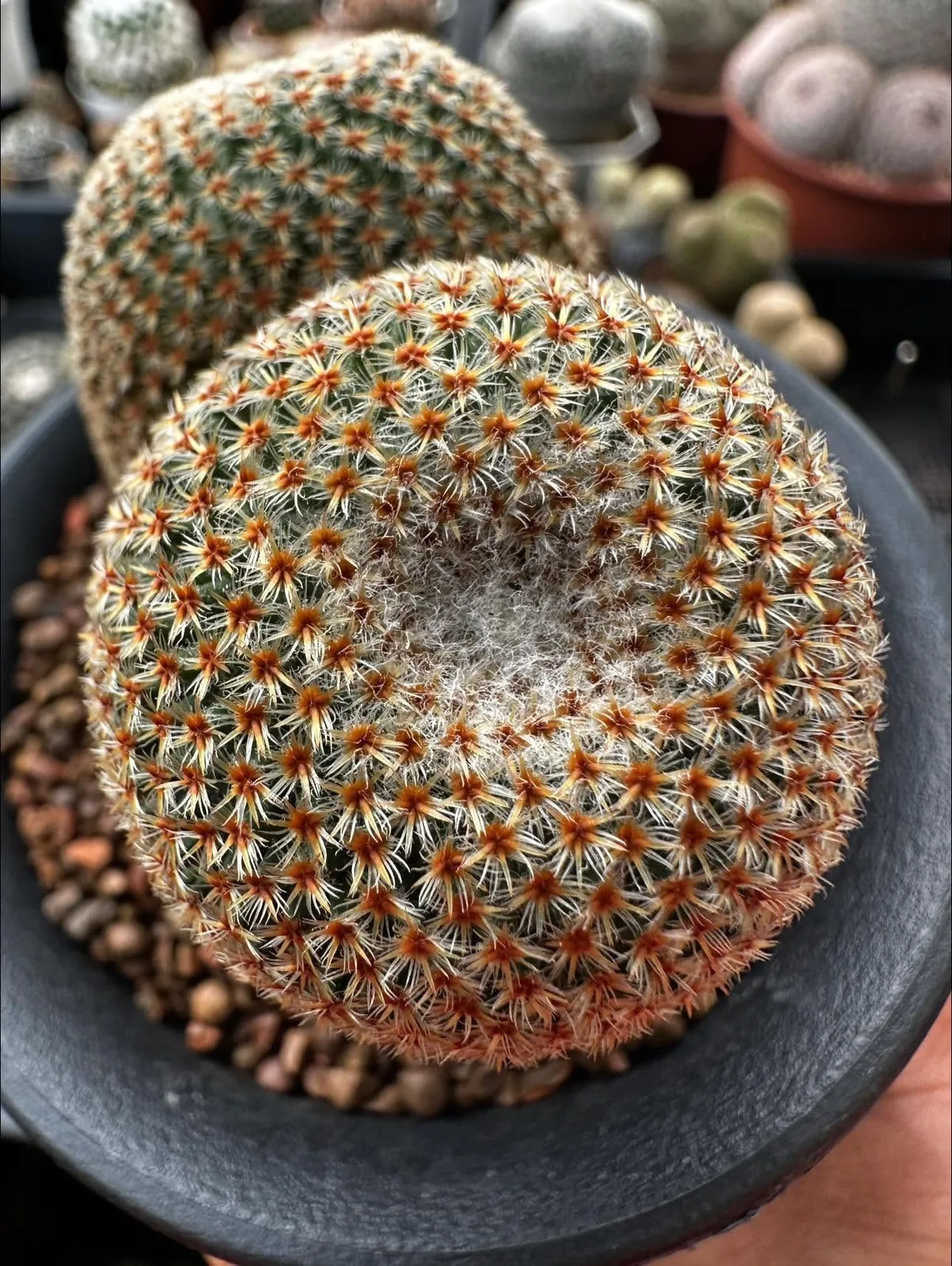
Mammillaria crucigera is the cross-spined living net of the Tehuacán-Cuicatlán limestone, a miniature whose body all but vanishes under one of the finest spine patterns in the genus. The tubercles are minute and packed so tightly that the short glassy-white radials from neighbouring areoles interlock into a continuous lattice, and the four little central spines on each areole sit in a cross, the arrangement that gives the species its name.
Carl Friedrich Philipp von Martius described the species in 1829, and it has stayed in Mammillaria ever since. It belongs to series Supertextae, the assemblage of small, densely netted Mexican species from the southern highlands, a different lineage from the soft snowball plants such as Mammillaria humboldtii that hide their bodies under hair-fine white wool. Crucigera instead shows a hard, geometric surface in which the cruciform centrals stay visible.
The species is a narrow endemic of the dry country where Puebla meets Oaxaca, sharing the eroding gypsum and limestone of the Tehuacán valley with neighbours like Mammillaria pectinifera and the tuberous Mammillaria napina. That fragile, easily eroded cliff habitat drives both its conservation status and the way it is grown.
Individual heads stay small, reaching only a few centimetres across, and the plant builds its presence slowly: solitary when young, it forks dichotomously with age into the low, crowded clumps of two, three or more heads shown on this page. In late winter and early spring a ring of small deep-pink flowers opens at the crown, seldom rising far above the spines.
Mammillaria crucigera quick reference
A limestone and gypsum cliff specialist from the Tehuacán-Cuicatlán region of Puebla and Oaxaca, where it roots in sharp calcareous debris with fast drainage and no standing water. Values calibrated for seed grown plants in cultivation, drawn from habitat and specialist grower experience.
Taxonomy & nomenclature
The accepted name is Mammillaria crucigera Mart., published in the Nova Acta Physico-Medica Academiae Caesareae Leopoldino-Carolinae 16(1): 340 in 1829 (IPNI LSID urn:lsid:ipni.org:names:150836-2). The authority is Carl Friedrich Philipp von Martius, the German botanist who named a number of early Mexican cacti. The epithet crucigera means cross-bearing, a direct reference to the four stiff central spines set in a cross at each areole.
Kew POWO treats the name as accepted and lists a single homotypic synonym, Cactus cruciger (Mart.) Kuntze, from Kuntze’s wholesale transfer of cactus names. Two subspecies are recognised: the type, subspecies crucigera, and subspecies tlalocii (Repp.) D.R.Hunt, a later-described population kept distinct at subspecific rank. The exact type locality is not pinpointed in the early literature beyond the Tehuacán region of Puebla.
Within the genus the species sits in subgenus Mammillaria, series Supertextae, the group of small southern-Mexican species with tiny, closely set tubercles and a dense net of fine radial spines, alongside M. supertexta and M. haageana. This is a separate lineage from the soft-spined snowball series Lasiacanthae that holds M. humboldtii and M. herrerae; the convergent white spination misleads the eye, but the hard geometric net and visible cruciform centrals of crucigera set it apart. Molecular work has shown Mammillaria to be artificial in its older, broad circumscription, though M. crucigera itself has stayed a stable accepted species.
Habitat
Mammillaria crucigera is a calcicole of the Tehuacán-Cuicatlán basin, the dry rain-shadow valley straddling the border of southern Puebla and northern Oaxaca. It grows on eroding gypsum and limestone, lodged on slopes and low cliffs in the thin mineral debris that gathers between rocks, at roughly 700 to 1,020 m. On that loose, free-draining calcareous ground water drains away fast and never stands at the root.
The valley carries one of the richest cactus floras in Mexico, a xerophilous scrub of columnar cacti, agaves and thorn shrubs under a warm, summer-rain, dry-winter climate. M. crucigera shares this limestone with other narrow Tehuacán endemics on the site, including the pectinate-spined M. pectinifera and the geophytic M. napina, each solving the same harsh, calcareous, seasonally dry conditions in its own way.
The fine, interlocking radial net is functional. On exposed pale rock at low latitude the glassy white spines scatter fierce sunlight off the body, soften the wide day-to-night temperature swing, and shade the epidermis. The same calcareous, easily eroded gypsum that supports the plant is also its vulnerability: once the binding vegetation is grazed or cleared, the substrate itself washes away.
Morphology
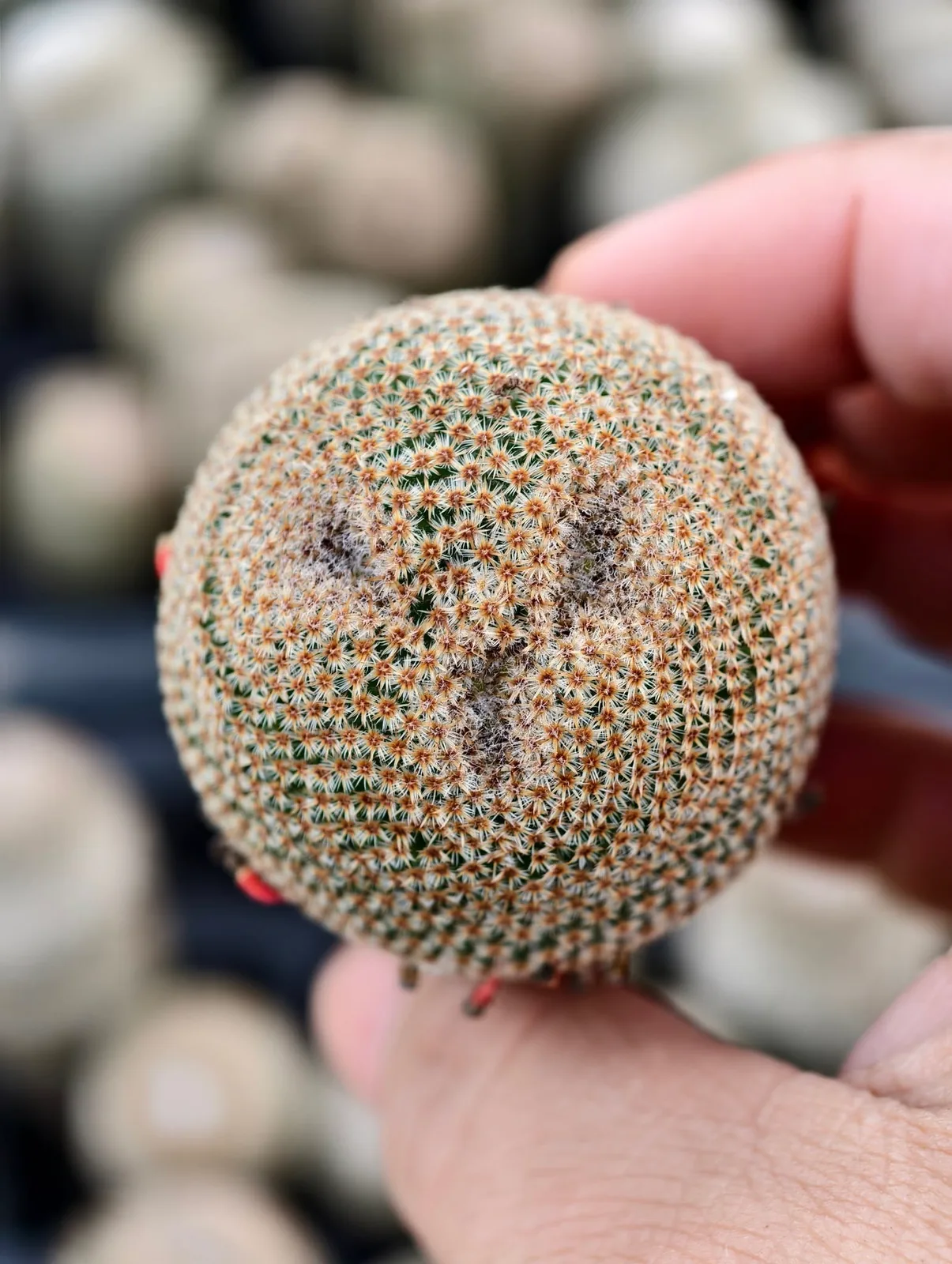
The stem is flattened-globose to short-cylindrical, becoming curved and pipe-shaped with age, reaching around 10 cm tall and 4 to 6 cm in diameter, olive to grey-green and at times flushed brownish or purplish where the sun strikes it. The plant is solitary when young and forks dichotomously at maturity, building low crowded clumps of two to several heads. The tubercles are minute, firm and keeled, set very close together in many spiralling ranks, with fine white wool filling the axils between them.
The diagnostic feature is the spination. Each reddish-brown areole carries 22 to 30 fine, needle-like, glassy-white radial spines only about 2 mm long, pressed flat and interlocking with those of the neighbouring areoles so the green body is lost beneath a continuous net. Set against them are four, occasionally five, short central spines, yellow-brown and rigid and likewise only about 2 mm, arranged in the small cross that names the species. This visible cruciform of stiff centrals over a hard geometric net is what separates crucigera at a glance from the soft, centralless snowball M. humboldtii and from the hook-spined M. huitzilopochtli of the same Oaxacan country.
Flowers open in a ring near the crown, small and funnel-shaped, deep pink to carmine or purplish, and seldom rise far above the spine net, so the effect is a coloured wreath set into the surface rather than a showy display. They appear in late winter and early spring and are followed by small fruit carrying the seed. Like the rest of subgenus Mammillaria the species has clear, watery sap rather than milky latex.
Locality detail
The species is endemic to the Tehuacán-Cuicatlán region on the border of Puebla and Oaxaca in southern Mexico, recorded from roughly ten localities on calcareous slopes and low cliffs. The map below shows a regional centroid only. Sharp coordinates are withheld here following standard practice for an Endangered, CITES-listed cactus that is actively targeted by collectors.
Because the plant is small, slow and tied to a fragile gypsum substrate in a handful of sites, its wild populations are easily damaged and have been the subject of dedicated demographic study. Any plant offered without clear evidence of cultivated, seed grown origin should be treated as suspect.
Mammillaria crucigera care and cultivation
Two habitat facts frame everything: the plant grows on loose, sharply drained calcareous ground where water never sits at the root, and its body is sheathed in a dense spine net that holds any moisture landing on it. Get drainage and a dry crown right and the species is undemanding for its reputation; get them wrong and it rots from the neck without warning.
Substrate
Grow it in a free-draining, mineral-dominant mix of roughly 29 per cent pumice, 28 per cent lava grit, 28 per cent decomposed granite, 10 per cent crushed limestone and 5 per cent low-nutrient organic base, with no zeolite and no silica sand. The limestone follows a named grower’s cultivation recommendation for better wool and spine development; it is grower practice, not a habitat reading, since the species grows wild on gypsum cliffs rather than limestone. Growers on hard tap water can reduce or drop the fraction; the pumice, lava and granite carry the instant drainage the plant demands. A grit top dressing under the body keeps the spine-packed neck dry and off wet substrate.
Every Mammillaria on this site runs a sharply drained, mineral-dominant mix built from the same declared house formulation; only limestone and the thin organic fraction vary by species, and neither is set by habitat rock. M. crucigera carries crushed limestone on a named grower’s cultivation recommendation, not because its gypsum-cliff habitat calls for it; organic sits at the genus floor.
| Species | Pumice | Lava | Zeolite | Granite | Limestone | Silica | Organic |
|---|---|---|---|---|---|---|---|
| M. herrerae | 40% | 15% | 0% | 30% | 10% | 0% | 5% |
| M. napina | 45% | 0% | 0% | 40% | 10% | 0% | 5% |
| M. pectinifera | 45% | 15% | 0% | 25% | 10% | 0% | 5% |
| M. duwei | 50% | 15% | 0% | 20% | 0% | 0% | 15% |
| M. schwarzii | 60% | 20% | 0% | 20% | 0% | 0% | 0% |
| M. bertholdii | 55% | 0% | 0% | 35% | 0% | 0% | 10% |
| M. luethyi | 60% | 0% | 0% | 30% | 0% | 0% | 10% |
| M. huitzilopochtli | 55% | 0% | 5% | 25% | 5% | 0% | 10% |
| M. crucigera (this page) | 29% | 28% | 0% | 28% | 10% | 0% | 5% |
| M. herrerae f. albiflora | 45% | 0% | 0% | 25% | 20% | 10% | 0% |
| M. humboldtii | 50% | 0% | 0% | 30% | 15% | 0% | 5% |
Watering and light
From spring through autumn, water thoroughly only once the substrate has dried out completely, and keep a spare hand even in growth: this is a plant that is killed far more often by generosity than by drought. Direct the water at the soil rather than over the plant, because the dense radial net holds droplets against the body and standing moisture in that net is the usual route to rot. Through the cool months keep it dry, mirroring the rainless valley winter. Bright light is essential; the species takes strong sun with only the fiercest summer midday glare softened, and good light is what keeps the body compact and the spine net crisp. Hold it above about 8°C, and never let cold and wet coincide.
The species comes true from seed, which is the route that holds its natural slow proportions and is the only one that suits its conservation status. Sow on a mineral surface at warm temperatures under a humid cover; seedlings are small and slow and want careful, sparing watering. Because the plant forks and clumps with age, offsets can also be removed and rooted, and specialist growers sometimes graft seedlings to carry them past the vulnerable early stage before growing them on. Seed grown plants are the target for any serious collection; grafted stock grows faster but coarsens and loses the tight, geometric character.
Comparison
Within its own series Supertextae, M. crucigera is closest to M. supertexta and M. haageana, which share the tiny tubercles and dense netted spination but reach larger bodies and carry showier flowers held clear of the spines. Crucigera is the smallest and most miniature of the group, with the most reduced flowers and the tightest, most engraved-looking surface, and it is the one that forks dichotomously into low clumps rather than building a single larger head.
Against the snowball series the contrast is sharper. M. humboldtii and M. herrerae bury the body under dozens of soft, hair-fine white radials and carry no real central spines, so the surface reads as fur; crucigera carries far fewer, stiffer radials and the four hard cruciform centrals stand out against them, so the surface reads as a geometric net. The two looks are easy to tell apart once the cruciform centrals are seen.
Its Tehuacán neighbours separate on growth habit rather than spine type. M. napina retracts into a fat tuberous taproot and lies flush with the soil, while the hook-spined M. huitzilopochtli of the same Oaxacan country arms itself with fierce hooked centrals. Because cluster density and spine quality vary from plant to plant, anyone choosing a crucigera should buy the exact specimen they can see.
Frequently asked questions
Is Mammillaria crucigera hard to grow?
It has a reputation as a tricky Mammillaria, but the difficulty is really one thing: rot. The dense spine net traps water against the small body, so the mix must drain instantly, the watering can must be used sparingly even in growth, and winter must be dry. Treated as a lean, calcareous cliff plant it is steady and long-lived. Overwatered or potted in a water-holding mix, it collapses fast, which is why many growers keep it on the intermediate-to-advanced shelf.
Can Mammillaria crucigera be grown from seed?
Yes, and seed is the preferred route. The plant comes true from seed and keeps its natural slow, miniature proportions that way, which also makes seed the responsible choice for an Endangered wild species. Sow on a mineral surface at warm temperatures under a humid cover and grow the seedlings on hard and lean. Because the plant forks and clumps, offsets can be rooted too, and growers sometimes graft seedlings briefly to carry them past the fragile early stage before growing them on.
Is Mammillaria crucigera legal to own?
Yes. Like all cacti the species is listed on CITES Appendix II, not the stricter Appendix I, so nursery-propagated plants are freely owned and traded with the right paperwork for cross-border movement. It is also an Endangered wild plant in continuing decline, which is exactly why wild collection is indefensible. Buy only seed grown, cultivated-origin plants.
Where does Mammillaria crucigera grow in the wild?
It is endemic to the Tehuacán-Cuicatlán region on the border of Puebla and Oaxaca in southern Mexico, where it grows in roughly ten localities on eroding gypsum and limestone slopes and low cliffs at about 700 to 1,020 m. The plants root in thin calcareous debris in one of the richest cactus floras in the country, a dry, summer-rain valley in the rain shadow of the surrounding sierras.
When does Mammillaria crucigera flower?
Flowering comes in the cooler months, generally from late winter into early spring, when a ring of small funnel-shaped flowers opens around the crown. The colour runs deep pink to carmine or purplish, but the blooms are small and rarely rise far above the spine net, so they read as a coloured wreath set into the surface rather than a large display. Strong light and a proper dry winter rest are what bring a settled plant into flower.
Sources & further reading
Martius, C.F.P. von 1829. Mammillaria crucigera. Nova Acta Phys.-Med. Acad. Caes. Leop.-Carol. Nat. Cur. 16(1): 340 · IPNI, International Plant Names Index, urn:lsid:ipni.org:names:150836-2 · Kew POWO, Mammillaria crucigera Mart., powo.science.kew.org/taxon/urn:lsid:ipni.org:names:150836-2 · Hunt, D.R. 2006. The New Cactus Lexicon. dh Books, Milborne Port (series Supertextae; subsp. tlalocii combination) · Hernández, H.M. & Gómez-Hinostrosa, C. 2015. Mapping the Cacti of Mexico, Part II. dh Books (Tehuacán-Cuicatlán distribution) · Contreras, C. & Valverde, T. 2002. Evaluation of the conservation status of a rare cactus (Mammillaria crucigera) through the analysis of its population dynamics. Journal of Arid Environments 51: 89–102 · Solórzano, S. et al. 2014. Identification of conservation units of Mammillaria crucigera (Cactaceae). Plant Ecology & Diversity 8(4) · IUCN Red List of Threatened Species, Mammillaria crucigera (Endangered) · CITES Checklist of Cactaceae, Mammillaria (Appendix II) · llifle.com, Encyclopedia of Living Forms, Mammillaria crucigera (stem, spine and flower detail)