
Is It Legal to Own San Pedro? A State-by-State Guide
All ArticlesSan Pedro cactus (Echinopsis pachanoi) is legal to own as an ornamental in all fifty US states; mescaline, the alkaloid it contains, is Schedule I under 21 USC § 812. Extraction or consumption flips the conduct into a felony almost everywhere. The state table below cites the operative statute for every jurisdiction so you can verify the current text.
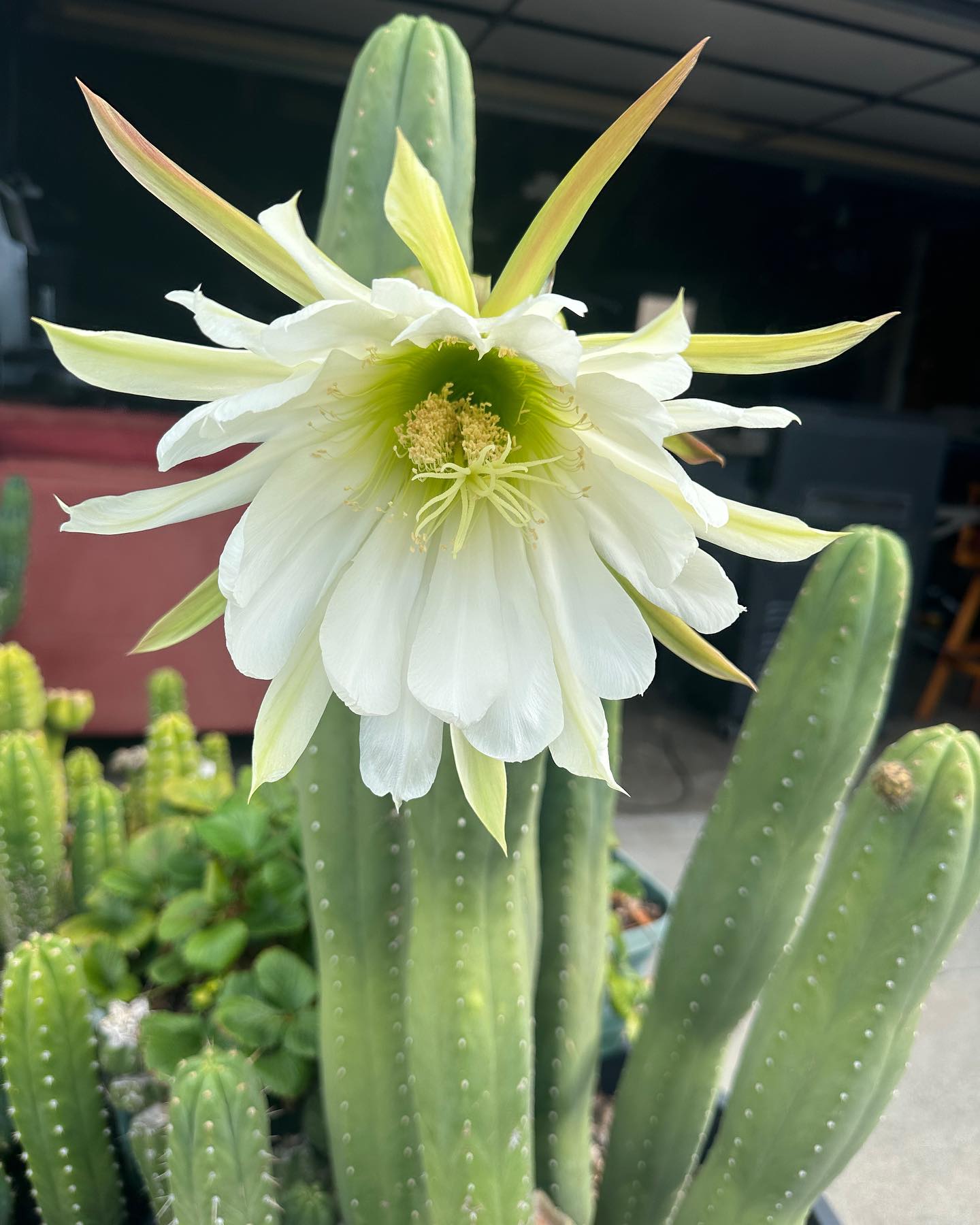
What follows is reference content, not legal advice. Drug law moves quickly, and the answer in your specific situation depends on facts a horticultural reference cannot evaluate. The state table below cites the operative statute for each jurisdiction so your attorney can pull the current text. Cell entries reflect the law as verified on September 21, 2026.
San Pedro Legal Status by US State (2026)
| State | Plant possession (ornamental) | Last verified |
|---|---|---|
| Alabama | Legal (Trichocereus not named) | 2026-09-21 |
| Alaska | Legal (Trichocereus not named) | 2026-09-21 |
| Arizona | Legal (Trichocereus not named) | 2026-09-21 |
| Arkansas | Legal (Trichocereus not named) | 2026-09-21 |
| California | Legal (HSC § 11363 names Lophophora only) | 2026-09-21 |
| Colorado | Legal; personal use, possession, gifting and home cultivation also decriminalized for adults 21+ under the Natural Medicine Health Act | 2026-09-21 |
| Connecticut | Legal (Trichocereus not named) | 2026-09-21 |
| Delaware | Legal (Trichocereus not named) | 2026-09-21 |
| District of Columbia | Legal; Initiative 81 (DC Law 23-268) made entheogenic plant enforcement the lowest MPD priority for adults 18+ | 2026-09-21 |
| Florida | Legal (Trichocereus not named) | 2026-09-21 |
| Georgia | Legal (Trichocereus not named) | 2026-09-21 |
| Hawaii | Legal (Trichocereus not named) | 2026-09-21 |
| Idaho | Legal (statute names Lophophora williamsii only; vendor-blog claim of a per-se Trichocereus ban is not in the statute) | 2026-09-21 |
| Illinois | Legal (Trichocereus not named) | 2026-09-21 |
| Indiana | Legal (Trichocereus not named) | 2026-09-21 |
| Iowa | Legal (Trichocereus not named) | 2026-09-21 |
| Kansas | Legal (Trichocereus not named) | 2026-09-21 |
| Kentucky | Legal (Trichocereus not named) | 2026-09-21 |
| Louisiana | Legal. RS 40:989.1 lists ~40 hallucinogenic plants by name. Trichocereus, San Pedro, and Echinopsis are not on the list. Subsection (D) carves out aesthetic, landscaping, and decorative cultivation. | 2026-09-21 |
| Maine | Legal (Trichocereus not named) | 2026-09-21 |
| Maryland | Legal (Trichocereus not named) | 2026-09-21 |
| Massachusetts | Legal (Trichocereus not named) | 2026-09-21 |
| Michigan | Legal (Trichocereus not named) | 2026-09-21 |
| Minnesota | Legal (Trichocereus not named) | 2026-09-21 |
| Mississippi | Legal (Trichocereus not named) | 2026-09-21 |
| Missouri | Legal (Trichocereus not named) | 2026-09-21 |
| Montana | Legal (Trichocereus not named) | 2026-09-21 |
| Nebraska | Legal (Trichocereus not named) | 2026-09-21 |
| Nevada | Legal (Trichocereus not named; NRS 453.541 NAC peyote exemption applies to Lophophora only) | 2026-09-21 |
| New Hampshire | Legal (Trichocereus not named) | 2026-09-21 |
| New Jersey | Legal (Trichocereus not named) | 2026-09-21 |
| New Mexico | Legal (Trichocereus not named) | 2026-09-21 |
| New York | Legal (Trichocereus not named) | 2026-09-21 |
| North Carolina | Legal (Trichocereus not named) | 2026-09-21 |
| North Dakota | Legal (Trichocereus not named) | 2026-09-21 |
| Ohio | Legal (Trichocereus not named) | 2026-09-21 |
| Oklahoma | Legal (statute names Lophophora williamsii and the alkaloid mescaline only; vendor-blog claim of a per-se Trichocereus ban is not in the statute) | 2026-09-21 |
| Oregon | Legal. Mescaline was not covered by Measure 109 (psilocybin only). HB 4002 (eff. Sept 1, 2024) restored personal-use possession of Schedule I substances to misdemeanor status. | 2026-09-21 |
| Pennsylvania | Legal (Trichocereus not named) | 2026-09-21 |
| Rhode Island | Legal (Trichocereus not named) | 2026-09-21 |
| South Carolina | Legal (Trichocereus not named) | 2026-09-21 |
| South Dakota | Legal (Trichocereus not named) | 2026-09-21 |
| Tennessee | Legal (Trichocereus not named) | 2026-09-21 |
| Texas | Legal (Trichocereus not named; H&S Code § 481.104 schedules peyote in Penalty Group 3 with a Native American Church religious-use carve-out at § 481.111(a), but Trichocereus and Echinopsis are not enumerated) | 2026-09-21 |
| Utah | Legal (Trichocereus not named) | 2026-09-21 |
| Vermont | Legal (Trichocereus not named) | 2026-09-21 |
| Virginia | Legal (Trichocereus not named) | 2026-09-21 |
| Washington | Legal (Trichocereus not named) | 2026-09-21 |
| West Virginia | Legal (Trichocereus not named) | 2026-09-21 |
| Wisconsin | Legal. Wis. Stat. § 961.14(4)(m) schedules “Mescaline in any form, including mescaline contained in peyote, obtained from peyote or chemically synthesized.” The statute names peyote and the alkaloid; Trichocereus is not enumerated. | 2026-09-21 |
| Wyoming | Legal (Trichocereus not named) | 2026-09-21 |
Two state-level shifts are worth flagging at the top. Colorado decriminalized personal use, possession, gifting, and home cultivation of non-peyote-derived mescaline for adults 21 and older under Proposition 122 (2022) and SB23-290 (2023). It is the only state where San Pedro cultivation is affirmatively lawful for personal use. Oregon moved twice: Measure 110 decriminalized personal-use possession of Schedule I substances in 2020, and HB 4002 restored misdemeanor status for personal-use possession effective September 1, 2024. Mescaline was never covered by Measure 109, which legalized only psilocybin services.
Municipal entheogen decriminalization resolutions, separately, do not change state schedules. They redirect local police priority. Resolutions covering mescaline-containing plants are now in effect in Oakland, Berkeley, San Francisco, Eureka, and Arcata (California); Somerville, Cambridge, Northampton, Easthampton, Salem, Provincetown, Amherst, and Medford (Massachusetts); Ann Arbor, Detroit, Hazel Park, Ferndale, Ypsilanti, and Washtenaw County (Michigan); Seattle, Port Townsend, Olympia, Tacoma, and Jefferson County (Washington); Minneapolis (Minnesota); and Washington, DC under Initiative 81. Santa Cruz is the cautionary exception: its 2020 resolution originally covered mescaline cacti, then a 2021 amendment removed peyote and other phenethylamine-bearing cacti at the request of Native American Church representatives, language broad enough to sweep San Pedro out with it. Berkeley’s 2023 resolution excludes peyote-derived mescaline specifically; San Pedro is covered. State law in every case still controls.
Is San Pedro a Controlled Substance Under Federal Law?
Mescaline is Schedule I under the federal Controlled Substances Act, listed at 21 USC § 812 and 21 CFR § 1308.11(d)(24). The live San Pedro cactus is not. No federal statute or DEA regulation names Trichocereus, Echinopsis, Echinopsis pachanoi or Echinopsis macrogona as a scheduled plant (nor Trichocereus pachanoi, Trichocereus peruvianus, or Trichocereus bridgesii under the parallel Trichocereus naming). Compare 21 CFR § 1308.11(d)(26), which schedules peyote as “all parts of the plant presently classified botanically as Lophophora williamsii Lemaire, whether growing or not, the seeds thereof, any extract from any part of such plant, and every compound, manufacture, salts, derivative, mixture, or preparation of such plant, its seeds or extracts.” That kind of plant-naming language exists for peyote alone.
The DEA has not issued formal guidance specifically on Trichocereus. The agency’s Drug Fact Sheet on peyote and mescaline lists Echinopsis pachanoi and Peruvian and Bolivian torch alongside peyote as botanical sources of mescaline, but it does not address ornamental cultivation, possession, or scheduling of the whole plant. A regulatory docket number sometimes cited in vendor blogs, “DEA-2021-D-0004,” does not exist on regulations.gov, the Federal Register, or DEA.gov. Treat any quote attributed to it as unsourced.
The federal posture, then, is two-part. The alkaloid is Schedule I. The plant is not. The practical legality of ornamental Trichocereus rests on regulatory silence on the genus, the absence of any reported federal conviction for whole-plant ornamental possession, and Department of Justice and DEA enforcement discretion focused on intent to extract or consume, not horticulture. Major retailers including Home Depot, Lowe’s, Etsy, and Amazon sell San Pedro cuttings as landscape stock without legal challenge, and US Department of Agriculture import classifications recognize Trichocereus macrogonus var. pachanoi as a CITES-permitted ornamental seed import.
What flips the conduct into federal exposure is intent, demonstrated by act. The regulatory text at 21 CFR § 1308.11(d) covers “any material, compound, mixture, or preparation, which contains any quantity” of mescaline. Slicing, drying, blending, boiling, powdering, or running plant material through extraction equipment converts a live cactus into a “preparation” within the regulation’s reach. Cutting a propagable section for replanting does not. The line is doctrinal rather than statutory; no federal court has issued a published decision drawing it crisply for Trichocereus, because no reported federal Trichocereus prosecution exists. The absence of case law is itself the load-bearing fact.
What does “legal” actually mean for San Pedro ornamental possession?
No federal regulation explicitly carves out an ornamental exemption for San Pedro. The phrase “ornamental purposes” describes a stable practical inference, not a statutory carve-out. The structural argument runs through three points. The Controlled Substances Act schedules mescaline the alkaloid. The accompanying regulation schedules Lophophora williamsii by binomial as a separately enumerated plant. Trichocereus and Echinopsis are not enumerated. When Congress and DEA have wanted to schedule a specific cactus, they have done so by name.
That structural reading underwrites a horticultural trade that is decades old and operates in plain view. Specialist nurseries, general garden centers, big-box retailers, and online marketplaces all sell the plant. Public botanical gardens display mature specimens in collections. The Huntington Desert Garden, Boyce Thompson Arboretum, and the Jardin Exotique de Monaco all hold Echinopsis pachanoi in accessioned plantings without regulatory issue. The plant is normalized horticulture.
What the framework cannot do is support possession in any form that looks like preparation. State analog acts and the federal Schedule I framework reach mescaline-bearing material the moment its form changes from live ornamental to processed preparation. Erowid’s legal analysis, the most-cited public reference on this question, identifies the “preparation” trigger in 21 CFR § 1308.11(d) as the operative threshold. Drying a specimen for a year on a shelf, blending stem material in a kitchen blender, boiling it down, or shipping powdered cactus to a third party all change what is in your possession from a plant to a preparation.
The intuitive reader test: if a Home Depot manager could open the shipment without their legal team objecting, the conduct sits on the ornamental side of the line. If the conduct involves any of the preparation behaviors above, it sits on the controlled-substance side, regardless of whether the original plant was sold as “ornamental.” The label does not travel with the plant; the form does.
What are the four ways states treat San Pedro?
The 50-state table sorts into four patterns. Forty-six states plus the District of Columbia follow the federal posture: mescaline is Schedule I in the state controlled-substances act, the live cactus is not named, ornamental possession is lawful by statutory silence, and intent to extract or consume converts the conduct into a Schedule I felony. The state CSA citations vary, but the analysis does not.
One state has affirmative state-level decriminalization. Colorado’s Natural Medicine Health Act, enacted as Proposition 122 in 2022 and built out through SB23-290 in 2023, removed criminal penalties for personal possession, use, gifting, and home cultivation of non-peyote-derived mescaline by adults 21 and older. The peyote exclusion is deliberate; the legislature carved peyote out of the “natural medicine” definition to protect Native American Church supply. Commercial sale of mescaline remains a felony pending the regulated-access program. Psilocybin healing centers have been licensed since April 2025; the rulemaking window for adding mescaline (along with DMT and ibogaine) to that program opened on June 1, 2026, and the Natural Medicine Advisory Board had not finalized a mescaline recommendation as of this article’s September 2026 verification date. Until that rulemaking concludes, Colorado is the only US jurisdiction where personal cultivation of San Pedro by an adult is affirmatively lawful.
One state recently flipped twice. Oregon decriminalized personal-use possession of all Schedule I substances under Measure 110 in 2020, then restored misdemeanor status under HB 4002 effective September 1, 2024. Mescaline was never covered by Measure 109, which is psilocybin-services-only. Personal-use possession of mescaline in Oregon today is a misdemeanor with deflection-program eligibility; manufacture or distribution remains a felony. Plain ornamental possession of the cactus is unaffected.
One jurisdiction has lowered enforcement priority without rescheduling. The District of Columbia’s Initiative 81, approved in 2020 and codified as DC Law 23-268, made enforcement of entheogenic-plant offenses the lowest priority for the Metropolitan Police Department for adults 18 and older. Mescaline remains Schedule I under the DC Code; the resolution shifts police behavior, not the schedule.
Roughly thirty municipalities across nine states now have lowest-enforcement-priority resolutions covering mescaline-bearing plants. They are listed in the table caveat above. None of them change state schedules. The distinction matters because vendor blogs frequently report “decriminalized in [city]” in language that invites readers to assume state-level legalization. It is not that. In every state where municipal resolutions exist, the state controlled-substances act remains the operative authority for any manufacture, distribution, or extraction charge.
Is San Pedro illegal in Louisiana, Idaho, or Oklahoma?
A persistent vendor-blog claim is that Louisiana, Idaho, and Oklahoma have explicit per-se bans on Trichocereus or San Pedro cultivation. Each claim fails when checked against the statute.
Louisiana Revised Statutes 40:989.1, often referred to as Act 159 of 2005, lists approximately forty hallucinogenic plants by name. The list includes Salvia divinorum, Datura, Brugmansia, Mimosa hostilis, Heimia salicifolia, Tabernanthe iboga, Mandragora, Atropa belladonna, Hyoscyamus, and Amanita muscaria, among others. Trichocereus, Echinopsis, San Pedro, and the species names pachanoi, peruvianus, bridgesii, and macrogona are not on the list. Subsection (D) carves out an exemption for “the possession, planting, cultivation, growing, or harvesting of [a hallucinogenic] plant strictly for aesthetic, landscaping, or decorative purposes,” and the exemption has not been amended off in subsequent sessions. Louisiana’s posture on San Pedro is the same as the federal posture: mescaline is Schedule I under RS 40:964; the live cactus is not named anywhere in state law.
Idaho Code § 37-2705 schedules peyote as Lophophora williamsii by binomial and schedules mescaline as the alkaloid. There is no per-se ban on mescaline-containing plants as a class. The vendor claim that Idaho criminalizes “any mescaline-containing plant” is not in the statute.
Oklahoma 63 OS § 2-204 follows the same pattern. The statute schedules peyote (Lophophora williamsii) and mescaline the alkaloid. Trichocereus is not enumerated. Vendor claims of a per-se Trichocereus ban in Oklahoma do not appear in the statutory text.
The point is not that these three states are unusually permissive. They are unusually written about. The actual legal posture in each is identical to the posture in the forty-three other states that schedule mescaline as the alkaloid and stay silent on the cactus. When a vendor source says a particular state “explicitly bans” San Pedro, ask which statute and which subsection. If the answer is RS 40:989.1, § 37-2705, or § 2-204, the claim is not in the cited statute.
Can you legally buy San Pedro cactus online?
Yes, you can legally buy San Pedro cactus online in the United States. Live San Pedro plants and cuttings ship legally to all fifty states as ornamental nursery stock. Licensed specialist nurseries sell rooted plants and fresh cuttings openly, general garden centers carry the plant seasonally, and eBay and Etsy both allow listings. CITES Appendix II permitting applies only at international borders; domestic interstate shipping needs no permit, and the family-level CITES annotation exempts seeds outright.
The marketing language is where sellers create risk, not the plant. A listing that touts mescaline content, ceremonial dosing, or extraction yield converts an ornamental sale into evidence of intent. Buy from growers who sell the plant as a plant, with a botanical name and stated provenance, and keep your own records the same way. Seed grown specimens with documented provenance also hold collector value far better than anonymous cuttings; the field-number conventions used across our encyclopedia are the model.
Why does San Pedro law differ from peyote law?
San Pedro and Lophophora williamsii (peyote) both contain mescaline, but their legal treatment diverges at three points. First, the federal regulation names peyote as a scheduled plant by binomial. Trichocereus is not named. That is the structural difference that drives almost everything else.
Second, the federal religious-use exemption at 21 CFR § 1307.31 covers peyote alone. The regulation reads in full: “The listing of peyote as a controlled substance in Schedule I does not apply to the nondrug use of peyote in bona fide religious ceremonies of the Native American Church, and members of the Native American Church so using peyote are exempt from registration. Any person who manufactures peyote for or distributes peyote to the Native American Church, however, is required to obtain registration annually and to comply with all other requirements of law.” The American Indian Religious Freedom Act Amendments of 1994, codified at 42 USC § 1996a, provide a parallel statutory protection for traditional ceremonial use of peyote by members of federally recognized tribes. Both instruments are peyote-specific. Neither extends to Trichocereus, Echinopsis, or any non-peyote mescaline-bearing cactus.
Third, the case law that gets cited around psychedelic religious-use claims does not reach San Pedro. Gonzales v. O Centro Espirita Beneficente Uniao do Vegetal, 546 U.S. 418 (2006), is a Religious Freedom Restoration Act case about ayahuasca and the alkaloid dimethyltryptamine, not mescaline and not Trichocereus. The Supreme Court did not extend its holding beyond the UDV church and DMT. United States v. Boyll, 774 F. Supp. 1333 (D.N.M. 1991), expanded the regulatory peyote exemption to non-Indian Native American Church members but is also peyote-specific. No reported federal case has applied an RFRA defense successfully to a Trichocereus prosecution, and there is no reported federal Trichocereus prosecution to apply it to.
The conservation context also differs. Lophophora williamsii and Echinopsis both sit on CITES Appendix II via the family-level Cactaceae listing, but Lophophora is also on Mexico’s NOM-059-SEMARNAT-2010, with wild populations under heavy poaching pressure across south Texas and northern Mexico. Echinopsis pachanoi and Trichocereus bridgesii, by contrast, are categorized Least Concern by IUCN with stable populations across their Andean range. The cactus that the law guards most carefully is not the one the law treats most leniently. Reading the legal divergence requires holding both halves at once.
What species count as San Pedro, and are they endangered?
The taxonomic placement of San Pedro is in active scientific disagreement. Plants of the World Online, the Royal Botanic Gardens Kew taxonomic backbone, treats Trichocereus as a synonym of Echinopsis following the Schlumpberger and Renner phylogeny published in the American Journal of Botany in 2012. Under that treatment the accepted name is Echinopsis pachanoi. The Caryophyllales.org taxonomic working group, the Hunt CITES Cactaceae Checklist (third edition, 2016), and a number of contemporary monographers retain Trichocereus as a separate genus on the same molecular evidence. Both treatments are current and defensible. rarecactus.com generally follows POWO; this article uses the Echinopsis combinations for San Pedro and the Peruvian torch and uses Trichocereus bridgesii for the Bolivian torch, which is the binomial growers and the working literature actually use.
Three binomials cover most of the mescaline-containing cactus trade. Echinopsis pachanoi is San Pedro proper, native to southern Ecuador and northern Peru between 2,000 and 3,000 meters. Trichocereus bridgesii, the Bolivian torch (which POWO synonymizes under Echinopsis lageniformis on nomenclatural-priority grounds), is native to La Paz, Cochabamba, Tarija, and Chuquisaca departments at 1,000 to 3,300 meters. Echinopsis macrogona, which under POWO subsumes the horticultural “Peruvian torch” (Trichocereus peruvianus), ranges across western and southern Peru into Bolivia. All three carry mescaline at variable concentrations; the cactus trade has historically priced specimens more on form, glaucousness, and provenance than on alkaloid content.
All three are IUCN Least Concern, with stable wild populations and broad naturalized ranges including Spain, the Canary Islands, central Chile, and Colombia. CITES lists the Cactaceae family on Appendix II rather than the genus or species individually. Cross-border trade in artificially propagated ornamental San Pedro is governed by general Appendix II permitting, with the family-level annotation exempting seeds, cut flowers of artificially propagated plants, and in vitro tissue cultures. (The fruit-and-pads exemption in the same annotation is scoped to Opuntia subgenus Opuntia only and does not extend to Echinopsis fruit.) Compare that posture to the Appendix I commercial-trade ban that applies to Ariocarpus, Aztekium, Strombocactus, Pelecyphora, and several Turbinicarpus species. The cactus that the law guards most carefully is the cactus that wild populations actually need it to.
The ceremonial context bears mention because it shows up in the international legal posture. Peru’s Vice-Ministry of Cultural Heritage declared the traditional medicinal use of San Pedro and Wachuma in northern Peruvian curanderismo Cultural Heritage of the Nation in 2022 (Resolución Viceministerial 000252-2022-VMPCIC/MC), covering practices in Piura, Lambayeque, La Libertad, Tumbes, and parts of Cajamarca. Cultivation, possession, and sale are fully legal in Peru. Bolivia and Ecuador are similarly permissive on the live plant. Canada schedules mescaline as Schedule III under the Controlled Drugs and Substances Act but does not schedule the cactus. The United Kingdom places mescaline in Class A under the Misuse of Drugs Act 1971; the live plant is legal as ornamental, and any preparation of it is Class A. Australia is the most uneven, with Western Australia, Queensland, and the Northern Territory treating Trichocereus as a prohibited plant under state drug schedules while New South Wales, Victoria, South Australia, and the Australian Capital Territory pin liability to mescaline content. The plant-versus-alkaloid split is the global default; Switzerland and France are the principal outliers.
How can US growers keep San Pedro legally?
Three points carry through. First, in forty-nine states and the District of Columbia, owning a live San Pedro plant as part of a horticultural collection is legal. The fiftieth, Colorado, affirmatively permits home cultivation for personal use by adults 21 and older under the Natural Medicine Health Act. There is no US jurisdiction where the live ornamental plant is per-se illegal.
Second, the line everywhere except Colorado is intent demonstrated by act. Drying material for processing, blending stem tissue, boiling extracts, shipping powdered cactus, or possessing extraction equipment alongside cactus material flips the conduct into Schedule I felony exposure under the state controlled-substances act, the federal Controlled Substances Act, or both.
Third, the regulatory landscape on natural-source mescaline is moving in both directions. Colorado’s mescaline rulemaking window opened June 1, 2026. Massachusetts voters rejected statewide psychedelics decriminalization 57 to 43 in November 2024, and the question cannot return to the ballot before 2028. New Mexico’s Medical Psilocybin Act, signed April 2025, covers psilocybin only and leaves mescaline untouched, as does Utah’s hospital pilot. Municipal resolutions keep expanding on the other side of the ledger: Olympia joined in August 2024 and Tacoma in January 2025. None of this changes the federal Schedule I status of the alkaloid, but the state-level table will not look the same in 2027 that it looks in September 2026. Pull the current statute before relying on any specific cell.
This article is reference content, not legal advice. The horticultural and statutory facts above are accurate as of the verification date; the application to any particular set of facts is a question for a licensed attorney in your jurisdiction. Drug law is fact-intensive and evolving, and a horticultural reference cannot substitute for individualized counsel.
For the botany behind the law, see our Echinopsis pachanoi specimen page. For the parallel legal analysis on peyote, see Is It Legal to Own Peyote? A 50-State Guide for Collectors.
Frequently Asked Questions
Is San Pedro cactus legal in the United States?
Yes. Owning Echinopsis pachanoi (San Pedro) and the related mescaline-containing Trichocereus species Trichocereus bridgesii (Bolivian torch) and Echinopsis macrogona (Peruvian torch) as live ornamental plants is generally legal in all fifty US states and the District of Columbia. No federal statute and no state controlled-substances act schedules these cacti by botanical name. Mescaline, the alkaloid the plants contain, is Schedule I federally under 21 USC § 812 and in every state CSA. Conduct that converts the live plant into a preparation, including drying, blending, boiling, powdering, or extracting, is what triggers Schedule I exposure.
Is San Pedro the same as peyote under US law?
No. The two cacti both contain mescaline, but the legal answers diverge. Peyote is scheduled as a named plant under 21 CFR § 1308.11(d)(26) (Lophophora williamsii Lemaire). The federal Native American Church religious-use exemption at 21 CFR § 1307.31 and the American Indian Religious Freedom Act Amendments of 1994 (42 USC § 1996a) cover peyote alone. Trichocereus and Echinopsis are not named in either federal regulation, are not covered by the religious-use exemption, and are not scheduled by binomial in any state. The plants are taxonomically and legally distinct.
What states have banned San Pedro cactus by name?
None. Across all fifty states and the District of Columbia, no state controlled-substances act names Trichocereus, Echinopsis, San Pedro, pachanoi, peruvianus, bridgesii, or macrogona as a scheduled plant. Vendor blogs sometimes claim that Louisiana RS 40:989.1, Idaho Code § 37-2705, or Oklahoma 63 OS § 2-204 contain such a ban. The statute text in each case lists peyote (Lophophora williamsii) and the alkaloid mescaline; no Trichocereus species is enumerated. Louisiana RS 40:989.1 also contains an aesthetic, landscaping, and decorative cultivation carve-out at subsection (D).
Is mescaline legal if it is still in the cactus?
The alkaloid is Schedule I in any form, but the live cactus is not the alkaloid for enforcement purposes. The federal regulation at 21 CFR § 1308.11(d) reaches “any material, compound, mixture, or preparation, which contains any quantity” of mescaline, but enforcement and prosecutorial practice focus on preparations rather than living plants. No reported federal case has prosecuted plain ornamental possession of a Trichocereus specimen. Drying, blending, boiling, powdering, or extracting plant material converts the cactus into a “preparation” within the regulation’s text and exposes the possessor to Schedule I charges. The line is doctrinal rather than statutory; consult a licensed attorney for specifics.
What is the legal difference between Trichocereus pachanoi, peruvianus, and bridgesii?
There is no legal difference at the species level. No US federal statute or state controlled-substances act distinguishes among the three. All are governed by the same framework: the live plant is legal as ornamental in every state; mescaline as an alkaloid is Schedule I; intent to extract or consume converts the conduct into a felony. Taxonomically, Plants of the World Online accepts Echinopsis pachanoi, Trichocereus bridgesii (which POWO synonymizes under Echinopsis lageniformis on nomenclatural-priority grounds), and Echinopsis macrogona (with Trichocereus peruvianus treated as a synonym). The Caryophyllales.org working group and Hunt’s CITES Cactaceae Checklist retain Trichocereus as a separate genus on the same molecular evidence.
Does the federal peyote exemption cover San Pedro?
No. The exemption at 21 CFR § 1307.31 applies to “peyote” as defined in 21 CFR § 1308.11(d)(26), namely Lophophora williamsii Lemaire and its parts, extracts, and preparations. The exemption protects bona fide ceremonial use by Native American Church members and registered manufacturers and distributors supplying the church. Trichocereus and Echinopsis are not named in the regulation. The American Indian Religious Freedom Act Amendments of 1994 protect traditional ceremonial use of peyote only, not San Pedro. No reported federal case has extended the exemption beyond Lophophora williamsii.
21 USC § 812 (Schedules of controlled substances) · 21 CFR § 1308.11 (Schedule I) · 21 CFR § 1307.31 (Native American Church peyote exemption) · 42 USC § 1996a (American Indian Religious Freedom Act Amendments of 1994) · DEA Drug Fact Sheet, Peyote and Mescaline (2025 reissue) · Gonzales v. O Centro Espirita Beneficente Uniao do Vegetal, 546 U.S. 418 (2006) · United States v. Boyll, 774 F. Supp. 1333 (D.N.M. 1991) · Erowid Cacti Law Vault · NORML state-by-state guides · Vicente LLP guide to Colorado SB23-290 · Ballotpedia, Colorado Proposition 122 (2022) · Oregon HB 4002 (2024) · DC Law 23-268 (Initiative 81) · Louisiana Revised Statutes 40:964 and 40:989.1 · Idaho Code § 37-2705 · Oklahoma 63 OS § 2-204 · Texas Health & Safety Code §§ 481.103, 481.104, 481.111 · California Health and Safety Code §§ 11054, 11363, 11379.6 · Plants of the World Online, Royal Botanic Gardens Kew · Schlumpberger & Renner, “Molecular phylogenetics of Echinopsis (Cactaceae),” American Journal of Botany 99(8) (2012) · Albesiano & Kiesling, Haseltonia 17 (2012) · Korotkova et al., “Cactaceae at Caryophyllales.org,” Willdenowia 51(2) (2021) · Hunt, The CITES Cactaceae Checklist, 3rd ed. (Kew, 2016) · IUCN Red List, Echinopsis pachanoi (LC, 2013, amended 2017) · IUCN Red List, Trichocereus bridgesii (LC, 2013; assessment listed under the synonym Echinopsis lageniformis) · CITES Appendices, post-CoP19 (2022) · USDA APHIS commodity import requirements (Trichocereus macrogonus var. pachanoi) · Resolución Viceministerial 000252-2022-VMPCIC/MC, Peruvian Ministry of Culture · Therapeutic Goods Administration, Standard for the Uniform Scheduling of Medicines and Poisons (Australia, current Schedule 9) · Western Australia Misuse of Drugs Act 1981; Queensland Drugs Misuse Regulation 1987; Victoria Drugs, Poisons and Controlled Substances Act 1981 (AustLII)