Copiapoa Field Numbers Explained: A Collector’s Guide
All ArticlesCopiapoa field numbers anchor cultivated plants to specific Atacama localities. FK 107, Friedrich Ritter’s FR 211, and Karel Kníže’s KK numbers are the most common acronyms a collector encounters. This guide explains how to read a field number, who the major Copiapoa fieldworkers were, and how to look up any locality in the rarecactus.com Field Number Database.
What Is a Field Number?
A field number is a personal identifier a fieldworker assigns to a single collecting event. The fieldworker visits a locality, notes down GPS coordinates, takes seed or cuttings (or just observes and photographs the plants), and gives the visit a number. The notation is initials plus a number, sometimes with letter or decimal suffixes for re-collections or splits. FK 107 means “Fred Kattermann’s 107th documented collection,” which corresponds to a specific stand of Copiapoa cinerea on the coastal hills above Paposo. Anyone propagating from FK 107 seed is propagating from Kattermann’s plants at that exact locality, and the chain of provenance is preserved through the number alone.
Field numbers are not taxonomic identifiers. They do not tell you what species a plant is. They tell you where the plant came from. The combination of the two (taxonomy plus locality) is what makes the plant scientifically and collectibly valuable: Copiapoa cinerea from PV-144 (Paposo) is different from Copiapoa cinerea from KK 1810 (Antofagasta), even though both are nominate cinerea. The bodies look different, the spination pattern differs, and the populations have been reproductively isolated long enough that habitat-specific traits show up reliably in cultivation.
Most field numbers correspond to actual coordinates. Many are published in monographs or in the collector’s own records, and the rarecactus.com Field Number Database stitches these together with cross-references to herbarium records and published locality data.
How do you read a Copiapoa field number?
The standard format is acronym, then number, with optional suffixes. Examples:
- FK 107 : Fred Kattermann, collection 107
- FR 211 : Friedrich Ritter, collection 211
- GC 1011.05 : Graham Charles, collection 1011, fifth re-visit or sub-record
- KK 1810a : Karel Kníže, collection 1810, sub-population A
- AW 02-073 : Andreas Wessner, year 2002, collection 73 (some collectors prefix the year)
- RMF 168 : Roger M. Ferryman, collection 168
The acronym is the most important piece. It tells you whose records you are consulting, which determines what published documentation exists. FR numbers connect to Ritter’s 1980 monograph Kakteen in Südamerika. FK numbers connect to Kattermann’s Cactaceae Systematics Initiatives papers. GC numbers connect to Graham Charles’s BCSS field reports and his published genus monograph. The same numerical suffix under different acronyms refers to entirely different plants.
The number itself is sequential within the collector’s career. Low numbers were assigned early in the collector’s fieldwork; high numbers later. Re-collection suffixes (a, b, .01, .02) indicate the collector visited the locality more than once and split the original number into sub-records when the population structure warranted.
The Major Copiapoa Collectors
Copiapoa is unusual among cactus genera for the depth of its collecting record. The plants are concentrated in coastal northern Chile, accessible by road from Antofagasta or Caldera, and the populations are visible enough that careful fieldworkers could establish locality records over multiple seasons. Six collectors account for the bulk of cultivated provenance, though dozens of others contributed.
Friedrich Ritter (FR)
Ritter was the most prolific Copiapoa collector and the dominant taxonomic authority for the genus through the second half of the 20th century. His four-volume Kakteen in Südamerika (1979-1981) describes most accepted Copiapoa species and pairs each description with a type locality and an FR number. FR 211 (the type material of C. cinerea), FR 444 (C. solaris from Paposo), and the FR 1000s (later collections) anchor much of the cultivated material in European collections. Ritter worked the Atacama coast extensively in the 1950s through the 1970s, often staying for months and revisiting populations across seasons.
If you see an FR number on a Copiapoa label, the plant traces back to Ritter’s seed, often via a long European propagation chain. Many FR-numbered plants are now multi-generation cultivated, and the field number is the only fixed point connecting modern stock to its natural origin.
Fred Kattermann (FK)
Kattermann is a US-based cactus taxonomist who reorganised Eriosyce and Copiapoa systematics in the 1990s. His Cactaceae Systematics Initiatives series re-examined Ritter’s species concepts and split or combined several. FK numbers concentrate on the coastal stretch from Caldera to Taltal, with strong representation around Paposo, Pan de Azúcar, and the Tropic of Capricorn populations. Kattermann’s records are tightly tied to coordinates and are well represented in the rarecactus.com database.
Graham Charles (GC)
Charles is a British collector and writer whose Copiapoa fieldwork through the 2000s and 2010s filled in gaps Ritter had left, particularly in the southern range and the inland fog populations. His BCSS journal coverage and his genus monograph (published as a BCSS handbook) are the primary published source for many GC numbers. GC numbers tend to use the format GC NNNN.NN, with the decimal indicating split sub-records.
Andreas Wessner (AW)
Wessner is a German collector active from the 1990s. His AW numbers cover Copiapoa, Eriosyce, and Neoporteria across the Chilean coast, often filling in localities other collectors did not reach. The Wessner records are particularly strong on the inland populations south of Taltal and on the small fog-dependent species like C. esmeraldana and C. laui. See our Copiapoa laui specimen page for an example of an AW-numbered taxon.
Roger M. Ferryman (RMF)
Ferryman was a British fieldworker who specialised in Copiapoa from the 1980s onward. RMF numbers are highly regarded in the European collector community for their tight locality data and for the photographs Ferryman took at each site. His self-published Copiapoa monograph remains a standard reference. Many cultivated Copiapoa in UK and continental European collections trace to RMF seed.
Karel Kníže (KK)
Kníže was a Czech collector whose KK numbers cover South American cacti generally, including extensive Copiapoa material from the 1970s through the 1990s. KK numbers are common on Czech and central European propagation chains, often transmitted through seed exchanges. The Kníže records are sometimes less precisely georeferenced than Ritter’s or Kattermann’s, but the breadth is unmatched outside Ritter.
Other contributors
Several smaller collections appear regularly on labels and warrant a quick mention:
- L : Alfred Bernhard Lau, German priest and collector whose Latin American work is broad rather than Copiapoa-specific
- SB : Steven Brack of Mesa Garden, the long-running US specialist nursery
- BB : Brian Bates, British collector
- PV : various Czech-issue numbers used in seed exchange (the prefix has been used by more than one source; check the cited locality before assuming)
- HU : Horst Uebelmann, primarily Brazilian cacti but with some Chilean records
Why do Copiapoa field numbers matter so much?
Copiapoa is the genus where field-number provenance carries the most weight, for three reasons.
First, the populations are morphologically distinct over short distances. Coastal C. cinerea from one bay can look measurably different from coastal C. cinerea from the next bay 30 km north or south. The wax thickness, the spine colour, the body proportions, and the offset habit all vary at the locality scale. A plant raised from a known FK or RMF number expresses the morphology of that specific population, and the difference shows up in cultivation.
Second, the wild populations are increasingly threatened. Coastal Atacama development, mining, and climate-driven fog reduction have shrunk many of the localities the FR and KK numbers were collected from in the 1970s. Some populations are now functionally extinct in habitat. The cultivated material from those numbers is a genetic record that no longer exists at the source.
Third, hybridisation has not erased the distinctions. Most cultivated Copiapoa are seed-propagated from documented parents within the same population, so the numbered material has stayed coherent. If you grow GC 1011.05 alongside an unnumbered “C. cinerea” from a generic seed list, the GC plant will look like its parent population in a way the unnumbered plant typically will not.
For deeper coverage of individual Copiapoa taxa, see Copiapoa cinerea, Copiapoa cinerea subsp. krainziana, Copiapoa solaris, and the broader Copiapoa genus hub.
How do you use the rarecactus.com Field Number Database?
The Field Number Database holds 45,000+ records across eleven cactus genera, including the Copiapoa coverage above. The interface supports multiple ways of querying using the unified filter bar.
Search by field number
Type the field number directly into the “Search field #…” input. The format is acronym, space, number (“FK 107”, “FR 211”, “GC 1011.05”). The search matches both the acronym and the number, so partial searches work: typing just “FK” filters to all Kattermann records, and typing “107” filters to all collections numbered 107 across all collectors.
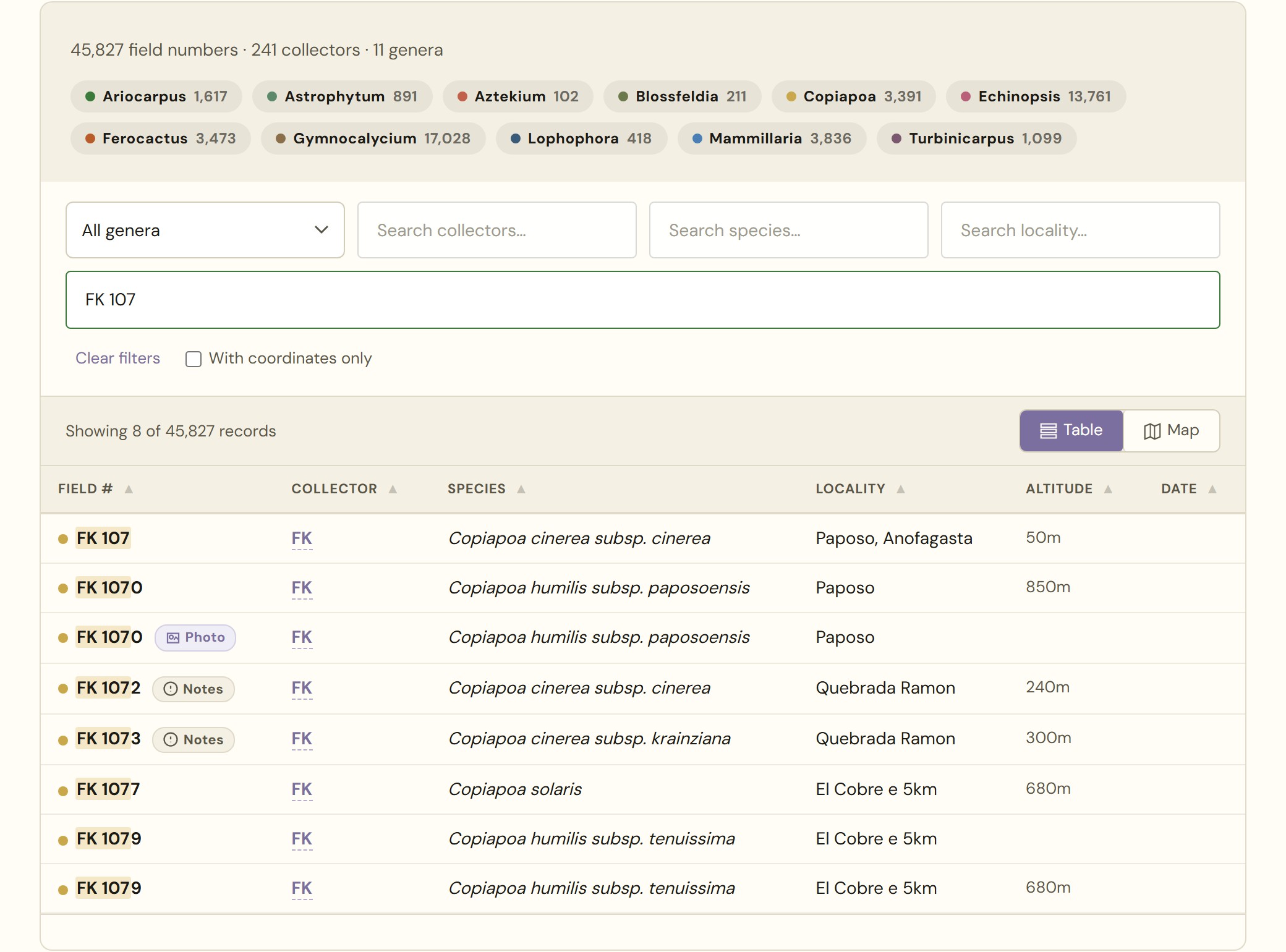
The result row shows the field number, collector acronym, species name, locality description, altitude, and collection date.
Filter by genus and species
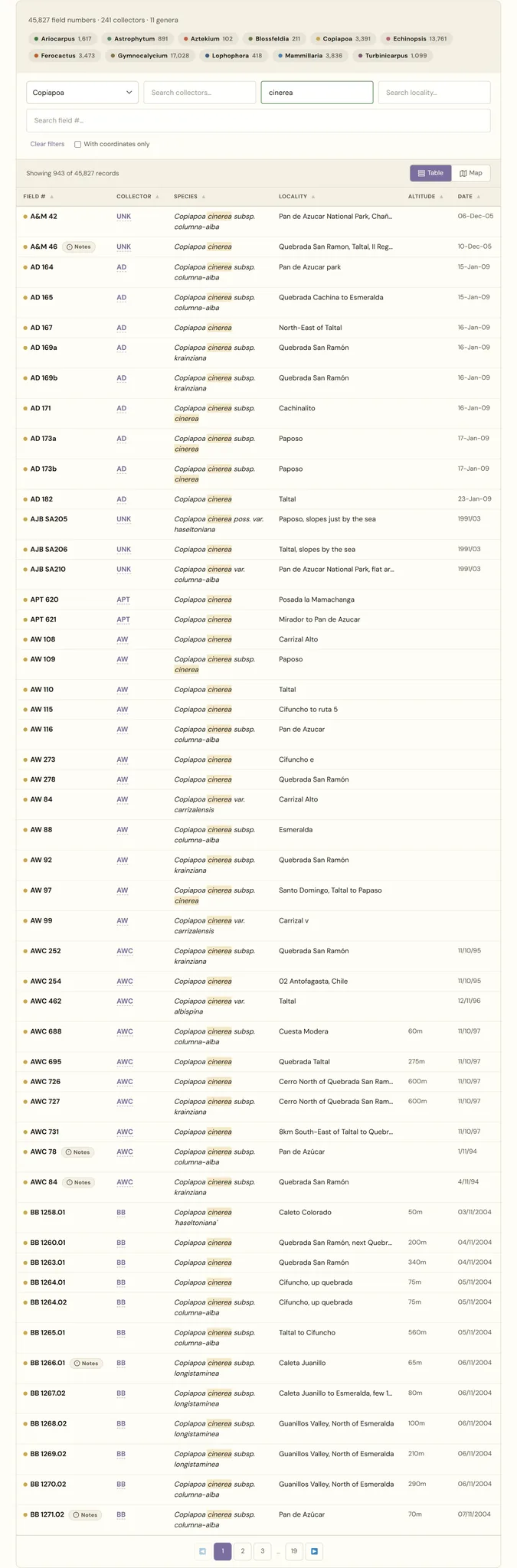
Use the “Filter by genus” dropdown to restrict results. Select “Copiapoa” to see only that genus. Combine this with the “Search species…” input to narrow further: typing “cinerea” with the genus filter set to Copiapoa returns every C. cinerea record across all collectors. Without the genus filter, “cinerea” might pull in unrelated species name matches from other genera.
Browse localities on the map
The database includes thousands of precise GPS coordinates. Toggle from the “Table” view to the “Map” view using the buttons on the right side of the toolbar.
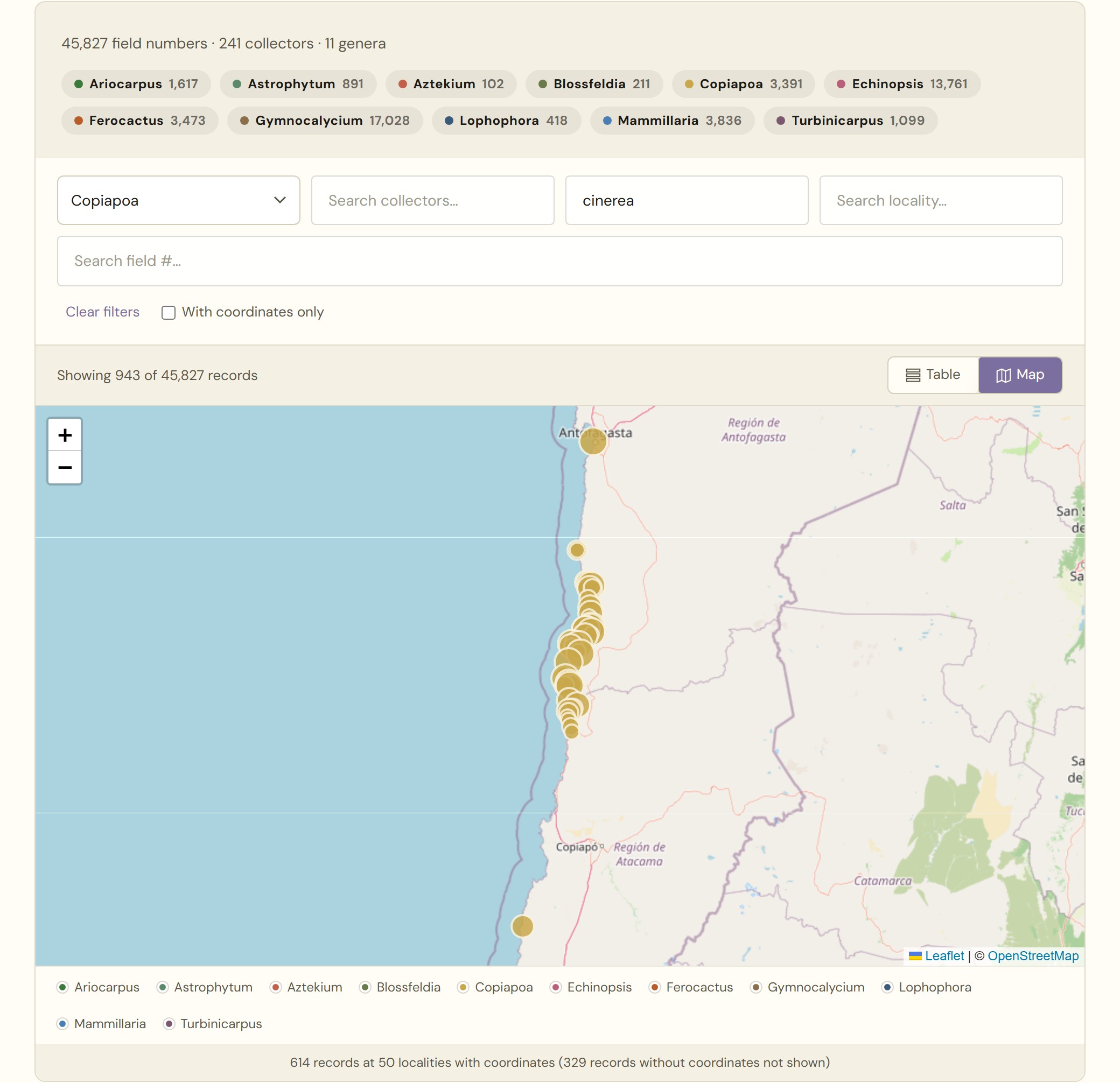
When a record has GPS coordinates, the map renders a marker at the exact spot, color-coded by genus (e.g., yellow for Copiapoa). Clicking the marker pulls up the locality name and collection details. You can zoom out to see how the Copiapoa range stretches from roughly Vallenar in the south to the southern Peru border in the north, and zoom in to see the relationship between coastal fog gradients and individual locality clusters.
Cross-reference with specimen pages
Every Copiapoa specimen page on rarecactus.com links into the Field Number Database for that taxon. Open Copiapoa cinerea, scroll to the locality section, and the field-number reference points directly into the database. This shortens the lookup loop: read about the species in depth on the specimen page, then jump to the numbered records to see exactly which localities are documented in cultivation.
The reverse also works. From a database result row, the species name links back to the specimen page when one exists. So if you encounter “C. cinerea subsp. krainziana, FK 522, Taltal” in the database and want the full taxonomic and habitat treatment, the species name is a clickable link straight to Copiapoa cinerea subsp. krainziana.
Worked Example: Tracing FK 107 End to End
A practical walkthrough makes the workflow concrete. Suppose you receive a packet of Copiapoa seed labelled “C. cinerea var. columna-alba, FK 107.”
Step 1: open the Field Number Database. Type “FK 107” into the “Search field #…” input.
Step 2: confirm the species and locality. The result row should show FK as the collector, Copiapoa cinerea as the species, and Paposo as the locality.
Step 3: view the map. Click the “Map” button to see the geographic context. Note the proximity to the coast and the exact cluster on the Atacama coastline.
Step 4: cross-reference with our species pages. Click the species name to open Copiapoa cinerea. Read the habitat section to understand what coastal fog conditions the population grows under, and what the cultivation implications are.
Step 5: record the chain. In your own collection records, write down “FK 107, Paposo, C. cinerea, seed sown [date], received from [supplier].” That note is what makes your seedlings provenanced. Without it, the seed becomes anonymous within one generation of propagation.
Common Field Number Mistakes
Three errors come up often enough to flag.
Confusing collector acronyms. FR (Friedrich Ritter) and FK (Fred Kattermann) are visually similar and refer to entirely different collectors with different career arcs. RMF (Roger M. Ferryman) is sometimes mistyped as RM. KK (Karel Kníže) is sometimes confused with KH (Bruno Knutti and Christian Hefti). Always check the full acronym before assuming the collector identity.
Treating the field number as a taxonomic identifier. “FK 107” is not a species name. It is a locality code paired with whatever taxon the collector identified at that site. If the collector mis-identified the plant (rare with the major Copiapoa fieldworkers, more common with general collectors), the field number stays attached to the original taxonomic call. Some published lists update the species name when the original identification was wrong, but the number itself does not change.
Assuming a number guarantees provenance. A modern seed packet labelled “Copiapoa cinerea FR 211″ is only as reliable as the seller. Reputable specialist nurseries maintain documented chains back to the original collection. Anonymous online sellers do not. The field number on a label is a claim, and the value of the claim depends on who is making it.
Building a Documented Collection
The practical implication for collectors is simple in concept and demanding in execution. A documented Copiapoa collection assembles plants whose field numbers connect to specific Atacama localities. The collection then carries scientific weight: each plant represents a population, the populations span a geographic range, and the collection as a whole maps to the natural distribution of the genus.
Sources of documented material include specialist seed lists from collectors and nurseries who maintain provenance records (Mesa Garden, Köhres, several Czech and German propagators), direct seed from specialist propagators with parental field numbers, and plant exchange among serious collectors who track provenance.
Sources to avoid for documented work include generic mass-market seed lists with no field number, unnumbered grafted retail plants from chain nurseries, and online sales where the seller cannot produce a chain of custody.
For each plant in a documented collection, record the field number, the species, the immediate parent (the source nursery or grower), and the year the seed was sown. Pair the record with the database entry. The result is a private holding that mirrors the public scientific record, and that can survive the loss of any individual plant or the death of any individual collector.
Conclusion
Copiapoa field numbers are the bridge between a plant in a pot and a coordinate on the Atacama coast. The major collectors (Ritter, Kattermann, Charles, Wessner, Ferryman, Kníže) built up the documented record across roughly seventy years of fieldwork, and the rarecactus.com Field Number Database brings the records into a single searchable surface. Use it to verify a plant’s claimed provenance, to find which other collectors visited the same locality, or to see how the genus’s distribution shapes itself along the fog coast.
For the broader genus context, see the Copiapoa hub and individual specimen pages including Copiapoa cinerea, Copiapoa solaris, Copiapoa laui, Copiapoa esmeraldana, and Copiapoa hypogaea.
Ritter, F. Kakteen in Südamerika, vol. 3 (1980) · Kattermann, F. Cactaceae Systematics Initiatives, IOS Bulletin series · Charles, G. Copiapoa, BCSS Handbook (British Cactus and Succulent Society) · Ferryman, R.M. The Genus Copiapoa (private monograph) · Hunt, D. Cactaceae Checklist, 2nd ed. (Royal Botanic Gardens Kew, 2016) · BCSS Field Number Database, bcss.org.uk · cl-cactus.com locality records
Frequently Asked Questions
What does FK stand for in cactus collecting?
FK stands for Fred (Friedrich) Kattermann, the US-based cactus taxonomist who published the Cactaceae Systematics Initiatives papers in the 1990s. His FK numbers concentrate on Chilean Copiapoa from Caldera to Taltal.
How do I look up a specific Copiapoa locality?
Use the Field Number Database and type the field number into the search bar. If you only have the locality name (e.g., “Paposo”), use the locality search field instead.
Are field numbers the same as type localities?
No. A type locality is the place where a species was first collected and described. A field number is any documented collection event, including non-type material. A species typically has one type locality but may have hundreds of field numbers from later collectors.
Why do some Copiapoa labels not have field numbers?
Field numbers track collected, documented plants. Material propagated commercially without provenance tracking, or seed mixed across populations, will not carry a field number. Most retail-channel cacti are unnumbered for this reason.
Can I trust the field number on a seed packet?
The number is a claim, not a guarantee. Specialist suppliers with established provenance records (Mesa Garden, Köhres, several Czech and German propagators) typically maintain accurate documentation. Anonymous sources should be treated as unverified.
What if my plant’s field number is not in the database?
The rarecactus.com database is comprehensive for FR, FK, KK, GC, AW, RMF, L, BB, and SB but not exhaustive for every minor collector. If your number is missing, it may be a less-documented collector or a typo. Check the spelling, then check the BCSS Field Number Database for cross-reference.