
Golden Barrel Cactus
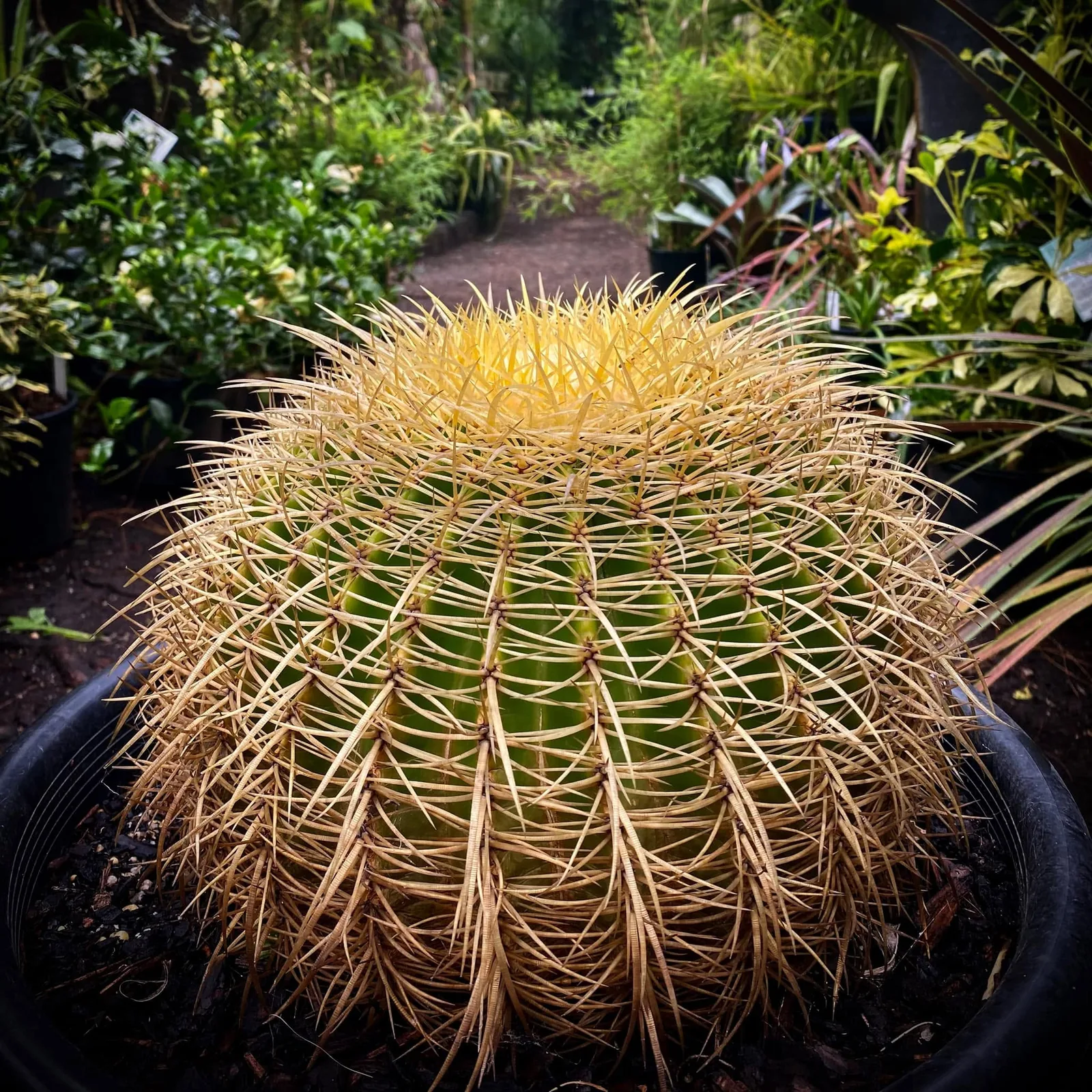
The golden barrel cactus is instantly recognisable, an ornamental grown all over the world: a rounded, ridged ball armored in dense, glowing golden spines that catch the light like a small sun. It is also, somewhat improbably, among the scarcest wild cacti left in Mexico, reduced in nature to a handful of fragmented sites, protected under CITES and Mexican law, and formally assessed as Endangered, even as commercial nurseries propagate it by the million for gardens and houseplants worldwide.
Botanically the plant is Kroenleinia grusonii (Hildm.) Lodé, the currently accepted name recognised by Kew’s Plants of the World Online since 2014, though almost everyone in the nursery trade still knows it by its older name, Echinocactus grusonii. Both names describe the same plant; the newer genus reflects DNA evidence that set this species apart from true Echinocactus.
In the wild it grows on rocky, semi-arid slopes of east-central Mexico, from Zacatecas south to San Luis Potosí, with a once-famous population in the Rio Moctezuma valley that was largely lost when a dam reservoir filled the canyon in the 1990s. This page sets out the taxonomy, the conservation story, and the cultivation profile in full, alongside hundreds of other species profiled in this encyclopedia.
The scale of the irony is worth stating plainly. A species whose wild population may number only in the low thousands, hemmed into two to four defensible localities and targeted by illegal collectors precisely because it is so recognisable, is at the same time propagated by the million and sold in home-improvement stores and garden centres on every continent. Nursery ubiquity has done essentially nothing to relieve the collecting pressure on the wild populations, which remain a separate and serious conservation concern from the cultivated global supply.
Kroenleinia grusonii quick reference
A fast-growing, sun-loving barrel from the semi-arid scrub of east-central Mexico, where it roots in rocky, volcanic and locally limestone-influenced ground with sharp drainage. Values below reflect the plant’s habitat and decades of widespread cultivation experience.
Taxonomy & nomenclature
The accepted name is Kroenleinia grusonii (Hildm.) Lodé, published in 2014 in Cactus-Aventures International (International Cactus Adventures), moving the species out of the broadly circumscribed Echinocactus into its own new, monotypic genus. Plants of the World Online (Kew) records Kroenleinia grusonii as the currently accepted name, with the earlier Echinocactus grusonii Hildm. and its varietal combinations listed in synonymy.
The basionym is Echinocactus grusonii Hildm., published in 1886 in Deutsche Garten-Zeitung and named for Hermann Gruson, the German industrialist whose Magdeburg garden first raised the species from Mexican-collected seed. Lodé’s 2014 transfer rested on molecular phylogenetic evidence that the old, broadly circumscribed Echinocactus was polyphyletic: this species’ DNA signal did not group cleanly with true Echinocactus species such as Echinocactus platyacanthus, instead pointing to a distinct lineage sitting near the boundary between Echinocactus and Ferocactus.
Not all authorities have adopted the new genus. Many nurseries, hobbyist references and even some regional floras still use Echinocactus grusonii as the working name, and it remains by far the more common label in retail and general reference sources. This page follows Kew’s POWO/WCVP standard of using the current accepted name, Kroenleinia grusonii, while noting Echinocactus grusonii as the widely used synonym gardeners will most often see on a plant tag.
Two named colour and spine forms circulate in cultivation as Echinocactus grusonii var. albispinus Runge, a white-spined form, and Echinocactus grusonii var. subinermis (Backeb.) Krainz, a form with few or very short spines. POWO does not carry either as a distinct accepted infraspecific taxon; both are best treated as horticultural forms of the same species rather than separately validated names.
Historical synonyms (10)
- Echinocactus corynacanthus Scheidw., 1841 basionym
- Echinocactus grusonii Hildm., 1886 homotypic synonym
- Echinocereus grusonii (Hildm.) Von Zeisold, 1893 homotypic synonym
- Echinocereus grusonii var. azureus Von Zeisold, 1893 homotypic synonym
- Echinocactus grusonii var. albispinus Y.Itô, 1981 homotypic synonym
- Echinocactus grusonii var. horridus Y.Itô, 1981 homotypic synonym
- Echinocactus grusonii var. intertextus Y.Itô, 1981 homotypic synonym
- Echinocactus grusonii var. subinermis Y.Itô, 1981 homotypic synonym
- Ferocactus grusonii (Hildm.) Guiggi, 2021 homotypic synonym
- Echinocactus galeottii Scheidw., 1841 heterotypic synonym
Sources: POWO (Kew) · IPNI · GBIF · Wikidata
Habitat
Kroenleinia grusonii is native to east-central Mexico, with Plants of the World Online recording its range from Zacatecas south to San Luis Potosí. Plants grow on rocky, volcanic slopes in semi-arid, subtropical scrub, in full sun with sparse surrounding vegetation and sharply drained ground, typically between roughly 1,400 and 1,900 metres elevation.
The species’ best-known historical population sat outside that core range, in the Rio Moctezuma valley straddling the Querétaro-Hidalgo border, centred near Mesa de León. Construction of the Zimapán Dam ran from 1990 to 1993, and the reservoir began filling in 1994, flooding the valley and eliminating the wild population at that specific site; botanic gardens and collectors mounted a rescue effort to salvage plants ahead of the flooding. It remains the signature habitat-loss event in the species’ conservation history, on top of decades of poaching pressure across its range.
Extent of occurrence across the known wild subpopulations is put at roughly 4,500 square kilometres, but the habitat is severely fragmented into only two to four actual locations in the technical sense conservation assessors use, areas that share a single threat event rather than one continuous population.
Morphology
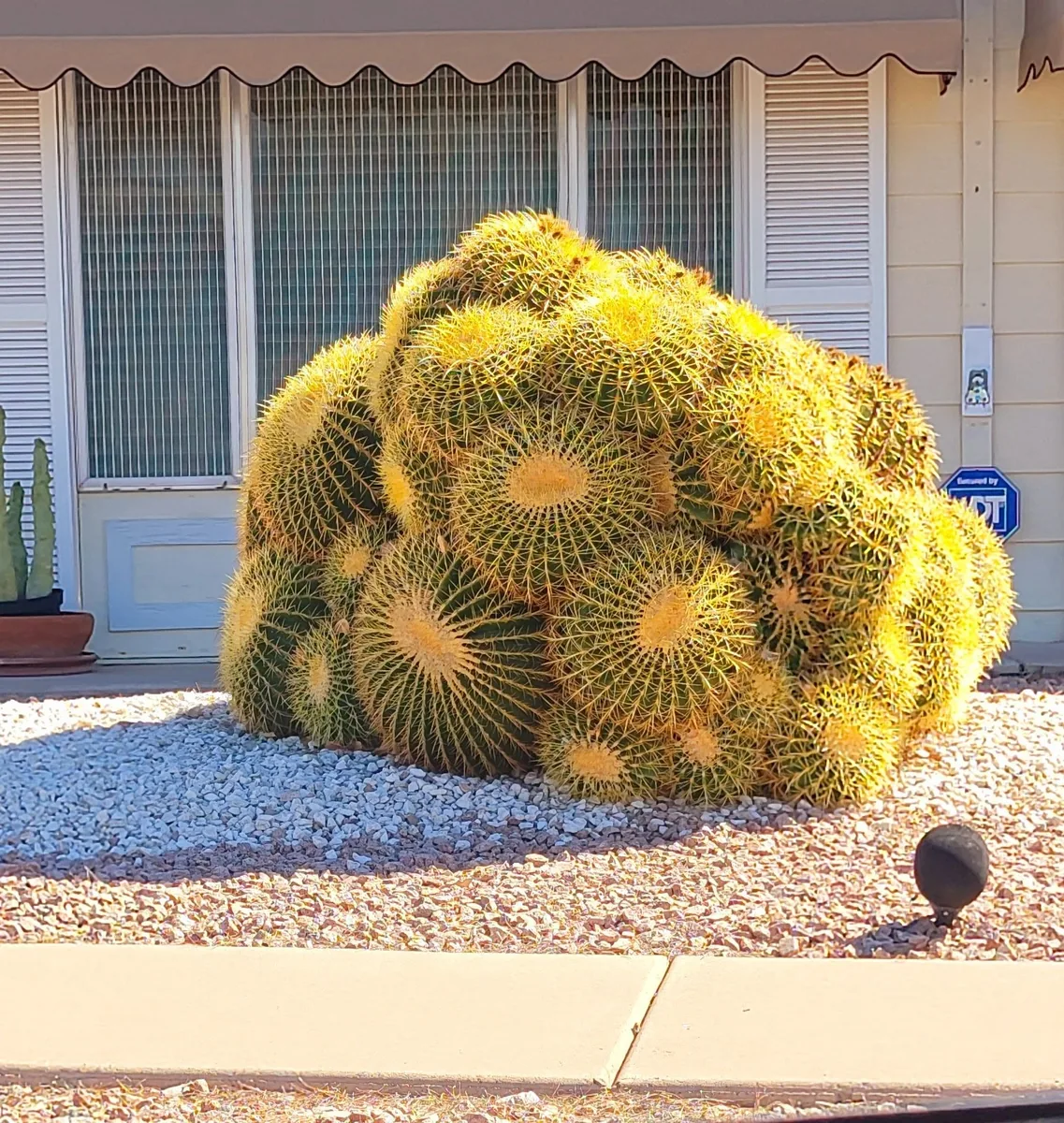
Individual plants are solitary for most of their life, sometimes offsetting at the base with age, and grow globular when young before elongating into the ribbed barrel or cylindrical shape that gives the species its common name. A mature specimen commonly reaches around a metre in height with a diameter in the 40 to 90cm range, a scale that takes many decades of steady growth to reach.
Each areole carries roughly 8 to 10 slender radial spines to about 3cm, plus 3 to 5 stouter central spines to about 5cm, the lowest central often slightly hooked. New spines emerge a vivid golden yellow, the source of both the common name and the species epithet, then fade toward grey, tan or straw white as the plant ages and the spine tissue weathers; a white-spined horticultural form, var. albispinus, is also grown. Mature plants typically carry 21 to 35 pronounced ribs, with counts approaching 40 recorded on very old, large specimens; young plants have far fewer.
Areoles are densely felted with wool that runs yellowish to white on young growth and greys with age, most conspicuous at the crown, where it surrounds the flowering zone. Yellow, funnel-shaped flowers around 4 to 5cm wide open in a ring at the crown from late spring into summer, but only on plants that have already reached a substantial size, generally at least 35 to 40cm across and ten to twenty years old or more; the species essentially never flowers as a young or small specimen, and rarely flowers at all in typical indoor conditions.
Locality detail
The species’ confirmed native range runs from Zacatecas south to San Luis Potosí in east-central Mexico, per Plants of the World Online. Its best-known historical population, now believed lost, sat separately in the Rio Moctezuma valley on the Querétaro-Hidalgo border. The map below shows generalised centroids only; sharp coordinates are withheld here following standard practice for a CITES-listed cactus that is actively targeted by collectors.
Precise range and population figures for the surviving wild subpopulations are not consistently published in accessible sources, partly because the terrain is remote and hard to census. Any wild-origin claim attached to a plant offered for sale should be treated with scepticism; virtually all commercially available specimens are nursery-propagated.
Cultivation
Echinocactus grusonii wants strong light and a mineral mix that drains instantly. It is also a notably fast grower for a barrel cactus, so the substrate needs enough structure to support real bulk over the decades it takes to reach full size.
Substrate
The mix below runs a sharp, mineral-dominant profile with a small buffered fraction: 35 per cent pumice, 20 per cent lava rock, 10 per cent zeolite, 20 per cent granite grit, 5 per cent crushed limestone and 10 per cent low-nutrient organic base, with no silica sand. Pumice and lava carry most of the drainage load, the zeolite buffers pH and holds nutrients between waterings, and the modest limestone fraction is house convention, not a species requirement. Hard tap water already supplies calcium and bicarbonate at every watering; rainwater and RO water supply neither.
As a monotypic genus, the ratio below is simply the profile for K. grusonii itself: a sharp, mineral-dominant mix with a small buffered fraction, built for fast drainage and steady root health in a container.
| Species | Pumice | Lava | Zeolite | Granite | Limestone | Silica | Organic |
|---|---|---|---|---|---|---|---|
| K. grusonii (this page) | 35% | 20% | 10% | 20% | 5% | 0% | 10% |
Watering, light and cold
Give it full sun to very bright light; in deep shade the ribs stretch, the body pales, and the spine colour dulls toward straw. From spring through autumn, water thoroughly once the mix has dried out completely, then let it dry again before the next soak. Cut back sharply for winter and keep the plant close to dry, since overwatering combined with cold is the single biggest cause of rot at the crown and roots. Established plants tolerate brief dips to roughly -5 to -6°C / 20 to 23°F provided the substrate is bone dry through the cold snap; sustained wet cold is far more damaging than dry cold alone.
Growth is slow to moderate, typically adding around 2.5cm of diameter a year, and a plant needs to reach roughly 35 to 40cm across, generally ten to twenty years or more of steady growth, before it flowers at all; specimens grown as houseplants rarely get enough light or age to bloom. Because the root system is broad and comparatively shallow rather than a deep taproot, a wide, sturdy, well-draining container suits the plant better than a tall one.
Comparison
The most useful comparison is not another species in the same genus, since Kroenleinia is monotypic, but the barrel-shaped cacti of the related genus Ferocactus, alongside the true Echinocactus species it was reclassified out of. Mature Ferocactus barrels typically carry stouter, often hooked or strongly banded spines and a more variable body colour, while Kroenleinia grusonii keeps a strikingly uniform, densely packed coat of golden yellow spines across the whole rib structure.
True Echinocactus, such as Echinocactus platyacanthus, develops a dense woolly cephalium of spineless felt at the crown once mature, a structure this species never forms; its crown wool stays thin, and its flowers emerge without a true cephalium, one of the character differences that supported moving it into its own genus.
Retail nurseries almost always still sell the plant under its familiar synonym, Echinocactus grusonii, so gardeners should not read the name change as a sign the plant itself has changed. On the shelf it remains unmistakable: no other common barrel cactus wears such a uniform coat of golden spines over a symmetrical ribbed sphere.
Frequently asked questions
How do you care for a golden barrel cactus?
Give it full sun, a fast-draining mineral mix, and a clear seasonal rhythm: water thoroughly through spring and summer whenever the soil has dried out, then cut back sharply and keep it nearly dry through winter. It tolerates brief cold well below freezing as long as the substrate stays dry, but wet cold rots it quickly.
How fast does a golden barrel cactus grow?
It is a slow to moderate grower, typically adding around 2.5cm of diameter a year under good conditions. That unhurried pace is exactly why large, decades-old barrels are prized in gardens, even though nurseries propagate the species in huge numbers.
How big does a golden barrel cactus get?
A mature specimen typically reaches around a metre in height with a diameter commonly in the 40 to 90cm range, though that scale takes many decades of slow growth to reach. Young plants sold in nurseries are usually a small fraction of that eventual size.
Is the golden barrel cactus rare or endangered?
In the wild, yes. The IUCN Red List classifies it as Endangered, with populations reduced to a few fragmented sites across Zacatecas and San Luis Potosí after decades of poaching and the loss of its best-known historical site to a dam reservoir in the 1990s. In cultivation it is the opposite of rare, since it ranks among the most widely propagated ornamental cacti sold worldwide.
Why is it called the golden barrel cactus?
The name describes its shape and its spines. A mature plant is a rounded, barrel-like cylinder densely ringed with vivid golden yellow spines, most pronounced when the plant is young and actively growing. That spine colour is the plant’s most recognisable feature and the reason it became a favourite ornamental centrepiece in gardens worldwide.
Sources & further reading
Plants of the World Online (Kew), Kroenleinia grusonii (Hildm.) Lodé and Echinocactus grusonii Hildm., powo.science.kew.org · Lodé, J. 2014. New combination in Kroenleinia. Cactus-Aventures International · Hildmann, H. 1886. Echinocactus grusonii. Deutsche Garten-Zeitung · World Flora Online (WFO), taxon record cross-referencing POWO’s accepted name · IUCN Red List of Threatened Species, Echinocactus grusonii assessment (species ID 40962), assessed 2013 by Guadalupe Martínez, J., Sánchez, E. & Gómez-Hinostrosa, C. · CITES Appendix II listing, Cactaceae spp. · NOM-059-SEMARNAT-2010, Mexico’s national list of species at risk · Anderson, Edward F. 2001. The Cactus Family. Timber Press · LLIFLE, Encyclopedia of Living Forms, Echinocactus grusonii entry