
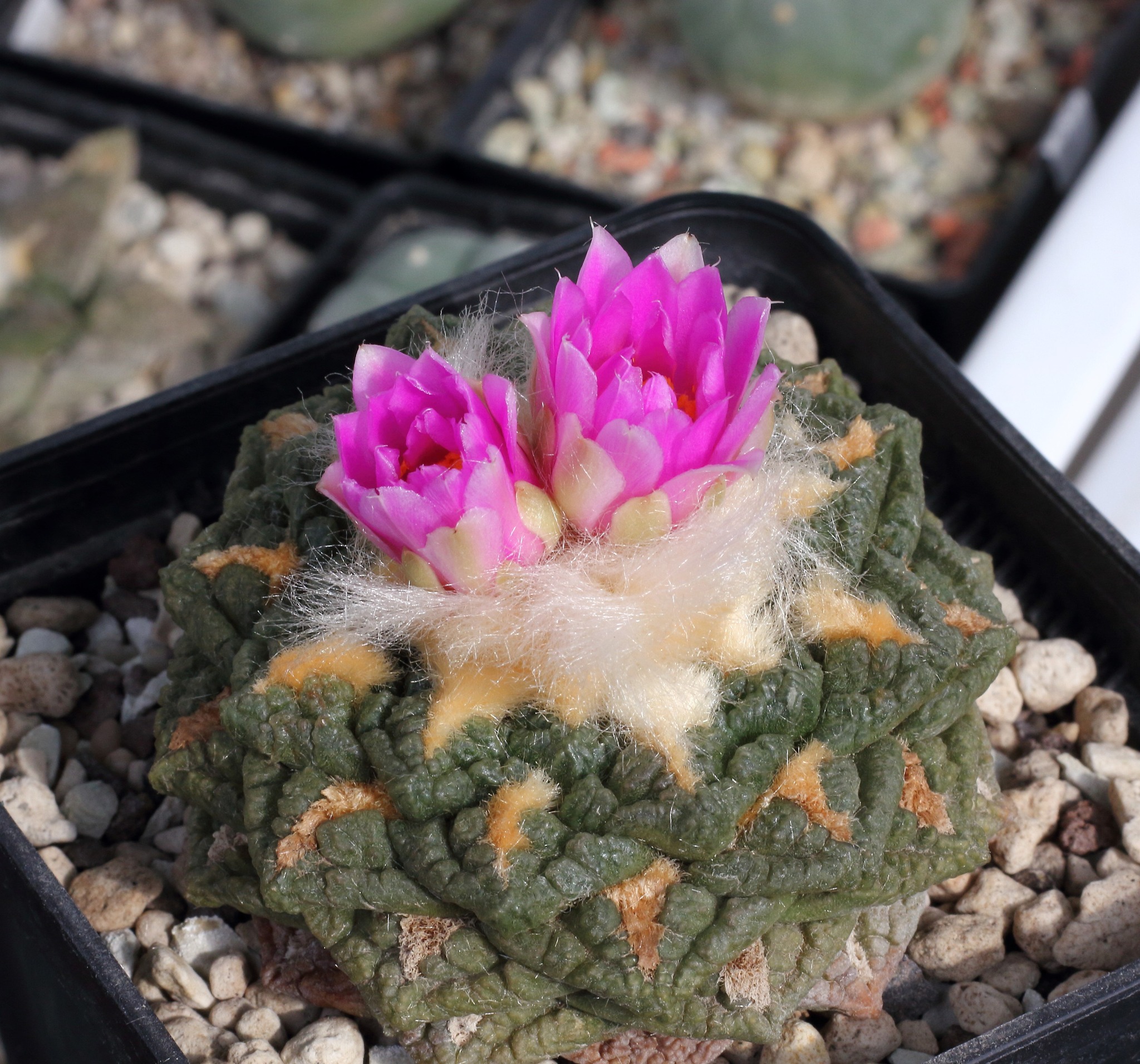
Ariocarpus fissuratus
| Family | Cactaceae |
| Named by | Engelmann (1856) → Kladiwa & Fittkau (1976) |
| Native range | SW Texas, N. Coahuila, N. Chihuahua |
| Altitude | 300–1,500 m |
| Stem diameter | Up to 15 cm habitat; larger cultivated |
| Flowers | Pink to magenta, Sep–Nov |
| First bloom | 10–15 years (seed grown) |
| IUCN status | Vulnerable |
| CITES | Appendix I |
Living Rock Cactus · Star Rock · Chaute
Press your hand flat against limestone rubble in the Chihuahuan Desert and you might lay your palm right on top of one. That is the central trick of Ariocarpus fissuratus subsp. fissuratus: it has evolved to look so much like the fractured rock around it that experienced field botanists still walk past them. The flat, angular body, the grey-brown color, the deeply grooved and ridged tubercle surface. Every detail works toward invisibility. Then October comes, and a flower the color of a ripe plum opens from that stone-grey crown, and the illusion is broken.
This is the northern subspecies, the one that ranges from the Big Bend region of southwest Texas down into Coahuila and Chihuahua. It is the form George Engelmann first described in 1856 and the one most people mean when they say “fissuratus” without qualification. This page covers the full picture: the taxonomy, the wild habitat, what the plant actually looks like and why, how it behaves through the seasons, and everything you need to grow it well in cultivation. If you are trying to understand this species at depth, not just keep one alive, read on.
Contents
Taxonomy & Nomenclature
Ariocarpus fissuratus has carried several names since 1856, and those changes account for most of the confusion in catalogs, seed lists, and field guides. George Engelmann first formally described the species in 1856, working from specimens collected in southwest Texas near the Rio Grande. He placed it in Anhalonium, the genus that housed most flat-bodied, spineless cacti at the time, under the epithet fissuratum, from the Latin for split or fissured, a direct reference to the deeply grooved tubercle surface. The plant moved through several genera over the following decades, passing through Mammillaria and Anhalonium again, before K. Schumann transferred it to Ariocarpus in 1898, where it has remained.
The subspecific status of subsp. fissuratus is a more recent formality. For most of the twentieth century, all plants in the fissuratus complex were treated either as a single species or split into two full species: A. fissuratus from Texas and northern Mexico, and A. lloydii from southern Coahuila. When the evidence for intergradation between the two forms accumulated through the latter half of the century, a subspecific treatment became the preferred solution. Kladiwa and Fittkau formalized this in 1976, giving the northern form its current trinomial designation: Ariocarpus fissuratus subsp. fissuratus.
The synonymy in this species is extensive. Names you may encounter in older literature and collector catalogs include Anhalonium fissuratum Engelmann (1856), Mammillaria fissurata (Engelm.) A.Gray (1859), Ariocarpus fissuratus var. fissuratus sensu Anderson, and Roseocactus fissuratus (Engelm.) A.Berger (1925). The Berger name is particularly persistent in German horticultural literature. Kew’s Plants of the World Online accepts Ariocarpus fissuratus (Engelm.) K.Schum. as the species, with subsp. fissuratus as the autonym for the northern form.
Common names are equally variable. Living Rock Cactus is the most widely used English name and appears consistently in Texas field guides and park materials. Star Rock, Chaute, and Peyote Cimarón appear in Spanish-language Mexican sources, the last name indicating a historical association with Lophophora that derives from the plant’s presence in similar habitat rather than any pharmacological relationship. A. fissuratus contains no psychoactive alkaloids at meaningful concentrations.
Two naturally occurring locale forms have attracted particular attention among collectors. Brewster County, Texas plants, sometimes listed as the “Texas form,” tend toward smaller body size and very tight, compact tubercle arrangement. The Coahuila material from around Cuatro Ciénegas often shows slightly larger tubercles and a more blue-grey color, though this population also grades toward the lloydii form as you move south into the range overlap zone. Neither has formal subspecific or varietal status, but they are recognizable in well-sourced cultivation material. The companion atlas covers the wider fissuratus habitat and forms across its full range.
Historical synonyms (12)
- Mammillaria fissurata Engelm., 1856 basionym
- Anhalonium fissuratum (Engelm.) Engelm., 1859 homotypic synonym
- Roseocactus fissuratus (Engelm.) A.Berger, 1925 homotypic synonym
- Ariocarpus fissuratus var. lloydii (Rose) W.T.Marshall, 1941 homotypic synonym
- Ariocarpus fissuratus subsp. pailanus Halda, 1998 homotypic synonym
- Ariocarpus fissuratus subsp. lloydii (Rose) U.Guzmán, 2003 homotypic synonym
- Anhalonium engelmannii Lem., 1868 heterotypic synonym
- Ariocarpus lloydii Rose, 1911 heterotypic synonym
- Ariocarpus lloydii var. mayor Fric, 1925 heterotypic synonym
- Roseocactus lloydii (Rose) A.Berger, 1925 heterotypic synonym
- Roseocactus intermedius Backeb. & Kilian, 1960 heterotypic synonym
- Ariocarpus intermedius (Backeb. & Kilian) M.Voldan, 1965 heterotypic synonym
Sources: POWO (Kew) · IPNI · GBIF · Wikidata
Habitat & Native Range
Ariocarpus fissuratus subsp. fissuratus is a Chihuahuan Desert endemic. Its range runs from the Big Bend region of Brewster County and Presidio County in southwest Texas, crosses the Rio Grande, and extends south and west through the Mexican states of Coahuila and Chihuahua. This makes it the only Ariocarpus with a natural foothold in the United States, a distinction that has contributed significantly to its visibility in English-language horticultural literature and to the pressure from illegal collection it has faced within Texas.
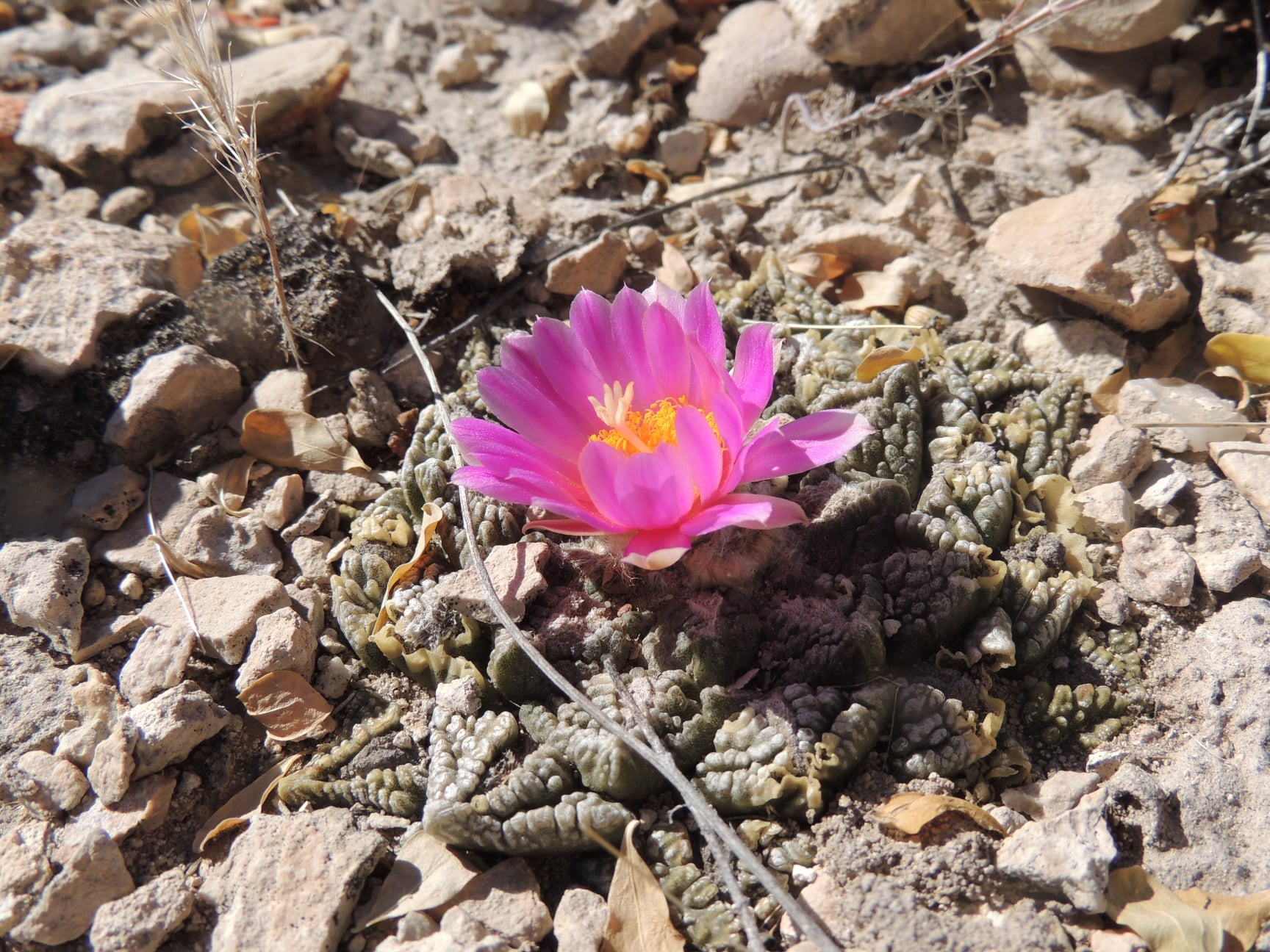
The terrain throughout this range is consistent: flat to gently rolling Chihuahuan Desert, with limestone and gypseous substrates dominating. The plants favor the rubble zones where limestone bedrock has broken down to a mix of flat chips and coarse gravel. Hillslopes with shallow soil over limestone are productive search areas; flat creek banks are not. Soil depth is minimal in most localities, ranging from a few centimeters of loose mineral grit above bedrock to occasionally deeper pockets in crevices where organic debris has accumulated. pH runs consistently alkaline, typically 7.5 to 8.5.
Elevation range is 300 to 1,500 meters across the full subspecific range, with most Texas populations sitting in the lower half of that band. At Big Bend National Park, where the species is protected and where many of the most-referenced Texas populations exist, plants occur at roughly 600 to 900 meters on limestone flats and bajadas.
The climate is classic Chihuahuan Desert: hot summers with a monsoon season running July through September, cold and dry winters. Annual precipitation averages 200 to 380 mm, with the majority arriving as convective summer thunderstorms. Winter precipitation is minimal and occasionally falls as snow at higher elevations, brief and light, not accumulating. The plants handle short-term frost readily in this dry-cold context; temperatures to approximately −12°C are documented in habitat during extreme events, though the plants are typically dry and dormant for these episodes.
The vegetative community surrounding A. fissuratus in most Texas localities consists of lechuguilla (Agave lechuguilla), creosote bush (Larrea tridentata), various Opuntia species, candelilla (Euphorbia antisyphilitica), and scattered ocotillo. In Mexico, the community shifts somewhat with altitude but remains desert shrub throughout. The cactus grows in the open, not under nurse plants. It is fully sun-exposed, which matters considerably when setting up a cultivation environment.
Morphology: What Fissuratus Actually Looks Like
A. fissuratus subsp. fissuratus is not a round, domed cactus. It is flat. A mature specimen in habitat sits nearly level with the surrounding soil surface, its top face essentially parallel with the ground. The only part of the plant clearly visible from above is the rosette of tubercles arranged around a central woolly crown, pressed low and wide. In cultivation, plants often develop a slightly more convex profile as the body swells with consistent water and nutrients, but the fundamentally low-profile character of the species persists.
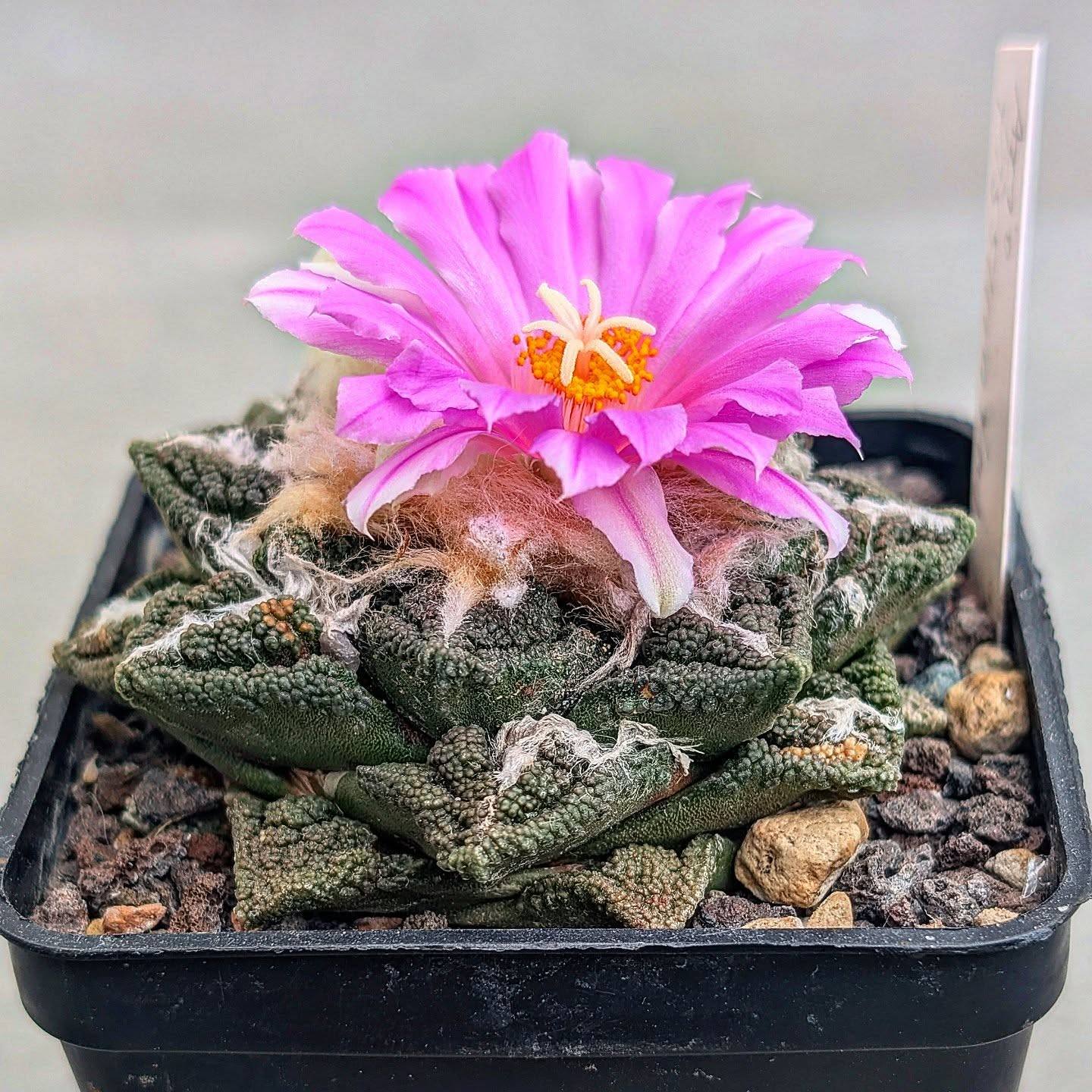
The coarsely ridged, angular tubercle surface that gives the species its name. Each tubercle carries a lateral longitudinal furrow along its upper edge.
The tubercles are the diagnostic center of the species and the character that most obviously separates subsp. fissuratus from subsp. lloydii. They are triangular to rhombic in outline, pointed at the apex, and densely packed in a tight spiral arrangement. The surface is coarsely papillated, covered in transverse ridges and wart-like protuberances that give the plant a rough, fractured look. This papillation is what Engelmann named: fissuratum, fissured. Each tubercle also carries a lateral longitudinal furrow running along its upper margin, a channel visible in side view that is absent in the lloydii form. Tubercle color in healthy habitat plants ranges from grey-brown to brownish-green, with the roughened surface texture scattering light and disrupting the smooth outline that would otherwise betray a plant to a grazing animal or a collector.
The areoles are positioned toward the upper surface of the tubercle, filled with woolly white hairs. This wool is concentrated at the center of the plant in the growing apex and thins progressively on the outer, older tubercles. In a well-grown and properly hardened specimen, the central wool is dense and slightly cream-colored. Areoles produce no spines in adults; spines appear only on the juvenile leaves of seedlings and disappear as the plant transitions to its adult form.
Stem diameter in habitat plants is typically 5 to 15 cm, with most specimens in the 8 to 12 cm range. The stem is largely subterranean. The above-ground portion is a fraction of the full plant body. The taproot is large, napiform (turnip-shaped), and serves as the primary water storage organ. A plant with a 10 cm above-ground diameter may have a root system three times that length extending downward into crevices in the limestone. This architecture is the reason deep pots are not optional in cultivation.
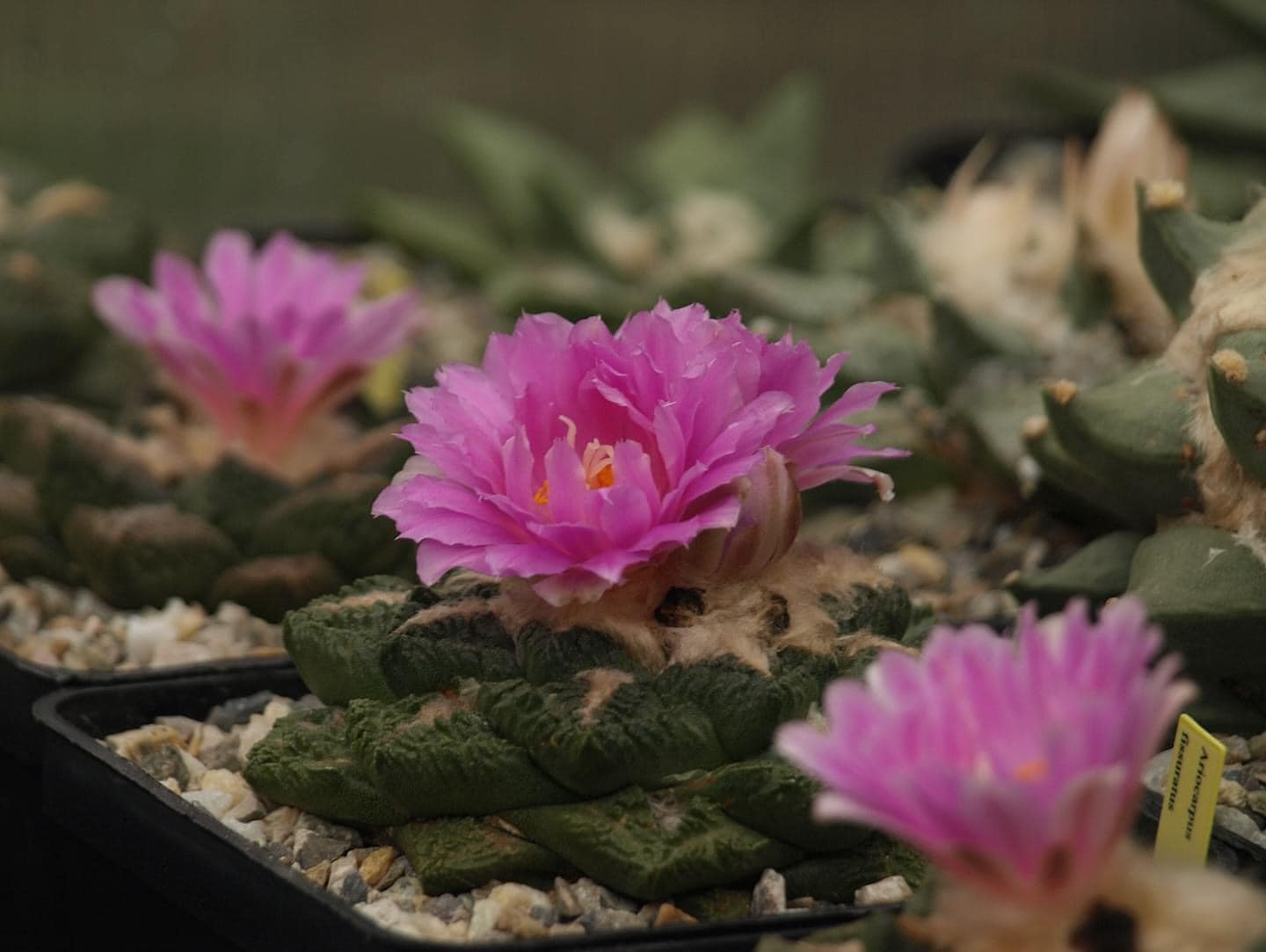
Flowers emerge from the youngest areoles at the very center of the plant, appearing directly from the woolly apex. They open broadly funnel-shaped, 3 to 5 cm in diameter, in shades ranging from pale pink to deep, saturated magenta, occasionally nearly purple in some Texas populations. Each flower lasts three to four days; a single plant may produce five to fifteen flowers across the blooming window, which spans September through November depending on temperatures. The white style and stigma lobes contrast clearly with the colored petals. Fruit is small, pale green to white, and contains small black seeds with a finely roughened seed coat that aids in germination timing in habitat.
Seasonal Behavior and Dormancy
A. fissuratus grows, flowers and rests on a fixed annual timetable. This is a plant built around predictable seasonal cycles, and the biggest cultivation mistakes (rot, stunted growth, poor flowering) almost all trace back to working against those cycles rather than with them.
The growing season begins as temperatures warm in late spring. In habitat, this corresponds roughly with the buildup toward the monsoon: lengthening days, rising soil temperatures, and the anticipation of summer rain. In cultivation, nighttime temperatures consistently above 10°C are a reliable cue that the plant is ready to receive water. The body often becomes slightly plumper and the central wool brightens as growth resumes. New tubercles develop slowly from the apex during this window, and the plant as a whole gains mass through summer, though slowly. Even under optimal growing conditions, the annual gain in stem diameter is measured in millimeters, not centimeters.
The monsoon window, July through September, is the period of peak growth. Rainfall events in habitat are intense but brief, soaking the thin soils before the water drains away rapidly through the fractured limestone. The plant’s root system is adapted to capture this fast-moving moisture, and the taproot can swell noticeably after a good soaking. In cultivation, mimicking this with a thorough drench followed by complete drying of the substrate is more effective than light, frequent watering that never penetrates the root zone.
Flowering occurs as temperatures begin to fall in autumn, typically September through November depending on locale and the year’s weather pattern. Some Texas populations are notably earlier bloomers than Mexican material; Brewster County plants in cultivation often open their first flowers in September. The timing appears to be triggered by a combination of shortening daylength and dropping nighttime temperatures rather than by watering regime.
After flowering, the plant moves toward winter dormancy. The body often flattens further and may appear to sink partially into the substrate. This is normal and expected. In very dry, cold conditions, the above-ground stem can contract significantly, covering itself with loose soil and debris. Watering during this period is the most reliable way to kill a fissuratus: wet, cold roots rot. The plant should receive no water from the time nighttime temperatures drop consistently below 10°C until growth clearly resumes in spring.
From Seedling to Specimen: What to Expect
A. fissuratus takes decades, not years, to grow from seed to a large specimen. This is worth stating plainly before you make purchasing decisions, because the slow growth is one of the things that makes large, old seed grown specimens so valuable and so rewarding to own.
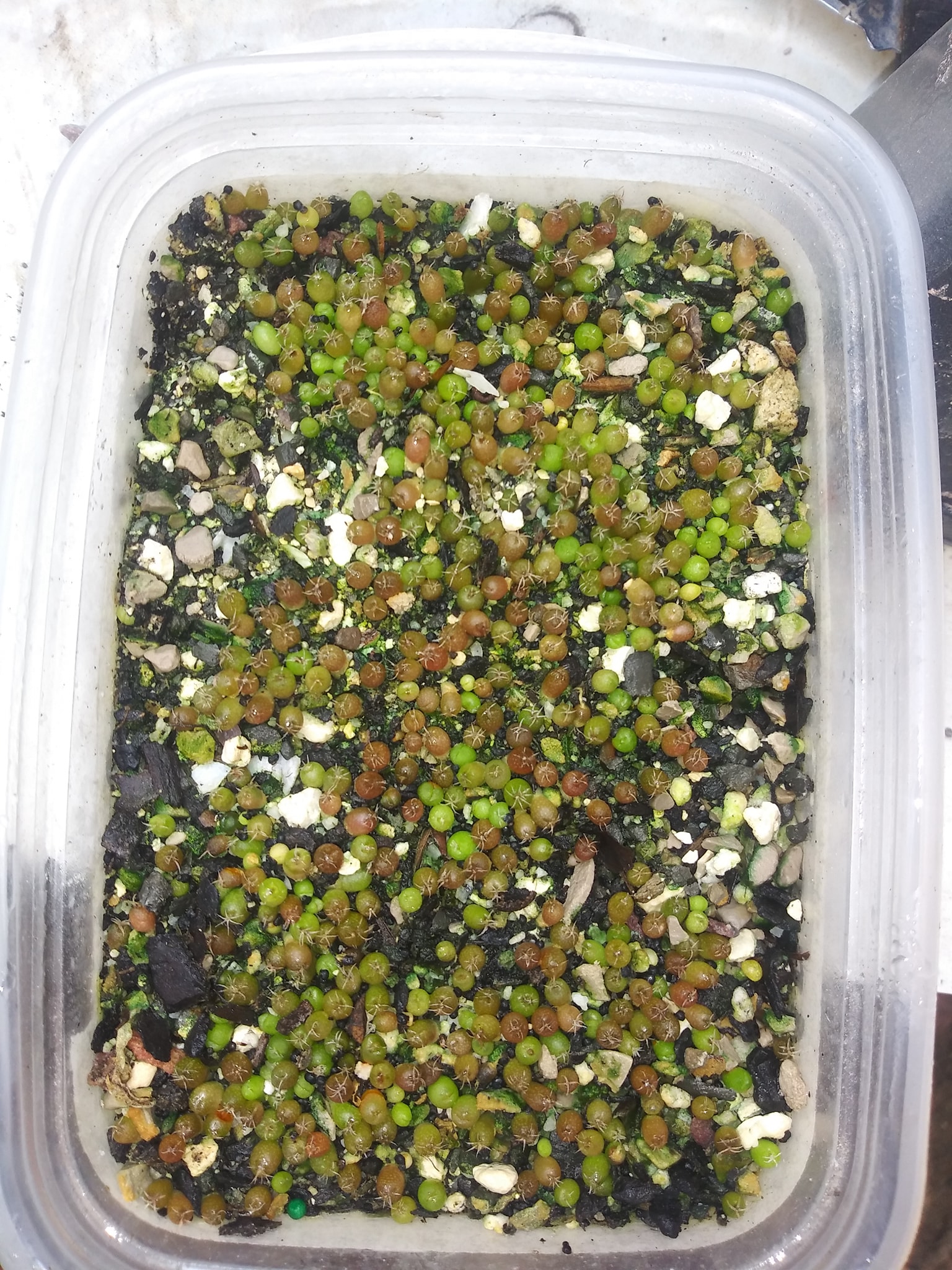
Ariocarpus fissuratus starting out as seedlings
Seedlings in their first two years are almost unrecognizable as Ariocarpus. They produce a small hypocotyl and a set of narrow, elongated, ascending juvenile tubercles with tiny rudimentary spines at the areole tip, the only point in the plant’s life when spines are present. This juvenile form is shared across all taxa in the fissuratus complex; there is no reliable way to distinguish subsp. fissuratus from subsp. lloydii at this stage based on morphology alone.
Between years three and six, the transition to adult form begins. The tubercles broaden and shorten, the characteristic angular outline and papillated surface start to develop at the center, and the woolly apex becomes increasingly prominent. This is the stage at which locale differences in cultivation material begin to show. Texas-sourced plants tend to maintain a flatter, more compact profile than Mexican material even in this intermediate phase.
By year eight to ten from seed under good growing conditions, a plant is unmistakably adult fissuratus. Stem diameter in the 4 to 8 cm range, full adult tubercle character, and the beginning of the grey-brown hardened coloring that comes from sun exposure and drought cycling. Flowering on ungrafted plants rarely begins before ten to fifteen years. This is the number that surprises new growers and explains why a blooming-size specimen carries the price it does.
Grafted plants compress this timeline considerably. A fissuratus grafted onto a vigorous rootstock at the seedling stage can reach blooming size in four to six years, and can grow larger in stem diameter than habitat plants often reach in twice the time. The trade-off is the characteristic low, flat profile. Grafted plants tend to grow taller and rounder, losing some of the near-flush-with-soil presence that makes a mature seed grown specimen such a distinctive object. Many collectors maintain both types: grafted for propagation, flowering, and seed production, ungrafted plants for long-term display and the aesthetic of the true habitat form.
Ariocarpus fissuratus care and cultivation
Soil composition
Ariocarpus fissuratus grows on thin, alkaline, mineral soils over fractured limestone in Texas and Coahuila, with drainage so rapid that the root zone dries within hours of summer rain. A pot has no comparable drainage profile of its own, so the mix below is built for container physics, not to recreate that ground. The canonical cultivation ratio is 43 per cent pumice, 15 per cent lava rock, 5 per cent zeolite, 20 per cent granite grit, 12 per cent limestone chip, and 5 per cent worm castings. The zeolite buffers pH around 7.2 to 8.0 and paces nutrients through the watering cycle; the lava fraction is the structural drainage aggregate. The limestone chip is a genus-wide house convention rather than a fissuratus-specific finding, so growers on hard tap water should reduce or omit it since the water itself already supplies calcium. The mix must drain completely within seconds of watering.
All eleven Ariocarpus pages on this site share one uniform mineral formulation; no cultivation source anywhere in the genus supports a different mineral share for any taxon, gypsum-hill locality included. The limestone chip sits at 12 per cent, a house convention drawn from published grower recipes (one of which runs as high as 20 per cent) rather than a per-species measurement, and growers on hard tap water should reduce or omit it since the water itself already supplies calcium.
| Species | Pumice | Lava | Zeolite | Granite | Limestone | Silica | Organic |
|---|---|---|---|---|---|---|---|
| A. fissuratus (this page) | 43% | 15% | 5% | 20% | 12% | 0% | 5% |
| A. fissuratus subsp. lloydii | 43% | 15% | 5% | 20% | 12% | 0% | 5% |
| A. retusus | 43% | 15% | 5% | 20% | 12% | 0% | 5% |
| A. retusus subsp. furfuraceus | 43% | 15% | 5% | 20% | 12% | 0% | 5% |
| A. retusus f. cristata | 43% | 15% | 5% | 20% | 12% | 0% | 5% |
| A. kotschoubeyanus | 43% | 15% | 5% | 20% | 12% | 0% | 5% |
| A. scaphirostris | 43% | 15% | 5% | 20% | 12% | 0% | 5% |
| A. agavoides | 43% | 15% | 5% | 20% | 12% | 0% | 5% |
| A. bravoanus | 43% | 15% | 5% | 20% | 12% | 0% | 5% |
| A. bravoanus subsp. hintonii | 43% | 15% | 5% | 20% | 12% | 0% | 5% |
| A. trigonus | 43% | 15% | 5% | 20% | 12% | 0% | 5% |
Watering
The single biggest error with A. fissuratus is watering during cold weather. Wet roots at temperatures below 10°C will rot. This is not a matter of overwatering in the sense of watering too frequently during the growing season; it is a matter of the root zone being cold and wet simultaneously. A plant that receives generous water in July will handle it fine; the same plant receiving any water in December may not survive.
During the active growing season, roughly late April through early September in most of the continental United States, water thoroughly and then wait for the substrate to dry completely before watering again. In hot, sunny conditions with a properly inorganic mix, this might mean watering every ten to fourteen days. In cooler or cloudier stretches, extend the interval considerably. The plant should look firm and plump at the start of each watering. If it looks slightly deflated, that is a cue that it is ready; if it still looks full, wait longer.
Autumn watering should taper off as temperatures fall. Stop altogether once nights are reliably below 10°C, and do not resume until growth is visibly active at the apex in spring. This winter dry period typically runs four to five months in most temperate growing climates, a long time to leave a plant completely unwatered, which is why growers new to the genus sometimes can’t resist giving it “just a little” water in February. That is how rot starts.
Light
Full, unobstructed sun is the standard for this species. In its native habitat it sits fully exposed on pale limestone flats, receiving maximum UV radiation at elevations up to 1,500 meters for most of the year. Insufficient light produces the characteristic signs of a stressed fissuratus: tubercles that elongate and lose their tight, angular character, a green body color that lacks the grey-brown hardening of a sun-exposed plant, and a loose, open rosette that looks nothing like the compact disc of a habitat specimen.
The grey-brown coloring that collectors prize in well-grown fissuratus is partly a UV response. The epidermis thickens and develops more pigmentation under intense light, exactly as it does in habitat. A plant that has spent a season in strong sun will show noticeably different, more textured, more saturated coloring than the same plant kept under shade cloth. This is not sun damage. It is the plant looking the way it is supposed to look.
In northern climates or indoor growing situations, supplemental lighting during winter can help maintain the body condition of the plant through dormancy, though fissuratus does not require it and may simply rest regardless of light levels during the cold period.
Temperature and hardiness
The cold hardiness of A. fissuratus is often overstated in general cactus literature. It handles brief frost comfortably when completely dry. Documented lows reach approximately −12°C for short episodes. This cold tolerance drops significantly if the plant is at all moist. A dry plant at −8°C is far safer than a slightly damp plant at −2°C. In USDA zones 9b and warmer, an established plant in well-drained soil can be left outdoors year-round with only protection during the coldest nights. In zones 8 and colder, bring it under cover during winter or at minimum ensure the substrate is bone-dry before cold arrives.
Summer heat tolerance is considerable. Temperatures well above 40°C in the root zone are not a problem if the plant is dry or recovering from a recent watering. In extremely hot, sunny greenhouse conditions, brief shading during the absolute peak of summer heat can prevent bleaching, though most well-established specimens handle full-sun greenhouse temperatures without difficulty.
Fertilizing
Fertilizing is not necessary for A. fissuratus but can improve growth rates when applied correctly. Use a low-nitrogen, high-phosphorus fertilizer. Choose something formulated for cacti or succulents, with an NPK ratio weighted toward the middle and last numbers. Apply diluted to half the recommended strength once or twice during the peak growing season (June through August). Never fertilize during dormancy. Over-fertilizing produces the same visual result as over-watering: bloated, soft-bodied plants with loose tubercle arrangement that does not resemble the natural form.
Repotting
Repot infrequently. A. fissuratus grows slowly enough that it will not need a larger pot on any kind of annual schedule. Once every three to five years is a reasonable interval for established plants, and longer is often fine. The signals that a plant needs repotting are a root system visibly emerging from the drainage hole, a pot that is bulging or cracking from root pressure, or soil that has become so compacted that water no longer passes through it quickly.
Always repot in late spring or early summer, when the plant is actively growing and can recover from root disturbance readily. Autumn and winter repotting exposes damaged root tissue to cold, wet conditions, which is a reliable path to rot. After repotting, wait two to three weeks before watering to allow any broken roots to callous.
Conservation & Sourcing
Ariocarpus fissuratus is listed as Vulnerable on the IUCN Red List and as Appendix I under CITES, meaning all international commercial trade requires documentation and permits. Within Texas, the species is protected under state law, and collection from the wild, including from private land without specific landowner authorization, is illegal. In Mexico, it falls under federal NOM-059 protection as a threatened species.
The practical result of this for collectors is that sourcing matters. Wild-collected plants still appear on the market periodically, often hard-grown, flattened, and showing the grey-brown scarring of habitat exposure. These plants are visually recognizable to experienced eyes and their presence on the market is consistently to the detriment of wild populations that are already under pressure from habitat loss, drought intensification, and decades of commercial collection that predated modern protection frameworks.
Legally and ethically sourced material is seed-grown, and there is plenty of it available from specialist growers in the US, Europe, and Japan. Seed-grown plants typically show greener, more vigorous body coloring when young, with the grey-brown hardening developing over time with sun exposure. Reputable sellers will document provenance; if a seller cannot or will not tell you where a plant came from, that is meaningful information. Brewster County, Texas seed-origin material is particularly well-documented and is a strong starting point for anyone building a legitimate fissuratus collection.
Frequently asked questions
How difficult is Ariocarpus fissuratus to grow?
How long does it take to grow Ariocarpus fissuratus from seed?
Is Ariocarpus fissuratus legal to own?
Where does Ariocarpus fissuratus grow in the wild?
When does Ariocarpus fissuratus flower?
Related Taxa in the Genus
Fissuratus sits at the center of a tangled, morphologically variable complex in Ariocarpus. Understanding where it fits relative to the other species sharpens your eye for both the genus and the subspecific variation within this species. Pages for all taxa are being built throughout 2026.
Ariocarpus fissuratus subsp. lloydiiThe southern counterpart, with broader, smoother, more convex tubercles and a hemispherical stem profile that rises clearly above the soil. Rose’s 1911 species, now treated as a subspecies after extensive fieldwork showed intergradation across central Coahuila.Ariocarpus retususThe largest species in the genus, ranging widely across central Mexico. Faster-growing than fissuratus, with triangular pointed tubercles and white to pale pink flowers. The most accessible entry point to the genus for new collectors.Ariocarpus kotschoubeyanusThe smallest species in the genus, tiny, deeply embedded in soil, with a flat body and intensely colored magenta flowers that seem almost too large for the plant. A deeply rewarding species for patient collectors.Ariocarpus trigonusThe northeast Mexico counterpart to retusus, with a more pronounced triangular-lobed body and a wider, more sprawling growth habit. Longer, more prominently keeled tubercles and yellow-white flowers distinguish it immediately.Sources & References
Anderson, E.F. & Fitz Maurice, W.A. (1997). Ariocarpus: The Most Dangerous Cactus? Cactus and Succulent Journal 69(2). · Engelmann, G. (1856). In Wislizenus, Memoir of a Tour to Northern Mexico. · Kladiwa, L. & Fittkau, F. (1976). Kakteen und andere Sukkulenten 27(7). · Lüthy, J.M. (2000). Ariocarpus fissuratus. Cactus & Co. 4(1). · IUCN Red List of Threatened Species. Ariocarpus fissuratus. Assessed 2017. · Royal Botanic Gardens, Kew. Plants of the World Online. Ariocarpus fissuratus (Engelm.) K.Schum. Retrieved 2026.