
Grafted vs Seed Grown Cactus: Why Collectors Won’t Budge
All ArticlesGrafted vs seed grown cactus is the central question of rare-cactus collecting. Across Japanese specialist nurseries, Belgian collector shows, and German seed catalogues since the 1960s, collectors agree: raising from seed is the standard for mature Ariocarpus and Aztekium ritteri, grafted is a tool for tricky propagations, and the price gap is real.
What grafted and seed grown actually mean
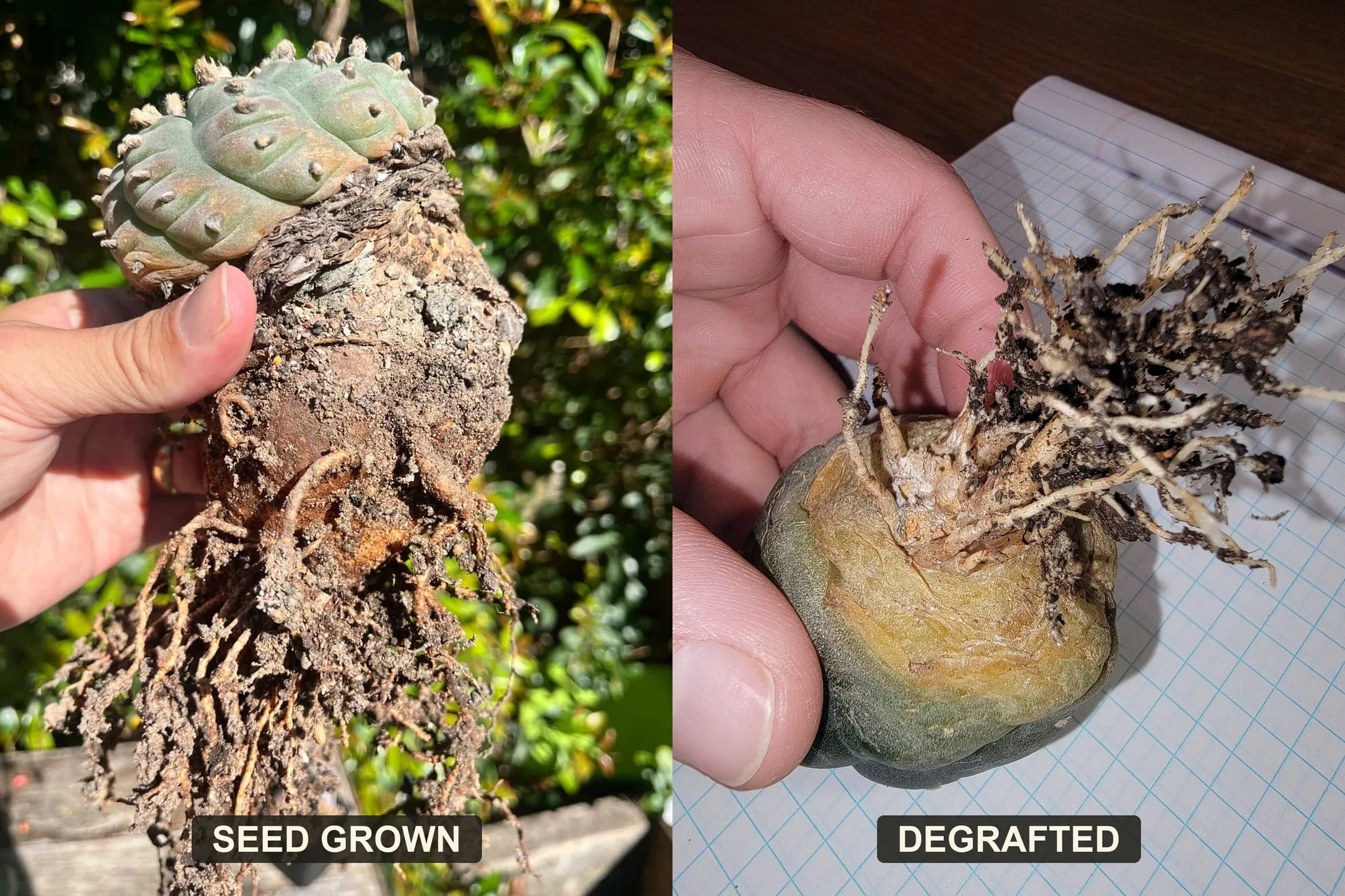
Three cultivation types matter for valuation. Seed grown is a plant raised from seed and never grafted, growing unaided from germination onward. Grafted is a scion fused to a separate rootstock that supplies water and sugars, dramatically accelerating growth. Degrafted is a plant that was grafted, then cut from its rootstock and rooted on its own. The market in Indonesia calls degrafted plants “ex-graft” to keep the distinction clean. European and Japanese collectors price the three tiers the same way: seed grown above degrafted, degrafted above grafted.
Common rootstocks are Pereskiopsis for fast seedling pushes, Hylocereus undatus (the dragonfruit) for retail Moon Cacti, and Trichocereus or Echinopsis species for permanent grafts. The rootstock determines almost every trade-off that follows: how fast the scion grows, how the body shape develops, how long the union lasts, and what the plant looks like five years from now.
When is grafting actually the right call?
Three cases earn it. The first is the obligate graft. Chlorophyll-free Gymnocalycium mihanovichii cultivars (the red, yellow, and orange Moon Cactus tops sold in every garden centre) cannot photosynthesize at all. The cultivar lineage began in 1940 when the Japanese nurseryman Eiji Watanabe grew out 10,000 G. mihanovichii seedlings and isolated two albino mutants; the first red ‘Hibotan’ was named in 1948. Every Moon Cactus alive today descends from that lineage, and every one of them is on a rootstock by structural necessity. Removing the graft kills the plant in days.
The second case is the rescue graft. Copiapoa cinerea is endemic to a narrow strip of fog-fed Chilean coast and joins its swollen tap root to the body through a structurally narrow neck. In cultivation outside that climate, rot ascends from the taproot through the neck and the body fails. When a serious specimen is collapsing, the only path is excise the healthy crown above the rot line, dry it, and graft it onto Trichocereus pachanoi or Selenicereus. The same logic saves Mammillaria pectinifera (now Pelecyphora pectinifera) and other notoriously rot-prone miniatures. The plant survives. The genetic material survives. The alternative is loss.
The third case is cultivar propagation. The Japanese Astrophytum tradition (Super Kabuto, V-type, Onzuka, Kikko, Akabana) was built on graft-accelerated selection. Super Kabuto traces to a single field-collected mutant found in 1981 by Masaomi Takeo. From one plant to a stable named cultivar took decades of repeated crosses. Variegated and cristate forms grow so slowly ungrafted that most never reach flowering size before crown rot claims them. Grafted onto vigorous rootstock, the same selection flowers in two years instead of five-plus and the breeding work becomes possible. Cristate and monstrose lines depend on graft-accelerated growth to stay viable against the constant pressure of biological reversion. None of this is controversial. The cultivar genus exists because of grafting.
Why grafted plants lose their character
Outside those three cases, grafting buys speed at the cost of shape. The trade is direct. A scion fed by a fast vascular system enlarges faster than its rib geometry and spine deposition cycle can keep up with. The plant gets bigger; it does not get the body the species actually has.
LLIFLE, the standard online reference, says it openly on its Aztekium ritteri page: “Grafted plants produce rather atypical plants which tend to be more obese and to offset much more readily than plants growing on their own roots.” That is the trade encyclopedia conceding on the record that grafted specimens are not what the species looks like. Aztekium grows roughly one millimetre per year ungrafted. Reaching flowering size takes seven to ten years of patience. A graft is in flower in two. What you save in time, you lose in proportion.
Copiapoa cinerea takes more than twenty years to reach four inches diameter ungrafted. A graft hits the same size in seven to ten. The lost years are exactly the period during which the species deposits the chalk-white farina, the black spines, and the ceramic patina that collectors prize. Cultivated C. cinerea in fog-mimic conditions takes on the habitat character slowly. Pushed onto fast rootstock, the plant outgrows the wax-deposition cycle, the cuticle stays thin, and the body comes out brown or green where the species should be ghost white.
The same logic applies across the difficult genera. Pelecyphora aselliformis and Pelecyphora pectinifera are named for pectinate, woodlouse-like spines that develop only under slow stress-grown conditions. Ariocarpus grown from seed stays flat to the substrate in the habitat habit; grafted, it grows tall and chimneyed. Astrophytum tubercle geometry is only confirmable on specimens raised from seed; grafted Super Kabuto V-types come out plumper and more succulent than the species reference. In every case the slow-deposition trait is the species signature, and grafting blurs it.
The graft penalty in the collector market
Collectors price the morphology trade-off. The serious end of the European market (BCSS auction circuit, Köhres, Kakteen-Haage, Uhlig) and the Japanese specialist trade both apply a visible-graft discount of roughly forty to sixty percent against the comparable plant grown from seed. Hidden grafts (where the union sits at or below the substrate line and the plant reads as ungrafted at a glance) carry less of a penalty but still trade below plants grown from seed. The collector canon for Lophophora and Ariocarpus is unambiguous: seed grown or nothing.
The secondary market for wild-character specimens is where this gets expensive. Operation Atacama, the 2020 Italian Carabinieri seizure of trafficked Chilean cacti (later assessed and repatriated with the IUCN Cactus and Succulent Plants Specialist Group), recovered 1,035 wild-collected Copiapoa and Eriosyce from a single Italian collection with an estimated market value of one million euros, working out to roughly five hundred to fifteen hundred euros per plant. None of those plants were grafted. The buyers were not in the market for grafted nursery stock. Grafted and seed grown stock serve different buyers, and the wild-character premium does not transfer down the tier.
Degrafting is not the escape valve people think it is. A degrafted scion will slow back to species-typical growth rate within a season. The body shape, however, is baked in. Years on a fast rootstock leave a permanent signature in proportions, ribbing, and tubercle development that does not unwind. Degrafted Astrophytum asterias stays more inflated than a plant of the same age raised from seed. Degrafted Ariocarpus develops fine adventitious roots, never the deep tap root of a habitat specimen. The market sees this and prices ex-graft below plants grown from seed. A plant cannot earn back into the top tier by losing its rootstock.
Rootstocks fail too, and they fail predictably
The argument that grafting saves a plant assumes the graft itself is stable. Most are not. Pereskiopsis, the rootstock used for almost every retail seedling, loses vigour in one to two years and drops its leaves through the second winter. The Cactiguide grafting guide is explicit: Pereskiopsis is a temporary tool, not a finished rootstock. Most growers either degraft within eighteen months or re-graft onto a permanent stock. A retail Pereskiopsis-grafted seedling sold to a hobbyist with no plan for either is a plant on a two-year clock.
Moon Cacti on Hylocereus undatus die faster. Most retail specimens fail in one to three years. The mechanism is mechanical: Hylocereus grows roughly thirty centimetres per year while the chlorophyll-free scion grows under a centimetre. The growth-rate differential pulls the union apart. Cool dry overwintering finishes the rootstock off. The 1948 Hibotan lineage is alive at the cultivar level, but every individual Moon Cactus you see in a supermarket has a short calendar.
Permanent rootstocks last longer. Grafts on Trichocereus pachanoi and Trichocereus spachianus can run ten to twenty years and occasionally several decades. Myrtillocactus geometrizans is the durable warm-climate alternative. Both have failure modes. Trichocereus tends to sucker, throwing pups that compete with the scion for water and light. Myrtillocactus dies back at minus four degrees Celsius and below, which rules it out for unheated European glasshouses. Even the long-term solution is a maintenance commitment, not a finished plant.
Does grafting actually save wild plants?
The strongest pro-grafting argument is conservation. If grafted nursery stock satisfies collector demand, wild plants get left alone. The Mexican CONANP nursery program at the Barranca de Metztitlán Biosphere Reserve documented an eighty percent reduction in illegal extraction after a local nursery began supplying nearby markets. That is real, and it is the cleanest concession the pro-graft side has.
The data does not generalise. The IUCN’s 2015 global cactus assessment (Goettsch et al., Nature Plants) found that thirty-one percent of cactus species are threatened, and that eighty-six percent of threatened cacti used in horticulture come from wild populations. The proportion of Copiapoa taxa in a threatened category rose from fifty-five percent in 2013 to eighty-two percent in 2024, the same eleven years during which grafted nursery stock was widely available worldwide. The supply did not protect the wild populations. It tracked alongside their decline.
Operation Atacama’s 1,035-plant seizure came from a market that explicitly preferred wild-collected character over commercial propagation. In 2024 the US Fish and Wildlife Service prosecuted four Ariocarpus fissuratus traffickers for stripping plants from Big Bend, despite Ariocarpus being one of the most widely seed-propagated CITES Appendix I genera on the international market. The buyers at the top of the prestige market are not substitutes for the buyers of nursery grafts. Local-scale managed reserves with attached propagation programs can reduce poaching where the buyer is local. International collector demand for wild character is structurally different, and grafting has not solved it.
How do you spot a grafted plant before you buy?
A grafted plant gives itself away with five tells. Check the substrate line first. A clean ring or scar at the soil surface where the scion meets a different-coloured stem tissue is a hidden graft. Reputable sellers disclose; the rest bury the union and hope. Body proportions come next. A plant that reads larger than its stated age (a four-inch Copiapoa cinerea claimed at five years, or a two-inch Aztekium ritteri at three) was not raised from seed. Spine character is the third tell. Sparse, long, underdeveloped spines on a species named for fine-pectinate spination (Mammillaria pectinifera, Pelecyphora aselliformis) indicate accelerated growth past the deposition window.
Farina is the fourth on Chilean genera. Wild-typical Atacama Copiapoa carry a thick chalk-white wax that develops over years; a green or brown specimen of any size is grafted, fast-grown, or both. The fifth tell is the root system, when you can see it. Seedling Ariocarpus, Lophophora, and Copiapoa develop a deep central tap root with a narrow neck. Degrafted plants and grafted plants on adventitious roots show fine fibrous root systems with no taproot. The seller who shows the root mass is the seller worth buying from.
Where this leaves the collector
Seed grown is the standard because it produces the plant the species actually is. Grafting earns its place in three cases (chlorophyll-free obligate cultivars, rescue work on collapsing specimens, and breeding acceleration for variegated and cristate selections) and nowhere else. Outside those three, grafted plants are a faster, cheaper, less interesting version of what a slow plant looks like, and the secondary market prices them accordingly. If you want the full method behind that standard, how we grow every specimen from seed documents the four-to-ten-year germination process from sowing to a saleable plant. Buy seed grown when you can. Buy degrafted when you must. Buy grafted only when you understand exactly what you are paying for and exactly when it will fail.
If you want to see what these species look like in habitat where the slow-grown phenotype actually develops, the twelve best places to see rare cacti in the world walks through the wild reserves and managed collections that hold them. For provenance lookup on a specific plant, the rare cactus field number database indexes more than eleven thousand collector records across eight genera. If you would rather own one than read about it, every specimen in our shop is grown from seed in our greenhouse at rarecactus.com, never grafted and never collected from the wild.
Frequently Asked Questions
Is a grafted cactus worth less than a seedling?
Yes, in almost every case. Serious collector markets in Europe and Japan apply a visible-graft discount of roughly forty to sixty percent against a seedling of the same species and size. Hidden grafts (where the union sits at or below the substrate) carry less penalty but still trade below plants grown from seed. Three exceptions hold: chlorophyll-free cultivars like Hibotan have no seedling comparable, named Japanese Astrophytum selections sell on cultivar identity rather than cultivation type, and a documented rescue graft on a notable specimen retains provenance value.
Why do serious cactus collectors prefer seed grown plants?
Slow growth produces the morphological signature collectors prize. Copiapoa farina, pectinate spines on Pelecyphora, the flat habitat habit of Ariocarpus, and Astrophytum tubercle geometry are all slow-deposition traits that develop only when growth rate matches the species’ native pace. Grafting outpaces the deposition cycle, so the body inflates past the rib and spine architecture and the plant loses species character. A specimen raised from seed in habitat-mimic conditions is the closest a collector can legally get to a wild-type plant.
Should I buy a grafted cactus or a seedling?
Buy a seedling when the species can be raised that way and a reputable seller is offering one. Buy grafted only for chlorophyll-free cultivars (every red, yellow, or orange Moon Cactus), for rescue specimens you intend to degraft yourself, or for retail-priced variegated and cristate forms where the alternative is no plant at all. Avoid grafted purchases of species that grow well ungrafted (most Mammillaria, most Echinocereus, most Ferocactus); the price gap is real and the plant is the wrong shape.
Can you degraft a cactus and recover the original shape?
No. Degrafting recovers the species-typical growth rate within a season but the body proportions are baked in. A scion that spent five years on fast rootstock keeps the inflated ribbing and exaggerated tubercle expansion for life. Degrafted Ariocarpus and Copiapoa develop fine fibrous root systems rather than the deep tap root habitat plants have. The Indonesian market calls degrafted plants “ex-graft” and prices them between grafted and seedling, which is the right read.
When is grafting actually justified for rare cacti?
Three cases. Chlorophyll-free obligate cultivars (Hibotan and the rest of the Watanabe 1940 lineage) cannot photosynthesize and would die in days ungrafted. Rescue grafts save collapsing specimens of rot-prone species like Copiapoa cinerea and Pelecyphora pectinifera when the alternative is total loss of the plant. Cultivar propagation programs use grafting to push variegated and cristate selections through the slow juvenile phase to flowering size, where breeding work becomes possible. Outside those three, grafting is a commercial shortcut, not a botanical necessity.
Goettsch et al., “High proportion of cactus species threatened with extinction,” Nature Plants (2015) · IUCN Red List, Cactaceae assessments · IUCN Cactus and Succulent Plants Specialist Group, Operation Atacama (2020–2021) · Margulis et al., Conservation Biology (2024), Atacama trade and poaching · IUCN / CPSG Copiapoa Action Plan, Chile (2025) · British Cactus and Succulent Society, Cultivation Notes on Aztekium · Cactus and Succulent Society of America, market and conservation reporting · US Fish and Wildlife Service, “Catching Cactus Crooks” (2024) and Big Bend Ariocarpus prosecutions · CITES Appendices I and II (current) · Mexican NOM-059-SEMARNAT-2010 · Anderson, E.F., The Cactus Family (Timber Press) · Hunt, D., The New Cactus Lexicon (DH Books) · Lapshin, “A short history of Hibotan in Japan,” Cultivar · LLIFLE, online cactus encyclopedia · Cactus-Art.biz reference entries on Mammillaria pectinifera, Pelecyphora aselliformis, and degrafting · Cactiguide grafting article and forum threads · Köhres-Kakteen, Kakteen-Haage, and Uhlig Kakteen specialist seed and plant catalogues · University of Arizona repository, double-cut grafting on Trichocereus pachanoi · SciELO Mexico, distribution and conservation of Mammillaria pectinifera · SpringerPlus, micrografting of Pelecyphora aselliformis