
Copiapoa humilis subsp. tenuissima
| Family | Cactaceae |
| Named by | F.Ritter ex D.R.Hunt (2003) |
| Epithet | tenuissima: very slender (spines) |
| Native range | South of Antofagasta, Chile |
| Altitude | 300–800 m, coastal escarpment |
| Stem (above soil) | 2–4 cm across; geophytic |
| Taproot | Up to 25 cm; primary storage organ |
| Ribs | 8–12; tuberculate |
| Flowers | Yellow, fragrant, diurnal; spring–autumn |
| Population | <800 known individuals |
| AOO | <10 km² |
| IUCN status | Critically Endangered |
| CITES | Appendix II |
The Geophytic Miniature · Chinna Chico
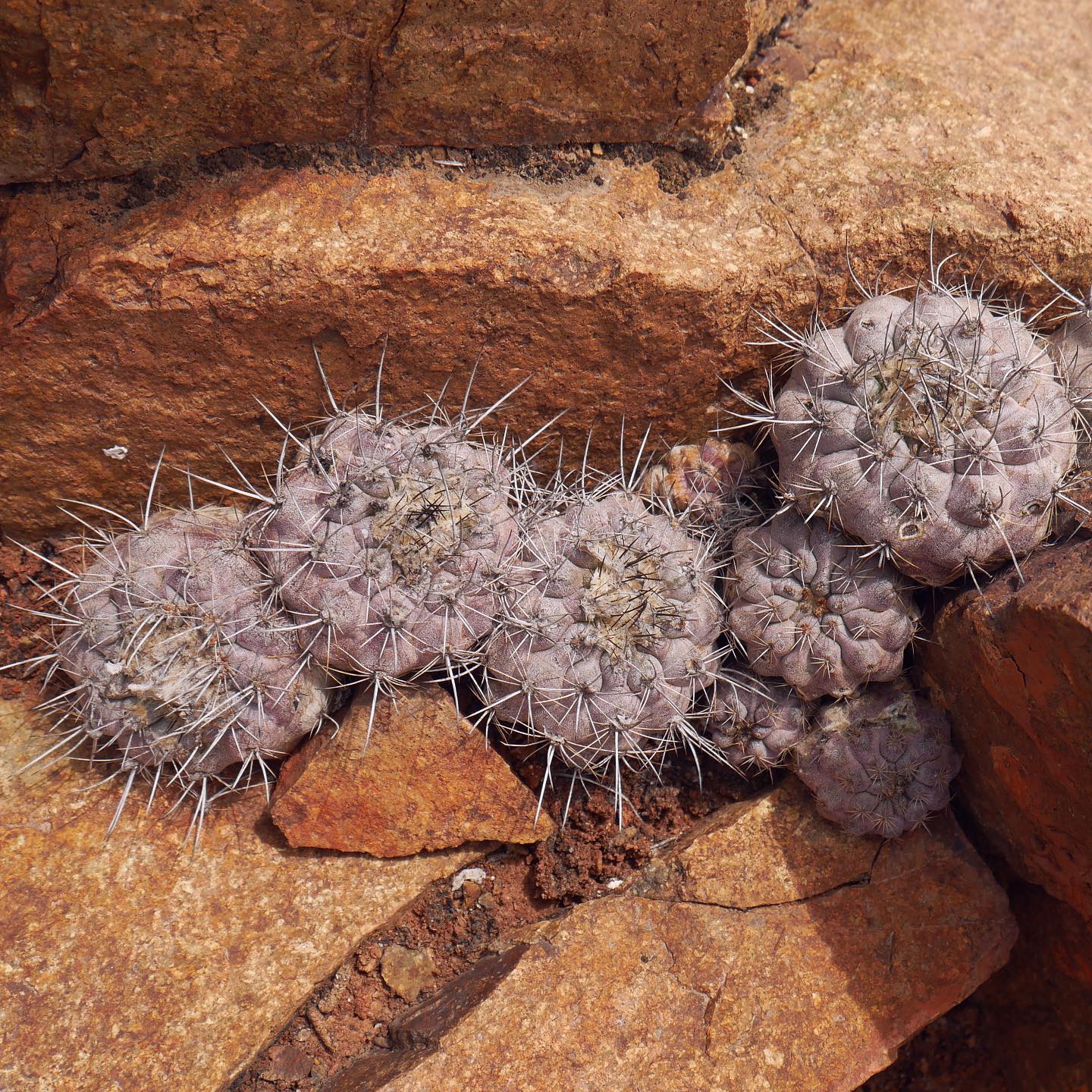
Most of the plant is hidden. Copiapoa humilis subsp. tenuissima takes the underground growth habit that appears across several Atacama Copiapoa to its most fully developed expression: a stem measuring only 2 to 4 cm across at the soil surface, fine-spined and dark, sitting flush against the coastal gravel like a small stone rather than a plant. Below that modest hemisphere lies the actual structure, a taproot that extends 20 cm or more through fractured coastal rock, swollen with stored water, invisible from above. The above-ground portion is almost incidental to the plant’s survival strategy.
The subspecies occupies a strikingly restricted range within the humilis complex: a narrow coastal escarpment south of Antofagasta, with fewer than 800 individuals known and an area of occupancy estimated at under 10 km². No protected area covers the site. For collectors with serious interest in the genus, seed grown specimens of this subspecies represent something worth growing: a plant of significant conservation weight in a form small enough to fit on a window ledge, grown slowly from seed into a specimen that does what the wild plant has been doing for decades.
Contents
Taxonomy & Nomenclature
Friedrich Ritter documented this plant during his intensive Atacama fieldwork across the 1950s and 60s, a period of extraordinary productivity that also generated considerable taxonomic complexity. Ritter’s unpublished manuscript name Copiapoa tenuissima circulated in his correspondence and field notes, referring to the fine, sparse spination that separates this form from other members of the humilis group. The name appeared in print in Kakteen in Südamerika (1980), though as a manuscript name rather than a formally validated description. The epithet is a Latin superlative: tenuissima means “very slender” or “very thin,” and refers specifically to the fine radial spines that are the most immediately obvious diagnostic feature in the field.
The formal combination Copiapoa humilis subsp. tenuissima (F.Ritter ex D.R.Hunt) D.R.Hunt was published by David Hunt in Cactaceae Systematics Initiatives 16: 6, dated 11 October 2003. Hunt’s treatment placed the plant within Copiapoa humilis on the basis of shared morphological characters: clustering growth habit, tuberculate ribs, and yellow flowers from a woolly crown. Kew’s Plants of the World Online follows this circumscription and treats Copiapoa humilis subsp. tenuissima as the accepted name.
The taxonomy is more complicated than the Kew consensus suggests. The geophytic habit links the plant morphologically to Copiapoa hypogaea, and Hunt himself published the alternative combination Copiapoa hypogaea subsp. tenuissima F.Ritter ex D.R.Hunt in the same Cactaceae Systematics Initiatives volume. G.J. Charles, in Copiapoa (The Cactus File Handbook 4, 1998), had already treated it as Copiapoa humilis var. tenuissima. A further combination exists at species rank: Copiapoa tenuissima (D.R.Hunt) D.R.Hunt, which some seed list compilers prefer. Collectors navigating provenance records should expect to encounter material under all three principal names. For practical purposes, the Kew treatment is the working standard: Copiapoa humilis subsp. tenuissima.
Ritter also described a range of additional forms from the northern Chilean coast that have since been absorbed into the humilis complex as synonyms. None bear directly on the tenuissima taxon, but the overall pattern of Ritter’s naming practice across the genus means that collectors will encounter an unusually large number of names in trade and seed lists that ultimately resolve to a small number of accepted subspecies.
Historical synonyms (2)
- Copiapoa hypogaea subsp. tenuissima F.Ritter, heterotypic synonym
- Copiapoa tenuissima F.Ritter, 1963 nom. inval.
Sources: GBIF
Habitat & Native Range
Copiapoa humilis subsp. tenuissima occurs on a coastal section of the Antofagasta escarpment immediately south of the city of Antofagasta, in the Antofagasta Region of northern Chile. The population is highly localized, with an area of occupancy estimated at under 10 km², making it the most range-restricted subspecies within the humilis complex. The broader type subspecies spans roughly 400 km of coastline; this plant occupies a fraction of that.
The habitat is structurally similar to that of the broader humilis range: coastal fog desert on fractured, mineral-poor rock at elevations between approximately 300 and 800 meters on the steep escarpment that rises abruptly from the Pacific. The defining water source is the camanchaca, the persistent Atacama marine fog generated where cold Humboldt Current upwelling meets the warm coastal landmass. Measured rainfall at this latitude is effectively zero in most years. Plants grow in crevices between fractured coastal rock, with the stem sitting at or slightly below the gravel surface and the taproot extending vertically into any available gap in the underlying rock.
The specific micro-topography of the site tends toward more broken substrate than the type subspecies habitat, with deeper pockets of accumulated mineral dust and fine grit collecting between rock faces. This substrate profile allows the taproot to extend further and anchor more securely than it could in shallower soils, which is probably relevant to the plant’s ability to survive the periodic drought cycles that characterize even fog-dependent habitats.
An ecologically interesting pressure in the habitat is grazing by guanacos and feral donkeys. Both species browse the above-ground stems, and the site has documented evidence of plants that have lost their above-ground portions to grazing and subsequently regenerated from the taproot, often producing juvenile spination on the recovering growth. This resilience helps explain how populations persist under moderate grazing pressure, but it provides no buffer against the infrastructure development pressures associated with the expanding port and mining corridor around Antofagasta, which represent the primary threat to the site and the principal driver of the Critically Endangered assessment. No protected area covers the subspecies’ range.
Morphology
The above-ground stem of Copiapoa humilis subsp. tenuissima is small: 2 to 4 cm across and rarely more than 3 to 5 cm in height above the soil surface. Young plants grow as solitary individuals, with the stem contracting into the gravel to sit nearly flush with the surface under drought stress. With age, the plant slowly produces basal offsets, forming low clumps of two to six heads that spread outward at or just below soil level. In habitat, the combined impression is of a small dark constellation of stems embedded in the gravel rather than growing above it.
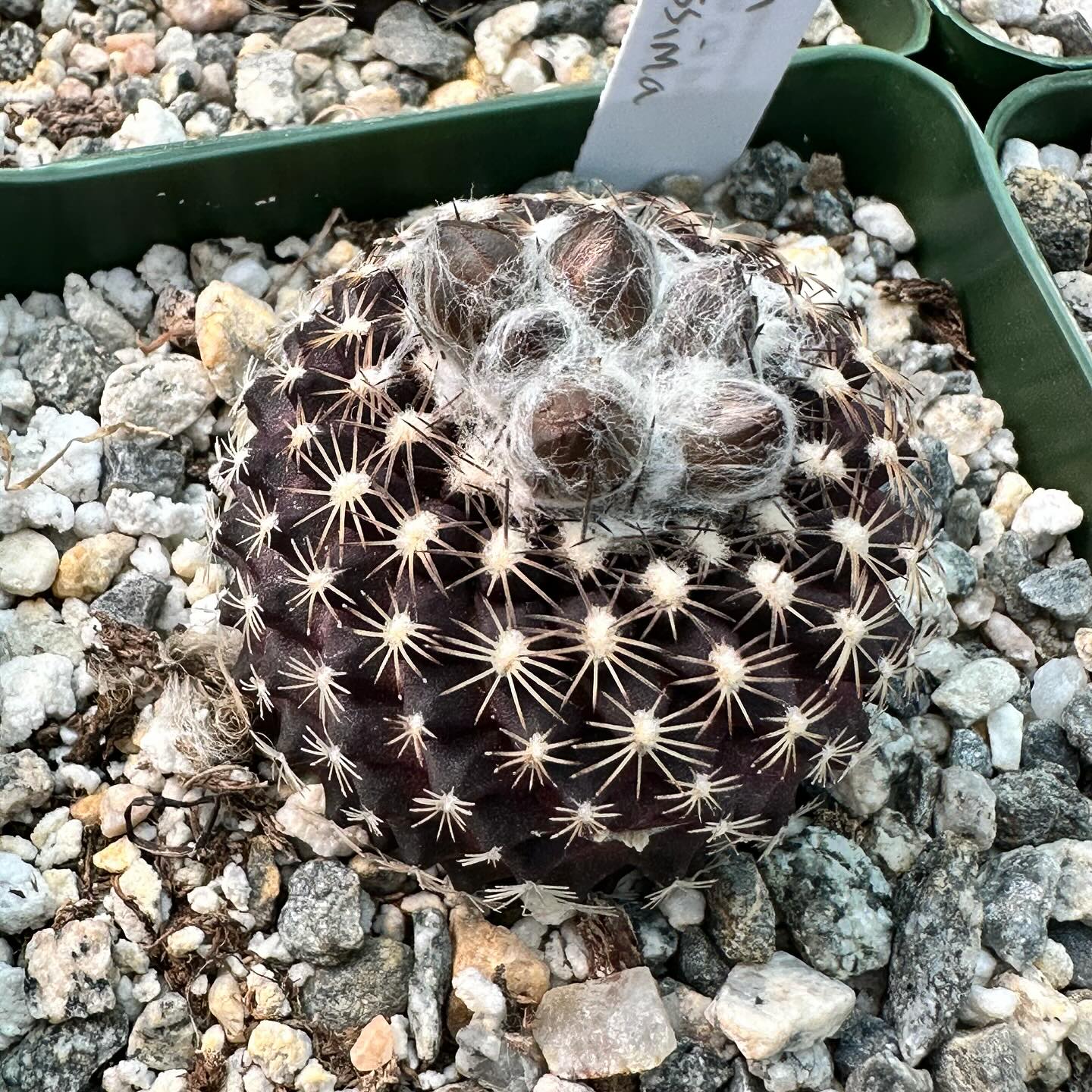
Body color ranges from dark olive-green to purplish-brown or near-black, shifting with light intensity, water status, and temperature. The same reversible photo-protective response that operates across the humilis complex is present here, but the small above-ground surface concentrates the response: plants kept in strong sun and maintained on the dry side take on deeply saturated dark tones, while greenhouse specimens grown in moderate light will be uniformly green. The color shift is real-time and reversible. Moving a plant from full sun to partial shade for several weeks will produce visible greening in the above-ground stem.
Ribs number 8 to 12 and are tuberculate, following the humilis complex pattern. Areoles are small and white-felted, with the crown wool forming a compact tuft that becomes more pronounced during flowering. The spination is the diagnostic character: radial spines number only 1 to 3 per areole, occasionally absent altogether in plants under strong stress, and are noticeably fine relative to the type subspecies. They lie close to the body surface, are thin enough that the epidermis is clearly visible through the spine array, and run from pale grey or whitish when young to slightly darker with age. Central spines are typically absent or reduced to a single weak central that is difficult to distinguish from the radials.
Flowers are yellow and campanulate, diurnal, and carry a light fragrance that distinguishes them from the scentless flowers of some related species. They are proportionally large relative to the stem head, sometimes approaching or exceeding the stem width in diameter. The plant flowers from a young age in cultivation and reliably in subsequent years through spring into autumn. Fruit is small and globose, green ripening to reddish or maroon.
The taproot is the plant’s most structurally significant feature and the character that has the most direct cultivation implications. In mature specimens, the taproot extends 15 to 25 cm below the soil surface, with its shoulder diameter approaching that of the above-ground stem. The root tapers gradually toward the base and is fleshy rather than fibrous, storing water and nutrients over the dry intervals between fog events. This root-to-stem ratio is the most extreme in the humilis complex and explains both the plant’s fog dependency and its sensitivity to excess moisture at the root collar.
Position Within the humilis Complex
Copiapoa humilis subsp. tenuissima sits at a taxonomic boundary that has never been fully settled: between the humilis complex and the geophytically overlapping hypogaea complex. The geophytic habit, with its radically reduced above-ground stem and dominant taproot, links it morphologically to Copiapoa hypogaea. But the flower and fruit characters, the clustering basal offset pattern, and the spination profile all fall within the humilis circumscription as established by Hunt. The dual nomenclatural history reflects genuine uncertainty: the same authority published both the humilis subsp. and the hypogaea subsp. combination in the same journal volume.
Larridon et al. (2015), working with an integrative morphological and molecular dataset across the genus, found broad support for the humilis complex as a clade but noted that the geophytic subspecies create unresolved ambiguities at the humilis/hypogaea boundary that sequence data alone does not clarify. The current Kew consensus places tenuissima within humilis, which is the treatment this page follows. The question matters less for cultivation than for provenance documentation: the plant’s growth requirements are determined by its habit, not its assignment to one species complex or another.
Within the accepted humilis subspecies, tenuissima is most usefully understood as the geophytic end of a gradient that runs from the clustering, more upright type subspecies through the smaller-stemmed tocopillana and the green-bodied variispinata, to this smallest, most underground form. The gradient roughly follows the north-to-south environmental shift along the coastal escarpment, with decreasing fog reliability southward producing smaller above-ground plant mass and progressively greater dependence on the taproot as a water storage organ.
The related species Copiapoa laui, from the Esmeralda coast, represents a parallel solution to the same problem: extreme fog dependency, minimal above-ground surface, and a massive root structure relative to the visible plant. The two are not closely related by phylogenetics but have converged on a similar structural answer to the same environmental question.
Localities & Distribution
The known range of Copiapoa humilis subsp. tenuissima is confined to a coastal escarpment section south of Antofagasta, covering an area of occupancy estimated at under 10 km². This is among the smallest documented ranges of any Copiapoa subspecies. Population surveys have located fewer than 800 individuals across this area. The locality data below reflects Ritter’s original field records from the 1960s and subsequent survey work.
The map below shows the approximate extent of the known population, plotted within the broader context of the northern Chilean fog corridor. The site lies within the southern portion of the broader Copiapoa humilis range, in the transitional zone where the fog belt begins to narrow and environmental conditions become more marginal for the genus.
Copiapoa humilis subsp. tenuissima: Known Distribution
Highly localized coastal escarpment population south of Antofagasta, Antofagasta Region, Chile. AOO <10 km²; <800 individuals known. Based on Ritter (1980), Hunt (2003), Charles (1998), Kew POWO 2025. Population boundary approximate.
Zones
Markers
All boundaries approximate. Click markers for details.
IUCN: Critically Endangered · CITES Appendix II · AOO <10 km² · <800 individuals known · No protected area coverage
Documented Copiapoa humilis subsp. tenuissima localities
South of Antofagasta
- Coastal escarpment, south Antofagasta (type area)
- Quebrada del Ancla sector
- Lower fog belt transition, ~600 m
- Ritter field collection, 1960s
Trade & Seed List Designations
- FR [field number]: Ritter collections
- KK [Uebelmann] provenance lots
- Copiapoa tenuissima (seed list form)
- C. hypogaea subsp. tenuissima (alt. name)
Locality names reflect field collection records from Ritter (1980) and subsequent survey data. Population boundaries are approximate. AOO <10 km²; estimated <800 individuals. No protected area covers the known range.
Copiapoa humilis subsp. tenuissima care and cultivation
Copiapoa humilis subsp. tenuissima is cultivable and, once established, reasonably forgiving of the normal range of Copiapoa management. The critical period is the first two to three years from seed, when the above-ground stem is at its smallest and most vulnerable and the taproot has not yet developed the storage capacity that gives mature plants their drought resilience. Watering discipline and substrate drainage matter most at this stage. A plant that has been grown through this period correctly becomes progressively easier to manage as the root system matures.
Substrate
The canonical ratio mirrors the parent subspecies: 33 per cent pumice, 12 per cent lava rock, 10 per cent zeolite, 25 per cent granite grit, 5 per cent limestone chip, 10 per cent coarse silica, and 5 per cent worm castings. Organic stays capped at 5 per cent for the same rot-risk reason as the type subspecies: the only species-specific cultivation source found for this genus’s tuberous-rooted end recommends less organic and more fine gravel near a water-storing root, not more, to keep stagnant moisture off it. The substrate should drain through the pot in under two seconds and return to visibly dry within 24 hours of watering. A thin layer of coarse grit mulch around the crown reduces moisture contact at the root collar in ambient humidity above 50 per cent.
All ten Copiapoa species on this site share a genus-flat 95/5 mineral-organic cultivation mix. Limestone stays at the low end of an indeterminate carbonate band and organic at the class-prior 5 percent; neither figure is a per-species finding. The only value that varies by species is lava, sized to container depth: the tuberous-rooted trio (hypogaea, hypogaea var. barquitensis, laui) gets a deeper pot allowance than the rest of the genus.
| Species | Pumice | Lava | Zeolite | Granite | Limestone | Silica | Organic |
|---|---|---|---|---|---|---|---|
| C. laui | 27% | 18% | 10% | 25% | 5% | 10% | 5% |
| C. humilis | 33% | 12% | 10% | 25% | 5% | 10% | 5% |
| C. humilis subsp. tenuissima (this page) | 33% | 12% | 10% | 25% | 5% | 10% | 5% |
| C. solaris | 33% | 12% | 10% | 25% | 5% | 10% | 5% |
| C. cinerea | 33% | 12% | 10% | 25% | 5% | 10% | 5% |
| C. cinerea subsp. cinerea | 33% | 12% | 10% | 25% | 5% | 10% | 5% |
| C. cinerea subsp. krainziana | 33% | 12% | 10% | 25% | 5% | 10% | 5% |
| C. esmeraldana | 33% | 12% | 10% | 25% | 5% | 10% | 5% |
| C. hypogaea | 27% | 18% | 10% | 25% | 5% | 10% | 5% |
| C. hypogaea var. barquitensis | 27% | 18% | 10% | 25% | 5% | 10% | 5% |
Watering & temperature
Water thoroughly every 14 to 21 days during the spring through autumn growing period. The longer interval, relative to the type subspecies, reflects the smaller above-ground stem area: with less transpiring surface, the plant cycles moisture more slowly. Let the substrate guide you; if the pot still feels at all damp or the substrate shows any visible moisture at depth when you probe it, wait. In winter, keep completely dry. No water at all below 10°C. The species tolerates brief dips to ?2°C if bone dry, but any residual moisture in the root zone will cause irreversible cold damage. Overwinter at a minimum of 5°C.
Summer heat above 40°C is tolerable in a well-ventilated space with good airflow around the pot. Very light afternoon shade benefits the plant at extreme temperatures, but avoid anything that materially reduces the total daily light dose.
Light & containers
Full sun is essential. Insufficient light produces etiolated stems that turn uniformly green and lose the dark, compact proportions that are the plant’s most valued visual character. A minimum of six hours of direct sun daily is the baseline; more is better. The container should be deep rather than wide: the taproot requires vertical space and should not be compressed into a shallow pot. Unglazed terracotta 15 to 20 cm deep is appropriate for a mature single-headed specimen; slightly wider pots accommodate multi-headed clumps without forcing horizontal root compression. Avoid deep glazed pots in humid climates, where the moisture retention difference between glazed and unglazed becomes significant at the crown level.
The taproot: repotting and establishment
Repotting should be done with care at the root collar. The taproot is fleshy and tapers toward the base; minor damage at the distal end is not fatal and the wound will callus if allowed to dry for several days before replanting. The critical zone is the collar itself, where the root meets the stem below the soil surface. Handle the plant without flexing this junction, and settle it into the new substrate with the crown positioned just at or slightly above the soil surface to maximize air circulation at the collar.
Seed grown plants take time to develop the characteristic taproot profile. Young plants from seed will look similar to the type subspecies for the first few years; the full geophytic character, with its deep root and tucked-down stem, becomes apparent from year four or five onward as the root system accumulates. Do not be alarmed if a young specimen seems proportionally conventional. The underground development is happening even when the above-ground growth appears slow.
Collector FAQ
Is this the same plant as Copiapoa tenuissima?
Yes. Copiapoa tenuissima (D.R.Hunt) D.R.Hunt is a species-rank combination for the same plant, treated by some seed list compilers and specialist growers as a full species rather than a subspecies of Copiapoa humilis. Both names are legitimate and refer to the same taxon. Kew POWO follows the subspecies treatment; other authorities prefer the species-rank name. When buying seed or plants, all three principal names, Copiapoa tenuissima, Copiapoa humilis subsp. tenuissima, and Copiapoa hypogaea subsp. tenuissima, should be treated as applying to the same plant unless specific locality data or morphological description suggests otherwise.
How do I distinguish a seed grown specimen from a degrafted one?
In young plants this is not always obvious, but several characters help. Seed grown plants develop naturally from the base, with the taproot thickening gradually and uniformly. Degrafted plants often show an irregular or scarred base at the graft point, sometimes with a slightly different diameter or texture at the junction. Root architecture also differs: seed grown plants produce a single dominant taproot from germination, while degrafted plants develop fibrous secondary roots from the base of the former graft scion that lack the unified taproot structure of a seed grown specimen. With mature plants, the root profile on repotting is the clearest diagnostic. Seed grown material is the standard serious collectors hold for this subspecies.
Why does my plant keep rotting at soil level?
The root collar of Copiapoa humilis subsp. tenuissima is more exposed to rot risk than the type subspecies because the zone where the stem meets the root sits at or just below the substrate surface rather than clearly above it. Three causes account for most losses: substrate that retains moisture too long at crown level (add coarse grit mulch and verify your pumice percentage), watering during cold or cloudy stretches when the plant is not actively transpiring, and placing the crown in contact with wet substrate after repotting. If you catch early rot at the collar, the plant can sometimes be saved by removing the damaged tissue cleanly, treating with sulfur powder, letting the wound dry for a week, and replanting into fresh dry substrate. A healthy taproot below the damage zone is enough to regenerate.
What is the realistic pace of taproot development from seed?
Slow. In the first two years, the plant puts most energy into establishing the primary root rather than producing visible above-ground stem growth. A two-year-old seedling may have a taproot already 5 to 8 cm long and an above-ground stem of only 1 cm. By year five, the root may be 12 to 15 cm with a stem of 2 to 3 cm. This ratio is precisely what you want: the root investment is the plant’s primary adaptation, and pushing faster growth through heavy watering or fertilizing produces soft tissue that is more vulnerable to rot and cold damage. Grow it slowly on a dry substrate in full sun, and by year eight to ten you have a specimen with genuine character.
Is Copiapoa humilis subsp. tenuissima legal to own?
It falls under Copiapoa humilis on CITES Appendix II, which regulates international trade in nursery-propagated plants rather than banning it. Every plant we offer is nursery propagated, never wild collected.
Related Taxa in the Genus
Copiapoa humilisThe type subspecies and entry point to the genus for most serious collectors. Wider distributed, more forgiving, and the parent species of this subspecies.Copiapoa hypogaeaShares the geophytic growth habit and presents the closest morphological parallel. Source of taxonomic ambiguity at the humilis/hypogaea boundary.Copiapoa hypogaea var. barquitensisA smooth-epidermis variety from Barquito at the southern edge of the humilis range. The most available member of the hypogaea complex in cultivation.Copiapoa lauiThe extreme geophytic end of the genus from the Esmeralda coast. A parallel adaptation to fog dependency and UV stress, not a close relative.Copiapoa cinereaThe silver-coated emblem of the Atacama fog zone. Long-lived, spectacular with age, and an excellent complement to tenuissima in any serious collection.Copiapoa cinerea subsp. cinereaThe classic silver form found around Taltal. Most available member of the cinerea group in cultivation and an introduction to the genus for new collectors.Copiapoa cinerea subsp. krainzianaWhite-spined and confined to a single colony in the San Ramón Valley. Collector demand has been documented as a direct extinction driver.Copiapoa esmeraldanaA neighbor of Copiapoa laui on the Esmeraldas coast. The best remaining habitat condition of any Copiapoa, with a range measured in tens of kilometers.Copiapoa solarisThe sun cactus of Antofagasta. Cliff-growing, distinctively woolly, and among the highest evolutionary distinctiveness values in the genus. Critically Endangered.
Sources & References
Ritter, F. (1980). Kakteen in Südamerika, Volume 3. · Hunt, D. (2003). New combinations in Copiapoa. Cactaceae Systematics Initiatives 16: 6. · Charles, G.J. (1998). Copiapoa. The Cactus File Handbook 4. Cirio Publishing. · Schulz, R. & Kapitany, A. (1996). Copiapoa in Their Environment. Schulz Publishing. · Anderson, E.F. (2001). The Cactus Family. Timber Press. · Hunt, D., Taylor, N. & Charles, G. (2006). The New Cactus Lexicon. dh books. · Larridon, I. et al. (2015). An integrative approach to understanding the evolution and diversity of Copiapoa. American Journal of Botany 102: 1506–1520. · Guerrero, P.C. et al. (2024). Effects of trade and poaching pressure on extinction risk for cacti in the Atacama Desert. Conservation Biology 38: e14353. · Govaerts, R. (2025). Copiapoa humilis in Kew Science Plants of the World Online.