Copiapoa esmeraldana
Copiapoa esmeraldana — The Fog Cliff Miniature
| Family | Cactaceae |
| Named by | F.Ritter (1980) |
| Synonym | Copiapoa humilis var. esmeraldana |
| Native range | Las Lomitas, S of Esmeralda |
| Altitude | ~600–980 m |
| EOO | 35 km²; single location |
| Population | 250–500 individuals |
| Stem diameter | Up to 7–8 cm |
| Ribs | 13–16, strongly tuberculate |
| Flowers | Yellow, campanulate, scented |
| IUCN status | Critically Endangered |
| CITES | Appendix II |
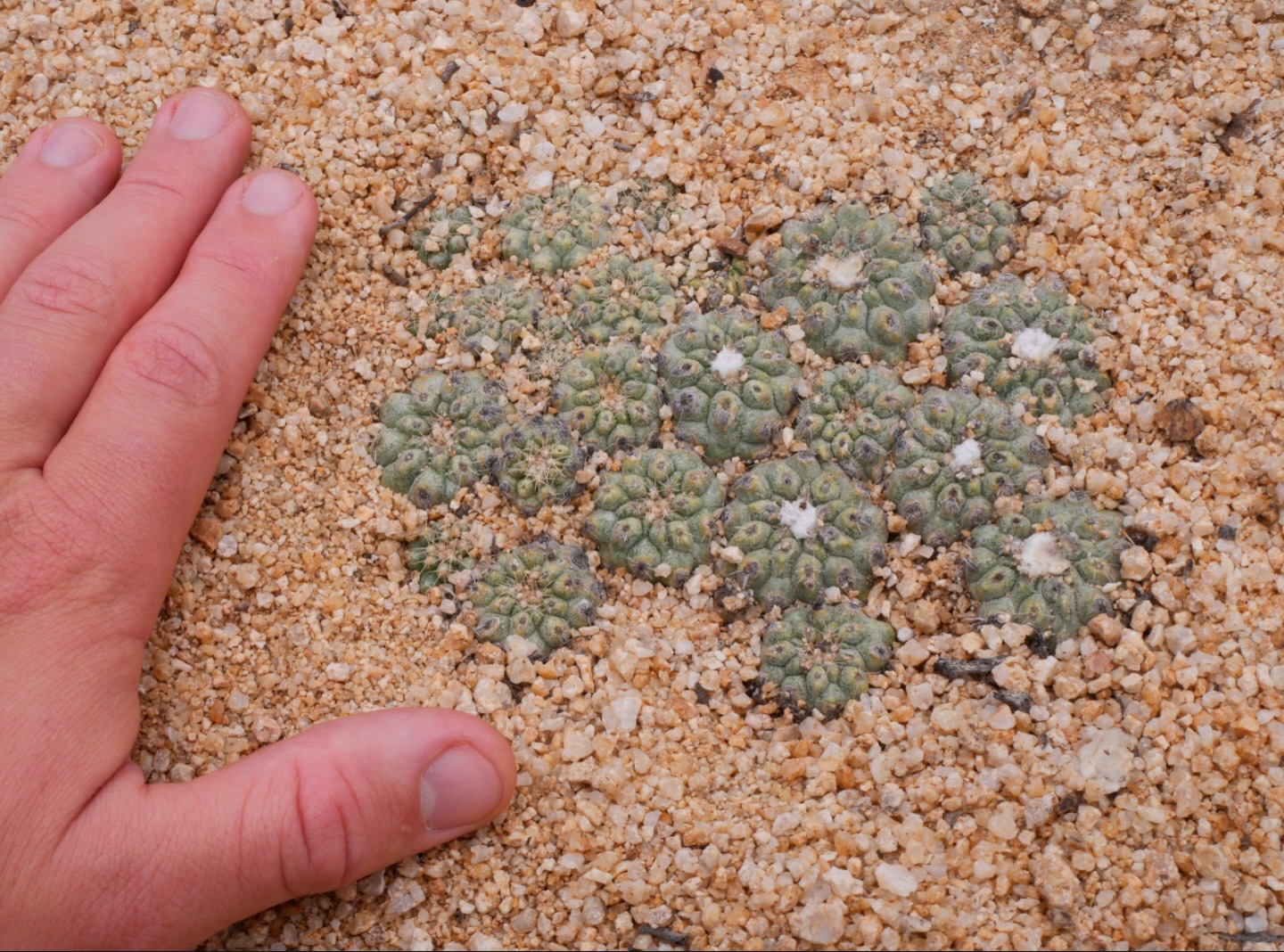
Copiapoa esmeraldana exists at the edge of a cliff, in every sense. Its entire confirmed population of 250 to 500 individuals clings to the steep granitic hillsides of Las Lomitas, a promontory just south of the town of Esmeralda on the Atacama coast, within the boundaries of Pan de Azúcar National Park. The extent of occurrence is 35 square kilometers. The plants grow at around 600 to 980 meters elevation, in the zone where Pacific fog condenses most heavily against the coastal escarpment. Below them is the ocean. Above them is bare rock and desert. This is one of the smallest and most precisely defined ranges of any cactus species on Earth.
The species was described by Friedrich Ritter in 1980 in Kakteen Südamerika, volume 3. Its taxonomic position has been debated since publication. Hoffmann and Walter (1989) reduced it to Copiapoa humilis var. esmeraldana, treating it as a local form of the widespread Copiapoa humilis complex. Larridon et al. (2015) recovered it as a distinct lineage, sister to Copiapoa angustiflora, and the current consensus treats it as a valid species. The taxonomic uncertainty is compounded by confusion in the field: some plants sold as Copiapoa esmeraldana from the nearby Guanillos Valley may actually be small forms of Copiapoa grandiflora.
What sets Copiapoa esmeraldana apart is a combination of characters. The stems are small, reaching only 7 to 8 centimeters in diameter, green and not pruinose (unlike the silver-coated Copiapoa cinerea). The ribs are strongly tuberculate, numbering 13 to 16, giving the body a more sculptured texture than the smooth-ribbed cinerea group. The flowers are large relative to the body size, broadly campanulate (bell-shaped), scented, and yellow. Ritter placed the species in section Copiapoa, not in subsection Cinerei, reflecting its morphological distance from the cinerea complex.
In cultivation, Copiapoa esmeraldana is moderately slow but not as demanding as Copiapoa solaris or Copiapoa laui. It flowers readily, often within a few years of reaching adult size, and the scented blooms are a genuine reward. Seed grown plants with documented Las Lomitas provenance sell for $200 to $800 depending on age and development. Mature clumping specimens can exceed $2,000.
Conservation status
Copiapoa esmeraldana is listed as Critically Endangered by the IUCN Red List (Walter, Faundez, Guerrero & Saldivia, 2013/2024). A single location at Las Lomitas with 250 to 500 individuals. The site falls within Pan de Azúcar National Park, providing formal in-situ protection. Threats include illegal collection, erosion, and guanaco predation. The 2024 Guerrero et al. reassessment listed Copiapoa esmeraldana among the Critically Endangered taxa with an AOO under 20 square kilometers.
Contents
Taxonomy & Nomenclature
Ritter described Copiapoa esmeraldana in 1980 in his monumental Kakteen Südamerika, volume 3. The specific epithet refers to the town of Esmeralda on the Atacama coast, near which the type material was collected. The species was placed in genus Copiapoa from the outset, without the detour through other genera that characterized the taxonomic history of some congeners like Copiapoa solaris (originally Pilocopiapoa).
The species has been treated at different ranks by different authors. Hoffmann and Walter (1989) reduced it to a variety of Copiapoa humilis, publishing the combination Copiapoa humilis var. esmeraldana. Alexander Doweld later treated it as a subspecies of Copiapoa grandiflora, reflecting its proximity to that species at the Las Lomitas site. Molecular phylogenetic work by Larridon et al. (2015) recovered Copiapoa esmeraldana as sister to Copiapoa angustiflora, a recently described species, which supports its treatment as a distinct taxon rather than a variant of either humilis or grandiflora.
The current consensus, followed by Kew POWO, treats Copiapoa esmeraldana as a valid species. The synonym Copiapoa humilis var. esmeraldana is still encountered in older literature and some commercial listings.
Habitat & Las Lomitas
Las Lomitas is a steep, fog-drenched promontory on the Atacama coast just south of the town of Esmeralda. The site sits within the boundaries of Pan de Azúcar National Park, which provides formal legal protection, a significant distinction from species like Copiapoa cinerea subsp. krainziana and Copiapoa solaris, which have no in-situ protection at all.
The plants grow on steep granitic cliffs at elevations between roughly 600 and 980 meters, in the band where the camanchaca fog concentrates most heavily. The substrate is hard, acidic rock with thin mineral soils. Individual plants are usually isolated rather than forming the dense colonies typical of some other Copiapoa species. They share the site with Copiapoa laui, Copiapoa grandiflora, and Copiapoa longistaminea, making Las Lomitas one of the most species-rich Copiapoa localities known.
Threats at Las Lomitas include illegal collection (despite the national park status), natural erosion of the steep cliff habitat, and predation by guanacos that dig up plants to eat the moisture-rich stems. The guanaco pressure is a genuine ecological factor: these large camelids actively seek out Copiapoa as a water source in the hyper-arid landscape, and a species with only 250 to 500 individuals cannot absorb sustained predation without population-level consequences.
Morphology
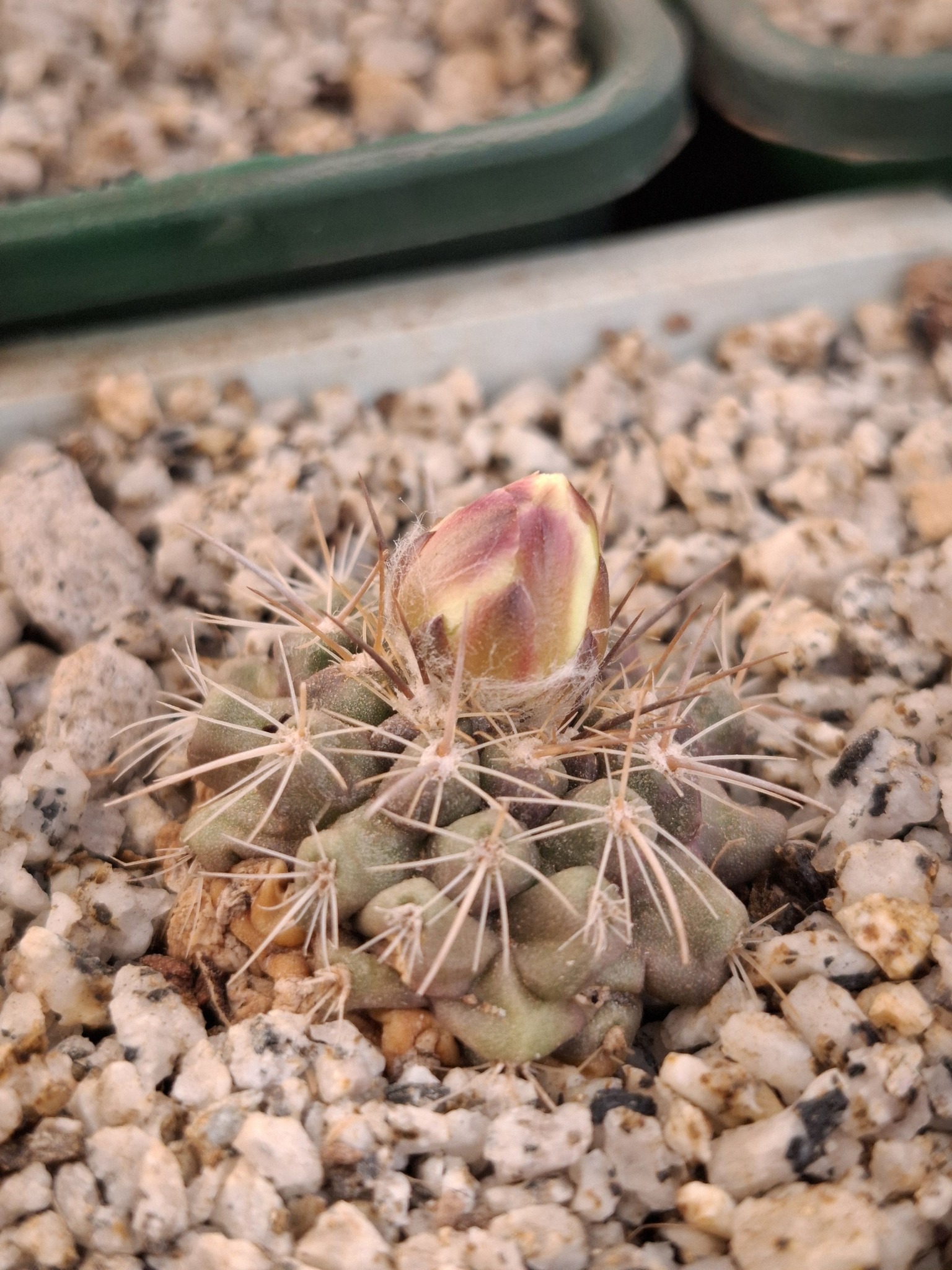
The strongly tuberculate ribs and green, non-pruinose epidermis of Copiapoa esmeraldana. The body resembles the humilis complex more than the silver-coated cinerea group, which helps explain the historical taxonomic confusion.
Copiapoa esmeraldana is a small, green, partially geophytic cactus. The stems reach 7 to 8 centimeters in diameter and sit low to the ground, sometimes partially buried in the substrate. The epidermis is green, not pruinose. This green, uncoated body immediately distinguishes it from the silver-white cinerea complex and places it visually closer to the Copiapoa humilis group, which helps explain why Hoffmann and Walter treated it as a humilis variety.
The ribs number 13 to 16, strongly tuberculate, with individual tubercles reaching up to one centimeter in height. Each tubercle bears an areole at its tip, covered in short whitish wool when young, becoming hairless with age. Spines are straight, brownish when young, aging to ash-grey, reaching up to 2 centimeters in length. Young plants produce only radial spines; central spines appear as the plant matures.
The flowers are the species’ most distinctive character after its small size. They are broadly campanulate (bell-shaped), scented, yellow, approximately 32 millimeters long. The nectar chamber is short and broadly cup-shaped, a character that Larridon et al. (2015) noted distinguishes esmeraldana from the narrowly funnelform flowers of its sister species Copiapoa angustiflora. Flowers emerge from the center of the white apical wool. Seeds are approximately 1.5 millimeters wide, black.
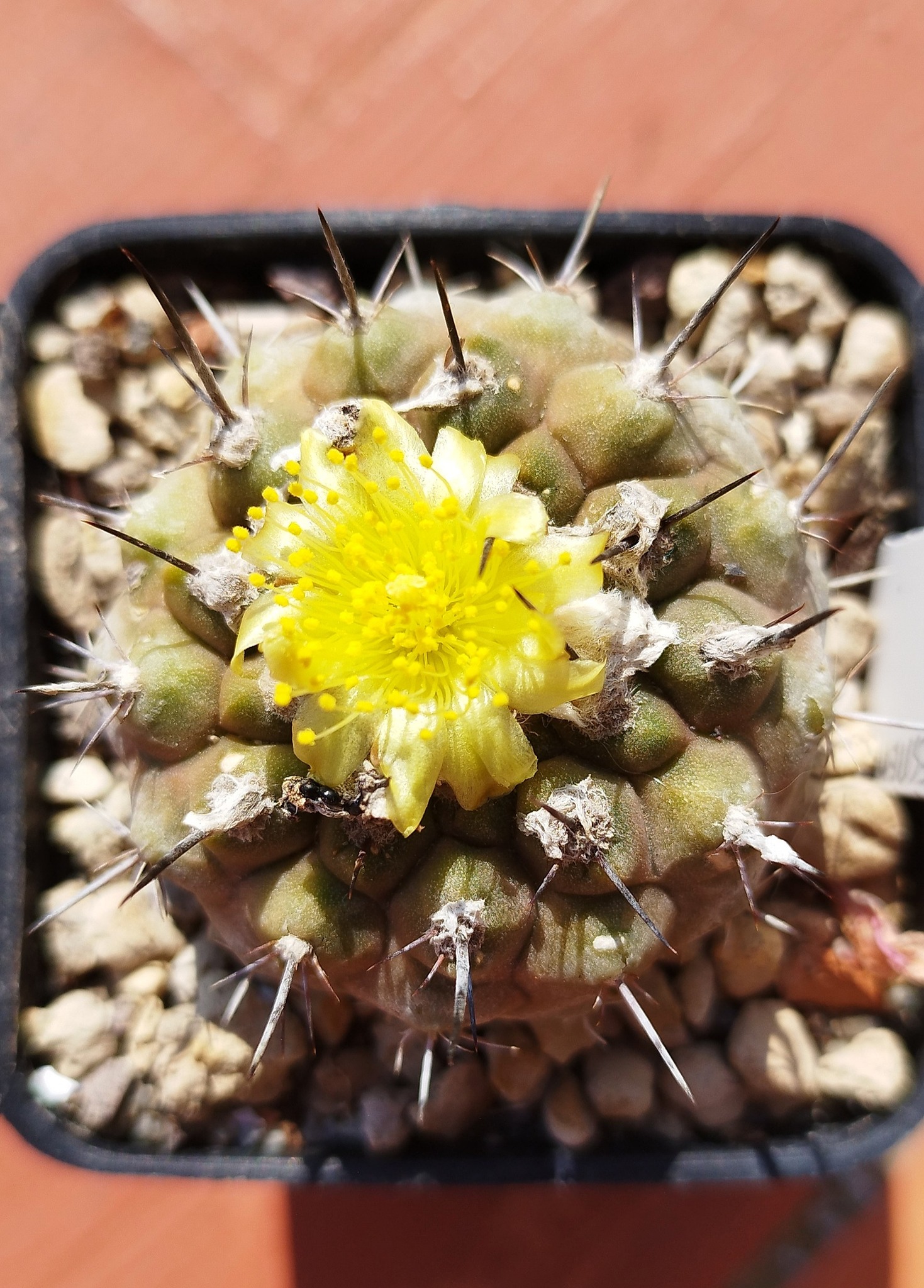
The plant is moderately prolific for a Copiapoa, eventually forming clumps of multiple heads. Each head develops from a thickened taproot that anchors it into rock crevices.
The Identity Question
No discussion of Copiapoa esmeraldana is complete without addressing the confusion that has surrounded it since Ritter’s original description. The problem is that the Esmeralda area supports multiple Copiapoa species in close proximity, and small or juvenile plants of Copiapoa grandiflora can closely resemble Copiapoa esmeraldana. Some material that has circulated in the trade as esmeraldana, particularly from the Guanillos Valley near Esmeralda, may actually be juvenile grandiflora.
The true Copiapoa esmeraldana from Las Lomitas can be distinguished by its smaller maximum stem diameter (7–8 cm versus the much larger grandiflora), its strongly tuberculate ribs, its broadly campanulate flowers with a short cup-shaped nectar chamber, and its green non-pruinose epidermis. A mature grandiflora will eventually outgrow an esmeraldana significantly and develop a different body form. In cultivation, the distinction becomes clearer as plants age, but young seedlings of the two species can be difficult to separate with confidence.
For collectors, the practical lesson is that provenance documentation matters. A plant grown from seed sourced directly from the Las Lomitas population, with a verifiable collection record, is almost certainly true esmeraldana. Material of uncertain origin from the broader Esmeralda area warrants more caution.
Locality Detail
Las Lomitas is the only confirmed locality. The site is accessed from the Pan de Azúcar National Park trail system. Copiapoa esmeraldana grows on the steep upper slopes facing the Pacific, in areas where the fog belt reaches its maximum density. The site co-occurrence with Copiapoa laui is notable: two of the most restricted species in the genus share a single cliff system, each adapted to slightly different microhabitats within the same fog zone.
Cultivation
Substrate and watering
Standard mineral-dominant substrate with pumice, lava rock, and granite grit. Fast drainage is essential. Water lightly and regularly during the growing season, with full dryout between applications. The green, non-pruinose epidermis suggests the species tolerates somewhat less intense light than the cinerea complex, which aligns with its habitat on fog-drenched cliffs where direct sun is moderated by moisture. Partial shade in summer works well, with stronger light in winter.
Growth rate and flowering
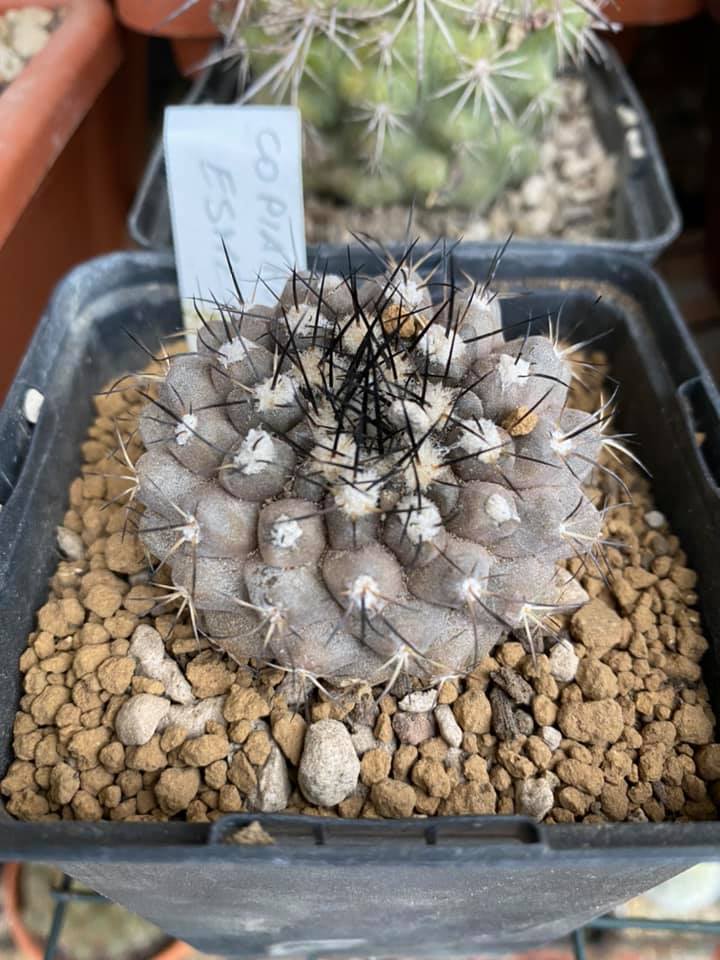
Copiapoa esmeraldana is slow but not as glacial as Copiapoa solaris. In cultivation, it reaches flowering size within 5 to 8 years from seed under good conditions. The scented, broadly bell-shaped yellow flowers are one of the genuine rewards of growing this species. They open during the day and carry a detectable fragrance that is uncommon among Copiapoa.
Seed grown plants are the collector standard. Young specimens sell for $100 to $400. Mature clumping plants with multiple heads and documented provenance reach $1,000 to $2,000. The species is not in the same pricing bracket as Copiapoa cinerea or krainziana, but its extreme rarity in habitat and the taxonomic interest surrounding it sustain consistent collector demand.
Comparing Copiapoa esmeraldana to Related Species
Copiapoa laui shares the Las Lomitas locality and the distinction of being one of the most restricted species in the genus. But the two are morphologically quite different. Copiapoa laui is even smaller, with stems only 1 to 3 centimeters in diameter, fine bristly spines, and a partially subterranean habit more reminiscent of Copiapoa hypogaea. Copiapoa esmeraldana is larger-bodied with strongly tuberculate ribs and more robust spination.
Copiapoa humilis subsp. tenuissima occupies a similar ecological niche further north along the coast and was the taxonomic home Hoffmann and Walter proposed for esmeraldana when they reduced it to varietal rank. The two share the green, non-pruinose epidermis and the compact clustering habit, but esmeraldana has more strongly tuberculate ribs, larger flowers, and a smaller maximum body size. The molecular data (Larridon 2015) confirms they are not particularly closely related despite the morphological resemblance.
From the Copiapoa cinerea complex, esmeraldana differs fundamentally: no farina, no dark spines, no columnar growth, and a completely different rib structure. The two coexist in the broader Esmeralda to Taltal stretch of coast but occupy different microhabitats and belong to different sections of the genus.
Related Taxa in the Genus
Copiapoa solarisThe sun cactus of the Atacama. Restricted to two fog-dependent localities near El Cobre and Blanco Encalada. Slower than Aztekium on its own roots.Copiapoa humilis subsp. tenuissimaA compact, dark-bodied form from the Paposo coast. Faster growing and more forgiving than the cinerea complex, it is an excellent entry point for collectors new to the genus.Copiapoa humilisThe parent species of the humilis complex. Miniature clustering habit, highly variable across its range from Paposo to Chañaral.Copiapoa cinereaThe silver ghost of the Atacama. Three geographically segregated subspecies span the coast from Caleta Colorado to Chañaral. The most iconic species in the genus.Copiapoa cinerea subsp. krainzianaThe shaggy-spined showpiece from the quebradas north of Taltal. Hair-like white spines are unique in the cactus family. A single known population.Copiapoa cinerea subsp. cinereaThe classic Taltal form. The nominotypical subspecies with the most iconic silver farina, dark spines, and the form most collectors picture when they hear the name.Copiapoa lauiA miniature species from a single site near Esmeralda. Tiny, densely clustering heads with fine white spines. Rivals Copiapoa solaris for restricted range.Copiapoa hypogaeaPartially subterranean. The most unusual growth form in the genus, with the stem largely buried below the soil surface.Copiapoa hypogaea var. barquitensisDistinct variety from Barquito. Flatter, more tuberculate stems. Sought by specialist collectors for its unusual surface texture.
Sources & References
Ritter, F. (1980). Kakteen Südamerika, vol. 3. · Hoffmann, A. & Walter, H. (1989). Cactáceas en la Flora Silvestre de Chile. · Schulz, R. & Kapitany, A. (1996). Copiapoa in Their Environment: Chañaral to El Cobre. · Hunt, D. (2013). The New Cactus Lexicon. · Walter, H.E. et al. (2013). Copiapoa esmeraldana. IUCN Red List 2013: e.T151989A584522. · Larridon, I. et al. (2015). An integrative approach to understanding the evolution and diversity of Copiapoa. American Journal of Botany 102: 1506–1520. · Villalobo-López, A. et al. (2024). Effects of trade and poaching pressure on extinction risk. Conservation Biology 38: e14353. · Royal Botanic Gardens, Kew. Plants of the World Online. Retrieved 2026.