
Ariocarpus Kotschoubeyanus
| Family | Cactaceae |
| Named by | Lemaire (1842) → K.Schum. (1898) |
| Key varieties | var. kotschoubeyanus, var. macdowellii, var. elephantidens |
| Native range | Coahuila to Querétaro, NE Mexico |
| Altitude | 1,000–1,900 m |
| Stem diameter | 3–7 cm (type); to 8 cm (elephantidens) |
| Flowers | Magenta to pale mauve, Sep–Nov |
| First bloom | 8–15 years (own root) |
| IUCN status | Vulnerable |
| CITES | Appendix I |
Star Rock · Living Rock · Chaute Negro
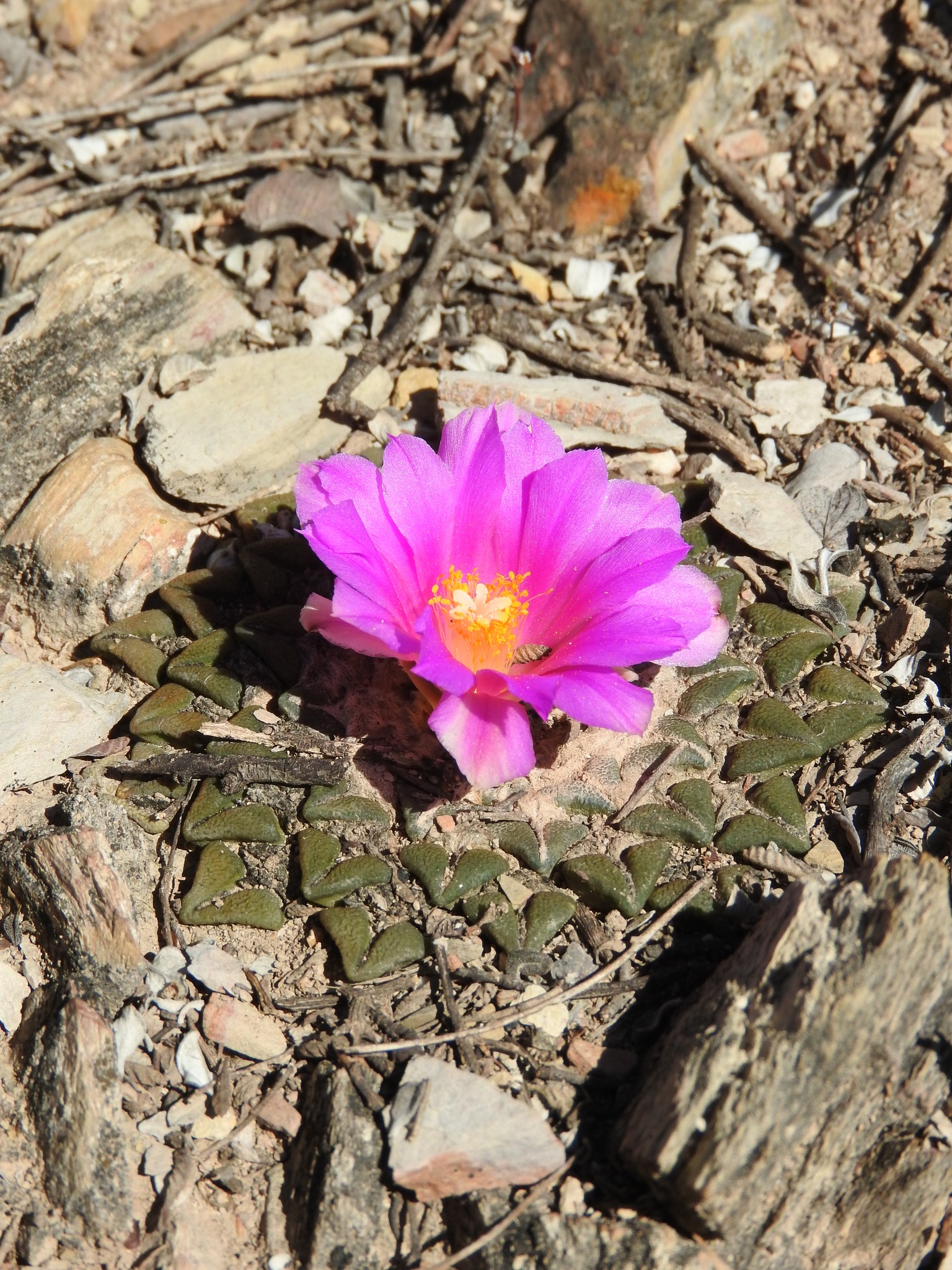
Everything about Ariocarpus kotschoubeyanus seems engineered to make you underestimate it. The plant is small — the smallest in its genus — and the body presses so close to the earth that a dry specimen on a gypsum flat can disappear entirely. The tubercles are dark olive-green, each one narrow and triangular, with a furrow of cream-white wool running up the center. From a distance the whole plant reads as a small dark star lying flat on pale ground. Then it flowers, and something happens that collectors who grow a lot of cacti still stop and stare at: a bloom two to five centimeters across, saturated crimson-magenta, opens from that tiny woolly crown, and the flower is frequently larger than the above-ground stem that produced it.
The species covers a wide arc of northeastern Mexico, from central Coahuila in the north all the way south to Querétaro, a range of over 600 kilometers. But within that range the populations are scattered and isolated, small pockets of plants in specific gypsum and limestone habitats, separated by terrain they cannot cross. That isolation has produced meaningful variation, and the two varieties that collectors most often encounter — var. macdowellii from the northern end of the range and var. elephantidens from the south — are different enough in size, tubercle character, and flower color to surprise you if you see them side by side.
This page covers the full species in depth: the taxonomy, the habitat ecology and what drives the variation across its range, a detailed look at the type form and both key varieties, the flowering biology, and a complete cultivation guide. If you are serious about growing kotschoubeyanus well and not just keeping one alive, the distinction between these varieties matters more than most growers realize.
Contents
Taxonomy & Nomenclature
The species has a clean if well-traveled taxonomic history. The first specimens were collected around 1840 by Wilhelm Friedrich von Karwinsky, a Bavarian naturalist conducting botanical surveys in northern Mexico, who sent material back to Europe for formal description. Charles Lemaire described the plant in 1842 as Anhalonium kotschoubeyanum — placing it in the catch-all genus that housed flat-bodied spineless Mexican cacti at the time — and the specific epithet honored Prince Wassili Viktorovich Kochubey, a Russian nobleman and patron of botanical science. That name, in various orthographic forms, has stuck. Karl Moritz Schumann transferred the species to Ariocarpus in 1898, and it has not moved since.
The synonymy is nonetheless substantial, reflecting the enthusiasm of twentieth-century European collectors for naming new forms. Names you will encounter in older literature and specialist catalogs include Mammillaria sulcata Salm-Dyck (1850, illegitimate), Ariocarpus sulcatus (Salm-Dyck) K.Schum. (1894), and Roseocactus kotschoubeyanus (Lemaire) A.Berger (1925) — the Berger name was widely used in German horticultural circles for decades. A cluster of subspecific names proposed by Halda and Horacek between 1998 and 2002 — including subsp. tulensis, subsp. sladkovskyi, and subsp. neotulensis — are not accepted by Kew’s Plants of the World Online and are generally regarded as splitting beyond what the morphological evidence supports. POWO accepts the species as Ariocarpus kotschoubeyanus (Lem.) K.Schum., with no formally accepted infraspecific taxa, though the varietal names macdowellii and elephantidens are widely used in cultivation and in field accounts and correspond to real and recognizable geographic forms.
The common name Star Rock is the most widespread English designation, a direct reference to the star-shaped outline of the tubercle rosette viewed from above. Living Rock appears frequently in shared usage with other Ariocarpus. In Spanish-language Mexican literature the plant is called Chaute Negro or simply Chaute, the same folk name applied across several species in the genus.
One additional note on nomenclature worth flagging: the epithet appears in various spellings in older sources, including kotschoubeyi, kotschoubeyana, and the simplified kotschubeyana. The correct form under current nomenclatural rules is kotschoubeyanus, but searching seed lists and herbarium records under the alternate spellings will occasionally surface material not indexed under the accepted name.
Historical synonyms (12)
- Anhalonium kotschoubeyanum Lem., 1844 basionym
- Roseocactus kotschoubeyanus (Lem.) A.Berger, 1925 homotypic synonym
- Roseocactus kotschoubeyanus subsp. macdowellii Backeb., 1949 homotypic synonym
- Roseocactus kotschoubeyanus var. albiflorus Backeb., 1951 homotypic synonym
- Ariocarpus kotschoubeyanus var. macdowellii (Backeb.) Krainz, 1958, 1958 homotypic synonym
- Roseocactus kotschoubeyanus var. macdowellii (Backeb.) Backeb., 1961 homotypic synonym
- Ariocarpus kotschoubeyanus var. elephantidens Skarupke, 1973 homotypic synonym
- Ariocarpus kotschoubeyanus subsp. albiflorus (Backeb.) C.E.Glass, 1998 homotypic synonym
- Ariocarpus kotschoubeyanus subsp. elephantidens Halda, 1998 homotypic synonym
- Ariocarpus kotschoubeyanus subsp. macdowellii (Backeb.) Halda, 1998 homotypic synonym
- Ariocarpus kotschoubeyanus subsp. sladkovskyi Halda & Horácek, 1998 homotypic synonym
- Ariocarpus kotschoubeyanus subsp. tulensis Halda, 1998 homotypic synonym
Sources: POWO (Kew) · IPNI · GBIF · Wikidata
Habitat & Native Range
Ariocarpus kotschoubeyanus has the broadest north-south range of any species in the genus — a band stretching over 600 kilometers from central Coahuila in the north down to Querétaro in the south, passing through Nuevo León, Zacatecas, San Luis Potosí, and Tamaulipas along the way. But range maps can be misleading. The species does not cover that territory continuously; it exists as a collection of small, scattered, isolated populations separated by terrain where the habitat conditions are wrong. Understanding the substrate requirements goes a long way toward explaining both the distribution and the varietal differences that emerge across it.
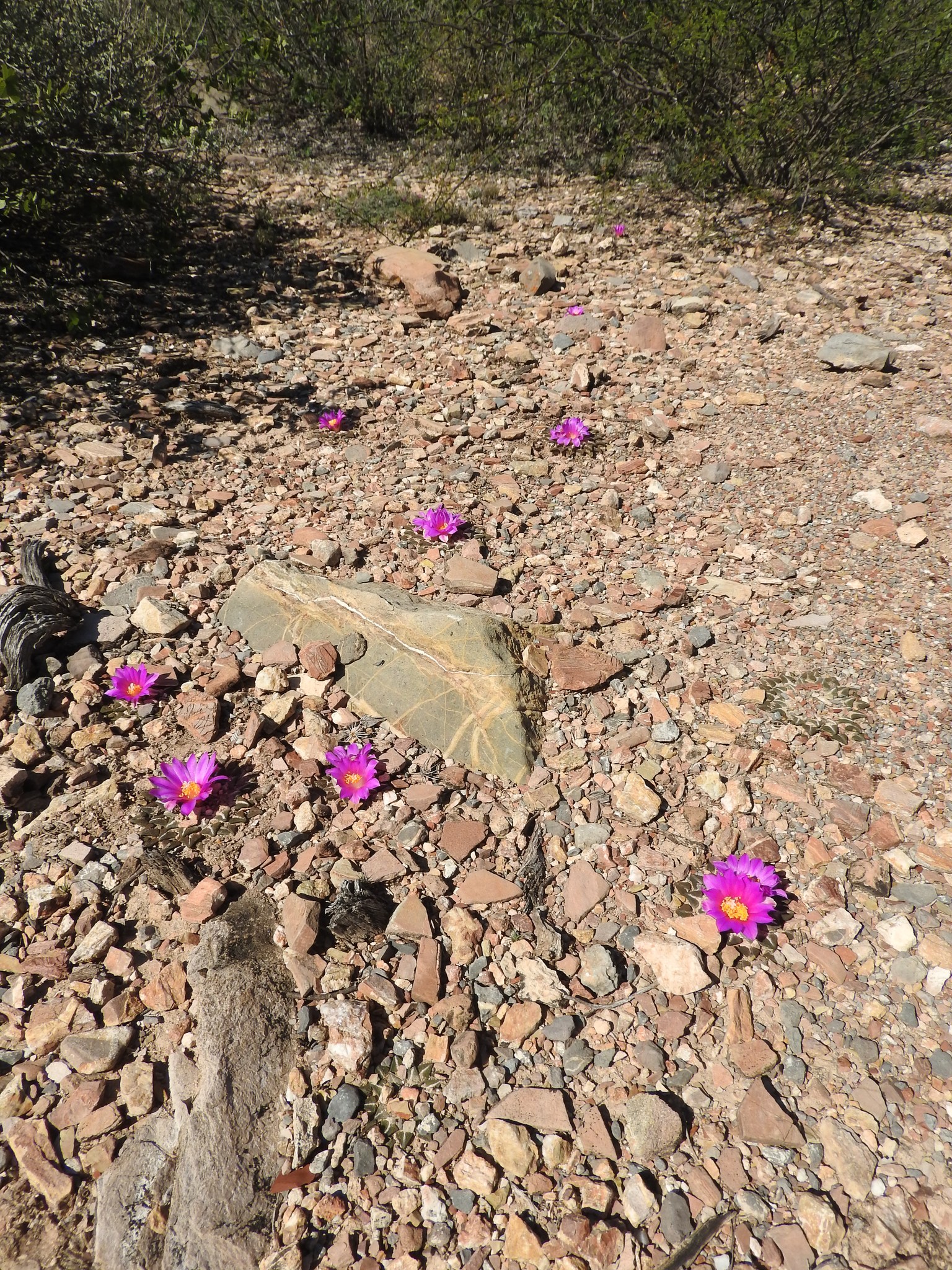
A defining and somewhat unusual characteristic of this species is its affinity for gypsum-derived substrates. While most Ariocarpus are strongly associated with limestone, many populations of A. kotschoubeyanus grow on gypsum silt flats — pale, almost white, low-lying terrain where calcium sulfate deposits create a very specific set of soil chemistry conditions. After summer rains, these flats flood briefly and the chalky white mud coats everything at ground level. When it dries, a plant already pressed flush with the soil vanishes behind a film of white dust. Some populations also occur on limestone-derived soils and on low hills and bajadas, but the gypsum flat populations are the most characteristic and the most photographed in field accounts.
Elevation across the range sits between 1,000 and 1,900 meters, notably higher on average than A. fissuratus and reflecting the species’ core distribution through the higher interior plateau of northeastern Mexico rather than the lower-elevation basins along the Rio Grande. The climate is Chihuahuan Desert throughout: hot, dry summers with a monsoon season concentrated in July through September, and cool to cold winters that are almost entirely dry. Annual rainfall averages 250 to 450 mm across the range, with meaningful variation between the more arid northern localities (where var. macdowellii occurs) and the slightly better-watered southern sites (where var. elephantidens is found in Querétaro).
The vegetative community in most localities includes Dasylirion longissimum, Agave stricta, Thelocactus bicolor, Mammillaria elongata, Ferocactus uncinatus, and — notably — Lophophora williamsii, with which kotschoubeyanus shares habitat across much of the central and southern range. Both share the gypsum flat preference and both draw the attention of poachers, which has contributed to population pressure on some of the most accessible localities.
Morphology: The Type Form
The type form of Ariocarpus kotschoubeyanus is the smallest species in the genus, and its proportions take some adjustment when you first encounter it. The above-ground stem diameter in mature habitat plants is typically 3 to 7 centimeters — rarely reaching 8 centimeters in the most robust specimens. The stem is flat-topped, often with a slightly depressed center in older plants, and it sits almost level with the surrounding soil. A large fraction of the plant is below ground, consisting of the napiform taproot that stores water and nutrients through the dry season.
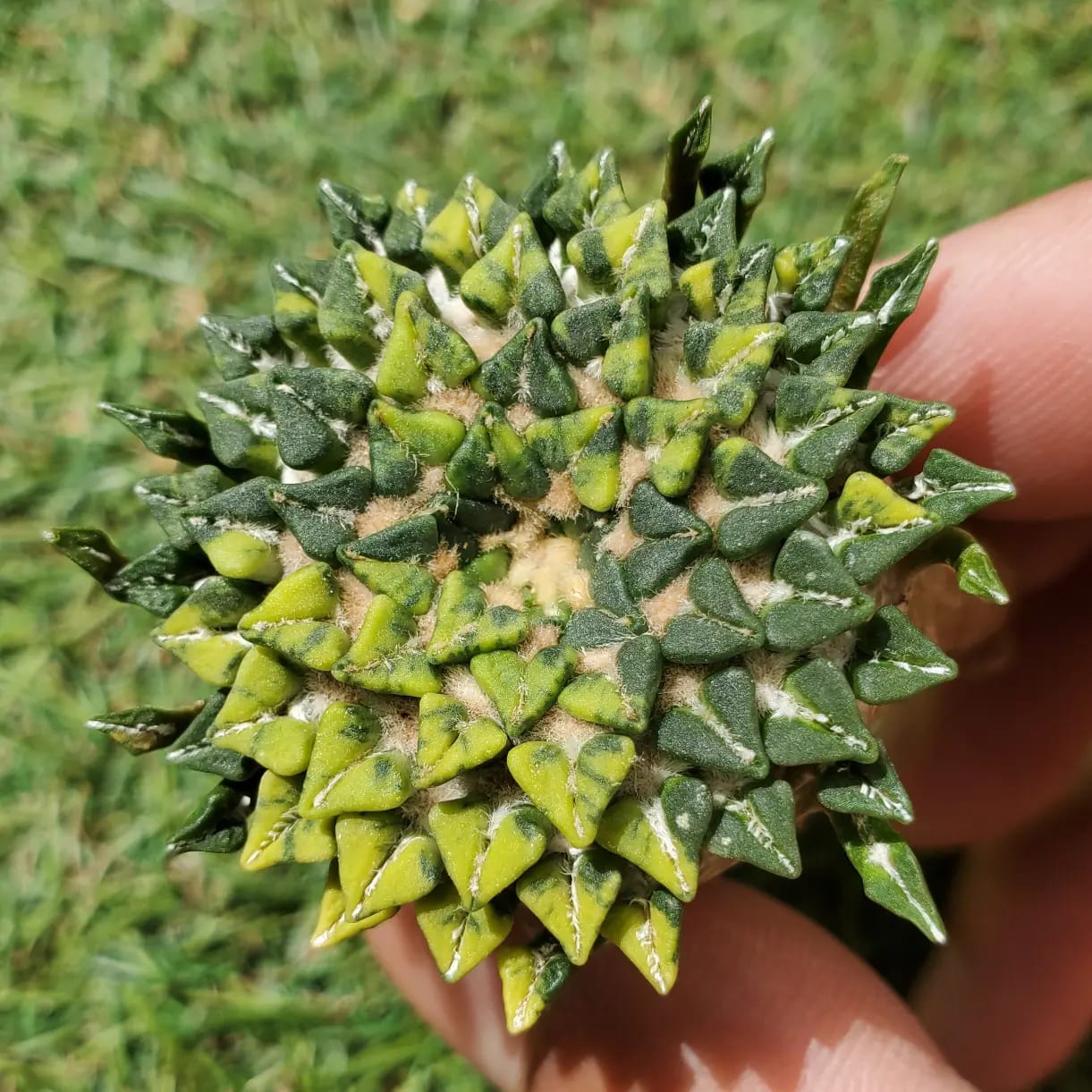
Shown is a rare variegated kotschoubeyanus. The narrow, elongated tubercles of the type form, each carrying a central woolly furrow that runs the full length of the upper surface. This stripe of wool is the defining visual character of the species.
The tubercles are the most distinctive feature and the one that most immediately separates kotschoubeyanus from everything else in Ariocarpus. They are deltoid to elongated-triangular in outline, 5 to 13 mm long and 3 to 10 mm wide, spirally arranged from the center outward, and narrower at the base than at the widest point. The surface is dark olive-green, darker than the grey-green of most Ariocarpus, and this color intensifies with drought stress and light exposure. The defining character is the woolly furrow — a continuous stripe of off-white wool running along the center of each tubercle from base to tip. This furrow is the areole itself, drawn out across the full length of the tubercle surface rather than concentrated at a point. No spines are present in adults.
The overall silhouette viewed from above is a compact star or rosette, with the narrow tubercle tips pointing outward from the woolly center. In younger plants the arrangement is quite open; in mature plants the tubercles pack more densely and the star outline becomes tighter. The central crown of white to cream wool, from which the flowers emerge, is prominent and clean in healthy actively-growing plants. In dormancy it may grey slightly and flatten.
The taproot in established own-root plants is substantial, often exceeding the above-ground stem in diameter and frequently two to three times longer than the above-ground portion is wide. This root is the plant’s primary water reserve and the reason it can survive the prolonged dry winters of its native range with no surface-level moisture at all. In habitat, during extreme drought, the above-ground stem can contract and retract slightly below soil level, with loose soil debris providing additional insulation and camouflage.
The Key Varieties: macdowellii and elephantidens
The species is variable enough across its 600-kilometer range that two forms have attracted consistent collector attention and appear with regularity in specialist nursery lists. They are different enough in the field that growers encountering both for the first time often do not immediately recognize them as the same species.
var. macdowellii — the northern form
Ariocarpus kotschoubeyanus var. macdowellii occupies the northern end of the species’ range, centered on populations west and east of Parras in Coahuila, with documented localities extending from Viesca across to Estación Marte — a span of over 100 kilometers within Coahuila. This form is smaller than the type, with even more compact proportions and a distinctive tubercle character: the tubercles are notably smaller and hook-shaped at the tip, sometimes described as beak-like, giving the rosette a more delicate, almost fern-like appearance compared to the broader deltoid leaves of the type form.
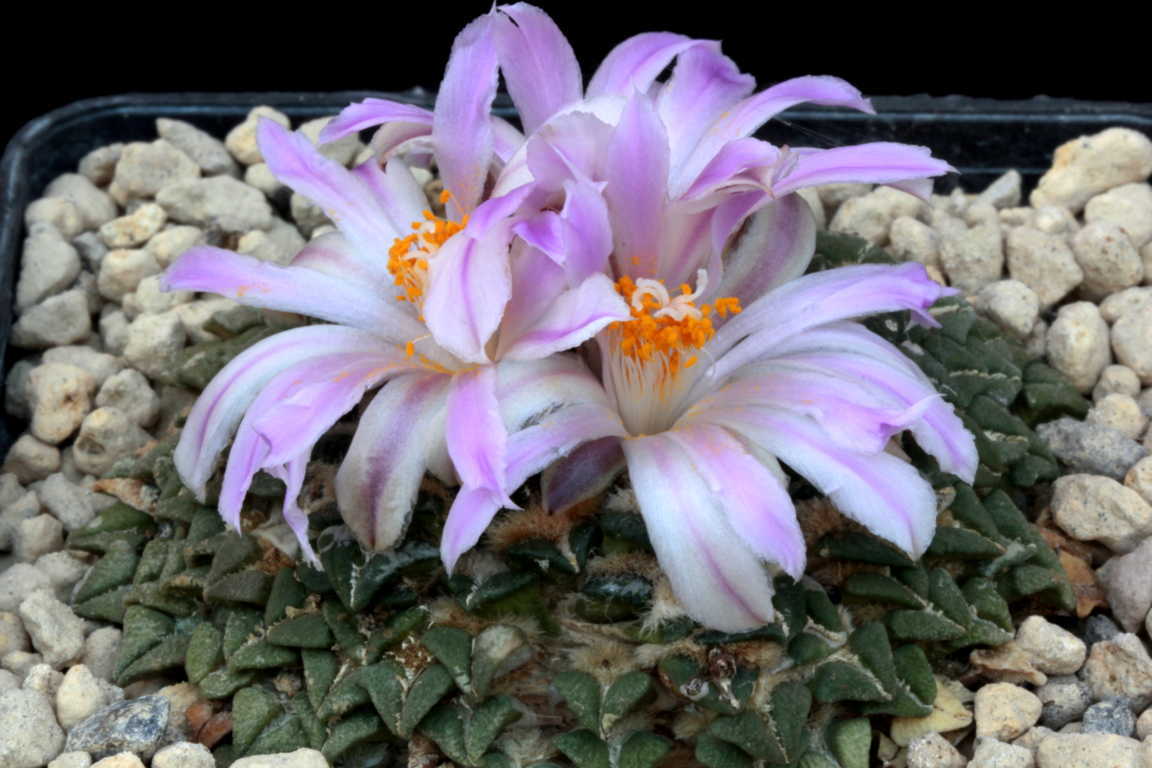
The flower color is one of the clearest diagnostic characters between the varieties. In var. macdowellii, blooms are pale mauve to soft lavender, often with a high proportion of white in the outer petals, giving the flower a washed-out, almost pastel quality compared to the intense magenta of the type form. The overall effect is gentler — a small, quietly pretty plant rather than the vivid flowering display of its southern relatives. Bloom timing typically runs slightly earlier than the southern variety, often beginning in September at the more northerly localities.
Because it comes from the northernmost part of the species’ range, var. macdowellii is the hardiest form of kotschoubeyanus in terms of cold tolerance, making it a logical choice for growers in cooler climates who want to push the boundaries of unprotected outdoor cultivation. It is also the form most often sourced from seed by northern European collectors, partly for this reason and partly because the Coahuila populations are better-documented in the field and more consistently available from ethical specialist suppliers.
var. elephantidens — the southern giant
Ariocarpus kotschoubeyanus var. elephantidens grows at the southern extreme of the species’ range, in a considerably more restricted area in Querétaro. The name refers to the tubercles — elephantidens, elephant tooth — and is well chosen. This variety is the largest form of the species, reaching 7 to 8 centimeters in stem diameter, with tubercles that are noticeably broader and more coarsely textured than those of the type or macdowellii. Where the type form’s tubercles are narrow and elongated, those of elephantidens are broadly triangular and prominently ridged, with a more three-dimensional, chunky presence that reads very differently in the hand and on the bench.
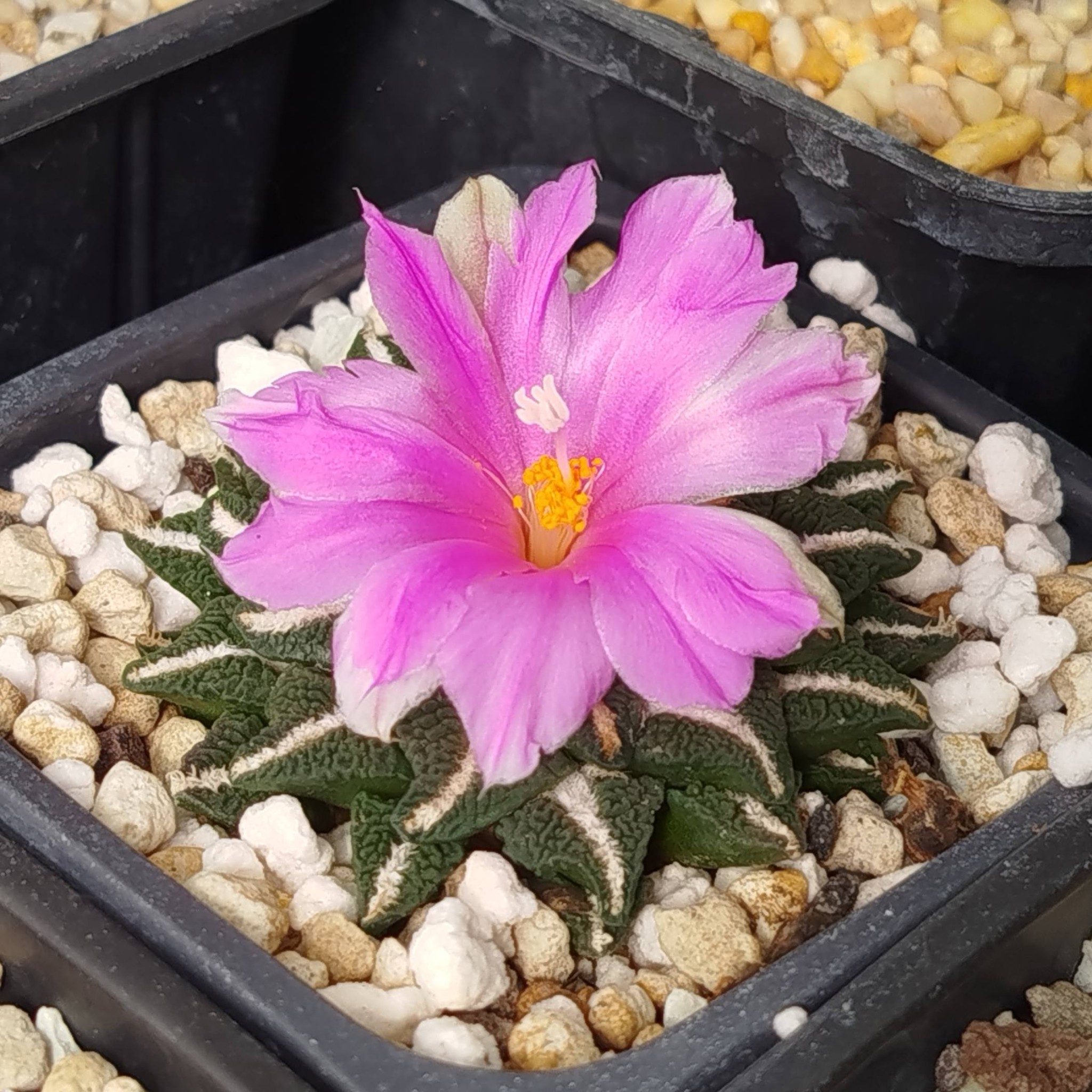
The flower color difference between elephantidens and macdowellii is striking enough that side-by-side flowering plants could plausibly be mistaken for different species by someone who had not seen both before. Where macdowellii produces a pale mauve with white outer petals, elephantidens opens a deep, fully saturated magenta with little or no white content in the petals — a bloom that sits at the intense end of the color range for the entire genus. The flowers typically appear slightly later in the season than macdowellii, from October into November, which aligns with the broader seasonal shift observed in many Querétaro cactus populations relative to Coahuila ones.
One cultivation note specific to elephantidens that experienced growers mention repeatedly: despite its southern, nominally warmer origin, this form is quite cold-sensitive and needs reliable frost protection. It also tends to be somewhat slower-growing than macdowellii under comparable conditions, which combined with its restricted natural range in Querétaro makes it the least commonly available of the three forms and correspondingly more sought-after in the collector market. Legally sourced, seed-grown elephantidens from specialist Czech, Spanish, and Japanese growers does exist and is worth seeking out.
| Character | Type (var. kotschoubeyanus) | var. macdowellii | var. elephantidens |
|---|---|---|---|
| Stem diameter | 3–7 cm | 3–5 cm; smaller than type | 6–8 cm; largest form |
| Tubercle shape | Elongated-deltoid, 5–13 mm long | Small, hooked at tip; beak-like | Broadly triangular; coarser texture |
| Flower color | Crimson-magenta | Pale mauve; high white content | Deep magenta; little or no white |
| Bloom period | Sep–Nov | Sep–Oct; often earliest | Oct–Nov; often latest |
| Native range | Coahuila south to Querétaro (broad) | Northern Coahuila (Viesca to Est. Marte) | Southern range, Querétaro (restricted) |
| Cold hardiness | Moderate; to approx. −6°C dry | Hardiest form; most northerly origin | Most frost-sensitive; needs protection |
Flowering: The Disproportionate Bloom
No single feature of Ariocarpus kotschoubeyanus generates more comment from first-time viewers than the flower-to-plant size ratio. This is a cactus with a mature stem that fits comfortably in the palm of your hand, and when it blooms the flower can cover it. A 5-centimeter plant opening a 4-centimeter bloom is not unusual, and this proportion holds across all three varieties — the flower is always strikingly large relative to the body that produced it.
Flowers emerge from the youngest areoles at the center of the woolly crown. They are broadly funnel-shaped when fully open, with lanceolate petals that taper to a pointed tip. Color range across the species runs from pale mauve in var. macdowellii through the intermediate crimson-magenta of the type form to the deeply saturated magenta of var. elephantidens. White-flowered populations (var. albiflorus, recorded from Tamaulipas) exist and occasionally appear in specialist seed collections, though they are rare enough that most collectors will never grow one. Each individual flower lasts three to four days, remaining open during daylight and closing at night. A well-established plant may produce multiple blooms sequentially, extending the display window through several weeks if conditions cooperate.
Pollination in habitat appears to be primarily by bees, and seed set in cultivated plants is achievable by hand-pollinating between plants flowering simultaneously. Fruit is small — white to pale green, 5 to 10 mm long — and ripens slowly over several weeks after pollination. The seeds are small, black, and finely roughened. Fresh seed germinates well; stored seed loses viability more quickly than most cactus species, so sowing in the season of collection gives substantially better germination rates.
From Seedling to Specimen: What to Expect
Ariocarpus kotschoubeyanus is the slowest-growing species in an already slow-growing genus. That statement is not meant to discourage — the slowness is part of what makes a well-grown, decade-old own-root specimen such a satisfying thing to own. But it does mean that timeline expectations need calibrating before you start.
Germination is actually one of the better aspects of working with this species. Fresh seed, sown under warm conditions (25 to 35 degrees Celsius daytime with a modest night drop), can show sprouts within three to five days using the closed-bag or propagator method. Seedlings emerge as a small hypocotyl carrying a pair of cotyledons and then a set of first tubercles that bear tiny rudimentary spines at the areole tip — the same juvenile spine-bearing stage seen in all Ariocarpus species, which disappears as the plant transitions to its adult form.
Growth in the first two years is genuinely slow. You will likely be looking at seedlings with stem diameters of 5 to 10 mm by the end of year two under good growing conditions. This is the stage at which most losses happen in cultivation, particularly from overwatering or from exposing young plants to too much direct sun before they have hardened. Young kotschoubeyanus are more sun-sensitive than adult plants and benefit from filtered light in their first growing seasons.
The adult tubercle character begins to develop in year three to five, and by year five to seven a recognizable plant in the 2 to 3 cm range is achievable on its own roots under good management. Flowering on own-root plants is a long wait — ten to fifteen years is a realistic expectation, and some plants will not flower until even later. Grafted plants reach blooming size much faster, sometimes flowering in three to four years from seed, and grafting remains a practical approach if the goal is seed production or watching the flowers rather than building a collection of long-term own-root specimens.
The largest kotschoubeyanus encountered by experienced growers at shows and in well-documented collections are typically 5 to 6 centimeters across for the type form and macdowellii; elephantidens can reach 7 to 8 centimeters. These are old plants, often twenty or more years from seed. The compactness of the species across all growth stages is one of the reasons it lends itself well to serious collection in limited space: a shelf of mature own-root kotschoubeyanus in deep pots represents decades of cultivation history in a relatively small footprint.
Cultivation
Soil and substrate
The gypsum and limestone substrates that kotschoubeyanus grows on are mineral-dominant, alkaline, and fast-draining despite a fine surface texture. The canonical cultivation ratio is 35 per cent pumice, 15 per cent lava rock, 5 per cent zeolite, 20 per cent granite grit, 20 per cent limestone chip, and 5 per cent worm castings. The zeolite buffers pH around 7.2 to 8.0 and paces nutrients; the lava fraction is the structural drainage aggregate; the limestone chip at 20 per cent covers both the limestone-hill and gypsum-flat populations because the plants grow equally well on limestone-derived soils at all documented localities. The mix must dry completely within 24 hours of watering. Deep pots are essential: this species sits flush with the substrate surface in habitat, but the taproot descends well below the visible body.
All eleven Ariocarpus pages on this site share the genus calcicole identity; limestone is the load-bearing variable across the range, running 20 per cent for the limestone-hill species and matching that fraction for the gypsum-hill taxa (bravoanus, hintonii) with 5 per cent coarse silica added to reflect calcium-sulphate mineralogy at those localities.
| Species | Pumice | Lava | Zeolite | Granite | Limestone | Silica | Organic |
|---|---|---|---|---|---|---|---|
| A. fissuratus | 35% | 15% | 5% | 20% | 20% | 0% | 5% |
| A. fissuratus subsp. lloydii | 35% | 15% | 5% | 20% | 20% | 0% | 5% |
| A. retusus | 35% | 15% | 5% | 20% | 20% | 0% | 5% |
| A. retusus subsp. furfuraceus | 35% | 15% | 5% | 20% | 20% | 0% | 5% |
| A. retusus f. cristata | 35% | 15% | 5% | 20% | 20% | 0% | 5% |
| A. kotschoubeyanus (this page) | 35% | 15% | 5% | 20% | 20% | 0% | 5% |
| A. scaphirostris | 35% | 15% | 5% | 20% | 20% | 0% | 5% |
| A. agavoides | 35% | 15% | 5% | 20% | 20% | 0% | 5% |
| A. bravoanus | 35% | 15% | 5% | 15% | 20% | 5% | 5% |
| A. bravoanus subsp. hintonii | 35% | 15% | 5% | 15% | 20% | 5% | 5% |
| A. trigonus | 35% | 15% | 5% | 20% | 20% | 0% | 5% |
Watering
Ariocarpus kotschoubeyanus is among the most sensitive species in the genus to incorrect watering — both overwatering during dormancy and underwatering during active growth. Getting this balance right is the central challenge of growing the species well.
During the growing season (late spring through early autumn), the rhythm is drench and then wait. Water thoroughly, ensuring the substrate is soaked through to the bottom of the pot, and then wait until it has dried completely before watering again. In a warm, well-lit situation with a proper inorganic mix, this might be every ten to fourteen days in summer. In cooler or cloudier conditions, extend the interval considerably. The plant’s body is a reasonable guide: a firm, slightly turgid stem means it has adequate water; a plant that looks slightly deflated or whose tubercles feel less firm than usual is signaling it is ready.
Once temperatures drop in autumn and the plant moves toward dormancy, reduce frequency sharply and stop altogether once nights are consistently below 10 degrees Celsius. This is not a suggestion — a cold, wet root is how you lose this species quickly. The dry winter period typically runs four to five months in temperate growing situations. In spring, wait for nighttime temperatures to settle reliably above 10 degrees and for signs of new growth at the apex before resuming regular watering.
One characteristic of kotschoubeyanus worth knowing: the species is one of the few Ariocarpus that in habitat can experience brief flooding during the monsoon season, with standing water across the gypsum flats after heavy rain. This does not mean it should be treated as moisture-tolerant in cultivation — the critical difference is that habitat flooding is warm-season, brief, and followed by fast drainage through a mineral substrate. A plant standing in cold water for any extended period is a different situation entirely.
Light
Full sun is correct for mature plants, but this species requires more careful judgment about light than most other Ariocarpus. Several experienced growers note that kotschoubeyanus is the most sun-sensitive species in the genus, and that young or recently shipped plants need gradual acclimatization to direct sun rather than immediate full exposure. A plant placed in intense unfiltered sun too quickly can bleach, and the damage to small or weakened specimens can be severe enough to kill.
For established, hardened plants, direct sun through the growing season is fine and produces the best body color and most compact growth habit. The dark olive-green deepens and the tubercles hold their form better under strong light. Plants grown in shade or with insufficient light produce open, elongated tubercle arrangements that read immediately as suboptimal — the star rosette loses its tight character and the plant looks unwell even if it is not actually sick.
In extremely hot greenhouse conditions in midsummer, some light shading during the peak afternoon hours can prevent bleaching without meaningfully compromising growth. Watch the plant rather than following a fixed rule.
Temperature and cold hardiness
The type form and var. macdowellii handle brief dry frost to approximately −6 to −8 degrees Celsius; var. elephantidens is more cold-sensitive and should be protected once temperatures approach freezing. In all cases, the critical variable is moisture — a completely dry plant handles cold far better than one that has recently been watered. In USDA zone 9b and warmer, established own-root plants with bone-dry roots can often be left outdoors in winter. In zones 8 and colder, bring them under cover.
Grafting vs. own root
Grafted kotschoubeyanus are common in the trade and serve a legitimate purpose: they reach blooming size much faster and are useful for producing seed and observing flowers. The horticultural downside is the same as with all grafted Ariocarpus — grafted plants grow taller and more open than own-root specimens and do not develop the characteristic flat, flush-with-soil profile of a long-term own-root plant. If the goal is building a collection that looks like it belongs in the desert, own-root is the path.
Degrafted plants — plants that were grafted at some point and then had the graft removed, growing on their own roots thereafter — will develop a new taproot, but it is never the same as a root system that developed from seed in the ground. Own-root from seed is the benchmark, and the price premium for verified own-root seed-grown material from reputable suppliers reflects both the time investment and the quality difference.
Related Taxa in the Genus
Ariocarpus fissuratus subsp. lloydiiThe southern living rock — a convex, smoothly tubercled plant from Coahuila and Zacatecas with a very different silhouette from kotschoubeyanus. The contrast between the two species illustrates the remarkable morphological diversity within a single small genus.Ariocarpus retususThe largest species in the genus and the most commonly available to collectors. Faster-growing than kotschoubeyanus, with pointed triangular tubercles and white to pale pink flowers. The natural starting point for anyone new to the genus.Ariocarpus trigonusThe northeast Mexico counterpart to retusus, with longer, more prominent triangular tubercles and a sprawling, wide-bodied growth habit. Yellow-white flowers distinguish it from all other species in the genus at a glance.Sources & References
Lemaire, C. (1842). Anhalonium kotschoubeyanum. Cact. Gen. Nov. Sp. · Schumann, K.M. (1898). In Engler & Prantl, Nat. Pflanzenfam. · Anderson, E.F. & Fitz Maurice, W.A. (1997). Ariocarpus revisited. Haseltonia 5: 1–20. · Gómez-Hinostrosa, C., Sotomayor, M., Hernández, H.M. & Smith, M. (2013). Ariocarpus kotschoubeyanus. IUCN Red List of Threatened Species. Version 2022-2. · Royal Botanic Gardens, Kew. Plants of the World Online. Ariocarpus kotschoubeyanus (Lem.) K.Schum. Retrieved 2026. · Lüthy, J.M. (2000). Notes on Ariocarpus kotschoubeyanus. Cactus & Co. 4(2).