
Ariocarpus trigonus — The Seven Stars Cactus
| Family | Cactaceae |
| Named by | (F.A.C.Weber) K.Schum. (1898) |
| Basionym | Anhalonium trigonum Weber (1893) |
| Native range | Tamaulipas, Nuevo León |
| Altitude | 600–1,200 m |
| Stem diameter | 5–30 cm |
| Tubercles | 3–8 cm long, sharply keeled |
| Flowers | Yellow to creamy yellow |
| CITES | Appendix I |
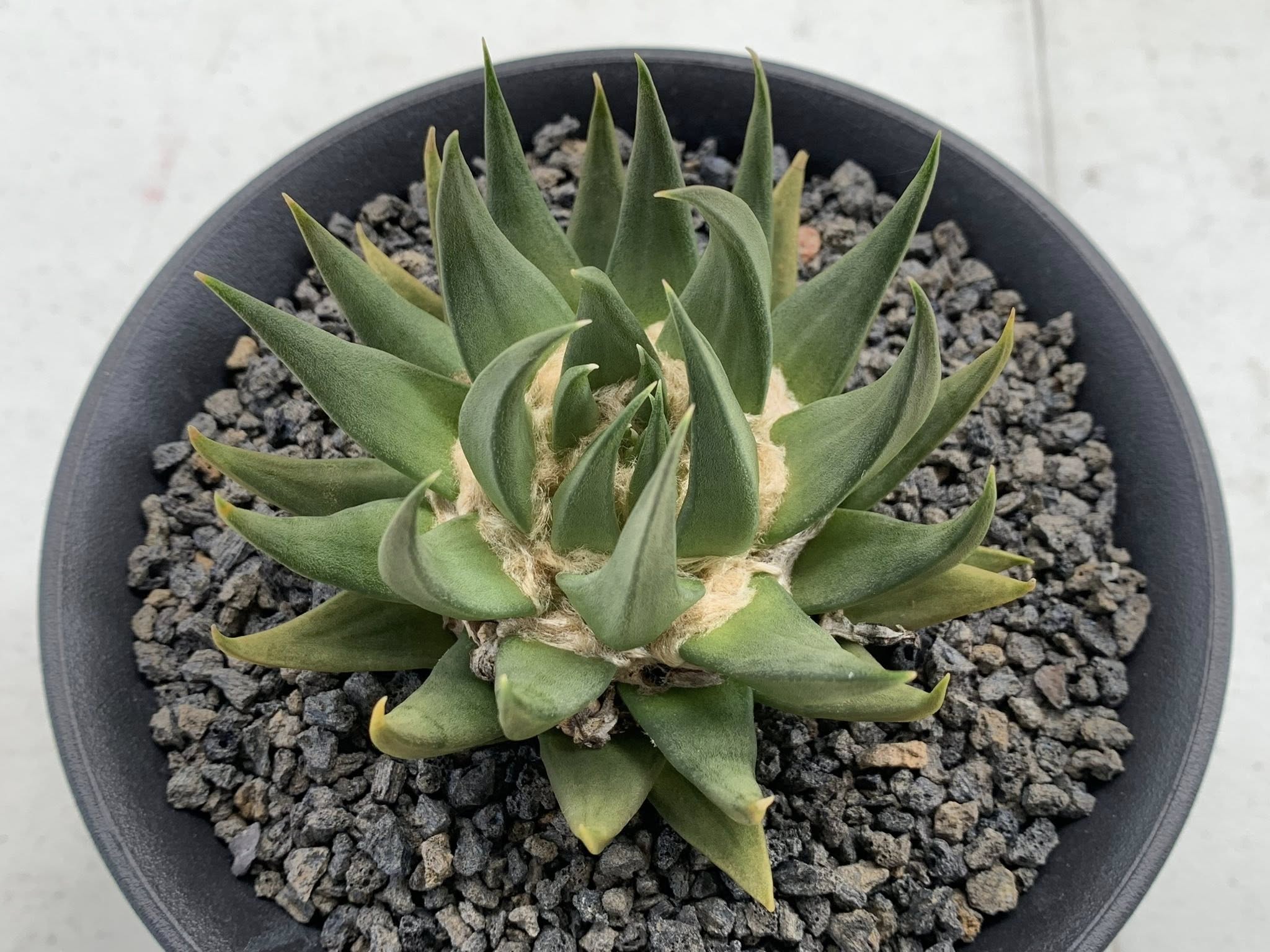
Ariocarpus trigonus is the largest member of its genus and one of the most distinctive. A mature plant can reach 30 centimeters in diameter, with long, sharply triangular, strongly incurved tubercles that give the rosette a bold, angular profile unlike anything else in Ariocarpus. The flowers are yellow, which is the single most reliable diagnostic character separating it from the closely related Ariocarpus retusus, whose flowers are white to pale pink. That floral character, combined with the longer and more pronouncedly keeled tubercles, has kept trigonus in periodic taxonomic tension with retusus for over a century.
The species occurs on the eastern slopes of the Sierra Madre Oriental in the Mexican states of Tamaulipas and Nuevo León, with its core populations concentrated in the Jaumave Valley and the limestone terrain between Montemorelos and Linares. It grows at lower elevations than most other Ariocarpus species, typically between 600 and 1,200 meters, in xerophytic scrubland on calcareous substrate. Among its genus, it has one of the larger natural distributions, stretching across roughly 400 kilometers of suitable habitat, and it can form sizable colonies of numerous individuals where conditions permit.
For collectors, Ariocarpus trigonus offers a different experience from the miniature, slow-motion species that dominate the genus. It is still slow by any reasonable standard, but it grows faster than fissuratus or bravoanus, reaches an impressive size at maturity, and the yellow flowers ringing the woolly crown are a sight that justifies the wait. This page covers the species in full: taxonomy, habitat, the distinctive morphology, localities, flowering, growth from seed, cultivation, and how to tell it apart from the retusus complex.
Contents
Taxonmy & Nomenclature
The species was first described in 1893 by Frédéric Albert Constantin Weber as Anhalonium trigonum, published in Bois’s Dictionnaire d’Horticulture. The specific epithet trigonus derives from the Greek for “three-angled” or “triangular,” a direct reference to the shape of the tubercles. Karl Moritz Schumann transferred the species to Ariocarpus in 1898, establishing the combination Ariocarpus trigonus (F.A.C.Weber) K.Schum. that remains in use today.
The species-level status of trigonus has been challenged. Anderson and Fitz Maurice, in their influential 1997 revision of the genus, reduced it to Ariocarpus retusus subsp. trigonus, treating the yellow-flowered, long-tubercled plants of Tamaulipas and Nuevo León as a geographic subspecies of the more widespread retusus. Their reasoning was based on the overlap in vegetative characters between the two, the existence of intermediate forms, and the molecular phylogenetic evidence available at the time, which did not strongly support species-level separation. Kew’s Plants of the World Online, however, currently accepts Ariocarpus trigonus at species rank, a position supported by the consistent difference in flower color and the geographic separation of the core populations.
The synonymy includes: Anhalonium trigonum F.A.C.Weber (1893), Ariocarpus retusus subsp. trigonus (F.A.C.Weber) E.F.Anderson & W.A.Fitz Maur. (1997), and Ariocarpus trigonus var. minor Voldan (1976), a smaller form from Kaktusy (Brno). Voldan’s variety is not widely accepted but appears occasionally in seed lists. The name Ariocarpus confusus Halda & Sladkovský also appears in the literature for plants intermediate between trigonus and retusus; its status is unresolved.
Common names: Seven Stars Cactus (shared with retusus), Living Rock (generic to the genus), and occasionally Landmine Flower in English-language popular media. The Huichol name tsuwiri (“false peyote”) has been applied to retusus broadly and may extend to trigonus populations as well.
Historical synonyms (3)
- Anhalonium trigonum F.A.C.Weber, 1893 basionym
- Ariocarpus trigonus var. minor Voldan, 1976 homotypic synonym
- Ariocarpus retusus subsp. trigonus (F.A.C.Weber) E.F.Anderson & W.A.Fitz Maur., 1997 heterotypic synonym
Sources: POWO (Kew) · IPNI · GBIF · Wikidata
Habitat & Native Range
Ariocarpus trigonus is native to the Mexican states of Tamaulipas and Nuevo León, where it grows on the eastern slopes and intermontane valleys of the Sierra Madre Oriental. The core distribution stretches from the area north of Monterrey, between Montemorelos and Linares, southward into the Jaumave Valley south of Jaumave in Tamaulipas. This gives the species one of the broader distributions in the genus, spanning roughly 400 kilometers of limestone terrain.
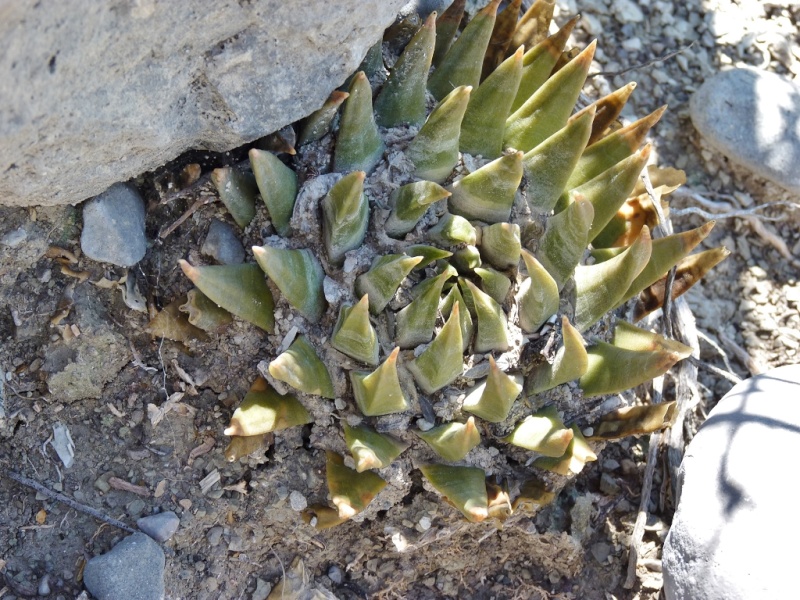
The altitude range is lower than most other Ariocarpus species: typically 600 to 1,200 meters, compared to the 1,500 to 2,000 meters occupied by bravoanus and fissuratus. The substrate is invariably calcareous, predominantly fractured limestone, with the plants growing in thin soil pockets or directly in crevices between rocks. The vegetation community is xerophytic microphyllous scrubland, a sparse, low canopy of thorny shrubs and small trees interspersed with bare rock and gravel.
Unlike several other Ariocarpus species that are restricted to a single valley or municipality, trigonus has demonstrated tolerance for a range of ecological conditions within its limestone niche. The paper by Martínez-Ávalos and Suzán-Azpiri on the distribution of Ariocarpus in Tamaulipas noted that retusus subsp. trigonus (as they treated it) had the largest distribution of any Ariocarpus taxon in the state, owing to its tolerance for different soil types, vegetation structures, and its ability to survive even without the nurse plants that many cacti depend on for establishment.
This broader distribution provides a somewhat more favorable conservation outlook than the extremely restricted bravoanus, though habitat loss to agriculture and urban expansion remains a concern, as does continued collection for the horticultural trade.
The eastern slopes of the Sierra Madre Oriental where Ariocarpus trigonus grows also support scattered populations of Lophophora williamsii in parts of Tamaulipas and Nuevo León, though the two genera tend to segregate by altitude and substrate preference. Lophophora favors the drier, more open flats at slightly different elevations, while trigonus colonizes the limestone slopes and valley floors of the Sierra’s eastern drainage. Further south in the range, the habitat transitions into territory occupied by other Ariocarpus species including Ariocarpus agavoides, which is restricted to a tiny area near Tula in southern Tamaulipas.
Morphology
Ariocarpus trigonus is the giant of its genus. Mature plants routinely reach 15 to 25 centimeters in diameter, and exceptional specimens can exceed 30 centimeters across, making them larger than any other Ariocarpus species. The body is a flattened to slightly domed rosette, though older plants sometimes develop a more elevated profile, and colonies of multiple stems can form over time.
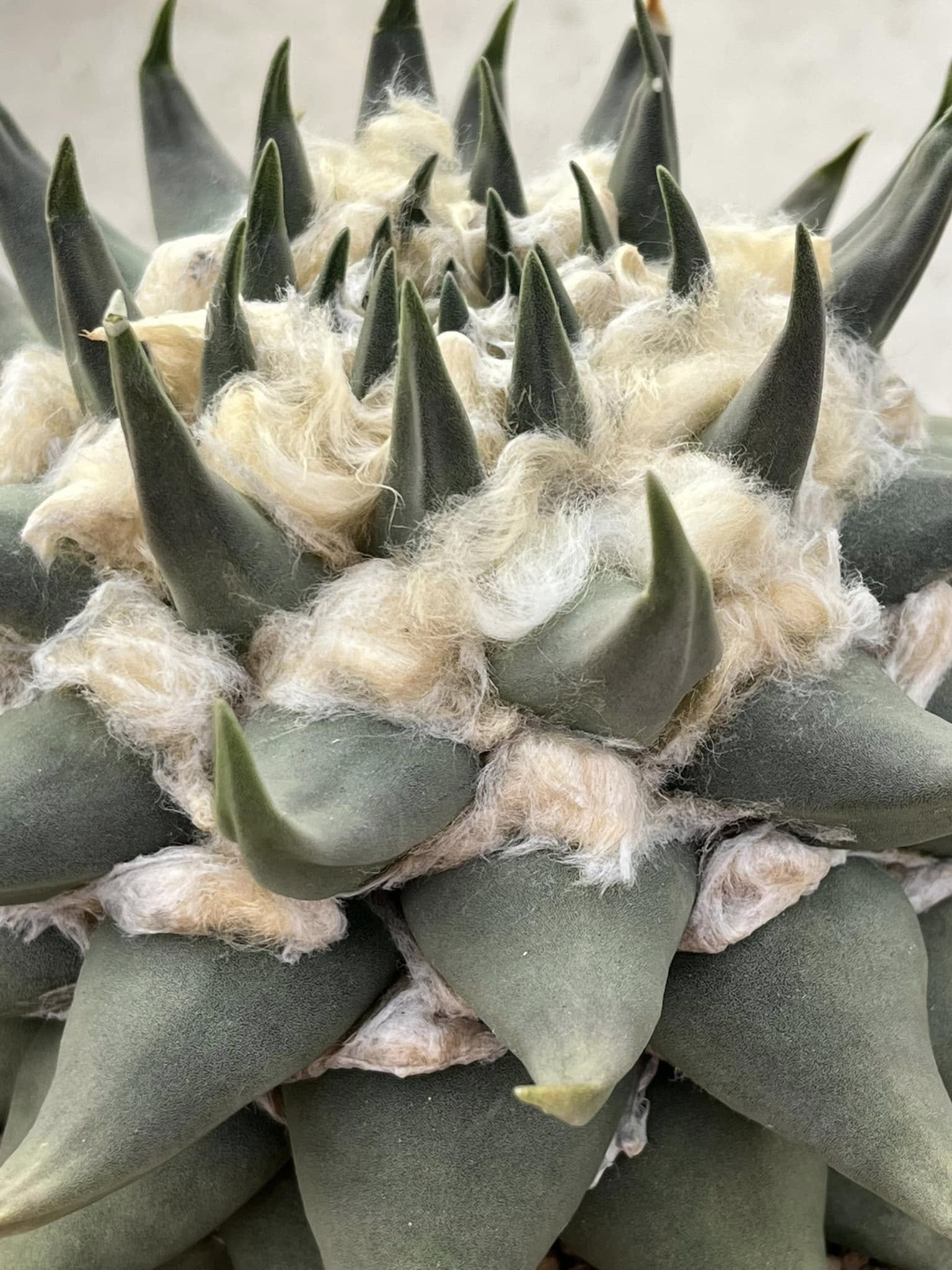
The tubercles are the species’ signature character. Each is sharply triangular, 3 to 8 centimeters long and 1.5 to 2.5 centimeters wide at the base, acutely pointed at the tip, and strongly curved inward. The upper surface is flat to slightly concave, the lower surface is sharply keeled, and the overall color ranges from brownish-gray-green to yellowish-green, often with a glossy sheen that distinguishes them from the matte surfaces of most other Ariocarpus species. The areoles are nearly invisible, reduced to small pads near the tubercle tips that are easy to overlook without magnification.
Beneath the rosette sits a massive, beet-shaped taproot that can exceed the above-ground body in volume. In seed grown plants grown for decades, the root system develops into a substantial structure that anchors the plant firmly in its rocky substrate and stores enough water and nutrients to carry it through the long dry season. The root surface is pale and smooth, with fine lateral roots branching from the lower third.
Population-level morphological variation across the range is notable. Plants from the Jaumave Valley in Tamaulipas tend to have particularly long, narrow tubercles and a more open rosette form, while material from around Aramberri in Nuevo León has been noted for an elongatus-like morphology with broader, flatter tubercles at the base. These geographic variants have been given various cultivar or informal names in the collector world but are not treated as formal taxonomic entities.
Localities & Distribution
The documented distribution of Ariocarpus trigonus extends across two Mexican states. Key locality clusters include the Jaumave Valley (south of Jaumave, Tamaulipas), the area between Montemorelos and Linares in Nuevo León, the hills north of Ciudad Victoria in Tamaulipas, and the geographically isolated population near Joya de Bocacelly in Aramberri municipality, Nuevo León. The last of these is particularly interesting: it occupies a valley dominated by Ariocarpus confusus (a debated taxon intermediate between trigonus and retusus), and the trigonus plants at the eastern end of that valley show morphological characteristics that suggest intergradation between the two.
Ariocarpus trigonus — Known Localities
The species’ distribution across a wider area than most Ariocarpus taxa provides some buffer against extinction from localized threats. However, the eastern slopes of the Sierra Madre Oriental are under increasing pressure from agricultural expansion, road construction, and urban growth around Monterrey. The combination of these habitat pressures and continued collection for the specialist trade means that even a relatively well-distributed Ariocarpus is not immune to population declines.
Flowering & Fruit
The flowers of Ariocarpus trigonus are yellow to creamy yellow, funnel-shaped, and reach up to 5 centimeters in both length and diameter. This is the single most important diagnostic character of the species: no other Ariocarpus consistently produces yellow flowers. The blooms emerge from the woolly center of the rosette in a ring around the crown, and a well-grown mature plant can produce multiple flowers simultaneously, creating the “wreath” of yellow blooms described in the original literature.
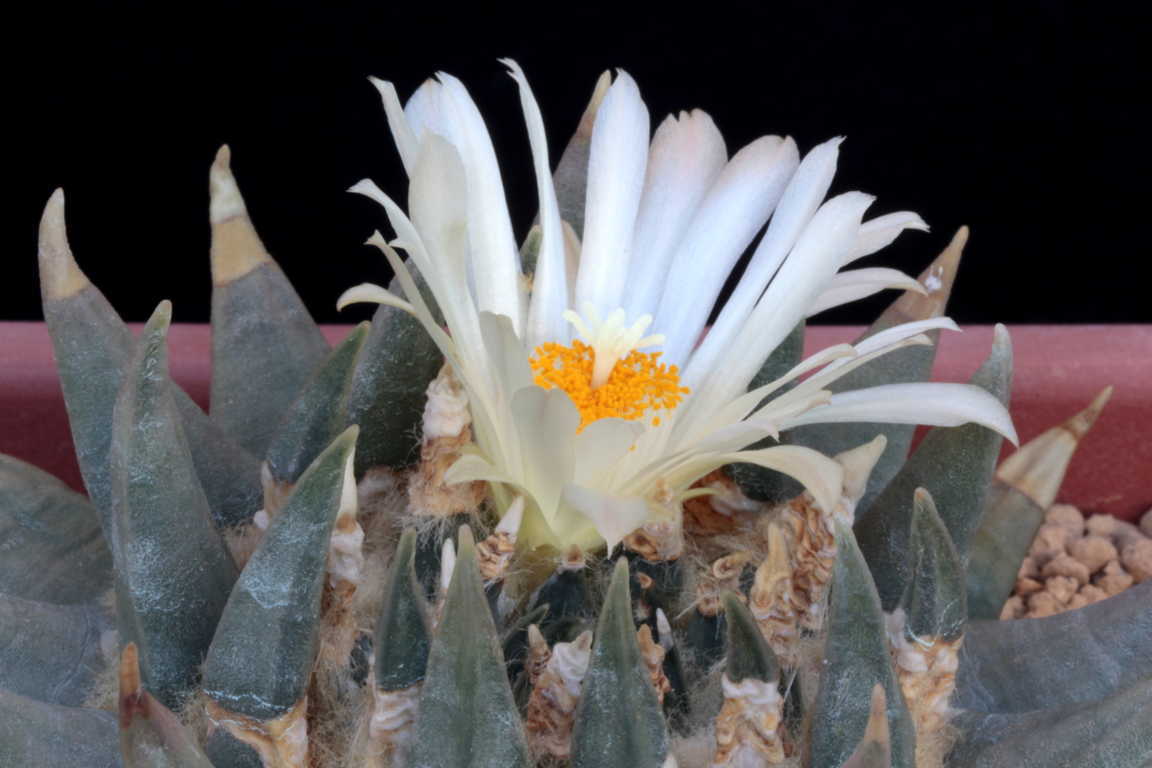
The flowering season runs from late September through November in cultivation, somewhat later than most other Ariocarpus species. In habitat, flowering occurs in autumn after the summer rains, and the timing varies with local conditions. The flowers are open during the day, closing at night, and each bloom lasts two to three days. Pollen is pale yellow, the stigma lobes are white to pale green, and the overall flower structure is typical of the genus.
Seed set requires cross-pollination. The fruits are greenish, globose to slightly elongated, and small relative to the flower. They dry within the crown wool as they mature, eventually splitting to release the small, black, pear-shaped seeds that are characteristic of all Ariocarpus species. Seed viability is good, and fresh seed germinates readily under standard controlled conditions.
From Seedling to Specimen
Ariocarpus trigonus is one of the faster-growing members of its genus, which is a relative statement: it is still a slow plant by any normal horticultural measure. From seed, a plant may reach 3 to 4 centimeters in diameter after five to seven years of attentive cultivation, with the taproot developing aggressively from the outset. The first triangular tubercles become recognizable within the first one to two years, and by year three or four the plant begins to display the characteristic keeled, incurved form that identifies the species.
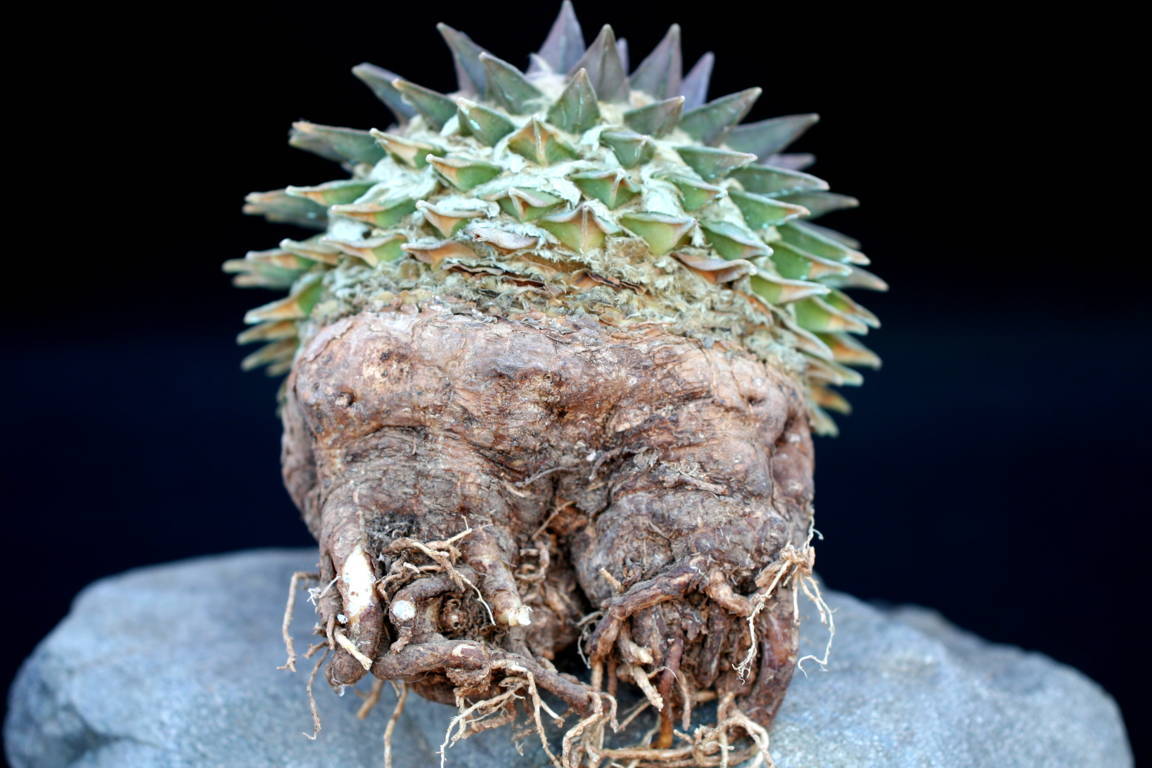
Because trigonus ultimately reaches a much larger size than most other Ariocarpus, the growth trajectory extends over a longer period. A truly mature seed grown specimen of 15 to 20 centimeters may represent 20 to 30 years of cultivation, and plants approaching 30 centimeters are multi-decade commitments. This long timeline is part of the appeal: a large, well-grown trigonus is a statement piece that announces patience, skill, and time.
Grafting onto vigorous rootstock (Pereskiopsis for seedlings, Echinopsis or Myrtillocactus for larger plants) accelerates growth substantially. Grafted plants can reach flowering size within three to four years. As with all Ariocarpus, the trade-off is a body form that is puffier, more elevated, and less natural-looking than a seed grown plant. For this species in particular, the visual impact of a large, flat, long-tubercled rosette on its own roots is dramatically different from the inflated, slightly comical look of a large grafted specimen.
Cultivation
Substrate
The standard Ariocarpus calcicole mineral mix calibrated for the calcareous slopes of Coahuila and Nuevo León. The canonical ratio is 35 per cent pumice, 15 per cent lava rock, 5 per cent zeolite, 20 per cent granite grit, 20 per cent limestone chip, and 5 per cent worm castings. The zeolite buffers pH around 7.0 to 8.0 and paces nutrients; the lava fraction is the structural drainage aggregate; the limestone chip at 20 per cent tracks the calcareous substrate across the broad Coahuila and Nuevo León range. Because trigonus grows to a larger size with a correspondingly large root system, use a long tom or rose-style pot and larger aggregate particles (4 to 6 mm) as plants mature.
All eleven Ariocarpus pages on this site share the genus calcicole identity; limestone is the load-bearing variable across the range, running 20 per cent for the limestone-hill species and matching that fraction for the gypsum-hill taxa (bravoanus, hintonii) with 5 per cent coarse silica added to reflect calcium-sulphate mineralogy at those localities.
| Species | Pumice | Lava | Zeolite | Granite | Limestone | Silica | Organic |
|---|---|---|---|---|---|---|---|
| A. fissuratus | 35% | 15% | 5% | 20% | 20% | 0% | 5% |
| A. fissuratus subsp. lloydii | 35% | 15% | 5% | 20% | 20% | 0% | 5% |
| A. retusus | 35% | 15% | 5% | 20% | 20% | 0% | 5% |
| A. retusus subsp. furfuraceus | 35% | 15% | 5% | 20% | 20% | 0% | 5% |
| A. retusus f. cristata | 35% | 15% | 5% | 20% | 20% | 0% | 5% |
| A. kotschoubeyanus | 35% | 15% | 5% | 20% | 20% | 0% | 5% |
| A. scaphirostris | 35% | 15% | 5% | 20% | 20% | 0% | 5% |
| A. agavoides | 35% | 15% | 5% | 20% | 20% | 0% | 5% |
| A. bravoanus | 35% | 15% | 5% | 15% | 20% | 5% | 5% |
| A. bravoanus subsp. hintonii | 35% | 15% | 5% | 15% | 20% | 5% | 5% |
| A. trigonus (this page) | 35% | 15% | 5% | 20% | 20% | 0% | 5% |
Watering
Ariocarpus trigonus tolerates slightly more generous watering during the active growing season than the smaller, more sensitive members of the genus, reflecting its lower-elevation habitat and broader ecological tolerance. A deep soak every 7 to 14 days from May through September, with complete drying between waterings, is a reasonable starting point. Reduce in autumn, stop by November, and keep dry through winter. The larger root system stores more water than that of a bravoanus or kotschoubeyanus, which provides a small buffer against occasional timing errors, but overwatering remains the primary cause of loss.
Light
Full sun to very bright light. The species occurs at lower elevations than most Ariocarpus, in relatively open xerophytic scrubland, and it is adapted to high light intensity. Strong light produces the compact, flat growth habit and the rich brownish-green tubercle coloring. Under insufficient light, the plant stretches upward, the tubercles become greener and softer in appearance, and flowering may be reduced.
Temperature
Tolerant of a wide temperature range. In habitat, plants experience summer highs well above 35°C and occasional light frosts in winter. In cultivation, maintain above 5°C during winter dormancy and provide good ventilation at all times. The lower-elevation origin of this species means it is slightly less cold-hardy than the higher-altitude members of the genus.
Containers
Use progressively larger, deep containers as the plant grows. A mature trigonus of 15 centimeters may need a pot 20 centimeters or more in depth. Wide, shallow bowls look appealing but restrict root development. Terracotta is recommended for breathability. Repot every two to three years, or when the taproot is visibly constricted.
Distinguishing from Ariocarpus retusus
Ariocarpus trigonus and Ariocarpus retusus are the two most frequently confused species in the genus. The confusion is not unreasonable: they share a similar overall body plan, overlap geographically in parts of Nuevo León and Tamaulipas, and intermediate forms exist. Anderson and Fitz Maurice’s decision to treat trigonus as a subspecies of retusus reflects this continuum. Nonetheless, the two are distinguishable by a set of consistent characters, summarized below.
The most reliable field and greenhouse character remains flower color. If the plant produces yellow flowers, it is trigonus. If white or pink, it is retusus. Vegetative characters show enough overlap that a non-flowering plant from the zone of sympatry can be genuinely difficult to assign with confidence, which is precisely the observation that led Anderson and Fitz Maurice to subsume trigonus under retusus in the first place.
Related Taxa in the Genus
Ariocarpus fissuratusThe type form of the Living Rock, ranging from southern Texas deep into Coahuila. Its deeply fissured tubercle surfaces and flat, soil-level growth habit make it one of the most effective camouflage artists in the plant kingdom.Ariocarpus fissuratus subsp. lloydiiA widespread subspecies occupying Coahuila and Zacatecas. Smoother, less fissured tubercles and a slightly greener tone set it apart from the type, though intermediates exist where ranges overlap.Ariocarpus retususThe largest and fastest-growing member of the genus. Broad, blunt-tipped tubercles and white to pale pink flowers across a wide range from Coahuila south to San Luis Potosí.Ariocarpus kotschoubeyanusThe smallest Ariocarpus, deeply embedded in clay soil with only the flat tubercle tips visible at ground level. Vivid magenta flowers emerge from a body barely two centimeters across.Ariocarpus scaphirostrisA narrow endemic from Nuevo León with elongated, keel-shaped tubercles unlike anything else in the genus. Among the most sought-after species in the collector world.Ariocarpus agavoidesNamed for its resemblance to a miniature agave. Elongated, pointed tubercles and persistent spines on mature plants set it apart from every other species in the genus.Ariocarpus bravoanusOne of the most recently described Ariocarpus, discovered in 1992 from a single locality in San Luis Potosí. Practically extinct at its type locality, it is among the rarest cacti on Earth.Ariocarpus bravoanus subsp. hintoniiA dwarf, dark-tubercled subspecies from northern San Luis Potosí with a tangled taxonomic history. Its verrucose, olive-green rosette is unlike any other Ariocarpus in texture.
Sources & References
Weber, F.A.C. (1893). Anhalonium trigonum. In: Bois, D., Dict. Hort. 1: 90. · Schumann, K.M. (1898). Gesamtbeschreibung der Kakteen (Monographia Cactacearum). · Anderson, E.F. & Fitz Maurice, W.A. (1997). Ariocarpus revisited. Haseltonia 5: 1–20. · Martínez-Ávalos, J.G. & Suzán-Azpiri, H. (1999). Geographic distribution of the genus Ariocarpus (Cactaceae) in Tamaulipas, Mexico. · Anderson, E.F. (2001). The Cactus Family. Timber Press. · Voldan, J. (1976). Ariocarpus trigonus var. minor. Kaktusy (Brno) 12: 3. · Royal Botanic Gardens, Kew. Plants of the World Online. Ariocarpus trigonus (F.A.C.Weber) K.Schum. Retrieved 2026.