
Astrophytum Types: A Collector’s Identification Guide
All ArticlesAstrophytum types come down to six species that Kew POWO accepts as of June 2026: asterias, capricorne, caput-medusae, coahuilense, myriostigma, and ornatum. They are told apart by spines, rib count, and flower throat colour. Older lists count four because caput-medusae was only discovered in 2001. This guide identifies all six with photos, plus the cultivar groups collectors search for.
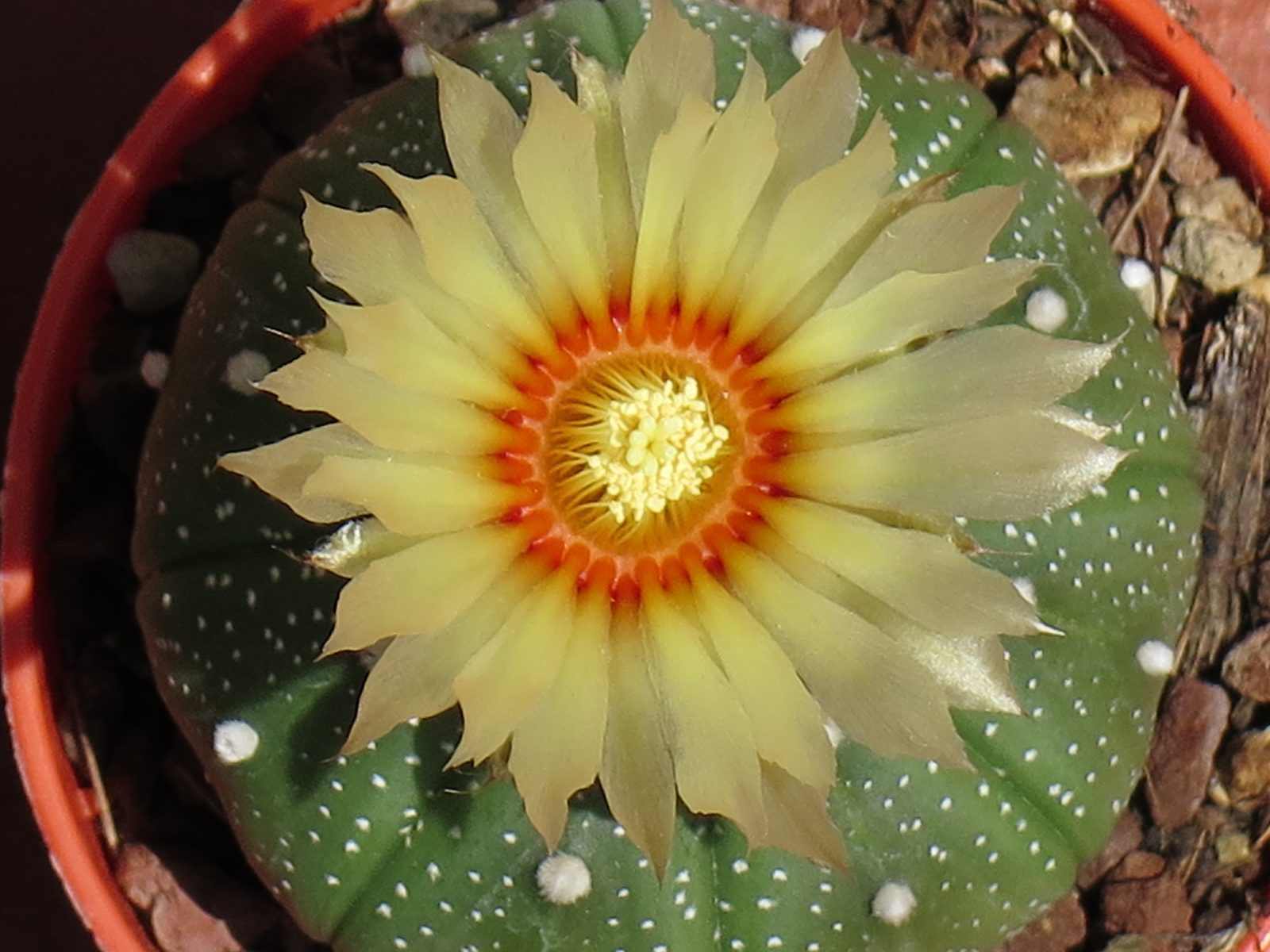
How many Astrophytum species are there?
Astrophytum has six accepted species. Plants of the World Online, the Kew backbone this site follows, accepts Astrophytum asterias, A. capricorne, A. caput-medusae, A. coahuilense, A. myriostigma, and A. ornatum as of June 2026. Older references count four or five because caput-medusae was only discovered in 2001 (first published in its own genus, Digitostigma, before being moved into Astrophytum in 2003), and coahuilense spent decades treated as a subspecies of myriostigma before being raised to full species. The content-farm lists that promise “111 types” reach that number by counting every cultivar and hybrid as a separate species, which is where their credibility ends.
Everything else with an Astrophytum label is a cultivar or a hybrid of these six. The genus is endemic to a band running from south Texas down through the Chihuahuan Desert and the Mexican plateau, and the whole group is unmistakable for the fine white trichome flecking, the “stars” the genus name describes, scattered over the epidermis. Browse the species we cover in depth on the Astrophytum genus hub. To see where the genus sits among the wider family, browse cactus types by growth form.
The six Astrophytum species
1. Astrophytum asterias (Sand Dollar Cactus)
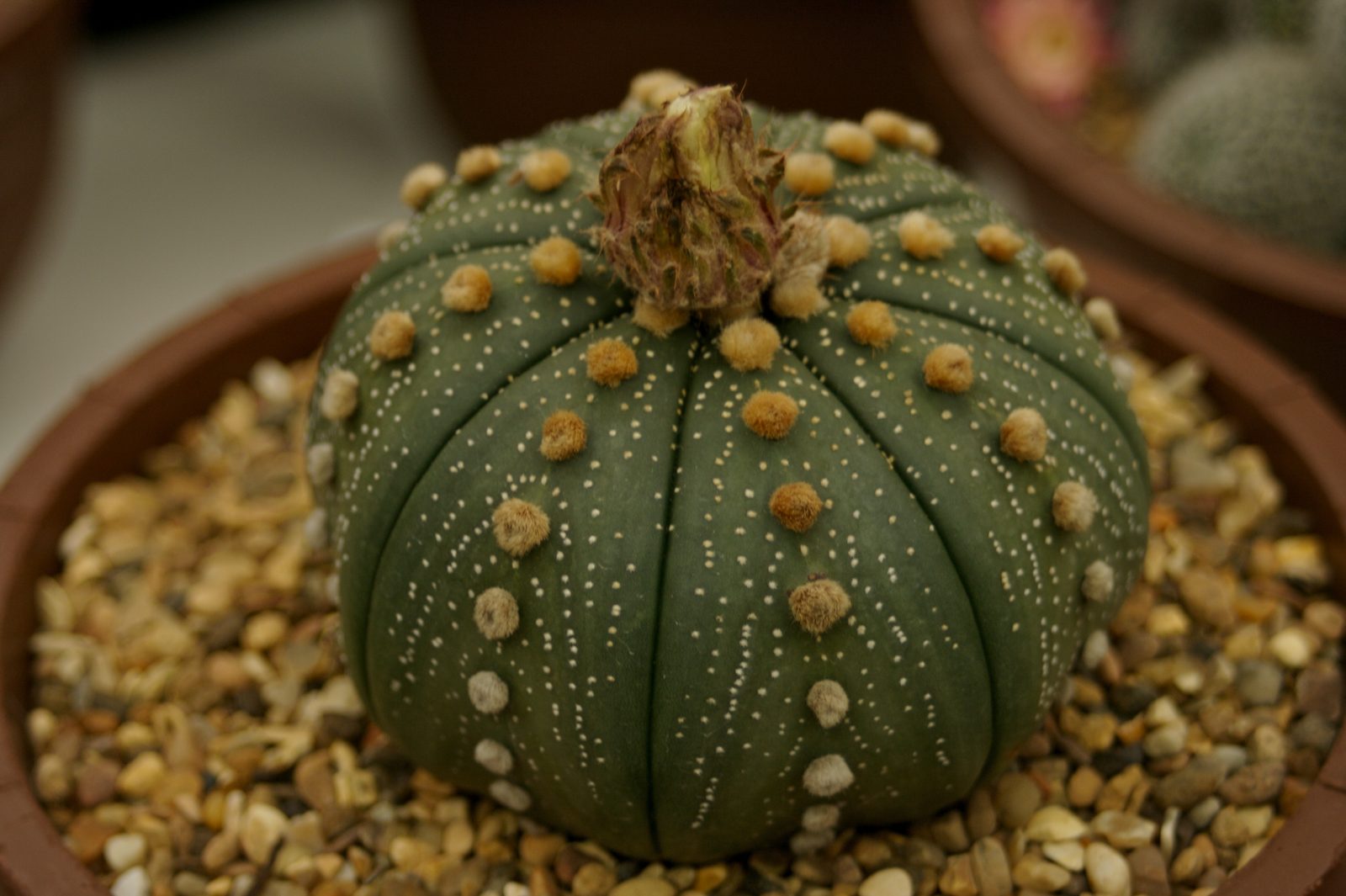
Astrophytum asterias is the flat one. A. asterias stays a low, spineless disc, usually eight broad ribs separated by sharp furrows, with white woolly areole dots running down each rib and fine flecking between. It never builds a column. The yellow flower carries a red-orange throat. This is the most conservation-sensitive cactus in the genus: a narrow native range across south Texas and Tamaulipas, an IUCN listing of Vulnerable, US Endangered Species Act protection, and the only Astrophytum on CITES Appendix I, where it was moved in 1987. Its flat body pools water at the apex, so it is the most rot-prone of the six and wants the sharpest mineral mix and the strictest winter dry rest. Our A. asterias specimen page carries the full habitat and cultivation detail.
2. Astrophytum myriostigma (Bishop’s Cap)
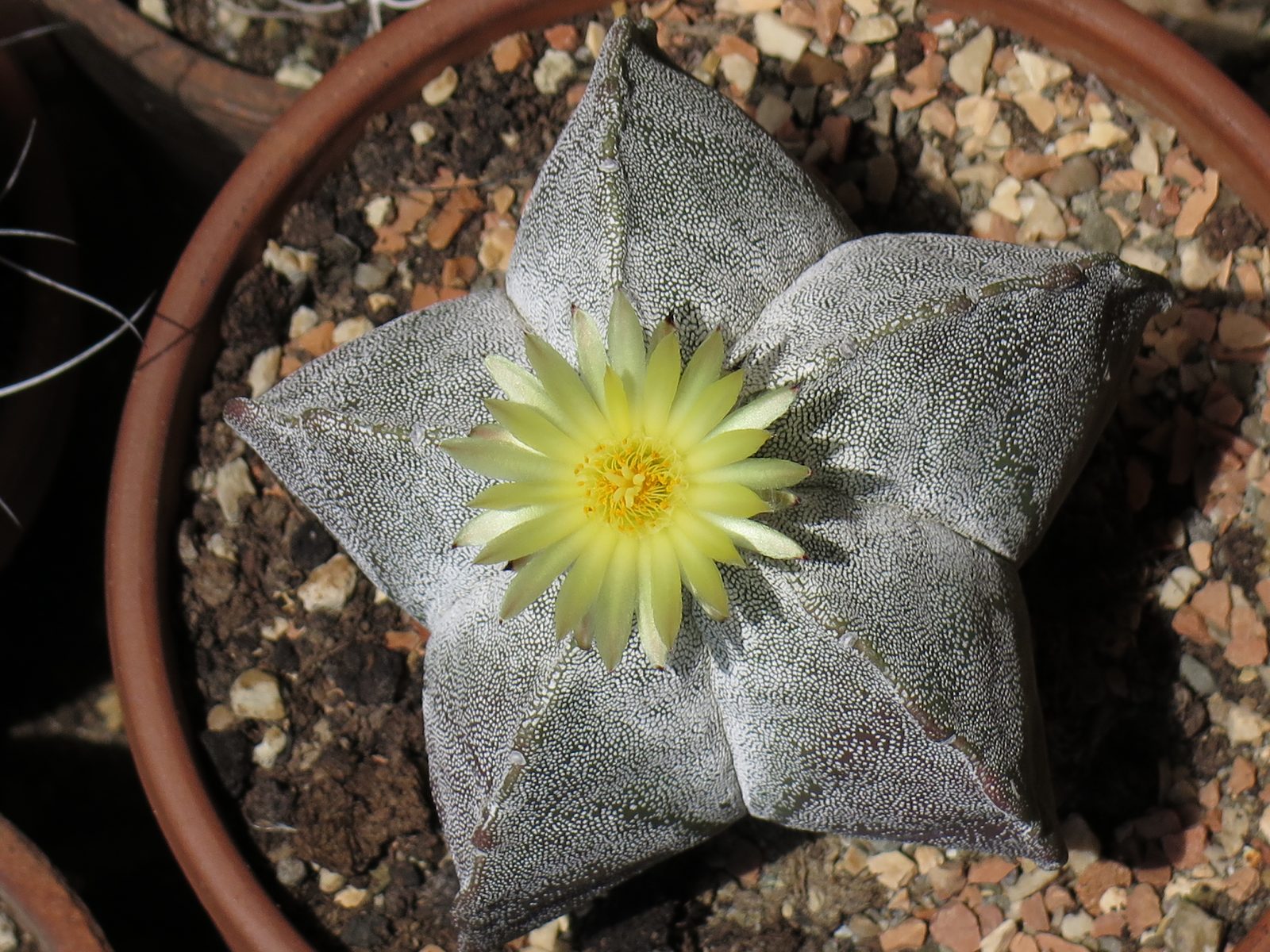
The Bishop’s Cap, and the most-grown Astrophytum. A spineless body, globose when young and slowly becoming columnar to about a metre, with five broad triangular ribs that give the “mitre” outline and a dense, even coat of white trichome scales that can make the plant look silver. The flower is pale to deep yellow, usually without the strong red throat that marks its close relative coahuilense. POWO accepts a four-ribbed form, subsp. quadricostatum. It is the most forgiving species in the genus and the base of the Onzuka cultivar line. See the A. myriostigma specimen page for cultivation specifics.
3. Astrophytum coahuilense (Coahuila Bishop’s Cap)
The look-alike with a tell. A. coahuilense is a spineless, five-ribbed star much like myriostigma, but its flocking is denser, softer, and greyer, giving a more uniformly velvet-white body, and its yellow flower carries a consistent red throat where myriostigma’s does not. The two are reproductively isolated: crosses between them set no seed, which is the clean evidence behind their split into separate species. Its fruit opens at the base and is pinkish, another point of difference. It comes from southwestern Coahuila and Durango at 1,100 to 1,600 m. Our A. coahuilense specimen page sets the two side by side.
4. Astrophytum capricorne (Goat’s Horn Cactus)
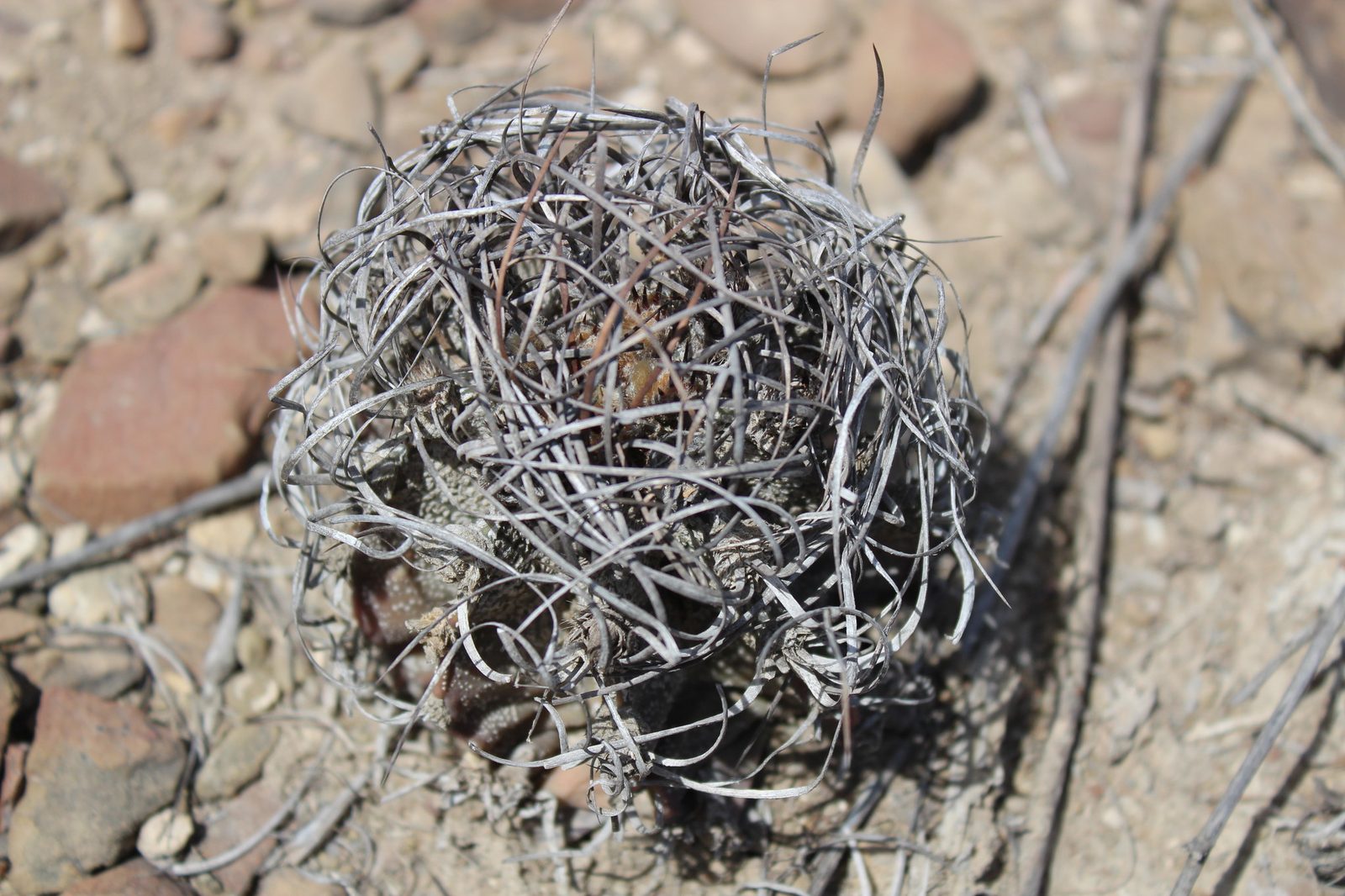
The spined one. Where the star-bodied species are bare, A. capricorne wraps itself in long, twisted, flattened grey-brown spines, up to seven centimetres, papery and flexible rather than rigid, curling over a globose-to-ovoid body of seven to nine flocked ribs. The spines are the instant identifier. The flower is yellow with a red centre and faintly scented. It grows on Coahuila limestone at 500 to 1,500 m and, unlike the rot-prone asterias, is one of the easier species for beginners. The white-spined plants often sold as “var. niveum” are a trade form, not a name POWO accepts.
5. Astrophytum ornatum (Monk’s Hood Cactus)

The big columnar one. A. ornatum is the largest and fastest Astrophytum, building a column that tops a metre in cultivation and three in habitat, with eight ribs that often spiral. It is spined like capricorne but the spines are stout, straight, and yellow-brown rather than twisted and papery, and the white flocking falls in scattered bands across a darker green body rather than coating it evenly. The flower is pale yellow with an orange centre. It is the only species endemic to central Mexico, on limestone canyon slopes in Hidalgo and Querétaro at 800 to 2,000 m, and IUCN lists it as Vulnerable. Being the vigorous grower of the genus, it wants more root room and tolerates more summer water than its relatives.
6. Astrophytum caput-medusae (Medusa’s Head)
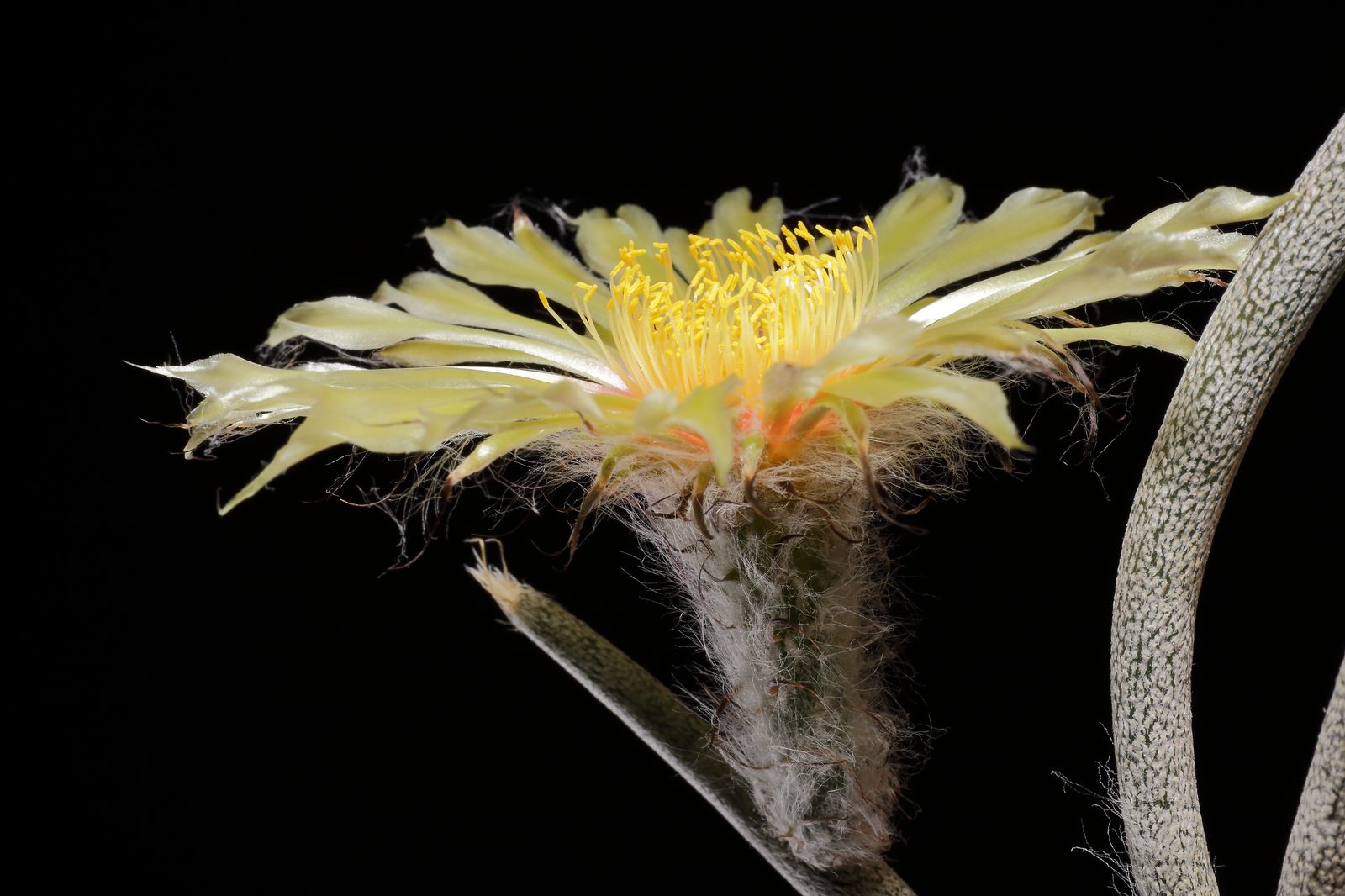
The rule-breaker, and proof that Astrophytum is not a single shape. A. caput-medusae has no ribs at all. Instead, long, thin, cylindrical tubercles up to 19 cm emerge from a reduced stem like the snakes of a Medusa head, each one grey-green and almost entirely coated in white trichomes. Only discovered in Nuevo León in 2001 and originally placed in its own genus Digitostigma, it carries the genus signature only in its flower, yellow with an orange base. It is Critically Endangered, known from a single locality, and grows in shade under desert shrubs, so it wants more shade in cultivation than any other Astrophytum. Its full story is on the A. caput-medusae specimen page.
Are Astrophytum cacti protected by CITES?
All of them, at two different levels. Every cactus is on a CITES appendix through the family-wide Cactaceae listing, so the whole genus sits on Appendix II, which governs trade through export permits. A. asterias alone was lifted to Appendix I in 1987, the strict tier that bans commercial trade in wild-collected plants, because its tiny Texas population is poached and is also taken by mistake during illegal peyote harvests. The practical point for collectors is the same one that runs through this whole site: nursery stock raised from seed is legal, documented, and the only ethical way to own these plants. Wild collection is what put asterias and caput-medusae on the threatened lists in the first place.
Japanese cultivar groups: Super Kabuto, Onzuka, and the rest
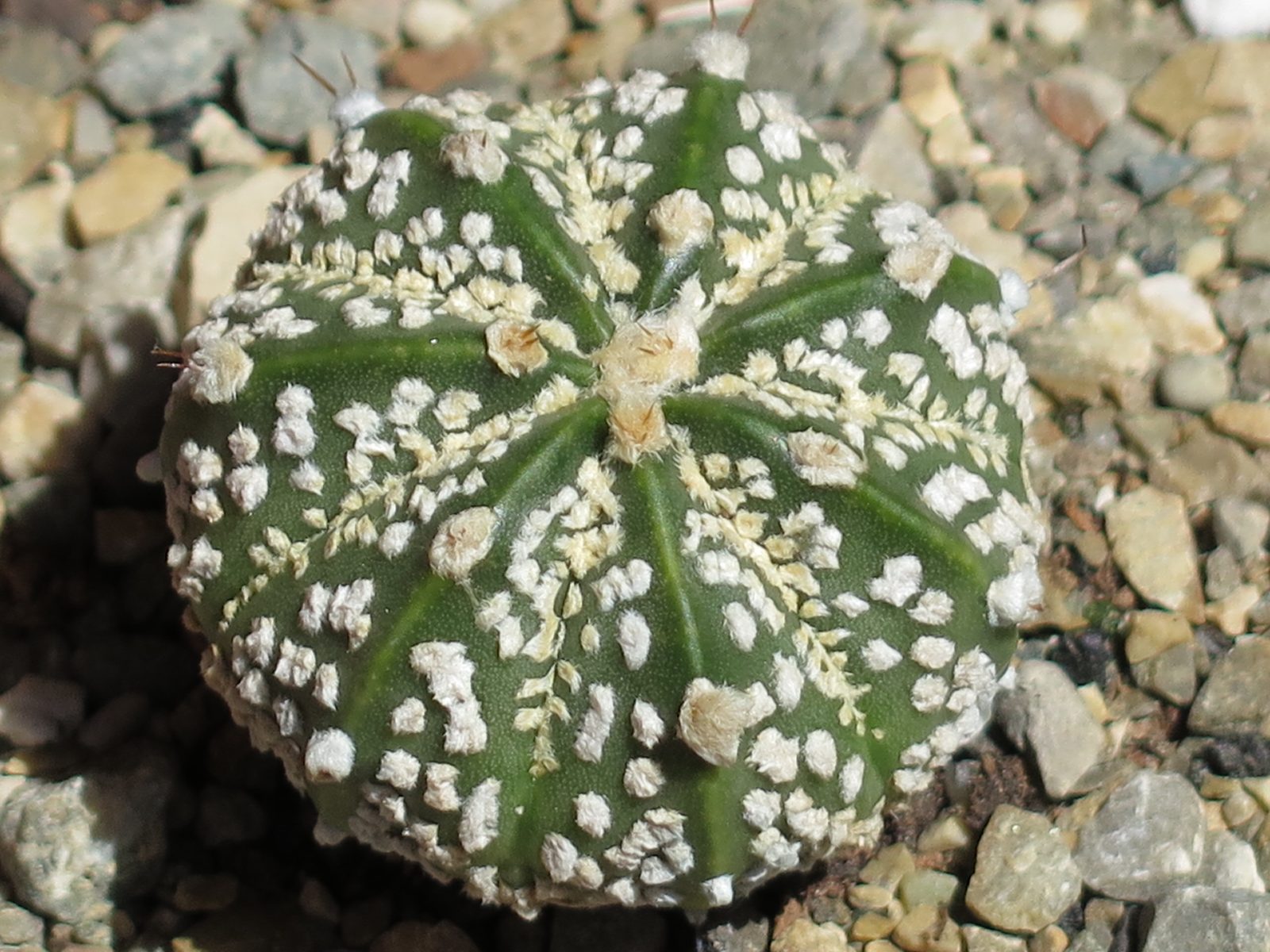
Most Astrophytum searches that are not about the six species are about the Japanese cultivars, and this is where collector value concentrates. Japanese breeders have worked the genus since at least the 1960s, selecting and naming forms with a precision the wider trade still struggles to match. Super Kabuto is the famous one: an A. asterias line traced to a single 1981 mutation, selected so the white trichome flecking thickens into a dense mosaic that nearly covers the green skin. Because the original was bred on through crosses with capricorne, every Super Kabuto carries a little of that species’ genetics, and the trait passes only partly to seedlings, which is why named, heavily-flecked clones command the prices they do.
Onzuka is the myriostigma equivalent, raised by Tsutomu Onzuka in Hiroshima in the mid-1970s and selected for the same kind of heavy white speckling; its epidermis is harder than a standard myriostigma and cracks if the plant is overwatered, the one real cultivation catch in the group. Beyond those two, the names describe traits rather than lineages: Nudum is a flockless, bare-green form of any species; Kikko raises the rib edges into a knobbly tortoiseshell; Fukuryu swells and doubles the ribs. Hybrid codes read female-parent-first, so a CAP-AS is capricorne crossed onto asterias. None of these are species, and a guide that lists them as “types” alongside the real six is selling confusion.
How do you tell Astrophytum species apart?
Three questions sort all six. Spined or spineless? Spines split the genus cleanly: capricorne and ornatum have them, the rest do not. If spined, twisted or straight? Capricorne’s spines are long, flattened, twisted, and papery; ornatum’s are stout, straight, and stiff, on a much larger columnar body. If spineless, how many ribs and what shape? A flat eight-ribbed disc is asterias; a five-ribbed star is myriostigma or coahuilense, separated by flower throat (red in coahuilense, plain yellow in myriostigma); and finger-like tubercles instead of ribs at all can only be caput-medusae. The white flecking confirms the genus; one of those three questions names the species.
One confusion worth flagging, because it has conservation stakes: spineless A. asterias is mistaken for Lophophora williamsii (peyote), and the two share habitat in south Texas. The asterias body is harder, distinctly star-ribbed, and white-flecked, with only a small fibrous root; peyote is soft, blue-green, smooth, and sits on a large carrot taproot, and it contains mescaline while Astrophytum contains nothing of the kind. The series companion to this guide, our Echinopsis types guide, applies the same POWO-first approach to a far larger genus.
Frequently Asked Questions
How many Astrophytum species are there?
Kew POWO accepts six species as of June 2026: Astrophytum asterias, A. capricorne, A. caput-medusae, A. coahuilense, A. myriostigma, and A. ornatum. Older lists count four or five because caput-medusae was only discovered in 2001 and coahuilense was long treated as a subspecies of myriostigma. Everything else sold under the name is a cultivar or hybrid of these six.
What is the difference between Astrophytum asterias and myriostigma?
Body shape and ribs. A. asterias is a flat, low disc with eight ribs and never forms a column. A. myriostigma is a five-ribbed star that rises into a column with age. Both are spineless and white-flecked, but the quickest test is to count ribs and check the profile: flat and eight-ribbed is asterias, taller and five-ribbed is myriostigma.
What is a Super Kabuto cactus?
Super Kabuto is a Japanese cultivar of Astrophytum asterias selected for dense white trichome flecking that nearly covers the green body. It is not a separate species. The line traces to a single 1981 mutation bred on through crosses, so the heavy-fleck trait passes only partly to seedlings, and named clones are propagated by offset or grafting to keep the pattern.
Is bishop’s cap the same as Astrophytum capricorne?
No. Bishop’s Cap is the common name for Astrophytum myriostigma, a spineless five-ribbed star. A. capricorne is the Goat’s Horn Cactus, a separate species wrapped in long, twisted, papery grey spines. It is the only commonly grown Astrophytum besides ornatum that has spines at all, so the two are easy to keep apart.
Are Astrophytum cacti endangered?
Some are. Astrophytum asterias is Vulnerable on the IUCN Red List, US Endangered, and the only species in the genus on CITES Appendix I. A. caput-medusae is Critically Endangered, known from a single locality. A. ornatum is Vulnerable. The whole genus sits on CITES Appendix II through the family listing, so seed-grown nursery plants are the only legal and ethical way to own them.
Plants of the World Online, Royal Botanic Gardens Kew: Astrophytum genus and the six accepted species pages · D.R. Hunt, transfer of Digitostigma caput-medusae to Astrophytum, Cactaceae Systematics Initiatives 15 (2003) · Velazco & Nevárez, original description of Digitostigma caput-medusae, Cactaceas y Suculentas Mexicanas 47 (2002) · Anderson, The Cactus Family (2001) · Hunt, The New Cactus Lexicon (2013) · IUCN Red List assessments: A. asterias (Vulnerable), A. caput-medusae (Critically Endangered), A. ornatum (Vulnerable) · US Fish & Wildlife Service, star cactus (A. asterias) species profile · CITES Appendices: Cactaceae family Appendix II; A. asterias Appendix I (effective 1987) · Cactus Conservation Institute, “A Tale of Two Cacti” (asterias and peyote confusion) · llifle Encyclopedia of Living Forms and cactus-art.biz: species pages and the Super Kabuto, Onzuka, Kikko, Nudum, Fukuryu and CAP-AS cultivar histories · Henry Shaw Cactus and Succulent Society, Astrophytum plant-of-the-month · Images via Wikimedia Commons: Petar43 (CC BY-SA 4.0, asterias in flower and myriostigma; CC BY-SA 3.0, Super Kabuto) · Mike Peel (CC BY-SA 4.0, asterias body) · Francisco Martínez González (CC BY-SA 4.0, capricorne) · Daderot (CC0, ornatum) · Christer T Johansson (CC BY-SA 3.0, caput-medusae)