Cactus Fertilizer: What to Use, When, and How Much
All ArticlesCactus fertilizer should be low in nitrogen, higher in phosphorus and potassium, and used at quarter to half strength in the growing season only. Cacti evolved in nutrient-poor soils and need very little feed; over-feeding does more harm than under-feeding, driving soft, rot-prone growth. Most mineral-habitat species want feeding just once or twice a year.
Do cacti actually need fertilizer?
Cacti need a little fertilizer, not a lot. Cacti are not heavy feeders, having evolved in the lean, nutrient-poor mineral soils of deserts and rocky slopes, so they benefit from a light, occasional feed in the growing season but ask for far less than a typical houseplant. The mistake almost no one makes with cacti is under-feeding; a pale, stalled, starved cactus is a rare sight. The mistake growers make constantly is the opposite.
Over-feeding is as dangerous to a cactus as overwatering. Pushed with too much fertilizer, a cactus grows fast and soft, stretching into weak, etiolation-prone tissue with thin skin that splits and rots, and it skips flowering in favour of green bulk. This is why the lean mineral mix the site recommends pairs naturally with restrained feeding: a mineral substrate holds few nutrients by design, and modest feeding is the correct complement to it, not a deficiency to correct.
What NPK ratio is best for a cactus?
Low nitrogen, higher phosphorus and potassium. The first number on the label is nitrogen, which drives soft green growth, and a cactus wants little of it; the phosphorus and potassium that follow support roots, flowers, and sturdy tissue. Cactus-specific feeds reflect this with ratios like 2-7-7, and a low-nitrogen formula such as 5-10-10 works just as well, as does an ordinary balanced fertilizer cut to a quarter or half its usual strength. There is no single magic number; the principle is what matters, more phosphorus and potassium than nitrogen.
Worth being honest about the orthodoxy here. That high nitrogen produces weak, soft, flowerless growth is well established and widely seen. That cacti need ultra-low nitrogen specifically is more grower convention than settled science, and some experienced collectors feed balanced formulas with good results. The safe reading is to avoid high-nitrogen feeds, lean toward phosphorus and potassium, and keep the dose small, rather than to chase one exact ratio. For blooms in particular, it is the phosphorus and potassium that count, the connection our flowering guide follows through.
When and how often should you fertilize a cactus?
In the growing season only, spring through early autumn, and never during the winter rest, when a dormant cactus absorbs nothing and fertilizer salts simply build up in cold, wet soil. This is where careful cactus feeding diverges sharply from the generic advice to feed monthly. For the mineral-habitat and collector species the site grows, once or twice across the whole growing season is plenty, and the slow geophytes need even less. Always dilute, to a quarter or half the strength the label recommends for other plants.
The rare cacti make the point clearly. The living rocks, Ariocarpus, the calcicole Lophophora, and other geophytes that keep most of their mass underground in lean mineral soil, want a single weak feed or none at all in a season, and seedlings need nothing. Feeding these on a monthly schedule, as a generalist guide would have you do, is a fast way to ruin their tight, slow-grown character. After repotting, hold off feeding for four to six weeks, since fresh mix already carries what the plant can use, as the repotting guide notes.
Can you over-fertilize a cactus?
Yes, easily, and it is the failure mode to watch. Over-fed cacti grow soft and leggy, prone to the same stretching and weak skin that low light causes, and that soft tissue rots and attracts pests far more readily than tight, hard-grown growth. Fertilizer burn shows as yellowing or browning at the tips and margins, and a white or yellowish crust on the soil surface is accumulated salts from feed and hard tap water, which stunts roots over time.
The fixes are simple. Flush a salt-crusted pot with several pot-volumes of water, ideally rainwater or distilled rather than hard tap, and let it drain fully; in bad cases, repot into fresh mineral mix. Then feed less. Because cacti store reserves and grow slowly, a plant that has been over-fed recovers once you simply stop, where the soft growth it already put on stays soft, the same way etiolated growth never re-thickens. When over-feeding has tipped a plant into soft rot, the diagnostic guide covers the rescue.
Frequently asked questions about cactus fertilizer
Do cacti really need fertilizer?
A little, but they are light feeders that evolved in nutrient-poor soils, so they need far less than most plants. Under-feeding a cactus is rare; over-feeding is the common mistake and is as harmful as overwatering. A weak feed once or twice in the growing season is enough for most, and mineral-habitat species need even less.
What is the best NPK ratio for a cactus?
Low nitrogen, higher phosphorus and potassium. Cactus feeds use ratios like 2-7-7, and a low-nitrogen formula such as 5-10-10 works well, as does a balanced fertilizer cut to a quarter or half strength. There is no single magic number; what matters is keeping nitrogen low relative to phosphorus and potassium, and keeping the dose small.
When should I fertilize my cactus?
In the growing season only, spring through early autumn, and never during the winter rest, when a dormant cactus absorbs nothing and the salts just build up. Most cacti need feeding only once or twice across the season, and slow mineral-habitat species such as Ariocarpus want a single weak feed or none at all.
Can you over-fertilize a cactus, and what does it look like?
Yes, and it is the usual mistake. Over-fed cacti grow soft and leggy, with weak skin that splits and rots, and they often skip flowering. Watch for yellow or brown burnt tips and a white salt crust on the soil. Flush the pot with rainwater to clear the salts, then feed less. The soft growth already made stays soft.
Do rare cacti like Ariocarpus need fertilizer?
Barely. Geophytes such as Ariocarpus and Lophophora, and seedlings of any species, need little or no feeding; a single weak dose across a growing season is plenty. They grow in lean mineral soil in the wild, and a lean mineral mix in cultivation pairs with very modest feeding. Monthly feeding ruins their slow, compact character.
Gardening Know How, “Does a cactus need fertilizer” and fertilizing cactus plants · Royal Horticultural Society, feeding cacti and succulents · Henry Shaw Cactus and Succulent Society, cultivation and Ariocarpus notes · Anderson, E.F., The Cactus Family (Timber Press) · British Cactus and Succulent Society, cultivation notes · llifle, Encyclopedia of Living Forms
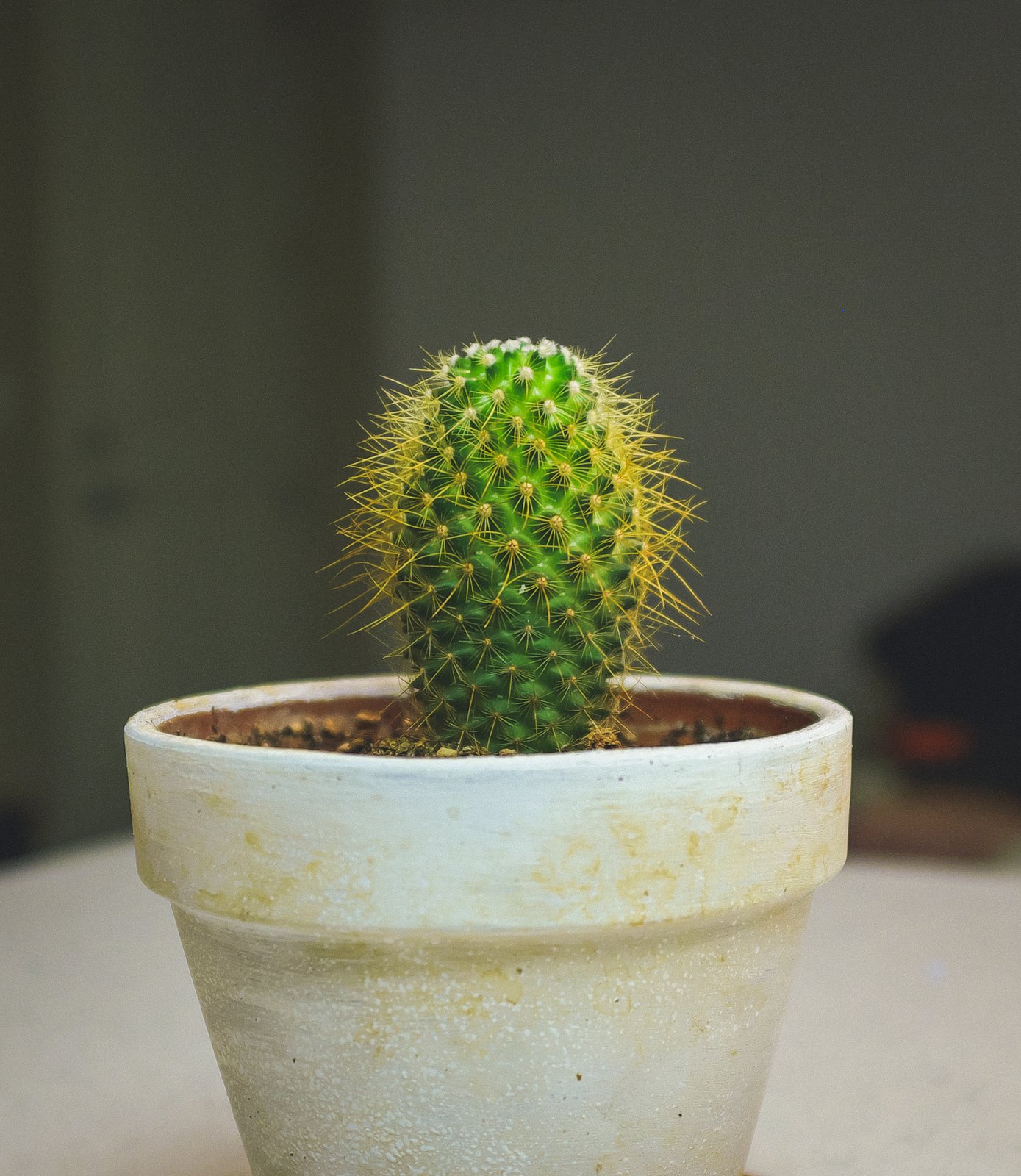
Photo: potted cactus by NeONBRAND (CC0 public domain), via Wikimedia Commons.