
Cactus Taxonomy: How Habitat Photography Reclassified Species
All ArticlesCactus taxonomy is the science of naming and ranking the roughly 1,800 species in Cactaceae. Field photography rebuilt it. Between Helia Bravo Hollis in the 1930s and the iNaturalist network today, photographer-taxonomists in Mexico, Chile, and Brazil turned the Backeberg-era tangle of names into a defensible modern classification.
What is cactus taxonomy and why is it so hard?
Plant taxonomy assigns names, ranks (genus, species, subspecies, variety), and relationships. The system rests on type specimens: physical material a future researcher can pull from a herbarium and compare against any plant they think might be the same thing. For most plant families, a pressed sheet works.
Cacti resist the system at every step. The body does not compress; spines pull free or rotate during pressing; epidermis colour shifts as the tissue dries; flowers lose their throat pigmentation. Whether a plant is solitary or caespitose, columnar or globose, ribbed or tubercled, smooth-skinned or pruinose, can be invisible on a flat sheet. The very characters that define a species in life vanish in preservation.
Curt Backeberg, the German amateur who named or renamed roughly 1,200 cactus species and whose six-volume Die Cactaceae (1958-1962) dominated the field for a generation, worked mainly from European nursery plants. He attached many of his names to no voucher at all. David Hunt, compiling the post-Backeberg rationalisation that became The New Cactus Lexicon in 2006, wrote that Backeberg left a trail of nomenclatural chaos that would vex cactus taxonomists for centuries. The post-1970 photographic fieldwork was the implicit correction.
The Pre-Photography Era and Its Limits
Britton and Rose’s four-volume The Cactaceae (Carnegie Institution of Washington, 1919-1923) set the genus-level baseline that every later worker pushed against. The Britton and Rose volumes carried colour plates, line drawings, and habitat photographs from expeditions through the Americas between 1912 and 1916. Even at that point the photograph was understood as the living-plant record the herbarium could not provide.
What followed was a forty-year split between two methodologies. Backeberg expanded the genus count from a nursery-and-armchair perspective. Helia Bravo Hollis, the first Mexican certified biologist (1927), did the opposite. From the 1930s through the 1980s she travelled the Mexican deserts with a camera, classifying more than 700 species in Las Cactáceas de México (three volumes, 1937-1991). Her work produced the geographic baseline for Mexican cactus distribution that every later field worker built on. Friedrich Ritter, working independently, took the same approach to South America between 1952 and 1971; his FR field numbers and the 1,416 illustrations in Kakteen in Südamerika (1979-1981) are still cited routinely in modern Copiapoa, Sulcorebutia, and Matucana literature.
How did field photography change Copiapoa taxonomy?
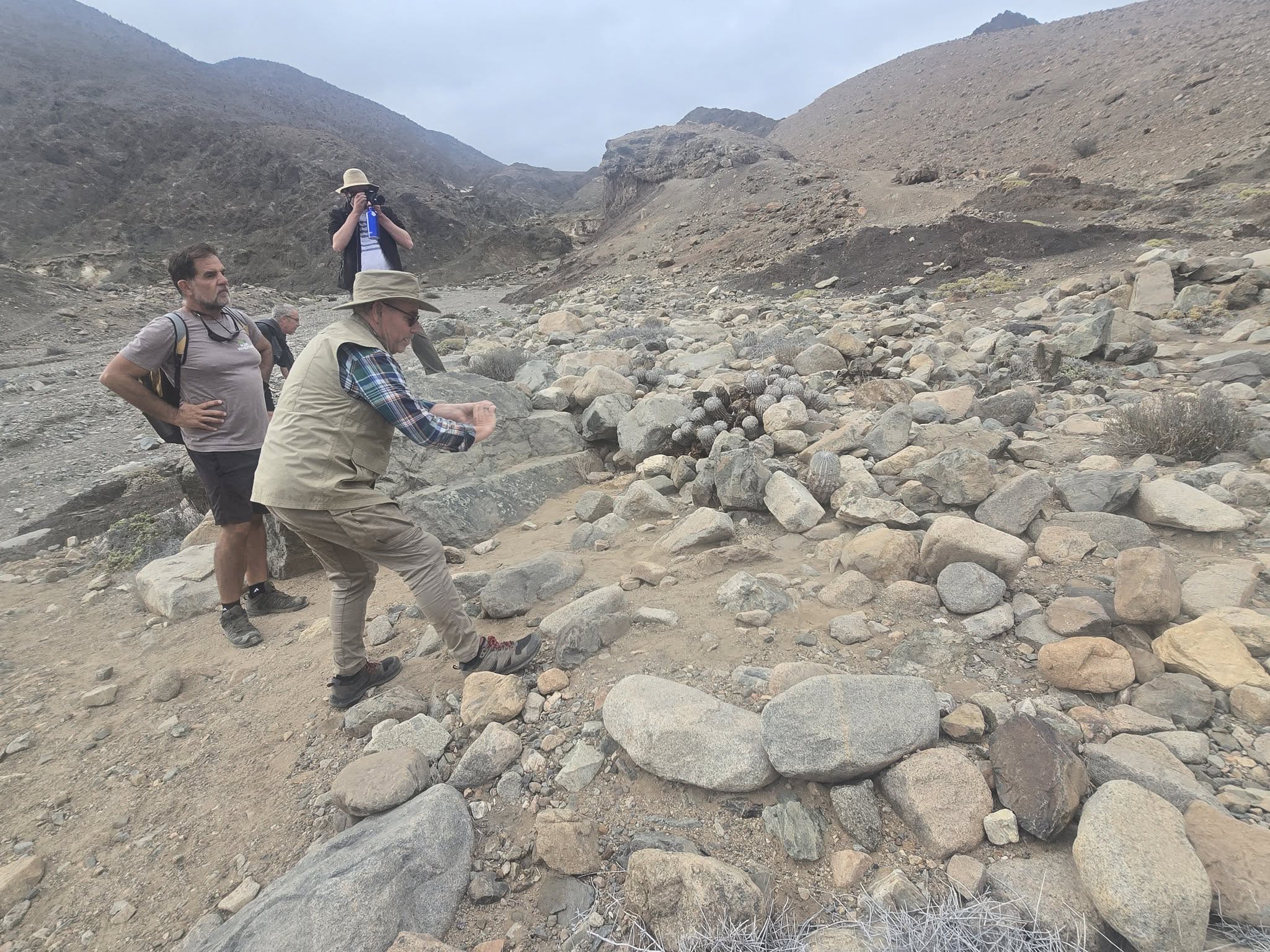
The Atacama genus Copiapoa is the cleanest case study. Backeberg and Ritter both worked the cinerea complex in the 1950s and 1960s. Ritter named columna-alba in 1963; Backeberg named haseltoniana and gigantea in 1957; krainziana appeared in the same Ritter 1963 paper. Each was treated as a distinct species because the herbarium and nursery record showed visually distinct extreme forms. None of the three workers had a continuous population sample to work from.
Rudolf Schulz and Attila Kapitany changed that. Their 1994 and 1996 expeditions covered the coast between Chañaral and El Cobre with a continuous photographic transect: 231 colour photographs with precise latitude and longitude for every study site, published in Copiapoa in Their Environment (privately printed, Victoria, Australia, 1996). The photographs revealed what the scattered type collections could not. The characters used to separate species (body colour, wool density, spine character) varied continuously along latitudinal gradients and in response to fog frequency and substrate. White-bodied northern populations graded into grey-green southern populations through intermediate forms, with no break that mapped to a species boundary.
Pablo Guerrero and his collaborators at Universidad de Concepción took the next step. The 2018 Kew Bulletin paper “Investigating taxon boundaries and extinction risk in endemic Chilean cacti (Copiapoa subsection Cinerei, Cactaceae) using chloroplast DNA sequences, microsatellite data and 3D mapping” genotyped 68 individuals from the known range across five microsatellite loci. The result confirmed the photograph-based argument: high genetic diversity, no significant population structure between named species, no support for treating columna-alba, krainziana, haseltoniana, and gigantea as anything other than regional ecotypes within a single morphologically plastic Copiapoa cinerea. Plants of the World Online now lists cinerea with subsp. cinerea, subsp. krainziana, and subsp. haseltoniana; the rest fell into synonymy.
The 2024 IUCN reassessment of Copiapoa used the same photograph-anchored occurrence data, drawing on iNaturalist and GBIF records along with fresh field surveys, to put 82% of the genus in a threatened category. Fourteen taxa were assessed Critically Endangered, fourteen Endangered, six Vulnerable, three Least Concern. The earlier 2013 assessment had 55% threatened. The reassessment was possible because the Schulz-Kapitany photographic baseline already existed, and the intervening twenty-five years of field photography had produced comparable points to track decline.
Ariocarpus: When Photographs Dissolved Species Boundaries
Edward F. Anderson and W.A. Fitz Maurice published “Ariocarpus revisited” in Haseltonia 5 (1997) on the back of multi-decade field work in San Luis Potosí, Coahuila, and Nuevo León. The paper reads as a case study in what continuous-population photography does to species concepts that were drawn from a handful of type specimens.
Two findings from the field record stand out. At El Huizache in San Luis Potosí, the population of A. retusus showed tubercles ranging from 1:1 to 4:1 in length-to-width ratio within a single locality, eliminating a character that had been used to distinguish species. A 1994 discovery near Aramberri in Nuevo León documented plants whose tubercle configurations ran from typical A. retusus to typical A. trigonus; the population was identified as a hybrid swarm rather than a clean species boundary. Continuous photographic sampling of A. fissuratus across a 150-kilometre north-south transect dissolved the var. fissuratus and var. lloydii distinction. The earlier separation of subgenera Ariocarpus and Roseocactus was eliminated as no longer supportable.
Anderson and Fitz Maurice also delivered IUCN categorisations directly from their field surveys. A. agavoides and A. bravoanus as Endangered, A. kotschoubeyanus and A. scaphirostris as Vulnerable. Each assessment was traceable to specific localities and counts a future researcher could revisit.
Aztekium and Mammillaria: Microhabitat Photography and Rediscovery
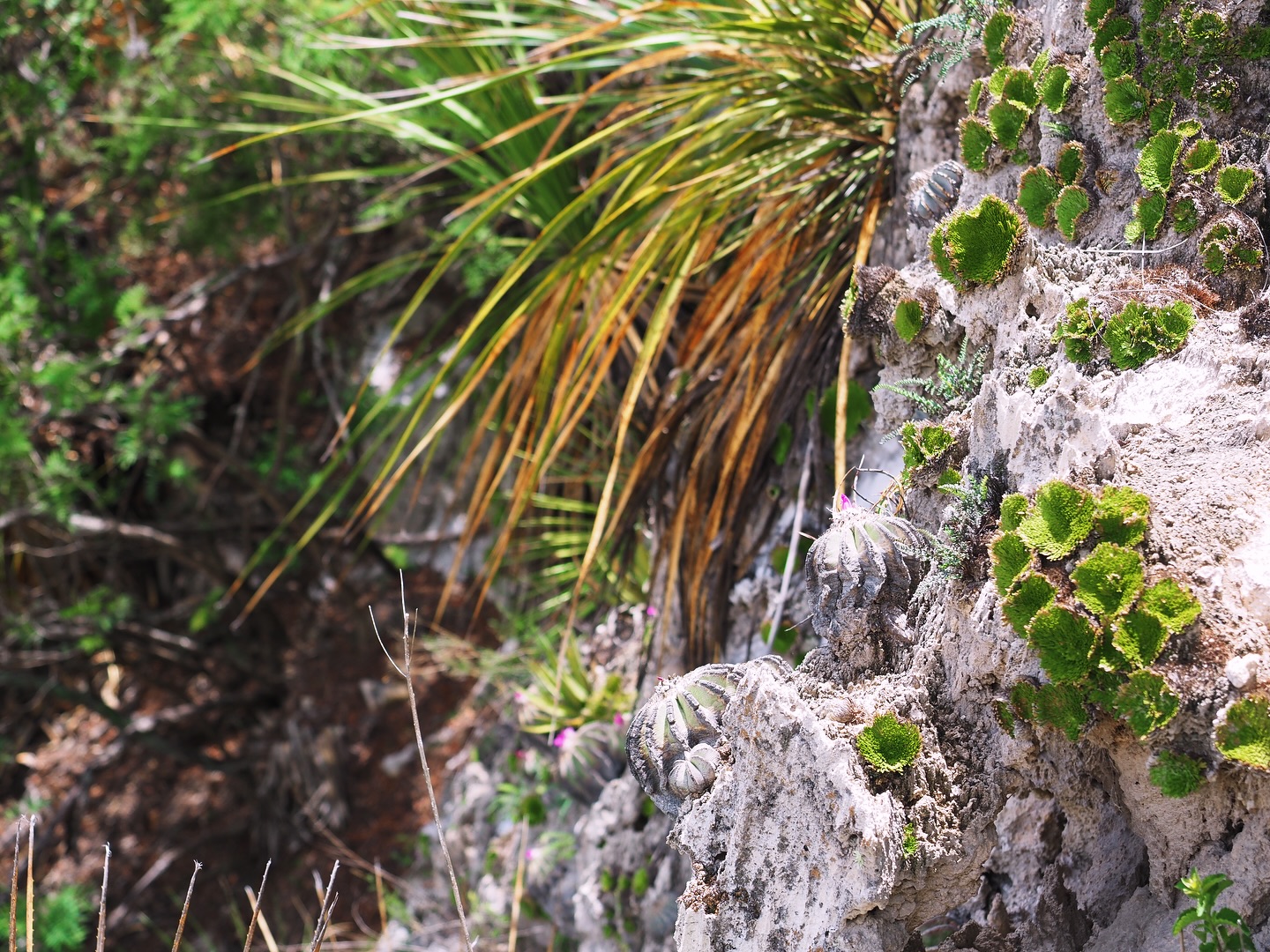
The 1990s in Mexican cactus taxonomy produced two of the most photograph-driven discoveries in the family’s recorded history. The first was Aztekium hintonii. Around 1990 George Sebastian Hinton, son of the English botanical explorer George Boole Hinton, found a second Aztekium on near-vertical gypsum cliffs near La Colorada in the municipality of Galeana, Nuevo León, growing at 1,100 to 1,200 metres among Selaginella gypsophila. Hinton sent the photographs to Charles Glass and W.A. Fitz Maurice, who described the species in Cactáceas y Suculentas Mexicanas in 1992. The same Galeana expedition yielded Geohintonia mexicana, a monotypic new genus on adjacent gypsum slopes. Two new genera in a single field season is unusual; both rest on photograph-anchored single-locality records because the populations are too small and too slow-growing to support a meaningful herbarium series.
The second was Mammillaria luethyi. In 1952 Norman H. Boke at Oklahoma University encountered an unfamiliar dwarf cactus on a windowsill in Ciudad Acuña, Coahuila, owned by a Mrs. Crosby; a mining prospector had brought it down from somewhere in the Coahuilan limestone. Boke photographed it and sent Kodachrome slides to Ladislaus Cutak at the Missouri Botanical Garden. Cutak ordered live material; both specimens died in transit during border fumigation.
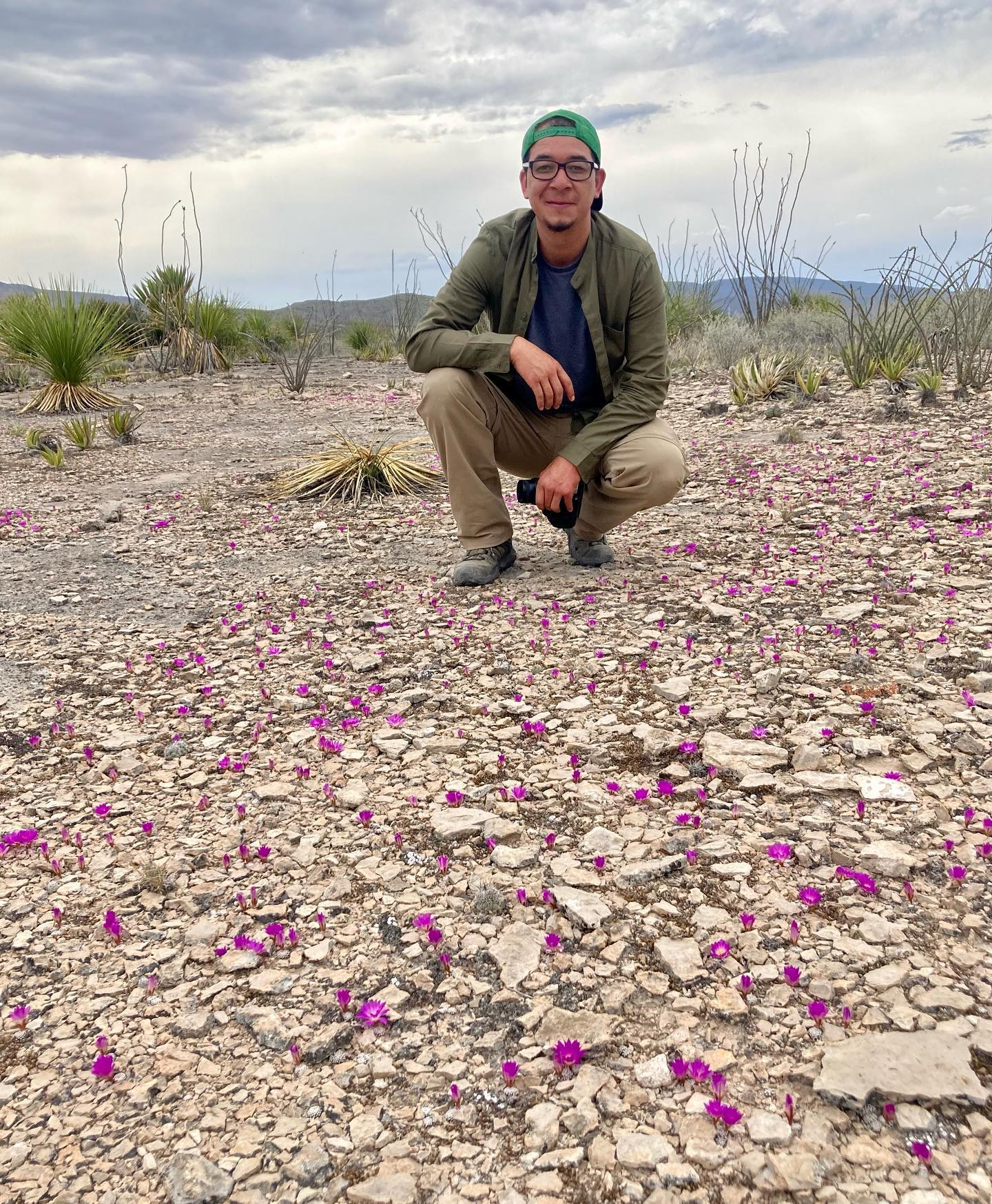
For forty-four years the species was known only from Boke’s photograph. It appeared in eight publications between 1952 and 1995, compared variously to Turbinicarpus valdezianus, placed tentatively in Neogomesia, once misidentified as Normanbokea valdeziana. Some early publications even printed the photograph rotated ninety degrees, which scrambled the question of whether the flowers emerged from the apex or the side. Then in 1996 George S. Hinton and Jonas Lüthy relocated the population by reading the Coahuila topographic map and prospecting the limestone-slab microhabitats the prospector’s account suggested. Hinton formally described the plant as Mammillaria luethyi, naming it for Lüthy’s role in the rediscovery. The plants grow sunken in gravel on horizontal limestone slabs in the Chihuahuan Desert, the kind of microhabitat invisible to anything other than ground-level field search. The species is Coahuila-endemic; the older Tamaulipas attribution was speculation based on the prospector’s route and was corrected after the rediscovery.
Werner Reppenhagen’s two-volume Die Gattung Mammillaria: Monographie (Druckerei Steinhart, Titisee-Neustadt, 1991-1992) captured the same lesson at family scale. Over more than thirty field trips to Mexico, Reppenhagen described over 300 species and varieties, each illustrated with a habitat photograph and accompanied by detailed locality, soil, and climate notes. The combination of in-situ photograph plus ecological context anticipated what is now standard practice in integrative plant taxonomy.
Astrophytum coahuilense: Field Photographs Lead the Molecular Work
Astrophytum coahuilense spent decades treated as a subspecies of A. myriostigma because herbarium specimens of the two were difficult to distinguish. Field photographers in Coahuila documented something the dried material could not: A. coahuilense populations consistently showed red-pigmented flower throats, distinct rib counts, and a different floccose covering, all separating them from A. myriostigma’s San Luis Potosí and Hidalgo core populations. Geographic isolation in the state of Coahuila added a biogeographic argument the herbarium specimens never carried.
The molecular confirmation came in 2015. Vázquez-Lobo, Aguilar Morales, Arias, Golubov, Hernández-Hernández, and Mandujano published “Phylogeny and Biogeographic History of Astrophytum (Cactaceae)” in Systematic Botany (volume 40, issue 4, pages 1022-1030; doi: 10.1600/036364415X690094). Using chloroplast DNA sequences (rbcL, trnL-trnF, trnK-matK) under Bayesian and maximum-likelihood frameworks, the study placed A. myriostigma and A. coahuilense in independent clades and dated their divergence to the late Miocene. The field photographs had argued for separate-species status for years; the molecular work confirmed it.
Field Numbers as a Photographic Provenance System
The mid-century field collectors built a parallel infrastructure that ties photographs, localities, and seed offspring into a single auditable chain. A field number is a collector prefix followed by a sequential integer, sometimes with a trailing letter for variants: FR 1034, L 703, SB 814, HU 287, KK 1583, WR 289. Each number encodes a collector identity, a single locality visit, a tentative species determination, and a date. A field-numbered seed packet links to a field-numbered photograph, which links to a documented GPS locality.
The major prefixes still in active use: FR for Friedrich Ritter (Chile, Bolivia, Peru, Argentina, Brazil from 1950s to 1970s); L or LAU for Alfred Bernhard Lau (Mexico and Central America 1972-1992); SB for Steven Brack at Mesa Garden (global, pre-CITES); HU for Leopoldo Horst and Werner Uebelmann (Brazil and neighbours 1960s-1980s); KK for Karel Knize (Peru and Bolivia 1970s-2010s, with the caveat that KK numbers sometimes denote regions rather than mother plants); WR for Walter Rausch (Bolivia and Argentina 1960s-1990s); and G for Charles Glass (Mexico 1960s-1990s). The BCSS Field Number Finder is the principal public database. The Field Number Database on this site continues the tradition with current accepted-name linking and georeferenced occurrence records.
The reproducibility argument is the load-bearing one. Any researcher can travel to an FR-numbered locality today, photograph the population as it now stands, and compare against Ritter’s 1960s documentation. That single capability is what separates a defensible modern taxonomy from the Backeberg-era tangle.
iNaturalist and Citizen-Science Photography
The 2010s extended the photographic record from a small group of named field workers to a network of roughly three million iNaturalist users. Observations that two or more independent identifiers agree on to species level are flagged as research-grade and exported to GBIF, where they become citable in scientific literature. Twelve or more plant species across all families have been formally described since 2022 from records first detected on iNaturalist.
The 2024 IUCN reassessment of Copiapoa ran the citizen-science pipeline at scale. iNaturalist research-grade observations and GBIF occurrence records joined fresh field surveys in the assessment, and the 82% threatened figure rests on that combined dataset. The implication for collectors is mixed. The same photographic culture that enables conservation reassessment also drives illegal wild collection: the IUCN press release accompanying the reassessment noted that European and Asian collector demand, fed by Instagram and social-media imagery, has measurably accelerated Copiapoa poaching since 2015.
What the citizen-science network has demonstrably ended is the Mammillaria luethyi pattern of a species disappearing for decades behind a single archived photograph. A research-grade iNaturalist observation today carries GPS coordinates, a timestamp, and multiple-observer confirmation. A future luethyi-class species will not stay hidden for forty-four years.
When is field photography not enough to identify a cactus?
Photographs document morphology and locality. They do not measure genetic structure. The post-2000 wave of cactus phylogenetics (Arakaki and collaborators on Echinopsis, 2011, in American Journal of Botany; Guerrero on Copiapoa, 2018, in Kew Bulletin; the 2024 PhytoKeys redescription of the Eriosyce curvispina complex) has corrected places where photograph-based judgement called wrong.
The Eriosyce mega-merger is the canonical case. Fred Kattermann’s Eriosyce (Cactaceae): The Genus Revised and Amplified (Succulent Plant Research volume 1, David Hunt, 1994) lumped six Chilean and Peruvian genera (Horridocactus, Islaya, Neochilenia, Neoporteria, Pyrrhocactus, Thelocephala) into Eriosyce on the strength of field photographs of continuous populations. The merger held at the generic level. The 2024 PhytoKeys paper using molecular data re-split the curvispina complex into nine endemic Chilean species, showing that Kattermann’s photographic argument was correct about genus boundaries but too aggressive at species rank. That is the standard pattern: photographs are reliable for morphological intergradation, less reliable for cryptic genetic structure within a phenotypically continuous range.
What does taxonomic instability mean for cactus collectors?
Cactus names move, and the plant on the label stays the same. A plant labelled Copiapoa columna-alba on a 1990s nursery tag is now Copiapoa cinerea in current literature. A plant sold as Sulcorebutia rauschii is Weingartia rauschii in Plants of the World Online. The underlying biological entity has not changed; the rank and the label have.
The practical move is to record the field number wherever one is available, and to keep the original name on the label as a synonym. WR 289 will identify the same Bolivian population a century from now even as the formal name shifts from Sulcorebutia to Weingartia to whatever a future molecular treatment recognises. Field numbers are the stable backbone the names hang from. The encyclopaedia on this site tracks current accepted names against synonyms for the same reason: labels are useful exactly to the extent they cross-walk to the field record.
For a deeper look at the genera referenced throughout this article, browse the Rare Cactus Encyclopedia or read about the best places to see rare cacti in habitat.
Frequently Asked Questions
How has field photography changed cactus taxonomy?
Field photographs document the living-plant characters that pressed herbarium specimens lose, including body form, spine geometry, epidermis colour, clustering habit, and flower throat pigmentation. Continuous-population photography across a geographic range reveals whether named species grade into one another or hold visual breaks. The major post-1970 lumping in Copiapoa, splitting in Astrophytum, and rediscovery in Mammillaria all rest on photograph-anchored field records that the herbarium era could not produce.
What is the difference between taxonomic lumping and splitting in cacti?
Lumping reduces the number of recognised species, treating previously named taxa as variants of one species. Splitting raises subspecies or varieties to species rank or describes new species. Backeberg was an extreme splitter; the post-2000 rationalisation (Hunt’s New Cactus Lexicon, Kattermann’s Eriosyce revision, Guerrero’s Copiapoa work) has been mostly lumping, supported by field photographs showing continuous variation, then confirmed by molecular phylogenetics.
How does iNaturalist contribute to cactus taxonomy?
iNaturalist research-grade observations require two independent identifiers to agree to species level; once flagged, those records export to GBIF and become citable in scientific literature. The 2024 IUCN reassessment of Copiapoa incorporated iNaturalist and GBIF occurrence data alongside field surveys to produce the 82% threatened figure (14 Critically Endangered, 14 Endangered, 6 Vulnerable, 3 Least Concern). At least twelve plant species across all families have been formally described since 2022 from records first detected on iNaturalist.
Why does Copiapoa taxonomy keep changing?
Copiapoa grows along a narrow coastal Atacama strip from southern Peru to north-central Chile, where fog frequency, substrate, and altitude vary continuously. Body colour, wool density, and spine form vary with those gradients. Earlier workers (Backeberg, Ritter) saw the extreme forms in isolation and named them as separate species. The 1990s Schulz-and-Kapitany photographic transect documented intermediate populations; the 2018 Kew Bulletin molecular study confirmed the single-species reading. The reclassification of columna-alba, krainziana, haseltoniana, and gigantea as ecotypes within C. cinerea is where current Plants of the World Online treatment lands.
Can a photograph alone identify a new cactus species?
A single photograph can support a new species hypothesis but cannot finalise one. Aztekium hintonii and Geohintonia mexicana were photo-documented before their 1992 formal descriptions, but Glass and Fitz Maurice published the names against living material and accompanying locality data, not against photographs alone. The standard modern requirement is morphological description, type specimen (or living-plant equivalent for non-pressable species), photograph, GPS-anchored locality, and ideally molecular confirmation. Mammillaria luethyi was the outlier that proved the rule: 44 years known only from a photograph, formally named only after the 1996 rediscovery produced living plants.
What is a cactus field number, and why does it matter?
A field number is a collector prefix plus a sequential integer that identifies a single collection event: collector, locality, date, tentative species. FR 1034 means Friedrich Ritter, collection number 1034. Field numbers tie a photograph, a GPS locality, a herbarium voucher, and any seed offspring of the collection into one auditable chain. They survive taxonomic renaming because the number identifies a population, not a name. The major prefixes (FR, L, SB, HU, KK, WR, G) cover the bulk of cacti in serious specialist collections worldwide.
Britton, N.L. and Rose, J.N., The Cactaceae (4 vols., Carnegie Institution of Washington, 1919-1923) · Bravo Hollis, H., Las Cactáceas de México (3 vols., 1937-1991) · Backeberg, C., Die Cactaceae (6 vols., Gustav Fischer, 1958-1962) · Ritter, F., Kakteen in Südamerika (4 vols., 1979-1981) · Reppenhagen, W., Die Gattung Mammillaria: Monographie (2 vols., Druckerei Steinhart, Titisee-Neustadt, 1991-1992) · Glass, C.E. and Fitz Maurice, W.A., “Aztekium hintonii and Geohintonia mexicana,” Cactáceas y Suculentas Mexicanas (1992) · Hinton, G.S. (1996) on Mammillaria luethyi (Coahuila rediscovery) · Kattermann, F., Eriosyce (Cactaceae): The Genus Revised and Amplified (Succulent Plant Research vol. 1, David Hunt, 1994) · Schulz, R. and Kapitany, A., Copiapoa in Their Environment: Chañaral to El Cobre (privately printed, Victoria, Australia, 1996) · Anderson, E.F. and Fitz Maurice, W.A., “Ariocarpus revisited,” Haseltonia 5 (1997) · Pilbeam, J., Mammillaria: The Cactus File Handbook (Cirio Publishing, 1999) · Anderson, E.F., The Cactus Family (Timber Press, 2001) · Hunt, D., Taylor, N. and Charles, G. (eds.), The New Cactus Lexicon (DH Books, 2006) · Hernández, H.M. and Gómez-Hinostrosa, C., Mapping the Cacti of Mexico, Parts I and II (Succulent Plant Research vols. 7 and 9, DH Books, 2011-2015) · Arakaki, M. et al., molecular phylogenetics of Echinopsis, American Journal of Botany (2011) doi:10.3732/ajb.1100288 · Vázquez-Lobo, A. et al., “Phylogeny and Biogeographic History of Astrophytum (Cactaceae),” Systematic Botany 40(4):1022-1030 (2015) doi:10.1600/036364415X690094 · Guerrero, P.C. et al., Copiapoa subsection Cinerei, Kew Bulletin (2018) doi:10.1007/s12225-018-9780-3 · PhytoKeys (2024), Eriosyce curvispina complex re-split, doi:10.3897/phytokeys.107403 · IUCN, Copiapoa reassessment press release (2025) · BCSS Field Number Finder · Plants of the World Online (Royal Botanic Gardens Kew) · GBIF Occurrence Data · iNaturalist Research-Grade Observations