
Why Miracle-Gro Cactus Soil Kills Rare Cacti (And What Collectors Use Instead)
All ArticlesMiracle-Gro Cactus, Palm and Citrus soil kills rare cacti because the bag is 70-80% peat moss, perlite, and bark fines. Those three ingredients hold water against rot-prone roots, collapse within six months, and starve the root zone of oxygen. Serious collectors use 70-80% mineral mixes instead. Pumice, lava, zeolite, decomposed granite. No bag.
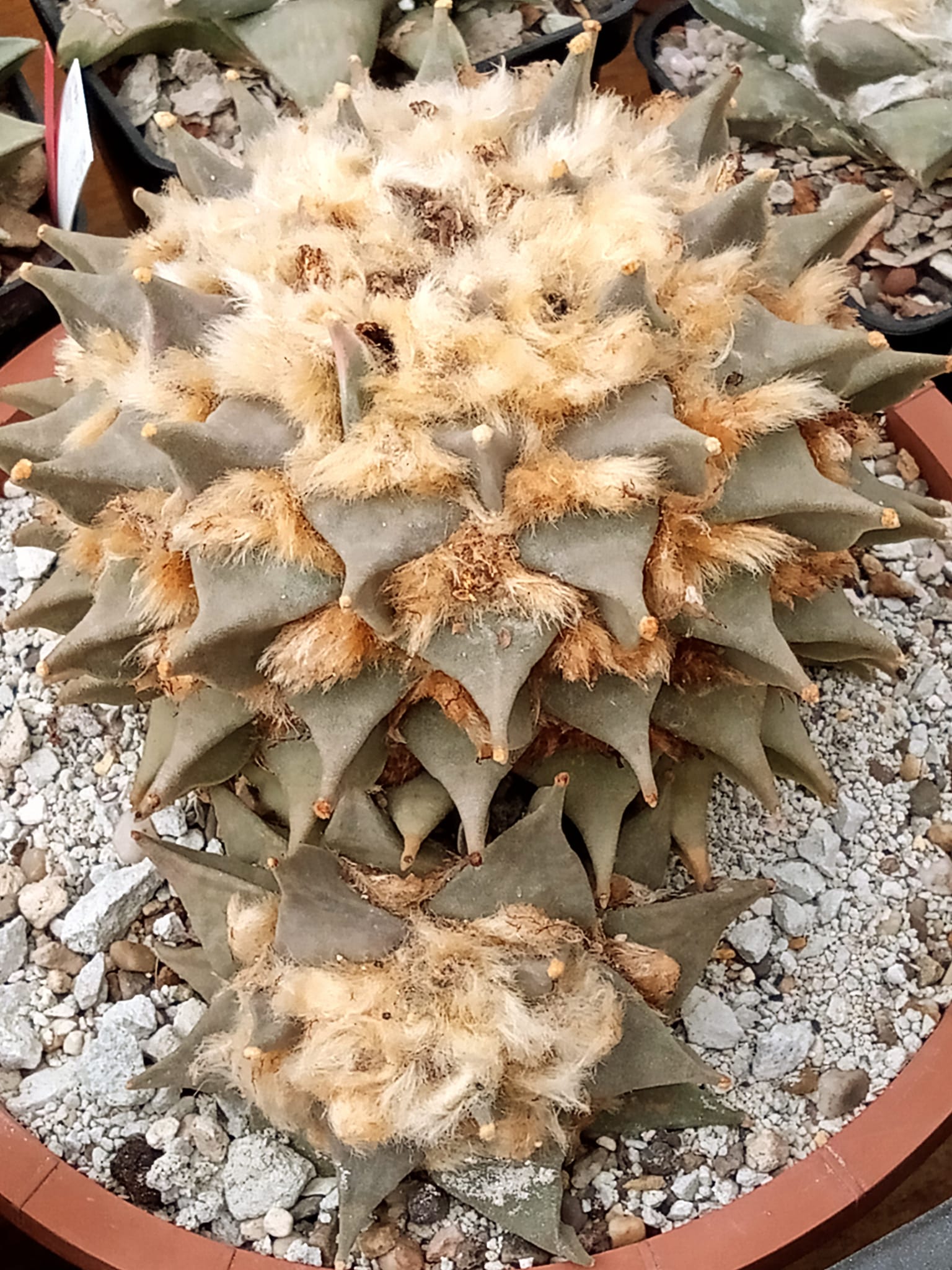
What is actually in a bag of Miracle-Gro Cactus, Palm and Citrus?
The label lists “blend of peat, sand, and perlite” plus a wetting agent and a slow-release fertilizer. Open the bag and pour some out. You see four things: a brown spongy fibrous matrix that is mostly Canadian sphagnum peat moss, a light bark component that breaks apart between your fingers, a fine grey sand, and white perlite chunks that float on contact with water.
Fox Farm Ocean Forest reads worse on a cactus pot. The label includes earthworm castings, bat guano, fish meal, crab meal, shrimp meal, plus forest humus, sphagnum peat moss, perlite, and sandy loam. It is a rich vegetable-garden soil that happens to get marketed for cacti. Excellent for tomatoes. A slow death sentence for Aztekium ritteri.
Both bags are designed for plants that want consistently moist roots. The peat fraction holds three to four times its dry weight in water. The perlite is supposed to break up that water-holding mass with air pockets, but perlite floats. The first deep watering moves it to the surface within a few weeks, where it does nothing for the root zone underneath. What is left is a peat brick.
Why does peat-and-perlite soil kill rare cacti?
Three failure modes show up in the same order on every rotted plant.
The peat collapses. Sphagnum moss in a pot shrinks by roughly 40% as it dries from saturated to bone-dry, then re-expands when watered. Six months of this cycle compresses the substrate into a dense mass that water beads off rather than penetrates. Hydrophobic peat is a real thing and an easy thing to verify with a kitchen scale and a watering can.
The air leaves the root zone. Healthy cactus roots respire. A Lophophora williamsii taproot or an Ariocarpus tuberous root system needs roughly 30% of its substrate volume as gas-filled pore space at any given watering interval. Compacted peat hits maybe 5%. Roots starve. Anaerobic bacteria move in. The plant looks fine on top for weeks, then deflates over a weekend.
The salts build up. Slow-release fertilizer prills (the green dots in Miracle-Gro) are designed for outdoor garden plants that get flushed by rain. In a closed cactus pot, the nitrate-phosphate-potassium load accumulates against root tissue that evolved on Mexican limestone scree, where annual nitrogen input is close to zero. Ariocarpus, Aztekium, and Copiapoa all react first. Brown corky lesions at the root crown. Then crown collapse.
None of this shows up the week you repot. It shows up four to nine months in, and by then the rot has a head start.
What do serious collectors use instead?
A collector mineral mix is roughly 90% inorganic by volume and 10% organic. The organic is worm castings or sterilized cactus compost, never peat. Six mineral ingredients carry the load. The full recipe with per-genus ratios lives in our guide to mixing well-draining soil for rare cacti; the short version follows.
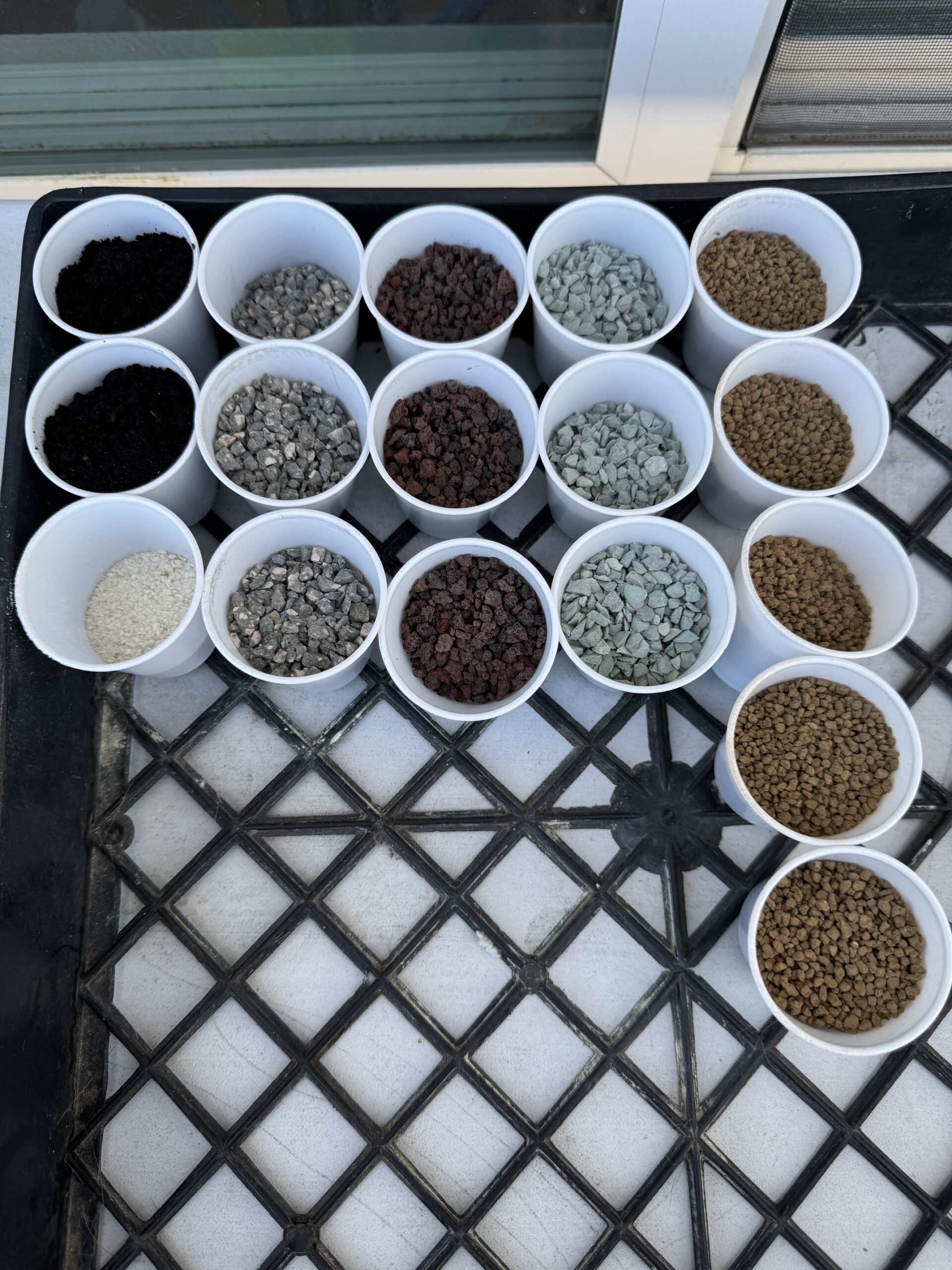
Pumice (sifted). Volcanic glass with 64-85% internal porosity. Drains instantly while holding moisture inside the granule rather than against the root surface. Sift to remove fines before mixing. 1mm to 6mm grades are standard. Buy from a koi or bonsai supplier rather than a hydroponics shop, since the hydroponics-grade product is often crushed lava with sharper edges.
Lava rock (scoria). Heavier than pumice with internal cavities that hold a small amount of water and aerate the bottom of deep pots. The 5-10mm grade is correct for deep containers and columnar plants. Red and black scoria are functionally identical.
Zeolite. A natural aluminosilicate with cation exchange capacity in the 100-240 meq per 100 gram range, roughly 5-10 times what other mineral ingredients offer. It holds nutrient ions in a slow-release reservoir and stabilizes pH around 7. Clinoptilolite, 4-6mm chunks, about 10% of mix volume.
Decomposed granite (sifted, dust removed). Sharp drainage and a slow trickle of trace minerals as it weathers. Sift before mixing because the fines kill drainage. The 1mm to 3mm grade fits most genera; the 3-6mm size goes into larger columnar plants.
Crushed limestone. For species native to limestone substrates, including most Ariocarpus, Lophophora, Aztekium, and many Mammillaria. Cap at 5-10% by volume; more locks out micronutrients. Skip for genera that grow on volcanic substrate in habitat (most Copiapoa).
Coarse silica. Quartz grit at 1-3mm grade. Adds drainage without compacting like fine construction sand does. Buy horticultural-grade silica grit or pool filter sand sized for cactus mixes.
Worm castings (the organic 10%). Slow nitrogen, beneficial microbes, and fungal partners. Cacti evolved on nitrogen-poor mineral scree, so 10% is the cap. Sterilized cactus compost works too, but worm castings are the cleanest choice.
Skip perlite, peat, coarse construction sand, vermiculite (outside seedling mixes), standard potting soil, and akadama. The first five hold water against roots. Akadama breaks down to mud after a season or two and destroys the drainage you built the mix to provide.
Soil ratios by growth form
Default ratio: 90% inorganic, 10% organic. These are starting points for temperate-climate cultivation. Hot dry climates can run 85/15 (more organic to hold water against fast-drying air). Humid wet climates can run 92/8 (less organic for faster drying).
| Growth form | Pumice | Lava | Zeolite | Granite | Limestone | Silica | Organic |
|---|---|---|---|---|---|---|---|
| Geophyte (Ariocarpus, Lophophora, Aztekium) | 30% | 20% | 10% | 15% | 10% | 5% | 10% |
| Globular hard-spined (Mammillaria, Turbinicarpus) | 35% | 15% | 10% | 20% | 5% | 5% | 10% |
| Globular soft-tissued (Astrophytum) | 35% | 20% | 10% | 20% | 0% | 5% | 10% |
| Columnar (San Pedro, Trichocereus) | 35% | 25% | 10% | 15% | 0% | 5% | 10% |
| Fog-dependent (Copiapoa cinerea) | 35% | 25% | 15% | 15% | 0% | 5% | 5% |
Cell color tracks proportion. Darker teal means more of that mineral. The amber column on the right is the organic 10%. Every row sums to 100%.
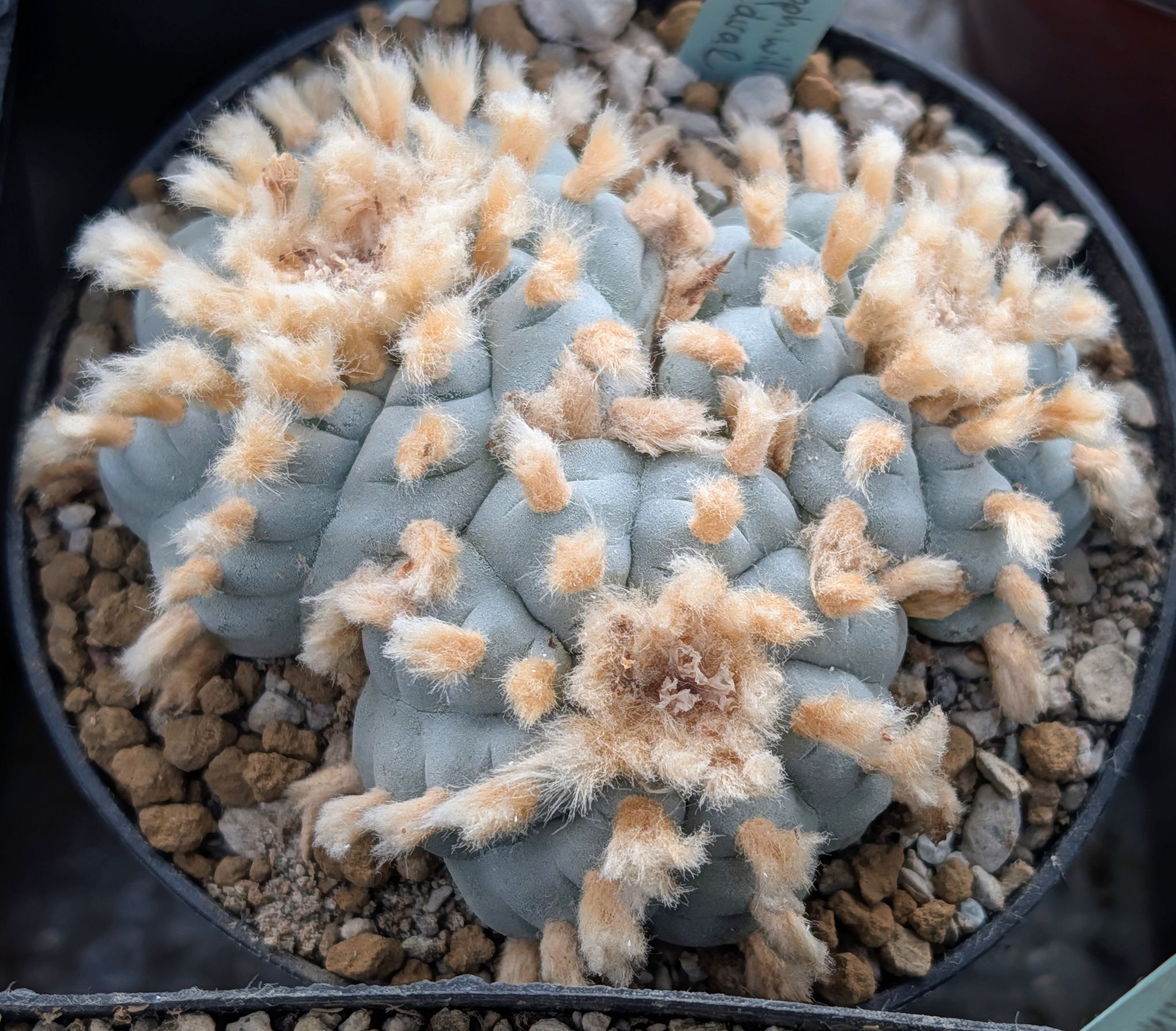
The geophyte ratio is the most contested in collector forums. The 5% organic is a compromise; many growers run zero. The right answer depends on your watering hand. If you tend to underwater, drop to zero. If you water like a tomato grower, drop to zero anyway and water less.
Frequently Asked Questions
Can I mix my own cactus soil at home?
Yes, and once you have the ingredients on hand it costs about a third of what bagged premium cactus soil costs. Buy pumice and lava rock in 50-pound bags from a koi or bonsai supplier, zeolite by the kilogram, decomposed granite and crushed limestone from a landscape stone yard, and worm castings from any garden center. Mix in a clean tub, store dry in a sealed bin.
What about Fox Farm Ocean Forest for cacti?
Worse than Miracle-Gro for rare cacti. Ocean Forest is a high-fertility vegetable mix with bat guano, earthworm castings, fish and crab meals, and forest humus. Excellent for tomatoes. Aztekium ritteri dies in it within a season.
What about akadama? It is in every cactus mix recipe online.
We do not recommend akadama for rare cacti. When akadama gets wet, it slowly breaks down to a muddy paste that destroys drainage. Hard grade akadama (Double Red Line, Triple Red Line) buys an extra year or two before breakdown but does not solve the underlying behavior. Pumice plus zeolite covers the same role (granule water-holding plus cation exchange) without the mud problem.
What about Bonsai Jack 1-1-1?
Bonsai Jack 1-1-1 (equal parts pine bark fines, calcined clay, and crushed granite) is a real upgrade over peat-based mixes and works for many succulents. For rare cacti, both the pine bark and the calcined clay are weak: the bark breaks down in 1-2 years, and Turface compacts and traps moisture. Substitute pumice and lava and you have a workable cactus mix.
How often do I need to repot?
Every two to four years for mineral-mix cactus pots, depending on the genus. Ariocarpus tolerates five years between repots. Astrophytum asterias hits a wall at three. Repot during the growing season after a dry-back of two weeks, never on a wet pot.
What if my plant is already in Miracle-Gro?
Pull it out at the next dry-back. Bare-root the plant carefully. Trim any black or mushy roots with a clean blade. Let it air-dry for three to seven days on a wire rack. Repot into your collector mix and do not water for ten days.
The squeeze test settles it
The reason Miracle-Gro Cactus, Palm and Citrus exists is not that it is the right soil for a cactus. The brand had a citrus, palm, and cactus customer base who could share one bag of soil at retail. The composition is engineered for that retail logic, not for the agronomy of a Lophophora williamsii taproot.
Buying the right minerals once and mixing them once means you stop spending money on the wrong soil, and your plants stop dying for reasons that look like watering mistakes but actually live in the bag itself.
If you are coming from a bag-soil habit, the squeeze test settles it. Take a handful of damp Miracle-Gro and a handful of damp 70-30 mineral mix. Squeeze both. The Miracle-Gro forms a packed clod. The mineral mix breaks apart and falls through your fingers. That is the difference between a substrate that holds water against roots and one that drains.
LLIFLE Encyclopedia of Living Forms, cultivation entries for Ariocarpus, Lophophora, and Aztekium · Anderson, E.F. (2001), The Cactus Family, Timber Press · Hernández, H.M. and Gómez-Hinostrosa, C. (2015), Mapping the Cacti of Mexico · Cactus and Succulent Society of America Journal, selected cultivation issues · USDA soils literature on peat hydrophobicity and cation exchange capacity · Miracle-Gro Cactus, Palm and Citrus Potting Mix product label · Fox Farm Ocean Forest Potting Soil product label · Bonsai Jack 1-1-1 Succulent and Cactus Gritty Mix specifications