
Acharagma galeanense
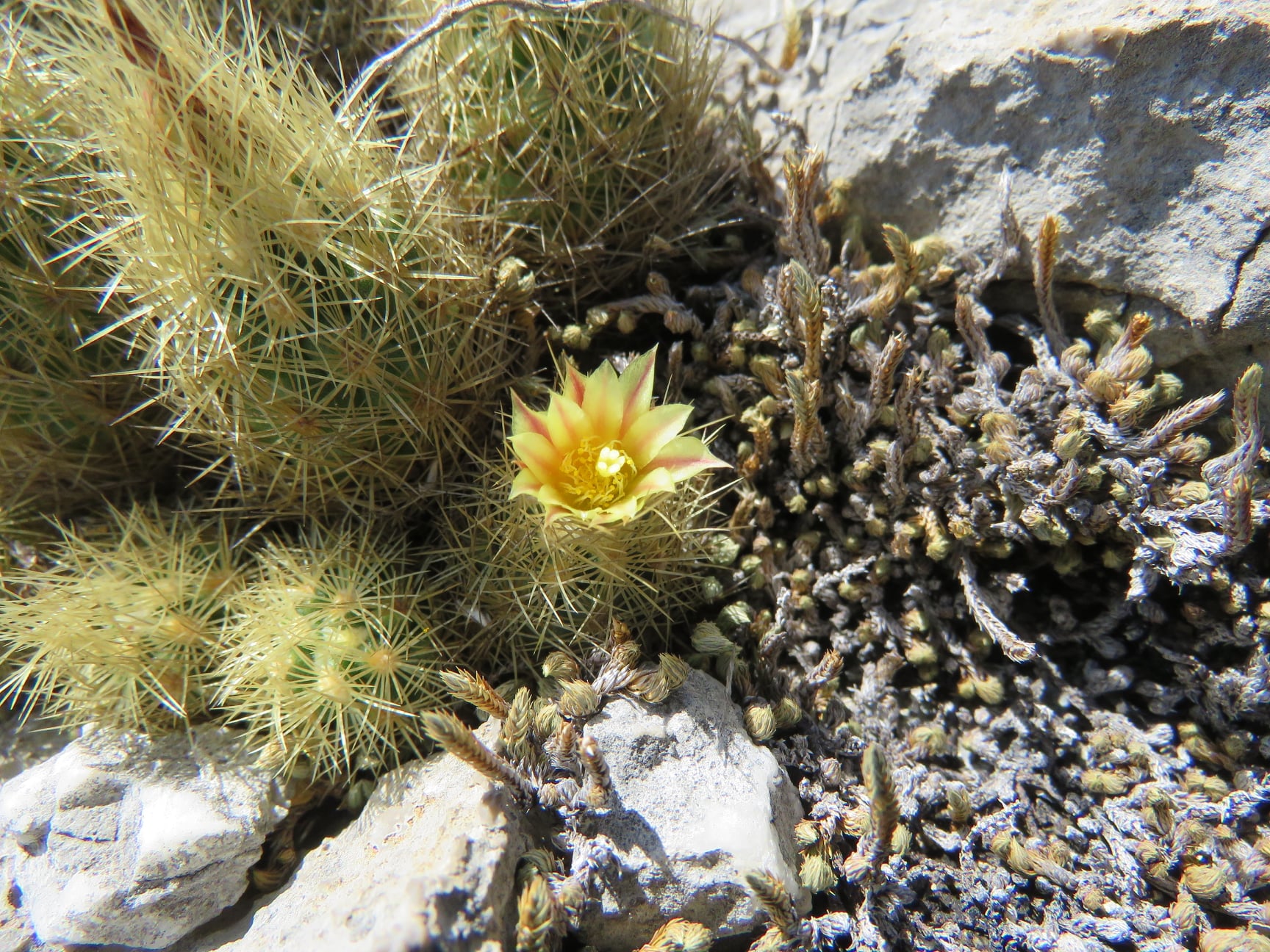
Acharagma galeanense (Haugg) Lodé is the most recently recognised species in a three-species genus of miniature limestone-calcicole cacti confined to the northeastern Mexican states of Coahuila and Nuevo León. The species was first collected by Alfred Lau in 1978 under field number L1187 near Galeana, Nuevo León, at an elevation of 2,650 m. Marcus Haugg formally described it in 1995 as Escobaria roseana subsp. galeanensis, recognising both its geographic isolation from the core range of Acharagma roseanum and its distinctive morphological characters. Joël Lodé elevated the taxon to full species rank in 2017, the combination now accepted by Kew POWO.
The specific epithet galeanense is a latinised adjective derived from Galeana, the municipality in southern Nuevo León where the type locality is situated. Haugg retained the epithet on publication; Lodé retained it again on elevation to species rank. The plant has circulated in the specialist trade under the informal name Escobaria laui (a reference to Alfred Lau’s 1978 collection), a combination that was never formally published and has no nomenclatural standing. Some older collection labels carry Acharagma roseana var. lauii for the same material.
The species is a confirmed single-locality endemic with an extremely restricted range around Galeana, geographically isolated from the core A. roseanum range in southeastern Coahuila by approximately 150–200 km. This disjunction was the primary argument for both Haugg’s original subspecific recognition and Lodé’s subsequent elevation. The morphological case for species rank rests on five characters: cylindrical versus ovoid stem form, mat-forming versus compact growth habit, undifferentiated versus differentiated central spines, cream-yellow versus pink-flushed flower colour, and the substantial geographic gap.
No separate IUCN Red List assessment has been conducted for A. galeanense since Lodé’s 2017 elevation. The 2013 assessment for A. roseanum included the galeanense populations under the then-current subspecific concept; that assessment is the closest available conservation benchmark. A single-locality endemic with a range far smaller than the already-Vulnerable A. roseanum would almost certainly qualify for a more severe threat category under independent assessment.
Acharagma galeanense quick reference
A high-elevation limestone-calcicole from the Sierra Madre Oriental of Nuevo León, Mexico, growing at a confirmed 2,650 m on rocky limestone scree near Galeana. Values calibrated for seed grown plants in cultivation, drawn from habitat data at the confirmed L1187 collection locality and specialist grower experience with A. galeanense specifically.
Taxonomy & nomenclature
The accepted name is Acharagma galeanense (Haugg) Lodé, published in Cactus-Aventures International 2017(1): 33. Kew POWO accepts this combination (LSID urn:lsid:ipni.org:names:77325784-1) with Joël Lodé as the combining author and 2017 as the publication year. The basionym is Escobaria roseana subsp. galeanensis Haugg, described by Marcus Haugg in Kakteen und andere Sukkulenten 46(3): 76 (1995), placing the new taxon in Escobaria at subspecific rank within E. roseana. D.R. Hunt transferred it to Acharagma roseanum subsp. galeanense (Haugg) D.R.Hunt in Cactaceae Consensus Initiatives No. 14: 7 (2002), the combination used in Hunt’s New Cactus Lexicon (2006) and still carried by llifle and many collector databases as the most widely cited alternative to the Lodé 2017 treatment. POWO is this site’s taxonomic authority; the page uses the Lodé 2017 accepted name with the Hunt 2002/2006 subspecies treatment noted as the prevailing prior arrangement.
A transparency note on recognition: Wikispecies (checked 2026-05-09) records that the Lodé 2017 name is “not entered in CACO or Tropicos (2025) either as a distinct species nor as a synonym.” Only POWO (Kew) carries the species-rank acceptance. This is a signal that the elevation is not yet universally adopted across major taxonomic databases. The morphological and geographic evidence for species rank is documented on this page; collectors and growers should be aware that some databases, nursery lists, and literature will continue to use A. roseanum subsp. galeanense for the same plant.
The genus Acharagma was erected by Charles Glass in his 1997/1998 Guía para la Identificación de Cactáceas Amenazadas de México (SEMARNAT/CITES). The name means “without groove” (Greek a- + charakma), identifying the ungrooved adaxial tubercle face that separates Acharagma from Escobaria and Coryphantha. Molecular phylogenetic analysis places Acharagma in a well-supported clade with Lophophora and Obregonia. The three POWO-accepted species are A. roseanum, Acharagma aguirreanum (Glass & R.A.Foster) Glass (1997/1998), and A. galeanense. Some collection labels for A. galeanense carry the informal name Escobaria laui, attributed to Alfred Lau’s 1978 field collection (L1187, Galeana); this combination was never formally published and has no nomenclatural standing.
Habitat
The type locality is near the town of Galeana in the municipality of Galeana, Nuevo León, Mexico. Haugg’s 1995 description gives Galeana as the type area; Alfred Lau’s 1978 field label for collection L1187 specifies “Mexico, Galeana, west of Ascensión, Nuevo León, 2,650 m,” the most precise locality data available for this species. POWO assigns the distribution to Mexico: Coahuila (Mexico Northeast), which conflicts with every available habitat and collection source placing the type in Nuevo León. Southern Coahuila is biologically adjacent to the Galeana area and populations there are biologically plausible given the sister species’ Coahuilan core range, but no primary source confirms A. galeanense in Coahuila specifically. This page treats Nuevo León as the documented range and notes the POWO discrepancy.
The habitat is rocky limestone scree and calcareous slopes within xerophytic shrubland (matorral xerófilo), consistent with the broader Acharagma habitat pattern. The Galeana municipality sits within the Sierra Madre Oriental; at 2,650 m the vegetation transitions from lower-elevation matorral into the montane zone below the conifer belt on Cerro El Potosí (3,600 m). The cactus populations are most likely on rocky limestone outcrops in this transitional zone, where drainage is excellent and the thick taproot can penetrate crevices. The confirmed 2,650 m elevation places A. galeanense above the stated upper elevation limit of the A. roseanum complex (1,100–2,100 m, IUCN 2013), suggesting the full elevational range of galeanense has not yet been formally documented.
The climate at Galeana is semi-arid, with approximately 446 mm annual precipitation concentrated in the summer monsoon (July through September). Winters at town level (approximately 1,655 m) reach −9°C; at 2,650 m the confirmed L1187 collection point, temperatures will be meaningfully colder. The species is adapted to genuine alpine-adjacent winters. The documented primary threat is overgrazing by goats, consistent with the IUCN 2013 assessment for the parent taxon; the extreme range restriction means that even localised grazing pressure has outsized population-level impact.
Morphology
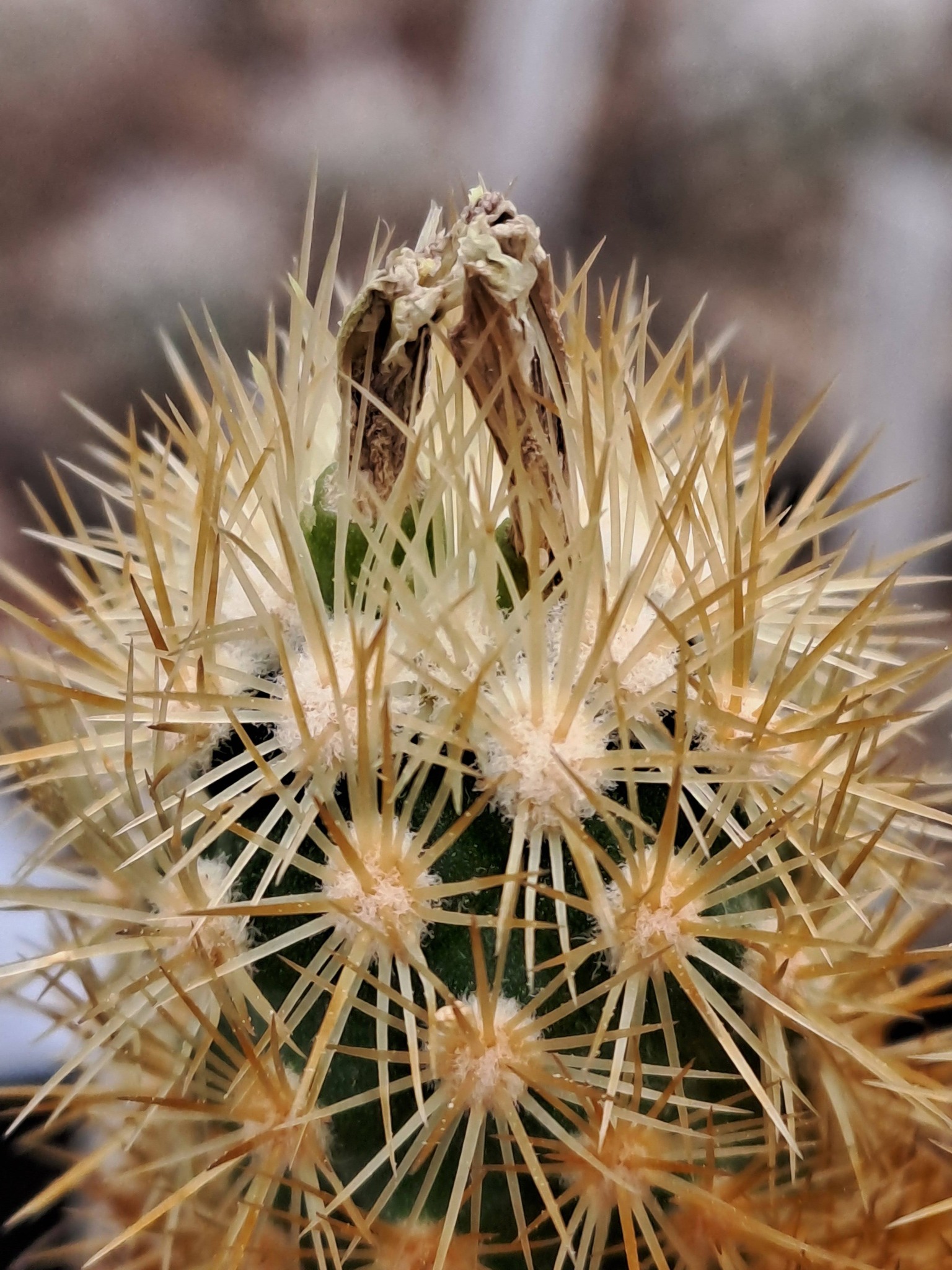
Acharagma galeanense is a mat-forming clustering cactus with a thick fleshy taproot system. Individual stems are cylindrical, initially erect, becoming prostrate with age and elongation, 6–10 cm tall and 2–2.5 cm in diameter. Mature plants reach approximately 15 cm height and 30 cm spread. This cylindrical, elongating, prostrate stem form is the single most reliable diagnostic character separating A. galeanense from its sister taxon: Acharagma roseanum maintains compact, upright, ovoid-to-subglobose stems 4–6 cm tall that never elongate in this way. The mat-forming spread of a well-grown adult A. galeanense is unmistakeable.
Tubercles are conical and ungrooved on the adaxial face, the defining genus character placing these plants in Acharagma rather than Escobaria or Coryphantha. Axils carry white wool. Spines number approximately 30 per areole; the centrals are nearly indistinguishable from the radials in colour and form. This is an important diagnostic: in A. roseanum, four to six centrals are differentiated by stouter form and darker amber-tipped coloration. In A. galeanense the overall spine array is more uniform, ranging from pale yellow through rich gold to dark amber across the whole areole without a clear central-versus-radial distinction.
Flowers arise at stem apices, funnel-shaped, 1–2 cm in diameter. The colour is cream-yellow with no pink component, a critical diagnostic against A. roseanum, whose flowers are cream to pink with bronze-rose or reddish midveins. All sources consulted are consistent on the absence of pink in A. galeanense flowers; this floral character separates the species reliably even when vegetative characters are not fully expressed in younger plants. The epidermis is pale green. Fruit is a small berry-like pod, green to purple at maturity, consistent with the genus-wide description for the Escobaria-alliance.
Locality detail
The confirmed collection locality for A. galeanense is near Galeana, Nuevo León, documented by Alfred Lau’s 1978 field number L1187. The label on this collection specifies “Mexico, Galeana, west of Ascensión, Nuevo León, 2,650 m.” This is the most precise primary locality data available; the Haugg 1995 description also gives Galeana as the type area. POWO assigns the species to Coahuila (Mexico Northeast), in conflict with every habitat and collection source. The discrepancy is documented in the POWO record itself and is likely a data-aggregation artefact; it does not reflect any published primary source placing the confirmed population in Coahuila.
The range of A. galeanense around Galeana is geographically disjunct from the core A. roseanum range in southeastern Coahuila by approximately 150–200 km. This disjunction was the principal geographic argument for Haugg’s 1995 subspecific recognition and is the single most load-bearing piece of evidence supporting Lodé’s 2017 elevation to species rank. The entire known range of A. galeanense may consist of one or a small number of populations in the Galeana municipality; no comprehensive range survey has been published in accessible sources.
The map above plots an approximate centroid. For a probable single-locality endemic with no independent IUCN assessment and active collector interest, publication of finer-grained coordinates carries real conservation risk. The locality given here is at the resolution already in the published field record (Haugg 1995, Lau L1187) and does not provide actionable precision beyond the Galeana municipality boundary.
Acharagma galeanense care and cultivation
A. galeanense is a high-elevation limestone calcicole with a rot-prone taproot. The cultivation requirements track those of A. roseanum in substrate character and watering pattern, but the higher confirmed elevation (2,650 m versus 1,100–2,100 m) justifies a higher limestone fraction and suggests the plants are adapted to more intense UV and colder, drier winters than the broader A. roseanum range demands. The single most documented failure mode, across every source consulted, is overwatering in autumn or under cool summer conditions, which causes root rot at the taproot neck.
Substrate
A. galeanense is a confirmed limestone calcicole growing on pure limestone scree at a confirmed 2,650 m. The working substrate recipe uses seven components summing to 100 percent: 35% pumice (3–6 mm), 10% lava rock (scoria, 3–6 mm), 10% zeolite (clinoptilolite, 4–6 mm), 5% granite grit, 25% crushed limestone (3–6 mm), 10% coarse silica (horticultural-grade, 1–3 mm), and 5% worm castings. The 25% limestone fraction is higher than the 20% used for A. roseanum and A. aguirreanum, reflecting the more extreme calcicole character of the 2,650 m limestone scree habitat. At least one specialist collector record documents a pure mineral approach with no organic fraction at all; growers in humid climates should reduce organic to 3% or omit it entirely. The taproot is highly rot-prone and any organic fraction that retains moisture around the root neck is a liability.
All three Acharagma species grow on limestone scree in the Sierra Madre Oriental foothills. A. galeanense carries 25% limestone (this page), reflecting its higher-elevation 2,650 m pure-limestone microsite near Galeana. A. roseanum and A. aguirreanum share a 20% limestone fraction from their 1,100–2,100 m habitat.
| Species | Pumice | Lava | Zeolite | Granite | Limestone | Silica | Organic |
|---|---|---|---|---|---|---|---|
| A. roseanum | 35% | 15% | 10% | 5% | 20% | 10% | 5% |
| A. aguirreanum | 35% | 15% | 10% | 5% | 20% | 10% | 5% |
| A. galeanense (this page) | 35% | 10% | 10% | 5% | 25% | 10% | 5% |
Watering and light
Water thoroughly from June through September, matching the summer monsoon growing season of the native habitat. Allow the substrate to dry completely between waterings. Taper sharply in October and keep the substrate entirely dry from November through March or April. Every source consulted is unanimous on the completely dry winter requirement; wet cold at any above-freezing temperature is more dangerous for the taproot than dry cold near freezing. First spring watering should wait for visible body swelling and rising night temperatures.
Light requirement is full sun. The 2,650 m habitat delivers intense UV with limited cloud cover outside the summer monsoon period, and the species is adapted to this exposure. In temperate collections, a south-facing position with 6–8 hours of direct daily exposure is appropriate. Under-lighting over multiple seasons produces loose, etiolated growth that does not recover the correct tight spine character without years of correction under better conditions.
Cold tolerance extends to approximately −7°C briefly if the substrate is completely dry, consistent with the genus-wide grower consensus. Given the habitat (2,650 m; Galeana winters reach −9°C at town level, colder at altitude), the species likely handles dry-cold exposure near or below −7°C in habitat. In cultivation, keeping the plant above 3–5°C dry through winter eliminates cold risk. Propagation from seed is the preferred route; germination is reported as reliable at 22–26°C on a calcareous mix under warm humid conditions. The mat-forming habit means individual stems can theoretically be separated, but the shared taproot system makes clean separation without damage difficult.
Comparison
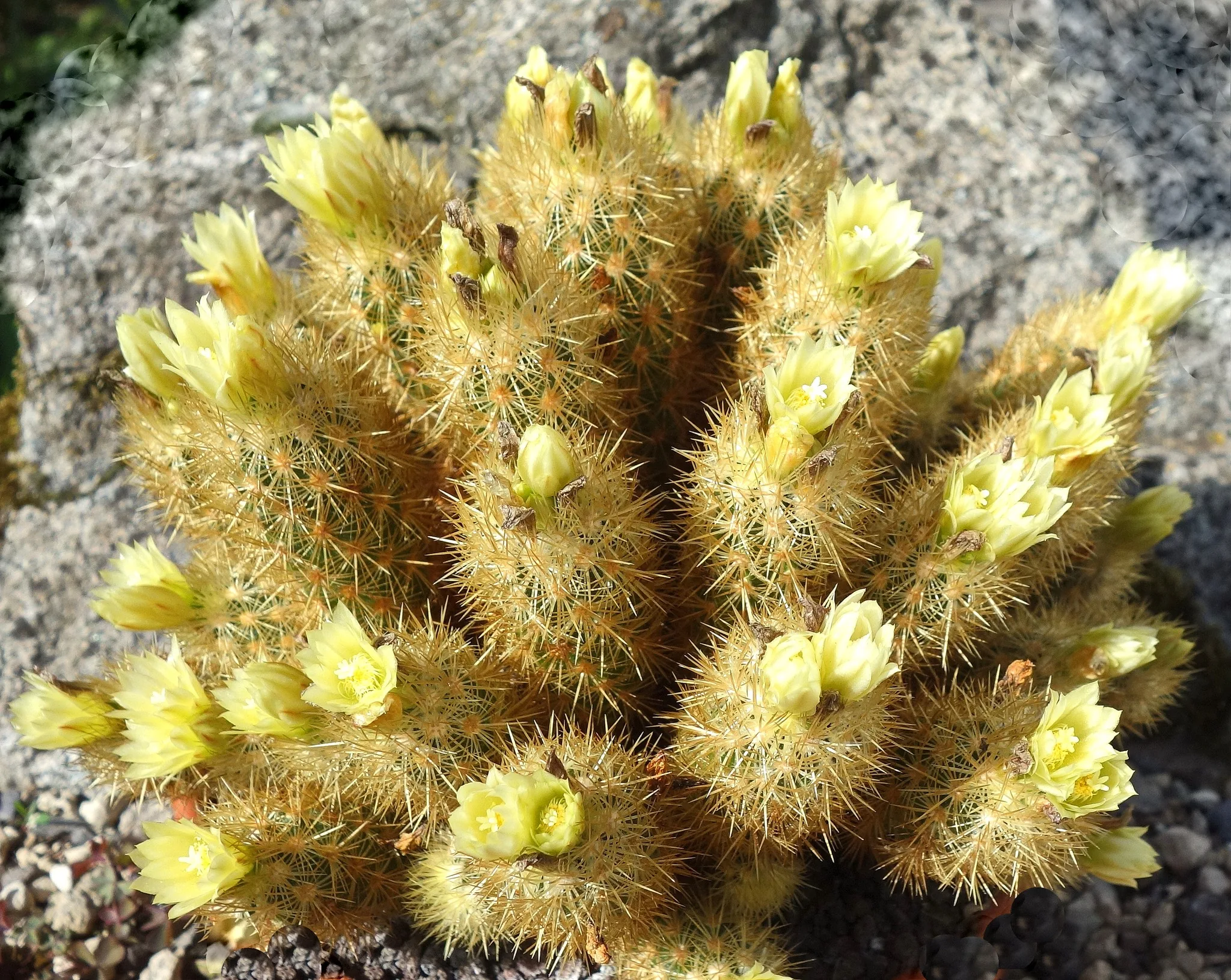
The primary comparison for A. galeanense is with Acharagma roseanum, because the galeanense plants were treated as a subspecies of A. roseanum from Hunt’s 2002 transfer through Lodé’s 2017 elevation. Much cultivation material labelled A. roseanum subsp. galeanense circulates in collections where the Lodé treatment is not yet widely adopted; some plants labelled simply A. roseanum may in fact be galeanense where the locality provenance is unknown. In adult plants the separation is unambiguous: A. galeanense develops long, narrow, cylindrical stems that become prostrate with age, eventually forming a mat up to 30 cm across. A. roseanum maintains compact, upright, ovoid-to-subglobose stems throughout its life and does not develop the elongating cylindrical form at any stage.
When plants are juvenile or when locality data is absent from collection records, flower colour is the fastest diagnostic: cream-yellow with no pink in A. galeanense; cream to pink with a bronze-rose or reddish midvein in A. roseanum. Spine differentiation provides a supporting vegetative character in mature plants: the approximately 30 spines of A. galeanense are nearly uniform in colour and form between centrals and radials, while A. roseanum has four to six centrals that stand out as slightly stouter and darker-tipped. The elevation gap is also informative for provenance-labelled material: A. galeanense at 2,650 m versus A. roseanum at 1,100–2,100 m.
Separation from Acharagma aguirreanum is reliable by contrast. A. aguirreanum is a solitary, globose-to-depressed-globose plant with dark brown to near-black spines and a distinctly blue-green to purplish epidermis, characters that are visible at arm’s length and wholly unlike the pale gold-spined, pale green cylindrical clusters of A. galeanense. Any plant with dark spines is almost certainly not A. galeanense. A. aguirreanum is also Critically Endangered with a range below 1 km² in the Sierra de la Paila, Coahuila, more than 100 km from the Galeana type locality of A. galeanense, so geographic provenance alone resolves any remaining uncertainty.
Frequently asked questions
Is Acharagma galeanense hard to grow?
Intermediate. The two non-negotiable requirements are a high-limestone mineral substrate (25% crushed limestone in the seven-component mix) and a completely dry winter rest from November through March or April. The taproot is rot-prone and collapses within days if the substrate retains moisture while temperatures are cool. The species is adapted to 2,650 m conditions with intense UV and cold dry winters; replicating the calcicole substrate profile is the hardest part of the cultivation problem.
Can Acharagma galeanense be grown from seed?
Yes, and seed is the preferred route for serious collectors. Germination from seed is reported as reliable at 22–26°C on a fine calcareous mix under warm humid conditions for the first six weeks. Growth from seed is very slow; the diagnostic cylindrical prostrate stem form only becomes apparent in plants that are several years old. Grafting accelerates growth and flowering but typically produces proportions inconsistent with the correct habitat form of a seed grown plant grown at a natural pace.
Is Acharagma galeanense legal to own?
Acharagma galeanense is covered by CITES Appendix II, which applies to all Cactaceae. Appendix II does not prohibit ownership but requires export permits from Mexico and allows importing countries to require import permits. The parent taxon A. roseanum carries special protection (Pr) under Mexican law NOM-059-SEMARNAT-2010; the same protection is assumed for A. galeanense, though a specific NOM-059 listing for the elevated species has not been confirmed in accessible sources. Nursery-propagated seed grown stock with documented artificial propagation origin is legal to buy and keep in most jurisdictions.
Where does Acharagma galeanense grow in the wild?
On rocky limestone scree in xerophytic shrubland near Galeana, Nuevo León, Mexico, at a confirmed elevation of 2,650 m. The entire known range appears to be one or a small number of populations in the Galeana municipality, within the Sierra Madre Oriental. This ranks it among the most geographically restricted cacti in the genus; its range is disjunct from the core A. roseanum range in southeastern Coahuila by approximately 150–200 km. Precise coordinates are withheld given the single-locality character of the known range and active collector interest.
When does Acharagma galeanense flower?
Summer, approximately June through September, aligned with the Mexican monsoon season that governs the growing calendar for the native habitat. No published source gives specific flowering months for A. galeanense; this timing is inferred from habitat analogy with the broader Acharagma genus and from the summer-rain origin of the type locality. Each flower is funnel-shaped, 1–2 cm in diameter, cream-yellow with no pink component. A cool, dry, bright winter rest of three to four months is the most reliable preparation for the following season’s flowering.
Sources & further reading
Haugg, E. (1995). Escobaria roseana subsp. galeanensis Haugg. Kakteen und andere Sukkulenten 46(3): 76 · Hunt, D.R. (2002). Transfer to Acharagma roseanum subsp. galeanense (Haugg) D.R.Hunt. Cactaceae Consensus Initiatives No. 14: 7 · Hunt, D., Taylor, N. & Charles, G. (eds, 2006). The New Cactus Lexicon. DH Books · Lodé, J. (2017). Elevation to species rank as Acharagma galeanense (Haugg) Lodé. Cactus-Aventures International 2017(1): 33 · Anderson, E.F. (2001). The Cactus Family. Timber Press. ISBN 0-88192-498-9 · Fitz Maurice, B., Sotomayor, M., Fitz Maurice, W.A., Hernández, H.M. & Smith, M. (2013). Acharagma roseanum. The IUCN Red List of Threatened Species 2013: e.T152561A651256 · Glass, C.E. (1997/1998). Guía para la Identificación de Cactáceas Amenazadas de México. SEMARNAT/CITES · Demir, S. (photographer, 2007). Acharagma roseanum ssp. galeanense L1187. Flickr (flickr.com/photos/s-demir/1222170024). Field label: Galeana, west of Ascensión, Nuevo León, 2,650 m · Kew POWO (2026). Acharagma galeanense (Haugg) Lodé. powo.science.kew.org/taxon/urn:lsid:ipni.org:names:77325784-1 · llifle.com (2026). Acharagma roseanum subsp. galeanense entry. Encyclopedia of Living Forms of Succulents · llifle.com (2026). Escobaria roseana subsp. galeanensis entry. Encyclopedia of Living Forms of Succulents · Wikispecies (2026). Acharagma galeanense (Haugg) Lodé. species.wikimedia.org/wiki/Acharagma_galeanense (notes name not yet entered in Tropicos as of 2025)