
Aporocactus flagelliformis
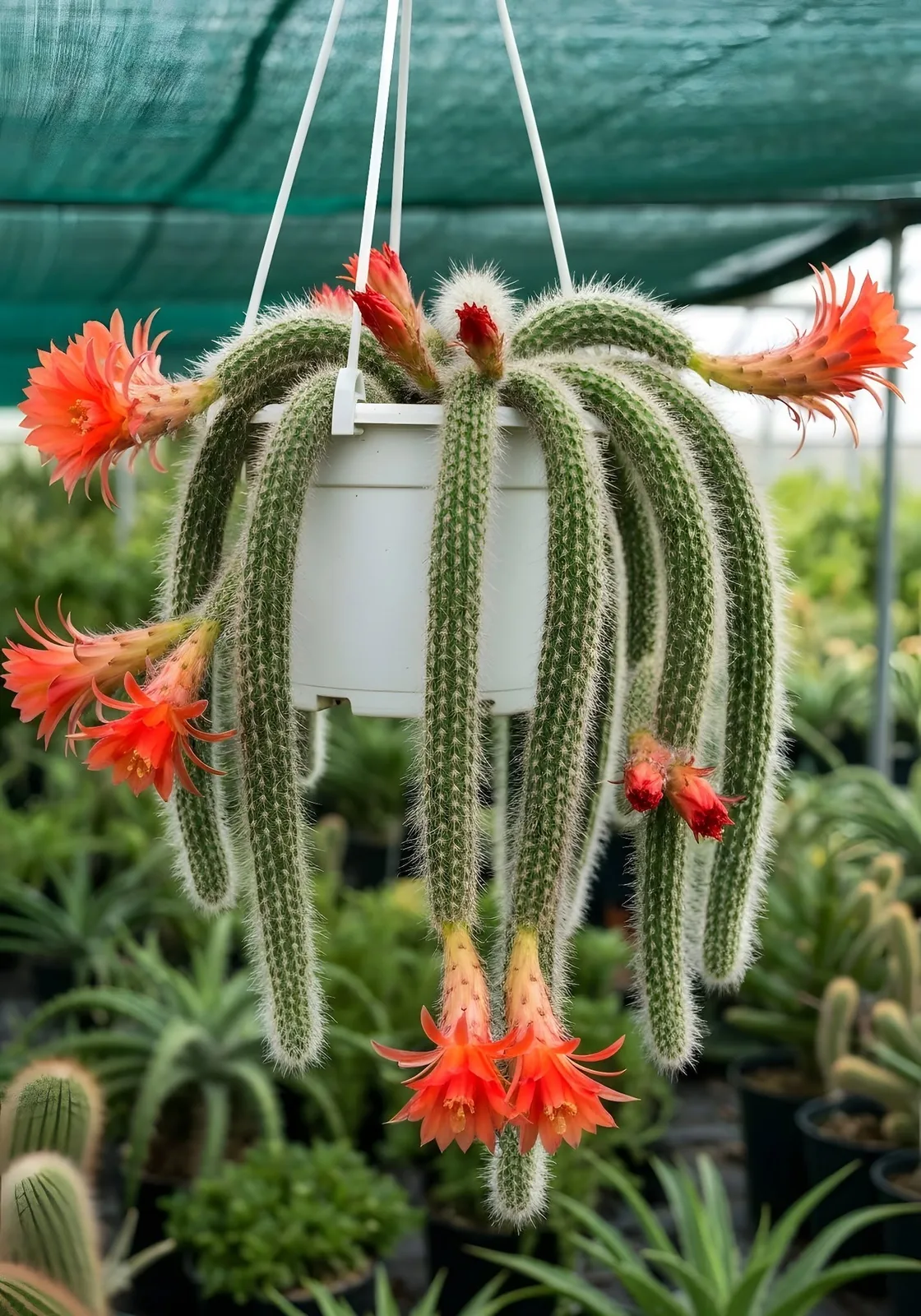
The rat tail cactus, Aporocactus flagelliformis, is one of the oldest and easiest houseplant cacti in the world: an epiphyte that has been grown in cultivation for roughly three hundred years, and is so widely traded that its true wild range in Mexico is now uncertain. It trails long, slender, cylindrical stems over the rim of a basket, clothes them in soft reddish bristles, and opens vivid magenta-pink flowers by day in spring. Most buyers still meet it under the older trade name Disocactus flagelliformis, which is the name most people type into a search bar.
This is not a collector rarity, and we will not pretend otherwise. It is cheap, common and close to indestructible, the opposite of the demanding desert endemics that fill most of this encyclopedia, from the globular miniatures to the tall Andean torches such as Echinopsis pachanoi. What it offers instead is a different world entirely: the rat tail is the first forest epiphyte on this site, a plant that grows perched on tree branches and rock rather than rooted in desert grit, and it wants a wetter, more organic regime to match.
It is also a small lesson in names. The plant once sat in Disocactus, the broad genus of flat, leaf-like epiphytic cacti, but the rat tail keeps slender round stems rather than flattened leaves, and molecular work supports returning it to its own genus, Aporocactus. Kew POWO follows that split, so this page headlines Aporocactus flagelliformis while keeping the familiar Disocactus name close at hand. The genus holds only two accepted species, this one and Aporocactus martianus, both gathered on the Aporocactus genus hub.
For all that taxonomic interest, the appeal is plain. The rat tail asks for bright light, a generous summer drink, a cool and drier winter rest, and almost nothing else, and it rewards that with a heavy spring bloom from a young age. The Royal Horticultural Society gave it an Award of Garden Merit on exactly that record, which is why it makes such a good first epiphytic cactus.
Aporocactus flagelliformis quick reference
A Mexican forest epiphyte, not a desert cactus: it grows perched on tree branches and rock, drinks freely in summer, and rests cool and drier in winter. Values calibrated for seed grown plants in cultivation, drawn from habitat-matched practice and society horticultural notes.
Taxonomy & nomenclature
The accepted name is Aporocactus flagelliformis (L.) Lem. Kew POWO places the species in the small Mexican genus Aporocactus and treats the widely used name Disocactus flagelliformis as a synonym. The two names mean the same plant; the Disocactus combination is simply the one printed across a generation of nursery labels and garden references, and remains the name most people search.
Linnaeus described the plant in 1753 as Cactus flagelliformis, the basionym, the epithet meaning whip-shaped for the long trailing stems. It has since been shuffled through Cereus, Cereaster and Disocactus before Charles Lemaire’s genus Aporocactus, raised in the nineteenth century for the rat tail group, was confirmed by modern data as its proper home.
The split from Disocactus is not arbitrary. True Disocactus are flat, leaf-like epiphytes with strap-shaped stems, whereas the rat tail keeps slender cylindrical stems that are round in cross-section, and molecular phylogenetic work supports excluding Aporocactus from Disocactus as a separate genus. POWO follows that separation, so this page headlines Aporocactus flagelliformis while flagging Disocactus flagelliformis prominently for searchers. One more name needs untangling: the popular garden hybrid Disocactus × mallisonii, also sold as a rat tail, is a separate hybrid-origin plant and should not be confused with the true species, the second of just two in the genus alongside A. martianus.
Historical synonyms (12)
- Cactus flagelliformis L., 1753 basionym
- Cereus flagelliformis var. minor Salm-Dyck, 1834 homotypic synonym
- Cereaster flagelliformis (L.) F.Berge, 1842 homotypic synonym
- Cereus flagelliformis var. funkii Walp., 1843 homotypic synonym
- Cereus flagelliformis var. mallisonii Walp., 1843 homotypic synonym
- Cereus flagelliformis var. nothus Walp., 1843 homotypic synonym
- Cereus flagelliformis var. schottii Walp., 1843 homotypic synonym
- Cereus flagelliformis var. smithii Walp., 1843 homotypic synonym
- Cereus flagelliformis var. speciosus Salm-Dyck, 1849 homotypic synonym
- Cereus flagelliformis var. leptophis (DC.) K.Schum., 1897 homotypic synonym
- Disocactus flagelliformis (L.) Barthlott, 1991 homotypic synonym
- Aporocactus flagelliformis var. leptophis (DC.) P.V.Heath, 1992 homotypic synonym
Sources: POWO (Kew) · IPNI · GBIF · Wikidata
Habitat
Aporocactus flagelliformis is endemic to Mexico, most often recorded from the states of Oaxaca and Hidalgo, with some sources adding Puebla and Veracruz. It grows as an epiphyte perched on the branches of forest trees and as a lithophyte lodged on rock, rooting in the pockets of leaf litter and moss that gather there rather than in open ground. This forest, air-and-litter life is the single fact that sets its culture apart from every desert species on this site.
Pinning down the exact habitat is harder than it should be, because the plant has been in cultivation for three centuries and its wild populations are rarely recorded. Sources even disagree on elevation: some place it in the seasonally dry forests of the Mexican highlands, others in humid cloud forest above two thousand metres. The honest description is mid-to-high-elevation Mexican forest, seasonally dry to cloud forest, on oak and pine and on rock, rather than any single precise band.
What the habitat does make clear is the rhythm the plant expects: a warm, humid growing season when rain and leaf drip keep the roots moist, then a cooler, drier rest. Reproduce that wet-summer and cool-dry-winter cadence, with the sharp drainage an epiphyte’s roots demand, and the rat tail behaves exactly as it does on a Mexican oak branch.
Morphology
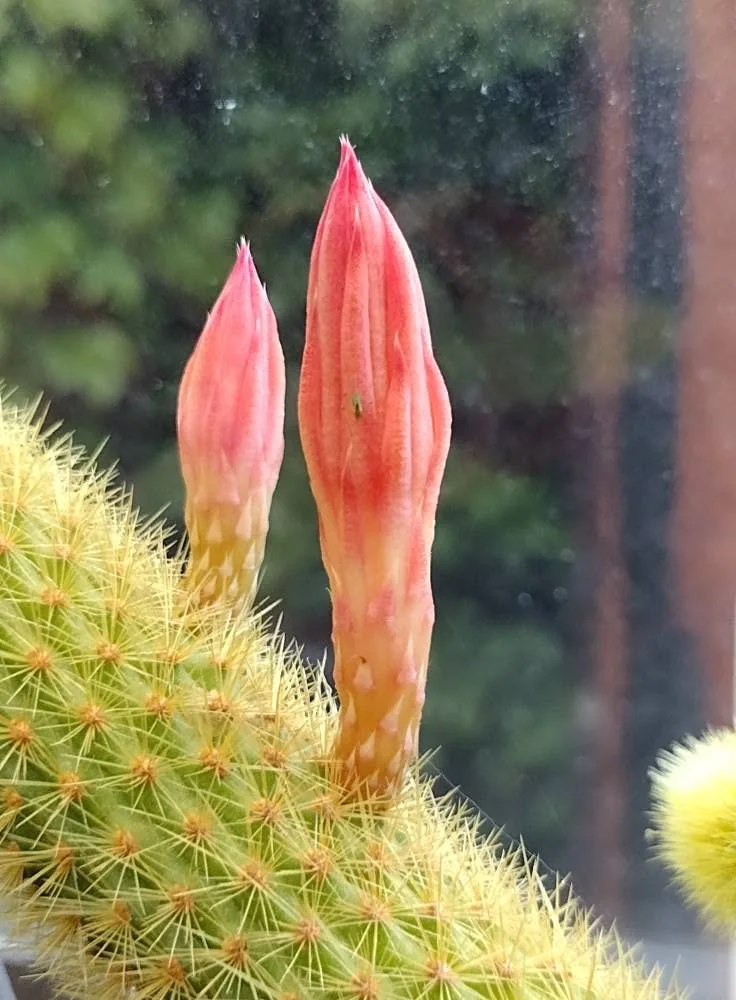
The rat tail is built to trail. Its stems start more or less erect, soon arch over and hang, and branch freely from the base, so a settled plant becomes a dense curtain of pendant growth. Each stem runs to around one to two metres long but only about one to two centimetres thick, slender, cylindrical and round in cross-section, the very trait that separates it from the flat, leaf-like stems of true Disocactus. Low ribs, between seven and fourteen, run the length of each stem.
The spines are bristles rather than weapons. Each areole carries roughly eight to twenty fine, bristle-like spines, about three to ten millimetres long, in reddish-brown through reddish-yellow to yellow, giving young stems their soft, hairy look and their reddish cast. They are dense enough to read as fur from a distance but soft enough to handle with care, part of why the plant has always been an easy one to live with.
The flowers are the reward and the giveaway. They are day-opening, borne laterally along the stems, and zygomorphic, meaning bilaterally rather than radially symmetric, a tubular bloom built for a hovering pollinator. Colour runs through vivid magenta-pink to crimson, the tube some five to eight centimetres long and two and a half to four across, each flower lasting three to five days and the whole display spread over several weeks. The small globose fruit that follows is red, bristly and about a centimetre across, carrying reddish-brown seeds.
Locality detail
The native range is a band of southern and central Mexican forest, most consistently cited from Oaxaca and Hidalgo and sometimes extended to Puebla and Veracruz. Because the plant has been traded and grown for three hundred years, and is only rarely recorded in the wild, the map below shows a regional centroid for that forest country rather than any precise field locality.
Older suggestions of a South American origin are now discounted; the species is treated as Mexican. For a plant this common in cultivation the point is largely academic for buyers, since every rat tail cactus in the trade is nursery-grown, raised from seed or rooted from cuttings, and none depends on the blurred wild population.
Cultivation
Aporocactus flagelliformis is about as easy as cactus growing gets, provided you remember it is a forest plant. Two things matter: a mix that holds some moisture yet drains sharply, and enough light to keep the stems firm and the flowers coming. Get those right and the rat tail is close to foolproof; get them wrong only with a cold, soggy winter, and the stems rot.
Substrate
Grow it in a free-draining but moisture-retentive mix of roughly 30 per cent pumice, 20 per cent decomposed granite, 10 per cent lava rock, 5 per cent zeolite and 35 per cent low-nutrient organic matter such as leaf mould or composted bark, with no limestone and no silica sand. That organic third is the whole difference from a desert-cactus soil: as an epiphyte the rat tail roots in leaf litter and wants a slightly acidic, humus-rich, airy medium that stays just moist in summer. The pumice, lava and granite keep it from ever turning to mud. A practical shortcut is about two-thirds of a standard gritty cactus mix to one-third leaf mould; for the reasoning behind every ingredient see our cactus soil mix recipe.
Aporocactus is the first epiphyte on this site, so its mix breaks the desert pattern: both rat tail species carry a much higher organic fraction than any globular or columnar genus, matching the leaf-mould and bark third of the classic rat tail soil. The parent material is non-calcareous forest debris, so there is no limestone and no silica sand, only sharp mineral grit to keep the epiphyte’s roots aired.
| Species | Pumice | Lava | Zeolite | Granite | Limestone | Silica | Organic |
|---|---|---|---|---|---|---|---|
| A. flagelliformis (this page) | 30% | 10% | 5% | 20% | 0% | 0% | 35% |
| A. martianus | 32% | 10% | 3% | 20% | 0% | 0% | 35% |
Watering and light
From spring through autumn, water generously and keep the mix evenly moist but never waterlogged; this is a thirstier plant than the desert species, and a forest epiphyte sulks if baked bone-dry for weeks in growth. Through the cool months cut back sharply and keep it cool and nearly dry, which both prevents rot and sets the flowers. Give it bright light with a few hours of direct morning sun, softening only the fiercest summer midday glare; in deep shade the stems grow lank and pale and will not bloom. Hold it above about 5°C and off frost, roughly USDA zones 10 to 11, with a cool winter rest near 7 to 10°C the trigger for a heavy spring bloom.
Propagation is trivial, which is exactly why the plant is everywhere. A detached stem segment, left a few days to callus and set on a barely-moist mix, roots almost unaided, and a cutting-grown plant flowers within two to three years. Because this is a true species and not the sterile hybrid sometimes sold under the same name, it also comes readily from seed, the route that keeps the most natural variation. At rarecactus.com we grow our rat tail cactus from seed and from stem cuttings in our own greenhouse, and we keep one on the bench as the forgiving counterpoint to the demanding endemics: a plant that flowers on a windowsill while the desert rarities ask for precision. If you are weighing how a plant was started, our guide to grafted versus seed grown cacti sets out why we favour seed.
Comparison
Aporocactus flagelliformis has two names in circulation, and the name is the first thing to settle. Disocactus flagelliformis and Aporocactus flagelliformis are the same plant; a seller offering both is not offering two species. The real confusion is with true Disocactus, the broad genus of flat, strap-stemmed epiphytes the rat tail was once lumped into. Set the two side by side and the difference is obvious: those have leaf-like flattened stems, while the rat tail is a tail in fact as well as name, slender and round in section, which is the morphological core of why POWO keeps it in its own genus.
Closer to home, the plant is widely crossed with related epiphytes to produce easy garden hybrids, the best known being Disocactus × mallisonii, sold simply as a rat tail or rat’s tail cactus. These hybrids keep the trailing habit but are propagated only vegetatively and do not come true from seed. A grower who wants the real Aporocactus flagelliformis should look for the plain magenta wild-type flower and buy from stock raised as the true species.
Against the demanding desert endemics elsewhere in this encyclopedia, the contrast is the whole reason to cover the rat tail at all. Where a cliff-dwelling miniature or a slow globular rarity punishes a wrong watering, the rat tail forgives it, asking only for a wetter summer and a cooler winter than its desert cousins. That makes it the right first epiphytic cactus and a gentle doorway into the forest-cactus world, rather than a place to spend a collector’s budget.
Frequently asked questions
Is the rat tail cactus hard to grow?
No. Aporocactus flagelliformis is a beginner plant and a classic first epiphytic cactus. Its bristles are soft enough to handle, it grows fast, and cuttings root almost on their own. The main thing to remember is that it is a forest plant, not a desert one: it wants more water in summer and a more organic mix. The only common ways to lose it are a cold, wet winter, which rots the stems, and deep shade, which leaves it lank and flowerless.
Can the rat tail cactus be grown from seed?
Yes. Because this is a true species and not a sterile hybrid, it comes readily from seed, which keeps the most natural variation, though seedlings need consistent moisture and careful watering in their first weeks. It is even simpler from cuttings: a detached stem segment, left to callus and set on a barely-moist mix, roots itself within weeks and flowers in two to three years. Both routes are easy, which is why the plant is so widespread.
Is the rat tail cactus legal to own?
Yes, freely. Like all cacti it falls under CITES Appendix II through the family-wide Cactaceae listing, not the stricter Appendix I, so nursery-propagated plants are owned and traded normally, with paperwork only for cross-border movement. Every rat tail cactus in the trade is cultivated, grown from seed or rooted from cuttings, so there is no wild-collection question hanging over it the way there is with the rarer desert cacti.
Where does the rat tail cactus grow in the wild?
It is endemic to Mexico, most often cited from the forests of Oaxaca and Hidalgo and sometimes Puebla and Veracruz, where it grows as an epiphyte on tree branches and as a lithophyte on rock. The wild plant is elusive: Aporocactus flagelliformis has been cultivated for some three hundred years and is rarely recorded in habitat, so its precise natural range and elevation are uncertain, and old claims of a South American origin are discounted.
When does the rat tail cactus flower?
From late spring into early summer, usually in a display spread over several weeks even though each flower lasts only three to five days. The blooms are day-opening, vivid magenta-pink to crimson and tubular, around five to eight centimetres long, and they appear from a young age, often on plants only two to three years old. The trigger is a cool, drier winter rest near 7 to 10°C followed by strong spring light; a plant kept warm and watered all winter grows on but flowers poorly.
Sources & further reading
Linnaeus, C. 1753. Cactus flagelliformis. Species Plantarum 1: 467 (basionym) · Lemaire, C. 1860. Aporocactus Lem. (genus established for the rat tail group) · Kew POWO, Aporocactus flagelliformis (L.) Lem. (accepted; Disocactus flagelliformis in synonymy), urn:lsid:ipni.org:names:128832-1 · Barthlott, W. 1991. Combination Disocactus flagelliformis. Bradleya 9: 87 (heavily used synonym) · LLIFLE, Encyclopedia of Living Forms, Aporocactus / Disocactus flagelliformis (morphology, habitat, cultivation, cold tolerance) · Desert-Tropicals, Rat Tail Cactus (Aporocactus flagelliformis) (range, temperature, light, watering, propagation) · Royal Horticultural Society, Aporocactus flagelliformis (Award of Garden Merit; cultivation) · World of Succulents, Aporocactus flagelliformis (rattail cactus; care, hardiness, USDA zones) · Travaldo’s blog, Disocactus flagelliformis care and culture (substrate, seasonal watering, winter rest 7–10°C) · CITES Checklist of Cactaceae (Kew), Cactaceae family-wide Appendix II listing