Ferocactus — Complete Collector’s Guide
Encyclopedia
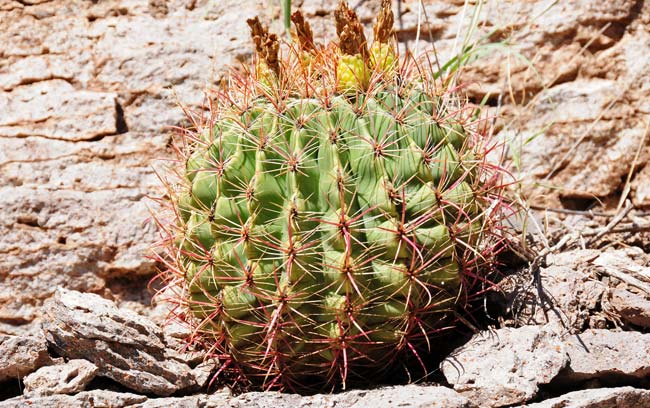
~30 species
- F. wislizeni
- F. latispinus
- F. glaucescens
- F. chrysacanthus
- F. pilosus
- F. emoryi
- F. hamatacanthus
- F. cylindraceus
- F. gracilis
- F. histrix
Ferocactus is the barrel cactus of desert art, cartoons, and film — the silhouette that, for most people, represents the idea of a cactus. The genus name comes from the Latin ferox, meaning fierce, and the spines deserve it. These are large, ribbed, deeply structural plants with dense, rigid spines that in some species hook, in others flatten, and in others curve into overlapping arrays.
As a collector’s genus, Ferocactus is often overlooked in favour of smaller, rarer plants. That is a mistake. Several species have spine colours and forms that develop dramatically with age, flowers running from yellow to deep purple, and body sizes that create real presence in a collection. F. chrysacanthus, restricted to Isla Cedros and West San Benito off Baja California, is endangered and produces spine colouring that no other barrel cactus matches.
Beyond the standout species, Ferocactus is one of the most accessible genera on this site. Most species are straightforward to grow, suitable for outdoor cultivation in mild climates, and available from seed. Not every plant in a serious collection needs to be critically endangered and difficult to source.
Contents
What is Ferocactus?
Britton and Rose established the genus in 1922, separating it from Echinocactus. The name ferox (fierce) refers to the spination. The genus includes approximately 30 species, distributed across the southwestern United States and northwestern Mexico. Young specimens are globose or short-cylindrical; as they grow older, ribs develop and the barrel form becomes pronounced. Most species are solitary, but F. robustus and F. glaucescens both cluster.
The genus occupies a different ecological niche from most of the other genera on this site. Where Turbinicarpus and Aztekium grow in the most extreme, most restricted microhabitats available, Ferocactus grows in broad, open desert — gravelly flats, rocky slopes, canyon edges, and washes where water concentrates briefly after rain. Because of this, they are considerably more tolerant in cultivation than the Mexican limestone specialists.
Where they come from
The genus ranges from southern California and Nevada east through Arizona, New Mexico, and Texas, then south through Baja California, Sonora, Sinaloa, Chihuahua, Coahuila, Tamaulipas, San Luis Potosí, Hidalgo, Guanajuato, and Querétaro in Mexico. The core habitat is hot, arid desert with sandy or rocky soils and intense solar radiation. Ferocactus plants typically grow where water moves irregularly — in arroyos and depressions where brief floods concentrate moisture.
Species profiles
Ferocactus wislizeni
The fishhook barrel cactus — one of the most common and recognisable barrel cacti in Arizona and northern Mexico. Named for the characteristic hooked central spines. In habitat, plants reach 90 to 180 cm tall. Summer flowers run orange to red. The yellow fruit is edible. Hardy to around -12 degrees Celsius when dry. Start here for outdoor Ferocactus cultivation in warm temperate climates.
Ferocactus latispinus
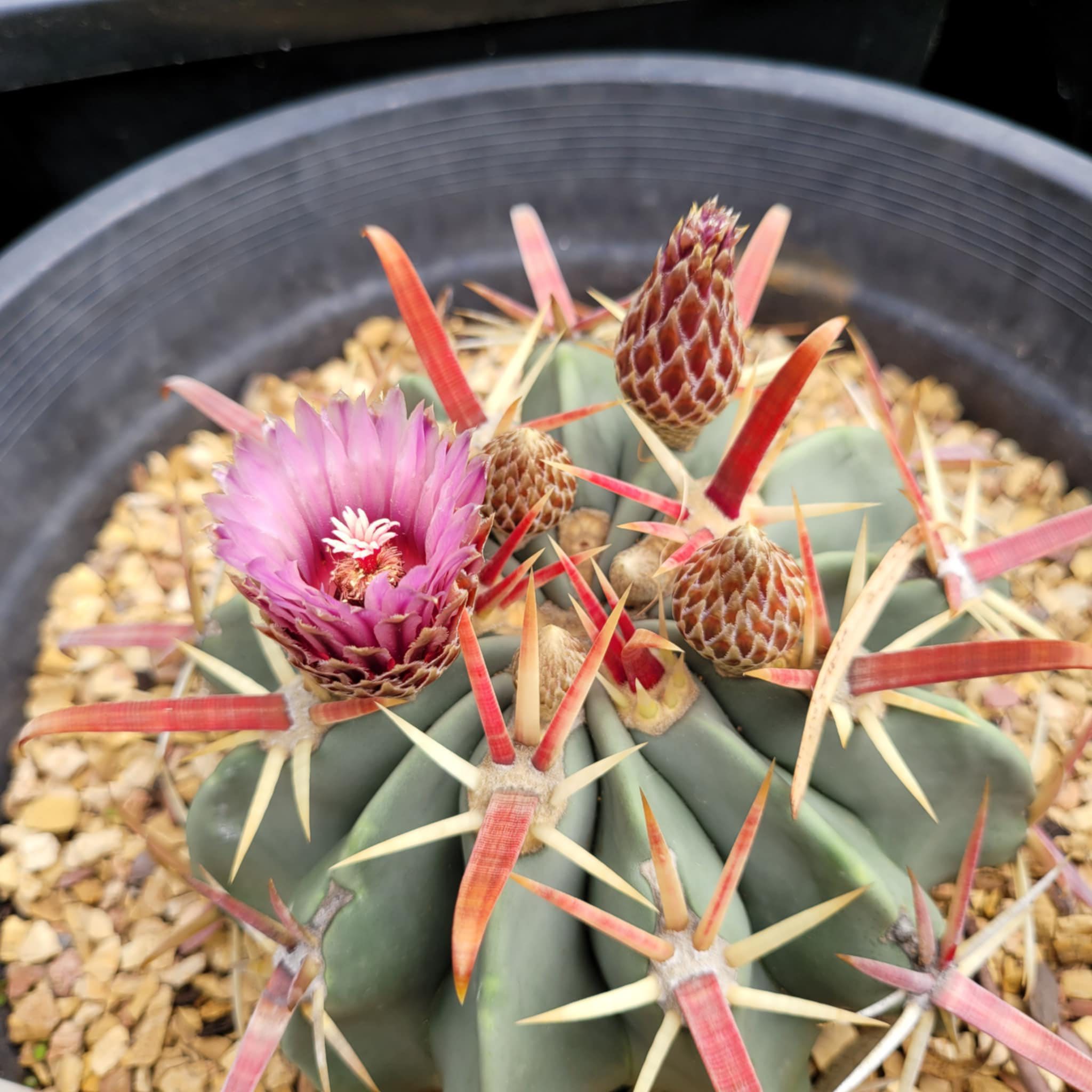
The devil’s tongue cactus. Three characters distinguish it from most of the genus: it flowers in winter rather than summer, it produces purple flowers rather than yellow to red, and the principal central spine is broad and flat rather than round or hooked. These characters together make it immediately identifiable. The winter flowering is a useful trait for any collection that runs short of interest in cold months.
Ferocactus glaucescens
The blue barrel cactus. The blue-green body colour justifies the name. Sometimes clustering — unusual in the genus — with pale yellow spines and bright yellow flowers. Native to the limestone hills of Hidalgo, Guanajuato, Querétaro, and San Luis Potosí. Well-suited to outdoor growing in mild climates.
Ferocactus chrysacanthus
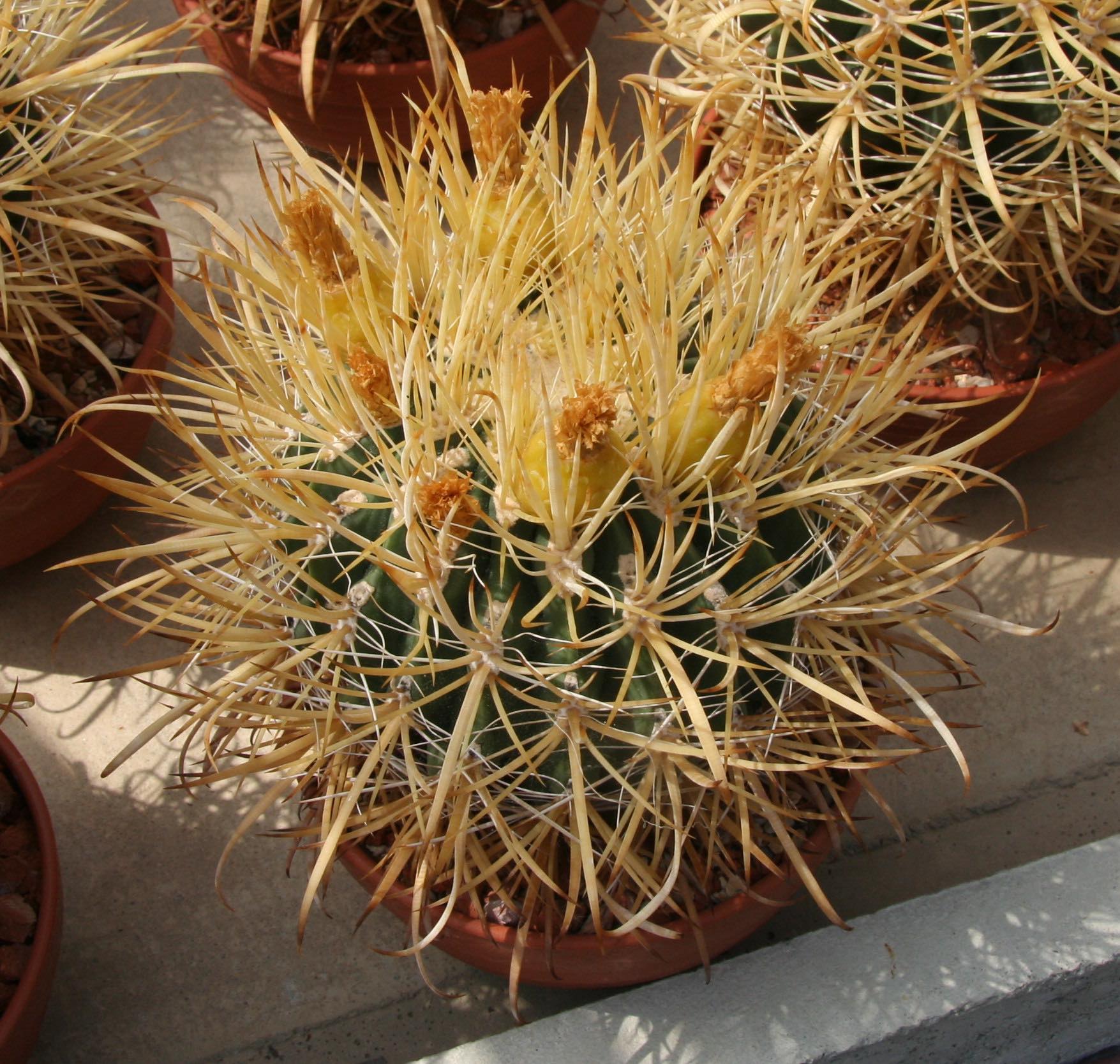
Endemic to Isla Cedros and West San Benito off the Pacific coast of Baja California. IUCN: Endangered. One of the spiniest and most visually dramatic species in the genus, with spines running from golden yellow to red-orange depending on age and sun exposure. Available through specialist seed sources with correct provenance.
Ferocactus pilosus
The Mexican lime cactus. Solitary or clustering, deep green, barrel-shaped to columnar, potentially reaching 2.4 metres in habitat. Dense red spines age to grey. Summer flowers run orange-red.
Ferocactus emoryi
Emory’s barrel cactus. Green to blue-green body, spherical to cylindrical, reaching 1.8 to 2.4 metres in age. Usually produces red flowers, though yellow-flowering individuals occur. Hardy to around -8 degrees Celsius.
Flowers and flowering season
Most Ferocactus flower in summer, with blooms appearing at the crown from June through September. Flower colour runs from yellow through orange and red to pink, depending on species. F. latispinus is the notable exception, flowering in winter with purple blooms. Plants typically take 15 or more years from seed to produce their first flowers.
Growing them
Soil
Use a well-draining mix, around 60 to 70% inorganic. Sandy to gravelly texture suits them well. Ferocactus tolerates modest organic content better than the extreme limestone specialists on this site, but standing moisture still causes rot.
Watering
Water freely in the growing season. These are not drought-adapted in the same extreme sense as Ariocarpus or Turbinicarpus. Occasional deep watering in summer promotes good growth. In winter, keep them dry or give very occasional watering.
Light and temperature
Give them full sun throughout the growing season. Most species tolerate temperatures well below freezing when dry: F. wislizeni to -12 degrees Celsius, F. emoryi to -8, F. glaucescens and F. latispinus to around -5 to -7. All figures assume completely dry root zones.
Containers vs in-ground
In climates where winters are reliably mild, Ferocactus does well in-ground in full sun. In containers, the barrel form develops more slowly but the plant remains manageable. Grow container specimens in deep pots so the root system and body develop more characteristically.
Rarity and what to buy
F. wislizeni, F. glaucescens, and F. latispinus are available from both specialist and general cactus sources. F. chrysacanthus requires seeking from documented seed sources given its endangered island-endemic status. Start with species that suit your climate and build toward the more restricted species over time.
Legal status
CITES lists all Ferocactus under Appendix II. Several species carry additional legal protection under state or national legislation in the US and Mexico. Wild collection from public lands in Arizona, California, and other states requires permits.
Questions collectors ask
Is it true barrel cacti tilt south?
F. wislizeni in Arizona does lean somewhat toward the sun, which is why some people call it the compass cactus. F. cylindraceus, however — the species most commonly labelled compass barrel — actually grows mostly straight. The lean in F. wislizeni is real but inconsistent and not reliable as a navigation tool.
Can I drink the water from a barrel cactus?
No. The internal moisture is alkaline and contains compounds that worsen dehydration rather than relieve it. The fruit of some species — F. wislizeni and F. histrix in particular — is edible; the internal stem tissue, however, is not a useful water source. This is a persistent piece of folklore and it is wrong.
How long do they live?
Wild Ferocactus can live 100 years or more. Because growth is slow, a plant the size of a football has probably been growing for 15 to 25 years depending on species and conditions.