Lophophora — The Ultimate Collector’s Guide to Keeping This Rare Specimen Alive
Encyclopedia
2 accepted species + up to 3 proposed
- L. williamsii
- L. diffusa
Possible additional species
- L. fricii
- L. koehresii
- L. alberto-vojtechii (status debated)
This page is a botanical reference. This site does not sell Lophophora, and the information here is for scientific and horticultural education only. Because L. williamsii is a Schedule I controlled substance in the United States — and carries equivalent restrictions through most of the western world — you should check applicable law before acquiring any species in this genus.
If you want to understand why serious botanists find this genus worth a career, start with the alkaloid chemistry. Lophophora williamsii contains more than 50 distinct alkaloids, with mescaline as the dominant compound at roughly 30% of total alkaloid content. Researchers who radiocarbon-dated archaeological specimens from Shumla Cave on the Rio Grande placed them at 3,780 BCE, and analysis still detected approximately 2% mescaline in the dry tissue. As a result, these plants carry a documented history of human use stretching at least 5,500 years.
The botany, separate from the pharmacology, also rewards attention. Taxonomists actively contest the species count. Wild populations are declining. The plants grow so slowly that a 10 cm specimen represents more years than most people would guess. None of that connects to the cultural reputation the genus carries — but all of it matters if you want to understand what these plants actually are.
Contents
What is Lophophora?
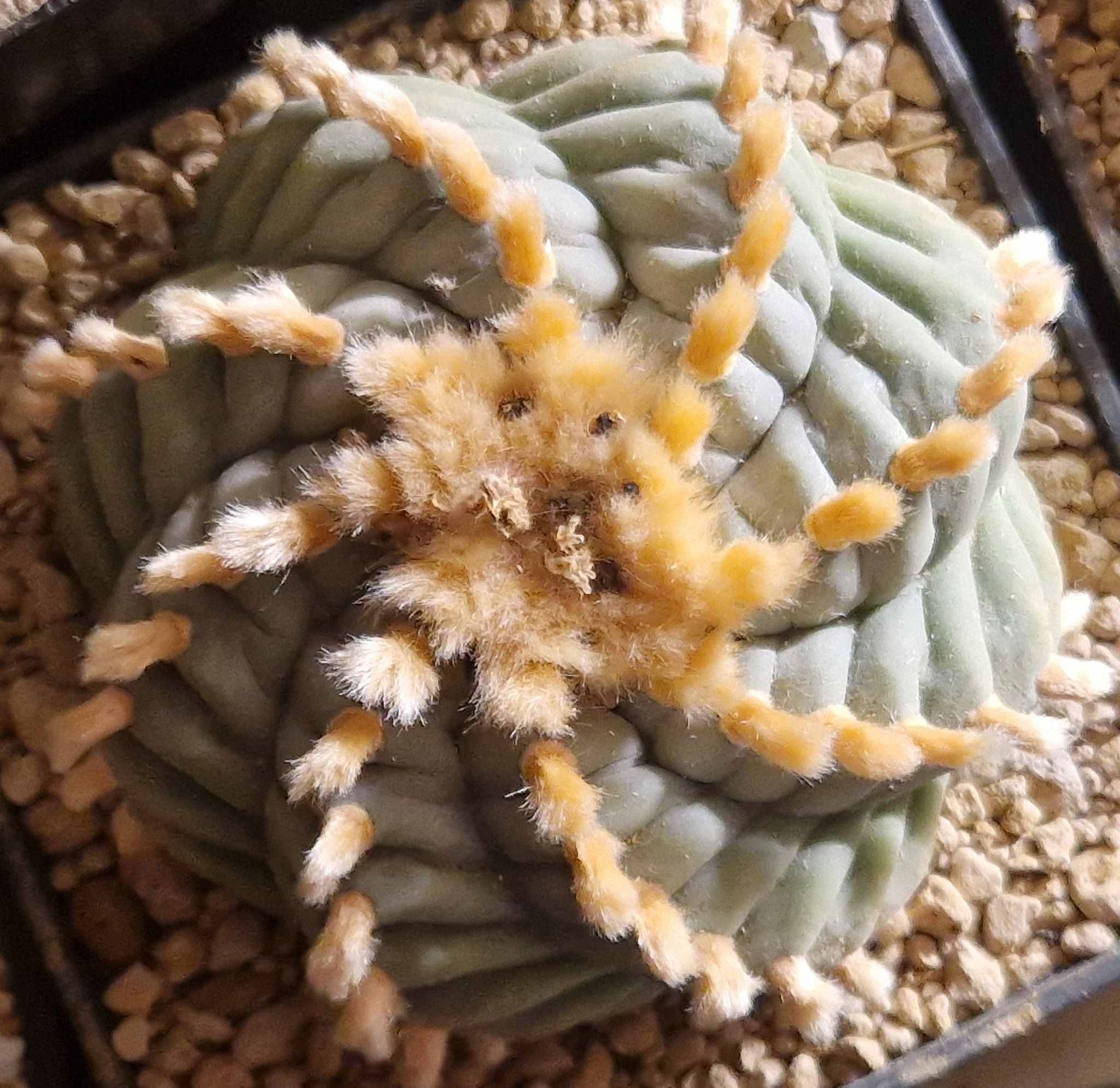
John Merle Coulter established the genus in 1894, with L. williamsii as the type species. The name comes from the Greek lophos (crest) and phoros (bearing), referring to the tufts of white trichomes that emerge from each areole. Those woolly tufts are diagnostic for the genus, and they immediately distinguish it from other spineless cacti that might otherwise cause confusion.
Most authorities accept two species: L. williamsii and L. diffusa, confirmed as genetically distinct by Butterworth et al. in 2002. Botanists have proposed three further species — L. fricii, L. koehresii, and L. alberto-vojtechii — though their status remains unsettled. L. koehresii grows in alluvial silty flats near Río Verde in San Luis Potosí, a substrate quite different from the rocky limestone ground of L. williamsii. Morphological, chemical, and DNA evidence all support treating it as distinct. L. fricii, distributed around a lagoon near Viesca in Coahuila, shows substantial variation across its range.
Researchers at the Journal of the Botanical Research Institute of Texas established that rib number in L. williamsii follows the Fibonacci sequence, with 5, 8, and 13 ribs as the most stable configurations. Importantly, mescaline concentration correlates positively with rib count and crown diameter. As a result, mature 13-ribbed plants carry measurably higher alkaloid loads than juvenile 5-ribbed individuals.
Where they come from
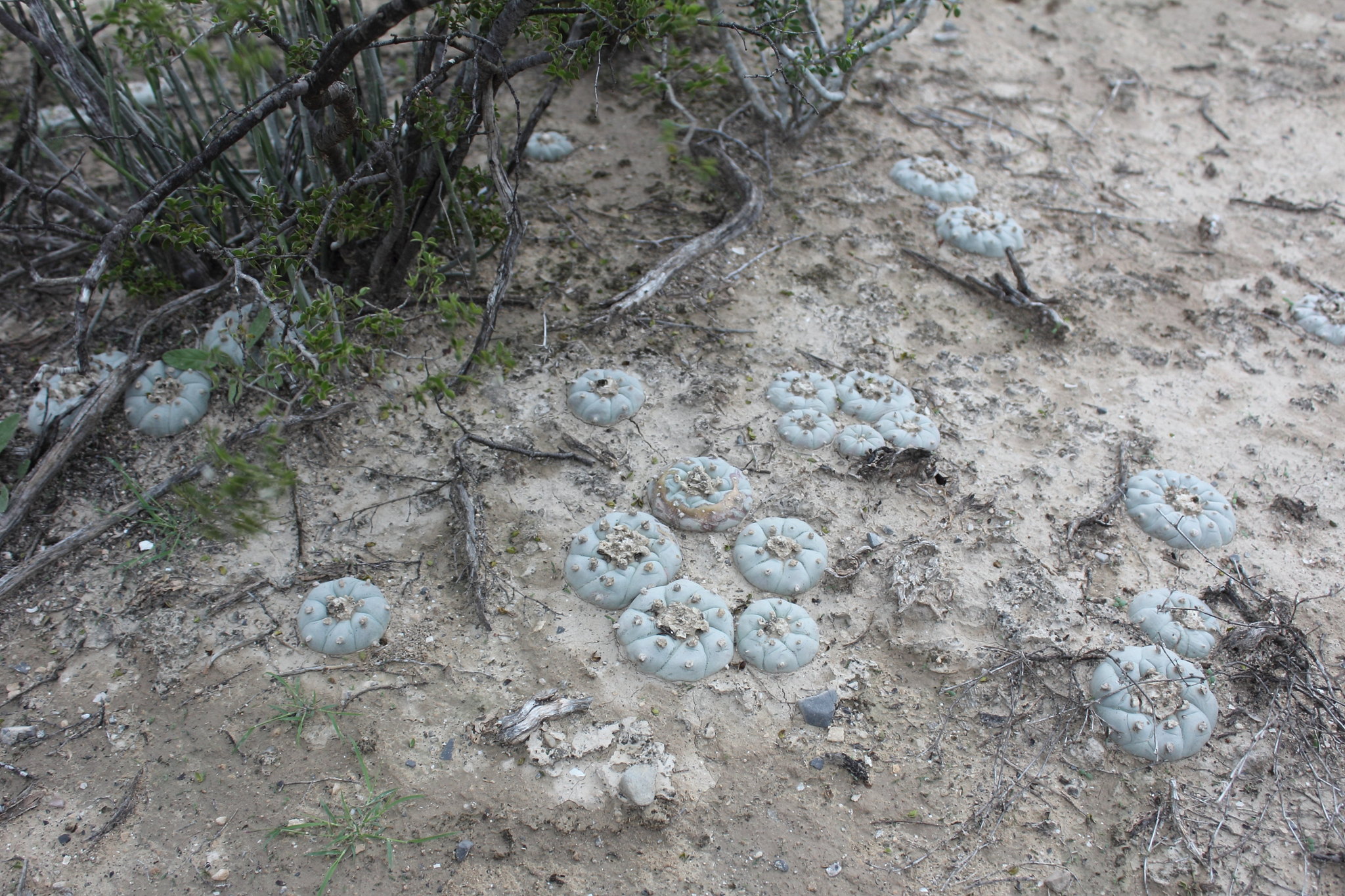
L. williamsii ranges from Trans-Pecos Texas south through Coahuila, Nuevo León, Tamaulipas, Zacatecas, and San Luis Potosí in Mexico, at elevations between 100 and 1,500 metres. More than 80% of that range lies in Mexican territory. In habitat, the plant grows in Chihuahuan Desert scrub on limestone substrates, usually in partial shade beneath nurse plants. A 2022 study in Coahuila found that individuals grew most frequently in the north-facing quadrant beneath shrubs including Flourensia cernua, Agave lechuguilla, Larrea tridentata, and Prosopis glandulosa. That spatial pattern was aggregated rather than random, which suggests these nurse plant associations are ecologically essential rather than incidental.
By contrast, L. diffusa occupies a much smaller range — restricted to a small area between Vizarrón, Bucareli, and Tolimán in Querétaro state. It is the southernmost species in the genus. L. koehresii grows in silty alluvial flats near the Río Verde lagoon in San Luis Potosí. L. fricii is found around the Viesca lagoon in Coahuila.
The IUCN assessed L. williamsii as Vulnerable in both 2013 and 2017. Illegal harvest, habitat loss, overgrazing, and fire ant predation of seedlings all drive population declines. In south Texas, the state lists the plant as endangered. Moreover, the actual distribution is probably considerably smaller than published maps suggest, because the species occurs in isolated patches rather than continuously across its apparent range.
Species profiles
Lophophora williamsii
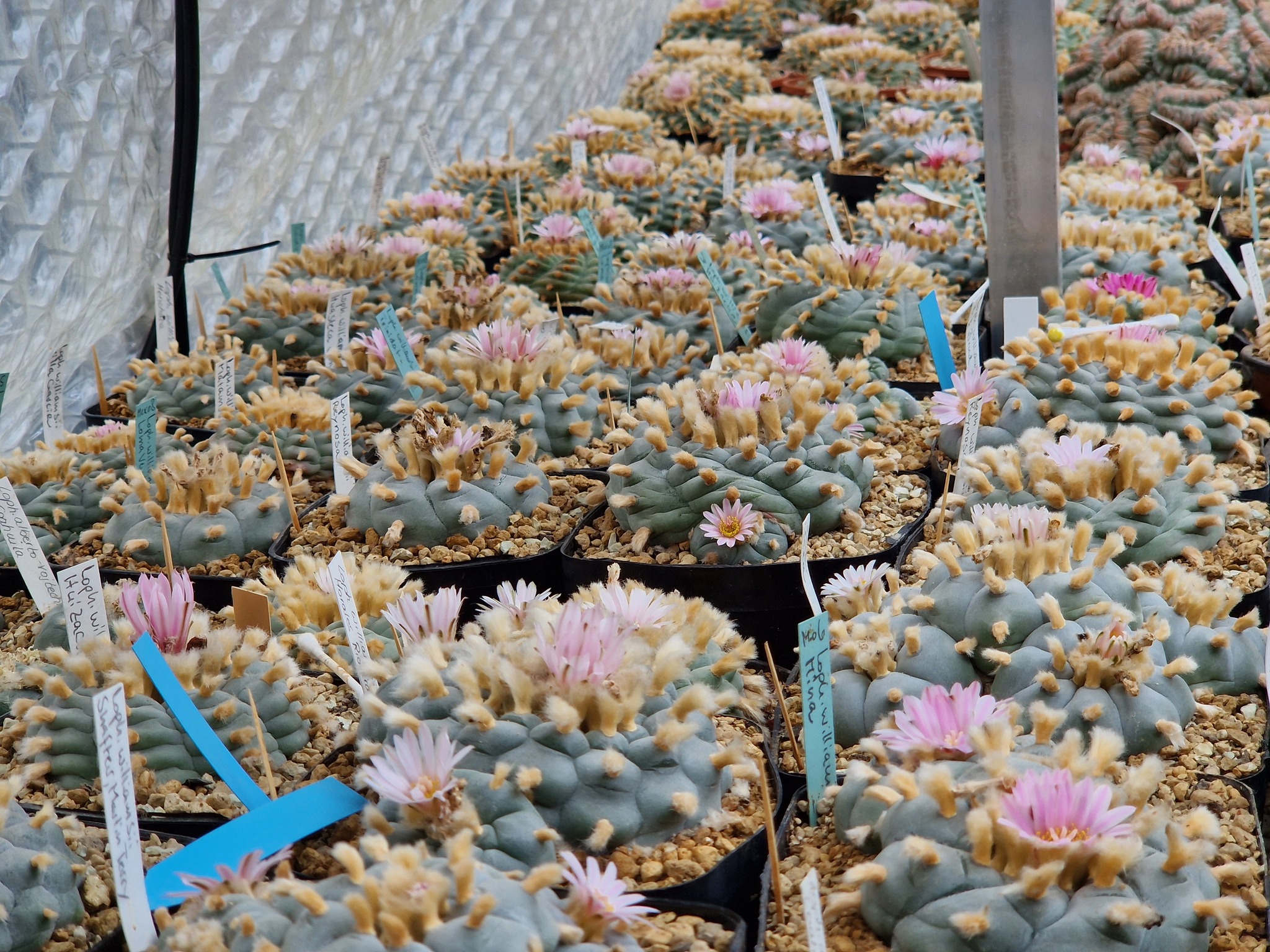
The type species and the most widely distributed in the genus. Blue-green to grey-green flattened stems, 4 to 12 cm in diameter, carry 5, 8, or 13 ribs. Areoles produce dense tufts of white wool. Flowers run pink to white, 1 to 2.4 cm across, followed by slender pink fruit. Crucially, this is the only species in the genus that is self-fertile — it can set viable seed without a cross partner.
Lophophora diffusa
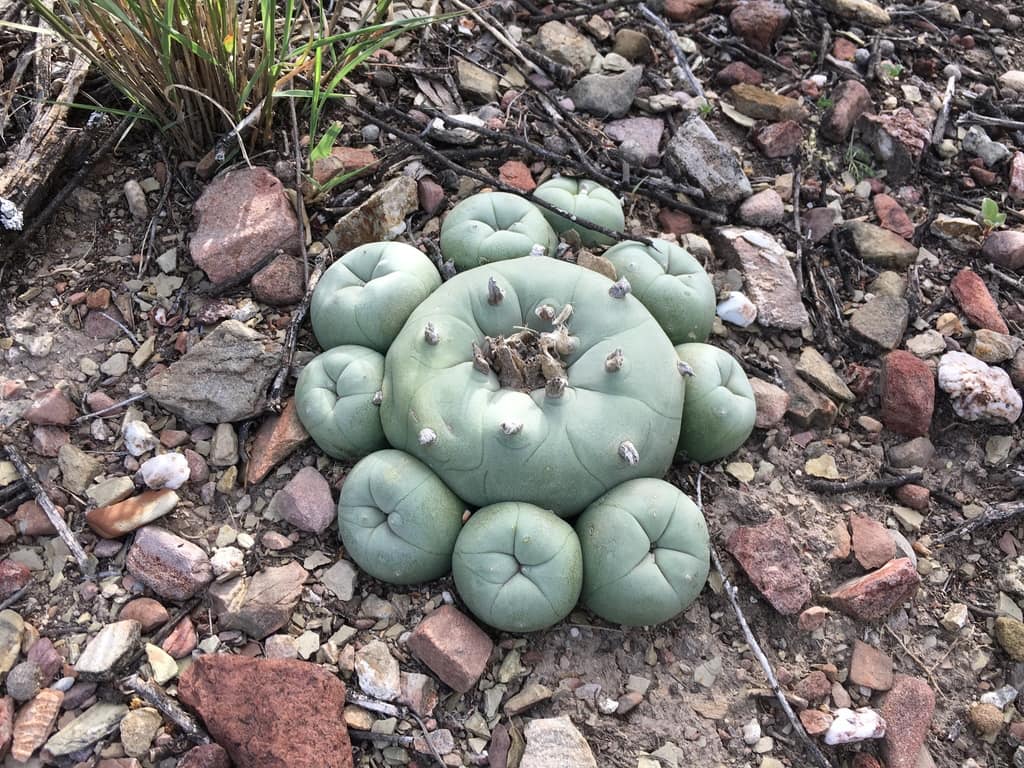
Endemic to Querétaro and the southernmost species in the genus. You can identify it by its yellow-green to green body (greying with age), flat and ribless podaria, and a broader, shallower root than L. williamsii. The principal alkaloid is pellotine rather than mescaline. Unlike L. williamsii, this species is self-sterile: two genetically distinct plants are needed to set seed.
Lophophora fricii
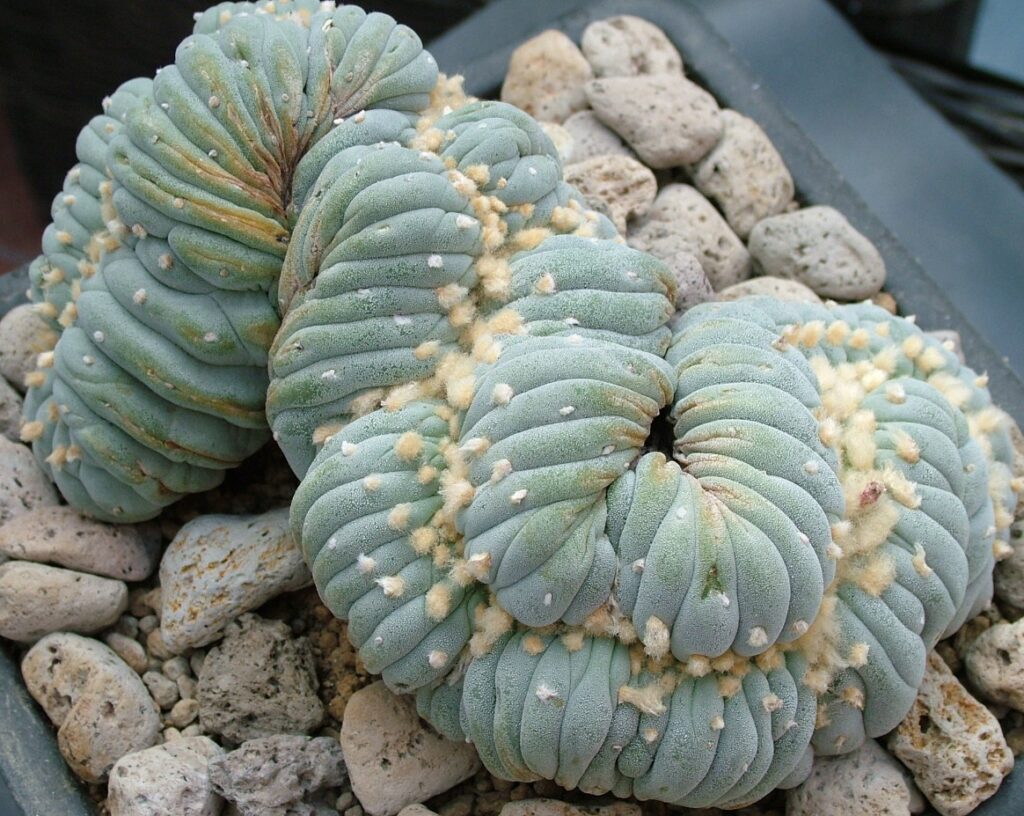
Lophophora koehresii
Named after seed grower Gerhard Koehres. This species grows in alluvial silty flats near the Río Verde lagoon in San Luis Potosí — a habitat quite unlike the rocky terrain of L. williamsii. Edward Anderson encountered it in the field and initially misidentified it as L. williamsii; subsequent morphological, chemical, and DNA work confirmed it as a distinct taxon. Taxonomists consider it the smallest species in the genus. Self-sterile.
Alkaloid chemistry
Researchers have isolated more than 50 alkaloids from L. williamsii. Mescaline makes up approximately 30% of total alkaloid content by mass, with pellotine at 17%, anhalonidine at 14%, and hordenine at 8%. Mescaline concentration in dry crown tissue runs around 3 to 6%; fresh tissue contains roughly 0.4%. When analysts tested the Shumla Cave specimens in 2005, those plants — dated to 3,780 BCE — still contained approximately 2% mescaline in dry tissue.
The alkaloid profile differs between species. L. diffusa contains only trace mescaline; pellotine dominates instead. L. fricii and L. koehresii carry intermediate profiles. These chemical differences, alongside the morphological and genetic data, form part of the basis for treating the proposed species as distinct rather than as varieties.
Flowers and reproduction
Flowers emerge from the apical wool from March through May, and sometimes into September. They run pink to white, 1 to 2.4 cm long, with thigmotactic anthers that respond to touch — a trait shared with Opuntia and uncommon in the cactus family. L. williamsii is self-fertile; all other species require a genetically distinct cross partner. In the wild, plants may take up to 30 years to reach flowering size. In cultivation, however, plants reach flowering stage in 3 to 10 years depending on conditions.
Growing them
Soil
Use a fast-draining, predominantly mineral mix: 90% inorganic material, and 10% worm castings. The root is a large, fleshy taproot that rots quickly in wet conditions, so err toward the coarser end.
Watering
Water through the growing season whenever the mix has been dry for at least a week. From October through April, keep them dry. Because the natural climate delivers summer rainfall followed by dry winters, replicating that seasonal pattern is the single most important factor in long-term success.
Light and temperature
Give them full sun to bright filtered light. South-facing under glass works well in northern latitudes. Keep the winter minimum above 5 degrees Celsius. Cold and dry is fine. Cold and wet, however, is lethal.
Pots
Choose pots deeper than wide to accommodate the taproot. Terracotta dries faster than plastic, which matters here. Repot in spring before the growing season begins.
Conservation status
The IUCN lists L. williamsii as Vulnerable. Populations continue declining in both Texas and Mexico from over-harvest and habitat loss. The IUCN also lists L. diffusa as Vulnerable, with an extremely restricted range in a single area of Querétaro. Because of this, cultivation from seed is the only ethical route to a collection of these plants where local law permits it.
Legal status
L. williamsii is a Schedule I controlled substance in the United States. Possession, cultivation, and distribution all require DEA authorisation, except for members of the Native American Church using peyote as a sacrament under the American Indian Religious Freedom Act of 1978. In Mexico, the plant carries special protection under NOM-059-SEMARNAT-2010.
In most of western Europe mescaline is a controlled substance, though plant-level legal status varies by country. Research the specific law that applies to your location before acquiring any Lophophora. CITES lists all species under Appendix II. This site does not sell Lophophora under any circumstances.
Questions collectors ask
Is Lophophora legal to grow?
That depends entirely on where you are. In the United States, L. williamsii is a Schedule I controlled substance, and cultivating it without DEA authorisation is illegal. L. diffusa and L. fricii occupy a legal grey area because they contain negligible mescaline; interpretations vary by jurisdiction. Check your specific jurisdiction before acquiring any plant in this genus.
How do you tell the species apart?
The most reliable characters are rib form, body colour, and flower morphology. L. williamsii has prominent, straight ribs; L. diffusa has flat, suppressed podaria with no pronounced rib. In practice, locality data from the seed source is often the single most useful piece of information for a correctly labelled plant.
How slow are they really?
In the wild, extremely slow — up to 30 years to reach flowering size. In cultivation with optimal conditions, however, 3 to 10 years from germination to a flowering plant is achievable. Grafted plants develop faster but look different from own-root specimens.