
San Pedro Cactus (Trichocereus pachanoi): The Collector’s Complete Botanical Guide
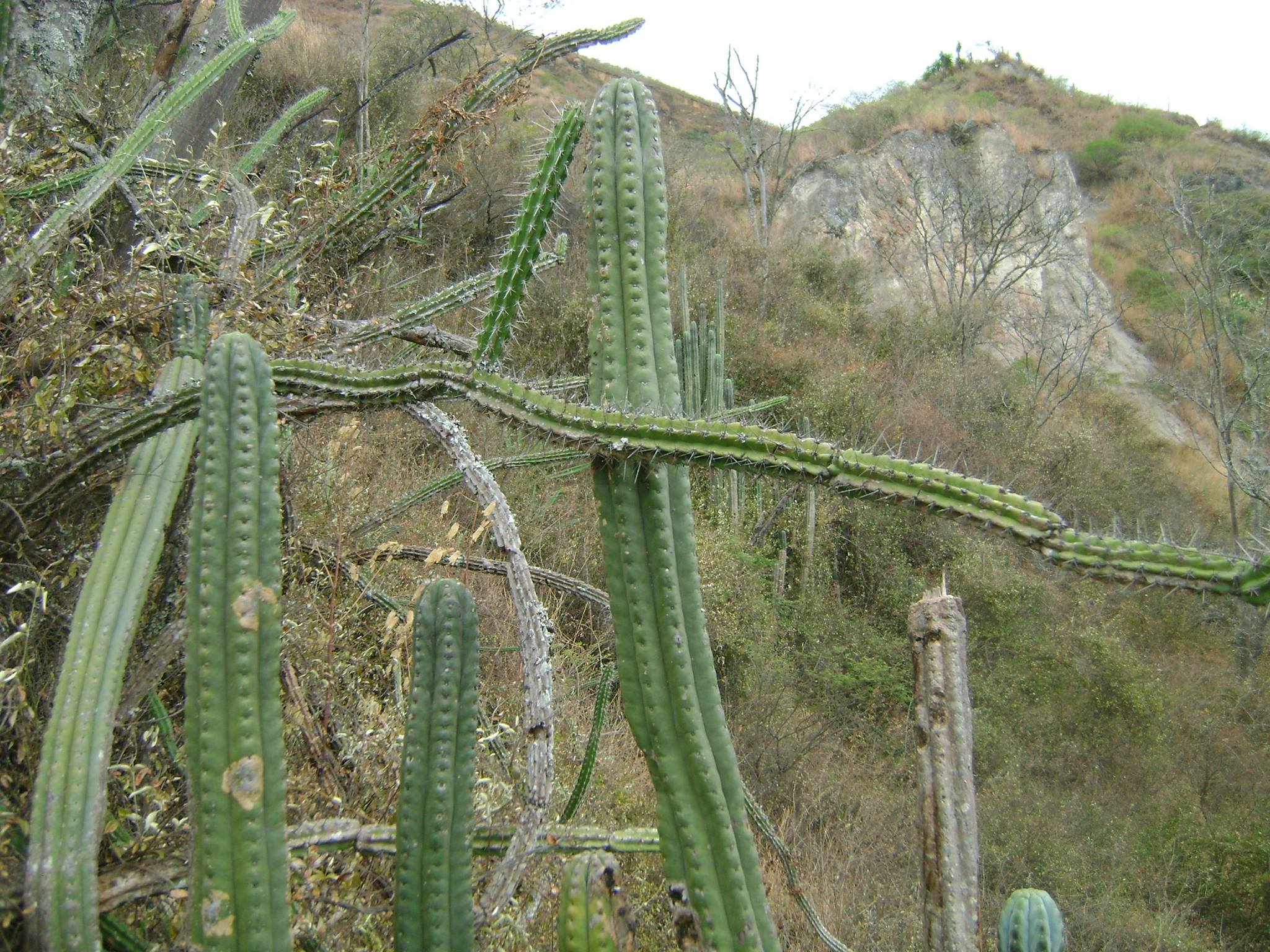
All ArticlesSan Pedro cactus is Trichocereus pachanoi (Britton and Rose, 1920), a fast-growing Andean columnar cactus native to Ecuador and Peru at 2,000 to 3,300 m. Kew now lists it as Echinopsis pachanoi, but specialist taxonomy and the trade keep Trichocereus. Six to eight ribs, spines under 2 cm, and white nocturnal flowers up to 24 cm long.
Why does San Pedro cactus go by two scientific names?
San Pedro cactus carries two valid scientific names because of a genus dispute: Britton and Rose described it as Trichocereus pachanoi in 1920, and a 1974 reclassification moved it into Echinopsis as Echinopsis pachanoi. Both names point to the same plant, and the history is worth understanding before you read any other source on the species.
Britton and Rose described Trichocereus pachanoi in 1920 from a plant collected near Cuenca, Ecuador, on a 1918 expedition led by J.N. Rose with the agronomist Abelardo Pachano (the species honors him). For most of the next century, the trade and the scientific community both used Trichocereus.
In 1974, Friedrich and Rowley sank Trichocereus into Echinopsis, and the new combination Echinopsis pachanoi started showing up in monographs. Kew’s Plants of the World Online accepts Echinopsis pachanoi today. So does GBIF.
The split-vs-lump argument has solid molecular footing on both sides. Molecular work by Schlumpberger and Renner showed Echinopsis in the broad sense is non-monophyletic, which is the technical case for keeping Trichocereus as a separate genus. Albesiano and Kiesling went the other direction, lumping T. pachanoi, T. peruvianus, and T. macrogonus into a single species (T. macrogonus) with three varieties.
What this means for a collector: both Trichocereus pachanoi and Echinopsis pachanoi are correct in their respective frameworks. Sacred Succulents, Mesa Garden, and most named-clone documentation use Trichocereus. Botanical garden labels and most taxonomic checklists use Echinopsis. We use Trichocereus in this article because that is what serious collectors search and what the established named-clone literature uses.
Where does San Pedro cactus grow in the wild?
San Pedro cactus grows wild in Ecuador and Peru, along the Andean cordillera between roughly 4° South and 14° South at 2,000 to 3,300 meters elevation. IUCN-confirmed wild populations sit at Huancabamba (Piura, Peru), Quebrada Santa Cruz (Áncash, Peru), and the Cuenca region of Ecuador.
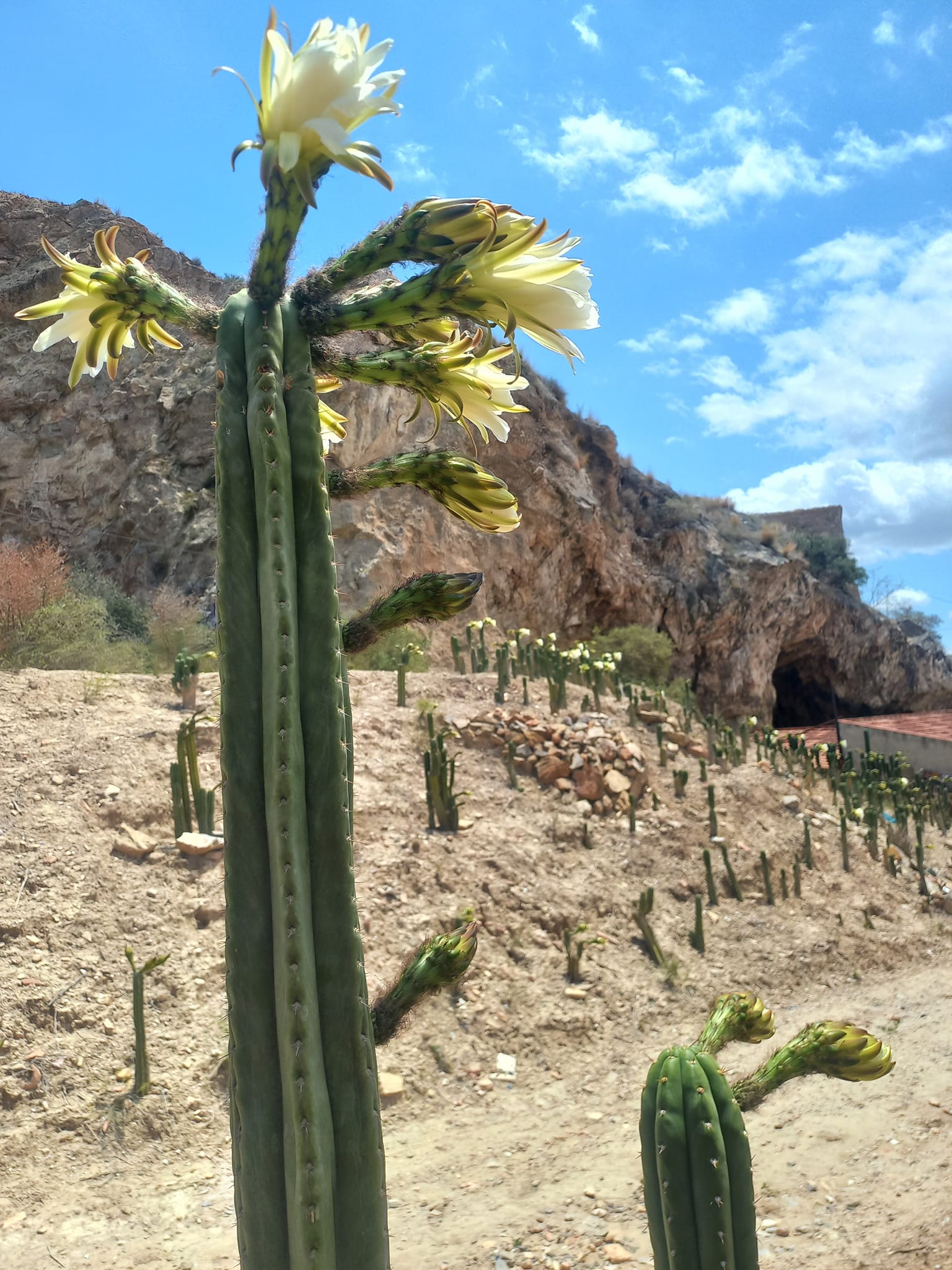
The habitat is high-Andean dry shrubland to seasonally wet montane scrub. Cool nights (5 to 8 °C is common), intense UV, rainfall concentrated December to March (austral summer), dry winter. Plants grow on rocky slopes among Caesalpinia, Schinus, and Puya species; they tolerate freezing temperatures briefly when bone-dry.
Here is the load-bearing caveat. Most populations described as “wild” are difficult to separate from 3,000 years of indigenous Andean cultivation. Archaeological evidence at Guitarrero Cave (Callejón de Huáylas, Áncash) puts ritual use of the species at 1300 BCE. Chavín de Huántar stone reliefs depict the cactus. By the time Britton and Rose described the species in 1920, the boundary between native populations and post-cultivation escapes had already blurred for millennia. Any honest range map for T. pachanoi shows confirmed wild localities and a much larger zone where wild status is undefinable.
How do you tell San Pedro from Bolivian Torch and Peruvian Torch?
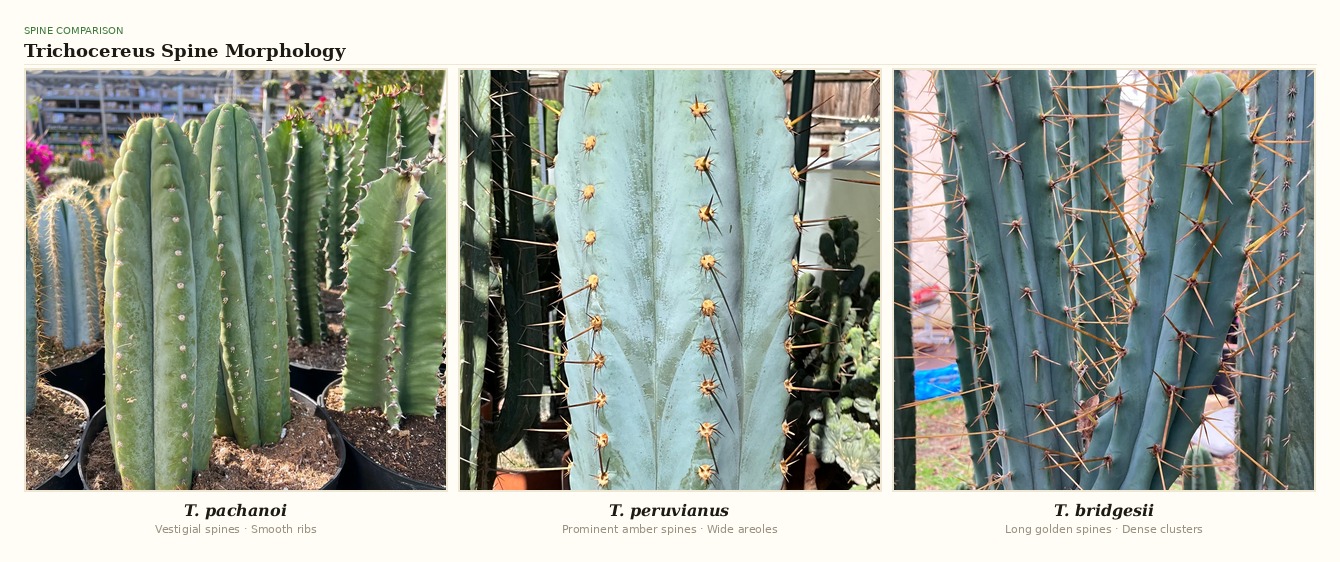
San Pedro, Peruvian Torch and Bolivian Torch separate mainly on spine length and stem color. T. pachanoi has spines under 2 cm and a green, lightly glaucous stem; T. peruvianus has spines up to 4 cm and a strongly blue-frosted stem; T. bridgesii shows sharp angular ribs, often only four to six. The three are routinely confused at the retail level and in young-plant photos, but mature plants separate cleanly on a few diagnostic traits.
| Trait | T. pachanoi | T. peruvianus | T. bridgesii |
|---|---|---|---|
| Ribs | 6-8, rounded and gentle | 6-9, often slightly sharper | 4-8, often 4-6, sharp and angular |
| Spine length | 2 mm to 2 cm | Up to 4 cm typical, occasionally 15 cm | Longer than pachanoi, shorter than peruvianus |
| Stem color | Green to lightly glaucous | Strongly glaucous, frosted blue | Light to vibrant green, sometimes glaucous |
| Areole eyebrow | Distinctive notch above each areole | Less pronounced | Variable |
| Floral tube hair color | Brown to black at base | Brown to black | White |
Two diagnostics matter most in practice. Spine length: a plant with spines you can comfortably grab is pachanoi. A plant with 4 cm needles is peruvianus. Stem color in raking light: hold the plant under early-morning sun. T. peruvianus reads visibly blue-frosted. T. pachanoi reads green with a thin glaucous bloom.
The lump-side taxonomy from Albesiano and Kiesling treats these as varieties of T. macrogonus. The split-side keeps them separate. Either way, the morphological diagnostics above hold.
A note on Echinopsis cuzcoensis: 7-8 ribs, robust spines 2-7 cm, more glaucous than pachanoi. The Cuzco / Apurímac plant is a separate species in most treatments and shows up occasionally in named accessions. If you bought a “San Pedro” from Cuzco-region seed and it has heavy spines and bluish skin, you may have cuzcoensis.
Named clones and provenance: what is a PC?
A PC, or Predominant Cultivar (sometimes Predominate Cultivar), is the single mass-propagated clone that most retail “San Pedro” in the US and Europe descends from, sold as unlabelled cuttings of cuttings. PC dominated US nursery stock from the 1980s onward. Phenotypically, PC is anomalous: sawtooth ribs, often spineless or with short yellow spines, and white floral hairs. White floral hairs do not match true Ecuadorian T. pachanoi, which has brown to black hairs at the base of the floral tube.
The provenance argument is open. Some specialist taxonomists believe PC is closer to T. bridgesii or to T. riomizquensis than to true pachanoi. DNA testing has not been published. What is verifiable: PC reproduces true from cuttings, has been distributed for decades, and is what most retail buyers receive when they order “San Pedro.”
Documented named accessions matter for collectors who want a known-provenance plant:
- KK339 · Karel Knize 1970s-80s seed-grown line from Ecuador. Spinier than PC.
- Hutchison 1597 (BBG 57.0884) and Hutchison 6212 (BBG 64.0762) · Paul Hutchison field-collected accessions held at UC Berkeley Botanical Garden, propagated through Sacred Succulents.
- Juul’s Giant · Tom Juul’s Ecuadorian phenotype, distributed by Sacred Succulents.
- Huancabamba · Dick Van Geest 1960s seed collection from Piura, later sold by Mesa Garden. Long-spine and short-spine forms documented.
- Matucana · separate Lima Department line, with documented phenotypic differences from PC stock.
- Backeberg pachanoi · 1950s European nursery grafting stock.
If your collecting interest leans toward documented field origin, buy from Sacred Succulents, Sanchez, or the small handful of nurseries that publish accession history. If you just want a fast-growing columnar plant for landscape use in a frost-free climate, PC stock is fine and inexpensive.
How do you grow San Pedro cactus in cultivation?
San Pedro cactus needs full sun, a fast-draining mineral mix at 70 to 80% inorganic, a weekly deep soak through the summer growing season, and protection from wet cold below roughly −9 °C. The quick-reference card below covers the numbers a grower checks first.
- Growth rate: up to about 30 cm per year in cultivation; 10 to 15 cm per year in habitat.
- Hardiness: USDA zone 8b to 10; reliable in zone 9 and warmer in-ground.
- Water: weekly deep soak spring through early autumn; near-dry October through April.
- Light: full sun once acclimated over two to three weeks.
Substrate: a fast-draining mineral mix at 70 to 80% inorganic, similar to the recipe in our mineral substrate guide. Pumice plus 5-10mm decomposed granite plus a small organic fraction for the columnar build. Skip peat. Use a deeper pot than for globular cacti because the root mat extends laterally and benefits from anchorage depth.
Watering: weekly deep soak from spring through early autumn when the plant is in active growth. Near-dry from October through April. Cold-and-wet kills Trichocereus faster than any pest. The genus tolerates dry cold to roughly −9 °C briefly, but only when bone-dry; a frost on a wet pot is a death sentence.
Light: full sun once acclimated. Step plants up gradually over two to three weeks if the plant has come from a shaded greenhouse or northern climate. Un-acclimated T. pachanoi burns visibly within 48 hours of being moved into peak summer sun in low-elevation Mediterranean or southern California climates.
Growth rate: up to 30 cm per year on well-watered, well-fed cuttings. In habitat at 2,500 m, growth slows to perhaps 10 to 15 cm per year. This is among the fastest columnar genera, and a 30 cm cutting can become a 1.5 m plant in five years under cultivation.
Cold hardiness: USDA zone 8b to 10. Reliable in zone 9 and warmer in-ground. Containers come inside or get protected below zone 9b.
Propagation: cuttings root readily. Cut a 30 cm minimum length for vigorous establishment, callous one to three weeks before potting, plant in dry mineral mix, hold off watering for ten days. Seed germinates light-dependent at 25 to 30 °C in two to three weeks, and seedlings tolerate light shade for the first year.
CITES status: family Cactaceae sits on Appendix II, so live plant material crossing borders requires a permit. Seeds of Cactaceae from Ecuador and Peru are exempt from CITES controls. (Mexican Cactaceae seed has separate restrictions.)
IUCN status: Least Concern (assessed 2017). For comparison, Lophophora williamsii is listed Vulnerable, and our peyote conservation article covers why the protections layer so differently between the two columnar-and-globular Andean and Chihuahuan species.
Legal status: San Pedro is legal to own and grow as an ornamental and botanical plant throughout the United States. The living plant is unrestricted; the mescaline it contains is a Schedule I controlled substance, a distinction our guide to San Pedro legality covers in full.
Frequently Asked Questions
How fast does San Pedro cactus grow?
Up to about 30 cm per year on well-watered cuttings in cultivation. In habitat at 2,500 m, growth runs roughly 10 to 15 cm per year. T. pachanoi is among the fastest columnar cacti when given heat, sun, and water in the growing season.
What is the difference between San Pedro and Peruvian Torch?
Spine length and stem color. T. pachanoi has spines under 2 cm and a green stem with a thin glaucous bloom. T. peruvianus has spines up to 4 cm and a strongly blue-glaucous stem. Both have 6-8 ribs typically. The two grade into each other in the wild and lump-side taxonomy treats them as varieties of T. macrogonus.
Trichocereus or Echinopsis: which is correct?
Both, in their respective taxonomic frameworks. Kew POWO and most modern taxonomic authorities use Echinopsis pachanoi. Specialist taxonomy, named-clone literature, and the trade use Trichocereus pachanoi. Either name maps to the same plant.
Can San Pedro survive freezing temperatures?
Brief dips to about -9 degrees C if bone-dry. Sustained freezes damage or kill the plant. Hardy USDA zone 8b to 10. The combination of freezing and wet substrate is what actually kills the species, not low temperature alone.
How tall does San Pedro get in cultivation?
3 to 6 meters in normal cultivation. The tallest documented specimen is 12.2 m. Container plants generally cap around 2 to 3 m before they topple under their own weight without staking.
Is San Pedro cactus legal to own?
Yes. San Pedro is legal to own and grow as an ornamental and botanical plant throughout the United States. The mescaline it contains is a Schedule I controlled substance, but the living plant grown for ornamental purposes is not restricted. At rarecactus.com we grow our Trichocereus from seed and document the accession line, because the PC clone most retail San Pedro descends from is botanically anomalous and its provenance is undocumented.
A column among columns
The collector’s read on Trichocereus pachanoi is that it is the easiest gateway to a serious columnar collection. Fast, forgiving, hardy enough for in-ground planting in much of the western US, and supplied with enough provenance literature that you can chase known clones if you want to. The PC stock most retail buyers get is botanically anomalous but still grows the way the species is supposed to grow. The accession lines (KK339, Hutchison, Juul’s, Huancabamba) bring documented field origin and small but recognizable phenotypic differences.
If you can grow any large columnar cactus in your climate, you can grow San Pedro. If your climate is borderline, container culture and the dry-cold rule above will keep it alive. For the wider genus and its relatives, browse the rare cactus encyclopedia.
Britton, N.L. and Rose, J.N. (1920), The Cactaceae Vol. 2: 134 · Anderson, E.F. (2001), The Cactus Family, Timber Press · Hunt, D. (2006), The New Cactus Lexicon, dh Books · Albesiano, S. and Kiesling, R. (2012), Haseltonia 17: 24-34 · Schlumpberger, B.O. and Renner, S.S. (2012), American Journal of Botany 99(8): 1335-1349 · Ogunbodede, O. et al. (2010), Journal of Ethnopharmacology · Ostalaza, C., Cáceres, F. and Roque, J. (2017), IUCN Red List assessment of Echinopsis pachanoi · LLIFLE Encyclopedia of Living Forms, Echinopsis pachanoi entry · Sacred Succulents Trichocereus list (2022) · Trichocereus.net, PC clone history and accession documentation · Cactus Culture Australia, San Pedro identification guide · Kew Royal Botanic Gardens, CITES Cactaceae Checklist (3rd ed.) · San Pedro Source field guide