How to Grow Cactus From Seed
All Articles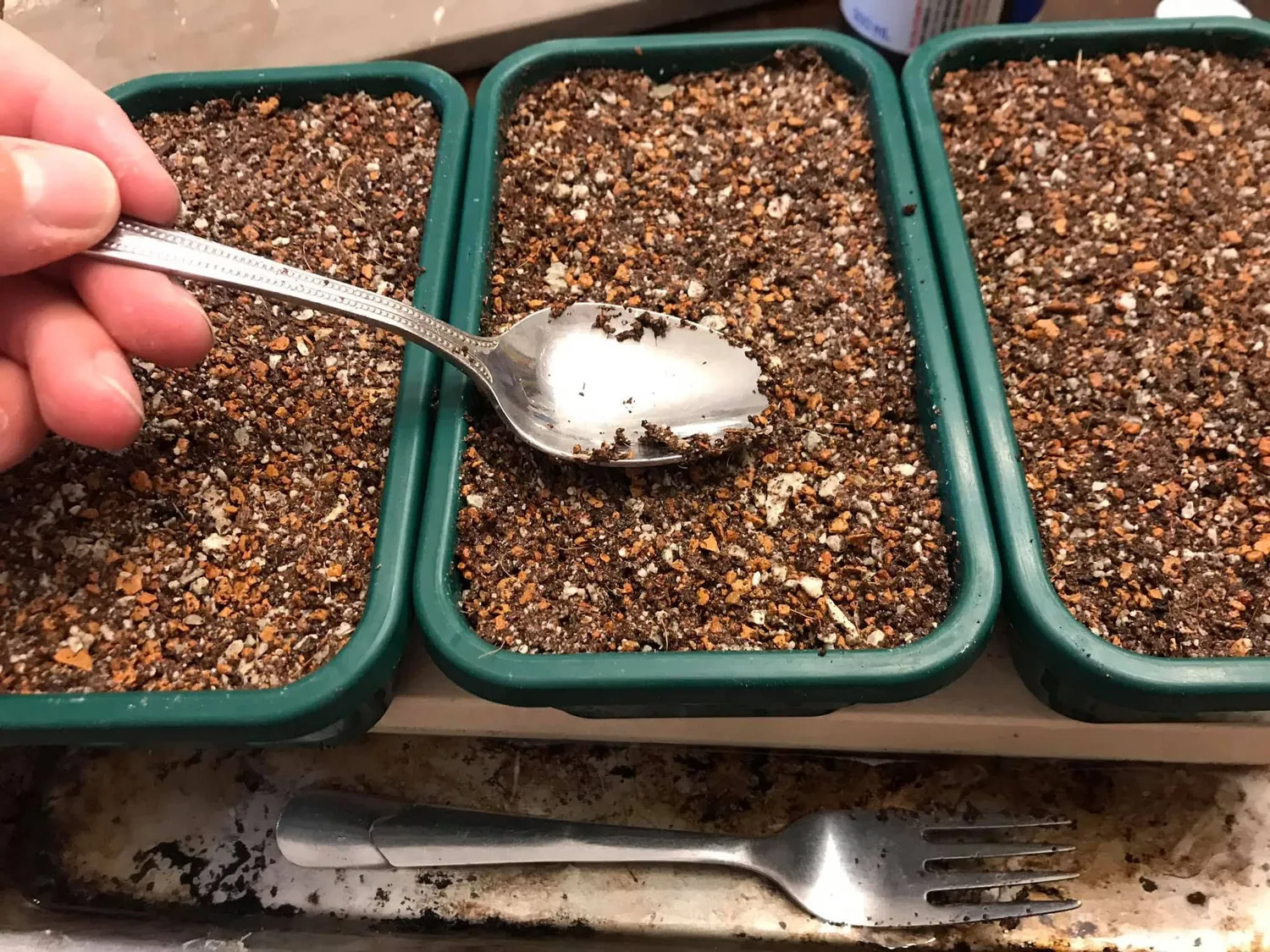
Growing cactus from seed takes patience: most rare genera need four to ten years from germination to a saleable plant. At rarecactus.com we sow every specimen from seed in a mineral grit mix, never grafting and never collecting from the wild. Our guide to propagating cactus sets seed beside offsets and cuttings.
How long does it take to grow a cactus from seed?
A cactus grown from seed reaches saleable size in four to ten years for most rare genera, and the slowest take longer still. Germination is the quick part. A viable seed of Astrophytum or Mammillaria splits and greens within one to three weeks of sowing. The years that follow are the wait, because a seedling that has just shown its first pair of cotyledons is the size of a pinhead and grows at the unforced pace its habitat sets.
That pace varies sharply by genus. Astrophytum and many Mammillaria put on enough size to pot individually inside three to four years. The geophytes are slower. A slow Ariocarpus spends its first few years building a taproot far larger than the button visible at the surface, and Aztekium is slower again, sometimes needing a decade to reach two centimetres across. None of this can be hurried without changing the plant, which is the whole argument for the method.
Saleable size and flowering size are not the same milestone. A plant can be large enough to sell years before it blooms. A seed-raised Astrophytum may flower at four or five years, many Mammillaria flower earlier, and the slow geophytes later still. The first year is also where most losses happen. A cohort that clears its first winter as firm, rooted seedlings is largely through the dangerous stretch, and the attrition curve flattens fast after that.
We sow in cohorts and track each batch by its sowing year, because a tray sown today will not yield a collector-grade plant until the early 2030s. A grower who understands that timeline reads a mature specimen raised from seed correctly: its size is a record of years, not a number on a fertiliser schedule.
What soil do cactus seeds need to germinate?
Cactus seeds germinate in a fine, sterile, mostly mineral mix that drains within seconds and never holds a wet skin at the surface. The seedling medium is a finer screening of the same mineral grit we grow adult plants in: sifted pumice fines, fine decomposed granite, and a little crushed lava, with no peat, no coarse sand, and no perlite anywhere in it.
The reasoning is the same as for mature cacti, only the stakes are higher. A seedling has no water reserve to fall back on and no bark to resist rot, so a medium that stays soggy kills it in days through damping off. Pumice fines hold a trace of moisture inside each granule while the surface dries fast. Fine decomposed granite gives sharp drainage and a slow trickle of trace minerals. Crushed lava keeps the lower layer open. For the genera where grower convention calls for it, a pinch of crushed limestone is house practice rather than a proven need. Hard tap water already supplies calcium and bicarbonate at every watering; rainwater and RO water supply neither. The full build sits in our cactus soil mix recipe; the seedling version is that recipe sifted to a finer grade and sterilised before sowing.
Sterilising matters more than the exact ratio. Pour boiling water through the filled pots, or bake the damp mix, and let it cool before sowing. Fungal spores in unsterilised grit are the most common reason a tray of seed greens up and then collapses. Top the sown surface with a thin layer of fine grit to anchor the seed and keep the neck of each seedling dry as it emerges.
Grade the grit fine but not dusty. Particles in the one-to-four-millimetre range give the open structure seedling roots need while staying small enough that a pinhead plant is not perched on a boulder. Sift the fines out before sowing, because dust migrates to the surface, seals it, and traps the moisture that feeds damping off. A shallow pot dries more evenly than a deep one at this stage, so reserve the deep containers for the taproot genera once they are potted on.
How do you sow and care for cactus seedlings?
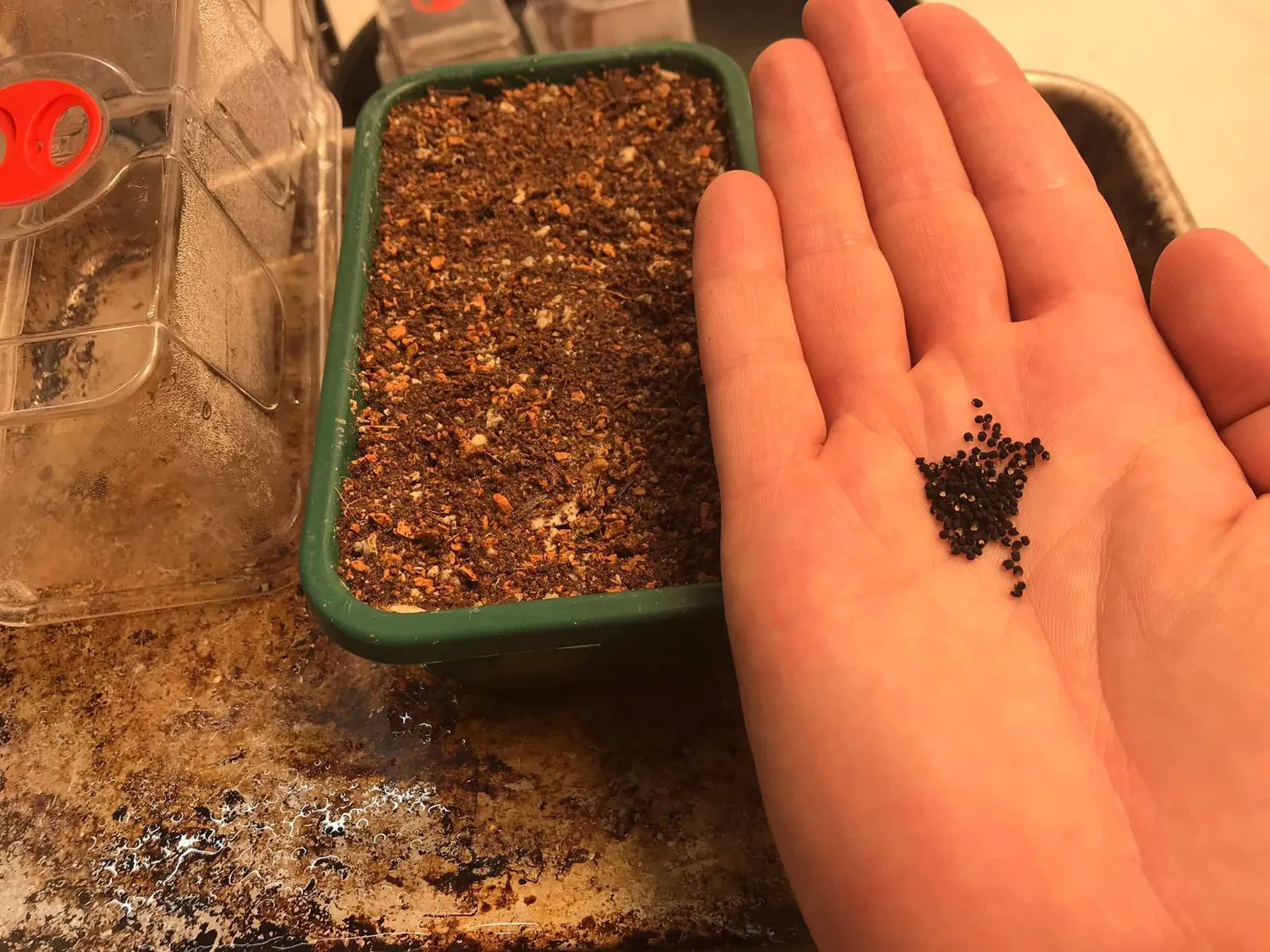
Cactus seed is sown on the surface of a sterile mineral mix in our greenhouse, in trays sealed to hold humidity and kept warm and brightly lit until the seedlings are established. Cactus seed is mostly tiny and needs light to germinate, so it is pressed onto the surface and never buried.
The method is the closed-tray approach most serious growers use. Fill clean pots with sterilised seedling mix, water from below until the surface is damp, and scatter the seed thinly across the top. Cover the pot or seal the tray in a clear bag to trap humidity, then set it on a heat mat at 21 to 27 degrees Celsius under bright, indirect light. Direct midday sun through glass cooks seedlings, so a grow light or a shaded bright sill is safer. Most genera show their first green within one to three weeks.
Hardening off is where trays are won or lost. Once most of the seed is up, open the cover a little more each week over a month so the humidity falls gradually and the seedlings firm up. Air movement and restraint with water keep damping off at bay; a sealed tray left shut too long is an incubator for the fungus that flattens a whole cohort overnight. We grow our trays on in the greenhouse and leave the first prick-out until the seedlings are six to twelve months old and large enough to handle without crushing.
From there the routine is ordinary cactus care, run slowly. Bright light, a thorough soak only once the mix has dried, and no fertiliser beyond the trace minerals already in the grit.
Through the first growing season the trays stay barely moist rather than wet, watered from below so the necks never sit damp. As autumn closes in, ease off and let the seedlings take a cool, dry rest, because a first winter run too warm and wet undoes a summer of careful growth. Pot the strongest seedlings on individually once their roots fill the cell, and leave the laggards together for another season rather than forcing them.
How do you stop damping-off in cactus seedlings?
Damping-off is the single biggest reason a tray of cactus seed fails. A fungus takes hold in the warm, closed, humid conditions that germination needs, and seedlings collapse at the soil line within a day, toppling in spreading patches that can wipe out a whole sowing before it establishes. Two cheap techniques have become standard among growers raising rare seed, and we run both on every batch.
Pasteurise the mix before sowing
Heat is the first line of defence. Even a clean mineral mix carries fungal spores, algae, moss, and fungus gnat larvae, and a short bake kills them. Microwave the damp mix in a vented microwave-safe container, no metal, for about ninety seconds per pound, until the core reaches 180 to 200°F, then let it cool fully before sowing. Do not push past 200°F, because hotter or longer scorches the grit and starts to release manganese. An oven does the same work at 200°F for thirty minutes in a covered tray, and the lowest-effort version is pouring boiling water through the mix and letting it drain. None of this fully sterilises the mix, it pasteurises it, but stripping out the bulk of the spore load is exactly what a seed tray needs.
Water with dilute hydrogen peroxide
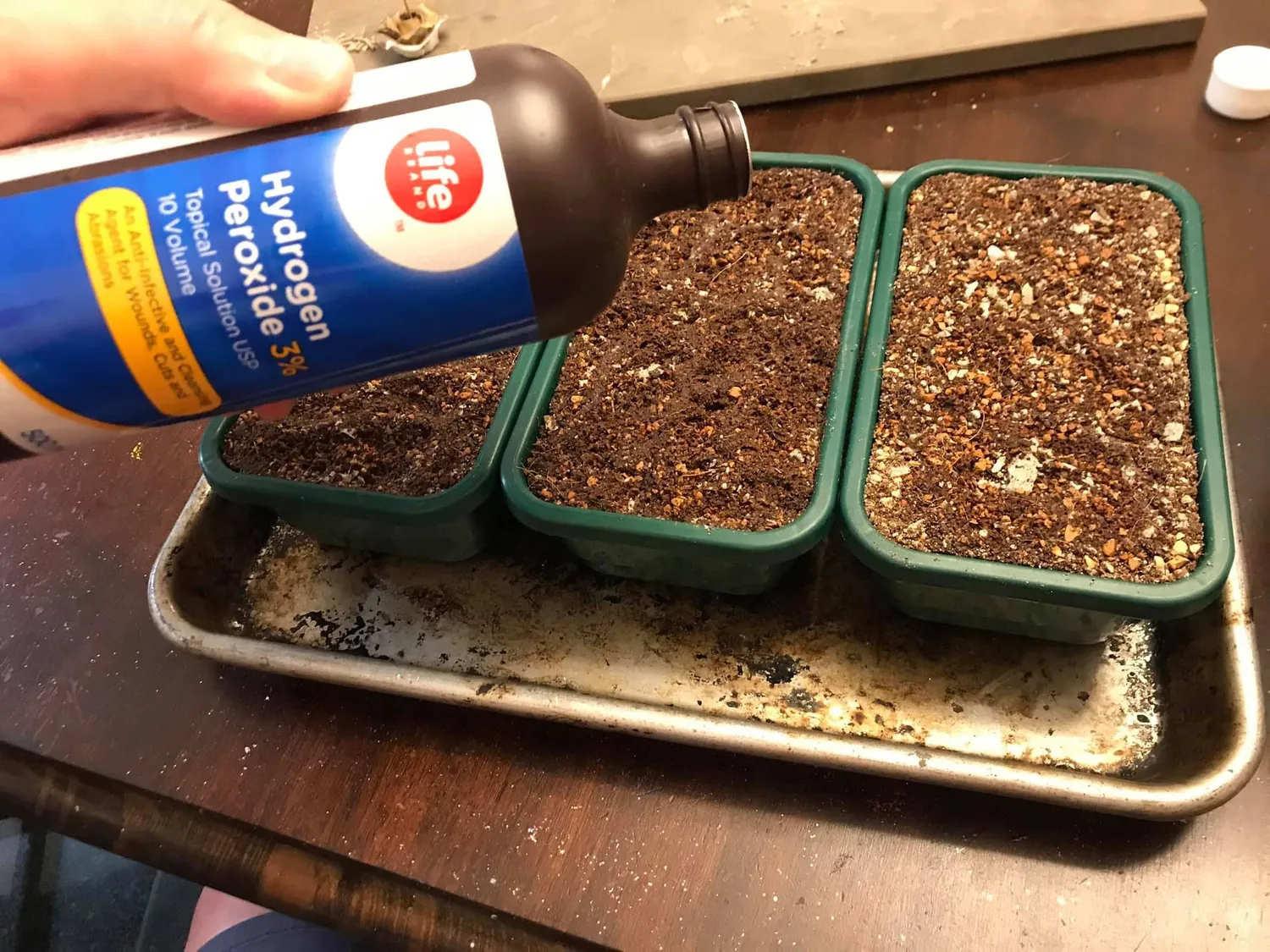
Hydrogen peroxide reaches what heat cannot, and it is the technique that has reshaped seed-raising over the last few years. Ordinary 3% household peroxide breaks down into water and oxygen, so it oxidises fungal spores and mould without leaving any residue. Use it two ways. Soak the seed before sowing, either a short dip in straight 3% for a few minutes up to twenty, or a gentler 1% mix of one tablespoon of 3% in a cup of water for an hour or two, then sow at once. That soak disinfects the seed coat and tends to speed and even out germination. Then water the tray with a dilute solution rather than plain water, a few millilitres of 3% per litre, which keeps damping-off from taking hold and carries oxygen to the new roots. Keep the soaks short and weak. Strong, long exposure burns seed, and Opuntia left overnight in peroxide has been known to turn to jelly and never sprout.
Neither trick replaces restraint with water. Fungi need the mix wet, dark, and stagnant, so give the tray light and air and let the surface dry between waterings. Clear that one hurdle and the hardest part of raising cactus from seed is behind you.
Why do we grow every cactus from seed instead of grafting?
Every cactus in our greenhouse is grown from seed because a plant grown from seed keeps the natural body, spine character, and taproot the species carries in habitat, all of which grafting distorts. Grafting is a production shortcut, not a way to make a better plant.
A scion fused onto a fast rootstock such as Pereskiopsis or Myrtillocactus grows several times quicker than it would ungrafted. The cost is shape. The forced feed bloats the body, swells the ribs out of proportion, and pushes flowering years early on tissue that never built a proper root system. Degrafting later removes the rootstock but leaves a scar at the base and a plant that has to learn to root from a body grown soft. A specimen raised from seed never has that history to undo. It builds its taproot from the first week and grows into the proportions the species actually shows on habitat ground.
There is a tell in the roots and the base that experienced buyers look for. A seed-raised plant sits on a single dominant taproot or a balanced fibrous spread that runs straight into the body with no graft line, while a degrafted plant shows a flat union scar and often a ring of offsets thrown after the cut. The body reads differently too. Slow growth lays down tight, even ribbing and full spine clusters, where forced growth leaves stretched internodes and sparse early spines that the plant never fully corrects.
At rarecactus.com every specimen is seed grown, never grafted and never collected from the wild, which is why a plant that leaves here holds its habitat form for the buyer who keeps it for decades. The full case, side by side, sits in our comparison of grafted versus seed grown plants.
Can you buy rare cactus seeds, or is a plant grown from seed a better buy?
You can buy rare cactus seeds, but for most growers an established plant grown from seed is the better purchase, because someone has already carried it through the years of slow growth and the heavy seedling losses that the seed packet hides. Both paths are legitimate; they answer different questions.
Seed is cheap, and sowing a genus yourself is the most rewarding way to learn how it grows. It is also slow and lossy. A packet of Ariocarpus seed costs little, but turning it into a single show plant means a sterile setup, a heat mat, a year of humidity discipline, and the acceptance that damping off will take a share of the tray before you reach a plant you can pot on. The four-to-ten-year timeline is real, and it runs from your bench, not the seller’s.
Seed quality is its own variable. Fresh seed from a reputable house germinates far better than old stock, and viability falls with age in many genera, so a cheap packet of unknown age can disappoint before the growing even starts. None of that is a reason to avoid sowing. It is a reason to weigh the true cost of a finished plant against the seed, the kit, the bench space, and the years, rather than the packet price alone.
A finished plant skips all of that. We sell established specimens raised from seed, not seed packets, which means the germination and the grow-on are already done and the plant you receive is years ahead of anything you could sow this season. If you want the process, buy seed from a specialist seed house. If you want the plant, every specimen in our shop is grown from seed in our greenhouse and ready to grow on. We do not sell seed, and we do not pretend the shortcut exists.
Frequently Asked Questions
Do cactus seeds need cold stratification before sowing?
Most desert cactus seeds germinate without stratification, but winter-growing and high-elevation genera respond to a short cold period first. For Mexican summer-rain genera such as Ariocarpus, Astrophytum, and most Mammillaria, sow fresh seed on a warm, sterile mineral mix and skip stratification. For cold-climate genera, a few weeks of moist refrigeration before sowing lifts the germination rate.
How long do cactus seeds take to germinate?
Most cactus seeds germinate in one to three weeks at 21 to 27 degrees Celsius with steady humidity and bright, indirect light. Fresh seed germinates fastest. Old or hard-coated seed can be erratic, with a first flush in two weeks and stragglers appearing over several months, so keep the tray sealed and warm rather than discarding it early.
Can you grow rare cactus from seed indoors?
Yes. Rare cactus seed grows well indoors under a grow light or on a bright windowsill, provided the seedlings get warmth, humidity during germination, and protection from direct midday sun. A sealed tray on a heat mat reproduces the closed, warm, humid conditions of the germination season. Vent the tray gradually over several weeks once the seedlings are up so they harden off without damping off.
Why do cacti raised from seed cost more than grafted plants?
Cacti raised from seed cost more because they carry years of slow, unforced growth that grafting skips. A grafted plant races to size on a fast rootstock in a year or two, while a specimen raised from seed of the same size may represent four to ten years of ungrafted growth. That slow growth is what holds the natural body, spination, and taproot collectors want, and it is why a plant grown from seed commands a premium.
Does rarecactus.com sell cactus seeds?
No. rarecactus.com sells established plants raised from seed, not seed packets. Every specimen is sown from seed in our greenhouse and grown on to a strong root system, never grafted and never collected from the wild. Buying a finished plant means the four-to-ten-year germination and grow-on is already done, so you receive a plant that already holds its habitat form rather than a packet that may take a decade to get there.
Anderson, E.F. (2001), The Cactus Family, Timber Press · Nobel, P.S. (ed.) (2002), Cacti: Biology and Uses, University of California Press · Rojas-Aréchiga, M. and Vázquez-Yanes, C. (2000), “Cactus seed germination: a review”, Journal of Arid Environments · Hernández, H.M. and Gómez-Hinostrosa, C. (2015), Mapping the Cacti of Mexico · LLIFLE Encyclopedia of Living Forms, propagation and germination entries for Ariocarpus, Astrophytum, Aztekium, and Mammillaria · British Cactus and Succulent Society (BCSS), seed-raising and propagation guidance · Cactus and Succulent Society of America (CSSA), propagation notes · Köhres Kakteen, seed catalogue and sowing instructions