
Echinopsis lageniformis
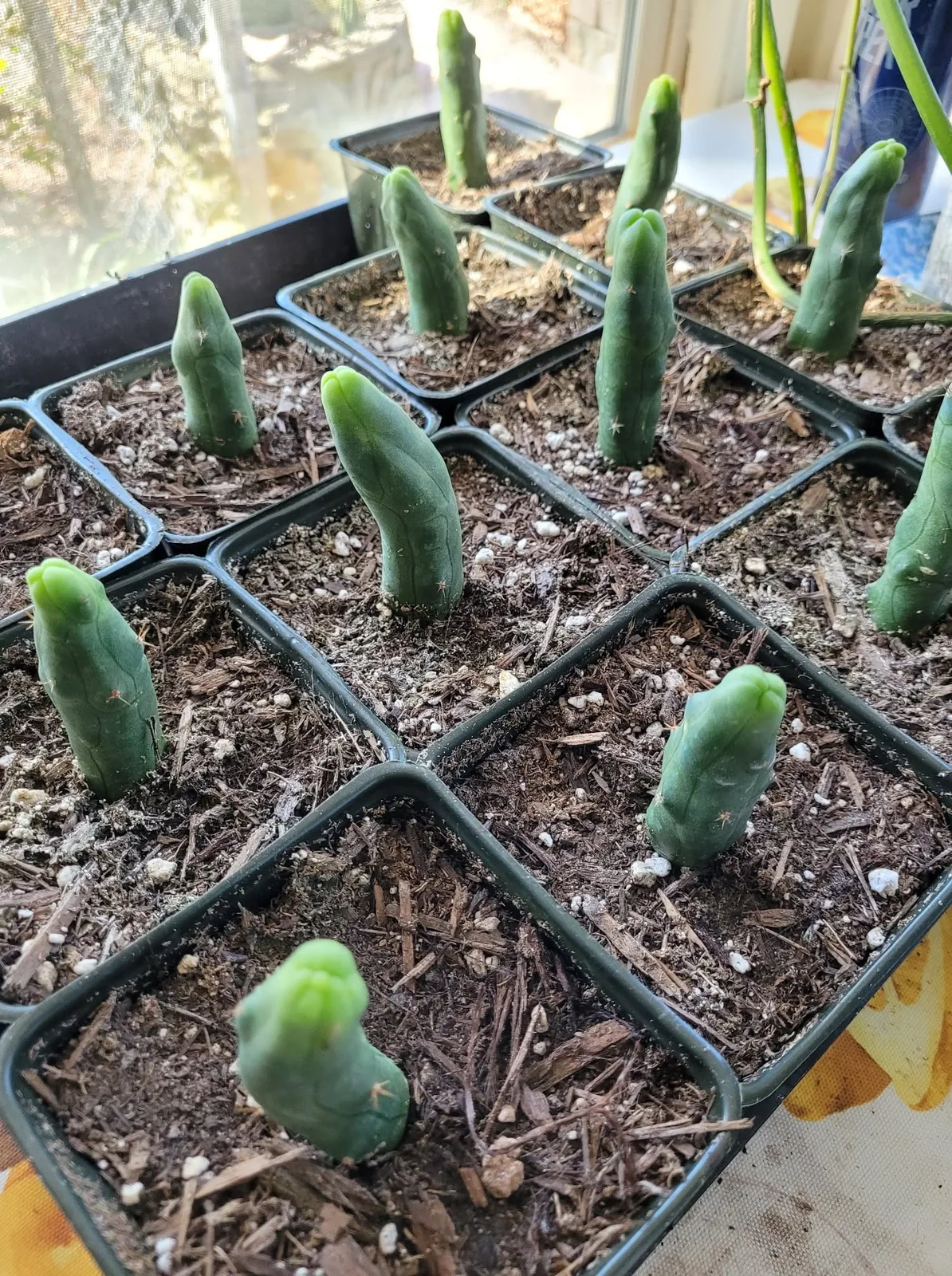
To the cactus trade this plant is Trichocereus bridgesii, the Bolivian torch, and its knobby mutant clone is the plant the internet knows as the penis cactus. To botanists the accepted name is Echinopsis lageniformis. It is one species with two famous names and two very different faces: a tall, fast, blue-green Andean column in the wild, and a lumpy, finger-jointed novelty on a thousand windowsills. The columnar form belongs to the San Pedro group of mescaline-bearing torches, alongside Echinopsis pachanoi, the true San Pedro.
The split in names is a quirk of nomenclature, not biology. When Trichocereus was folded into the broad Echinopsis in 1974, the obvious combination Echinopsis bridgesii was already occupied by an unrelated Bolivian cactus, so the older epithet lageniformis was used instead. The horticultural trade never followed, and to this day almost every plant is sold, labelled and searched as Trichocereus bridgesii. This page headlines the accepted Echinopsis lageniformis and flags the trade name throughout, because that is the name most buyers type.
The reason most people arrive here is the monstrose form, the penis cactus or TBM, short for Trichocereus Bridgesii Monstrose. It is not a wild plant and not a botanical variety. It is a single garden-origin mutation that lost the normal columnar geometry and grows instead as a cluster of blunt, rounded, mostly spineless fingers, and every one in the trade is a rooted cutting of that original clone. The crucial fact for a buyer is that the monstrose does not come true from seed: sow its seed and an ordinary column grows back. We treat it as the vegetative novelty it is, and we say so plainly.
As a San Pedro relative the Bolivian torch contains mescaline, which makes its legal status a common question. The short version, covered in the FAQ below and in our guide to San Pedro legality, is that the living ornamental cactus is legal to grow almost everywhere, while the mescaline it contains is a controlled substance. The line the law draws is about extraction and intent, not about owning the plant. This page treats it as what it is: an ornamental and a botanical curiosity.
Echinopsis lageniformis quick reference
A vigorous columnar from the inter-Andean dry valleys of Bolivia, roughly 1,000 to 3,300 m, fast and sun-loving with sharp drainage and a dry winter rest. Values below cover the cultivated plant, column or monstrose alike; note that the monstrose is a vegetatively propagated cultivar, not a seed grown plant, and is the slower and more rot-prone of the two.
Taxonomy & nomenclature
The accepted name is Echinopsis lageniformis (C.F.Först.) H.Friedrich & G.D.Rowley, with the basionym Cereus lageniformis C.F.Först., published in 1861 (IPNI / POWO urn:lsid:ipni.org:names:132706-1). Kew POWO treats it as accepted and files the famous trade name Trichocereus bridgesii (Salm-Dyck) Britton & Rose as a synonym of it, along with Cereus bridgesii Salm-Dyck, the basionym of that trade name. For a grower the two names mean one plant; the trade simply kept the older label.
The reason botanists and sellers disagree is a naming collision. When Friedrich and Rowley merged Trichocereus into Echinopsis in 1974, an Echinopsis bridgesii already existed for a different Bolivian species, so they could not simply transfer bridgesii; they fell back on Förster’s older epithet lageniformis. Several Ritter names, including Trichocereus crassicostatus and T. riomizquensis, fall here too, and recent treatments even sink the near-spineless Echinopsis scopulicola into lageniformis, though this site still carries that taxon under its own name.
The broad Echinopsis is itself contested, and several authors revive Trichocereus for the tall columnar torches such as Echinopsis peruviana and the Bolivian torch alike; POWO keeps them in Echinopsis, so this page does too. The monstrose deserves a word of caution here. Growers and llifle catalogue it informally as E. lageniformis f. monstruosa, with long-joined and short-joined types, but that is a horticultural label, not a validly published botanical rank. The penis cactus is a clonal cultivar of the species, written parenthetically as the monstrose form, never as a true forma.
Historical synonyms (12)
- Cereus bridgesii Salm-Dyck, 1850 basionym
- Cereus lageniformis C.F.Först., 1861 homotypic synonym
- Cereus bridgesii var. brevispinus K.Schum., 1897 heterotypic synonym
- Cereus bridgesii var. lageniformis (C.F.Först.) K.Schum., 1897 heterotypic synonym
- Cereus bridgesii var. longispinus C.A.Maass, 1905 heterotypic synonym
- Cereus bridgesii f. brevispinus (K.Schum.) Schelle, 1907 heterotypic synonym
- Cereus bridgesii f. lageniformis (C.F.Först.) Schelle, 1907 heterotypic synonym
- Trichocereus bridgesii (Salm-Dyck) Britton & Rose, 1920 heterotypic synonym
- Trichocereus bridgesii var. brevispinus Borg, 1937 heterotypic synonym
- Trichocereus bridgesii var. longispinus (C.A.Maass) Borg, 1937 heterotypic synonym
- Trichocereus crassicostatus F.Ritter, 1966 heterotypic synonym
- Trichocereus scopulicola F.Ritter, 1966 heterotypic synonym
Sources: POWO (Kew) · IPNI · GBIF · Wikidata
Habitat
Echinopsis lageniformis is native to Bolivia, where POWO restricts its wild range, with documented populations across the departments of La Paz, Cochabamba, Chuquisaca and Tarija. It is a plant of the inter-Andean dry valleys, the warm rain-shadow quebradas that thread between the Andean ranges, where it grows on rocky cliff faces, river-bank escarpments and field edges, often alongside the algarrobo Prosopis alba in the lower valleys.
An old type label reading ‘Peru, cultivated’ has misled some sources into calling the plant Peruvian, but that reflects inaccurate locality data for a cultivated specimen; the wild plant is Bolivian. Its elevation runs broadly from about 1,000 to 3,300 m, with most populations between roughly 2,000 and 3,000 m. The climate is the summer-rain, dry-winter monsoon pattern of the central Andes, a warm wet growing season followed by a cool, dry rest, which is exactly the rhythm cultivation reproduces.
That valley origin explains the plant’s habits in the pot. It wants strong light, heat and a hard dry winter, and it tolerates more cold than a lowland desert cactus but less than the high-altitude San Pedro of the Peruvian sierra. The same warm-dry-valley regime suits the whole San Pedro group, the columnar torches led by Echinopsis pachanoi, which respond to the identical cycle of summer water and winter drought.
Morphology
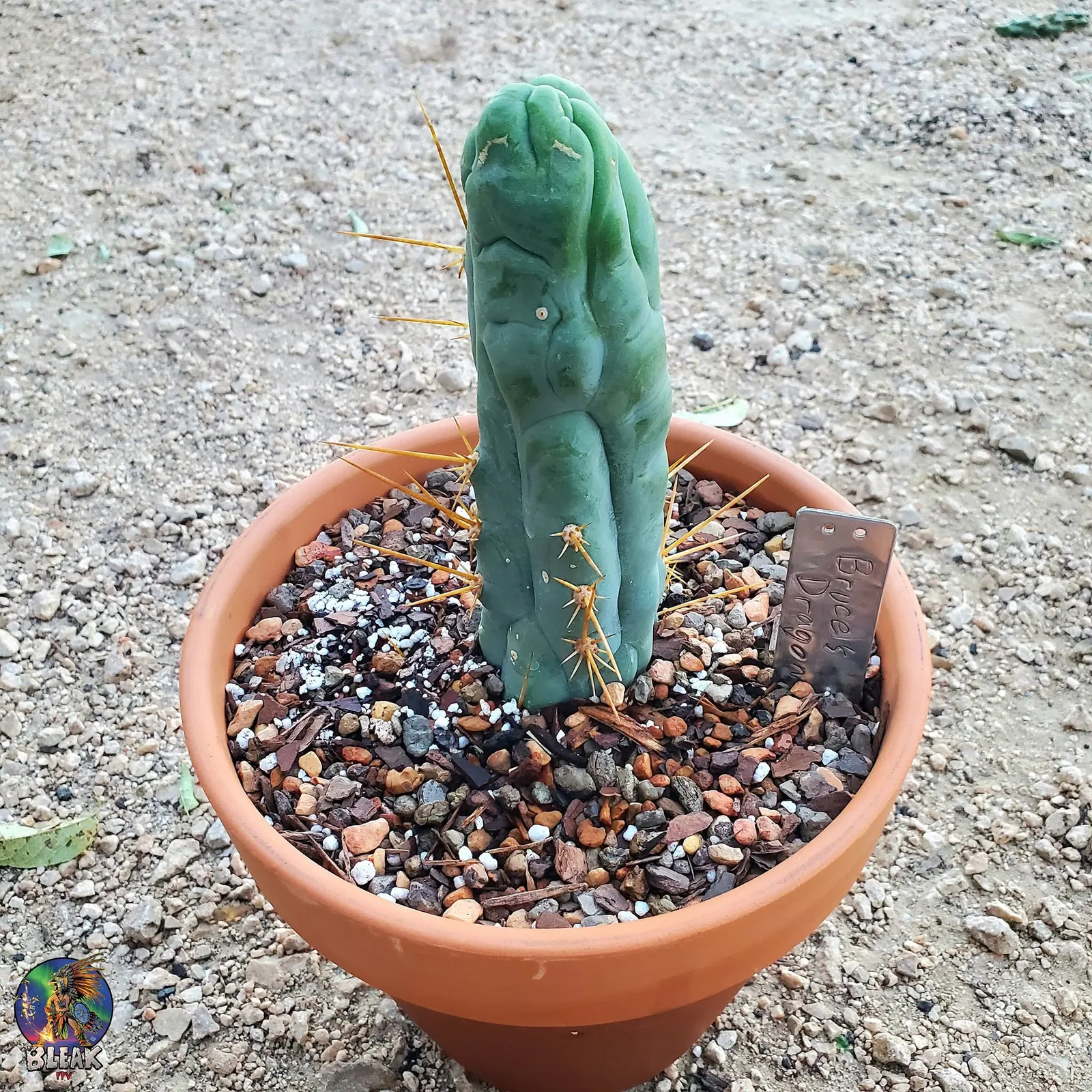
The wild plant is a tall, vigorous, blue-green column, notably robust for the San Pedro group. It branches from the base into clumps of erect stems two to five metres tall and ten to twenty centimetres thick, the skin a light, slightly waxy green that is markedly less blue than the glaucous Echinopsis peruviana. The ribs are the first field mark: four to eight of them, distinctly sharp and angular rather than the rounded ribs of most San Pedros.
The spines are the second mark, and the one that out-spines true San Pedro. Each areole carries two to six stiff spines that run from a few millimetres to as long as seven centimetres, honey to amber-brown, far longer than the short, often near-absent spines of cultivated Echinopsis pachanoi. A light-green, sharply angular column hung with long honey spines reads as Bolivian torch, not San Pedro. The flowers are large, white, funnel-shaped and night-opening, around sixteen to twenty centimetres long and fragrant, and their floral tube is densely clothed in white hairs, a reliable separator from most Peruvian torches.
The monstrose is the same plant with its geometry dissolved. Instead of clean ribbed columns it grows a knot of short, blunt, cylindrical fingers, smooth and spineless over most of their surface with a few honey spines only near the base, branching low and spreading into a clump. Growers sort it loosely into a long-jointed type, with fingers ten to twenty centimetres tall, and a shorter, denser, rounder-jointed type. It grows markedly more slowly than the wild column and is more prone to rot where water lodges in the creases between joints. Crested and variegated versions of the monstrose exist as well, multiplying the novelty without changing the underlying clone.
Locality detail
The verified native range is Bolivia, across the inter-Andean valleys of La Paz, Cochabamba, Chuquisaca and Tarija, with Santa Cruz reported in the trade but not carried in the POWO narrative. Because the species is widespread rather than tied to any single point, the map below shows a regional centroid for that valley country rather than a precise locality. There is no conservation reason to redact it: the plant is abundant and ubiquitous in cultivation.
The persistent claim that the plant is Peruvian traces to a nineteenth century type label for cultivated material and is not supported by the wild distribution. Every Bolivian torch and every penis cactus in the trade is nursery-propagated, grown from seed or rooted from cuttings, so the wild range is a matter of botanical record rather than a sourcing question for buyers.
Cultivation
Echinopsis lageniformis is among the easier and faster of the columnar cacti, and the page treats it that way. Two things matter: sharp drainage so the plant never sits cold and wet, and strong light through a long warm growing season. Get those right and the Bolivian torch is close to foolproof; the monstrose asks for the same plus a little extra care to keep water out of its joints.
Substrate
Grow it in a gritty, free-draining mineral mix of 50 per cent pumice, 20 per cent lava rock, 20 per cent decomposed granite, and 10 per cent organic matter, with no limestone, no zeolite and no silica sand. The case against limestone here is cultivation evidence, not geology: Trout relays Borg’s 1937 warning against calcareous soils for this species by name, and separately reports it forming black rot easily under heavy watering, an effect he notes is worse on the monstrose form. The high pumice fraction gives the immediate drainage the plant demands, while the modest organic share feeds its fast growth without holding water at the base. The same principle scales up for bigger pots in our cactus soil mix recipe.
Every Echinopsis on this site runs a sharply drained, mineral-dominant mix. E. lageniformis carries no limestone on cultivation evidence, not habitat: Trout relays Borg’s 1937 warning against calcareous soils for this species by name, and separately reports this species forming black rot easily under heavy watering, worse in the monstrose form. Organic stays low at 10 per cent, the most pumice-led mix in the columnar group, keeping pace with its fast, vigorous growth.
| Species | Pumice | Lava | Zeolite | Granite | Limestone | Silica | Organic |
|---|---|---|---|---|---|---|---|
| E. lageniformis (this page) | 50% | 20% | 0% | 20% | 0% | 0% | 10% |
| E. chamaecereus | 42% | 16% | 5% | 27% | 0% | 0% | 10% |
| E. chiloensis | 38% | 22% | 5% | 27% | 0% | 0% | 8% |
| E. cuzcoensis | 33% | 19% | 5% | 23% | 5% | 0% | 15% |
| E. pachanoi | 31% | 18% | 5% | 21% | 5% | 0% | 20% |
| E. peruviana | 33% | 19% | 5% | 23% | 5% | 0% | 15% |
| E. scopulicola | 35% | 20% | 5% | 25% | 5% | 0% | 10% |
Watering and light
From spring through autumn, soak the mix and then let it dry out completely before the next water, roughly every one to two weeks in active growth and more often only in fierce summer heat. Through the cool months keep it dry, mirroring the rainless valley winter, which both prevents rot and sets up flowering. On the monstrose, direct water at the soil and not over the plant: water that lodges in the creases between the joints is the usual route to fungal rot, and the long-jointed form in particular benefits from a careful, dry-crowned regime. Full sun is the target once a plant is established, with light afternoon shade only in extreme heat. Hold the plant above about 10°C in winter; it survives short, bone-dry spells down to roughly −5°C, but it is somewhat more cold-tender than San Pedro, so a frost-free rest is the safe target.
Here the two halves of the plant part ways, and the distinction is the honest core of this page. The wild columnar species comes true from seed and also roots readily from cuttings, so good seed grown columns are a legitimate, sustainable way to own the Bolivian torch. The monstrose is a different matter entirely: it is a clonal mutation that does not come true from seed, so a sown seed simply gives back an ordinary column. The penis cactus is kept going only by cutting, callusing and rooting segments of the mutant clone, and a cutting must include areoles to branch. At rarecactus.com we grow the columnar Bolivian torch from seed in our own greenhouse and keep it as a San Pedro-group spine and rib calibration reference, while treating the monstrose strictly as a vegetatively propagated curiosity. We reserve the seed grown label for the column, where it is true, and never apply it to the monstrose.
Comparison
Trichocereus bridgesii and Echinopsis lageniformis are the same species, so a seller offering both is offering one plant. The harder comparison is with true San Pedro. Set beside San Pedro, the Bolivian torch is lighter green, its ribs sharper and more sharply angular, and its spines far longer and more honey-coloured, where cultivated San Pedro is frequently almost spineless. The white-haired floral tube and the long honey spines are the quickest tells in the field.
Within its own genus the Bolivian torch sits among the columnar torches, taller and lighter green than the blue Echinopsis peruviana and longer-spined than the near-spineless Bolivian Echinopsis scopulicola. It shares the genus, improbably, with the soft windowsill Echinopsis chamaecereus, the peanut cactus, which looks nothing like it. The broad Echinopsis is a botanist’s grouping, not something the eye would guess from the plants.
The monstrose is its own comparison. The long-jointed and short-jointed penis cactus, the crested form and the variegated clones are all the same mutation expressed differently, and none of them flowers or grows true the way the wild column does. Because each clump and crest is unique and slow, anyone buying a monstrose should choose the exact plant in front of them for the shape of its joints and the health of its base, rather than ordering a novelty sight unseen.
Frequently asked questions
Is Trichocereus bridgesii (the Bolivian torch) hard to grow?
No. Echinopsis lageniformis is one of the easier and faster columnar cacti: it wants full sun, a sharply drained mineral mix and a dry winter rest, and in return it grows quickly and roots readily from cuttings. The one real hazard is rot from cold, wet conditions. The monstrose form needs the same care plus attention to keeping water out of the creases between its joints, where fungal rot starts.
Can you grow the penis cactus (monstrose) from seed?
No. The monstrose, the penis cactus or TBM, is a clonal mutation that does not come true from seed; sow its seed and you get an ordinary blue-green column back. Every penis cactus in the trade is a rooted cutting of the original garden clone, propagated by cutting, callusing and rooting segments. The normal columnar species, by contrast, comes true from seed and also roots from cuttings, which is why we keep the seed grown label for the wild column and not for the monstrose.
Is Trichocereus bridgesii legal to own?
The ornamental cactus is legal to buy, sell and grow across the United States and in most countries; no US state names Trichocereus or Echinopsis by botanical name, and the living plant is sold openly as an ornamental. The mescaline it contains, however, is a controlled substance, federally Schedule I, so the legal line is crossed by extraction or preparation and intent, not by owning the plant. A few jurisdictions have decriminalised natural psychedelics. For the detail, see our guide on San Pedro legality rather than treating this page as legal advice.
Where does Echinopsis lageniformis grow in the wild?
It is native to Bolivia, in the inter-Andean dry valleys of the departments of La Paz, Cochabamba, Chuquisaca and Tarija, where it grows on rocky cliff faces and river-bank escarpments between roughly 1,000 and 3,300 m, most often from about 2,000 to 3,000 m. An old type label calling it Peruvian reflects mislabelled cultivated material; the wild plant is Bolivian. It is common and widespread, not a habitat rarity.
Why is it called the penis cactus?
Because of the monstrose mutation. In the monstrose form the plant loses its normal ribbed columns and grows blunt, rounded, mostly spineless cylindrical fingers that branch from the base, and the shape is the source of the nickname, along with TBM, short for Trichocereus Bridgesii Monstrose. It is a clonal cultivar of Echinopsis lageniformis, not a separate species, and it grows more slowly than the ordinary Bolivian torch.
Sources & further reading
Förster, C.F. 1861. Cereus lageniformis (basionym; original description) · Friedrich, H. & Rowley, G.D. 1974. Combination Echinopsis lageniformis (transfer of Trichocereus to Echinopsis) · IPNI, International Plant Names Index, urn:lsid:ipni.org:names:132706-1; basionym Cereus lageniformis C.F.Först. (1861) · Kew POWO, Echinopsis lageniformis (C.F.Först.) H.Friedrich & G.D.Rowley (accepted; Trichocereus bridgesii in synonymy; native Bolivia) · Britton, N.L. & Rose, J.N. 1920. The Cactaceae (Trichocereus bridgesii combination) · LLIFLE, Encyclopedia of Living Forms, Echinopsis lageniformis f. monstruosa (garden origin, segment size, vegetative propagation, slower growth) · trichocereus.net, Trichocereus bridgesii / Echinopsis lageniformis (morphology, substrate, watering, cold, white-haired flowers, monstrose clones) · cactusgrowguide.com, Bolivian Torch Cactus care (substrate, watering, USDA zones, growth rate) · San Pedro Source, Long Form vs Short Form penis cactus (TBM types) and San Pedro field identification · Schlumpberger, B.O. & Renner, S.S. 2012. Echinopsis polyphyly. American Journal of Botany 99(8): 1335–1349 · Ogunbodede, O. et al. 2010. Mescaline content of Trichocereus. Journal of Ethnopharmacology 131(2): 356–362 · IUCN Red List of Threatened Species, Echinopsis lageniformis (taxon 152817, Least Concern, 2010) · CITES Appendices, Cactaceae family-wide Appendix II listing