
Echinopsis chamaecereus
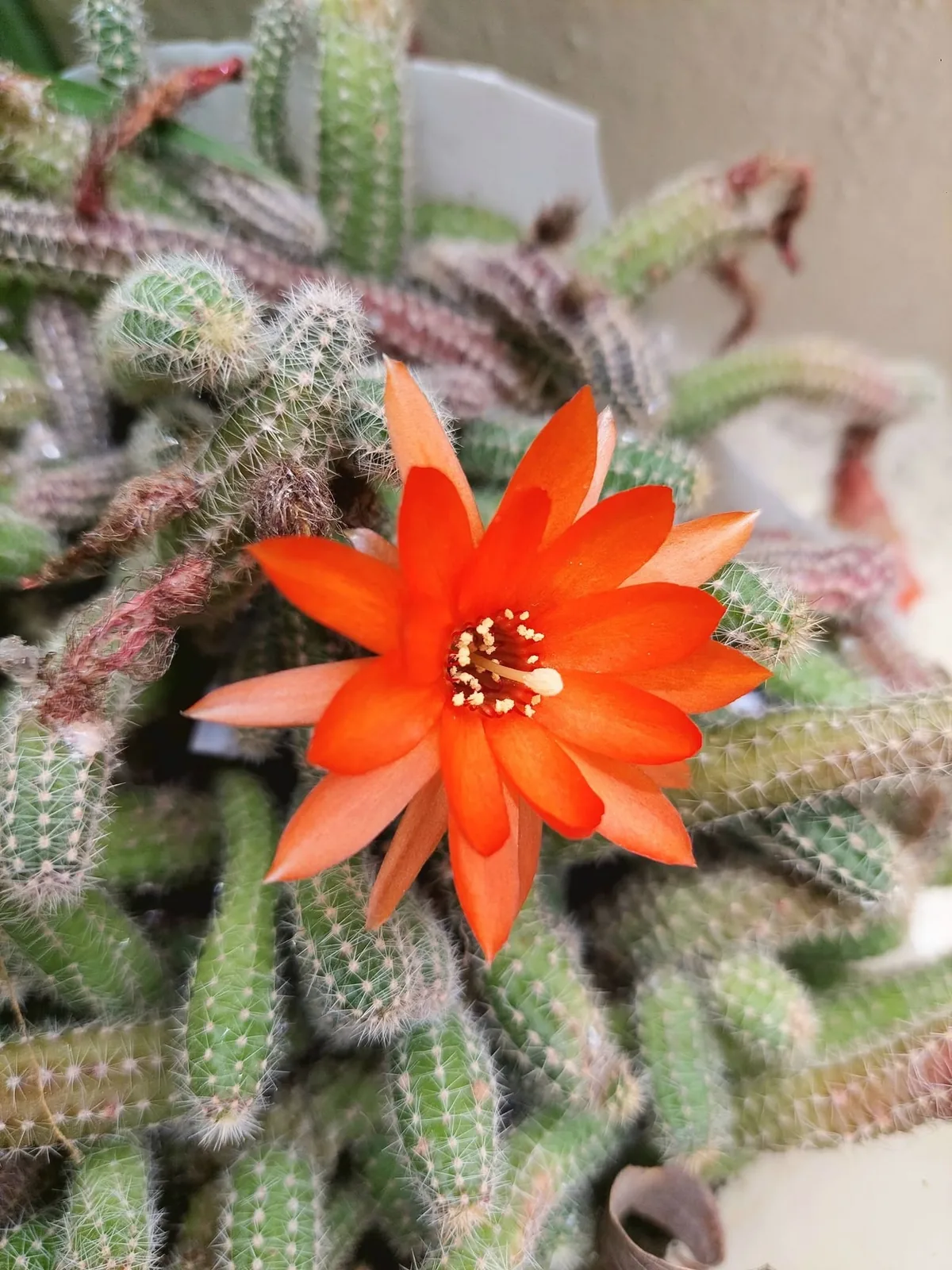
The peanut cactus, Echinopsis chamaecereus, ranks among the most widely grown cacti on Earth and carries one of the strangest stories in the family: it was collected once, by Carlo Spegazzini in 1896, and has never been reliably refound in the wild. A plant that is effectively lost in nature is, at the same time, a fixture on windowsills and in hanging baskets from Buenos Aires to Birmingham. Its short, plump, finger-thick joints, soft white bristles you can handle, and generous orange-red flowers make it a classic first cactus.
This is not a collector rarity, and we will not pretend otherwise. It is cheap, common and close to indestructible, the opposite of the demanding endemics that fill most of this encyclopedia. What it does offer is genuine interest: a taxonomic journey from Cereus to Chamaecereus to the broad Echinopsis, a remarkable tolerance of cold for a cactus, and a flowering habit that shames plants ten times its price. The trade still sells it under the old name Chamaecereus silvestrii, which is the name most buyers type into a search bar.
It belongs to the same broad genus as the tall Andean torches we cover elsewhere, the San Pedro group led by Echinopsis pachanoi, yet it looks nothing like them. Where those are metre-tall columns, the peanut cactus is a sprawling miniature whose joints snap off at a touch and root almost unaided, which is exactly how it earned its common name and how it propagates almost by accident.
Native to the mountains of northwestern Argentina, between Tucumán and Salta, it shrugs off cold that would kill most desert cacti, surviving short spells down to roughly −7 to −8°C when it is bone-dry and dormant. Strong light and a cool, dry winter rest are all it asks in return for a heavy spring bloom.
Echinopsis chamaecereus quick reference
A montane grower from the mountains of Tucumán and Salta in northwest Argentina, fast, forgiving and notably cold-tolerant for a cactus when kept dry. Values calibrated for seed grown plants in cultivation, drawn from habitat-matched practice and society horticultural notes.
Taxonomy & nomenclature
The accepted name is Echinopsis chamaecereus H.Friedrich & Glaetzle, published in Bradleya in 1983 (IPNI / POWO urn:lsid:ipni.org:names:907548-1). Kew POWO treats it as the accepted name and lists the familiar horticultural name Chamaecereus silvestrii as a synonym of it. For most growers the two names mean the same plant; the older one is simply the one printed on a generation of nursery labels.
The naming history is the interesting part. Spegazzini collected the plant in 1896 and described it as Cereus silvestrii, the basionym. In 1922 Britton and Rose moved it into the new segregate genus Chamaecereus, giving the long-lived trade name Chamaecereus silvestrii; it has also been combined as Lobivia silvestrii. When Chamaecereus was later sunk into the broad Echinopsis, the epithet silvestrii was already taken within that genus, so the replacement epithet chamaecereus was coined, preserving the old generic name as the species name.
That broad Echinopsis is itself contested. Several recent treatments split the genus back apart, reviving Trichocereus for the tall columnar species such as Echinopsis peruviana and Echinopsis scopulicola, and Lobivia for the small free-flowering ones the peanut cactus sits closest to. POWO currently keeps everything in Echinopsis, so this page uses Echinopsis chamaecereus as the headline name while flagging Chamaecereus silvestrii prominently, since that is the name most people still search.
Historical synonyms (4)
- Cereus sunestrii Speg., 1905, 1905 basionym
- Cereus silvestrii Speg., 1911 heterotypic synonym
- Cereus silvestrii var. crassicaulis Backeb., 1934 heterotypic synonym
- Lobivia silvestrii (Speg.) G.D.Rowley, 1967 heterotypic synonym
Sources: POWO (Kew) · IPNI · GBIF · Wikidata
Habitat
The honest answer is that almost nothing is firmly documented. Echinopsis chamaecereus is known to science from Spegazzini’s single 1896 collection in the mountains of northwestern Argentina, between the provinces of Tucumán and Salta, and it has not been reliably refound in the wild since. The natural vegetation it grew in, the rock it rooted on and the size of any wild population are all effectively unrecorded, the blank that the conservation note above reflects.
What can be said comes from the genus and the region. POWO restricts the verified native range to Argentina; a frequently repeated extension into Bolivia is unconfirmed and is best treated with caution. Cultivation literature reports the species from around 1,200 m and above, consistent with a montane grower, but no precise wild elevation can be tied to a field record, so that figure is approximate. The cold tolerance the plant shows in cultivation fits a mountain origin with cool, dry winters far better than it fits a low desert.
The practical lesson of the missing habitat is that culture is inferred from what the plant does rather than from where it lives. Fortunately it is forgiving enough that this works: a cool, dry rest, sharp drainage and strong light reproduce the conditions a high-Andean foothill would supply, and the plant responds the same way the columnar siblings such as E. pachanoi do to the same regime.
Morphology
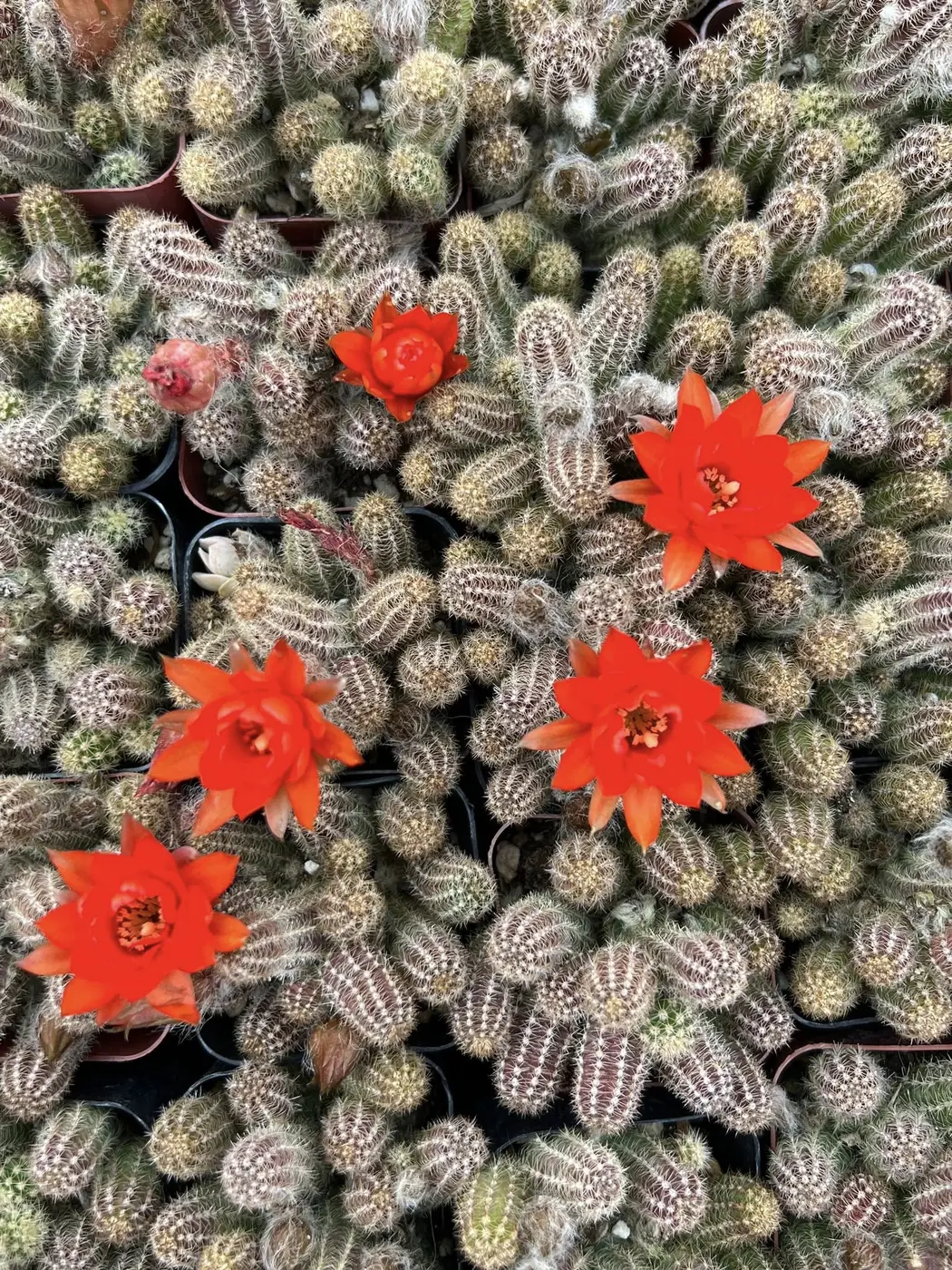
The peanut cactus is a low, clustering, mat-forming plant. Its stems are short, plump and finger-thick, growing to around 15 cm long and only about 1 to 1.2 cm in diameter, starting erect and soon becoming decumbent so a mature plant spreads and trails rather than standing up. Each stem carries 8 to 10 low, narrow ribs. The whole clump stays under about 15 cm tall while spreading to 30 cm or more across, happily cascading over the rim of a pot or basket.
The defining trait is how freely it offsets. The short joints look like plump peanuts and detach at the lightest touch, then root where they fall, often with no help at all. A bumped plant scatters ready-made propagules across the bench. The areoles bear 10 to 15 soft white bristles only 1 to 2 mm long, soft enough to handle without gloves, which separates this plant at once from the rigidly armed columnar members of the genus and is a large part of why it is handed to children as a first cactus. Old stems may turn woody at the base and shed their bristles with age.
The flowers are the reward. They are funnel-shaped, day-opening and vivid orange to orange-red, around 4 to 5 cm across, carried in several flushes from late spring into early summer. The plant blooms from a young age and blooms heavily for its size, an unusual generosity that earned it the RHS Award of Garden Merit. The mismatch between the modest green mat and the scarlet flowers standing above it is the whole appeal.
Locality detail
The verified native range is a narrow band in the mountains of northwestern Argentina, in the provinces of Tucumán and Salta. Because the plant is known from one nineteenth-century collection and no confirmed modern field records, the map below shows a regional centroid for that mountain country rather than any precise locality, which would in any case be guesswork.
A Bolivian occurrence is often cited but is not supported by the POWO distribution, so it is left off the verified range here. For a plant this common in cultivation the point is academic for buyers: every peanut cactus in the trade is nursery-propagated, grown from seed or rooted from offsets, and none depends on the lost wild population.
Cultivation
Echinopsis chamaecereus is about as easy as cactus growing gets, and the page treats it that way. Two things matter: sharp drainage so the plant never sits cold and wet, and enough light to keep the joints firm and the flowers coming. Get those right and the peanut cactus is close to foolproof; get them wrong only with a cold, soggy winter, and it rots.
Substrate
Grow it in a gritty, free-draining mineral mix of 42 per cent pumice, 16 per cent lava rock, 5 per cent zeolite, 27 per cent granite grit, no limestone and no silica sand, with 10 per cent organic matter. No source publishes an organic figure for this species at any tier, so the share is held at the site’s ordinary default rather than raised or lowered. E. chamaecereus has no confirmed wild habitat: IUCN rates the assessment Data Deficient, the type material was never relocated, and every occurrence record traces to cultivated or naturalised stock far outside Argentina, so no claim about its native geology is possible. Limestone stays at zero on the same unresolved carbonate basis as the rest of the genus. Mineral and sharp is still the target; the pumice, lava, and granite together give the immediate drainage that keeps winter rot at bay.
Every Echinopsis on this site runs a sharply drained, mineral-dominant mix. E. chamaecereus has no confirmed wild habitat at all: IUCN rates the assessment Data Deficient, and every specimen in cultivation traces to material with no verified collection locality, so no geology claim is possible for this species. Organic stays at the site’s ordinary 10 per cent default, a house convention with no published per-species figure; limestone stays at 0 following the class default, not a documented lime-free soil.
| Species | Pumice | Lava | Zeolite | Granite | Limestone | Silica | Organic |
|---|---|---|---|---|---|---|---|
| E. chamaecereus (this page) | 42% | 16% | 5% | 27% | 0% | 0% | 10% |
| E. chiloensis | 38% | 22% | 5% | 27% | 0% | 0% | 8% |
| E. cuzcoensis | 33% | 19% | 5% | 23% | 5% | 0% | 15% |
| E. pachanoi | 31% | 18% | 5% | 21% | 5% | 0% | 20% |
| E. peruviana | 33% | 19% | 5% | 23% | 5% | 0% | 15% |
| E. scopulicola | 35% | 20% | 5% | 25% | 5% | 0% | 10% |
Watering and light
From spring through autumn, water moderately and let the mix dry out between soaks; the plant grows fast and drinks willingly in warmth. Through the cool months keep it nearly dry, which both prevents rot and sets up the flowering. Bright light to full sun is essential, with only the fiercest summer afternoon glare softened in hot climates; in too much shade the joints stretch thin and pale and the plant will not bloom. Hold it above freezing in cultivation, with a frost-free 5°C winter minimum the sensible target, even though the plant can survive short spells far colder when bone-dry.
Flowering is driven by that winter regime. A cool, dry, restful winter followed by strong spring light brings the heavy orange-red bloom; a plant kept warm and watered through winter grows on but flowers poorly. Propagation is trivial: a detached joint, left a day to callus and set on dry mix, roots itself, and the species also comes readily and true from seed. Seed grown plants stay closest to the wild type, which matters less here than with the rarities but is still the route we use. At rarecactus.com we grow every specimen from seed in our greenhouse, and we keep a peanut cactus on the bench as a living benchmark: the forgiving counterpoint that flowers on neglect while the demanding endemics in the collection sulk.
Comparison
Echinopsis chamaecereus has two names in circulation, and the name is the first thing to settle. Chamaecereus silvestrii and Echinopsis chamaecereus are the same plant; if a seller offers both, they are not offering two species. Beyond that, the peanut cactus shares its genus with the tall San Pedro torches on this site but resembles none of them. Set beside Echinopsis chiloensis or its columnar relatives, which build metre-scale ribbed columns with stiff spines, the peanut cactus is a soft, sprawling miniature; the shared genus is a verdict of the botanists, not something the eye would guess.
The real confusion is closer to home. The peanut cactus has been crossed extensively with related Lobivia and Echinopsis to produce easy garden hybrids that keep its habit but carry flowers in yellow, pink, salmon or deep red. Many plants sold simply as peanut cactus are these coloured-flower cultivars rather than the wild-type orange-red species. For a buyer the distinction rarely matters, since culture is identical, but a grower who wants the true Echinopsis chamaecereus should buy it in flower and look for the plain scarlet-orange bloom.
Against the demanding endemics elsewhere in this encyclopedia, the contrast is the whole point of covering the plant at all. The peanut cactus asks for none of the precision a cliff-dwelling rarity demands; it forgives the overwatering, the wrong window and the missed winter rest that would kill a fussier species. That is what makes it the right first cactus and the wrong place to spend a collector’s budget.
Frequently asked questions
Is the peanut cactus hard to grow?
No. Echinopsis chamaecereus is a beginner plant and a classic first cactus. Its bristles are soft enough to handle, it grows fast, and it offsets and roots almost on its own. The only common ways to lose it are a cold, wet winter, which rots the joints, and deep shade, which leaves it thin, pale and flowerless. Sharp drainage, bright light and a dry winter cover almost everything it needs.
Can the peanut cactus be grown from seed?
Yes, and it is one of the easiest cacti to propagate by any route. The plant comes readily and true from seed, and it is even simpler from offsets: a detached peanut-shaped joint, left a day to callus and set on dry mix, roots itself within weeks, often unaided. Seed grown plants stay closest to the wild type, which is the stock we keep, though with a plant this forgiving either route succeeds.
Is the peanut cactus legal to own?
Yes, freely. Like all cacti it falls under CITES Appendix II through the family-wide Cactaceae listing, not the stricter Appendix I, so nursery-propagated plants are owned and traded normally, with the usual paperwork only for cross-border movement. Every peanut cactus in the trade is cultivated, grown from seed or rooted from offsets, so there is no wild-collection question hanging over it the way there is with the rarer cacti.
Where does the peanut cactus grow in the wild?
It is native to the mountains of northwestern Argentina, between the provinces of Tucumán and Salta. The wild plant is a mystery: Echinopsis chamaecereus is known from a single 1896 collection and has never been reliably refound in the field, so its natural habitat and population are undocumented. POWO restricts the verified range to Argentina; a Bolivian occurrence is sometimes claimed but unconfirmed.
When does the peanut cactus flower?
From late spring into early summer, usually in several flushes rather than one burst. The funnel-shaped flowers are vivid orange to orange-red and about 4 to 5 cm across, large for so small a plant, and they appear from a young age. The trigger is a cool, dry winter rest followed by strong light; a plant kept warm and watered all winter grows on but flowers poorly.
Sources & further reading
Spegazzini, C. 1896. Cereus silvestrii (basionym; original description) · Friedrich, H. & Glaetzle, W. 1983. Echinopsis chamaecereus. Bradleya 1: 91 · IPNI, International Plant Names Index, urn:lsid:ipni.org:names:907548-1 · Kew POWO, Echinopsis chamaecereus H.Friedrich & Glaetzle (accepted; Chamaecereus silvestrii in synonymy) · Britton, N.L. & Rose, J.N. 1922. The Cactaceae (transfer to Chamaecereus) · LLIFLE, Encyclopedia of Living Forms, Chamaecereus silvestrii / Echinopsis chamaecereus (morphology, cold hardiness) · Royal Horticultural Society, Echinopsis chamaecereus (peanut cactus; Award of Garden Merit) · IUCN Red List of Threatened Species, Echinopsis chamaecereus (taxon 152344, Data Deficient) · CITES Appendices, Cactaceae family-wide Appendix II listing · World of Succulents & Consultaplantas, Echinopsis chamaecereus (cultivation and propagation notes)