
Avonia papyracea
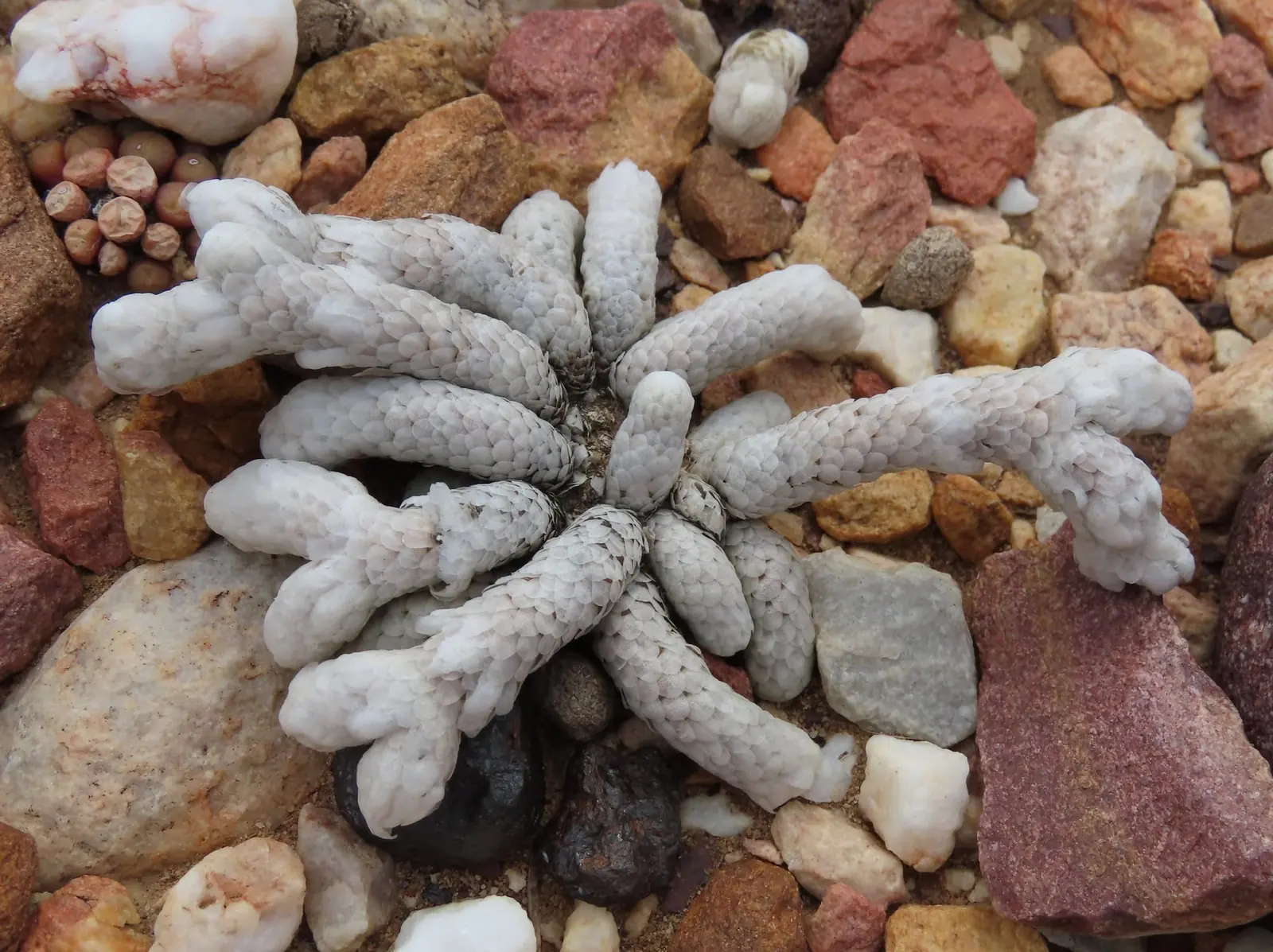
Avonia papyracea is the plant that taught the Karoo to hide things in plain sight. Stout white branches, no thicker than a little finger, radiate from a buried caudex and lie flat along the quartz gravel, each one sheathed head to tail in papery stipular scales that overlap like roof tiles. The green leaves are under there somewhere. You will not see them.
The scales are what make the genus. Avonia was carved out of Anacampseros for exactly this character: leaves tiny and buried, scales large and papery, against the naked leaves of Anacampseros proper. Roughly fourteen species carry it. This one is the best known of them and the one most people meet first, since it germinates readily and sells as seed by the packet.
Its range runs through the Little Karoo and the Great Karoo of South Africa, on arid hills and quartz flats where the plant is close to invisible until it flowers. Herbarium labels put it around Ladismith, Barrydale, Oudtshoorn and Calitzdorp, and out into Namaqualand on white quartzitic hills near Aggeneys.
It is also the counterweight to its own genus. Its sibling Avonia quinaria is Endangered and went onto CITES Appendix I in 2026 after thousands of wild plants were pulled out of the veld. A. papyracea was downlisted over the same decades, moving the opposite way. Both are easy from seed. Only one of them is actually grown.
Avonia papyracea quick reference
A quartz-gravel plant of the South African Karoo, growing in full sun on sharply drained mineral ground with a shallow root run and a wide day-to-night temperature swing. Published growing notes for this species do not separate the two subspecies, so these values are given at species level. Values calibrated for seed grown plants in cultivation, drawn from habitat and specialist grower experience.
Taxonomy & nomenclature
The accepted name is Avonia papyracea (E.Mey. ex Fenzl) G.D.Rowley, the combination Rowley made in Bradleya when he reassessed Anacampseros and allied genera in 1994. The basionym is Anacampseros papyracea E.Mey. ex Fenzl, validated in the Annalen des Wiener Museums der Naturgeschichte in 1840, where Avonia first appears as Fenzl’s subgenus under a manuscript name of Ernst Meyer’s. The family is Anacampserotaceae, split out of the old Portulacaceae in 2010. This is not a cactus, and nothing about growing it should be borrowed from one.
The genus itself is contested. Kew does not accept Avonia: its World Checklist sinks the whole genus back into Anacampseros and treats Avonia papyracea as a synonym of Anacampseros papyracea. The GBIF Backbone Taxonomy does the exact opposite, accepting Avonia papyracea and filing the Anacampseros combination as its homotypic synonym. Two of the largest taxonomic backbones in the world, pointing at each other. This site follows GBIF and publishes under Avonia, which is also the name the trade and every search for this plant actually uses. Kew’s combination is given alongside it. If you are looking this plant up elsewhere, expect to need both.
Authorship carries its own tangle. Kew’s checklist and Rowley give the basionym as E.Mey. ex Fenzl with the 1840 protologue; IPNI, also a Kew product, renders the same name E.Mey. ex Sond. and points at Sonder’s later treatment in Flora Capensis in 1862. The 1840 publication carries the validating description. Two subspecies are accepted, and both backbones agree on them despite disagreeing on the genus: the autonym, and subsp. namaensis, described by Gerbaulet in 1992 from Namibia, the Richtersveld and Bushmanland.
The genus disagreement has a practical tail in the treaty text. There is no separate Avonia listing under CITES and never has been. What exists is a single genus entry for Anacampseros spp., on Appendix II since 1 July 1975, and Avonia is covered only because the annotation to it reads ‘Includes Avonia spp.’ The seed exemption that growers rely on, annotation number 4, is not part of that 1975 listing; it dates from CoP15 in June 2010. The family renders as Anacampserotaceae, not the Portulacaceae the older paperwork shows. A. papyracea is on Appendix II. Do not read that as a genus-wide statement, because it is not one: A. quinaria alone was transferred to Appendix I on 5 March 2026 after CoP20 adopted South Africa’s proposal, and the other six species, this one among them, stayed where they were.
One further name is worth knowing because it sits so close. Avonia perplexa was published in 2006 and then folded into this species as a subspecies in 2015. Both backbones rejected that move and keep it at species rank, so A. perplexa is not part of A. papyracea on any current treatment. The epithet records that the plant perplexed the people describing it.
Historical synonym (1)
- Anacampseros papyracea E.Mey. ex Fenzl, 1840 basionym
Sources: GBIF
Habitat
Avonia papyracea is a plant of arid Karoo hills and quartz flats. Fenzl’s 1840 protologue puts the type collection on arid hills near Bloedrivier in the Great Karoo, gathered by Drège under his number 916, at an altitude the text gives as 2000 to 2500 without naming its units. Read as the feet an 1840 Vienna work would have meant, that is roughly 610 to 810 m. The units are unstated and the conversion approximate, so the figure stands as an old estimate rather than a measured altitude.
Modern herbarium labels sharpen the picture. The South African National Herbarium places the species around Ladismith, Barrydale, Vanwyksdorp, Oudtshoorn and Calitzdorp, with two labels naming the Little Karoo outright, and further north on white quartzitic hills near Aggeneys and Springbok in Namaqualand. Growing alongside it are the quartz-field mesembs of that country, Gibbaeum heathii and Glottiphyllum among them, in full sun on open gravel.
The record carries a live conflict here. SANBI’s red list assessment gives the provincial distribution of subsp. papyracea as Eastern Cape. SANBI’s own herbarium database returns 102 Western Cape records against a single Eastern Cape one. The assessment dates from 2005 and its province field holds one value; the specimen labels are the harder evidence, and the protologue’s Great Karoo agrees with neither province exclusively. The defensible distribution is the Little and Great Karoo, in the Western and Northern Cape; the lone Eastern Cape record does not outweigh it.
Rainfall in that country is low and seasonal, and the ground swings from around 10°C at night to over 35°C by day. That swing, not the heat, is what the plant is built around. The subspecies do not separate cleanly on a map: the autonym turns up at Aggeneys and Springbok, which is subsp. namaensis country, so either the determinations are mixed or the ranges overlap more than the literature says. Only Avonia ustulata breaks the family pattern of white plants on white stone, matching itself instead to grey Karoo shale.
Morphology
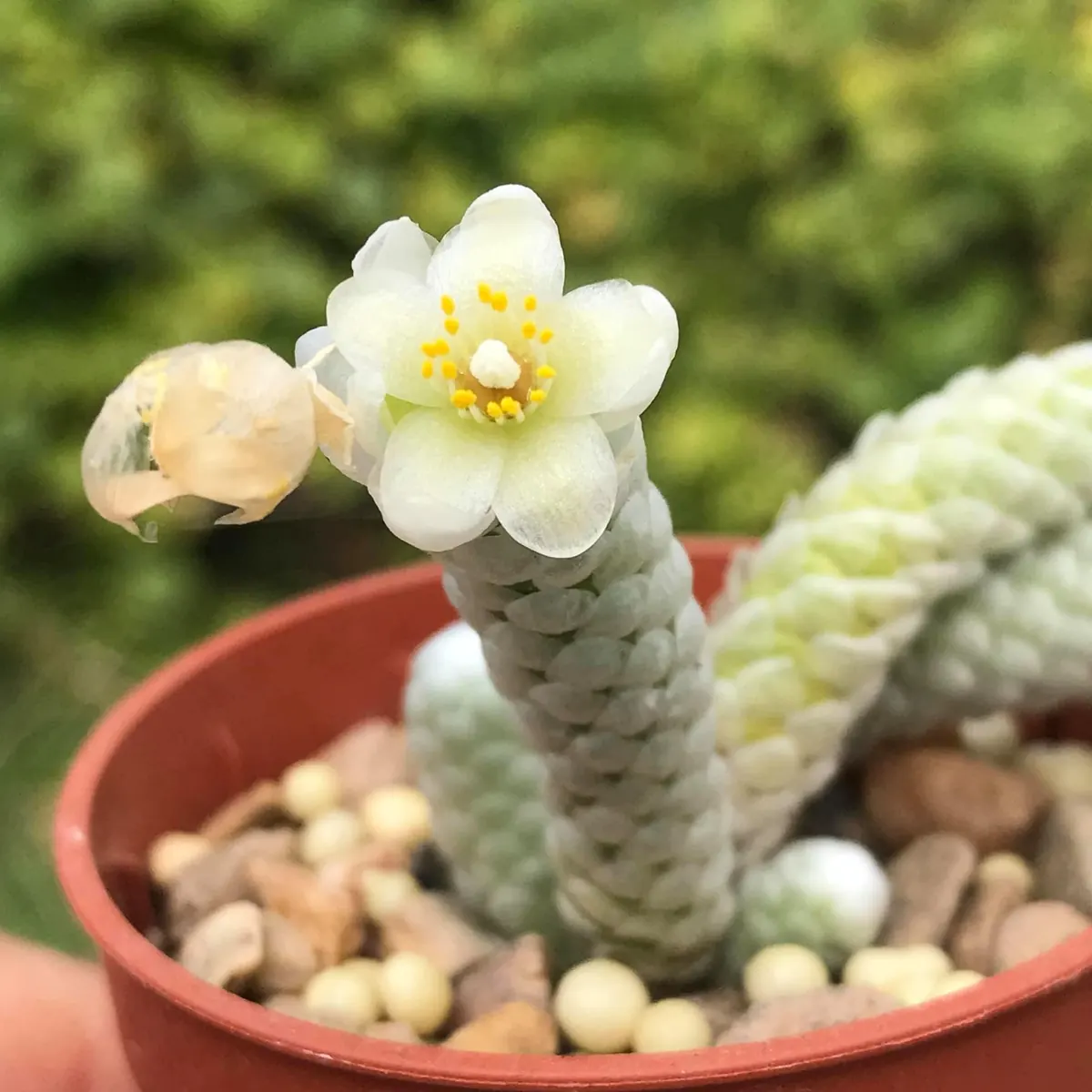
Avonia papyracea is a dwarf perennial whose several branches radiate from a short, much-divided caudex that sits below ground. The branches run 1 to 5 cm, occasionally to 10, and are 6 to 8 mm thick, which Fenzl described as the thickness of the little finger. They grow flat along the ground and often curve as they go. Below the caudex the roots are fine and fibrous, not a swollen tuber, and they stay shallow. That single anatomical fact decides the pot.
The stipules are the plant. Snow-white, papery, scarious and semitransparent, 6 to 8 mm long and 2 to 3 mm wide, tongue-shaped to broadly ovate with a rounded tip and an entire margin, transversely wrinkled across the face, and bearded with wool at the base. They overlap tightly in every direction and run five to ten times longer than the leaves they cover, so the leaves, tiny and semi-globose and green, are never visible. Fenzl recorded them as veinless, which is worth knowing because a midrib is often offered as a way to tell this genus apart and it will not do the job.
Flowers sit solitary and sessile at the branch tips, tucked inside the uppermost scales and much shorter than them, so a plant can be in bud without looking like it. Five rounded petals about 4 mm long open past the two sepals around a central ring of yellow anthers, with 16 to 20 stamens. They are scented. The flower opens in the afternoon and is finished the same day, and the published accounts of how long it stays open disagree with each other by roughly fourfold, so no reliable duration can be given. To catch it open, look in the afternoon.
Petal colour is unsettled. The 1840 protologue, describing the type, says the petals are yellow; a society journal eyewitness recorded pale yellow; the standard modern horticultural account says creamy white to greenish white with yellow anthers. The primary source sides with the outlier, which is unusual and unresolved. Expect something pale, and do not be surprised by yellow. The fruit is a nearly globular capsule around 4 mm; its cap falls away to leave a three-valved basket, and the many small pale brown seeds shake out of it on the wind.
Locality detail
Avonia papyracea is recorded from three parts of South Africa: the Little Karoo around Ladismith and Oudtshoorn, the Great Karoo around Beaufort West and Laingsburg, and the white quartzitic hills of Namaqualand near Aggeneys and Springbok. The markers below sit at district-level centroids drawn from public herbarium labels, not at plant positions. Ladismith, Oudtshoorn, Laingsburg and Beaufort West are already on those labels and are not sensitive at that resolution; anything finer is withheld, which is the standing practice across this genus. Its siblings are the reason. Avonia herreana is known from three or four locations in the Richtersveld, and A. quinaria is being dug out of the ground fast enough to have earned an Appendix I listing.
The type locality is the one place the record runs thin. Fenzl gives ‘arid hills near Bloedrivier, Great Karoo’ and Drège’s collection number 916, and that is all. Bloedrivier has no secure modern coordinate, so the locality stands as Drège wrote it and no province is named for it.
Cultivation
Avonia papyracea is easy to keep and slow to build, whatever its reputation as a choice and difficult plant says. The two get confused because a plant that takes years to look like anything gives you years in which to drown it. Water is the whole problem. Everything below is one long argument for a mix that cannot hold any.
Substrate
Use 37 per cent pumice, 18 per cent lava, 10 per cent zeolite, 10 per cent granite grit, 20 per cent silica grit, 5 per cent organic matter and no limestone, which puts the mix at 95 per cent mineral and 5 per cent organic, the rot-class figure this genus runs on. The pumice and lava carry the drainage and aeration; the silica and granite are house-formulation grit sizes rather than a reading of the gravel this plant grows in, and no published source ties either proportion to this species specifically. The zeolite buffers the mix around neutral and carries the cation-exchange load a lean organic fraction cannot. Top-dress with white quartz grit. It keeps the root neck dry, which is the whole justification the top-dressing needs.
Those figures are the temperate Mediterranean baseline. In hot, dry air, Phoenix or inland California, the organic share can run a little higher, toward 8 to 10 per cent, taken from the pumice. In cool wet climates, the United Kingdom or the Pacific Northwest, drop it toward 0 to 3 per cent and give the difference back to the grit. Published growing notes for this species all recommend a lightweight aggregate that floats and washes out of the pot; pumice does the same job and stays where you put it.
Organic and limestone are the two components with cultivation evidence behind them, and both are held to the same values across all seven Avonia: organic at 5 per cent, set by the rot-class evidence for arid caudiciform succulents, and limestone at 0 per cent, because no cultivation source in the literature recommends lime for any Avonia. The remaining columns (pumice, lava, zeolite, granite, silica) are house-formulation figures that set drainage and particle size in the pot; they vary from page to page as a growing convention, not because any source ties a percentage to a species’ own rock.
| Species | Pumice | Lava | Zeolite | Granite | Limestone | Silica | Organic |
|---|---|---|---|---|---|---|---|
| A. quinaria | 41% | 8% | 10% | 8% | 0% | 28% | 5% |
| A. papyracea (this page) | 37% | 18% | 10% | 10% | 0% | 20% | 5% |
| A. albissima | 30% | 15% | 8% | 15% | 0% | 27% | 5% |
| A. herreana | 28% | 15% | 8% | 12% | 0% | 32% | 5% |
| A. ustulata | 50% | 15% | 15% | 10% | 0% | 5% | 5% |
| A. dinteri | 35% | 20% | 10% | 20% | 0% | 10% | 5% |
| A. mallei | 30% | 20% | 12% | 20% | 0% | 13% | 5% |
Watering and light
Water from March to October, when the plant is in growth, and stop for the winter. Wait until the mix has dried out completely, soak it, and wait again. Ignore any fixed cadence you read for this species, twice weekly included: those numbers assume an Italian glasshouse, a clay pot and a mix that drains in seconds, and the dry-out rule travels where the cadence does not. Keep the humidity low. Overwatering is not one failure mode among several, it is the failure mode.
Give it very bright light, up to full sun, which is what drives flowering and keeps the branches from drawing out. In a hot glasshouse shade the worst of the midday hours; the white scales reflect a good deal of light and the plant is cryptic against quartz, but scorch on a mid-summer afternoon is on the record all the same. Hold it near 5°C in winter, bone dry, in a shallow clay pot no wider than it needs. The roots are fine and fibrous and shallow, and clay pulls the last of the water out of the mix between soaks.
Propagation
Sow fresh seed on a mineral surface with a light cover, at 25 to 30°C for the fastest result; seedlings can come up en masse inside a week, though germination still happens from around 15°C at a slower pace. Mist rather than soak, because soaking rots the seed. From there the seedlings develop their papery scales quickly and can reach a miniature adult form within twelve months. The accounts split at this point, and the split is informative: the standard reference calls the species not easy to raise from seed, while growers report trays of it. Both are right. Germination is easy and the months afterwards are where the water kills them.
At rarecactus.com we grow our Avonia from seed rather than buying in collected plants, and this genus is the clearest case anywhere in our collection for why that matters. Two species here are equally easy to raise. The one that nurseries actually raise at volume was downlisted; the one they do not is on Appendix I. Nothing about the plants explains that. Only the supply does.
Comparison
The plant to learn Avonia papyracea against is Avonia albissima, the genus’s other pure-white tight-scaled species and the one the standard reference names as the source of confusion. They share ground in Bushmanland and both are widely traded, so this is a real bench problem rather than a textbook one. Three characters separate them and none depends on the plant’s age. A. albissima holds its branches spreading or erect and they are 3 to 5 mm thick; A. papyracea lies flat on the ground and runs 6 to 8 mm, sometimes 10. Count the stamens if a flower is open: 8 to 10 against 16 to 20. And look at the scale surface, which on this species is transversely wrinkled and entire-margined, a character the 1840 protologue records and A. albissima does not share.
Two characters that circulate as diagnostics do not work and are worth striking from your mental list. Scent is one: it gets attributed to A. albissima as though it were distinctive, but the flowers of this species are scented too. The absence of a midrib is the other. It is a real feature of A. albissima and useless for telling the two apart, because Fenzl described A. papyracea’s stipules as veinless in 1840. Both lack it. Outside the overlap zone, geography does more work than either: a white Avonia in Angola or Griqualand West is not this plant.
Against Avonia dinteri and the rest of the genus the separation is easier, and the more interesting comparison is not morphological at all. Set this species beside A. quinaria and you get two plants of the same genus, both easy from seed, on opposite trajectories. A. papyracea is in ordinary nursery production and sells as retail seed packets; its listing was eased, not tightened. A. quinaria is, in the South African assessment’s own words, easy to propagate from seed but seldom grown commercially; 8,449 plants were confiscated between March 2019 and November 2022, and it went from Least Concern to Endangered to Appendix I.
The record holds a contradiction here. CITES documentation counts A. quinaria among the most traded plants in the genus while SANBI says it is seldom grown commercially, and both are probably right, because they measure different things. Heavy trade with no nursery production behind it means the trade is being supplied from the veld. That is not a footnote to the poaching story. It is the poaching story.
Frequently asked questions
Is Avonia papyracea hard to grow?
No, and its reputation says otherwise mostly because it is slow. It is easy to keep and takes years to build, which gives an impatient grower plenty of time to overwater it. That is the one real hazard. Give it a mix that is 90 per cent mineral and drains in seconds, let it dry out completely between soaks, keep it bone dry from October through February, and keep the air around it dry. Do that and it is a durable plant.
How do you propagate Avonia papyracea?
From seed, which is the only route worth using and one of the easier germinations in this family. Sow fresh seed on a mineral surface with a light covering at 25 to 30°C and seedlings can appear en masse within a week; germination still works from around 15°C, just slower. Mist rather than soak, since soaking rots the seed. Seedlings develop the papery scales fast and can reach a miniature adult form inside twelve months, and the months after germination are where the losses happen, not the germination itself.
How often should you water Avonia papyracea?
There is no schedule, only a rule: wait until the mix is completely dry, soak it, and wait again. Through the March to October growing season that might be weekly in a small clay pot in heat, or fortnightly in cooler air, and the pot decides, not the calendar. Fixed cadences published for this species, twice weekly among them, assume a glasshouse and a mix that drains in seconds. From November through February, stop entirely.
When is Avonia papyracea dormant?
Through the winter. This is a summer grower: it moves from roughly March through October and rests through the cold months, which is when watering stops altogether. Do not invert the calendar on the assumption that a white South African quartz plant must be a winter grower like the mesembs it grows beside. The core range of the genus is summer-rainfall country, and the two exceptions in this genus, Avonia mallei and A. herreana, are winter-rainfall taxa on their own evidence rather than by any genus rule.
Can you grow Avonia papyracea indoors?
Only in the brightest position you have, and a windowsill usually is not it. Light is what drives flowering and keeps the branches tight, and this plant wants very bright light up to full sun. Indoors the risks stack against it: less light, higher humidity, and a mix that stays damp for days. A glasshouse or a bright covered outdoor spot suits it far better. If it must live inside, put it under strong light in a shallow clay pot and err heavily toward too dry.
Sources & further reading
Fenzl, E. 1840. Monographie der Mollugineen. Zweiter Artikel. Annalen des Wiener Museums der Naturgeschichte 2: 243–307 (Avonia papyracea protologue at p. 295) · Sonder, O.W. 1862. Anacampseros papyracea. In Harvey, W.H. & Sonder, O.W., Flora Capensis 2: 383 · Gerbaulet, M. 1992. Die Gattung Anacampseros L. (Portulacaceae). I. Untersuchungen zur Systematik. Botanische Jahrbücher für Systematik 113(4): 477–564 (subsp. namaensis at p. 547) · Rowley, G.D. 1994. Anacampseros and allied genera, a reassessment. Bradleya 12: 105–112 · Nyffeler, R. & Eggli, U. 2010. Disintegrating Portulacaceae: a new familial classification of the suborder Portulacineae (Caryophyllales). Taxon 59(1): 227–240 · Snijman, D.A. (ed.) 2013. Plants of the Greater Cape Floristic Region 2: The extra Cape flora. Strelitzia 30 · Kew, World Checklist of Vascular Plants, Anacampseros papyracea E.Mey. ex Fenzl (accepted; Avonia papyracea treated as a synonym) · GBIF Secretariat, GBIF Backbone Taxonomy, Avonia papyracea (E.Mey. ex Fenzl) G.D.Rowley, key 6054000 (accepted; Anacampseros papyracea key 7344742 as homotypic synonym) · IPNI, International Plant Names Index, records 698276-1, 978182-1, 978183-1, 965790-1 · SANBI Red List of South African Plants, Anacampseros papyracea subsp. papyracea, Least Concern (Burgoyne & Potter, 2005) · SANBI Red List of South African Plants, Anacampseros papyracea subsp. namaensis, Least Concern (Williamson & Potter, 2005) · SANBI Red List of South African Plants, Anacampseros quinaria, Endangered (2022; confiscation figures and commercial-cultivation note) · BODATSA: Botanical Collections, South African National Herbarium, specimen label data for Anacampseros papyracea · CITES Appendices, Anacampseros spp. (Appendix II from 01/07/1975, annotation №4 from CoP15, 23/06/2010; A. quinaria transferred to Appendix I 05/03/2026, CoP20) · LLIFLE, Encyclopedia of Living Forms, Anacampseros papyracea (morphology, cultivation, habitat associates) · Deem, C. 2010. Plant of the Month: Avonia papyracea. Henry Shaw Cactus & Succulent Society (eyewitness flower observation)