
Avonia quinaria
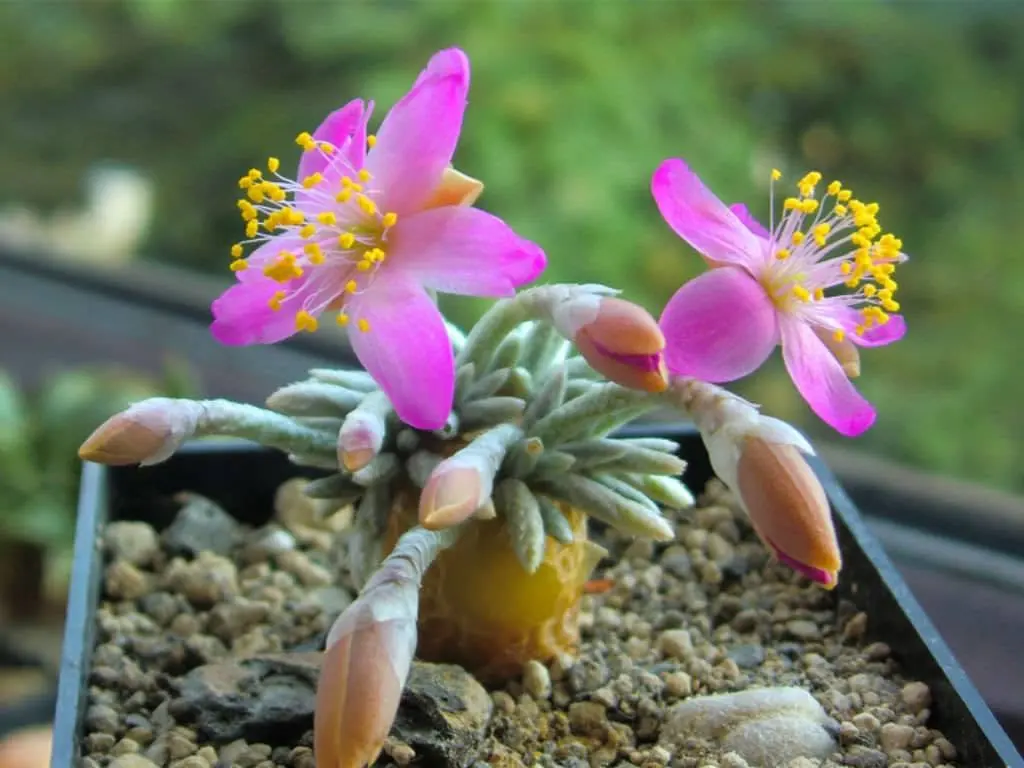
Avonia quinaria hides almost everything that matters. A swollen, turnip-shaped caudex sits flush with the gravel, and the branchlets it carries are barely two millimetres thick, sheathed in papery scales ranked in fives. For a few hours on a hot afternoon it opens a magenta flower wider than the branch beneath it.
The scales are the whole point of the genus. Avonia plants carry leaves so reduced that they vanish under overlapping stipules, where Anacampseros in the strict sense keeps larger naked leaves on show. That difference is why the name is contested, and the contest is live rather than settled: Kew and the GBIF backbone currently disagree about whether Avonia is a genus at all. The Taxonomy section below sets out both positions and which one we follow.
The plant belongs to Bushmanland and north-eastern Namaqualand in South Africa’s Northern Cape, and crosses into south-eastern Namibia. Its recorded localities read like a list of quartzite country: Gamsberg, Aggeneys, Pofadder, the Witberg. It is not a South African endemic, which matters, because the assessment that governs it is a national one.
What sets this species apart is an arithmetic problem rather than a growing one. Seed germinates in a fortnight and the plants flower at around two years old. Four years of careful growing still buys a caudex about one centimetre across, against wild plants that run to five centimetres and beyond. Nobody raises it at volume, so the demand goes to the veld instead, and that is the mechanism behind everything in the box below. The sibling species Avonia papyracea, which is fast enough to sell as seed by the packet, went the other way.
Avonia quinaria quick reference
A summer-growing caudiciform from the quartz plains of Bushmanland and north-eastern Namaqualand, sitting flush with the gravel in full sun and growing on rain that falls in the warm months. Values calibrated for seed grown plants in cultivation.
Taxonomy & nomenclature
Avonia quinaria (E.Mey. ex Fenzl) G.D.Rowley is an accepted name in the GBIF Backbone Taxonomy and no name at all at Kew, where Plants of the World Online sinks Avonia into Anacampseros and calls the plant Anacampseros quinaria. Two major authorities disagree, the disagreement is about the genus rather than the species, and neither is a fringe position: GBIF files Anacampseros quinaria as the homotypic synonym of the Avonia name, POWO does the reverse, and neither has yielded.
We publish under Avonia quinaria, following the GBIF backbone, and print the POWO name alongside it so that a reader arriving from either direction knows exactly what they are looking at. The choice is not arbitrary: it is also the name the search and collector worlds use, and GBIF itself flags a conflicting basionym combination on the Anacampseros record, which is a machine-readable admission that the authorities are tangled here.
The tangle runs into the authorship as well. The combination is Avonia quinaria (E.Mey. ex Fenzl) G.D.Rowley, published in Bradleya 12 in 1994, and that part is uncontested. The basionym is Anacampseros quinaria E.Mey. ex Fenzl. POWO, SANBI and Rowley all spell the basionym author that way, but the International Plant Names Index contradicts itself: its own record for Rowley’s combination spells the parenthetical author ‘ex Fenzl’, while its record for the basionym attributes it to E.Mey. ex Sonder in the Flora Capensis of 1862. The publication year is unsettled in the record, so the author string stands without one.
Avonia itself is older than Rowley. It began as E. Meyer’s manuscript name for a subgenus of Anacampseros, built around the papery stipules, and Rowley raised it to a genus in 1994. So POWO is not declining to recognise a modern invention; it is declining to raise a name that has been sitting at infrageneric rank for the better part of two centuries. The epithet quinaria means ‘in fives’, and it records the stipule arrangement.
Two subspecies are recognised. Subspecies alstonii, based on Anacampseros alstonii Schönland, is the northern one, running through Bushmanland toward the southern Richtersveld, and it carries the pale flowers. The autonymic subspecies quinaria sits south of it around the eastern edge of the Khamiesberg and carries the dark ones. Note that the variety schmidtii, which still circulates attached to this species, belongs elsewhere: it resolves to Avonia dinteri or to Avonia albissima depending on which record you read, and it is not part of our synonymy. The family is Anacampserotaceae, erected in 2010 when Portulacaceae was broken up, and not the Portulacaceae that older labels and some legal instruments still name.
Historical synonym (1)
- Anacampseros quinaria E.Mey. ex Fenzl, 1840 basionym
Sources: GBIF
Habitat
Avonia quinaria grows on quartz, on rock outcrops and on dry flats and gentle slopes of quartzite and red sand, in flat quartz-strewn ground or quartz crevices, whether out on the Bushmanland plains or up on the plateau areas of hills. The parent rock is quartz or quartzite throughout the range, and its two most-cited localities, Gamsberg and Aggeneys, are internationally known quartzite-hosted zinc deposits. No limestone, dolomite or calcrete occurs anywhere in its habitat.
The mix given below therefore carries no limestone, because no calcareous rock occurs in habitat. The plant’s response to lime is untested either way.
The red sand in that habitat description does real work. Bushmanland red sand is an aeolian, Kalahari-type material: fine, deep, and not gravelly at all. Read together with the plains habit and the ‘hard soil’ the growers describe, it says the wild root environment holds a fine fraction rather than being pure sharp grit, and that shapes the mix given below.
SANBI places the species in two biomes, and the pair is the key to its calendar. Nama Karoo takes its rain in summer; Succulent Karoo takes it in winter. The species spans both, but its centre of gravity is emphatically the summer side: the range statement leads with Bushmanland, and Pofadder, Aggeneys and Gamsberg are all Bushmanland localities. Only the north-eastern Namaqualand margin leans toward winter rain. This is the opposite of the mesemb pattern that shares the same quartz, and applying a Lithops calendar here is the single most common way to kill the plant.
Morphology
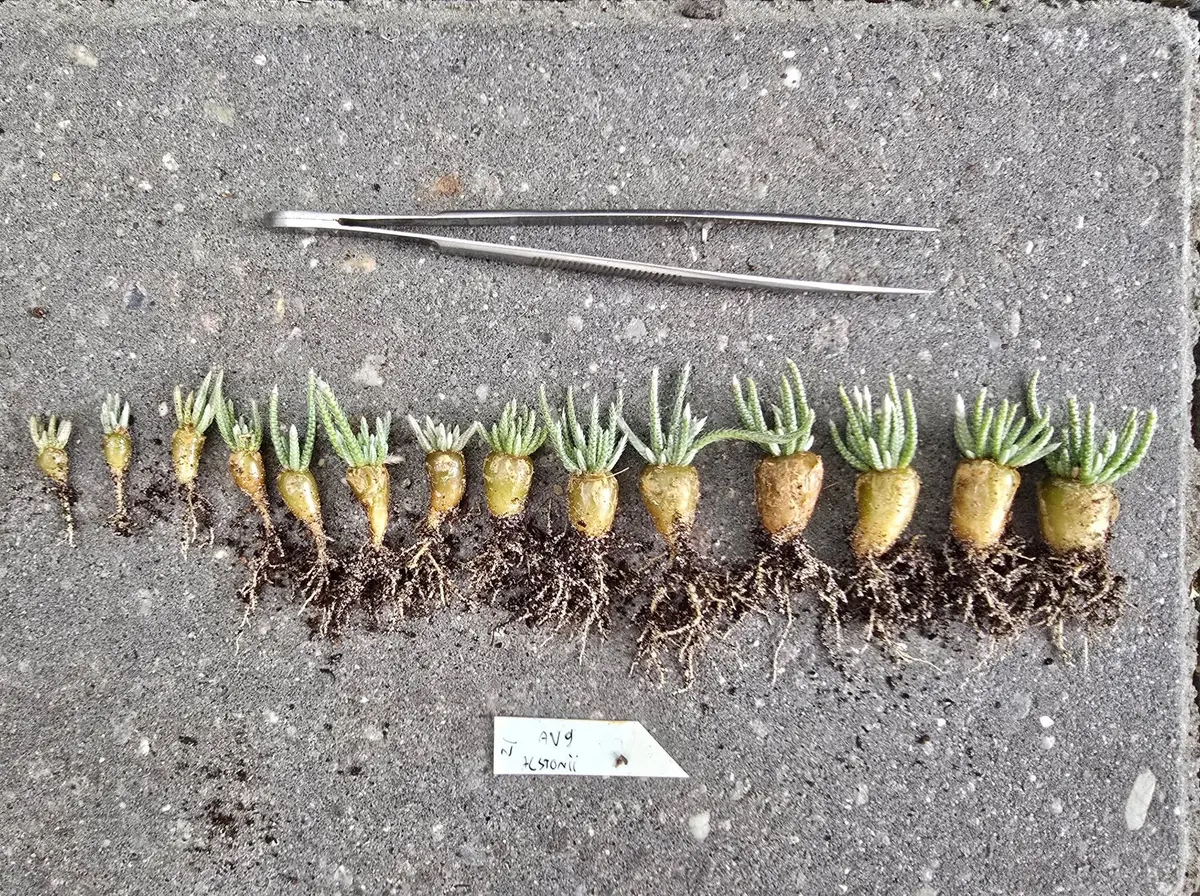
Avonia quinaria is a turnip-shaped caudex, typically 2.5 to 5 cm across, sitting flush with the soil surface under a crown of branchlets about 2 mm thick and sheathed in silvery papery scales. The caudex is the plant: fleshy becoming somewhat woody, neither proud of the gravel nor buried under it. Very old plants reach roughly 10 to 12 cm, well beyond anything a grower will meet. The original description calls the trunk thick, very short and many-headed, which is exactly what the photographs show.
From the crown of that caudex the branchlets burst out in numbers, sterile and flower-bearing together, undivided, finely cylindrical, about 2 mm thick and running to roughly 12 mm long at most.
The stipules are what the epithet records and what the genus is built on. They are scarious and parchment-like, broadly ovate, entire, silvery with brownish spots on a living plant and darkening toward the tip, and they lie appressed in five ranks arranged spirally. Five-ranked and spiral are not a contradiction, though the pairing is often read as one: a spiral phyllotaxis of two-fifths produces exactly five ranks, and the original diagnosis states both in the same phrase. Beneath them the leaves are almost obsolete, semi-orbicular, fleshy and flat, and completely hidden.
One stipule character is diagnostic within the genus rather than merely descriptive: this species is beardless at the stipule base. Avonia as a group was defined with bearded stipule bases, and A. papyracea carries a woolly beard there, so a monograph would lean on this character first. A. quinaria is the beardless one.
Flowers are solitary, terminal and sessile on the branch tips, with no distinct flowering stalk, and they run two to four times the length of the involucre. Colour splits cleanly by subspecies and is the reason collectors want the southern plants: subspecies quinaria carries dark flowers 1.2 to 1.5 cm across, variously called carmine, pink or purple, while subspecies alstonii carries white to pinkish-white flowers reaching about 3 cm, roughly double the diameter. The 3 cm figure belongs to alstonii alone and should never be quoted for the species. Seed capsules ripen within a few weeks and the seed is easily lost if they are not watched closely.
Locality detail
Avonia quinaria ranges from south-eastern Namibia through Bushmanland into north-eastern Namaqualand in the Northern Cape. Herbarium collections name Gamsberg, Aggeneys, the Witberg, Pofadder in the Kenhardt district, the Kabinakop Hills near Steinkopf, and Vanrhynsdorp, gathered between 1961 and 2010. The type material came from the arid plains of the Bushmanland Karoo, the same country that remains the heart of the plant’s range in the 2022 national assessment.
The map shows a regional centroid and nothing sharper. District names are already public in the herbarium and assessment record, but precise coordinates for an Appendix I plant with 8 449 confiscated individuals behind it stay withheld, as does the type locality as a findable modern place.
The two subspecies divide the range between them. Subspecies alstonii is the northern and eastern plant, running in a band from near Steinkopf east to Pofadder and through Bushmanland toward the southern Richtersveld. Subspecies quinaria is the southern element, found from around Springbok down to Kliprand on the eastern edge of the Khamiesberg. They also grow differently: the northern plants scatter as single individuals over wide ground, while the southern ones cluster in dense patches ten to twenty metres across, at roughly ten plants per square metre, with hundreds of metres of nothing between patches.
Cultivation
Grow Avonia quinaria in full sun in a sharply draining mineral mix, water it from March to October, and keep it bone dry and frost-free through winter with the caudex sitting flush at the surface where water never lingers. Every decision below follows from three habitat facts: sun on quartz gravel and red sand, rain in the warm months, and a storage organ at soil level. Get them right and the plant asks for very little. Get the water wrong and it rots at the neck, which is the one failure to avoid.
Substrate
Grow it in a sharply draining mineral soil of 41 per cent pumice, 28 per cent silica grit at 1 to 3 mm, 10 per cent zeolite, 8 per cent lava, 8 per cent granite grit, 5 per cent organic matter as worm castings and no limestone. Silica, granite, lava and zeolite are house-formulation figures that set drainage and grit size; no published source ties a silica percentage to this or any Avonia species, so treat the 28 per cent as a working convention rather than a per-species finding. Limestone sits at zero because no source in the cultivation literature recommends lime for this species or its genus, not because the rock at any locality has been read for a mineral answer. Lava is held low deliberately: its job is aerating the bottom of a deep pot, and this plant’s shallow caudex wants a shallow one. The organic fraction sits at 5 per cent, the low end of the 0 to 15 per cent band this genus’s rot-class evidence supports. The single named grower who has published a recipe and four years of results for this species ran roughly half loam and half grit, which would put the true organic content nearer 12 to 15 per cent once the loam is counted. Other growers who write about this same arid caudiciform group generally spray a systemic fungicide at every watering, which this site’s readers do not, so the number here applies the standard discount for that gap and lands at the low end of the band rather than the middle. It is an open question whether that discount should apply to a grower who never mentions fungicide at all, and the honest range is 5 to 8 per cent rather than a single settled figure. The zeolite at 10 per cent carries the rest of the nutrition-holding job through cation exchange without adding water-holding mass.
Organic and limestone are the two components with cultivation evidence behind them, and both are held to the same values across all seven Avonia: organic at 5 per cent, set by the rot-class evidence for arid caudiciform succulents, and limestone at 0 per cent, because no cultivation source in the literature recommends lime for any Avonia. The remaining columns (pumice, lava, zeolite, granite, silica) are house-formulation figures that set drainage and particle size in the pot; they vary from page to page as a growing convention, not because any source ties a percentage to a species’ own rock.
| Species | Pumice | Lava | Zeolite | Granite | Limestone | Silica | Organic |
|---|---|---|---|---|---|---|---|
| A. quinaria (this page) | 41% | 8% | 10% | 8% | 0% | 28% | 5% |
| A. papyracea | 37% | 18% | 10% | 10% | 0% | 20% | 5% |
| A. albissima | 30% | 15% | 8% | 15% | 0% | 27% | 5% |
| A. herreana | 28% | 15% | 8% | 12% | 0% | 32% | 5% |
| A. ustulata | 50% | 15% | 15% | 10% | 0% | 5% | 5% |
| A. dinteri | 35% | 20% | 10% | 20% | 0% | 10% | 5% |
| A. mallei | 30% | 20% | 12% | 20% | 0% | 13% | 5% |
Watering and light
Treat it as a summer grower and water from March to October, soaking and then letting the mix dry through before the next one. Water must never be allowed to stand around the roots or against the caudex neck. Through winter keep it dry and frost-free. Its cold tolerance is unresolved, so treat frost as the limit. A -5°C hardiness figure circulates but is internally inconsistent, pairing that number with a zone that floors near -1°C, and growers keep the plant frost-free.
Give it full sun. High light is not a preference here; it is the trigger. The flowers open in response to fierce sunshine, a point the 1840 diagnosis already recorded, and in overcast or wet weather they simply do not open. Growers who complain their plant will not flower are usually growing it too dim.
Propagation
Seed germinates within a week or two at 15 to 21°C, and the plants start flowering at around two years old with the caudex still only a few millimetres across. Seed does not stay viable long, so sow it as soon after harvest as you can, though sowing the following spring on the surface of a seed mix in gentle heat does work. Whether it sets seed on its own is unresolved, and most likely it does not: while most Avonia are self-fertile, this one appears to be among the few exceptions, needing hand pollination between two individuals. Assume you need two unrelated plants. Expert growers report success from stem cuttings; grafting this species is undocumented either way.
Legal status
There has never been a separate Avonia listing under CITES. Anacampseros has been on Appendix II as a genus since 1 July 1975, and Avonia is covered because that listing carries an annotation reading ‘Includes Avonia spp.’. The seed exemption growers know as annotation #4 is not as old as the listing; it dates from 2010. The listing renders under Anacampserotaceae now, not the Portulacaceae still printed on older paperwork.
Avonia quinaria alone has left that regime. On South Africa’s Proposal 50, adopted at CoP20 in Samarkand in December 2025, the species was transferred from Appendix II to Appendix I without an annotation, in force from 5 March 2026. The other six Avonia remain on Appendix II under the genus listing; there is no genus-wide Appendix I, and anyone telling you otherwise is guessing.
The transfer takes the seed exemption with it. Annotation #4 had exempted Avonia seed from CITES control, and Proposal 50 states plainly that under an Appendix I listing the parts and derivatives of this species, seeds included, are no longer exempt. The published appendices confirm it: quinaria stands bare in the Appendix I column, carrying no annotation, while the genus stays in Appendix II reading ‘Anacampseros spp. #4 {Includes Avonia spp.} (Except the species included in Appendix I)’. The seed carve-out that still covers the other six no longer reaches this one.
CITES treats a plant species artificially propagated for commercial purposes as an Appendix II specimen for permit purposes, so an Appendix I listing here is not a flat prohibition on trade. How that provision applies to any given consignment is a determination for the exporting country’s management authority rather than something to read off a listing. Anyone moving this species across a border, seeds now included, should settle it with their own authority first.
Comparison
The species Avonia quinaria is actually confused with is Avonia albissima, and that confusion is a matter of record rather than a guess about lookalikes. The GBIF backbone files Anacampseros quinaria in the misapplied sense as a synonym of A. albissima, which is to say the name quinaria has been hung on albissima plants in the literature. Separately, a variety published in 1908 as a quinaria variety now sits inside albissima’s synonymy. The confusion runs the same direction in both records. The ranges help it along, since both plants reach Bushmanland.
Two characters separate them at any age, which matters because most keys quietly depend on the plant being mature. The first is architecture: A. quinaria is one fat turnip caudex sitting flush with the ground under a tight crown of 2 mm branchlets barely a centimetre long, while A. albissima is a low tuft of stems 3 to 5 mm thick and up to 5 cm long, branched low down off a short taproot with the crown below ground. The second is pigmentation: silvery scales with brownish spots here, pure white ones there. Add the stipule base, beardless on this species and hairy in the axils on albissima, and the flowers, which are dark on subspecies quinaria and invariably white on albissima. Their conservation profiles have diverged completely: albissima is widespread with a stable population.
Against the rest of the genus the differences are coarser. A. papyracea sprawls flat on the gravel with stout white snake-like branches and is fast enough to be sold as seed by the packet. Avonia ustulata is the outlier, dull grey-green and worm-like, camouflaged against Karoo shale rather than white quartz, and it flushes rust brown on the fertile stems. The winter-rainfall taxa, Avonia herreana on west-facing Richtersveld ridges and Avonia mallei in coastal Namaqualand fog country, run a different calendar entirely and must not be watered on the summer schedule this species wants. There is no genus-wide dormancy answer: the confident March-to-October advice all over the internet is right for this plant and wrong for at least two of its siblings.
Frequently asked questions
What is the common name for Avonia quinaria?
It does not have a settled English common name. Collectors and sellers use the botanical names, and they use both of them: you will find the same plant listed as Avonia quinaria and as Anacampseros quinaria depending on which authority the seller follows. It does carry a settled name in the Chinese trade, where Hong Kong’s CITES schedule lists it as 韌錦. If you are searching for it, search both botanical names; the results barely overlap.
How do you grow Avonia quinaria?
Full sun, a sharply draining mineral soil, water from March to October and nothing at all through winter. It is a summer grower despite living on the same quartz as the winter-growing mesembs, so do not invert the calendar. The one thing that kills it is water standing at the caudex neck, which rots it. Keep it frost-free and keep the pot shallow; in habitat the caudex sits flush with the gravel rather than buried.
When is Avonia quinaria dormant?
It is dormant through the northern-hemisphere winter, roughly November to February, and grows from March to October. That surprises people, because the plant shares its quartz habitat with Lithops and other winter growers, and the mesemb calendar gets applied to it by mistake. The reason it does not hold is geographic: the core of the range is Bushmanland, which sits in the summer-rainfall Nama Karoo, not the winter-rainfall Succulent Karoo. The published calendar was written for the species as a whole. It is subspecies quinaria, the southern Khamiesberg plant, that sits nearest the winter-rainfall side, and its dormancy has not been examined separately.
Can Avonia quinaria be grown from seed?
Easily, and that is the whole paradox of the species. Seed germinates in a week or two at 15 to 21°C and the plants flower at about two years old. Sow fresh, because viability drops off fast, and expect to need two unrelated plants to get seed at all, since it is one of the few Avonia that will not set seed on itself. The catch is speed: four years of bench space buys a caudex about a centimetre across. At rarecactus.com we grow Avonia quinaria from seed and accept that timeline, because the alternative is the thing driving the species down. SANBI is explicit that this plant is easy to propagate but seldom grown commercially precisely because it is too slow to be worth a nursery’s time, and that the gap is what sends the demand to the veld.
How do you care for Avonia quinaria subsp. alstonii?
Exactly as you would the species, and with more confidence than for the other subspecies. Subspecies alstonii is the Bushmanland plant, which is the summer-rainfall end of the range, so the March to October calendar fits it best of all. It is the one with the large pale flowers, white to pinkish-white and reaching about 3 cm, roughly double the diameter of the dark flowers on the southern plants. It grows as scattered individuals in the wild rather than in dense patches. It is also the more heavily poached of the two, because it is spread across more ground, so provenance matters even more here than usual.
Sources & further reading
Fenzl, E. 1840. Monographie der Mollugineen. Annalen des Wiener Museums der Naturgeschichte 2: 243-307 · Rowley, G.D. 1994. Bradleya 12: 111-112 (Avonia raised to generic rank) · Sonder, O.W. 1862. Anacampseros, in Harvey & Sonder, Flora Capensis 2: 383 · Schönland, S. 1903. Anacampseros alstonii. Records of the Albany Museum 1(1): 51 · Mhlongo, N.N., Rodgerson, C. & Dreher, H. 2022. Anacampseros quinaria E.Mey. ex Fenzl. National Assessment: Red List of South African Plants version 2024.1, SANBI · Smale, T. 2013. Avonia quinaria. British Cactus and Succulent Society, Plant of the Month, August 2013 · Henry Shaw Cactus and Succulent Society. 2009. Avonia · llifle, Encyclopedia of Living Forms, Avonia quinaria and subsp. alstonii · GBIF Secretariat, GBIF Backbone Taxonomy, Avonia quinaria (E.Mey. ex Fenzl) G.D.Rowley, key 5646643 (accepted; Anacampseros quinaria 6102857 homotypic synonym) · IPNI, International Plant Names Index, 978184-1, 978185-1, 698282-1 · CITES CoP20, Samarkand 2025, Proposal 50 (South Africa): transfer of Anacampseros quinaria from Appendix II to Appendix I · Agriculture, Fisheries and Conservation Department, Hong Kong SAR, Endangered Species Schedule ES 01/26, Annex · Nyffeler, R. & Eggli, U. 2010. Disintegrating Portulacaceae. Taxon 59(1): 227-240 · Gerbaulet, M. 1992. Die Gattung Anacampseros L. (Portulacaceae) I. Botanische Jahrbücher für Systematik 113(4): 477-564