
Copiapoa laui
| Family | Cactaceae |
| Named by | Diers (1980) |
| Native range | Planta Esmeralda, Atacama coast, Chile |
| Altitude | 400–700 m |
| Stem diameter | 1–3 cm; partially subterranean |
| Ribs | 15–20; dissolved into tubercles |
| Flowers | Yellow with reddish tips; funnel-shaped |
| Fruit | Globular, 3–5 mm, greenish-brown |
| IUCN status | Critically Endangered (2024) |
| CITES | Appendix II |
The Dwarf Copiapoa · Lau’s Copiapoa
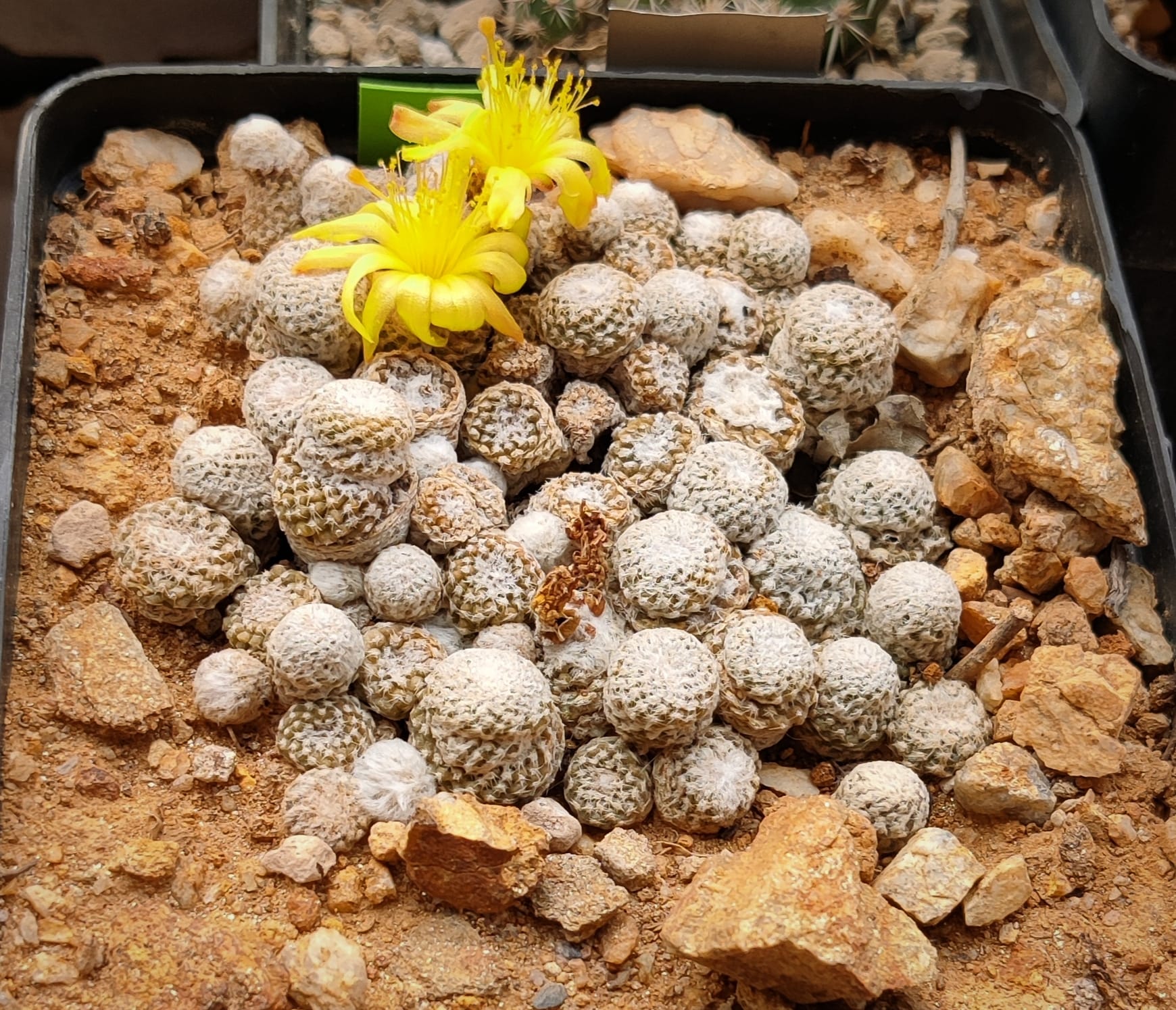
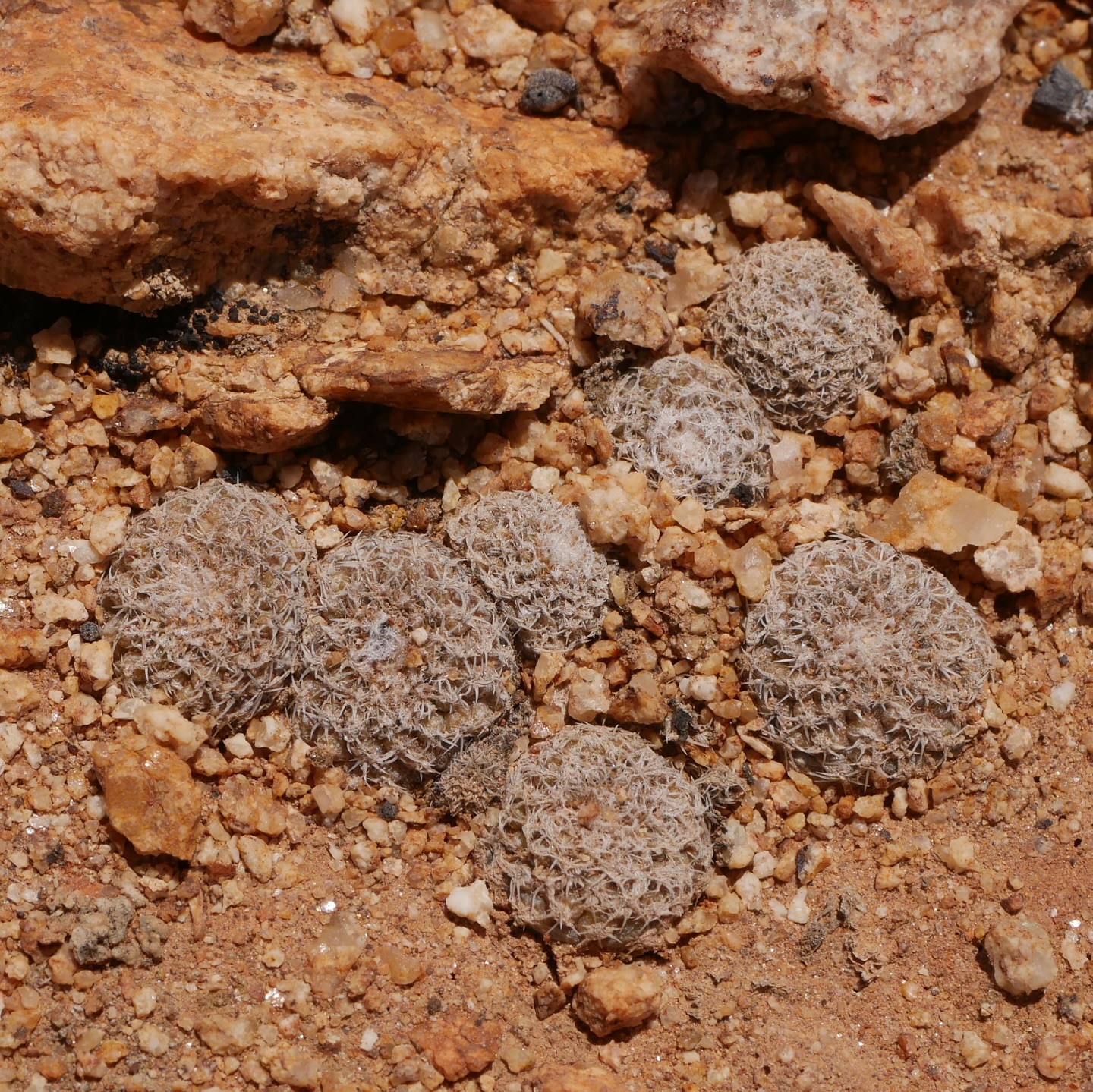
Copiapoa laui is the smallest species in the genus and phylogenetically isolated from its relatives. Its above-ground body rarely exceeds three centimeters across. Below the surface, a thick taproot anchors the plant into the gravelly substrate of the Atacama coast, holding most of its mass underground where the worst of the desert heat cannot reach it. In habitat, a mature cluster looks like a scatter of small grey pebbles sitting flush with the desert floor, each topped with a ring of fine white wool. You would walk past it without a second glance. That is the point.
The species was described by Lothar Diers in 1980 from material collected by Alfred Lau near Planta Esmeralda, a coastal mining settlement in the Antofagasta Region of northern Chile. The specific epithet honors Lau, a German-born cactus collector who spent decades working across Latin America and whose field numbers remain a standard reference in the cactus trade. Diers published the description in Kakteen und Andere Sukkulenten (volume 31, page 365), establishing the species as a distinct entity within what would later be called the hypogaea complex. That placement has been the subject of debate ever since, and the taxonomic question of whether this plant represents a full species or a subspecies of Copiapoa hypogaea has generated more nomenclatural revisions than most cacti this size have any right to.
For collectors, the appeal is obvious. This is a miniature clustering cactus with real architectural presence at a scale that fits in the palm of your hand. It flowers readily even when small, the yellow blooms disproportionately large against the tiny body. Seed grown specimens command premium prices among specialists, and documented provenance material from the Esmeralda coast is among the most sought-after Copiapoa in circulation. The species is critically endangered in the wild, with fewer than a thousand individuals estimated to remain across an area of occupancy under 20 square kilometers.
Contents
Taxonomy & Nomenclature
The taxonomic position of Copiapoa laui has been revised repeatedly since Diers’ 1980 description. The original publication in Kakteen und Andere Sukkulenten treated it as a full species within Copiapoa, based on its distinctive miniature habit, partially subterranean growth, fine spination, and restricted coastal distribution near Planta Esmeralda. That treatment held in most general references through the 1980s and 1990s.
The first significant reclassification came from Adriana Hoffmann in 1989, who reduced it to varietal rank as Copiapoa hypogaea var. laui. Graham Charles took a different approach in 2006, placing it as Copiapoa hypogaea subsp. laui in Cactaceae Systematics Initiatives. Both transfers reflected the morphological overlap between Copiapoa laui and Copiapoa hypogaea, particularly the shared subterranean growth habit, turnip-like taproot, and minute body size.
The molecular phylogenetic work of Larridon and colleagues (2015), published in the American Journal of Botany, offered a different perspective. Using three plastid DNA markers across 39 Copiapoa taxa, the study resolved Copiapoa laui as phylogenetically distant from the core of the genus. Alongside Copiapoa solaris, it occupies a basal position in the phylogeny with high evolutionary distinctiveness values. A 2024 conservation genetics study (Guerrero, Peña & Villalobo López) confirmed this pattern, finding that Copiapoa laui and Copiapoa solaris exhibit the highest evolutionary distinctiveness scores of any taxa in the genus after Copiapoa australis.
Kew’s Plants of the World Online currently accepts Copiapoa laui Diers as a distinct species, listing Copiapoa hypogaea subsp. laui (Diers) G.J.Charles and Copiapoa hypogaea var. laui (Diers) A.E.Hoffm. as synonyms. The genus name Copiapoa derives from the city of Copiapó in Chile’s Atacama Region, near where the first species of the genus were collected. The species name honors Alfred Bernhard Lau (1928–2007), a cactus field collector born in Germany who worked extensively in Mexico and South America. His field collection number FK 439 is the standard reference designation for this taxon in cultivation and seed lists.
Historical synonyms (2)
- Copiapoa hypogaea var. laui (Diers) A.E.Hoffm., 1989 heterotypic synonym
- Copiapoa hypogaea subsp. laui (Diers) G.J.Charles, 2006 heterotypic synonym
Sources: GBIF
Habitat & Native Range
Copiapoa laui is endemic to a narrow strip of the Atacama Desert coastline in northern Chile, centered on the area around Planta Esmeralda in the Antofagasta Region. The type locality sits on low coastal hills known as lomas costeras, where the terrain is flat to gently rolling and the substrate consists of coarse gravel, mineral sand, and weathered rock. The plant grows at elevations between roughly 400 and 700 meters above sea level, in the zone where Pacific fog moisture, locally called camanchaca, condenses against the coastal escarpment and provides the primary water source for vegetation.
The Atacama is the driest non-polar desert on Earth. Parts of its interior core receive virtually no measurable rainfall in any given decade. Coastal populations of Copiapoa, including Copiapoa laui, survive almost exclusively on fog moisture that rolls in from the Humboldt Current–cooled Pacific. This fog is not rain. It is a persistent, low-altitude marine layer that forms when cold ocean upwelling meets the warm coastal landmass, producing advection fog that saturates the first few hundred meters of elevation before burning off as it moves inland. For Copiapoa laui, this fog provides the only reliable moisture input throughout the year.
The species shares its habitat with several other Copiapoa taxa, including Copiapoa esmeraldana, Copiapoa grandiflora, and Copiapoa longistaminea, all of which occupy the same fog-dependent coastal belt near Esmeralda. The Guanillos valley and surrounding slopes support a community of these miniature to medium-sized Copiapoa growing in close proximity on slightly different substrate types and slope aspects. This sympatric distribution is typical of the northern Atacama fog belt, where genera and species intermingle within narrow topographic bands defined more by microclimate than by large-scale geography.
Guanacos (Lama guanicoe) have been documented digging up and consuming Copiapoa laui and Copiapoa esmeraldana in the wild, likely detecting the plants with their sense of smell rather than sight. Given the species’ small size and partially buried habit, this predation represents a meaningful additional pressure on already tiny populations. The area of occupancy for Copiapoa laui is estimated at under 20 square kilometers, with fewer than a thousand individuals remaining. No formal protected area currently covers the primary population.
Morphology
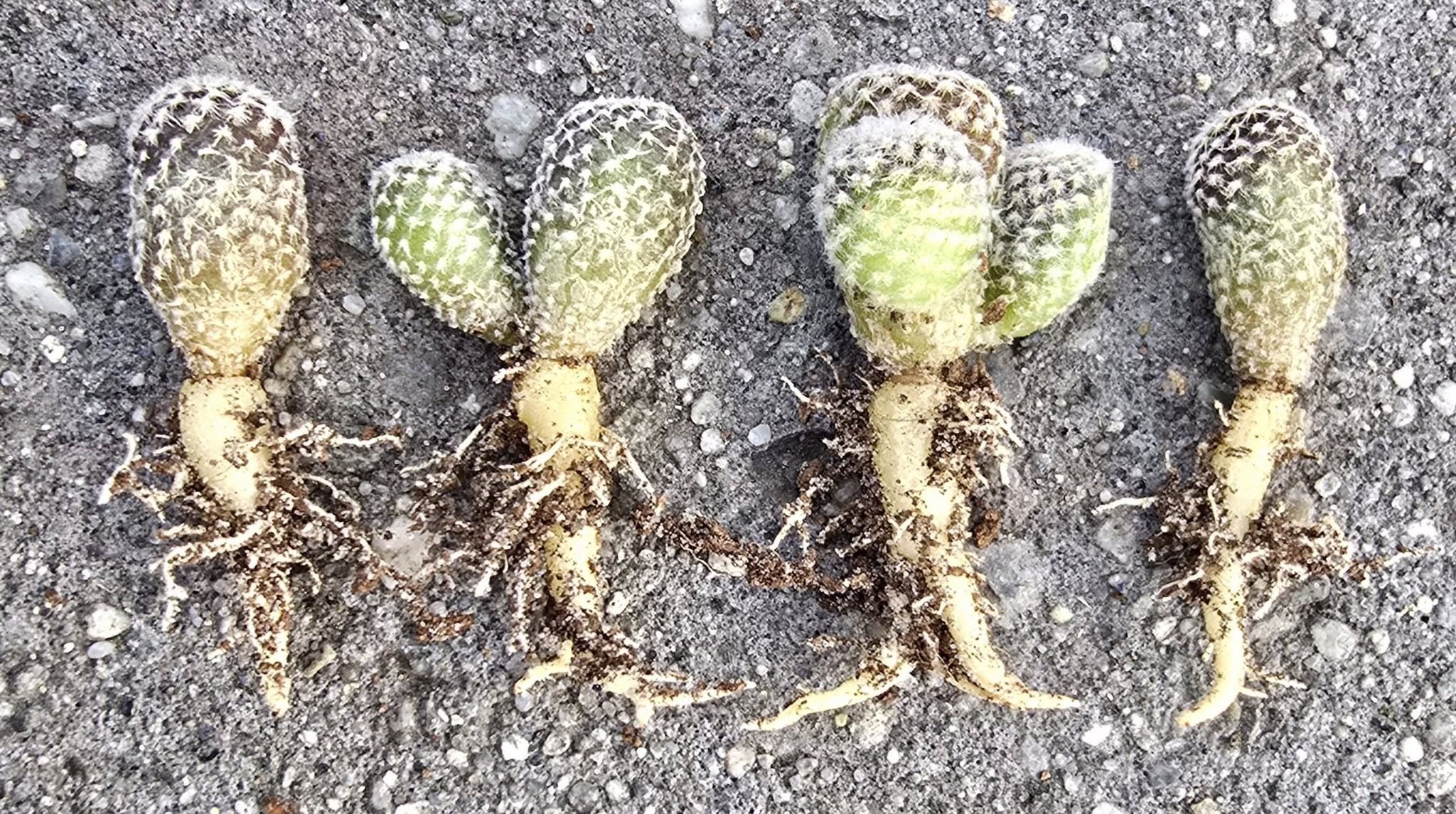
Copiapoa laui is the smallest species in the genus by a considerable margin. Individual stems measure 1 to 3 centimeters in diameter and roughly 1 to 1.5 centimeters tall above the soil surface. Below the surface, the picture changes completely. Each head connects through a narrow neck to a thickened, turnip-shaped taproot that can be several times the volume of the visible stem. This taproot is the plant’s primary water reservoir and the structural foundation that allows it to survive extended periods without fog moisture.
The epidermis ranges from clear grey to red-brown-grey, sometimes taking on a greenish cast in cultivated plants that receive more moisture and less UV stress than their wild counterparts. In habitat, the body color closely matches the surrounding gravel, and the above-ground portion sits flush with the substrate, making detection difficult even at close range. The apex is depressed and covered with whitish wool, which becomes denser and more conspicuous during flowering.
Ribs number 15 to 20 and are more or less dissolved into low, rounded tubercles arranged in vertical rows or loose spirals. This tuberculate rib structure is a distinguishing character separating Copiapoa laui from the more clearly ribbed stems of Copiapoa hypogaea. Areoles are tiny, measuring 0.7 to 1 mm in diameter and spaced roughly 2 mm apart. The spines are minimal: 4 to 7 radials, each very small and bristle-like, whitish to yellowish. Central spines are usually absent, though occasional individuals produce a single central spine similar in character to the radials.
With age and favorable conditions, Copiapoa laui clusters by offsetting from the base, eventually forming low mats of dozens of individual heads. In habitat, these clusters hug the ground and can spread to 10 centimeters or more across while remaining almost invisible from a standing height. Each offset develops a separate taproot, making division for propagation simple. The overall effect is a plant that maximizes surface contact with the substrate while minimizing exposure to aerial heat and UV radiation.
Localities & Distribution
Copiapoa laui: Known Distribution
Based on published habitat descriptions (Diers 1980; Charles 1998; Schulz & Kapitany 1996) and IUCN assessment data (Guerrero et al. 2024). Precise coordinates withheld for conservation.
Zones
Localities
All boundaries approximate. Click markers for details.
IUCN: Critically Endangered (2024) · AOO <20 km² · Est. <1,000 individuals
The distribution of Copiapoa laui is among the most restricted in the genus. All documented populations occur in a narrow band along the Atacama coast between Planta Esmeralda and the Guanillos valley in Chile’s Antofagasta Region. The area of occupancy, the total land surface actually used by the species, is estimated at under 20 square kilometers. Within that band, the plant occurs on flat to gently sloping coastal lomas at elevations of roughly 400 to 700 meters, always within the fog condensation zone.
The type locality at Planta Esmeralda is the best-documented population and the source of most cultivated material in circulation. Alfred Lau’s original collection (FK 439) was made here, and the designation “Esmeralda, Guanillos” appears on most seed list entries and provenance labels in specialist collections. The precise coordinates of wild populations are not published in the conservation literature, and this page follows that convention. The map below shows the approximate geographic extent of the known range based on published habitat descriptions and regional surveys.
Flowering & Fruit
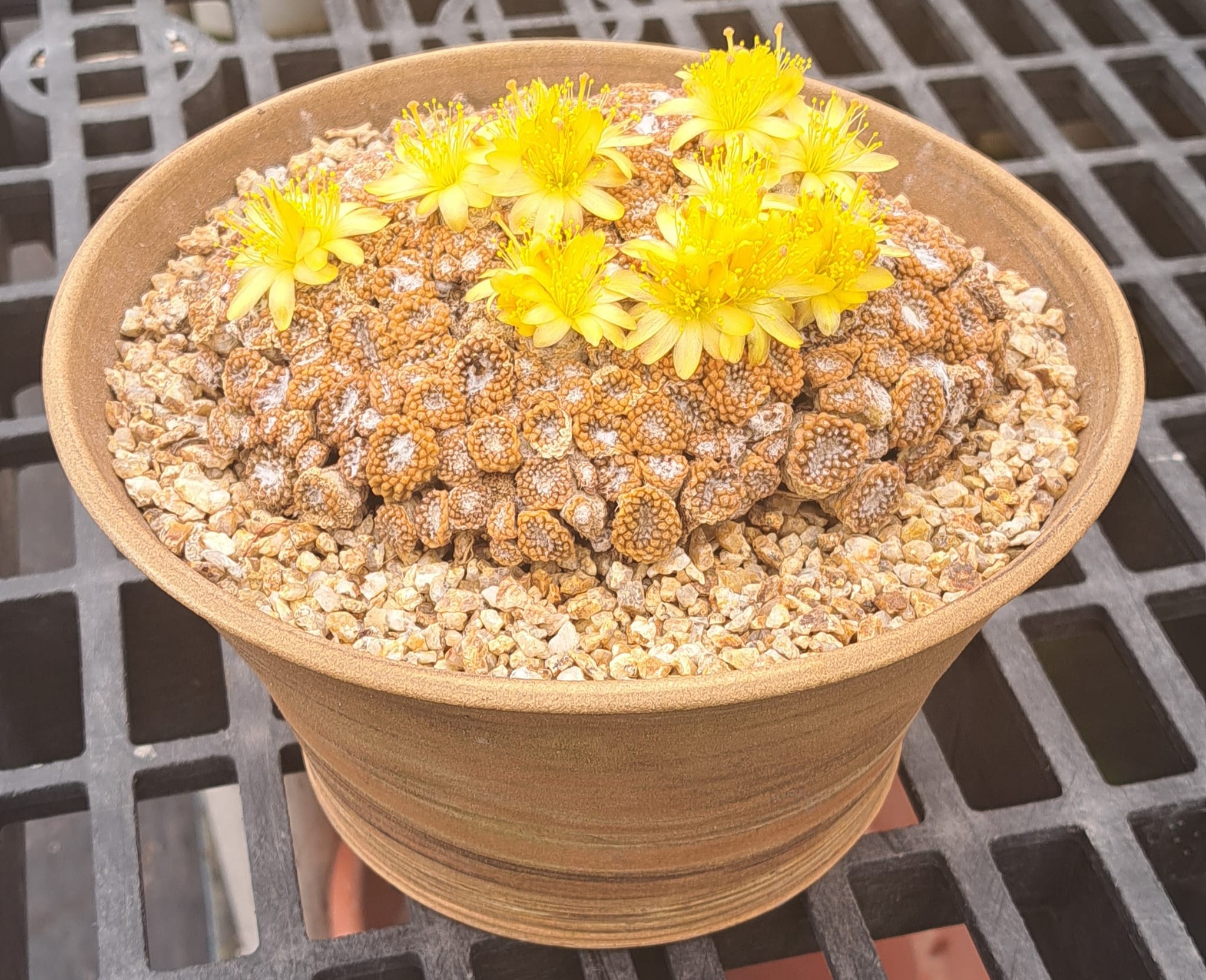
Copiapoa laui flowers freely in cultivation, and this is one of its most appealing characteristics for collectors. The flowers are yellow with reddish to pinkish-tipped petals, funnel-shaped, and measure 1.5 to 2.2 centimeters in diameter. They emerge from the woolly crown of the stem during the warmer months, typically from late spring through summer. Given the tiny size of the plant body, the flowers appear disproportionately large, and a mature cluster in full bloom presents a display that belies the miniature scale of the species.
Like all Copiapoa, the flowers are diurnal and self-sterile. Pollination in habitat is carried out by hymenoptera (bees of the genera Alloscirtetica and Centris) and small beetles (Buprestidae). In cultivation, hand pollination between genetically distinct clones is necessary to produce viable seed. The technique is standard: transfer pollen from one clone to the stigma of another using a fine brush or toothpick during the few hours the flower is fully open.
Fruit is small, globular, 3 to 5 mm across, and greenish-brown at maturity. Seeds are shiny black, measuring roughly 1 by 0.7 to 0.9 mm. In the wild, seed dispersal is primarily by ants, which carry the small seeds short distances from the parent plant. This limited dispersal radius contributes to the species’ restricted distribution and the clustered spatial structure of wild populations.
From Seedling to Specimen
Growing Copiapoa laui from seed is simple in principle and a test of patience in practice. Seeds germinate within one to two weeks at temperatures of 20–25°C on a fine, well-drained mineral substrate kept humid under a covered tray. The seedlings are among the smallest of any cactus: green specks barely visible without magnification, each already developing the rudiments of a taproot beneath the soil surface. Damping-off is the primary risk at this stage, and a fungicide treatment at sowing helps considerably.
Interactive
Seed to Specimen: 30 Years of Growth
Drag the slider to see how Copiapoa laui develops from seed to a mature cluster in cultivation. Growth is measured in decades, not seasons.
Growth through the first two years is barely perceptible. The seedling develops its taproot as a priority, investing most of its energy underground. By year three to five, the above-ground body reaches roughly 5 to 8 mm across, and the first recognizable tubercles and minute spines appear. Flowering can begin surprisingly early in cultivation, sometimes by year three or four in well-grown seedlings, though the first flowers tend to be smaller than those on mature plants.
Reaching a visually impressive cluster takes time measured in decades, not years. A ten-year-old seed grown Copiapoa laui might show a primary head of 1 to 2 centimeters with the beginnings of basal offsets. A twenty-year specimen can be a cluster of a dozen or more heads filling a small pot. Thirty-year-old plants with forty or more heads exist in European and Japanese specialist collections, and these represent the pinnacle of what seed grown cultivation can produce. The species rewards those who accept its pace rather than trying to accelerate it.
Grafting onto fast-growing rootstock (Pereskiopsis for seedlings, Hylocereus or Trichocereus for larger heads) is an option for those who want faster growth or a safety backup for rare clones. Grafted Copiapoa laui grow measurably faster and produce offsets more readily, but the resulting growth is softer, often greener, and lacks the compact density that seed grown plants develop naturally. For collectors who value form fidelity and provenance integrity, seed grown remains the standard.
Copiapoa laui care and cultivation
Copiapoa laui is among the more forgiving species in the genus for cultivation, provided the grower respects two non-negotiable requirements: sharp drainage and restrained watering. The subterranean taproot is the plant’s central organ, and any substrate that holds moisture against it for extended periods will eventually cause rot. Get the soil and watering right, and the rest falls into place.
Substrate
The substrate should be overwhelmingly mineral. The canonical ratio is 27 per cent pumice, 18 per cent lava rock, 10 per cent zeolite, 25 per cent granite grit, 5 per cent limestone chip, 10 per cent coarse silica, and 5 per cent worm castings. Lava sits higher than the genus default here because the tuberous, clump-forming root this species shares with C. hypogaea wants a deeper pot; limestone and silica stay genus-flat, with no per-species evidence behind either figure beyond the honest ceiling of an acknowledged carbonate band. The zeolite buffers pH and paces nutrients through the watering cycle. When you water, the mix should drain through the pot within seconds and be visually dry within two to three days. If it stays damp longer than that, increase the mineral fraction.
All ten Copiapoa species on this site share a genus-flat 95/5 mineral-organic cultivation mix. Limestone stays at the low end of an indeterminate carbonate band and organic at the class-prior 5 percent; neither figure is a per-species finding. The only value that varies by species is lava, sized to container depth: the tuberous-rooted trio (hypogaea, hypogaea var. barquitensis, laui) gets a deeper pot allowance than the rest of the genus.
| Species | Pumice | Lava | Zeolite | Granite | Limestone | Silica | Organic |
|---|---|---|---|---|---|---|---|
| C. laui (this page) | 27% | 18% | 10% | 25% | 5% | 10% | 5% |
| C. humilis | 33% | 12% | 10% | 25% | 5% | 10% | 5% |
| C. humilis subsp. tenuissima | 33% | 12% | 10% | 25% | 5% | 10% | 5% |
| C. solaris | 33% | 12% | 10% | 25% | 5% | 10% | 5% |
| C. cinerea | 33% | 12% | 10% | 25% | 5% | 10% | 5% |
| C. cinerea subsp. cinerea | 33% | 12% | 10% | 25% | 5% | 10% | 5% |
| C. cinerea subsp. krainziana | 33% | 12% | 10% | 25% | 5% | 10% | 5% |
| C. esmeraldana | 33% | 12% | 10% | 25% | 5% | 10% | 5% |
| C. hypogaea | 27% | 18% | 10% | 25% | 5% | 10% | 5% |
| C. hypogaea var. barquitensis | 27% | 18% | 10% | 25% | 5% | 10% | 5% |
Some growers run pure mineral substrates with zero organic component and compensate with slightly more frequent watering and regular fertilization. This approach works well in humid climates where ambient moisture already provides baseline humidity. In arid climates like inland Southern California, a small organic component helps buffer the root zone against total desiccation between waterings.
Watering
Water sparingly during the growing season (spring and summer) and keep the plant essentially dry through winter dormancy. A reasonable schedule in a temperate greenhouse is a thorough soak every 10 to 14 days during active growth, adjusting based on pot size, ambient humidity, and how quickly the substrate dries. The best signal to water is the plant itself: when the heads begin to look slightly deflated or the skin wrinkles faintly between the tubercles, the plant is drawing on its taproot reserves and will benefit from a drink.
Overwatering is the most common cause of loss with this species. The taproot is adapted to store water through extended dry periods, and keeping it continuously moist overwhelms that adaptation. Underwatering is far safer than overwatering. When in doubt, wait another few days. During winter, provide no water at all if temperatures drop below 10°C. The plant will shrink slightly and may retract further into the substrate, which is normal dormancy behavior.
Light
Copiapoa laui performs best in bright, direct light with good air movement. In habitat it receives intense Atacama sun moderated by coastal fog, and replicating something close to that balance produces the most compact, well-colored growth. Full sun exposure in a greenhouse or outdoor Mediterranean-climate garden is ideal. In climates with sustained summer temperatures above 40°C, some afternoon shade or a shade cloth rated at 20–30% prevents surface scorching without compromising form.
Insufficient light produces etiolated growth: the heads elongate, turn greener, and lose the compact, squat profile that makes the species visually distinctive. If growing under artificial light, aim for 2000+ µmol integrated daily light, positioned close enough that the plant maintains its natural proportions.
Temperature
Like most coastal Atacama Copiapoa, this species tolerates heat well but is sensitive to prolonged cold and frost. The practical minimum for safe overwintering is 5°C with completely dry soil. Brief dips to near 0°C are survivable if the plant is bone dry, but sustained cold combined with any moisture will rot the taproot. Summer heat above 45°C is tolerated in a well-ventilated greenhouse; the species handles high temperatures better than most miniature cacti.
Containers
Select a pot that accommodates the taproot with a modest margin. Underpotting restricts root development and slows growth further. Overpotting holds excess moisture around the root zone. For a single head or small cluster, a pot roughly 2 centimeters wider than the cluster on each side works well. Depth matters more than width: the taproot needs room to grow downward. Unglazed clay pots offer better evaporation than plastic, which is an advantage in humid environments but can dry too aggressively in desert conditions.
Distinguishing Similar Species
The species most commonly confused with Copiapoa laui are other members of the hypogaea complex and miniature Copiapoa from the northern Atacama. The following table highlights the key distinguishing characters a collector should examine when evaluating an unlabeled specimen or verifying provenance claims.
| Character | Copiapoa laui | Copiapoa hypogaea | Copiapoa esmeraldana | Copiapoa humilis |
|---|---|---|---|---|
| Stem diameter | 1–3 cm | 3–4 cm | 3.5–7 cm | 2–5 cm |
| Rib structure | Dissolved into low tubercles | Tuberculate, more defined | Distinct ribs, 10–17 | Distinct ribs, 10–14 |
| Spination | 4–7 minute bristles; centrals absent | Stronger; centrals often present | Short, dark; centrals present | Variable; often short & dark |
| Taproot | Prominent, turnip-shaped | Prominent, napiform | Tuberous | Fibrous to slightly thickened |
| Epidermis color | Grey to red-brown-grey | Dark brown to olive | Green to brownish | Grey-green to brownish |
| Distribution | Esmeralda coast | Chañaral area | Esmeralda/Pan de Azúcar | Northern Atacama, wider range |
Frequently asked questions
How difficult is Copiapoa laui to grow?
How is Copiapoa laui propagated from seed?
Is Copiapoa laui legal to own?
Where does Copiapoa laui grow in the wild?
When does Copiapoa laui flower?
Related Taxa in the Genus
Copiapoa humilisA miniature clustering species from the northern Atacama, variable across its range and frequently confused with members of the hypogaea complex. Several named subspecies reflect geographic variation within a single broadly distributed lineage.Copiapoa humilis subsp. tenuissimaThe most threatened population within the humilis complex, restricted to fewer than 800 individuals with an area of occupancy under 10 square kilometers. No in-situ protection currently covers its range.Copiapoa solarisThe sun cactus of Antofagasta, a cliff-growing species with dense white wool and among the highest evolutionary distinctiveness values in the genus. Critically Endangered, with road construction documented as an active threat.Copiapoa cinereaThe silver-coated emblem of the Atacama fog zone. Mature specimens can live over 200 years, their stems covered in a reflective farina that reduces water loss and defines the visual identity of the genus.Copiapoa cinerea subsp. krainzianaWhite-spined and confined to a single known colony in the San Ramón Valley near Taltal. Collector demand has been documented as a direct extinction driver for this Critically Endangered population.Copiapoa cinerea subsp. cinereaThe classic silver form found around Taltal and the coastal fog belt. The most available of the cinerea group in cultivation and an excellent introduction to the genus for new collectors.Copiapoa esmeraldanaA neighbor of Copiapoa laui on the Esmeraldas coast, with the best remaining habitat condition of any Copiapoa. Its range is extremely narrow, with perhaps 250 to 500 individuals documented.Copiapoa hypogaeaA partially subterranean species from the Chañaral area sharing the underground growth habit with Copiapoa laui. Larger stems, stronger spination, and a broader distribution separate it from its smaller relative.Copiapoa hypogaea var. barquitensisA distinct variety from Barquito characterized by a smooth epidermis. Sought by specialist collectors and the most commonly encountered form of the hypogaea complex in commercial cultivation.
Sources & References
Diers, L. (1980). Copiapoa laui. Kakteen und Andere Sukkulenten 31: 362–365. · Hoffmann, A.E. (1989). Cactáceas en la Flora Silvestre de Chile. Ediciones Fundación Claudio Gay. · Charles, G.J. (1998). Copiapoa. The Cactus File Handbook 4. Cirio Publishing. · Charles, G.J. (2006). New combinations in Copiapoa. Cactaceae Systematics Initiatives 21: 10. · Anderson, E.F. (2001). The Cactus Family. Timber Press. · Hunt, D., Taylor, N. & Charles, G. (2006). The New Cactus Lexicon. dh books. · Schulz, R. & Kapitany, A. (1996). Copiapoa in Their Environment. Schulz Publishing. · Larridon, I. et al. (2015). An integrative approach to understanding the evolution and diversity of Copiapoa (Cactaceae). American Journal of Botany 102: 1506–1520. · Guerrero, P.C., Peña, C. & Villalobo López, A. (2024). Copiapoa laui. The IUCN Red List of Threatened Species 2024: e.T212489791A212489935. · Guerrero, P.C. et al. (2024). Effects of trade and poaching pressure on extinction risk for cacti in the Atacama Desert. Conservation Biology 38: e14353. · IUCN SSC Cactus and Succulent Plant Specialist Group (2025). Action Plan for the Integrated Conservation of the Genus Copiapoa.