Encyclopedia · Ariocarpus
Ariocarpus retusus
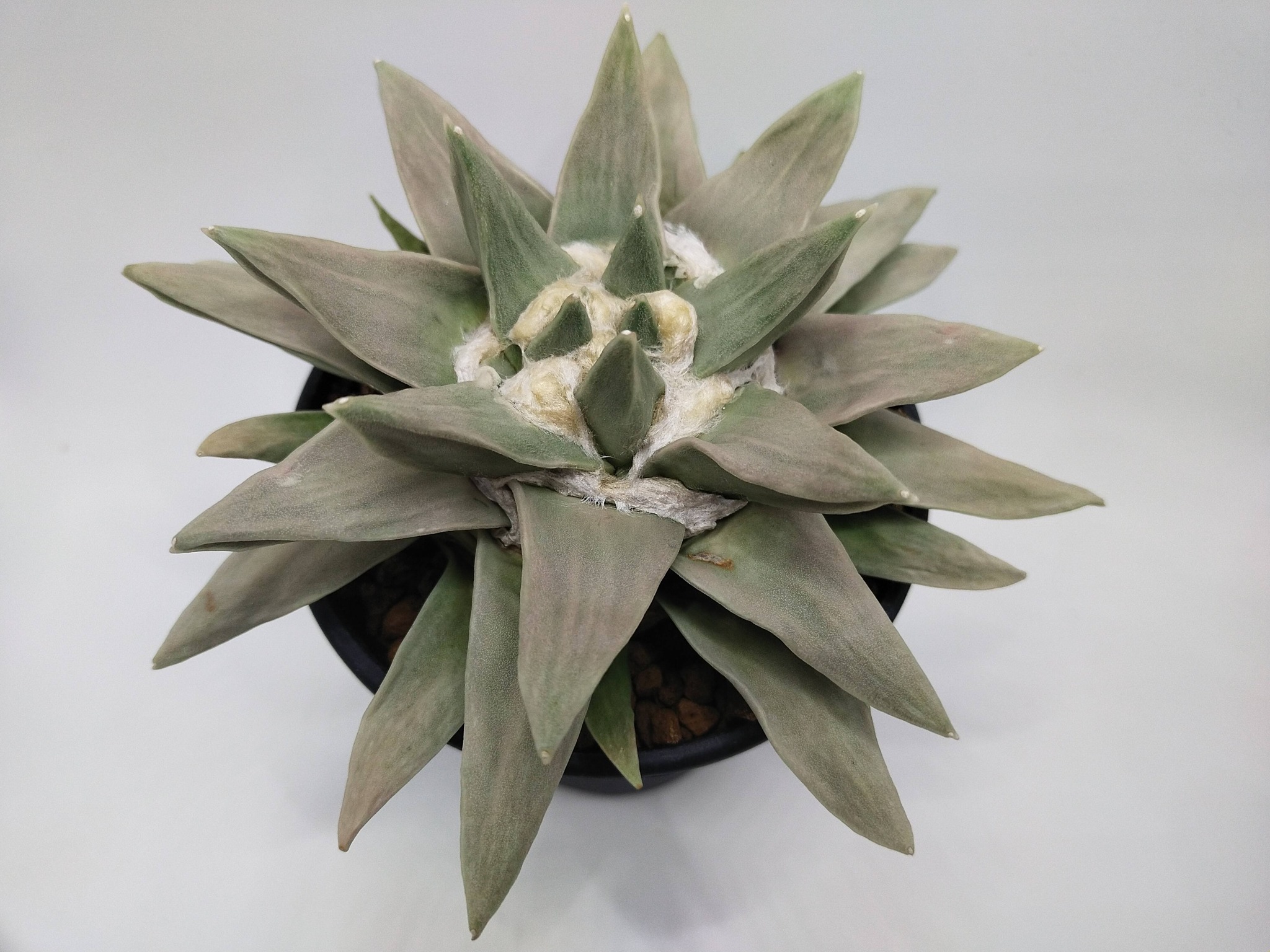
Star Rock · False Peyote · Chautle · Peyote Cimarón
Of the six Ariocarpus species, retusus is the one that surprises people most. It is the largest and fastest-growing in the genus. By genus standards it is also the most forgiving in cultivation, yet none of that makes it ordinary. Spread across five Mexican states from the limestone plateaus of Coahuila south into the Zacatecan highlands, it wears a dozen different faces depending on where it grows. The triangular tubercles, the deep central wool, the white to faintly pink flowers that open in autumn: the plant is unmistakably itself regardless of the population. This page covers the species, its widely cultivated subspecies furfuraceus, and the crested form f. cristata that collectors spend years tracking down.
Contents
Taxonomy and nomenclature
Ariocarpus retusus is not just another species in the genus. It is the species that founded it. When Belgian botanist Michael Joseph François Scheidweiler described this plant in 1838, he simultaneously erected the genus Ariocarpus, basing his account on specimens that Henri Galeotti had collected in Mexico and sent to European gardens. The genus name joins the Greek aria (an oak type) and carpos (fruit), referencing the acorn-like appearance of the berries. The specific epithet retusus comes from the Latin for “blunted,” alluding to the slightly rounded tubercle tips in the type material.
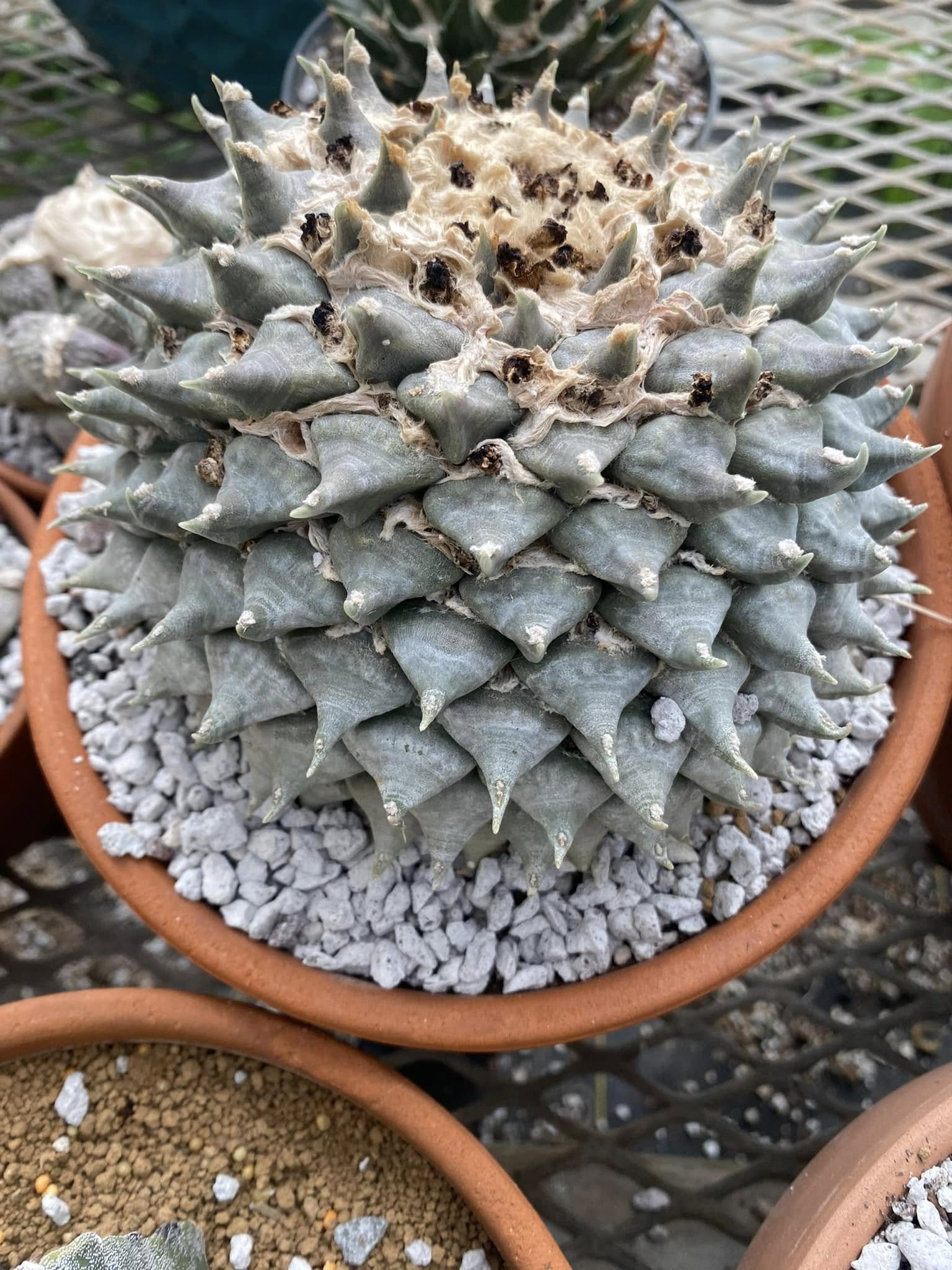
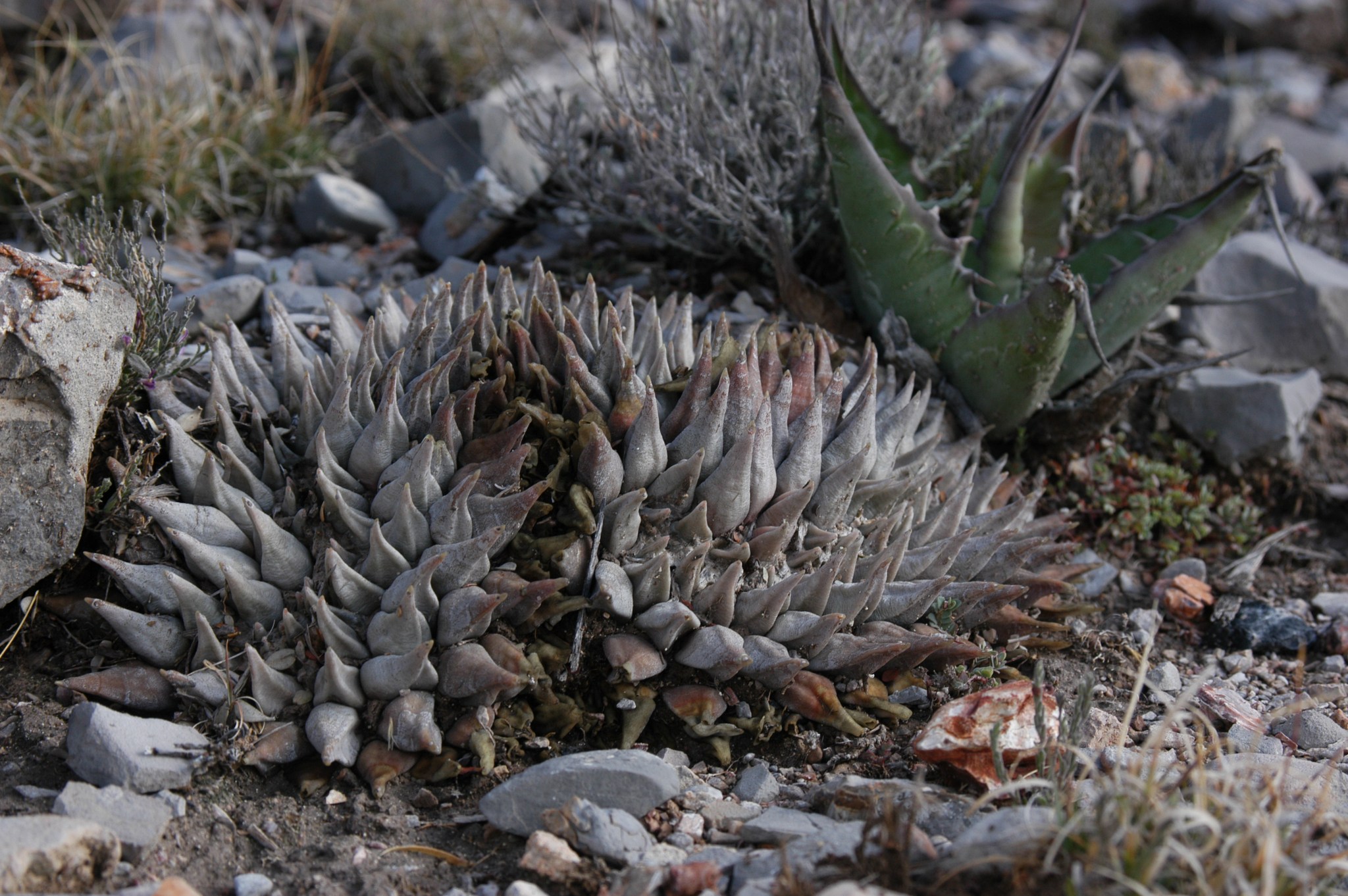
The woolly areole at the apex of each tubercle is diagnostic for the species. Spines are absent in adult plants.
That same year, Charles Lemaire independently described the same plant as Anhalonium prismaticum, and his name dominated the literature for decades because Lemaire’s authority as a cactus specialist outweighed Scheidweiler’s in the eyes of contemporary botanists. By the early 1900s, priority rules restored Scheidweiler’s epithet. The species since accumulated a remarkable list of synonyms (Ariocarpus furfuraceus, Ariocarpus trigonus, Ariocarpus elongatus, Anhalonium areolosum, among others), reflecting both the breadth of variation across the range and the enthusiasm of 19th-century collectors who described geographically distinct populations as separate species.
The definitive modern treatment is Anderson and Fitz Maurice’s 1997 revision in Haseltonia Vol. 5, which consolidates the sprawling synonymy and recognises infraspecific taxa within the species aggregate. Kew’s Plants of the World Online currently treats most former segregates as synonyms of Ariocarpus retusus, though collector and horticultural literature continues to use subspecies designations for practical distinction.
Habitat and distribution
Ariocarpus retusus has the widest natural range of any species in the genus, spanning five Mexican states: Coahuila, Nuevo León, San Luis Potosí, Tamaulipas, and Zacatecas. That breadth, stretching from high limestone plateaus above Saltillo east toward the Sierra Madre foothills and south into the Zacatecan highlands, explains both the plant’s morphological variability and its resilience compared to more narrowly distributed congeners like A. scaphirostris or A. bravoanus.
Populations occur between approximately 1,300 and 2,000 metres elevation on pale, sun-bleached Cretaceous limestone: gravelly colluvium on exposed hillsides, ridgetops, and plateau edges where drainage is absolute and organic matter nearly absent. The original type description placed the locality “near the purple rocks of San Luis Potosí at 6,500 to 7,000 feet elevation,” a reference to the highly distinctive lilac-hued limestone outcrops that local guides still use as landmarks.
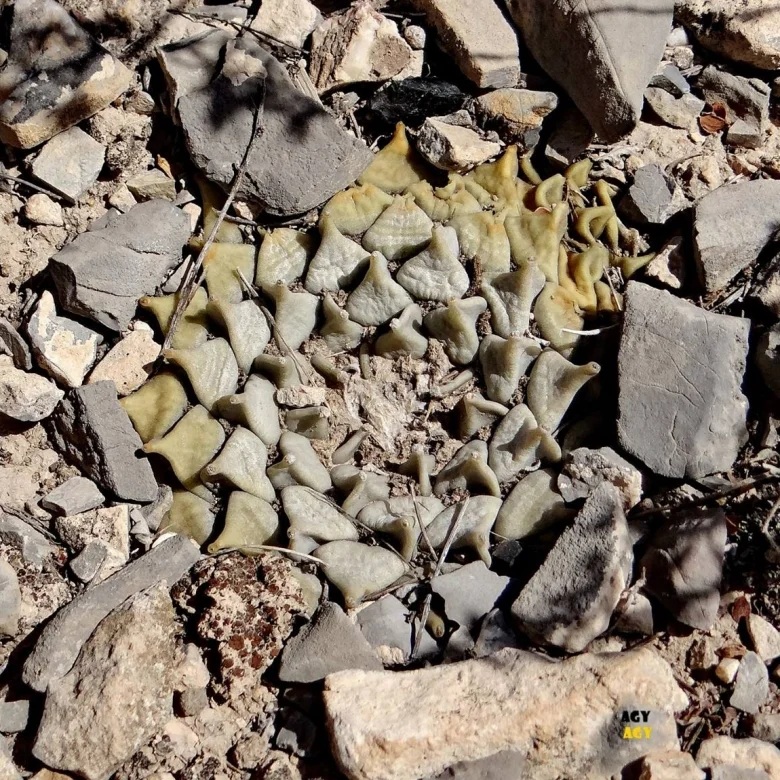
The vegetation community is Chihuahuan Desert scrub: sparse and wind-beaten, dominated by Larrea tridentata, Agave lechuguilla, yuccas, and a supporting cast of Echinocereus, Mammillaria, and Ferocactus. Within this community retusus behaves as a geophyte, sitting flush with or just barely above the soil surface. Its grey-green body matches the surrounding rock so closely that plants are almost impossible to spot until you are standing over them.
Morphology
Stem and overall form
The stem is flattened-globose, solitary, and can grow to 12–25 cm tall and up to 30 cm in diameter in very old specimens, making retusus the largest species in the genus by a considerable margin. Colour ranges from grey-green through blue-green to an almost yellow-green in some Tamaulipas populations, varying by population, growing season, and sun exposure. In severe drought the plant contracts, pulling the stem partially below soil level and presenting only the tubercle tips to the sky.
Tubercles
The tubercles are erect, pyramidal, and more or less triangular in cross-section, measuring 1.5–4 cm long and 1–3.5 cm wide, with a sharply pointed or slightly blunted tip. Each tubercle carries a woolly areole near its apex, set slightly back from the tip rather than at the point itself, producing dense white to buff wool that accumulates in the centre of the plant as a continuous mass. This central wool insulates the growing point and likely channels dew toward the root zone during arid-season nights. Spines are absent in adult plants; seedlings of 1–2 cm diameter occasionally show vestigial spines that disappear within the first two to three years.
Flowers and fruit
Flowers emerge from the central wool in autumn, typically October into November, coinciding with shortening days rather than a specific rainfall event. They are diurnal, 2–5 cm in diameter when fully open, white to pale pink with a satiny texture and faint sweet scent. Pollination requires cross-fertilisation between separate plants; self-pollination does not set viable seed. Fruit is a small fleshy berry containing 10–50 brown-black seeds, ripening slowly over several weeks after fertilisation.
Root system
Below the visible stem, retusus develops a massive carrot-like taproot that can equal or exceed the aerial stem in volume. This root serves as the primary water and carbohydrate reserve through dry seasons lasting six to nine months. In cultivation, accommodating this taproot requires a deep pot. A shallow pan may look proportionally correct from above but will constrain root growth and reduce long-term vigour.
Ariocarpus retusus subsp. furfuraceus
Ariocarpus retusus subsp. furfuraceus (S. Watson) Lüthy is the most widely cultivated form in the retusus aggregate and one of the most immediately recognisable. Where the nominal subspecies carries unequal, pyramidal tubercles that tilt upward, furfuraceus presents equilaterally triangular tubercles, all three sides roughly equal in length, arranged in a tight radial rosette that gives the plant an almost star-shaped outline from above.
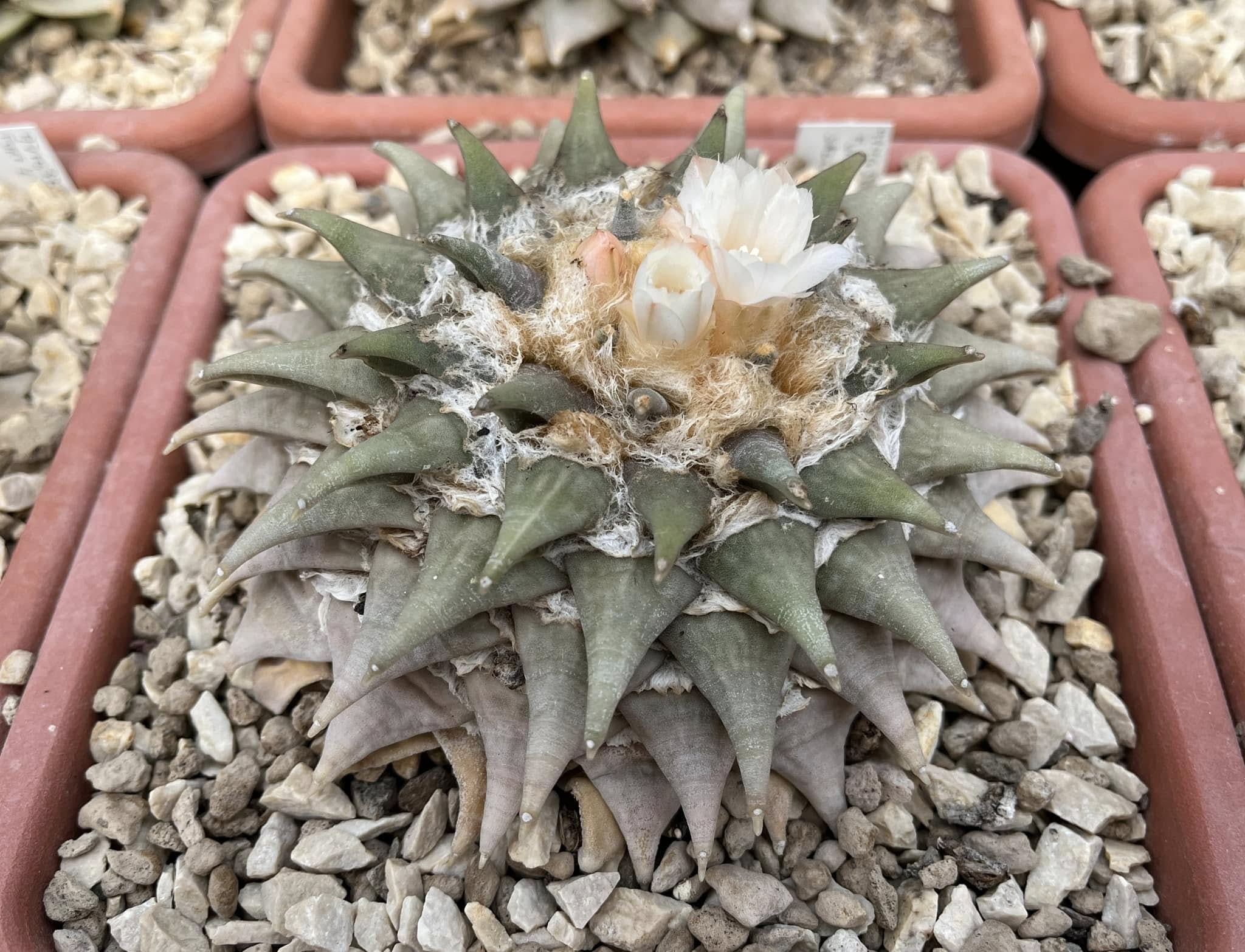
The equilateral triangular cross-section of each tubercle produces a more open, star-like rosette compared to the nominal form.
Sereno Watson first described these plants as Mammillaria furfuracea in 1891, noting the notably woolly areoles that gave the subspecies its name: furfuraceus from the Latin for “bran-like.” Anderson and Fitz Maurice’s 1997 revision concluded the equilateral-tubercle character was insufficient for species separation, as all other morphological features are shared with retusus and intermediates occur where populations overlap. Lüthy’s 1999 combination placed it at subspecies rank. Kew’s POWO currently treats it as a synonym of A. retusus, though the subspecies designation remains in wide use among collectors and specialists.
For cultivation purposes the two forms are completely interchangeable. The primary reason to grow furfuraceus alongside subsp. retusus is visual contrast: side by side, the difference in tubercle geometry is immediately apparent and makes for a genuinely interesting comparative display.
| Character | subsp. retusus | subsp. furfuraceus |
|---|---|---|
| Tubercle cross-section | Unequally triangular; wider than tall | Equilaterally triangular; all three sides equal |
| Tubercle orientation | Erect, strongly upward-pointing | Spreading, slightly more open rosette |
| Central wool | Dense continuous mass | Dense; often visually heavier at areoles |
| Flower colour | White to pale pink | White to pale cream-pink (near-identical) |
| Distribution | Throughout range | Coahuila, SLP, Tamaulipas, Zacatecas |
| Cultivation | Easiest in genus | Identical requirements |
Ariocarpus retusus f. cristata
A cultivated crest. The elongated meristem produces a fan shape that slowly folds back on itself over decades.
The crested form of Ariocarpus retusus is among the most coveted aberrant forms in the genus. Cresting occurs when the single apical meristem, normally a tight circular point, elongates laterally into a ridge. Instead of producing concentric rings of tubercles around a central point, the plant lays down tubercles along an ever-lengthening fan that eventually folds back on itself into a contorted, brain-like cushion. Very old specimens can reach 70 cm across; most cultivated plants reach 15–30 cm over a collector’s lifetime.
The mutation is spontaneous and not reliably inherited. Most f. cristata plants in cultivation arose spontaneously from seed batches or were propagated vegetatively from such plants. A 20 cm crest may represent three or more decades of growth. The handful of large, well-developed specimens that come to market, typically through estate sales or collector dispersals, change hands quickly.
The expanded, folded meristematic tissue creates deep crevices that trap moisture. Unlike a normal retusus whose compact growing point dries quickly, a crested plant can hold moisture in its folds for days after watering. The practical fix: raise the plant slightly above the pot rim, use an inorganic grit collar around the base, never overhead-water, and be especially conservative with watering in autumn and spring when temperature swings promote condensation. All other cultivation requirements mirror the parent species exactly.
Cultivation
Soil and container
The substrate must drain instantly and hold almost no moisture. A reliable mix: 60% coarse inorganic grit (pumice, perlite, or lava at 3–6 mm) plus 40% lean mineral loam or cactus compost. Avoid peat or coir. The taproot needs depth; a pot at least as deep as the stem’s diameter is a reasonable starting point. Terracotta regulates moisture better than plastic; a drainage hole is non-negotiable.
Light
Ariocarpus retusus handles intense direct sun in habitat, but plants moved from lower-light conditions must be acclimatised gradually over 3–4 weeks. Outdoors in warm climates, 50–70% of full summer sun keeps colour rich and reduces stress. Under grow lights, 12 hours per day through spring and summer dropping to 10 hours in autumn replicates the day-length cue that triggers flowering.
Watering
Water thoroughly when the soil has been completely dry for at least a week during the growing season (spring through early autumn), then allow full drying before the next watering, roughly every 2–4 weeks in summer depending on heat and pot size. From November through February, withhold water entirely unless tubercles are visibly shrivelling and losing dimension. Rain protection in winter is important: cold wet dormancy is a reliable path to root rot.
Temperature and feeding
A winter minimum of 5°C with completely dry soil is a safe lower limit. Brief dips below 0°C are tolerated if bone dry; sustained frost kills the plant. Feed once or twice during the growing season with a very dilute cactus fertiliser (quarter-strength, ~5-10-5 NPK with calcium). No feeding from September through April.
Seedlings
Germination from fresh seed is reliable. Ariocarpus retusus is one of the more obliging species in the genus to raise. Sow in spring on a mineral surface, maintain at 22–26°C with high surface humidity for 2–3 weeks. Germination typically occurs within 10–20 days. Transplant into deep individual pots by the end of the first growing season to avoid disturbing the developing taproot later.
Conservation status
Ariocarpus retusus is listed on CITES Appendix I and protected under Mexico’s NOM-059-SEMARNAT. It holds the most secure conservation position in the genus due to its wider distribution and greater population density. The IUCN assesses it as Vulnerable. That qualified optimism comes with caveats: a 2011 analysis published in the Revista Mexicana de Biodiversidad found that none of the known populations occur within designated Natural Protected Areas; all are on private or communal land without formal protection. Population surveys at historically productive localities have documented declining densities where livestock grazing and agricultural conversion have altered the habitat. Legal trade in cultivated-source plants requires CITES certification; absence of documentation is a reliable signal of problematic provenance.
Related taxa in this group
- Scheidweiler, M.J.F. (1838). Ariocarpus retusus. Bulletin de l’Académie Royale des Sciences et Belles-lettres de Bruxelles 5: 492.
- Anderson, E.F. & Fitz Maurice, W.A. (1997). Ariocarpus revisited. Haseltonia 5: 1–20.
- Lüthy, J.M. (1999). New combinations in Ariocarpus. Kakteen und Andere Sukkulenten 50: 278.
- Kew Science / POWO (2025). Ariocarpus retusus Scheidw. Plants of the World Online. Royal Botanic Gardens, Kew.
- González-Espinosa, M. et al. (2011). Distribución geográfica del género Ariocarpus. Revista Mexicana de Biodiversidad 82(1): 957–970.
- Watson, S. (1891). Mammillaria furfuracea. Proc. Am. Acad. Arts & Sciences 26: 154.