Astrophytum asterias
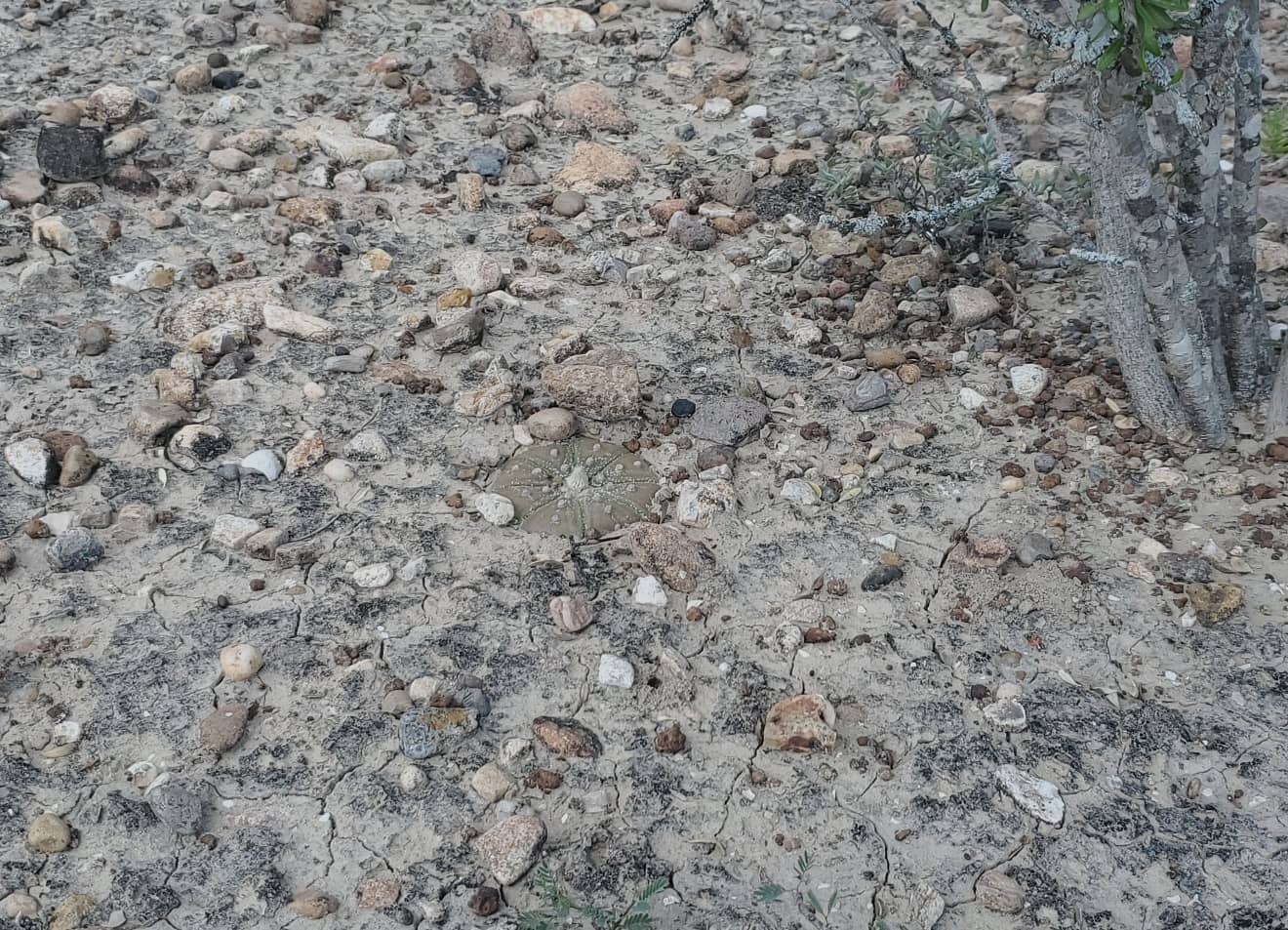
Astrophytum asterias is the flattest member of the genus, a spineless eight-ribbed disc that in habitat contracts below the soil surface during drought and becomes nearly invisible. Karwinski collected the first material in Tamaulipas around 1843 and the plant flowered at Munich in 1844; Zuccarini described it as Echinocactus asterias in 1845, and Lemaire transferred it to his new genus Astrophytum in 1868.
The body rarely exceeds 7 cm tall on a 5 to 16 cm disc, with eight flat ribs dividing the surface into triangular sections and a scatter of white woolly trichomes across the grey-green epidermis. Flowers are yellow with an orange-red throat, apical, and open only by day. These flecking and flower characters are the first thing collectors read on a plant, and they are also the characters that do the most work in separating asterias from A. coahuilense at small sizes and from A. myriostigma at any stage.
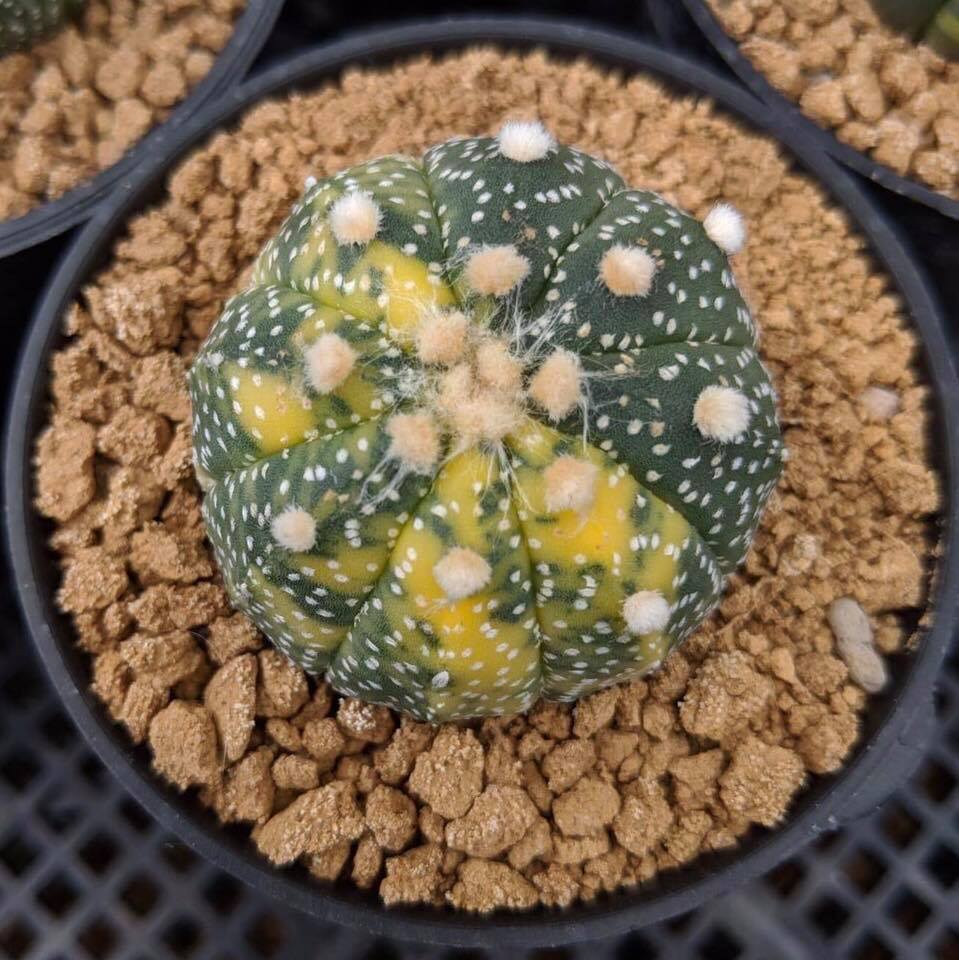
Two horticultural selections built from this species drive most of the collector interest: A. asterias f. nudum strips the trichome flecks and exposes a clean dark green epidermis; A. asterias f. variegata layers chimeric yellow and cream sectors across that body. Neither selection is accepted at infraspecific rank by POWO, but both carry stable identities in the Japanese breeding tradition and the global collector market.
The wild picture is much narrower than the cultivated one. Current confirmed range is a single Texas population in Starr County together with a handful of Tamaulipan localities, and the plant has been poached hard enough that CITES uplisted it from Appendix II to Appendix I in 1987. Texas surveys place the US population at fewer than 4,000 individuals across three metapopulations (Cactus Conservation Institute; Terry et al. 2007), and historical populations in Nuevo León, Hidalgo County, and Cameron County are either extirpated or unconfirmed.
Astrophytum asterias quick reference
A Tamaulipan thornscrub geophyte with a turnip-like taproot, eight flat ribs, and no spines at any age. Values calibrated for seed grown plants in cultivation, drawn from llifle, the Henry Shaw Cactus and Succulent Society genus note, and specialist grower cultivation diaries.
Taxonomy & nomenclature
The basionym is Echinocactus asterias Zuccarini (1845), published in the Abhandlungen der mathematisch-physikalischen Classe of the Bavarian Academy from material Baron Wilhelm von Karwinski sent to Munich in the early 1840s. Lemaire transferred the species to his new genus Astrophytum in Les Cactées (Paris 1868, p. 50), establishing the current combination Astrophytum asterias (Zucc.) Lem. Kew POWO accepts this combination without qualification.
The genus sits in tribe Cacteae of subfamily Cactoideae. Molecular work by Vazquez-Lobo et al. (2015) using rbcL, trnL-trnF and trnK-matK markers places A. asterias in a clade with A. capricorne, A. coahuilense, and A. caput-medusae, separate from the clade containing A. myriostigma and A. ornatum. The precise branching inside the asterias clade remains debated; treat A. coahuilense as sister or near-sister rather than forcing a strict pair without the full phylogram.
Synonymy is long. Frič published a run of horticultural varieties in the 1920s (magnipunctatum, multipunctatum, nudicarpa, roseiflorum, seminudum) and Itô added var. nudum and var. pubescente in 1981. POWO treats all infraspecific names as synonyms of the species, so the horticultural labels carry collector weight rather than botanical rank.
Habitat
A. asterias is a Tamaulipan thornscrub species, restricted in the USA to the Lower Rio Grande Valley and in Mexico to the drier calcareous flats of Tamaulipas with historical reports from Nuevo León. Texas Parks and Wildlife characterises the substrate as gravelly, somewhat salty, clay or loam soils; llifle records the same gravelly alluvial loams and saline or calcareous clays. Parent rock is limestone or calcareous alluvium and soil pH runs alkaline.
The plant grows flush with the soil surface between brushy thorn shrubs, using the semi-protected pockets under mesquite (Prosopis), blackbrush (Acacia rigidula), and associates like Opuntia leptocaulis, Mammillaria heyderi, Thelocactus schwarzii, and Homalocephala texensis. The turnip-like taproot contracts during drought and the whole body retracts below the surface, which makes the species close to invisible in dry years and is a real field-survey problem.
Rainfall is summer-dominant and erratic, averaging roughly 380 to 760 mm across the range, with Texas sites at the drier end and Tamaulipan sites higher. Winter is mild and dry with occasional freezes on the Texas side. Elevation runs 50 to 200 m overall (llifle), with the Texas populations at the lower end, 20 to 100 m, per TPWD.
Morphology
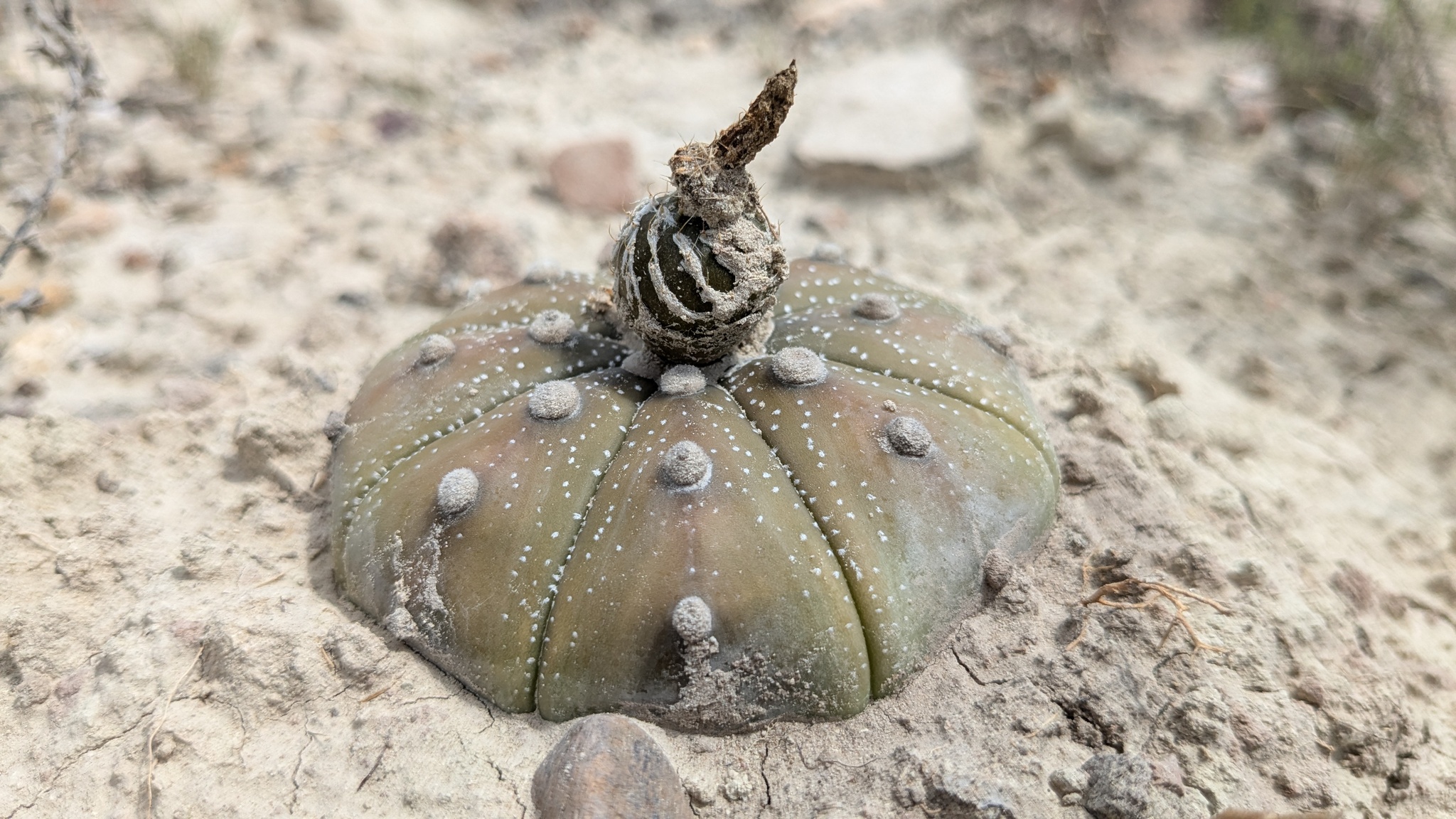
Body depressed-globose to truly disc-flat, 2 to 7 cm tall by 5 to 16 cm diameter, occasionally 20 cm on old cultivated plants. Wild plants stay flatter; cultivation sometimes pushes them taller and more domed. The eight flat ribs are remarkably stable in habitat (llifle explicitly: “very stable in wild specimens, independent of the age of the plant”), with rare natural variation to seven or nine to ten (Anderson, Arias Montes, & Taylor 1994 via secondary citation). Cultivated selections sit anywhere from four to thirteen ribs.
Areoles are prominent, round, 3 to 12 mm in diameter and spaced 3 to 10 mm apart, running in a clean line up the centre of each rib. They start white to cream and grey with age. No spines appear beyond the first few weeks of seedling life, and the shed seedling spines mark the genus character. The epidermis between the areoles carries scattered tufts of white trichomes: the source of the sand-dollar common name, and the trait that the nudum form removes.
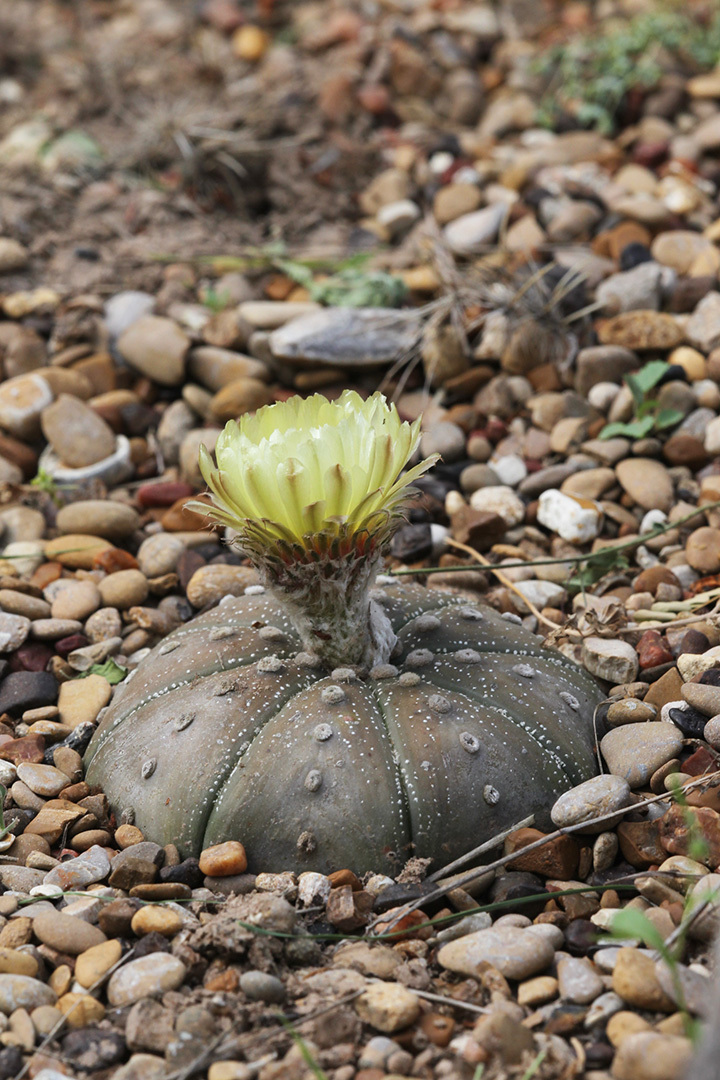
Flowers are apical, solitary, diurnal, 3 to 5 cm long and 5 to 7 cm across, with long slightly spatulate inner tepals carrying narrow orange-red bases that fade to clear yellow in the upper portion. Stamens are orange at the bases and yellow above; the stigma carries ten to twelve yellowish-green lobes. The ovary and floral tube are densely clothed in thin, bristle-like, black-tipped scales which give the bud its woolly appearance. Peak flowering runs March to June in habitat, with sporadic opening through warmer months in cultivation when water is available.
Fruit is oval to round, 1.5 to 2 cm long, green turning pinkish or grey-red at maturity, densely scaly and dehiscent at the base. Basal dehiscence pairs asterias with A. capricorne and A. coahuilense and separates it cleanly from A. myriostigma, whose fruit bursts apically in a star pattern. Seeds are 2 mm long by 3 mm broad, black, glossy, and helmet-shaped with the edge rolled toward a sunken prominent hilum: the diagnostic genus character (Sánchez-Salas et al. 2012). The seed tegument holds air chambers that let the seed float, consistent with flood-pulse dispersal through the thornscrub.
Locality detail
Confirmed current range is a single Starr County, Texas population on private land and scattered Tamaulipan localities. Historical Texas counties (Hidalgo, Cameron, Jim Hogg, Zapata) retain herbarium records but no current confirmed occurrence outside Starr; the 2003 Recovery Plan notes Zapata as marginal. The Nuevo León population at Lucio Blanco is probably extirpated. Map markers sit at county and municipality centroids; sharper coordinates are deliberately withheld because A. asterias is among the most poached cacti on earth and CITES Appendix I listing (1987) directly reflects that pressure.
Cultivation
Cultivation turns on two facts: the species evolved on alkaline, gravelly, fast-draining Tamaulipan soils, and it is a geophyte that spends most of its dry season partially buried. Matching those conditions is the whole game.
Substrate
A mineral, sharply draining mix with a small amount of organic matter. The approximate shape: 50 per cent pumice as the primary drainage component, 25 to 30 per cent low-organic succulent mineral base, and 20 to 25 per cent additional drainage from granite grit, decomposed granite, or lava rock. A small limestone chip or crushed oyster shell addition matches the calcareous native substrate. Skip the usual lightweight drainage shortcuts; pumice and granite grit carry the load cleanly. The Henry Shaw Cactus and Succulent Society genus note confirms the fast-draining principle at genus level; llifle gives the species-specific “mineral well permeable substratum with little organic matter” direction.
Watering and light
Water only when substrate is fully dry, from March through October. The rhythm is two to four weeks in summer depending on heat and container, then completely dry from October onward. Wet-cold rot at the root neck is the primary kill vector: the plant survives -5°C dry but fails at 4°C wet. A star-contracted body (ribs prominent, disc flatter than normal) is the plant asking for water in summer; do not read it as a distress signal in winter.
Full sun in habitat, but cultivation practice in temperate climates splits. Strong light (six hours direct daily, south-facing minimum) is required; above 35°C, afternoon shade prevents corking and bleaching. llifle notes the epidermis colour runs richer and darker under light shade, which is also what the Henry Shaw CSS article describes for wild plants growing under nurse shrubs. Mild coastal climates handle full sun year-round without acclimation drift.
Propagation and sourcing
Seeds germinate readily, 2 to 5 days at 25 to 30°C in bright indirect light at high humidity. Fresh seed reaches over 80 per cent germination; year-old seed drops. Seed grown plants typically flower at 4 to 7 years on 5 to 8 cm discs, with some growers reporting buds on well-fed 6 cm plants at 4. Grafted stock onto Hylocereus, Pereskiopsis, or Myrtillocactus flowers at 2 to 3 years but settles into a taller, more domed body than the seed grown norm. Hylocereus stocks are not permanent; the scion usually declines after three years, and degrafting or replacement onto Myrtillocactus is the longer-term path.
Source documented nursery stock only. CITES Appendix I protection covers wild specimens; artificially propagated plants from registered nurseries are legal under Article VII(4) with appropriate certificates, and that is the single clean paper trail for any plant in private hands.
Comparison
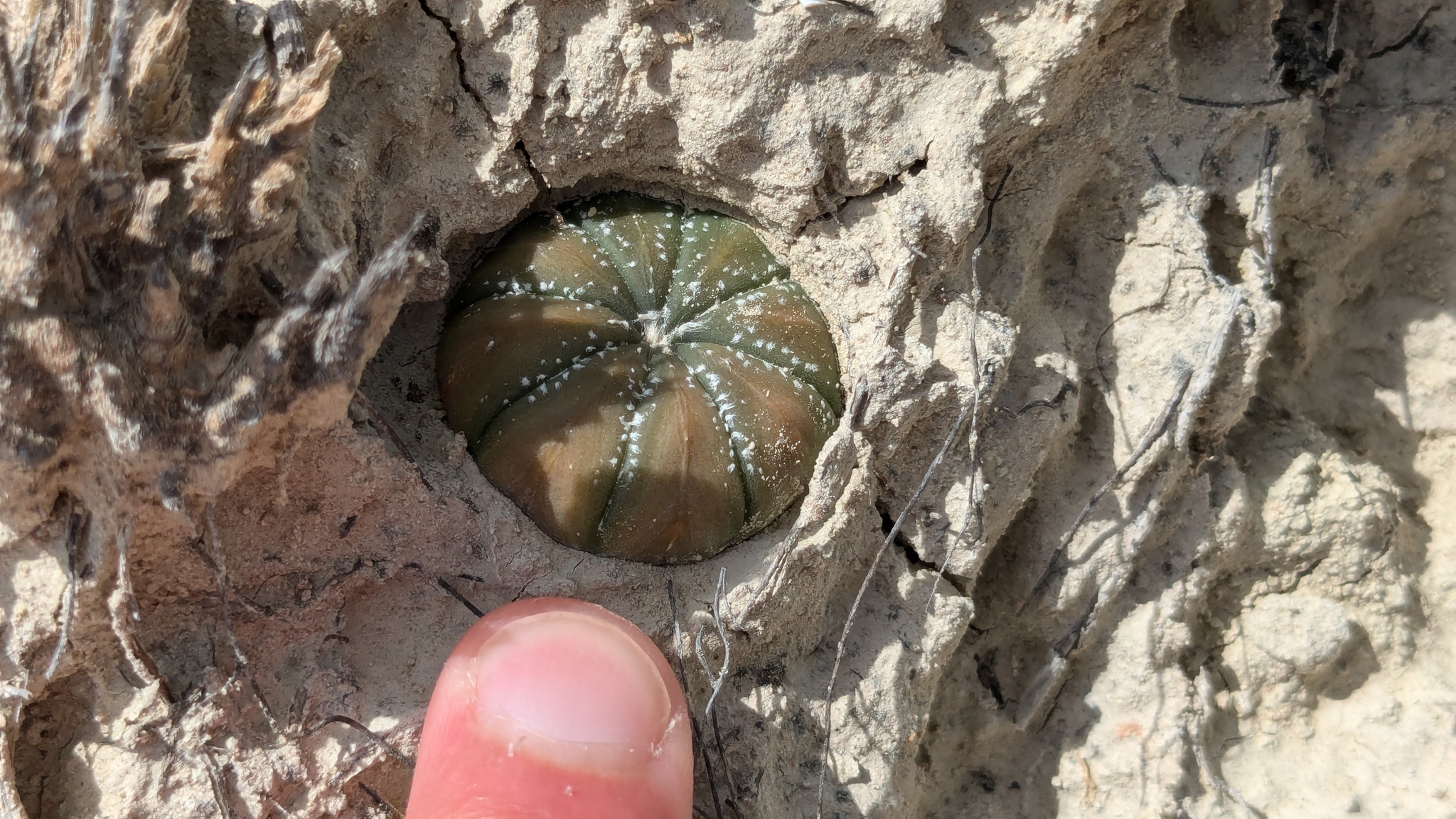
The most frequent identification problem is between A. asterias and A. coahuilense. Both are spineless, flecked, and carry yellow flowers with a red throat. At disc sizes below 4 cm the two species can be near-impossible to separate on body characters alone, and the Vazquez-Lobo phylogeny places both in the same clade. Rib count is the first cue (asterias eight, coahuilense five), and elevation-plus-locality is the most reliable provenance character: asterias is a 50 to 200 m Tamaulipan plant, coahuilense sits at 1,100 to 1,600 m on the calcareous uplands of southwest Coahuila and Durango.
A. myriostigma confuses some beginners at small sizes because both species carry white flecks on a ribbed body, but the separation is clean once the flowers open. A. myriostigma has no red throat, its fruit dehisces apically in a star pattern rather than basally, and the body turns columnar with age rather than holding the flat disc habit. A. caput-medusae does not enter the comparison set because its snake-like tubercles look nothing like an asterias disc.
A lower-stakes confusion happens in the field: Lophophora williamsii shares parts of the same south Texas and Tamaulipan thornscrub, and inexperienced peyote harvesters have accidentally taken asterias (Terry et al. 2007). The characters that separate them instantly are the eight sharp ribs, the woolly white flecks, and the yellow flower of asterias versus the bluish-green body, indistinct ribs, and pink flowers of Lophophora. This confusion is genuine enough to rank as an additional conservation threat.
Frequently asked questions
How do you tell Astrophytum asterias apart from A. coahuilense?
The two species are the closest lookalikes in the genus. Drag the slider to flip between them, then work down the character table. Rib count and flower-throat colour are the fastest reads; elevation-plus-locality is the most reliable provenance character.
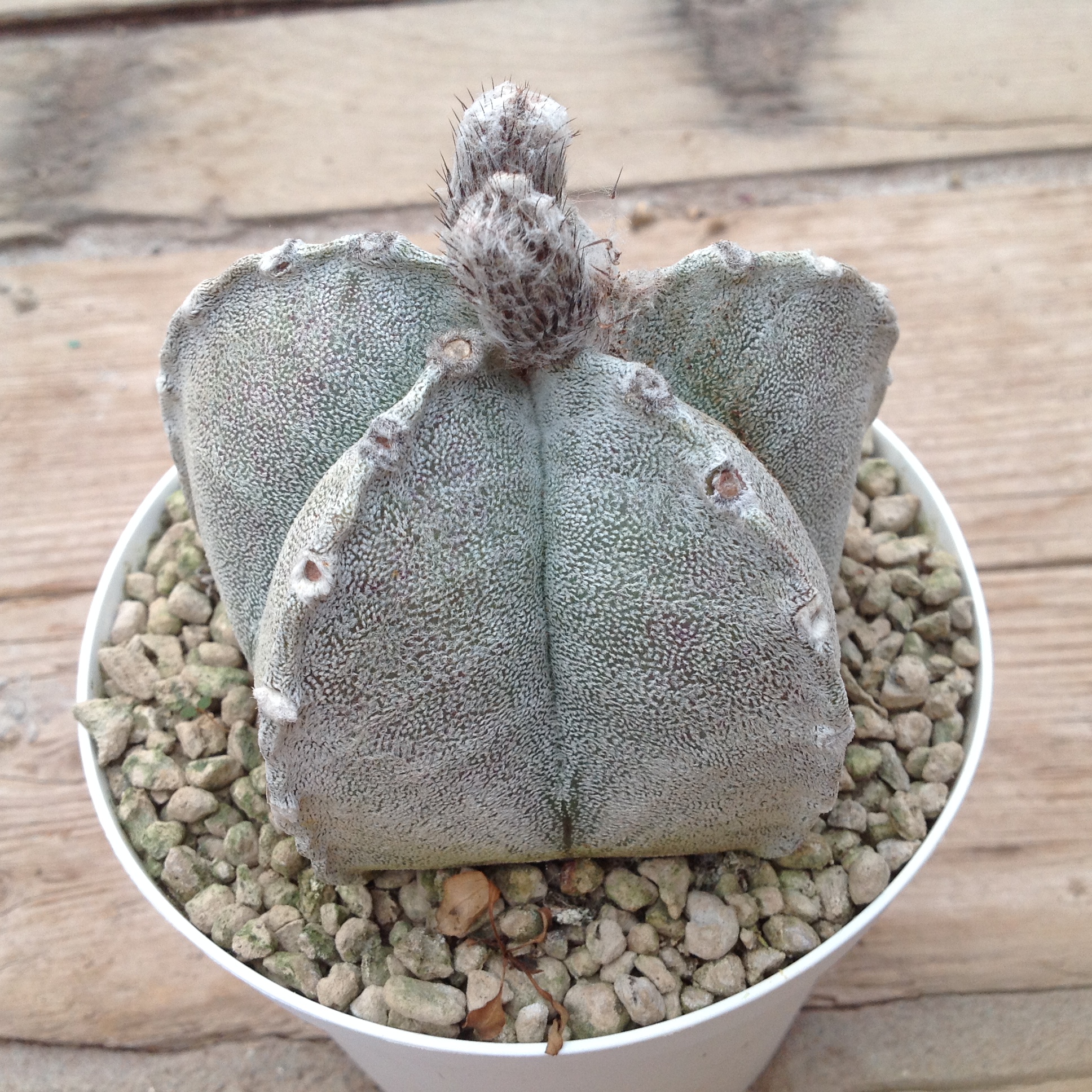
Rib count is the quickest diagnostic on a vegetative plant; flower-throat colour is the fastest when flowers are present. Provenance data (elevation, locality) is the most reliable single character when available.
Is it legal to own Astrophytum asterias?
Yes, when the plant is nursery-propagated. A. asterias is CITES Appendix I and US ESA Endangered, which prohibits commercial trade in wild-collected plants. Artificially propagated stock from a registered nursery is legal under CITES Article VII(4) with appropriate certificates, and private ownership of legally documented nursery plants is not restricted under the ESA. Buy only from sellers who document seed-grown nursery origin.
Why is Astrophytum asterias so endangered?
Four pressures compound. The wild range is very small, restricted to a single confirmed Texas population and a handful of Tamaulipan localities. The plant is an obligate outcrosser, so pollinator decline in Diadasia rinconis drops fruit set from about 89 per cent under hand-outcrossing to 18 per cent in the wild. Habitat loss to citrus, row crops, and brush management continues on both sides of the border. And accidental collection during peyote harvests adds an unquantified annual loss that Terry et al. (2007) called potentially comparable to the entire Texas population.
How fast does Astrophytum asterias grow, and when does it flower?
Slowly. Seed grown plants reach 5 to 8 cm diameter and begin flowering at 4 to 7 years; each flower lasts 1 to 2 days. Habitat peak bloom is March to June, with sporadic opening through warmer months in cultivation when the plant has water. Grafted stock onto Hylocereus, Pereskiopsis, or Myrtillocactus flowers in 2 to 3 years but settles into a taller, more domed body than seed grown plants.
Is Astrophytum asterias hard to grow?
Moderately. The cultivation problem is dryness rather than temperature or light: the plant tolerates -5°C dry and six hours of direct sun without fuss, but wet cold at the root neck kills it inside a few days. Winter bone-dry, mineral substrate, and a deep enough pot for the taproot solve the main failure mode. Once those are in place, asterias is more forgiving than many Tamaulipan endemics.
Can Astrophytum asterias be grown from seed?
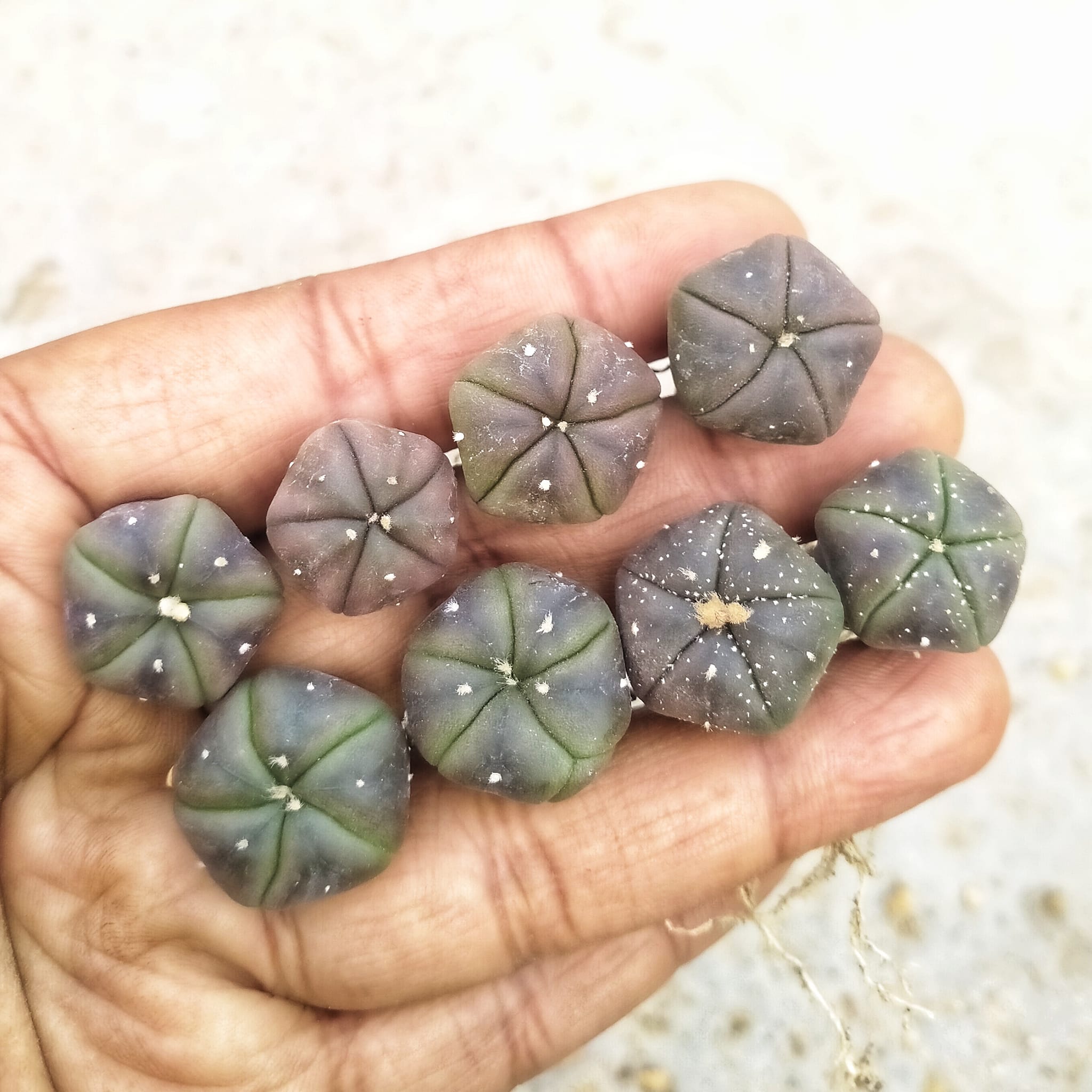
Yes. Seeds germinate in 2 to 5 days at 25 to 30°C in bright indirect light at high humidity, with fresh seed reaching over 80 per cent germination. The work is in the following years, not the first week; plants need slow, even conditions through five or more seasons before they flower, with careful acclimation as seedlings dislike direct sun until established.
Sources & further reading
Zuccarini, Abhandlungen math.-phys. Cl. Koenigl. Bayer. Akad. Wiss. 4(2): 13 (1845) · Lemaire, Les Cactées, Paris, p. 50 (1868) · Kew POWO, Astrophytum asterias (Zucc.) Lem. (2024) · IPNI record 128907-1 · Hernández et al., IUCN Red List assessment 2017 (T40961A121438670) · USFWS, Star Cactus Recovery Plan (2003) and ECOS species profile · CITES Appendix I listing, effective 22 October 1987 · Vazquez-Lobo et al., Systematic Botany 40(4): 1022 (2015) · Strong & Williamson, Southwestern Naturalist 52(3): 341 (2007) · Blair & Williamson, Southwestern Naturalist 53(4): 423 (2008) · Martínez-Ávalos et al., Journal of Arid Environments 71(2): 250 (2007) · Sánchez-Salas et al., Flora 207(10): 707 (2012) · Terry, Price & Poole, USFS RMRS-P-48CD: 115 (2007) · Henry Shaw Cactus and Succulent Society, genus notes (2019) · Texas Parks and Wildlife Dept., star cactus profile · Cactus Conservation Institute, Astrophytum research page · llifle Encyclopedia of Living Forms, A. asterias and A. coahuilense entries · NOM-059-SEMARNAT-2010 (DOF, México)