Astrophytum asterias f. variegata
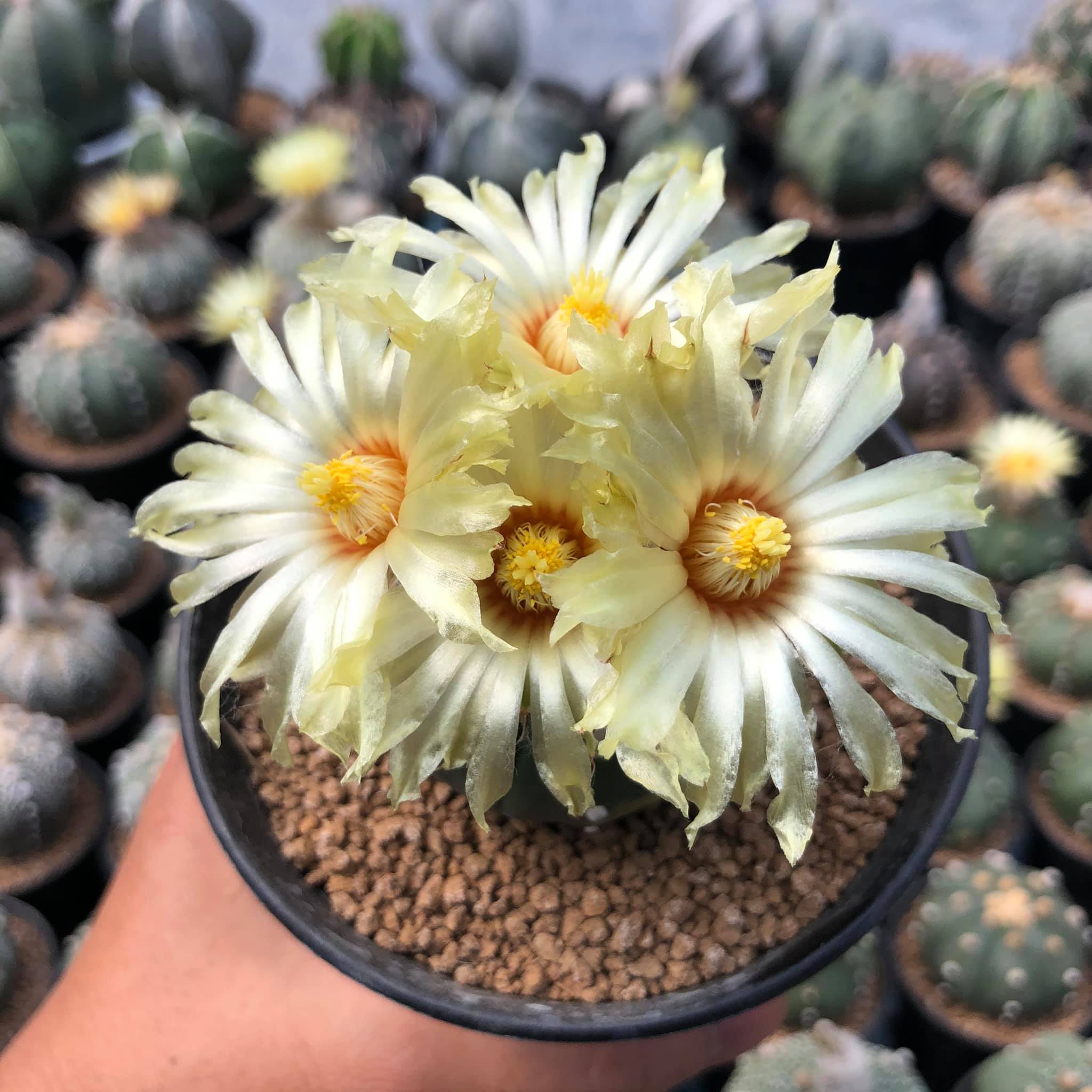
Astrophytum asterias f. variegata is the chimeric variegated selection of the Tamaulipan star cactus: the standard eight-ribbed spineless disc of the parent species overlaid with sectors of yellow, cream, orange, or pink chlorophyll-deficient tissue. Sector arrangement varies from a single wedge to clean ribbon bands to marbled mixing, and the same plant can shift its pattern across growth cycles. It is the visual opposite of f. nudum, which strips the epidermis to clean dark green; variegata layers extra colour on top of the standard flecked body.
Taxonomic standing is thin. POWO accepts no infraspecific taxa under A. asterias, and IPNI does not index f. variegata as a validly published botanical name. Under the International Code of Nomenclature for Cultivated Plants, a stable variegated selection maintained by vegetative propagation qualifies as a cultivar (A. asterias ‘Nisiki’ in the Japanese convention) rather than a forma. The page uses f. variegata because that is the universal collector label and matches the site’s URL slug.
Variegation is a chimeric chlorophyll mutation at the shoot apical meristem, not a Mendelian-inherited trait. Seeds from a variegated parent produce mostly green offspring; a small percentage are variegated because cactus meristems are anomalously large and chimeric sectors sometimes enter seed-forming tissue, but that is a low-frequency anomaly rather than a reliable propagation method. Stable cultivar lines are maintained vegetatively and by selecting the best seedlings out of each batch, overwhelmingly in the Japanese tradition. Stacked trait layers (kabuto body form, nudum epidermis, kikko tuberculation, ooibo enlarged areoles) combine with variegation freely, and the Ruri Kabuto Nisiki intersection sits at the top of the collector market.
Astrophytum asterias f. variegata quick reference
A chimeric variegated selection of the Tamaulipan star cactus. Values reflect the form-specific adjustments required by chlorophyll-deficient sectors: more shade, a tighter cold floor, and often graft support. Calibrated for seed grown plants in cultivation from llifle, Giromagi, and the Henry Shaw Cactus and Succulent Society variegated-cacti notes.
Taxonomy & nomenclature
POWO (Kew) accepts no infraspecific taxa under Astrophytum asterias; IPNI does not index f. variegata as a validly published name. The designation circulates universally in horticultural literature (Sadovsky & Schütz 1979, llifle, cactus-art.biz, Japanese cultivar registries) where it has practical utility for documenting a reproducible phenotype, but it has no botanical standing as an accepted rank.
Under the International Code of Nomenclature for Cultivated Plants, a stable variegated selection maintained vegetatively is more correctly a cultivar: Astrophytum asterias ‘Nisiki’ in the Japanese convention, with related cultivar designations for kabuto-nishiki, ruri-kabuto-nishiki, and other trait stackings. The f. variegata rank is a morphological shorthand rather than a taxonomic entity. The page uses it because it matches the market vocabulary collectors already know.
Variegation biology
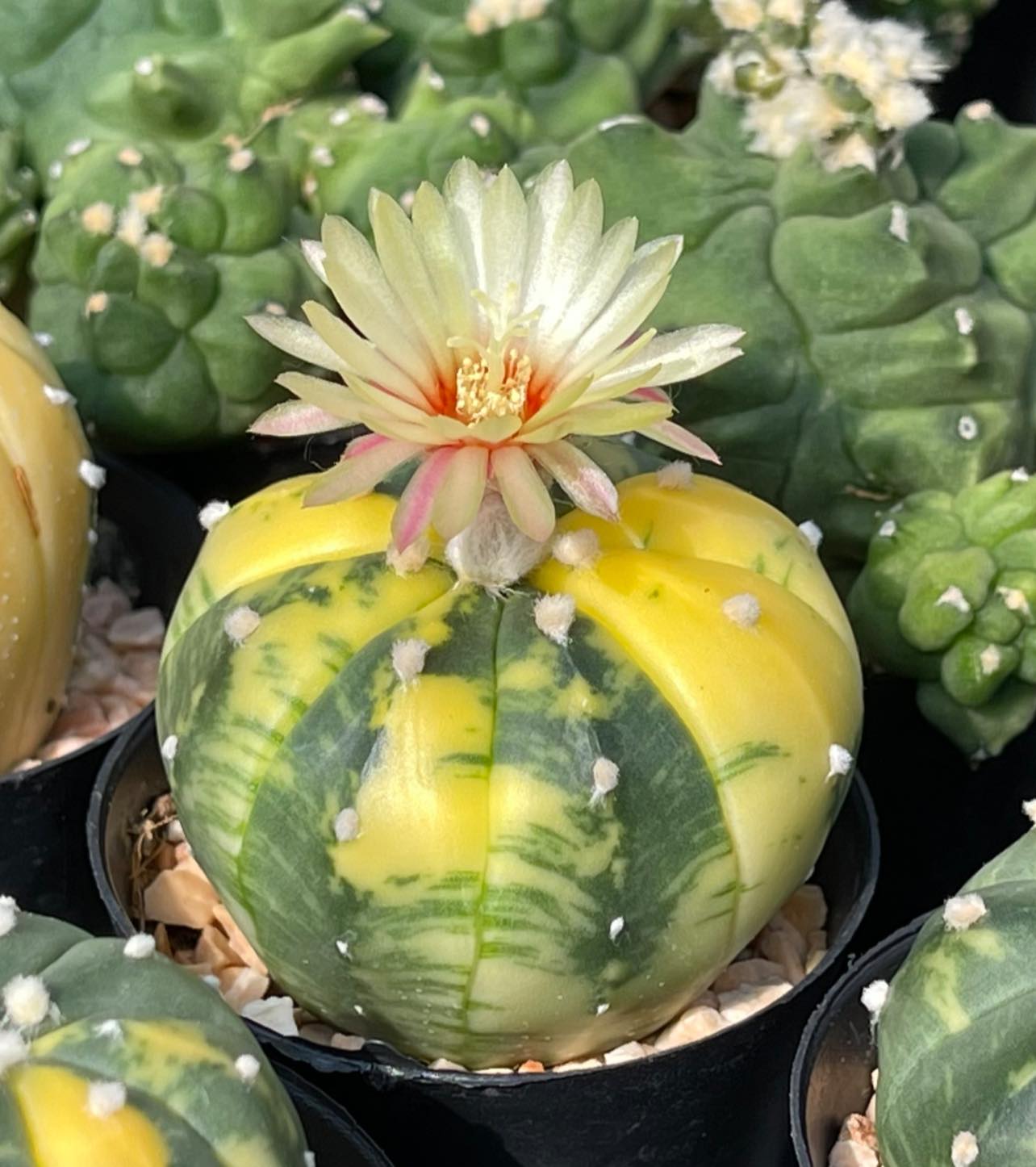
Chimeric chlorophyll variegation in A. asterias is a somatic mutation at the shoot apical meristem, in which one or more cell layers (L1, L2, L3 in cactus meristems) lose the ability to synthesise chlorophyll. Tissue descending from the mutated layer shows the sector colour; tissue from unaffected layers stays green. Carotenoid pigments produce yellow and orange sectors; betalains produce orange-red and pink. The mutation is not Mendelian: genetic information for variegation sits in tissue origin rather than in inheritable allele frequencies.
Cactus meristems are anomalously large, tens of thousands of cells compared to the hundreds found in most dicot meristems. This scale has two practical consequences. Periclinal chimeras (an entire tissue layer mutated across the full meristem) produce stable ribbon and marbled patterns that persist through growth. Sectorial chimeras (a wedge of the meristem mutated) produce sharper sector boundaries but are less stable; the boundary can shift with each growth cycle, and reversion to all-green or shift toward all-yellow both occur. The same meristem scale also allows a small proportion of seedlings from a variegated parent to express variegation, which is why seed from nishiki plants is not worthless for propagation even though most progeny will be green.
Sector types and stability
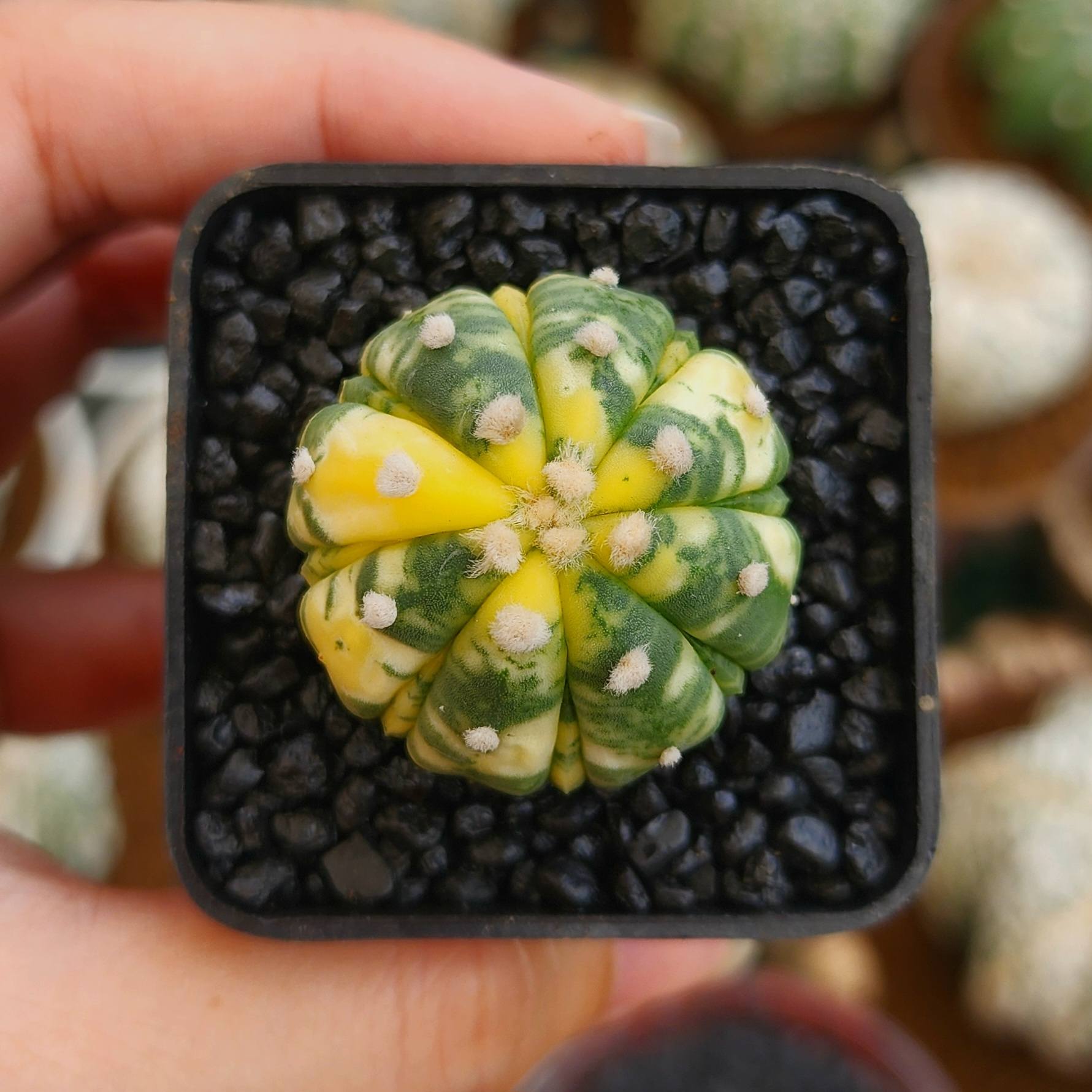
Sector patterns in cultivated variegated asterias fall into a small number of recognisable types:
- Full sector: one or more wedge-shaped chlorophyll-free zones running from areole line to crown; clean sector boundary.
- Ribbon: a continuous longitudinal band running down one or more ribs.
- Marbled: irregular diffuse mixing of green and yellow; periclinal in origin and more stable than sectorial.
- Half-and-half: approximately equal green and yellow divisions; visually striking and relatively uncommon.
- Full-yellow (f. aurea): entire body chlorophyll-free. Cannot photosynthesise enough sugar to sustain itself and must be grafted; distinct from f. variegata which retains green.
Pattern stability varies. Reversion to all-green is the most common shift over time because green tissue is metabolically superior and tends to outcompete chlorophyll-deficient cells at the meristem; a reverted plant is healthy but has lost its commercial identity. Shift toward all-yellow is less common but more dangerous, because a plant that becomes predominantly chlorophyll-free on its own tissue risks starvation unless grafted in time. llifle notes for the yellow variegatum entry: “the extent and nature of the variegation can vary, and sometimes the plant will return to the green form.”
Nishiki and kabuto stacking
Nishiki (also romanised Nisiki) is the Japanese word for brocade or variegated pattern. In Astrophytum cultivation it denotes the variegated phenotype specifically; llifle lists cv. Nisiki (yellow) and cv. Ruri Kabuto Nisiki (yellow) as separate entries, the former applied to standard flecked asterias with yellow sectors and the latter to the nudum base with yellow sectors. The Japanese breeding tradition developed multiple named trait layers that stack independently on the parent species:
- Kabuto (helmet): broad flat low body form with prominent areoles; Superkabuto is the maximum-flecked extreme.
- Ruri Kabuto (lapis lazuli helmet): the nudum epidermis character.
- Nishiki (brocade): the variegated phenotype.
- Kikko (tortoiseshell): tuberculate rib modification producing a cracked or tessellated surface.
- Ooibo (large areole warts): pronounced areolar projections.
These traits combine freely. A Superkabuto Nishiki is a dense-flecked kabuto plant with variegated sectors; an Ooibo Nishiki has enlarged areoles plus variegation; a Ruri Kabuto Nisiki is the canonical nudum-plus-variegated intersection. Plants that hold three or four of these layers simultaneously command the highest prices in the specialist market.
Cultivation
Cultivation tracks the parent-species protocol with several non-optional form adjustments. Chlorophyll-deficient sectors shift the plant’s requirements toward tighter light management, lower cold tolerance, and in some cases grafting. Substrate and winter dryness carry through unchanged.
Substrate and watering
Mineral-dominant and sharply drained, consistent with the parent: pumice as the primary drainage component, granite grit and decomposed granite as supplements, minimal organic content. Drainage insurance matters slightly more here because variegated sectors are more susceptible to fungal rot than green tissue. Water sparingly March through October when substrate is fully dry; keep completely dry from October onward. Err toward drier rather than the normal asterias rhythm; a wet-cold root collar is the usual kill pattern.
Light: half-shade is mandatory
Every specialist source converges on filtered sun or half-shade, not the full sun tolerated by typical A. asterias. Yellow and cream sectors contain no protective pigment apparatus; sunburn produces permanent scarring that takes years to outgrow if the plant outgrows it at all. Acclimation must be slower than for the parent species, and a grower moving a plant from indoor light to outdoor sun should treat the process over weeks rather than days.
Cold tolerance
Minimum 5°C for winter rest across the specialist grower literature. The parent species survives brief -5°C dry; variegated plants do not. The reduced metabolic capacity of chlorophyll-deficient tissue appears to drop cold resistance materially, and the 5°C floor is consistent across llifle, Giromagi, and the Henry Shaw Cactus and Succulent Society variegated-cacti notes.
Fertilisation
Sparse, low-nitrogen, or none at all. Variegated plants cannot process the nutrient load a fully green plant handles; several society-journal grower articles describe drastic or total reduction in fertilisation for variegated cacti. When any fertiliser is applied, use a very dilute low-nitrogen formula once or twice per growing season at most.
Grafting and rootstock
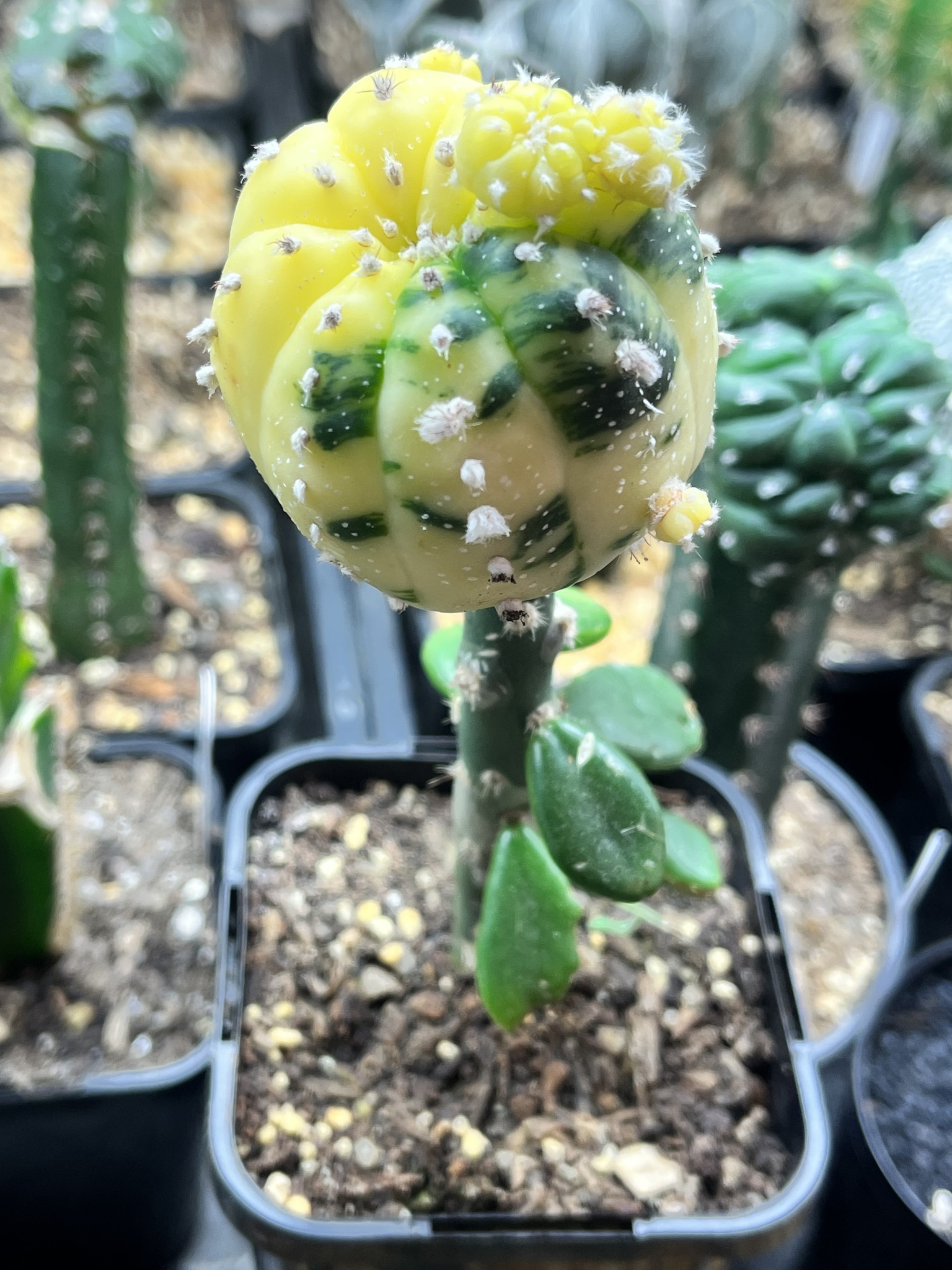
Partially variegated plants with substantial green tissue can survive and grow without graft support; llifle explicitly notes that many plants do well without a rootstock. Plants that approach the f. aurea condition (fully yellow, negligible green) cannot generate enough carbohydrate to sustain themselves and are found almost exclusively grafted. The graft provides sugar from the rootstock’s green tissue to the chlorophyll-deficient scion.
Grafting is also used as a growth accelerator for partly variegated show plants. Serious collectors run a seed grown plant alongside a grafted backup of the same clone as insurance: if the ungrafted plant loses green sectors and can no longer support itself, the graft carries the line forward while the original is regrafted or replaced. Common rootstock choices are Hylocereus (fast but declines after about three years), Pereskiopsis (fast, aggressive, good for seedlings), and Myrtillocactus geometrizans (slower but longer-lived).
Comparison
The comparison that carries weight is against the typical non-variegated form of A. asterias, not against other Astrophytum species. Variegation is a trait dimension that can appear on any base: A. myriostigma also produces nishiki selections, as do A. coahuilense and A. caput-medusae, but those carry the base-species rib count, body shape, and flower characters regardless of whether they are variegated. The variegated asterias is identifiable as asterias by the eight flat ribs and the red-throated yellow flower; the sector overlay only modifies colour.
Within asterias the split is clean: any sector of yellow, cream, orange, or pink tissue against the normal green-plus-white-fleck background marks the plant as variegata. The f. nudum selection is the trait dimension most often confused with variegata by beginners, but nudum removes the fleck layer to expose dark green epidermis, while variegata adds chlorophyll-deficient sectors. They are orthogonal traits and Ruri Kabuto Nisiki layers both simultaneously.
Frequently asked questions
How do you tell f. variegata from typical A. asterias?
Structurally the two forms are identical: eight ribs, spineless, yellow red-throated flower, basal-dehiscent fruit, helmet-shaped seed. The table below focuses on the cultivation and market characters that actually shift between the two.
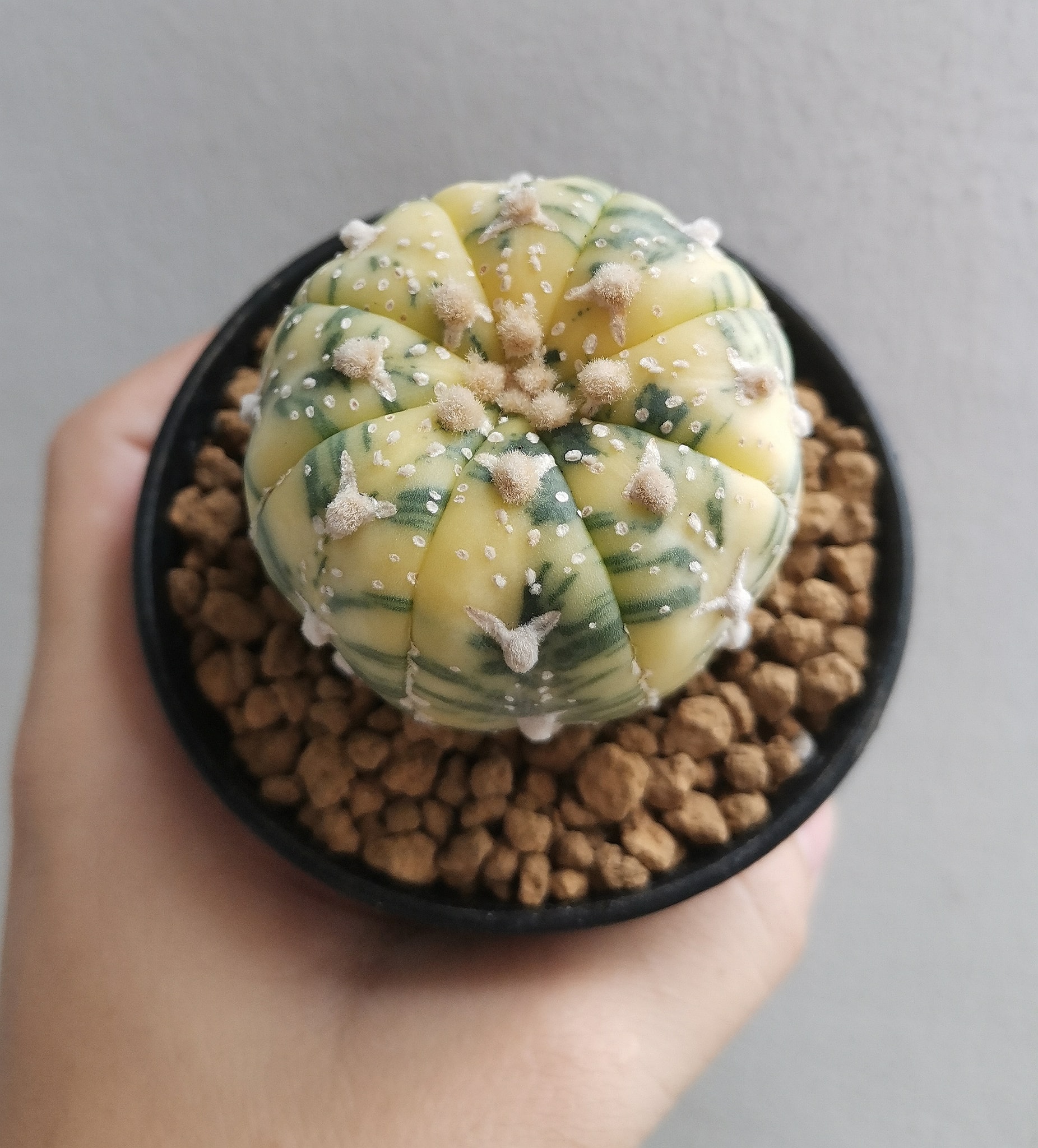
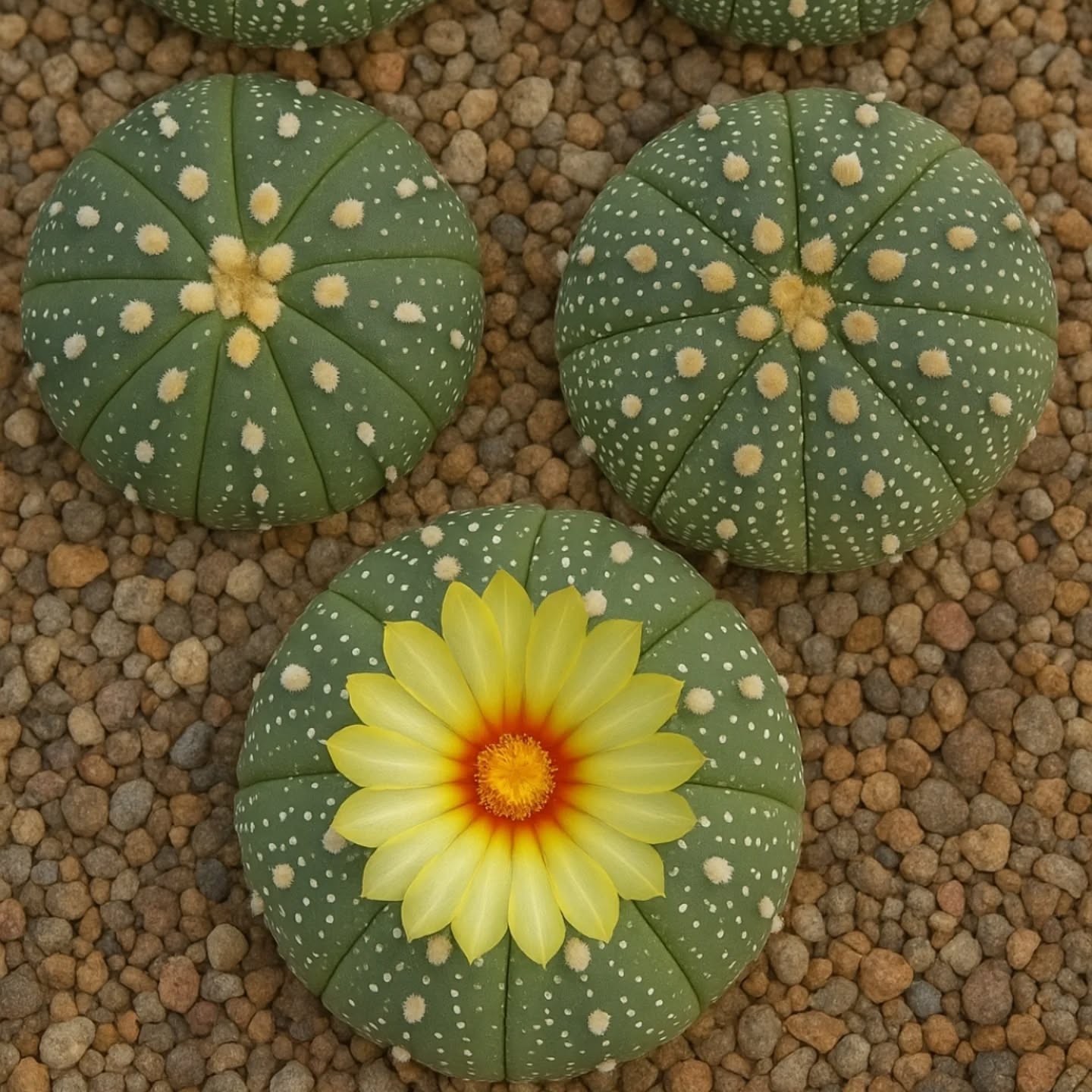
Epidermis sectoring is the immediate visual read. Cultivation divergence matters more in practice: half-shade, tighter cold floor, and graft planning are the adjustments a variegated plant forces.
How is variegation in cacti caused?
Chimeric chlorophyll mutation at the shoot apical meristem. One or more cell layers lose the ability to synthesise chlorophyll; the tissue they produce appears yellow, cream, orange, or pink because carotenoid and betalain pigments become visible without chlorophyll masking them. The mutation is somatic, not germ-line, which is why variegated plants do not reliably transmit the trait through seed.
Can variegated Astrophytum be grown from seed?
Mostly no. Seed from a variegated parent produces mainly green offspring. A small percentage of seedlings can carry variegation because cactus meristems are anomalously large and chimeric sectors occasionally enter seed-forming tissue, but this is low-frequency and unpredictable. Reliable propagation of a specific variegated clone requires vegetative means (offsets where present, or maintaining the grafted plant).
Why are variegated A. asterias so expensive?
Three factors compound. Variegated phenotypes arise at low frequency in seedling batches and cannot be reliably reproduced from seed, so production volume is small. Plants grow significantly more slowly than typical green asterias because green tissue alone carries the metabolic load, which extends the time-to-saleable-size. And plants carrying stacked traits like Ruri Kabuto Nisiki (nudum plus variegated) or Kabuto Nisiki (kabuto body plus variegated) sit at the top of a collector pyramid where each additional layer multiplies the premium.
Should I graft my variegated Astrophytum asterias?
Depends on how much green tissue the plant still carries. Partially variegated plants survive and grow without a rootstock. Plants approaching full-yellow (the f. aurea condition) cannot generate enough carbohydrate to sustain themselves and must be grafted. If a plant shifts toward more yellow over time, grafting before the green sectors collapse is safer than waiting. Serious collectors keep a grafted backup of important clones as insurance.
Is variegation in A. asterias stable?
Not entirely. Sectors can expand, contract, or revert completely to all-green at any growth cycle. Reversion is the most common shift because green tissue is metabolically superior and tends to outcompete chlorophyll-deficient cells at the meristem. Shift toward all-yellow is rarer but more dangerous, since a plant that becomes predominantly chlorophyll-free without graft support risks starvation unless grafted.
Sources & further reading
Kew POWO, Astrophytum asterias (Zucc.) Lem. (2024) – no accepted infraspecific taxa · IPNI: no entry for f. variegata as validly published name · Hernández et al., IUCN Red List assessment 2017 (T40961A121438670) · CITES Appendix I listing, effective 22 October 1987 · llifle Encyclopedia of Living Forms, A. asterias cv. Nisiki (yellow); var. nudum f. variegatum; cv. Ruri Kabuto Nisiki · Henry Shaw Cactus and Succulent Society, variegated cacti notes (Driskill 2017); Astrophytum plant of the month (2008) · University of Florida PropG & Texas A&M hortIPM, chimera biology references · UnusualSeeds, A. asterias hybrids guide · Giromagi Cactus and Succulents, A. asterias f. variegated listing · Cactus and Succulent Journal (US) 68: 245 (1996), Cacti and Succulents in Japan · Cactus Conservation Institute, Astrophytum research page · NOM-059-SEMARNAT-2010 (DOF, México)