Astrophytum myriostigma var. quadricostatum
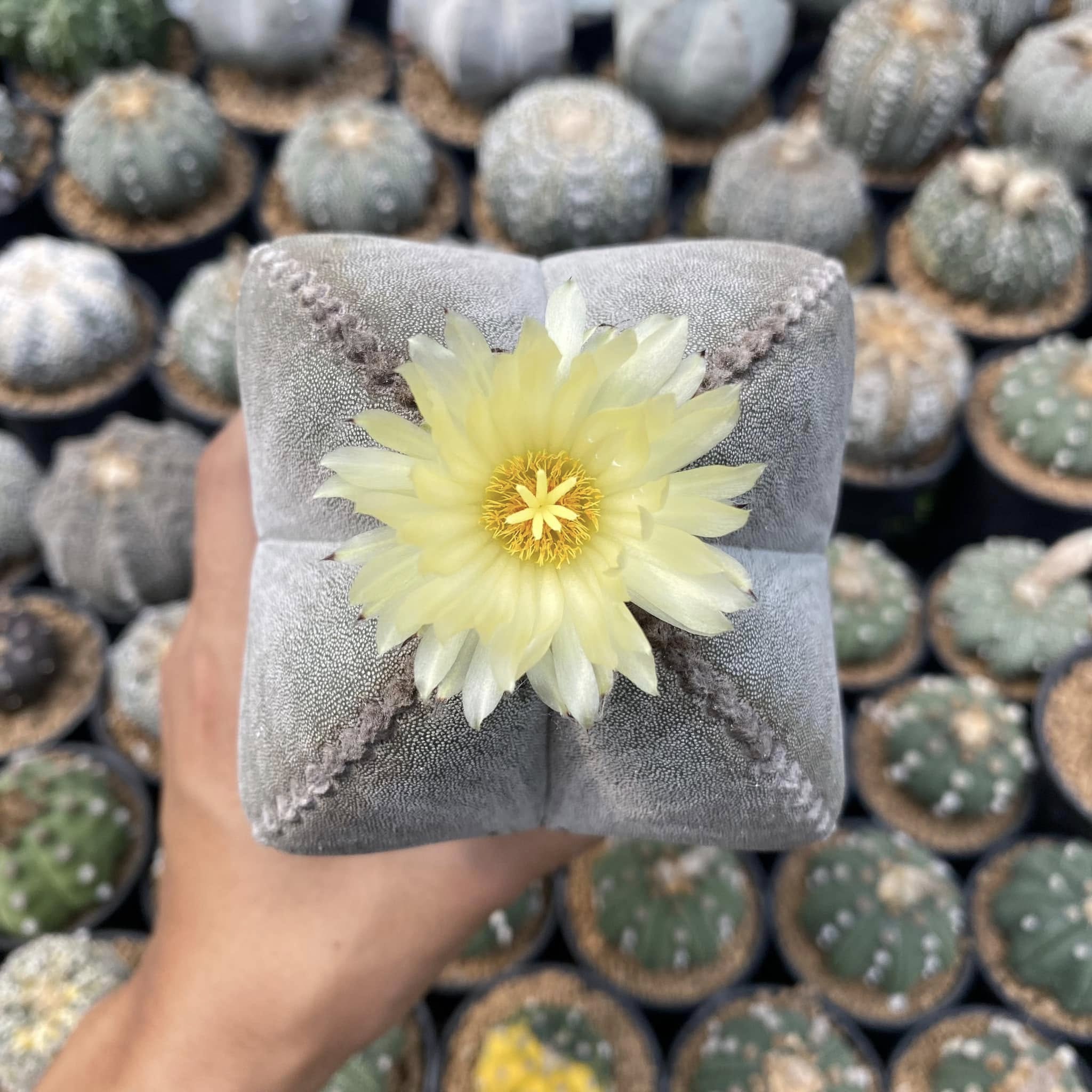
Astrophytum myriostigma var. quadricostatum is the four-ribbed form of bishop’s cap, a POWO-accepted infraspecific taxon with a wild footprint in the Jaumave Valley of Tamaulipas, Mexico. Its sole morphological criterion is rib count: four costae instead of the typical five, producing a squared or quadrangular cross-section most pronounced in juvenile and mid-sized plants. Full coverage of the parent species’ habit, distribution, and ecology lives on the A. myriostigma page; this page covers what specifically differentiates the four-rib taxon.
The nomenclature carries a rank disagreement that the page addresses directly. Kew POWO accepts the name at subspecies rank: A. myriostigma subsp. quadricostatum (H.Moeller) K.Kayser (Kakteen-Freund 1(6): 57, 1932). World Flora Online and the great majority of nursery catalogs, grower forums, and collector literature prefer the variety rank: var. quadricostatum. Both treat the taxon as nomenclaturally distinct from the typical form. The slug and most labels on this site follow the horticultural convention (var. quadricostatum); botanical sections use the POWO-accepted subspecies rank where precision matters.
Wild populations at Jaumave have been formally tied to subsp. quadricostatum by Montanucci and Kleszewski (2019, J. Bot. Res. Inst. Texas 13: 63–69), who established nomenclatural priority of quadricostatum (1927) over the competing name tamaulipense (1930). Plants in trade are nursery-produced clones: confirmed four-rib stock selected from seedling batches, not wild-collected material. Closely allied taxa in the genus include A. coahuilense (five ribs, dense flecking, Coahuila range) and the spineless disc form A. asterias.
Astrophytum myriostigma var. quadricostatum quick reference
A four-ribbed infraspecific taxon of bishop’s cap from Jaumave Valley, Tamaulipas. Cultivation is identical to the parent species in every respect. Values calibrated for seed grown plants in cultivation.
Taxonomy & nomenclature
H. Moeller published the basionym Echinocactus myriostigma var. quadricostatus in Zeitschrift für Sukkulentenkunde 3: 54 (1927), defining the taxon by its four ribs and quadrangular cross-section. In 1930, both A.F. Moeller and Houghton published new combinations in the Journal of the Cactus and Succulent Society of America (1: 157): A.F. Moeller as A. myriostigma var. quadricostatum, Houghton treating it as a full species, Astrophytum quadricostatum. K. Kayser elevated it to subspecies rank in Kakteen-Freund 1(6): 57 (June 1932); this combination, A. myriostigma subsp. quadricostatum (H.Moeller) K.Kayser, is the name POWO accepts today (IPNI identifier: urn:lsid:ipni.org:names:25938-2).
POWO currently accepts exactly two infraspecific taxa under A. myriostigma: the nominate subsp. myriostigma and subsp. quadricostatum. Six synonyms fall under the subspecies in the POWO backbone, including the three tamaulipense combinations published by A.F. Moeller and K. Kayser in 1930–1932. Montanucci and Kleszewski (2019) confirmed that quadricostatum (1927) has nomenclatural priority over tamaulipense (1930) and formally synonymised the latter.
World Flora Online (wfo-0000555092) accepts the taxon at variety rank as A. myriostigma var. quadricostatum (H.Moeller) Baum, citing a different combining author from POWO’s K. Kayser. These are two distinct nomenclatural acts at different ranks. The rank disagreement (subsp. vs var.) is genuine; neither treatment reduces the taxon’s accepted botanical standing. Horticulture runs predominantly on the variety designation, which follows the WFO treatment, but POWO’s subspecies rank is the primary authority this site uses for its botanical sections.
The tamaulipense synonymy is historically important. A.F. Moeller described the Jaumave Valley Tamaulipas population as a distinct entity in 1930. Montanucci and Kleszewski (2019) established that the Jaumave plants correspond to subsp. quadricostatum, and that tamaulipense falls as a later synonym. This makes the Jaumave Valley simultaneously the type area for the wild subspecies and the source of the trait that defines it in horticulture.
Diagnostic character
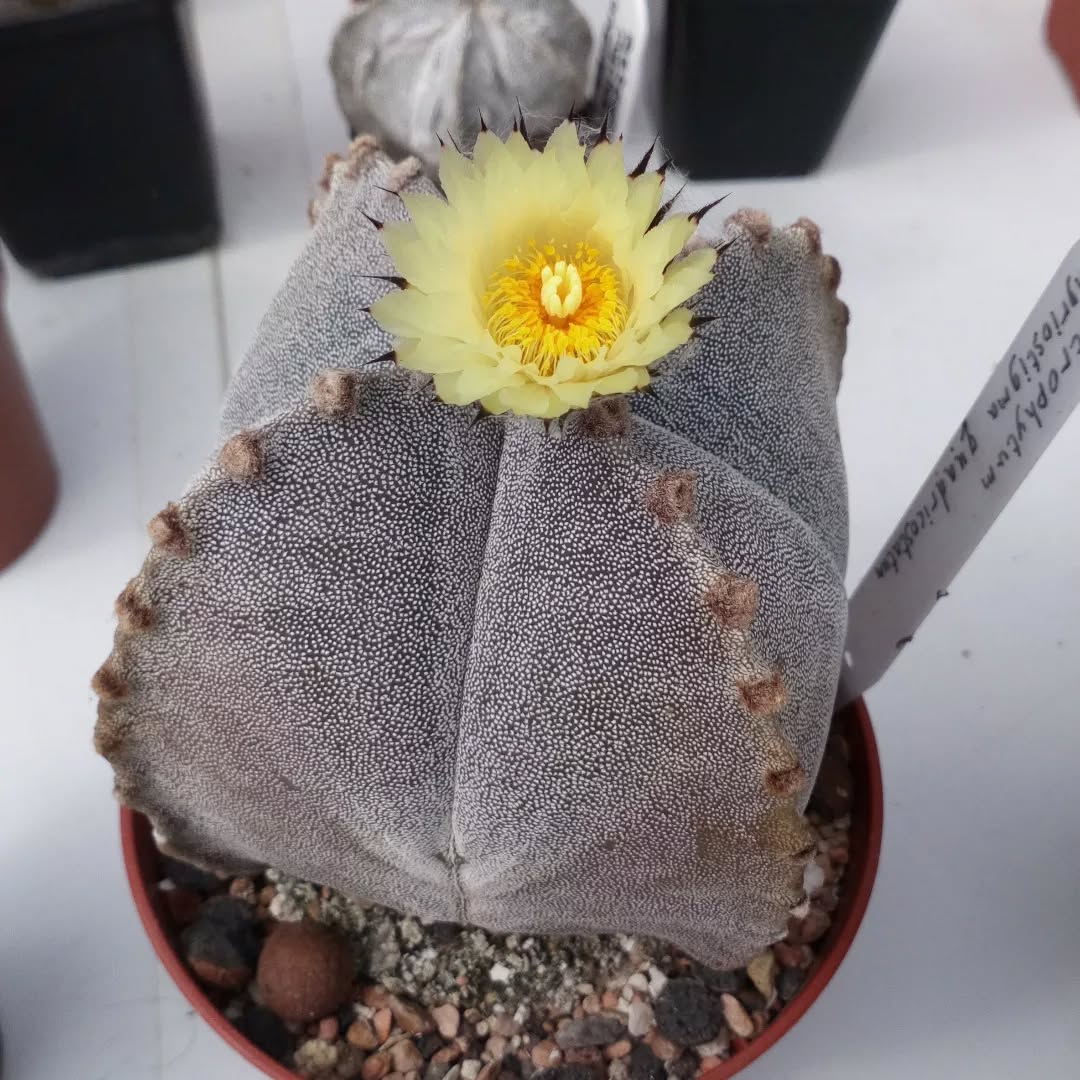
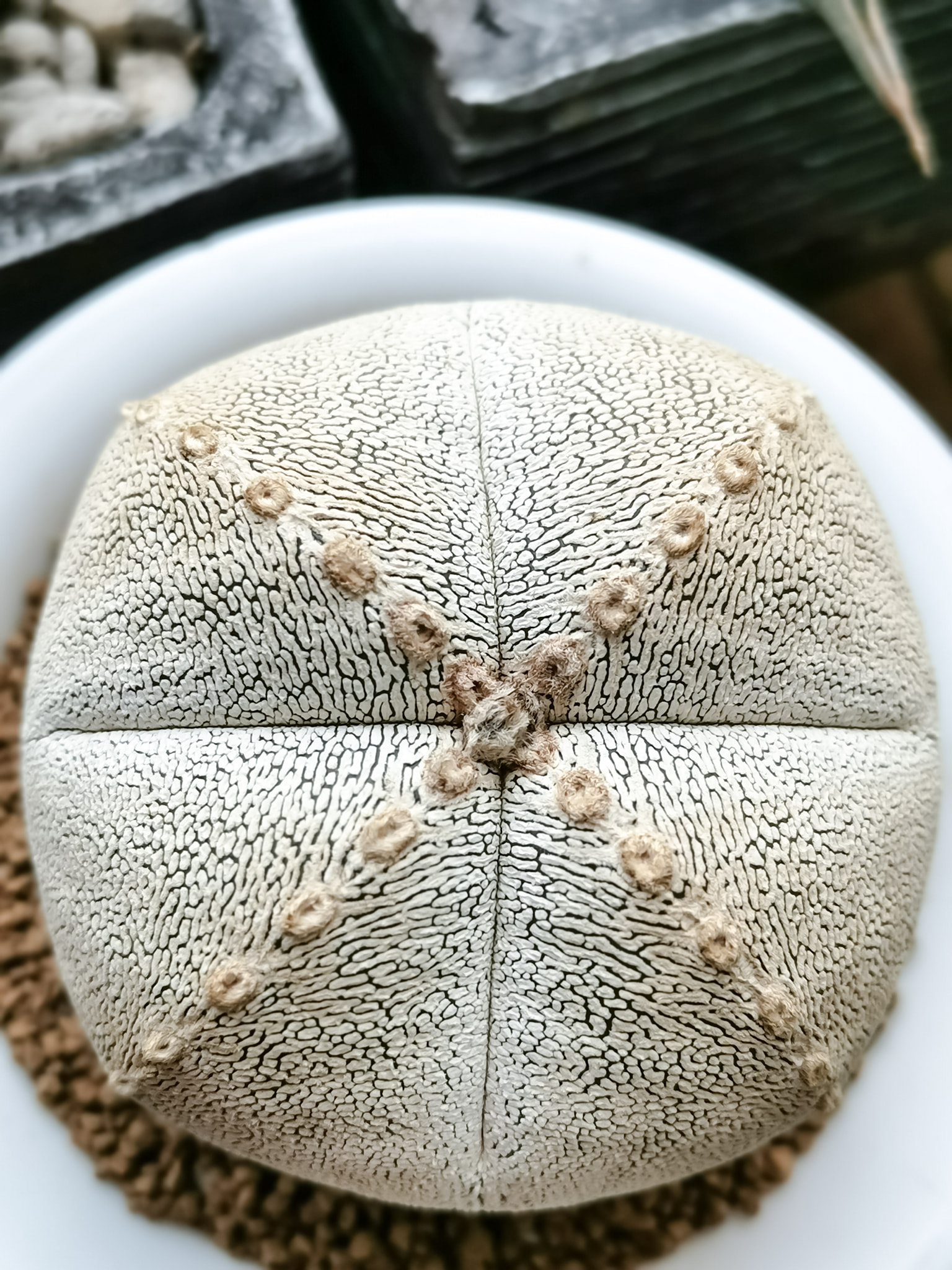
Four ribs is the entire morphological definition of this taxon. Young plants read as nearly square in cross-section, with four clean flat faces meeting at angles close to 90 degrees. This geometry is absent from any other Astrophytum species and absent from the typical five-ribbed A. myriostigma. Everything else belongs to the parent species and is shared without modification: white trichome flecking, pale yellow flowers with an orange throat, eventual columnar growth, cold tolerance.
The rib count is not fully fixed. Some plants that emerge from seed with four ribs develop a fifth rib as they increase in diameter. Old plants that maintain the four-rib form through their adult columnar stage are specifically prized; they are the exception rather than the rule. Montanucci and Kleszewski (2019) observed that the Jaumave Valley wild population retains the quadricostatum appearance into maturity more consistently than arbitrary nursery seed batches, which suggests the trait has higher penetrance in the Jaumave lineage without being genetically fixed even there.
Jaumave wild seedlings show one additional character not reported for typical A. myriostigma: black spines up to 4 mm in length per Montanucci and Kleszewski (2019). This is a wild-population seedling character and has not been documented in nursery-grown stock derived from those lines. Its presence in a cultivated seedling would suggest closer Jaumave provenance than typical commercial quadricostatum clones.
Flowers from Jaumave wild plants are slightly smaller than those of typical A. myriostigma, with one to three tepal rows and pale whitish-yellow coloration (Montanucci and Kleszewski 2019). Cultivated quadricostatum plants show the standard myriostigma flower: 4–6 cm diameter, pale yellow to creamy tepals with an orange throat, arising apically. First flowering occurs at roughly six years from seed.
Locality context
The subspecies has a documented wild footprint in the Jaumave Valley, Tamaulipas, at approximately 600 m elevation. This is notably lower than the parent species’ wider elevational range of 1,500–2,000 m across northeastern and central Mexico (Monaco Nature Encyclopedia). Montanucci and Kleszewski (2019) confirmed that Jaumave four-ribbed individuals represent a coherent population that retains the subsp. quadricostatum characters further into maturity than other populations, and that the competing name tamaulipense described this same locality population.
Four-ribbed individuals occur within the broader A. myriostigma population at the site, growing alongside five-ribbed plants; the population does not segregate cleanly into two rib-count classes. Four-rib plants constitute a smaller proportion of the population than five-rib plants. Wild plants are protected under CITES Appendix II and NOM-059; commercial quadricostatum stock is nursery-produced, not wild-collected.
Cultivation
Cultivation for var. quadricostatum is identical to the parent species in every respect. Substrate, watering schedule, light requirements, cold floor, and container guidance all follow A. myriostigma without adjustment; full detail lives on the parent species page. The care widget above summarises the values for quick reference.
Sourcing confirmed four-rib clones
Rib count segregates in seed batches. Four-rib parents crossed with four-rib parents produce a mix of rib counts in the offspring, not exclusively four-ribbed seedlings. Trex Plants characterises the rib outcome from seed as a roll of the dice. Selective breeding over multiple generations increases the proportion of four-ribbed seedlings but does not fix the trait. If a squared body is the goal, buying a vegetatively selected clone with confirmed four-rib expression is the reliable path; growing from seed labelled quadricostatum does not guarantee the form at maturity.
Comparison
Every comparison within the genus begins with the parent species. The typical A. myriostigma (five ribs, pentagonal cross-section) is the nearest plant visually and the one collectors most often need to separate from quadricostatum. The FAQ Q1 table below covers that distinction systematically.
A. coahuilense is a useful secondary comparison: five ribs, dense white flecking similar to or heavier than typical myriostigma, restricted to Coahuila and Durango at 1,100–1,600 m. It reads as a flecking extreme of the myriostigma body plan rather than a separate growth form. A. coahuilense never produces four-rib individuals; rib count alone distinguishes the two.
The Onzuka character requires clarification. Onzuka refers to an intensified white trichome flecking pattern developed from lines selected by Japanese breeder Tsutomu Onzuka from the 1970s onward. It is a flecking character, entirely separate from rib count. A standard quadricostatum plant carries normal myriostigma-grade flecking. An Onzuka quadricostatum is double-selected: four ribs combined with Onzuka-grade intensified flecking. Both traits contribute independently to the collector premium, and neither implies the other.
Sources & further reading
POWO. Astrophytum myriostigma subsp. quadricostatum (H.Moeller) K.Kayser. Plants of the World Online. powo.science.kew.org/taxon/urn:lsid:ipni.org:names:25938-2. Accessed 2026-04-21 · POWO. Astrophytum myriostigma Lem. Plants of the World Online. powo.science.kew.org/taxon/urn:lsid:ipni.org:names:30030274-2. Accessed 2026-04-21 · IPNI. A. myriostigma subsp. quadricostatum. ipni.org/n/25938-2. Accessed 2026-04-21 · Montanucci, R.R. and Kleszewski, K.-P. (2019). Nomenclature and redescription of the Jaumave Valley (Mexico) populations of Astrophytum myriostigma (Cactaceae). Journal of the Botanical Research Institute of Texas 13(1): 63–69 · Montanucci, R.R. and Kleszewski, K.-P. (2021). Taxonomic history, comparative morphology, and variation in Astrophytum myriostigma and its subspecies tulense (Cactaceae). Journal of the Botanical Research Institute of Texas 15(2) · llifle Encyclopedia of Living Forms. Astrophytum myriostigma var. quadricostatum. llifle.com/Encyclopedia/CACTI/Family/Cactaceae/1881/. Accessed 2026-04-21 · Giromagi Cactus and Succulents. Astrophytum myriostigma quadricostatum. giromagicactusandsucculents.com. Accessed 2026-04-21 · Trex Plants. How to Grow Astrophytum myriostigma. trexplants.com. Accessed 2026-04-21 · World of Succulents. Astrophytum myriostigma subsp. quadricostatum. worldofsucculents.com. Accessed 2026-04-21 · Monaco Nature Encyclopedia. Astrophytum myriostigma. monaconatureencyclopedia.com/astrophytum-myriostigma/. Accessed 2026-04-21