
Aztekium hintonii
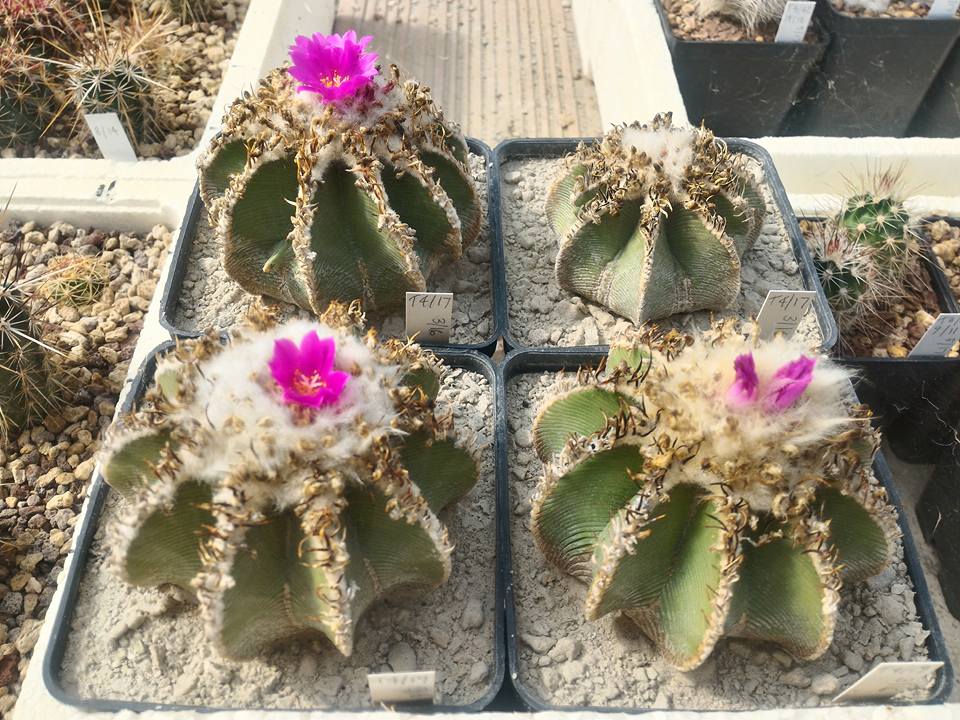
Aztekium hintonii is a small, slow-growing cactus confined to near-vertical gypsum cliff faces in the canyon systems of Galeana municipality, Nuevo León, Mexico. George Sebastián Hinton discovered the plant during his surveys of Nuevo León gypsum outcrops in 1991; the formal botanical description was published the following year by Charles Edward Glass and Walter Alfred Fitz Maurice in Cactáceas y Suculentas Mexicanas 37: 13–16 (1992). The species grows in the same gypsum canyon system as Geohintonia mexicana, an association that later provoked a contested hybrid hypothesis, and is one of only three recognised Aztekium species.
The stem is globose to shortly columnar, typically 3–8 cm in diameter in cultivation and reaching up to 10 cm in solitary plants. Multi-headed horticultural clump forms can spread to 20 cm, but this figure reflects the clump as a whole rather than any individual head. Ribs number 10–15 in most plants and carry sharp, acute margins with fine transverse wrinkles on the flanks. The apex is covered with prominent white wool. Flowers are deep magenta, up to 3 cm in diameter, emerging from the woolly crown during summer.
The species is an obligate gypsum specialist. It grows nowhere else: the parent rock chemistry governs both the substrate and the micro-drainage dynamics of the canyon walls. This specificity makes habitat loss through geological change slow, but it also makes the plant extremely vulnerable to collection pressure at any single locality. A documented mass collection event between 2019 and 2021 removed an estimated 90 percent or more of the mature population, prompting a major reassessment of the species’ conservation status following the 2019-2021 poaching event. Its sibling Aztekium ritteri faces similar pressures, while the third species, Aztekium valdezii, described in 2013, is even less well-known in cultivation.
CITES Appendix II governs all international trade in the species. Unlike A. ritteri, which some sources have proposed for Appendix I uplift, A. hintonii remains under Appendix II, meaning that international trade requires export permits from Mexico’s SEMARNAT authority but is not categorically prohibited for legitimately propagated material. The legitimate path for collectors outside Mexico is seed, which is offered by specialist suppliers and subject to different regulatory rules from live plants. Mature, seed grown plants are the collector standard; grafted specimens grow faster but lose the characteristic body proportions that develop at the plant’s natural pace.
Aztekium hintonii quick reference
A gypsum-cliff specialist from Galeana, Nuevo León, with a summer-active growing season and a near-mineral substrate requirement. Values calibrated for seed grown plants in cultivation, drawn from habitat data and specialist grower experience.
Taxonomy & nomenclature
The accepted name is Aztekium hintonii Glass & W.A.Fitz Maur., published in Cactáceas y Suculentas Mexicanas 37: 13–16 (1992). Kew POWO accepts this combination under IPNI LSID urn:lsid:ipni.org:names:300908-2. GBIF records the species at taxon ID 3960203; Tropicos at 50164055.
The discovery year (1991) and the publication year (1992) are two distinct events that secondary sources frequently conflate. George Sebastián Hinton located the plant during his systematic surveys of Nuevo León gypsum outcrops in 1991; Glass and Fitz Maurice completed the formal description and submitted it for publication the following year. The species epithet honors Hinton directly. Hinton, born 1949 in Monterrey, is the third generation of his family to collect Mexican plants professionally and has documented approximately 65 new species from Nuevo León and Coahuila gypsum systems.
The only synonym in POWO is × Aztekonia hintonii (Glass & W.A.Fitz Maur.) Mottram, published in Cactician 5: 15 (2014). Mottram proposed that A. hintonii is an intergeneric hybrid between Aztekium ritteri and Geohintonia mexicana, erecting the nothogenus × Aztekonia for it. POWO lists × Aztekonia hintonii as a homotypic synonym of A. hintonii, meaning the combination is recognised but the name is treated as synonymous with the accepted binomial. Molecular phylogenetic work since 2002 consistently places A. hintonii within the same clade as A. ritteri, undermining the intergeneric hybrid hypothesis. Modern molecular and floristic treatments place A. hintonii as a full species, accepted by POWO and confirmed by every Mexican floristic atlas published since 2015. The hybrid interpretation remains of interest to collectors but has not entered mainstream taxonomy.
Kew POWO lists Nuevo León and Tamaulipas as native range states. Field literature reviewed for this build attributes the species to Nuevo León exclusively, with all documented localities within Galeana municipality. The Tamaulipas record in POWO is not corroborated by any herbarium specimen, field study, or iNaturalist observation reviewed; it is cited here as an unresolved discrepancy and may reflect a range-model extrapolation or an uncorrected historical record. Distribution prose on this page anchors to the confirmed Nuevo León localities.
Habitat
Aztekium hintonii is an obligate gypsum specialist, growing exclusively on calcium sulphate outcrops and never on calcareous limestone. The confirmed localities fall within the canyon systems of Galeana municipality, Nuevo León, including the Río San José canyon system. Plants adhere to near-vertical to overhanging cliff faces in sharply incised gypsum canyons, occupying crevice pockets filled with fine gypsum clay and silt. Organic content in this substrate is minimal. Gypsum is slightly alkaline in chemistry, a property that must be replicated in cultivation.
The canyon walls where the species grows are predominantly north-facing, which gives the plants diffuse light and protects them from direct midday sun. This aspect is consistent across multiple field observer accounts and BCSS cultivation notes referencing habitat studies. The canyon microclimate also captures intermittent fog and moisture condensation from the Sierra Madre Oriental, supplementing direct rainfall. Regional precipitation at Galeana basin runs approximately 400–450 mm annually, constrained by its position in the Sierra Madre rain shadow. The canyon walls, however, never allow standing water; even during rain events, near-vertical surfaces drain immediately.
Elevation at the known localities is approximately 1,100–1,200 m above sea level, based on secondary sources citing the 1992 protologue; this figure has not been verified against the original publication. Associated vegetation includes Geohintonia mexicana, which shares the same gypsum canyon habitat and whose co-occurrence underlies Mottram’s intergeneric hybrid hypothesis. Additional associates documented at or near the localities include Mammillaria candida, Neolloydia conoidea, and Selaginella lepidophylla within the broader xeric scrub community.
Field-number-documented localities within Galeana municipality include: S of Río San José, NL (GCG 13116, the var. minor collection); Río de San Juan, NL (ROG 439); Río San José, NL (MZ 641); Santa Clara de Gonzáles, El Palmito (PP 222); El Palmito, NL (LRM 77, MMR 38); south of Galeana, NL (DU 12); and Galeana, NL (MZ 1329). All confirmed localities are within Galeana municipality; no GPS coordinates are published given the species’ documented collection pressure.
Morphology
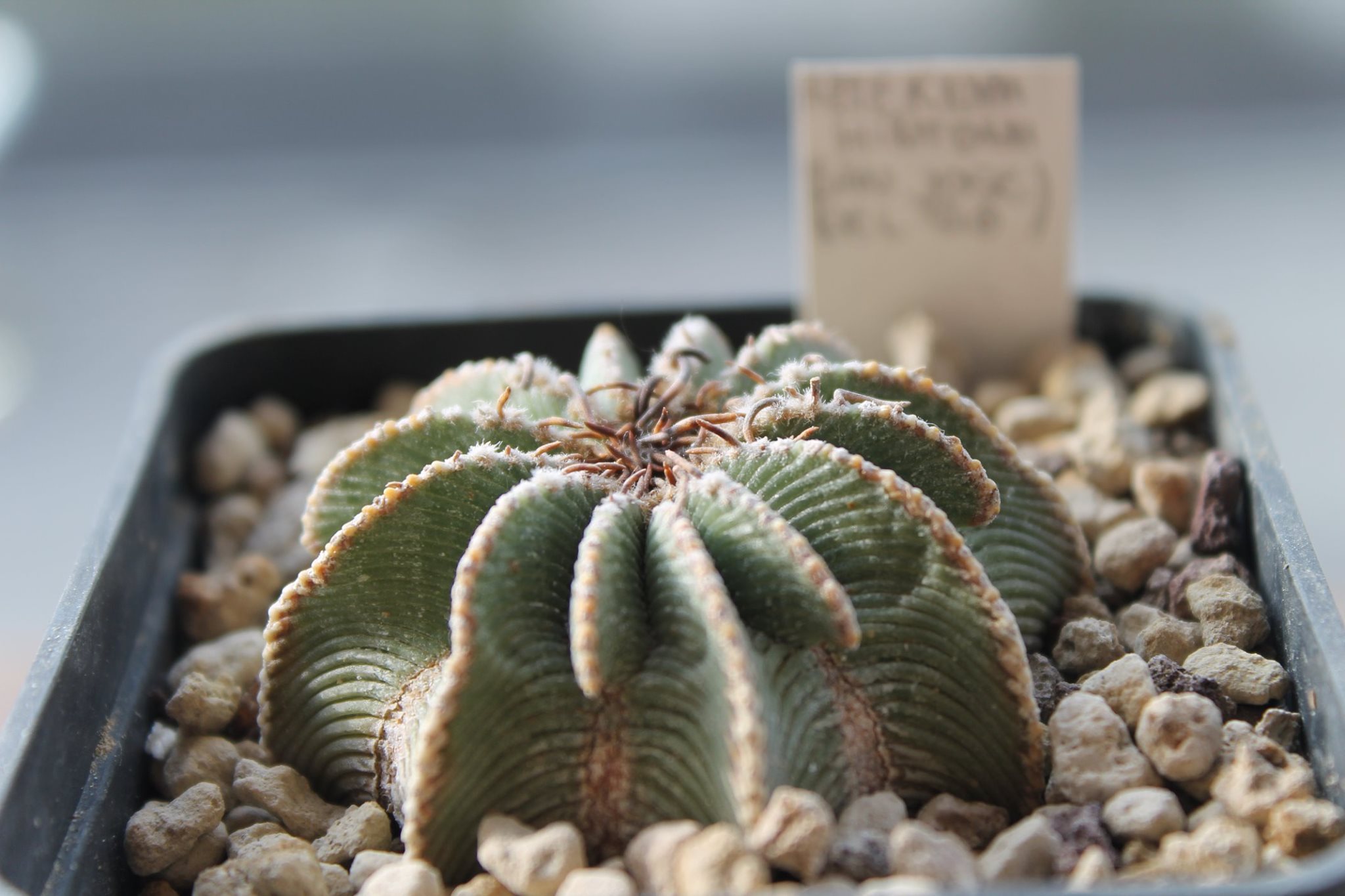
Aztekium hintonii is typically solitary in the wild. The stem is globose to shortly columnar, green to greyish-green, with a prominent woolly apex that gives the plant a capped appearance when viewed from above. Solitary plants reach up to 10 cm in diameter and 6–10 cm in height; most cultivated specimens are smaller, typically 3–8 cm across. Multi-headed horticultural forms (principally the garden-origin f. proliferum) can form clumps spreading to 20 cm, but this is a clump measurement, not an individual stem measurement. The two figures are frequently confused in popular sources.
Rib count ranges from 10 to 15 in most plants, with some older specimens approaching 18. Ribs carry sharply acute margins, a character that immediately separates A. hintonii from the rounded rib margins of A. ritteri. Rib flanks bear fine transverse wrinkles rather than the interpolated secondary ribs found in A. ritteri. This is a critical distinction for identification: A. hintonii has surface corrugations on the rib flanks; A. ritteri has distinct secondary ribs between its primary ribs that reach approximately halfway up the stem body. The two characters are different structures and produce a clearly different visual texture in the two species.
Areoles are positioned along the upper margin and crest of each rib. They are prominently woolly, particularly in juvenile plants, where the white wool is a conspicuous feature. Each areole carries 2–3 spines per areole, thin and papery rather than rigid, reaching up to 13 mm long, and notably curved. Areole spacing is not precisely quantified in any source reviewed; the areoles are closely set along the rib crest. On older plants, spines are frequently reduced or absent, with the areoles predominantly woolly, a pattern also observed in A. ritteri.
Flowers are deep magenta, consistently described across sources as lacking the white or pale pink tones of A. ritteri flowers. Diameter reaches up to 3 cm. Flowers emerge from the apical wool and are diurnal. The primary flowering season is summer, June through August, with spring onset possible in warm conditions. Fruit is pinkish, berry-like, hidden in the apical wool, elongated at the central apex. Seeds are brownish-black and extremely fine; Aztekium seeds rank among the smallest produced by any cactus genus.
Two garden-origin horticultural forms are recognised in cultivation but are not formally published taxa: f. proliferum is a multi-headed clumping form; f. monstruosum shows monstrous ribs with knobby swellings. A collector designation, var. minor (associated with GCG 13116, S of Río San José), refers to a smaller-bodied wild collection but is not a formally published taxon.
Locality detail
All confirmed localities for Aztekium hintonii fall within Galeana municipality, Nuevo León, Mexico. The type locality is described in the 1992 protologue in the vicinity of the Río San José canyon system south of Galeana. Multiple field numbers document plants across several canyon localities within this municipality, all on gypsum outcrops. The Kew POWO native range listing additionally includes Tamaulipas; this is not corroborated by any field literature reviewed and is noted as an unresolved discrepancy.
The map below shows a regional centroid for Galeana municipality. Specific GPS coordinates for individual plant localities are not published on this page. The documented 2019–2021 poaching event, which removed over 90 percent of the estimated population, was enabled by precise locality knowledge circulating in collector networks. Publishing sharp coordinates would exacerbate that risk for any remaining wild plants.
Aztekium hintonii care and cultivation
Two habitat facts structure every cultivation decision for A. hintonii. The substrate is a near-zero-organic gypsum silt and clay in crevices on near-vertical canyon walls, with immediate drainage at all times. The light regime is diffuse, from a north-facing canyon aspect, not full desert exposure. Violating either condition produces predictable failures: organic-heavy mixes rot the roots; direct midday sun bleaches or stress-cracks the body.
Substrate
No published cultivation source addresses substrate proportions for Aztekium hintonii specifically. The canonical ratio is 43 per cent pumice, 10 per cent lava rock, 5 per cent zeolite, 20 per cent granite grit, 12 per cent limestone chip, 5 per cent coarse silica, and 5 per cent worm castings. The limestone share follows the carbonate-convention pairing shared with Ariocarpus, a group-level guideline rather than a species-specific finding; reduce or omit it on hard tap water. The organic share holds at the low end of the taprooted-globular group’s rot-averse range, with zero organic content beyond the worm castings. Pumice, lava rock, zeolite, granite grit and coarse silica are the site’s declared house formulation for particle structure and drainage, carrying no lithology claim. The zeolite fraction handles cation exchange and pH buffering through the growing season.
All three Aztekium species on this site grow on near-vertical gypsum and limestone cliff crevices in Nuevo León, but that habitat fact does not set the recipe below. The substrate ratios are effectively identical across the genus: a house formulation carrying a carbonate-convention limestone share paired with the published Ariocarpus finding, plus the site’s standard drainage aggregates. No published cultivation source treats Aztekium substrate at species level.
| Species | Pumice | Lava | Zeolite | Granite | Limestone | Silica | Organic |
|---|---|---|---|---|---|---|---|
| A. ritteri | 43% | 10% | 5% | 20% | 12% | 5% | 5% |
| A. hintonii (this page) | 43% | 10% | 5% | 20% | 12% | 5% | 5% |
| A. valdezii | 43% | 10% | 5% | 20% | 12% | 5% | 5% |
Container depth matters. In habitat, roots follow gypsum crevices downward; a shallow tray confines the root system and retains moisture at the collar. A deep, narrow container with a drainage hole that allows the mix to dry quickly between waterings gives the best results. Avoid oversized pots: excess substrate volume holds moisture beyond the root zone and elevates rot risk at the stem base.
Watering and light
During the growing season (spring through summer), water thoroughly once the substrate has dried completely, then do not water again until it is dry again. In warm, bright conditions this cycle runs roughly every 10–21 days depending on pot size and ambient humidity. Begin cautiously in late February or March as nights warm above 10°C; the 10°C threshold marks the active-growth minimum temperature for the species. Taper watering through September and October. From late autumn through winter, withhold water entirely unless severe shrivelling occurs; the plant’s dormancy is dry and cool, not moist.
The care widget cold-floor of 5°C / 41°F is a winter dormancy minimum, achievable only when the plant is completely dry. A brief llifle entry for the f. monstruosum form notes tolerance to -4°C for short periods when dry, but this figure has a single source and no cross-verification; treat it as an emergency reference only, not a cultivation target.
Light should replicate the north-facing canyon wall: bright but diffuse, with morning sun well-tolerated and direct afternoon sun avoided. In temperate greenhouse conditions, a lightly shaded bench or east-facing exposure is appropriate. One popular cultivation source recommends full sun, which contradicts both habitat data and BCSS specialist guidance; do not follow it. Low light produces etiolated growth; strong filtered light produces the compact, well-ribbed habit characteristic of wild plants.
Propagation
Seeds are the legitimate and preferred propagation route. Seed grown plants develop the compact proportions, strong rib character, and mature spine quality that grafted stock never fully achieves; the graft forces rapid early growth that distorts the body geometry. Growth from seed to first flower takes approximately 7 years under good conditions, and some growers report plants still unflowered after 23 years in sub-optimal setups. Patience is not incidental; it is the defining experience of growing this species from seed.
Grafting is practised to compress the juvenile phase. Common rootstocks include Pereskiopsis spathulata for rapid early growth (not intended as permanent stock; plants are removed after 2–3 years), and Hylocereus or Myrtillocactus geometrizans for longer-term grafts. Growers report grafted plants flower in 3–5 years, though this timeline comes from grower-community consensus rather than a primary study. For collector purposes, degrafting onto a mineral gypsum mix after the scion reaches workable size allows the plant to settle into its natural proportions over subsequent years.
Fertilisation should reflect the low-nutrient gypsum habitat. The consensus among specialist growers is either no feeding or a very dilute trace-element solution once or twice per growing season. Nitrogen-rich fertiliser produces soft, rot-prone growth unsuited to the mineral character of this species.
Comparison
Within Aztekium, identification hinges on three characters that separate the three species reliably. Flower colour is the fastest check: deep magenta in A. hintonii, white to pale pink in A. ritteri, and reportedly pale in A. valdezii as well. When plants are not in flower, rib structure is the primary character.
A. ritteri carries distinct secondary ribs between its primary ribs that reach approximately halfway up the stem, creating an intricately furrowed surface across the entire body. A. hintonii does not have these interpolated secondary ribs; instead, its rib flanks carry fine transverse wrinkles, a clearly different structure. The rib margins also differ: sharp and acute in A. hintonii, rounded in A. ritteri. These two characters together, the absent secondary ribs and the acute rib margins, give A. hintonii a crisper, more geometrically severe appearance than A. ritteri.
Body size provides a supporting separation. A. hintonii is the larger species, reaching up to 10 cm diameter in solitary wild plants and occasionally more in old cultivated specimens. A. ritteri is substantially smaller, rarely exceeding 5–6 cm and typically staying under 3 cm in most collections; it may be the slowest-growing cactus in cultivation. A mature A. hintonii versus a mature A. ritteri placed side by side present no identification difficulty; the challenge arises with small seedlings, where both species share a similar globose form and woolly apex before rib characters develop fully.
A. valdezii, described from a single canyon in 2013, is morphologically the most distinct of the three: its ribs are smooth, without secondary furrows or transverse wrinkles, and the body has a different surface texture from either of its relatives. It is vanishingly rare in cultivation, so the identification problem in practice is overwhelmingly hintonii versus ritteri.
Frequently asked questions
How do you tell Aztekium hintonii apart from Aztekium ritteri?
The most-confused pair in the genus. Both species are small, globose, gypsum-cliff cacti with woolly apices and overlapping ranges in Nuevo León. Drag the slider to see both plants side by side, then check the character table.


Flower colour is the fastest diagnostic: deep magenta in A. hintonii versus white to pale pink in A. ritteri. On unflowered plants, the sharply acute rib margins and absence of interpolated secondary ribs identify A. hintonii at a glance.
Is Aztekium hintonii difficult to grow from seed?
Aztekium hintonii is one of the hardest cacti in cultivation, primarily because of its substrate requirement and its growth rate. No published cultivation source addresses substrate proportions for this species specifically; the mix follows the site’s house formulation and the group-level carbonate-convention limestone share, not a per-species finding. Seeds germinate without difficulty in warm spring conditions but the resulting seedlings grow at a pace that tests patience: most growers report 7 years or more to first flower from seed, and some plants remain unflowered after twice that time in sub-optimal conditions. Given the correct substrate and a dry winter rest, established plants are reasonably stable. The main practical difficulty after substrate is overwatering; the near-vertical habitat drains instantly, and the cultivation equivalent is a mix that does the same.
What is the difference between seed grown and grafted Aztekium hintonii, and which is better?
Grafted plants reach flowering size faster: growers report 3–5 years on a good rootstock, compared with 7 years or more from seed. The trade-off is character. Seed grown plants develop the compact, correctly proportioned body geometry, mature rib sharpness, and spine quality that the graft-accelerated growth distorts. The rootstock forces rapid early growth that produces an elongated, over-inflated juvenile body; plants grown from seed at the same age are smaller but more precisely formed. For serious collectors, growing from seed is the goal; grafted plants serve as a faster path to blooms or as backup insurance plants in a collection.
Is Aztekium hintonii legal to buy, and what does CITES Appendix II mean for collectors?
Aztekium hintonii is covered by CITES Appendix II under the family-level listing of Cactaceae, which has applied to all cacti since 1975. Appendix II means that international trade is permitted but requires CITES export documentation from the country of origin (Mexico, via SEMARNAT). Nursery-propagated plants sold within national borders do not require CITES permits in most jurisdictions; check applicable national legislation before any import. Commercially propagated seed is exempt from CITES Appendix II requirements in many contexts. The species has not been uplifted to Appendix I, which would categorically prohibit international commercial trade; Appendix II status means legal acquisition of legitimately propagated plants is possible. Wild-collected plants are illegal under both CITES and Mexican law; purchase only from sellers who can document nursery propagation origin.
Where does Aztekium hintonii grow in the wild?
All confirmed wild localities fall within Galeana municipality, Nuevo León, Mexico, on near-vertical gypsum cliff faces in sharply incised canyon systems, at approximately 1,100–1,200 m above sea level. The plant grows in crevice pockets of fine gypsum clay and silt on predominantly north-facing canyon walls, in diffuse light rather than direct sun exposure. Associated species include Geohintonia mexicana, Mammillaria candida, and Selaginella lepidophylla. Kew POWO additionally lists Tamaulipas in the native range, but this record is not corroborated by field literature reviewed. GPS coordinates are not published given the documented 2019–2021 mass poaching event.
When does Aztekium hintonii flower, and how long does it take from seed to first bloom?
The primary flowering season in cultivation is summer, June through August, with spring onset possible in warmer conditions. Flowers are deep magenta, up to 3 cm in diameter, and emerge from the woolly apex. From seed, most growers report a wait of 7 years or more to first flower, with the exact timeline varying considerably by cultivation conditions. Some plants are reported still unflowered after 23 years, which likely reflects sub-optimal substrate or light rather than a species maximum. Growers report grafted plants flower in 3–5 years, compressing the juvenile phase at the cost of long-term body character.
Sources & further reading
Glass, C.E. & Fitz Maurice, W.A. 1992. Aztekium hintonii, a new species. Cactáceas y Suculentas Mexicanas 37: 13–16 · Kew POWO, Aztekium hintonii Glass & W.A.Fitz Maur., IPNI LSID urn:lsid:ipni.org:names:300908-2 · Mottram, R. 2014. × Aztekonia hintonii (Glass & W.A.Fitz Maur.) Mottram, comb. nov. Cactician 5: 15 · Hernández, H.M. & Gómez-Hinostrosa, C. 2015. Mapping the Cacti of Mexico. Part II. Succulent Plant Research 9, DH Books, Milborne Port · Anderson, E.F. 2001. The Cactus Family. Timber Press, Portland · Hunt, D. et al. 2006. The New Cactus Lexicon. DH Books, Milborne Port · GBIF, Aztekium hintonii, taxon key 3960203 · Tropicos, Missouri Botanical Garden, Aztekium hintonii, name ID 50164055 · IUCN Red List, Aztekium hintonii, taxon ID 152003; dual assessment: Near Threatened (older) and Critically Endangered (post-2021 reassessment following documented mass collection 2019–2021). Primary URL inaccessible; data from secondary citations · CITES Cactaceae family listing (Appendix II, all Cactaceae, effective 1977); Appendix II status for Aztekium hintonii confirmed via CITES Cactaceae Checklist and multiple vendor CITES compliance statements · llifle Encyclopedia of Cacti, Aztekium hintonii f. monstruosum entry (cultivation notes) · llifle Encyclopedia of Cacti, Aztekium ritteri entry (Q1 comparator morphology) · BCSS Cultivation Notes on Aztekium (partial; confirmed via search snippet) · Wikipedia, Aztekium hintonii (morphology, distribution, elevation, associated species) · Wikipedia, Aztekium genus page (rib count comparison, secondary rib character) · Xataka.com, 2025. PROFEPA seizure of 6 A. hintonii from 2,157-cactus illegal shipment, Mexico City, July 2025 (NOM-059 Protección Especial status; poaching context) · JSTOR Global Plants, George Sebastián Hinton biography (born 1949, Monterrey) · Wikispecies, Aztekium hintonii (database IDs, publication page range, synonym details)