
Aztekium valdezii
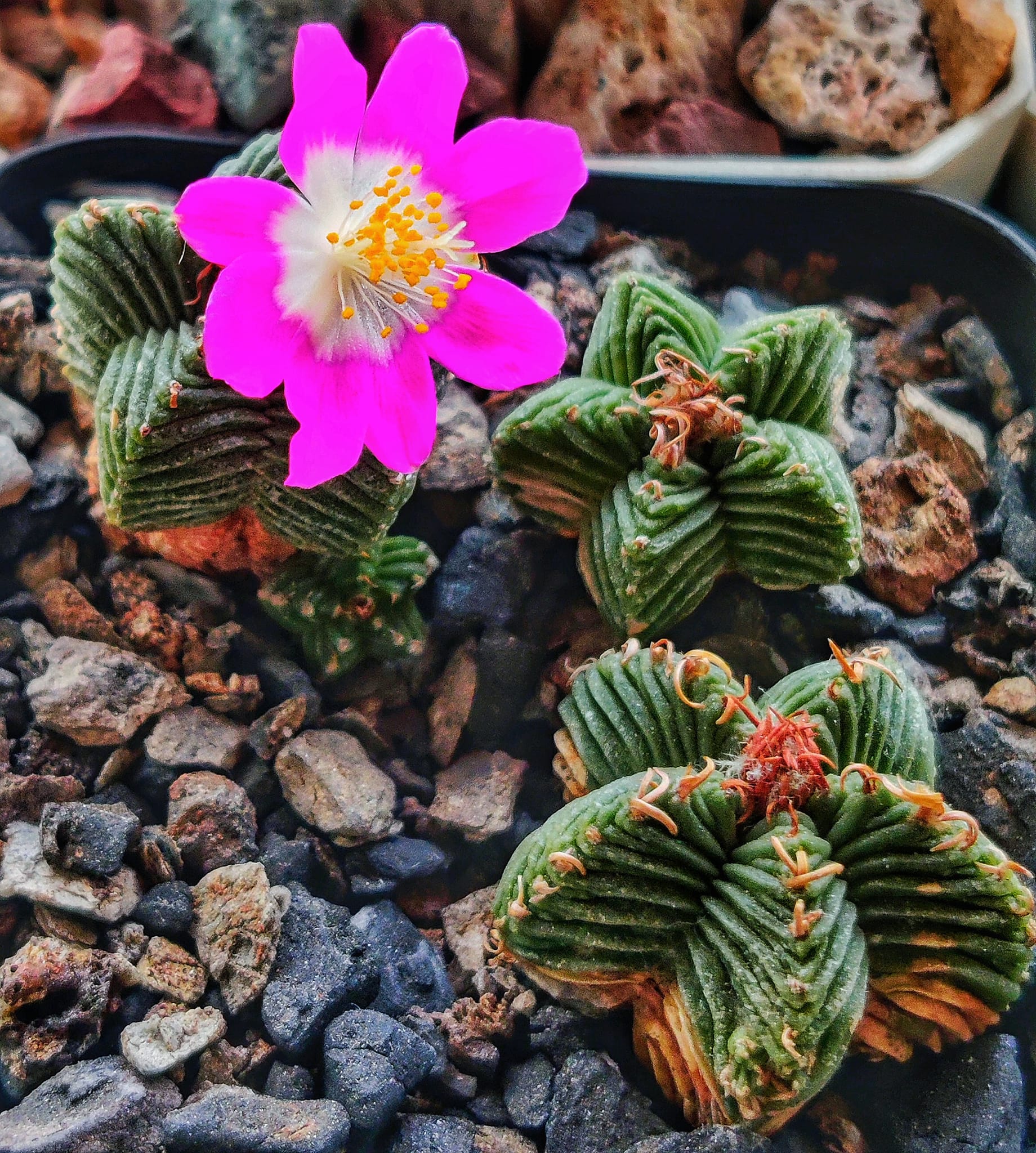
Aztekium valdezii was formally described in August 2013 in Xerophilia Special Issue no. 2, authored by Carlos Gerardo Velazco Macias, Marco Antonio Alvarado Vázquez, and Salvador Arias Montes. The species was named for Mario Alberto Valdés Marroquín, the biologist who first located the population in 2009 during fieldwork in the Sierra Madre Oriental, Nuevo León. It is the third and most recently described species in the genus Aztekium, alongside Aztekium ritteri (Boedeker, 1928) and Aztekium hintonii (Glass & S.Arias, 1992).
Five ribs: that is the defining vegetative feature. While A. ritteri carries 6 to 11 primary ribs and A. hintonii bears 10 to 15, A. valdezii consistently presents exactly five, without any secondary inter-ribs between the primary grooves. The body is small and globose, reaching up to 6 cm in diameter, with a greenish-grey skin and soft papyraceous spines concentrated near the apex. Flowers are funnel-shaped, white at the centre grading to bright magenta on the outer segments, appearing in late spring and early summer.
The entire known population occupies a single canyon in the Sierra Madre Oriental gypsum-canyon system of Nuevo León, Mexico. The original 2013 description deliberately withheld the precise locality to reduce poaching pressure; that redaction proved insufficient. Within weeks of publication, specimens appeared on online markets at prices up to 500 euros per plant. Multiple secondary sources report that wild populations were severely depleted by looting within years of the description. Published cultivation guidance for valdezii is correspondingly thin; the values throughout this page extrapolate from Aztekium ritteri and genus-level practice, and should be treated as starting points rather than species-specific tested protocols.
Aztekium valdezii quick reference
A cliff-crevice Aztekium from gypsum canyons in Nuevo León, growing on north-facing vertical walls with year-round seep moisture and minimal organic substrate. Values calibrated for seed grown plants in cultivation, extrapolated from A. ritteri and genus-level grower experience; species-specific data for valdezii is essentially absent from published cultivation literature.
Taxonomy & nomenclature
The accepted name is Aztekium valdezii Velazco, M.A.Alvarado & S.Arias, published in Xerophilia Special Issue no. 2: 5 (August 2013). Kew POWO (IPNI lsid urn:lsid:ipni.org:names:77131602-1) currently accepts the species as distinct, following the 2021 molecular reinstatement. No formal synonyms have been published for the name itself; the taxonomic complexity arises from a higher-level synonymy proposal, not from competing original descriptions.
The contested point: David Hunt’s 2016 New Cactus Lexicon (3rd edition of the CITES Cactaceae Checklist) synonymised A. valdezii under A. ritteri, arguing that the rib and tubercle differences fall within intraspecific variation. No molecular phylogenetic data distinguishing the two taxa has been published; the species distinction is morphological. A 2021 paper in Willdenowia (51(2): 251–270) reinstated A. valdezii as a distinct species; POWO follows that treatment. The page follows POWO. Wikispecies notes that POWO has shifted position on this taxon at least once; operators should verify the current POWO page at use time.
The specific epithet honours Mario Alberto Valdés Marroquín, the biologist who discovered the population in 2009. The type specimen was collected in April 2009; holotype deposited at the Universidad Autónoma de Nuevo León herbarium (UNL), with isotypes at MEXU (Herbario Nacional, UNAM) and ANSM. iNaturalist (taxon 475059) and GBIF treat A. valdezii as a distinct species.
Historical synonyms (3)
- Echinocactus ritteri Boed., 1928 basionym
- Aztekium ritteri (Boed.) Boed., 1929 heterotypic synonym
- Aztekium ritteri var. rotundum Snicer & Kunte, 2019 heterotypic synonym
Sources: POWO (Kew) · IPNI · GBIF · Wikidata
Habitat
Aztekium valdezii grows on near-vertical cliff faces in Jurassic gypsum, middle and lower Cretaceous limestone, and Tertiary conglomerate rock within a single canyon of the Sierra Madre Oriental gypsum-canyon system, Nuevo León. Plants lodge in crevices, anchored in fine gypsum clay and silt with minimal organic content; slopes approach 90 degrees in the core habitat. Intermittent streams run at the base of the canyon system.
All three Aztekium species in this region occupy north-facing walls, a shared aspect that provides shade from direct midday sun and traps condensation from fog and seep moisture. Despite the arid surroundings, the crevice microhabitat stays comparatively cool and damp year-round. This is not a classic xerophyte niche; the plants rely on steady but diffuse moisture rather than infrequent heavy rains.
Elevation is cited as 850 to 1,045 m above sea level in llifle (citing the original description); one secondary source gave approximately 800 m, another 600 to 700 m. The 850 to 1,045 m figure is used here as the most detailed published range. Associated vegetation includes Cordia boissieri, Acacia rigidula, Helietta parvifolia, Agave lechuguilla, Hechtia glomerata, Ferocactus hamatacanthus, and Selaginella lepidophylla. The Selaginella grows in closest proximity to the Aztekium plants; grower notes for A. ritteri suggest it may play a role in seedling establishment by providing brief shade and moisture retention in crevices.
The known range is approximately 2 km² based on secondary-source estimates tracing to the original description. No published EOO or AOO figure from a formal IUCN assessment exists; the 2 km² figure is an area estimate from secondary sources and should be treated accordingly. Any single disturbance event at this scale is potentially catastrophic for the entire population.
Morphology
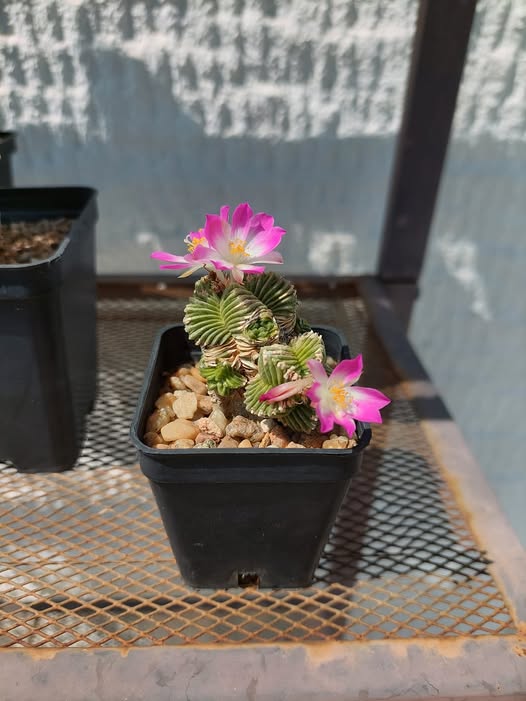
Five ribs, no secondary inter-ribs. That is the lede, and it should be stated plainly. Aztekium ritteri has 6 to 11 main ribs with tubercle bases that form narrow false ribs between the primary grooves. A. valdezii has five, consistently, and the grooves between them are clean; the transverse wrinkles across each rib run evenly from apex to base without the interrupted folds that produce the false-rib appearance in ritteri.
The body is globose, solitary or rarely branching from the base, reaching up to 6 cm in diameter and 1 to 6 cm tall. Stem colour is greenish-grey. Viewed from above, the five-ribbed body presents a five-pointed star outline. Cultivated grafted plants tend to grow more elongated and broader than habitat specimens; the dimensions given here are for plants in natural conditions.
Areoles are woolly with yellowish-white fluff. Each areole carries 3 to 4 spines, 6 to 11 mm long, flattened and papyraceous in texture: soft, paper-like, curving and twisting toward the apex. This papyraceous spine character is genus-wide in Aztekium and distinguishes all three species from virtually every other cactus genus. Spines are concentrated in the upper portion of the stem; lower areoles may carry vestigial or no spines.
Flowers are apical, funnel-shaped, 10 to 19 mm long and 15 to 25 mm across. The inner segments are deep pink to magenta; outer segments grade from white at the centre to bright magenta. Stamens are white with yellow anthers; the style reaches up to 10 mm, with 4 to 5 stigma lobes. Two to three flowers typically open simultaneously at the apex. Bloom season is late spring and early summer. Fruit is rounded and naked, dehiscing after drying. Seeds are ovoid, dark brown, 0.37 to 0.69 mm long and 0.42 to 0.69 mm thick.
Locality detail
The 2013 description by Velazco Macias, Alvarado Vázquez, and Arias Montes deliberately omits GPS coordinates and township-level locality data. The authors cited the poaching risk that had already affected other recently described cacti as justification. Published secondary sources, including llifle (citing the original description), give the locality only as a single canyon in the Sierra Madre Oriental gypsum-canyon system, Nuevo León, Mexico.
That redaction was insufficient to prevent collection. Within weeks of the August 2013 Xerophilia publication, specimens appeared on eBay and online cactus markets. Multiple sources report that the wild population was severely depleted within a few years. Precise locality data is not published on this page; the regional-centroid map marker above represents the general Sierra Madre Oriental canyon area.
Aztekium valdezii care and cultivation
Published cultivation guidance for Aztekium valdezii is thin. The species has been in circulation largely as grafted seedlings since 2014 at earliest, and the slow pace of growth from seed means that even the oldest legal seed-grown plants are barely 12 years old as of 2026. No grower documentation of a seed-grown valdezii at flowering age has been located. The guidance below extrapolates from A. ritteri and genus-level practice; treat it as a framework to refine, not a proven protocol.
Substrate
The habitat is near-vertical gypsum and limestone cliff crevices with fine gypsum clay-silt and minimal organic matter, but no published cultivation source addresses substrate proportions for Aztekium valdezii specifically; the values below extrapolate from the shared genus practice used for A. ritteri. The canonical cultivation ratio is 43 per cent pumice, 10 per cent lava rock, 5 per cent zeolite, 20 per cent granite grit, 12 per cent limestone chip, 5 per cent coarse silica, and 5 per cent worm castings. The limestone share follows the carbonate-convention pairing shared with Ariocarpus, a group-level guideline rather than a species-specific finding; reduce or omit it on hard tap water. The organic share holds at the low end of the taprooted-globular group’s rot-averse range, with no organic component beyond the worm castings. Pumice, lava rock, zeolite, granite grit and coarse silica are the site’s declared house formulation for particle structure and drainage, carrying no lithology claim.
All three Aztekium species on this site grow on near-vertical gypsum and limestone cliff crevices in Nuevo León, but that habitat fact does not set the recipe below. The substrate ratios are effectively identical across the genus: a house formulation carrying a carbonate-convention limestone share paired with the published Ariocarpus finding, plus the site’s standard drainage aggregates. No published cultivation source treats Aztekium substrate at species level.
| Species | Pumice | Lava | Zeolite | Granite | Limestone | Silica | Organic |
|---|---|---|---|---|---|---|---|
| A. ritteri | 43% | 10% | 5% | 20% | 12% | 5% | 5% |
| A. hintonii | 43% | 10% | 5% | 20% | 12% | 5% | 5% |
| A. valdezii (this page) | 43% | 10% | 5% | 20% | 12% | 5% | 5% |
Container depth matters. Plants grown from seed develop a taproot that needs vertical space; wide shallow dishes confine root development and destabilise the plant. Use taller containers proportionate to the body diameter. Glazed or plastic containers suit seedlings better than fast-drying terracotta, which can desiccate the fine taproot too rapidly in the early years.
Watering and light
The habitat microclimate complicates the standard cactus watering frame. North-facing vertical cliff walls receive seep moisture and condensation year-round; the crevice substrate stays comparatively damp even in the dry season. Aztekium is not a drought-adapted xerophyte in the conventional sense. In cultivation, the balance is moist-but-oxygenated substrate during the growing season, not the bone-dry-between-waterings protocol appropriate for Copiapoa or Turbinicarpus.
From spring through summer, water thoroughly when the top half of the substrate is dry; in warm conditions with a fast-draining mix, this is roughly every 10 to 14 days. Reduce through autumn. Winter rest (November through February) should be dry; the plants are not growing and the rot risk climbs when cold, wet substrate sits against the stem collar. Soft water is preferred; hard alkaline water can damage roots over time (BCSS genus notes, genus-level).
Light requirements reflect the north-facing cliff habitat. Full midday sun is not the native condition; bright indirect light or filtered sun is appropriate, with shade from the strongest summer afternoon sun. Unlike many Mexican cacti that thrive in full sun, Aztekium in intense direct sun shows desiccation stress. Morning sun and bright diffuse afternoon light is the practical target.
Cold tolerance
Two figures exist in the literature and they do not agree. BCSS genus notes give a minimum of 5 to 8°C, with a caution that cold humid conditions are harmful. Llifle cites -4°C as a reported brief-survival threshold when the plant is completely dry. The difference likely reflects moisture state: a bone-dry plant can endure brief temperature dips that a moist one cannot survive. Both figures are genus-level, sourced primarily from A. ritteri grower experience; no valdezii-specific cold tolerance figure has been published. The widget floor of 5°C (41°F) reflects the BCSS practical minimum; the -4°C figure is noted here as a grower report for bone-dry plants only, not a recommended operating temperature.
Trade and propagation context
Aztekium valdezii is almost exclusively encountered in current trade as grafted seedlings on Pereskiopsis, Trichocereus, or Echinopsis rootstocks. Grafted plants may reach flowering size in 2 to 3 years; they also tend to grow more elongated and broader than habitat specimens, losing the compact five-ribbed star form that makes wild plants distinctive. Seed grown plants are decade-rare: the species was described in 2013, the first legally propagated seed reached collectors no earlier than 2014, and growth from seed is extraordinarily slow. No published account of a seed grown valdezii at flowering age has been located as of 2026. By analogy with A. ritteri, which takes 7 to 10 years to flower from seed, expect a similar or longer timeline for valdezii; that inference is explicit here because no valdezii-specific data exists to refine it.
CITES documentation is required for any cross-border movement of Aztekium valdezii regardless of appendix. The full CITES history is complex: the species falls under the Cactaceae family-level Appendix II default; CoP18 Doc. 99 and CoP19 Doc. 84.1 referenced valdezii in the context of its possible uplift via the Hunt 2016 synonymy with A. ritteri, but whether A. ritteri holds a confirmed species-specific Appendix I uplift that would carry valdezii via synonymy is unverified at primary source. CoP20 (November–December 2025) primary documents were inaccessible during research; the CoP20 outcome is unverified. The most defensible framing: treat valdezii as Appendix II pending confirmed primary-source evidence of an Appendix I uplift. Wild collection and trade remain prohibited under Mexican federal law regardless of CITES appendix.
Comparison
With only three species in the genus, the identification matrix is small. The most practically important comparison is valdezii versus A. ritteri, the species it was synonymised under in the 2016 New Cactus Lexicon and the one most commonly encountered in established collections. Rib count is the quickest check: a plant showing five ribs is valdezii; one showing six or more is ritteri. On juvenile plants where rib count can be ambiguous at first glance, the absence of secondary inter-ribs in valdezii resolves the question. Run a finger along a groove: in ritteri, the tubercle bases between primary grooves produce a rougher, interrupted texture. In valdezii, the groove is clean.
Flower colour adds a second character at bloom time. A. valdezii flowers are white at the centre grading to bright magenta on the outer segments, giving a bicolour appearance. A. ritteri flowers are smaller and paler, typically white with a pink to pale-pink stripe, without the bold magenta intensity of valdezii.
The comparison with A. hintonii is less practically urgent because hintonii looks strikingly different from valdezii in person. A. hintonii carries 10 to 15 ribs, grows larger (up to 10 cm diameter), and has sharply pronouned rib edges with numerous fine transverse wrinkles on their flanks. Both species share the absent-secondary-inter-rib character, but the rib count difference is visually dramatic at any plant size. The FAQ table below focuses the head-to-head comparison on ritteri, where the distinction requires more careful attention.
Frequently asked questions
How do you tell Aztekium valdezii apart from Aztekium ritteri?
Aztekium ritteri is the most commonly held species in the genus and the one most likely to be confused with valdezii in a mixed collection. Hunt’s 2016 New Cactus Lexicon synonymised the two; later molecular work separated them; the identification characters below hold regardless of which taxonomic treatment one follows. Drag the slider to compare both plants, then check the character table.


Rib count is the fastest check: count five and you have valdezii. When rib count is ambiguous on a young plant, run a fingertip along a primary groove; the clean texture in valdezii versus the interrupted false-rib surface in ritteri is immediately perceptible. Flower colour confirms the identification when plants are in bloom.
Is Aztekium valdezii difficult to grow?
Advanced, for two related reasons. First, the gypsum-crevice substrate requirement is unlike most cactus growing; the mix must drain immediately while still providing the cool, diffuse moisture the north-facing cliff microhabitat supplies. Second, growth from seed is extraordinarily slow, and essentially no species-specific cultivation literature exists to guide the grower. Grafted plants are substantially easier to manage and produce flowers within 2 to 3 years, but lose the compact five-ribbed character of habitat plants. For collectors who want the true form, patience of 7 to 10 years or more from seed is the realistic expectation, based on the closely related A. ritteri.
Is Aztekium valdezii legal to own?
Nursery-propagated plants with documentation of captive origin can be legally owned and traded within national borders in most countries. Cross-border movement requires CITES documentation. The CITES status of valdezii is contested: the Cactaceae family-level Appendix II default applies absent a confirmed species-specific listing; CoP18 and CoP19 documents referenced valdezii in connection with a possible Appendix I classification via synonymy with A. ritteri, but the operative outcome of those documents is unverified at primary source, and CoP20 (2025) documents were inaccessible during research. Wild collection is prohibited under Mexican federal law regardless of CITES appendix. Purchase only from sellers with documented nursery-propagation origin and CITES paperwork.
Where does Aztekium valdezii grow in the wild?
In a single canyon within the Sierra Madre Oriental gypsum-canyon system of Nuevo León, Mexico, at 850 to 1,045 m elevation. Plants grow in crevices on near-vertical north-facing cliff faces of gypsum and limestone rock, in fine gypsum clay-silt with minimal organic content. The precise canyon is not published; the 2013 description deliberately withheld the locality to reduce poaching pressure. The total known range is approximately 2 km². Associated vegetation includes Agave lechuguilla, Hechtia glomerata, and Selaginella lepidophylla.
When does Aztekium valdezii flower, and how long until a seed-grown plant blooms?
Bloom season is late spring and early summer; 2 to 3 flowers typically open simultaneously at the apex. The funnel-shaped flowers are 15 to 25 mm across, white at the centre grading to bright magenta on the outer segments. As for the timeline to first flower from seed: no documented case of a seed grown valdezii reaching flowering age has been located as of 2026. The species was described in 2013; the oldest legal seed-grown plants are barely 12 years old and almost certainly grafted. By analogy with A. ritteri, which takes 7 to 10 years from seed, valdezii is likely to require at least as long; that is an explicit inference from a sibling species, not a confirmed valdezii figure.
Why is Aztekium valdezii so rare?
Three factors compound each other. First, the species has a single-canyon range of approximately 2 km² by nature; even before human pressure, the population was inherently small and vulnerable. Second, the 2013 publication gave collectors a specific target and the wild population was heavily looted within years, despite the locality redaction in the original description. Third, plants from seed take 7 to 10 or more years to reach maturity, meaning legal captive propagation catches up very slowly with collection demand. Wild plants are near-extirpated by poaching; seed grown specimens in cultivation are decade-rare.
Sources & further reading
Velazco Macias, C.G., Alvarado Vázquez, M.A. & Arias Montes, S. (2013). Aztekium valdezii sp. nov. Xerophilia Special Issue no. 2: 5, August 2013 · Korotkova, N. et al. (2021). Cactaceae at Caryophyllales.org. Willdenowia 51(2): 251–270 · Kew POWO, Aztekium valdezii Velazco, M.A.Alvarado & S.Arias, IPNI lsid urn:lsid:ipni.org:names:77131602-1 · Wikispecies: Aztekium valdezii (IPNI confirmation, POWO synonymy note) · llifle.com Encyclopedia of Living Forms, Aztekium valdezii entry ID 25623 · British Cactus and Succulent Society (BCSS), Cultivation Notes on Aztekium · CITES CoP18 Doc. 99. Aztekium valdezii CITES listing history (PDF blocked; reconstructed from secondary citations 2026-04-26) · Giromagi Cactus and Succulents, Aztekium valdezii species page · Succulents Network, Aztekium valdezii Care Guide · iNaturalist, Aztekium valdezii taxon 475059 · Wikidata Q135125, Aztekium ritteri, IUCN Least Concern 2022.2 (cross-reference) · Wikipedia, Aztekium hintonii (comparative morphology reference) · Hunt, D. 2016. New Cactus Lexicon, 3rd ed. (CITES Cactaceae Checklist); synonymy of valdezii under ritteri noted but not followed by POWO