Copiapoa hypogaea var. barquitensis — The Barquito Form
| Family | Cactaceae |
| Named by | F.Ritter |
| Parent species | Copiapoa hypogaea |
| Type locality | Barquito, S of Chañaral |
| Epidermis | Smooth (vs rugose in type) |
| Stem diameter | 3–4 cm (to 7 in cultivation) |
| Ribs | 10–14(16), spiraled tubercles |
| Spines | More prominent than type; centrals present |
| Habit | Clumping, 4–5 heads |
| IUCN status | Endangered (species level) |
| CITES | Appendix II |
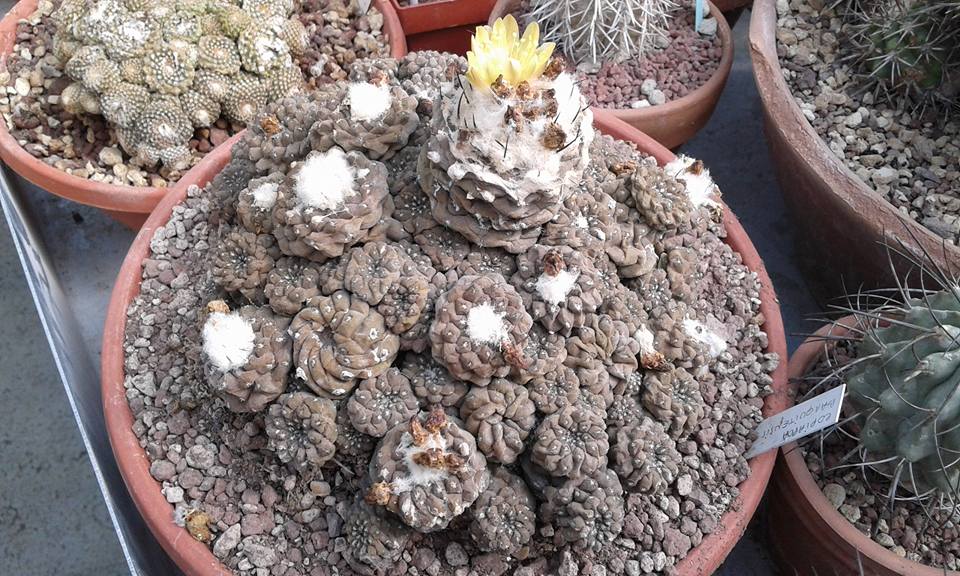
If you own a Copiapoa hypogaea, it is almost certainly this plant. Var. barquitensis is the smooth-skinned form from near the town of Barquito, south of Chañaral. It is more widely distributed in cultivation than the rugose “Lizard Skin” type form from north of Chañaral, and it is the variety most seed vendors list when they offer hypogaea material. For many collectors, it is the entry point into one of the genus’s most unusual species groups.
The plant shares the subterranean habit of the parent species: a depressed-globose body growing flush with or below the soil surface, connected to a tuberous-napiform taproot through a narrow neck. What distinguishes barquitensis is the epidermis. Where the type form has a rough, granular surface, barquitensis is smooth. The tubercles are low and spiraled, the areoles woolly when young, and the spines, while still short, are more numerous and more prominent than in the nearly spineless type. Central spines appear in barquitensis; they are typically absent in the type form.
The name comes from Barquito, a small settlement a few kilometers south of Chañaral on the Atacama coast. The locality is urbanized and environmentally degraded by copper mining infrastructure. This is not a remote, pristine habitat; it is a place where cacti and industry share the same ground, and the cacti are losing. Mature seed grown specimens of var. barquitensis with documented provenance carry value well into the thousands, reflecting both the difficulty of growing them to maturity and the declining security of their wild source population.
Conservation status
Copiapoa hypogaea is listed as Endangered by the IUCN Red List (Faundez et al., 2013/2024). The species-level assessment covers all infraspecific taxa. The Barquito locality is urbanized and degraded by industrial mining activity. Distribution is severely fragmented with an EOO under 150 square kilometers. Some populations occur within Pan de Azúcar National Park.
Contents
Morphology
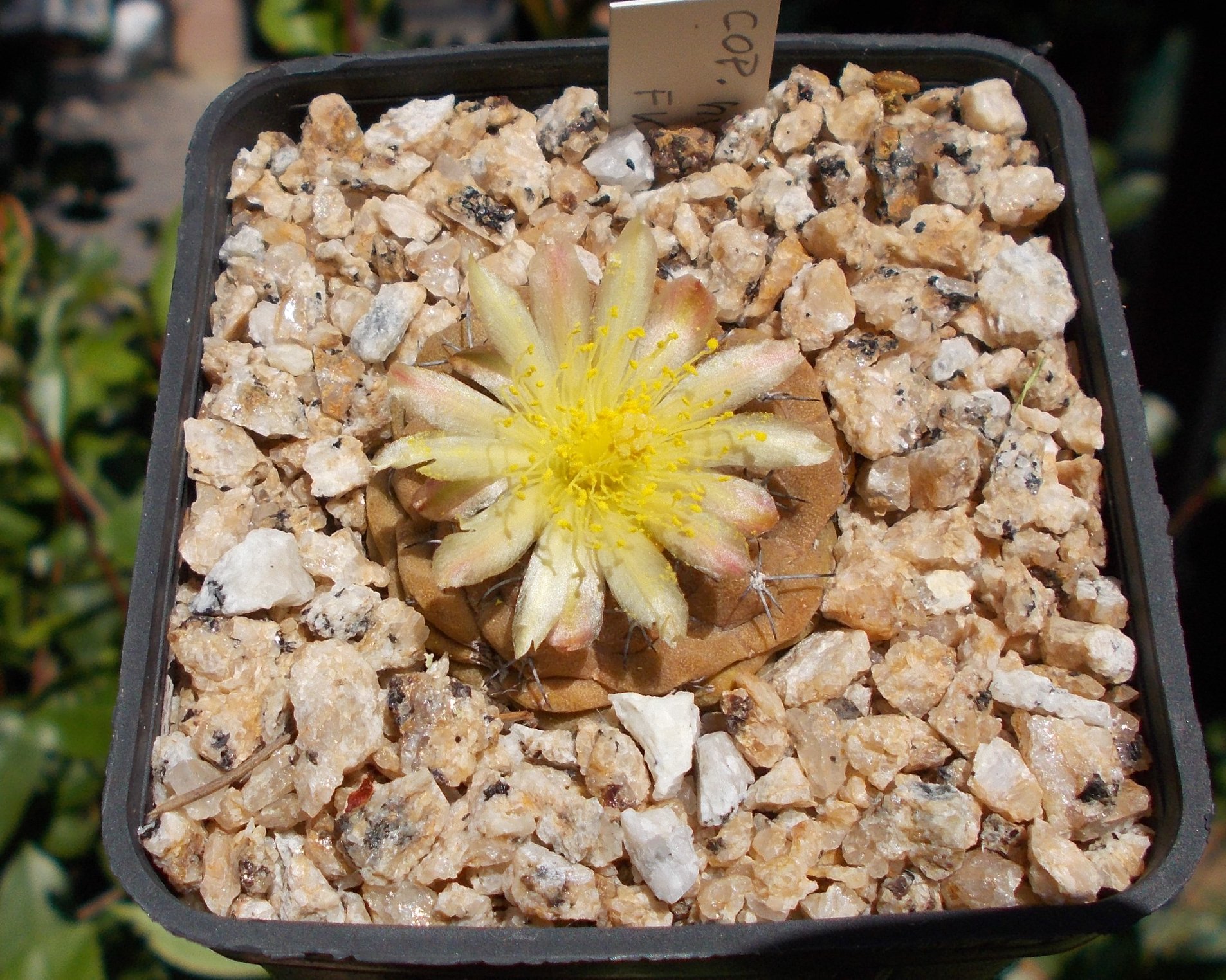
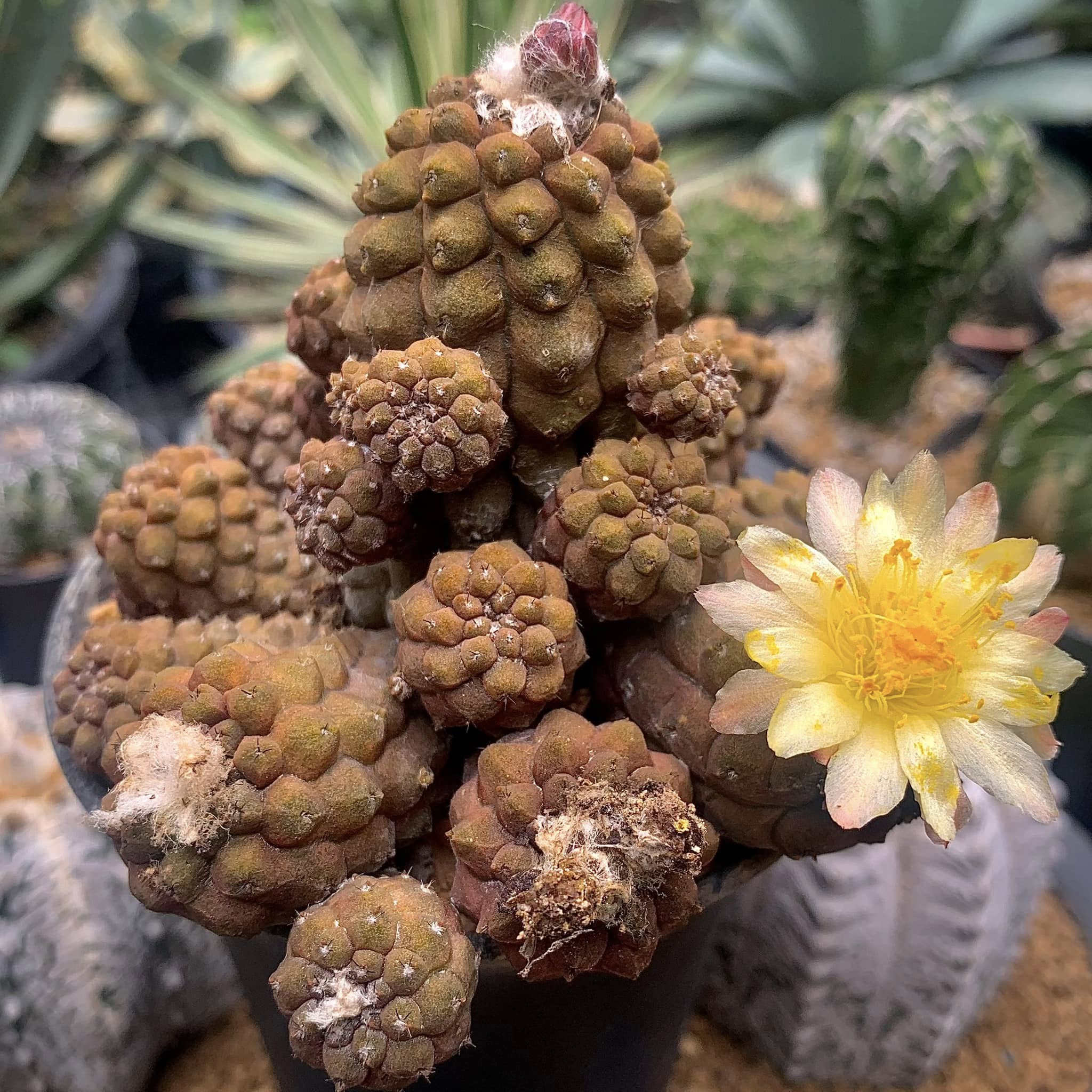
The smooth epidermis of var. barquitensis, with low spiraled tubercles and short black spines. Note the central spine visible at upper areoles, a character less common in the rugose type form.
The stem is depressed-globose, 3 to 4 centimeters in diameter in habitat, reaching up to 7 centimeters in cultivation. The aerial portion is almost disc-shaped, grey-brown to bronzed, and grows flush with the soil surface. The apex is sunken and filled with white wool, identical in form to the type variety. The key diagnostic character is the epidermis: smooth, without the rugose granular texture of the northern “Lizard Skin” populations.
Ribs number 10 to 14, occasionally up to 16, dissolved into extremely low tubercles arranged in spirals. Individual tubercles are 4 to 8 millimeters apart, 4 to 7 millimeters in diameter, and up to 5 millimeters tall. Areoles sit at the tips of the tubercles, covered with short whitish wool when young, becoming hairless with age.
Spination is more developed than in the type form. Short black spines are present at most areoles, with occasional central spines in addition to the marginals. This gives barquitensis a slightly more armed appearance than the nearly spineless type, though the spines remain short and the overall effect is still restrained by cactus standards.
The plant clumps more readily than the type form, typically producing 4 to 5 heads from the base. This clustering habit makes mature barquitensis visually distinct from the typically solitary type. Flowers and fruit are identical to the species description: yellow with reddish outer segments, approximately 2 centimeters long, opening for a single day.
How barquitensis Differs from the Type Form
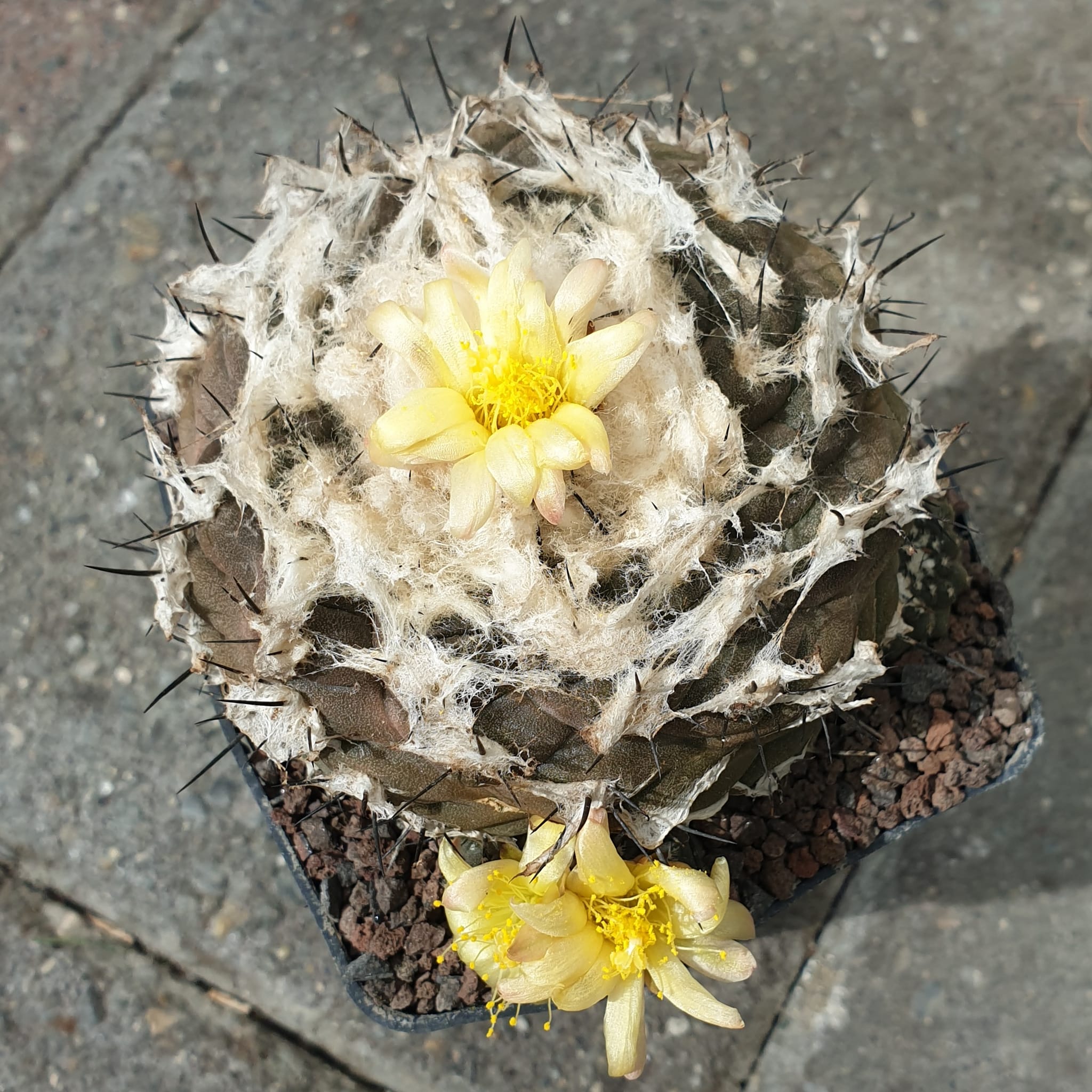 var. barquitensis
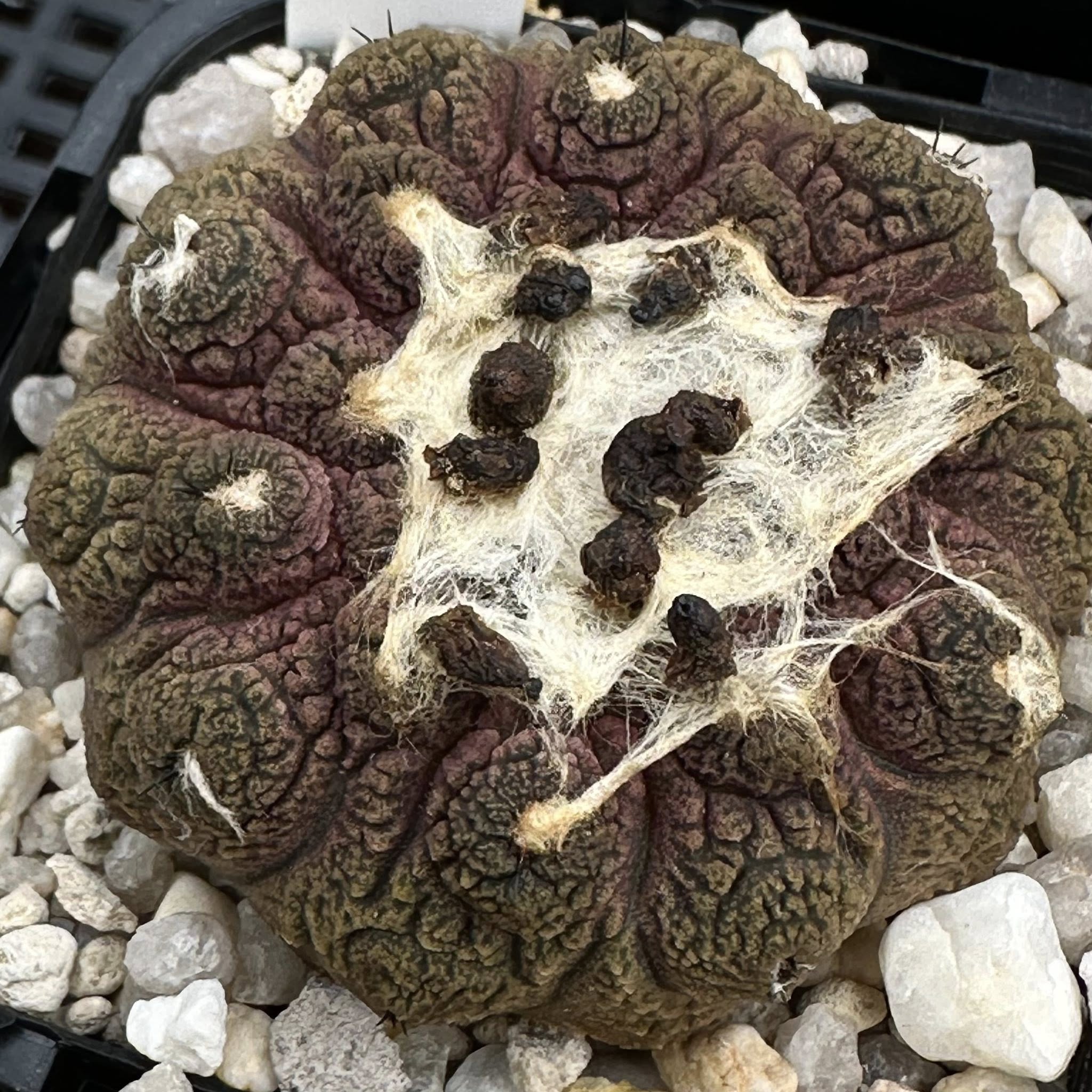 Lizard Skin (type)
The differences between the two are consistent and heritable. Seed grown plants from barquitensis parentage produce smooth epidermis; seed grown plants from the northern “Lizard Skin” population produce rugose epidermis. This is not environmental plasticity. The character breeds true and can be relied upon for identification.
Beyond the epidermis, barquitensis tends to cluster more readily (4 to 5 heads versus typically solitary type), produce slightly more prominent spination (including centrals), and reach a somewhat smaller maximum stem diameter in habitat. The root structure is identical: both produce the same tuberous-napiform taproot connected through a narrow neck.
Habitat & Barquito
The type locality of var. barquitensis is the area near and south of the town of Barquito, itself a few kilometers south of Chañaral. The habitat is low-elevation coastal desert: flat to gently sloping sandy gravel substrate at elevations near sea level. Fog provides the primary moisture source.
The Barquito area is one of the most environmentally compromised Copiapoa localities. Urbanization, copper mining operations, mine tailings, and road construction have fragmented and degraded the habitat. Plants growing near the edges of development face direct physical disturbance, dust deposition, and altered drainage patterns. The situation contrasts sharply with protected sites like Pan de Azúcar National Park, where Copiapoa esmeraldana enjoys formal legal protection.
Locality Detail
Cultivation
The basics
Cultivation mirrors the parent species: deep pot for the taproot, almost purely mineral substrate with pumice, light watering with complete dryout between sessions, bone-dry winter, full sun. Considered slightly more robust in cultivation than the “Lizard Skin” type, which is good news for growers entering the hypogaea complex for the first time.
Developing the character
The smooth epidermis, low tubercles, and bronzed body color develop best under strong light and lean conditions. Plants grown in shade or with excessive watering produce greener, softer bodies that lack the desert character of well-grown specimens. The clustering habit of barquitensis means that patience produces a multi-headed mound over time: 4 to 5 heads in a decade, each with its own sunken woolly apex, is a realistic expectation for a well-managed seed grown plant.
Seed grown is the standard. Grafted plants grow faster but lose the flat, disc-shaped habit that defines the species. A grafted hypogaea that sits above the soil surface like a conventional globose cactus is technically alive but has lost the visual point of the plant entirely. Copiapoa humilis subsp. tenuissima remains the recommended entry point for growers new to the genus; once you can keep tenuissima healthy, barquitensis is a reasonable next step.
Related Taxa in the Genus
Copiapoa solarisThe sun cactus of the Atacama. Restricted to two fog-dependent localities near El Cobre and Blanco Encalada. Slower than Aztekium on its own roots.Copiapoa humilis subsp. tenuissimaA compact, dark-bodied form from the Paposo coast. Faster growing and more forgiving than the cinerea complex, it is an excellent entry point for collectors new to the genus.Copiapoa humilisThe parent species of the humilis complex. Miniature clustering habit, highly variable across its range from Paposo to Chañaral.Copiapoa cinereaThe silver ghost of the Atacama. Three geographically segregated subspecies span the coast from Caleta Colorado to Chañaral. The most iconic species in the genus.Copiapoa cinerea subsp. krainzianaThe shaggy-spined showpiece from the quebradas north of Taltal. Hair-like white spines are unique in the cactus family. A single known population.Copiapoa cinerea subsp. cinereaThe classic Taltal form. The nominotypical subspecies with the most iconic silver farina, dark spines, and the form most collectors picture when they hear the name.Copiapoa lauiA miniature species from a single site near Esmeralda. Tiny, densely clustering heads with fine white spines. Rivals Copiapoa solaris for restricted range.Copiapoa esmeraldanaEsmeralda coast. Best habitat condition of any Copiapoa but range extremely narrow. Affinities to the cinerea complex.Copiapoa hypogaeaPartially subterranean. The most unusual growth form in the genus, with the stem largely buried below the soil surface.
Sources & References
Ritter, F. (1960). Copiapoa hypogaea sp. nov. Cactus (Paris) 15(66): 19. · Schulz, R. & Kapitany, A. (1996). Copiapoa in Their Environment: Chañaral to El Cobre. · Hunt, D. (2013). The New Cactus Lexicon. · Faundez, L. et al. (2013). Copiapoa hypogaea. IUCN Red List 2013: e.T152083A595222. · Larridon, I. et al. (2015). An integrative approach to understanding the evolution and diversity of Copiapoa. American Journal of Botany 102: 1506–1520. · Royal Botanic Gardens, Kew. Plants of the World Online. Retrieved 2026.