Copiapoa cinerea subsp. krainziana
Copiapoa cinerea subsp. krainziana — The Shaggy Ghost of Quebrada San Ramón
| Family | Cactaceae |
| Named by | (F.Ritter) Slaba (1997) |
| Basionym | Copiapoa krainziana F.Ritter (1963) |
| Parent species | Copiapoa cinerea |
| Native range | N of Taltal, Quebrada San Ramón |
| Altitude | 400–1,200 m |
| Area | ~60 km² total; AOO <20 km² |
| Spines | 14–20 centrals, 10–12 radials, filiform |
| Population | Single active colony |
| IUCN status | Critically Endangered |
| CITES | Appendix II |
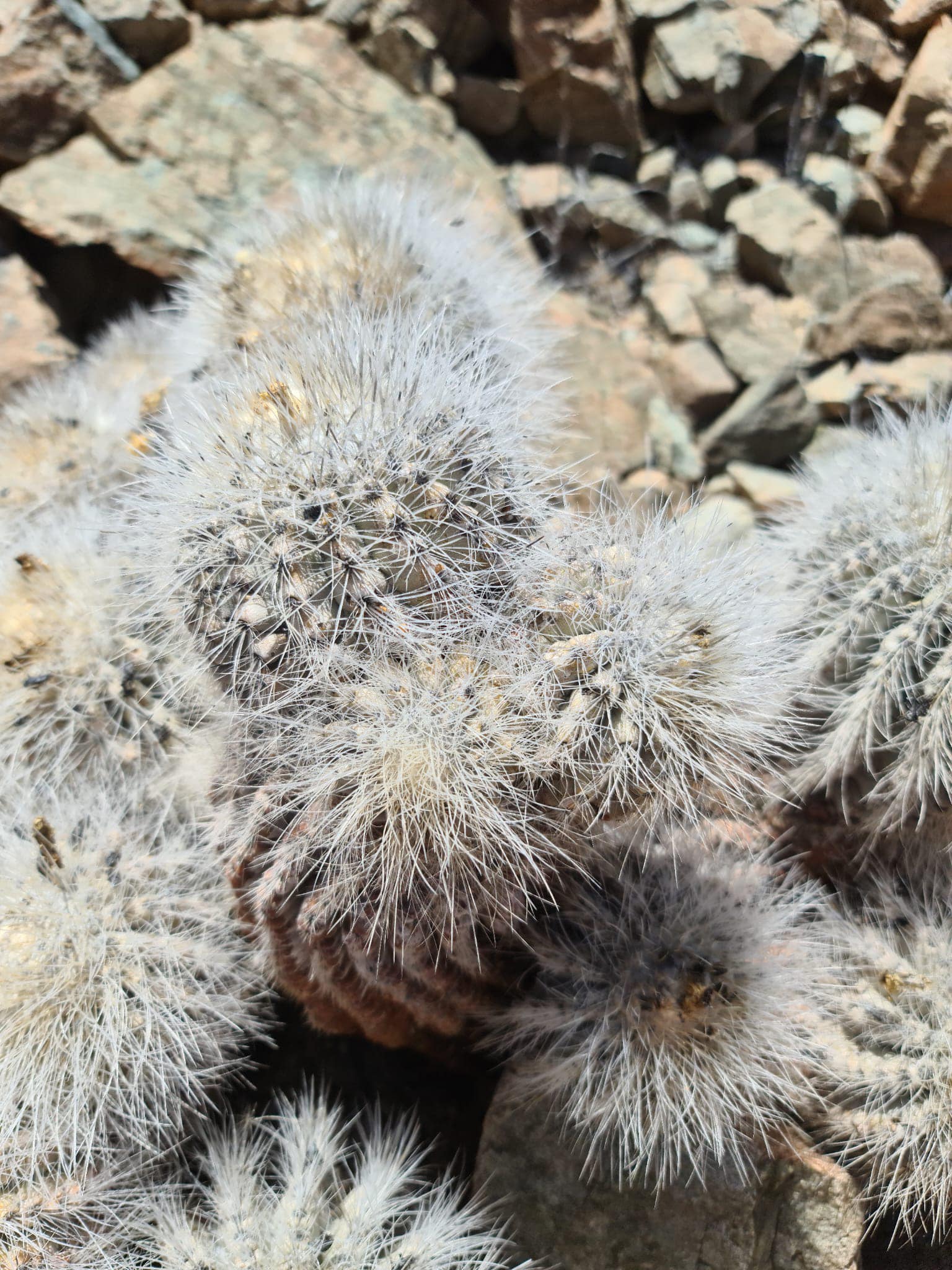
No cactus in the world looks like Copiapoa cinerea subsp. krainziana. Where the parent species Copiapoa cinerea carries a few robust, dark, subulate spines per areole, krainziana produces 14 to 20 fine, thread-like central spines and 10 to 12 radials, all white to greyish, all interweaving into a dense, shaggy coat that covers the body like matted hair. The visual effect is so different from any other Copiapoa that Friedrich Ritter described it as a full species in 1963. Most modern authorities treat it as a subspecies of Copiapoa cinerea, but even in that reduced rank, it remains the single most morphologically distinctive taxon in the entire cinerea complex.
The plant exists in one place. A single confirmed population occupies the Quebrada San Ramón, a ravine system in the coastal mountains north of Taltal in the Antofagasta Region of Chile. The total range is estimated at roughly 60 square kilometers, with an area of occupancy under 20 square kilometers. Everything that makes this subspecies remarkable is concentrated in that one drainage. If that population disappears, the taxon goes with it.
In cultivation, krainziana is the most recognizable and arguably the most desired form of Copiapoa cinerea. The spine character develops well in greenhouse conditions, often producing a fuller and more symmetrical covering than plants manage in the wind-battered quebrada. Flowering maturity takes 15 to 20 years in habitat but can be reached in 5 to 8 years in cultivation. Mature seed grown specimens with fully developed filiform spine coverage command prices comparable to the finest subsp. cinerea material, often exceeding $5,000 for plants of 15 to 20 years.
Conservation status
Copiapoa cinerea subsp. krainziana is listed as Critically Endangered by the IUCN Red List (Saldivia, Guerrero, Faundez & Walter, 2013/2024). A single active population in Quebrada San Ramón. No in-situ protection. Threats include fog retreat, habitat disturbance, and hybridization with adjacent subsp. cinerea that may limit ongoing speciation. Conserved in ex-situ seed bank and living collections, including the UK National Collection at Chester Zoo.
Contents
Taxonomy & Nomenclature
Friedrich Ritter described Copiapoa krainziana in 1963, publishing the name in Taxon 12, page 30. The species epithet honors Hans Krainz (1906–1980), a Swiss botanist and cactus specialist who directed the Sukkulenten-Sammlung Zürich for decades. Ritter considered the filiform spine character distinct enough to justify full species rank, a position that held for over three decades.
The transfer to subspecific rank came from Rudolf Slaba in 1997, who published the combination Copiapoa cinerea subsp. krainziana (F.Ritter) Slaba in Kaktusy (Brno) 33, a special issue. This reclassification reflected the growing consensus that the filiform spine character, while visually dramatic, represents a localized morphological extreme within the broader Copiapoa cinerea continuum rather than evidence of a separate evolutionary lineage. Molecular work by Larridon et al. (2018) supported this placement: krainziana shows minor but consistent sequence variation from the other cinerea subspecies (one nucleotide insertion and one substitution in the chloroplast marker rpl32-trnL), confirming genetic distinction at the subspecific level without warranting species-level separation.
Two named varieties are recognized in the trade. Copiapoa krainziana var. brunispina produces brownish rather than white spines and forms large clumps up to one meter wide. Some authors consider brunispina part of a hybrid swarm between subsp. krainziana and subsp. cinerea. Copiapoa krainziana var. scopulina F.Ritter has fewer spines, typically 10 to 20 total.
Habitat & the Quebrada San Ramón
The entire confirmed population of subsp. krainziana grows in the Quebrada San Ramón and adjacent ravines in the coastal mountains north of Taltal. The altitude range spans approximately 400 to 1,200 meters, with some reports suggesting plants may occur up to 2,000 meters in the highest parts of the drainage. Plants grow on north-facing slopes where fog influence is heavy and the accompanying vegetation is dense by Atacama standards, including columnar Eulychnia cacti and xerophytic shrubs.
This preference for north-facing slopes with heavy fog and dense vegetation cover distinguishes krainziana ecologically from subsp. cinerea, which tends to grow on more exposed, inland hillsides. The dense vegetation in the quebrada may contribute to the development of the filiform spine character: in a protected, fog-rich microclimate, the long thread-like spines may function as efficient fog-condensing surfaces, trapping moisture from the camanchaca more effectively than the short, robust spines of subsp. cinerea in its more exposed habitat.
The population health is better than might be expected for a Critically Endangered taxon. Schulz (2006) documented few dead individuals and frequent seedlings of all size classes, suggesting active and ongoing recruitment. The IUCN listing reflects the extreme geographic restriction (a single site) and the vulnerability that comes with it, not a population in active collapse. A single catastrophic event, whether mining activity, road construction, or a sustained shift in fog patterns, could eliminate the entire subspecies.
The subspecies is not protected in any formal reserve. It is conserved ex-situ in seed banks and living collections, including the UK National Collection of Copiapoa at Chester Zoo. The 2025 Copiapoa Action Plan identified increased in-situ protection as a priority.
Morphology
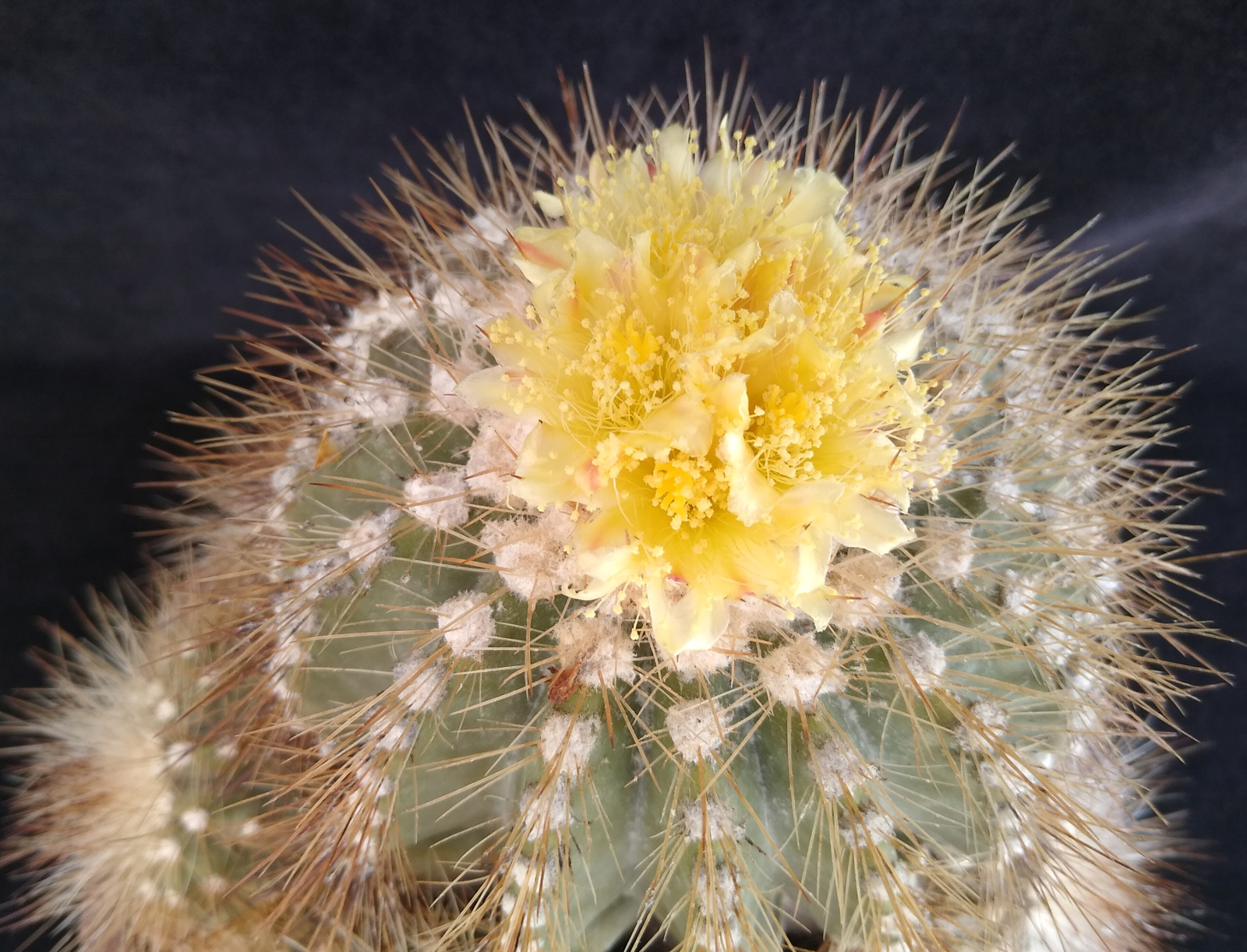
The filiform spine character up close: dozens of fine, thread-like white spines per areole interweave into a shaggy coat unlike anything else in the cactus family. Cultivated plants often develop a fuller covering than wind-battered wild specimens.
The body form is globose to short-cylindrical, with stems reaching 15 to 20 centimeters in diameter and comparable height. The epidermis carries the silver-white farina characteristic of the parent species, though the dense spine coverage often obscures it. The apex is covered in fine white wool from which the spines radiate.
The spine character defines the subspecies. Each areole produces 14 to 20 central spines and 10 to 12 radials, all filiform (thread-like), fine, flexible, and white to greyish. The combined effect of dozens of these fine spines per areole, multiplied across the entire body surface, creates a shaggy, mane-like covering that is unique in the cactus family. No other cactus species, in any genus, produces a comparable spine form. In old plants, the accumulated spines from many years of growth hang in a dense curtain that can almost completely conceal the stem beneath.
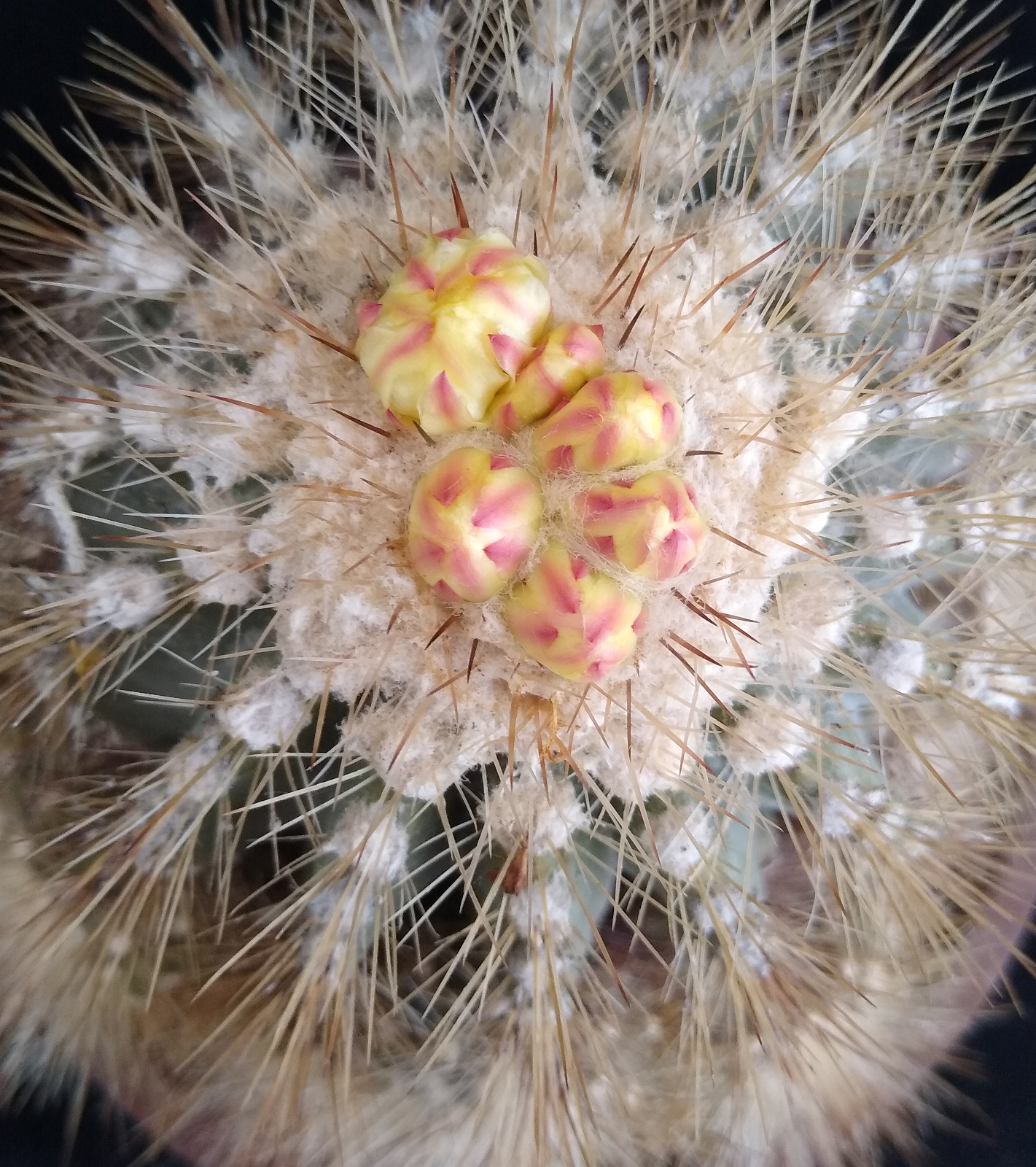
Flowers are yellow, funnel-shaped, emerging from the woolly apex. The perianth segments carry the red tips and mid-stripes characteristic of subsp. cinerea, though these can be less pronounced in some krainziana individuals. Flowering maturity in habitat takes 15 to 20 years. The ribs number 8 to 10, spiraled, prominent, with clearly defined areoles set close together along the rib crests.
Hybridization & the Cinerea Continuum
At the southern edge of its range, where the Quebrada San Ramón opens toward the coastal plain near Taltal, subsp. krainziana grows in close proximity to subsp. cinerea and to populations historically referred to as Copiapoa haseltoniana (now treated as Copiapoa gigantea). In these contact zones, intermediate plants occur: individuals with spine characters that blend the filiform form of krainziana with the subulate form of subsp. cinerea. These intermediates have been described as a natural hybrid, Copiapoa × scopa, and their existence complicates both taxonomy and field identification.
Larridon et al. (2018) confirmed with microsatellite data that gene flow occurs between the subspecies, driven by shared pollinators (bees and hoverflies) and overlapping flowering periods. The researchers noted that ongoing hybridization with subsp. cinerea may actually limit the future speciation potential of krainziana: rather than continuing to diverge into a fully independent lineage, it may be progressively absorbed into the broader cinerea gene pool at its range margins.
Field observations in the Quebrada San Ramón suggest an altitudinal gradient. At the highest elevations, plants show the purest krainziana morphology with fully developed filiform spines. At lower elevations closer to the coast, the spine character becomes progressively more intermediate, grading into forms that are difficult to assign confidently to either subspecies. Whether this gradient reflects hybridization, environmental plasticity, or both remains an open question.
Locality Detail
The Quebrada San Ramón is the core of the distribution. Plants grow on north-facing rocky slopes within the ravine system, in areas where fog accumulates most densely and vegetation cover is high. The quebrada runs roughly perpendicular to the coast, channeling fog-laden air from the Pacific inland and upslope. The lower reaches of the drainage grade into subsp. cinerea territory. The upper reaches, at 800 to 1,200 meters, support the most morphologically extreme krainziana plants.
Cultivation
Growing the spine character
The filiform spines are the reason collectors grow this plant, and they develop well in cultivation. In fact, cultivated plants often produce a fuller, more symmetrical spine covering than wild plants, which are subject to wind damage, sand abrasion, and UV degradation that thin and break the delicate spines over time. A greenhouse environment protects the fine spination and allows it to accumulate into the dense, shaggy coat that defines the subspecies at its best.
Moderate light produces the best spine development. Unlike subsp. cinerea, which needs strong UV to develop its farina, krainziana benefits from some shade during the hottest hours. This aligns with its natural ecology in the fog-heavy, vegetation-dense quebrada, where direct sun exposure is lower than on the open hillsides where subsp. cinerea grows. Morning sun with afternoon shade, or 30 to 40 percent shade cloth year-round, works well.
Substrate and watering
Standard Copiapoa cultivation applies: mineral-dominant substrate with pumice as the primary aggregate, fast drainage, light regular watering in the growing season with complete dryout between applications, bone-dry in winter. The taproot needs a deep pot. Copiapoa humilis subsp. tenuissima tolerates more generous conditions and remains the better starting point for growers new to the genus.
Growth rate and pricing
In cultivation, krainziana grows faster than in habitat and can reach flowering maturity in 5 to 8 years compared to 15 to 20 years in the wild. Seed grown plants are the collector standard. Young specimens under five years sell for $100 to $300. At 10 to 15 years, with well-developed filiform spine coverage, prices reach $2,000 to $5,000. The most mature seed grown specimens, showing the full shaggy character that takes 15 to 20 years to develop in cultivation, have sold for $5,000 to $10,000 in private transactions. The extreme rarity of the wild population and the visual uniqueness of the spine form drive consistent demand.
Comparing krainziana to the Other Subspecies
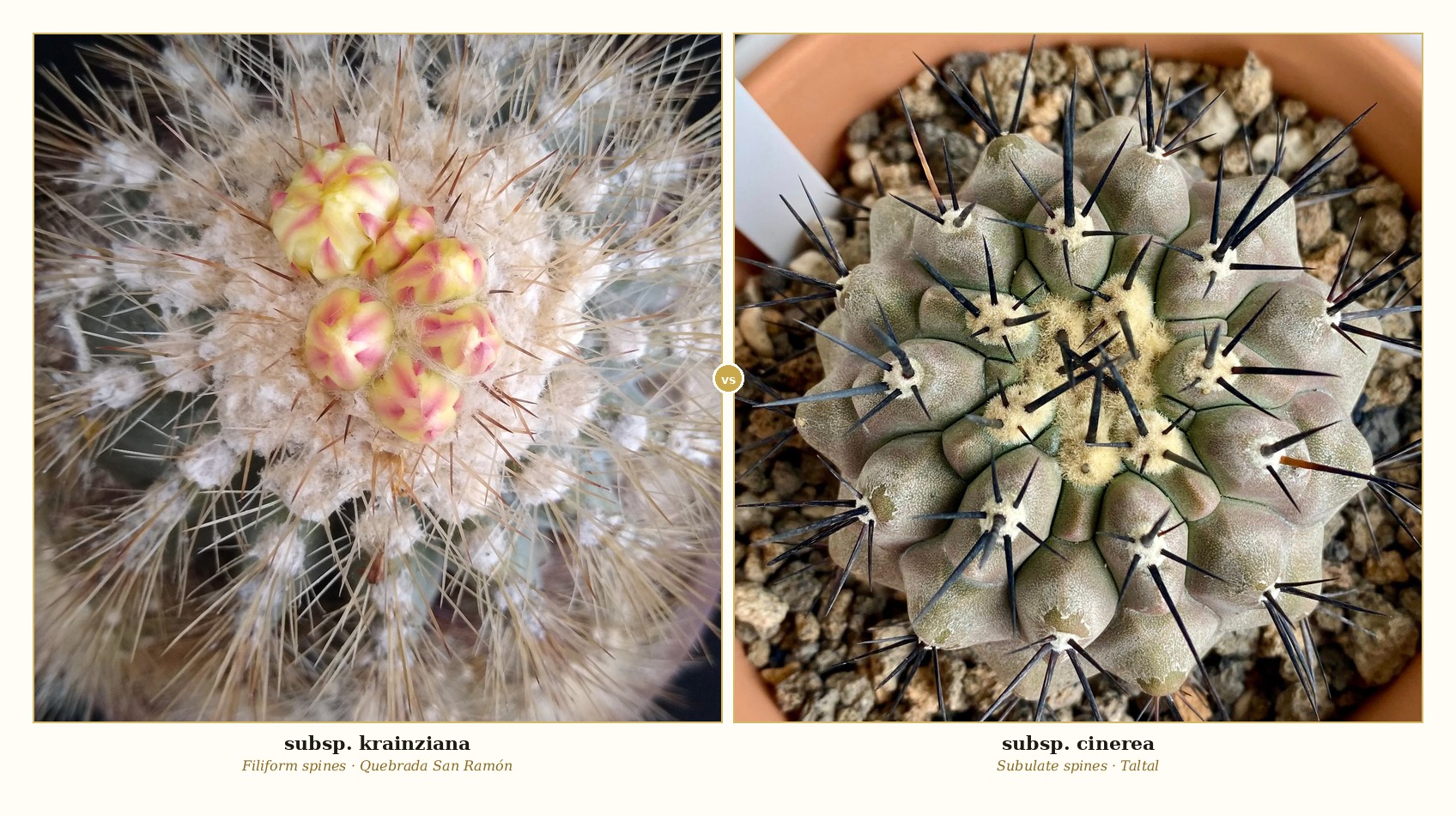
The differences from subsp. cinerea are immediately obvious. Subsp. cinerea has fewer than 10 robust, subulate, dark spines per areole. Subsp. krainziana has 24 to 32 fine, filiform, white spines per areole. The visual effect is entirely different: one is architectural and stark, the other is soft and textural. In habitat, subsp. cinerea occupies open, inland hillsides; krainziana grows in protected, fog-dense quebradas with heavy vegetation. Subsp. cinerea has the poorest recruitment among the three subspecies; krainziana shows healthy seedling establishment. The paradox is that the more abundant subspecies is demographically weaker.
From subsp. columna-alba, krainziana differs in branching habit (clustering versus typically solitary), rib count (8–10 versus up to 50), and spine form. Columna-alba occupies sandy coastal valleys further south, well beyond the Taltal area, and the two subspecies do not come into direct contact. Among the other species in the genus, Copiapoa solaris shares the Critically Endangered status and extreme geographic restriction but produces a completely different spine character: robust, amber to grey, interlocking rather than filiform.
Related Taxa in the Genus
Copiapoa solarisThe sun cactus of the Atacama. Restricted to two fog-dependent localities near El Cobre and Blanco Encalada. Slower than Aztekium on its own roots.Copiapoa humilis subsp. tenuissimaA compact, dark-bodied form from the Paposo coast. Faster growing and more forgiving than the cinerea complex, it is an excellent entry point for collectors new to the genus.Copiapoa humilisThe parent species of the humilis complex. Miniature clustering habit, highly variable across its range from Paposo to Chañaral.Copiapoa cinereaThe silver ghost of the Atacama. Three geographically segregated subspecies span the coast from Caleta Colorado to Chañaral. The most iconic species in the genus.Copiapoa cinerea subsp. cinereaThe classic Taltal form. The nominotypical subspecies with the most iconic silver farina, dark spines, and the form most collectors picture when they hear the name.Copiapoa lauiA miniature species from a single site near Esmeralda. Tiny, densely clustering heads with fine white spines. Rivals Copiapoa solaris for restricted range.Copiapoa esmeraldanaEsmeralda coast. Best habitat condition of any Copiapoa but range extremely narrow. Affinities to the cinerea complex.Copiapoa hypogaeaPartially subterranean. The most unusual growth form in the genus, with the stem largely buried below the soil surface.Copiapoa hypogaea var. barquitensisDistinct variety from Barquito. Flatter, more tuberculate stems. Sought by specialist collectors for its unusual surface texture.
Sources & References
Ritter, F. (1963). Copiapoa krainziana sp. nov. Taxon 12: 30. · Slaba, R. (1997). Copiapoa cinerea subsp. krainziana. Kaktusy (Brno) 33 (special): 3. · Schulz, R. & Kapitany, A. (1996). Copiapoa in Their Environment: Chañaral to El Cobre. · Schulz, R. (2006). Copiapoa. · Machado, M. (2002). A Copiapoa krainziana tale. British Cactus and Succulent Journal 20(2): 58–68. · Hunt, D. (2013). The New Cactus Lexicon. · Saldivia, P. et al. (2013). Copiapoa krainziana. IUCN Red List 2013: e.T152458A639215. · Larridon, I. et al. (2018). Investigating taxon boundaries in Copiapoa subsection Cinerei. Kew Bulletin 73: 55. · Villalobo-López, A. et al. (2024). Effects of trade and poaching pressure on extinction risk. Conservation Biology 38: e14353. · Royal Botanic Gardens, Kew. Plants of the World Online. Retrieved 2026.