
Cleistocactus
Known Species
What is Cleistocactus and what makes it different from other cacti?
Kew’s Plants of the World Online accepts around 45 species of Cleistocactus, slender columnar and pendant cacti from the Andes of South America. The name comes from the Greek kleistos, meaning closed, and it points straight at the diagnostic character. That character is the flower. Where most cacti open a wide cup, Cleistocactus produces a narrow tubular bloom, slightly bent, that barely parts at the tip and suits a hummingbird rather than a bee. Set on thin stems that carry many ribs and dense spines, that almost-closed flower separates the genus at a glance from the barrel cacti and the globular Mexican groups.
Where does Cleistocactus grow in the wild?
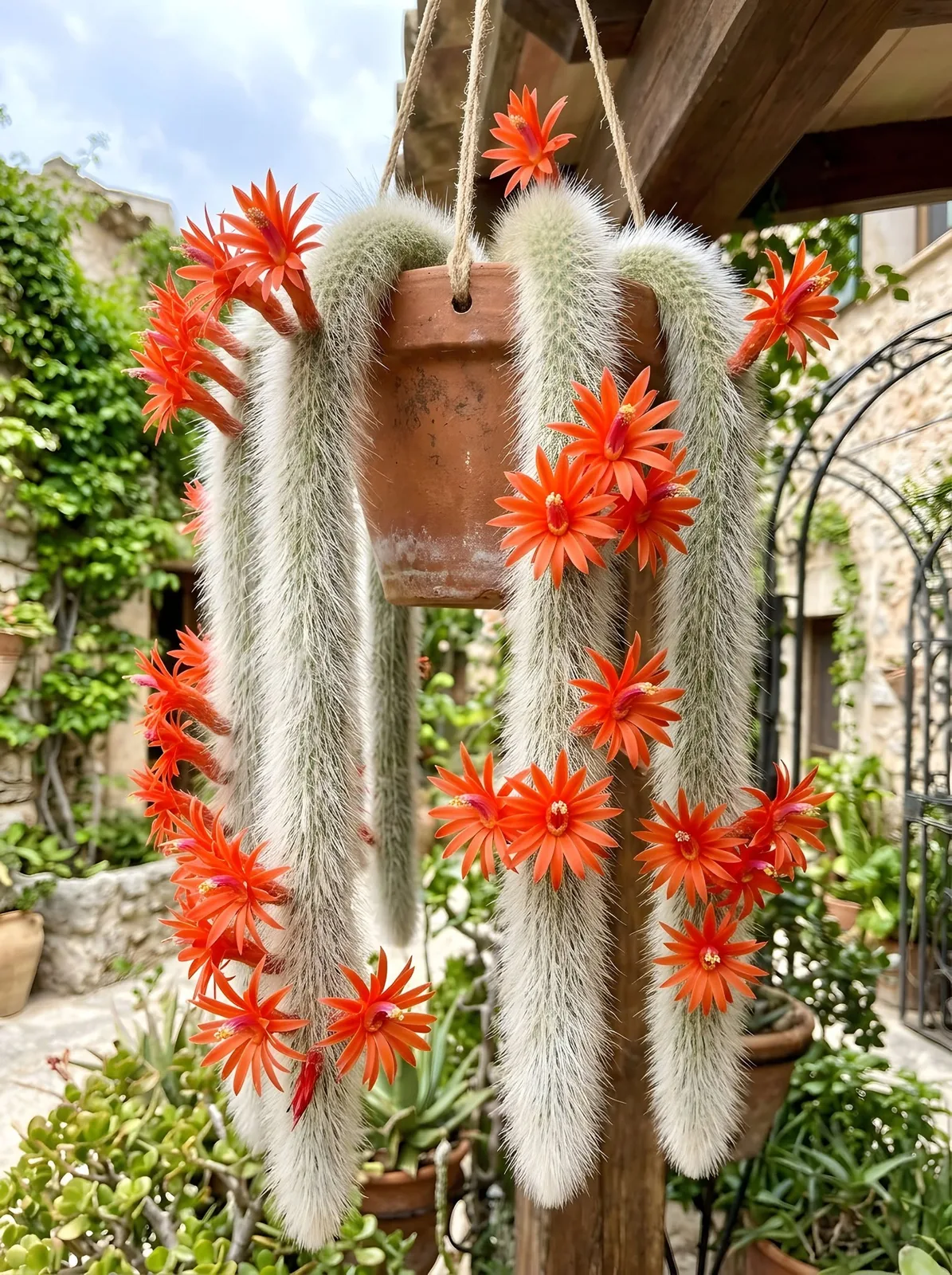
The genus is South American, centred on the eastern Andes and their dry inter-Andean valleys. Bolivia is the heartland, and species reach into Peru, Argentina, Paraguay and Uruguay. Plants grow on rocky slopes, in thorn scrub and on cliff faces, from warm lowland valleys up to several thousand metres. The hair-cloaked monkey tail, Cleistocactus colademononis, is a Bolivian cliff endemic that hangs from humid vertical rock near Samaipata at roughly 1,300 to 1,500 m.
How big does Cleistocactus get?
Most Cleistocactus are slim columns 3 to 8 cm thick. Upright species such as the silver torch stand 2 to 3 m tall in time and branch from the base into a stand of pillars, while the trailing species, the monkey tail among them, hang in ropes that lengthen to roughly 2.5 m. Growth is moderate for a cactus and quicker than the slow Mexican genera, so a young plant fills out within a few seasons.
What do Cleistocactus flowers look like?
The flowers give the genus its name and its look. They are narrow tubular trumpets, usually 3 to 8 cm long, often slightly S-curved and zygomorphic, and they open only a little at the mouth. Colour runs through red, orange, magenta and pink, with the occasional greenish or pale form. They project almost horizontally from the sides of the stems, and hummingbirds reach the nectar through the long closed tube. Many species flower freely once they reach mature stem length.
How cold-hardy is Cleistocactus?
Cold tolerance varies across the genus, so treat it per species. Most are essentially frost-tender and want a dry winter rest no colder than about 5°C. The toughest is the high-Andean silver torch Cleistocactus strausii, which shrugs off brief dry cold down toward −10°C, while warm-valley and cliff species such as the monkey tail should be held above roughly 4 to 5°C. Wet cold rots any of them; the dry cold of their mountain winters is what the genus is adapted to handle.
What substrate does Cleistocactus need in cultivation?
A sharply draining, mineral-dominant mix, around 80 to 90 per cent inorganic, suits the whole genus. Build it on pumice, crushed lava and granite grit so water clears in seconds. The upright valley columnars take only a small organic fraction. The cliff-dwelling trailers, such as the monkey tail, accept a slightly higher organic share, though they still sit at roughly four-fifths mineral. The house mix includes no limestone, and no cultivation source shows that any species in the genus either needs lime or is harmed by it.
Is Cleistocactus legal to own?
Yes, Cleistocactus is legal to own, and nursery-propagated plants are sold and kept without permits. Like every member of the cactus family, Cleistocactus is on CITES Appendix II rather than the stricter Appendix I, so nursery-propagated plants are freely owned and sold and only a border crossing calls for export paperwork; none of the popular species is individually restricted. At rarecactus.com we grow our Cleistocactus from seed in our own greenhouse, which leaves wild populations untouched and gives plants with the natural form of the species.
Why is the monkey tail cactus the most popular Cleistocactus?
The monkey tail, Cleistocactus colademononis, is the one species almost every grower knows. Its pendant stems are buried under soft, snow-white, hair-like spines you can stroke, and a mature plant spills a curtain of pale tails from a hanging basket. It roots easily from cuttings and flowers vivid red while young, which is why it is everywhere in the trade. In the wild it is a single-mountain Bolivian endemic assessed as Endangered, and that split, common in cultivation and rare in habitat, is what makes it the plant people picture when they hear the genus name.
Trace any specimen to its wild origin in our Cleistocactus field numbers.