
Thelocactus bicolor
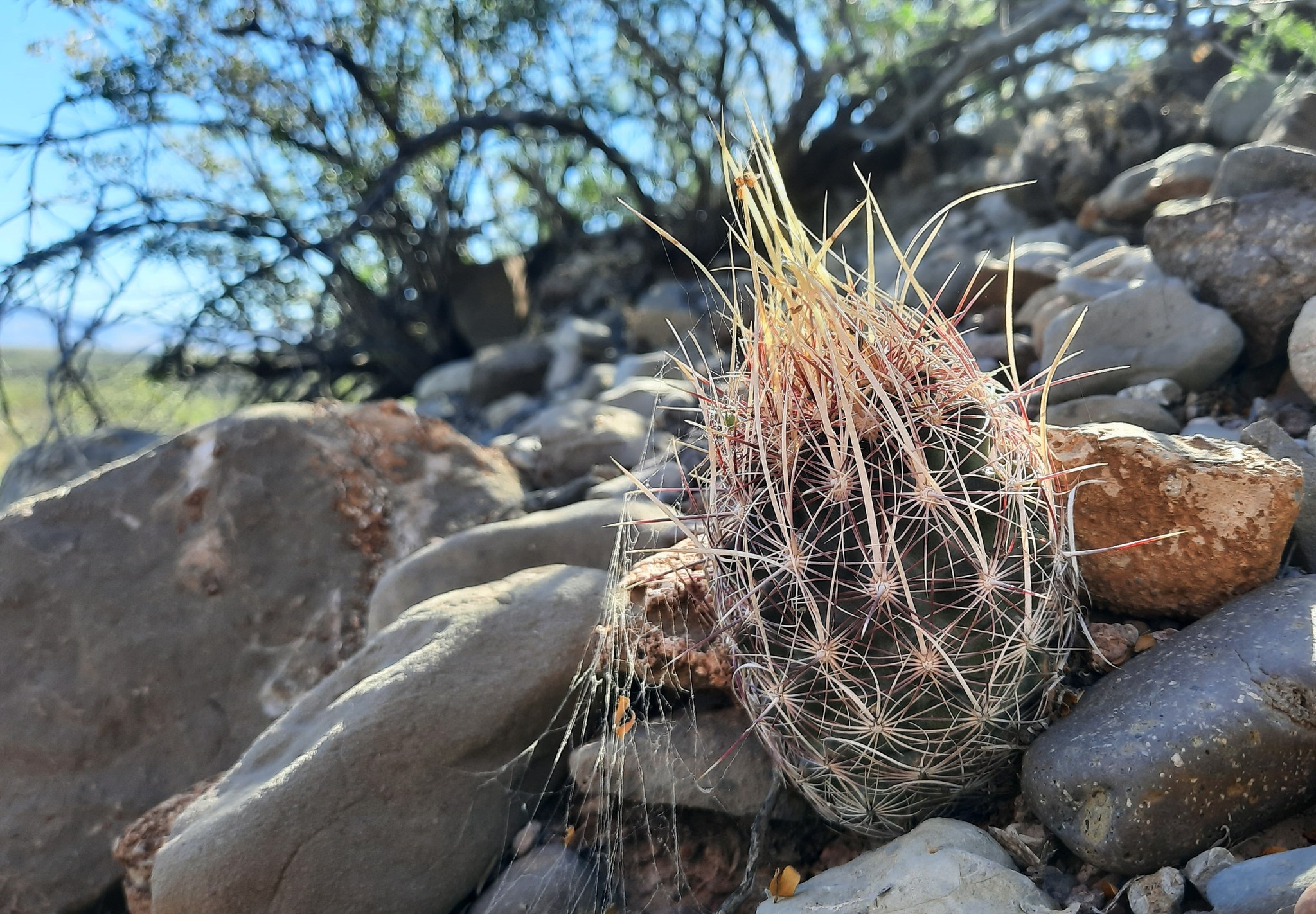
Thelocactus bicolor (Galeotti ex Pfeiff.) Britton & Rose is the most widely cultivated species in the genus and the most recognisable Chihuahuan Desert cactus in collector hands worldwide. Henri Guillaume Galeotti collected the type material during his Mexican botanical expeditions of 1835 to 1840; Ludwig Karl Georg Pfeiffer formally published the basionym Echinocactus bicolor in Abbildung und Beschreibung blühender Cacteen, plate 25, in 1848. Britton and Rose transferred the species to Thelocactus in the same 1922 paper that established the genus. The epithet bicolor describes the two-toned spine banding that makes the plant instantly recognisable: fresh growth emerges deep red, then fades to ochre-yellow as the spine ages, leaving a banded effect across the body.
Kew POWO accepts five subspecies under T. bicolor: the nominate subsp. bicolor, which covers the widest geographic range from south Texas through Chihuahua, Coahuila, Nuevo León, Tamaulipas, San Luis Potosí, and Zacatecas; subsp. bolaensis from the Sierra Bola area of Coahuila, known for large clumping plants up to 50 heads; subsp. flavidispinus, restricted to novaculite outcrops in Brewster and Presidio counties, Texas, and the only subspecies with characteristically yellow spines; subsp. heterochromus from Chihuahua and Durango, notably wider and flatter than the nominate with flowers reaching 100 mm in diameter; and subsp. schwarzii from two localities in Tamaulipas, the only form in the species complex that regularly lacks central spines. Var. schottii, sometimes listed separately for its long papery upper central spine in the Big Bend area of Texas, is treated as a synonym of subsp. bicolor under POWO.
Within the six Thelocactus covered on this site, T. bicolor is the widest-ranging and most readily available in cultivation. It shares the Chihuahuan limestone habitat with Thelocactus macdowellii and Thelocactus rinconensis, though T. macdowellii occupies a narrow corridor east of Saltillo, while T. bicolor spreads across a far wider arc of the northern Chihuahuan Desert. The Royal Horticultural Society has awarded T. bicolor its Award of Garden Merit, a signal of reliable performance in temperate cultivation that few desert cacti earn.
Collectors prize the species for its fast flowering from seed, its cold hardiness down to -7°C when completely dry, and a flower display that rivals anything in the Chihuahuan flora. Seed grown plants reach flowering at three to five years from germination, faster than most comparable species on this site, which makes T. bicolor an achievable cultivation target rather than a decades-long project. Thelocactus hexaedrophorus is the sculptural contrast in the genus collection, built for form over flower; T. bicolor delivers both.
Thelocactus bicolor quick reference
A Chihuahuan Desert species, growing on limestone-derived alkaline soils between 600 and 2,200 m across south Texas and seven Mexican states. Values calibrated for seed grown plants in cultivation, drawn from species-specific habitat data and specialist grower sources for T. bicolor; the soil mix and its pH target are house convention, not a reading of habitat soil.
Taxonomy & nomenclature
The accepted name is Thelocactus bicolor (Galeotti ex Pfeiff.) Britton & Rose, with the basionym Echinocactus bicolor Galeotti ex Pfeiffer published in Abbildung und Beschreibung blühender Cacteen, volume 2, plate 25, in 1848. Galeotti collected the type material in Mexico during his 1835–1840 botanical expeditions; Pfeiffer published the formal description, recording Galeotti as the collector. Britton and Rose transferred the species to Thelocactus in the Bulletin of the Torrey Botanical Club 49: 251 (1922), the same paper that established the genus.
Kew POWO currently accepts five subspecies. Subsp. bicolor is the nominate and covers the bulk of the range. Subsp. bolaensis (C.Runge) Doweld is the Sierra Bola, Coahuila entity, notable for large clumping growth to 50 heads. Subsp. flavidispinus (Backeb.) N.P.Taylor is restricted to Caballos novaculite outcrops in Brewster and Presidio counties, Texas, and is the only US-centric subspecies as well as the only form with consistently yellow spines. Subsp. heterochromus (F.A.C.Weber) Mosco & Zanov. is the widest-flowered form (up to 100 mm), from Chihuahua and Durango, with a distinctly flatter, broader body than the nominate. Subsp. schwarzii (Backeb.) N.P.Taylor is the most restricted, known from only two Tamaulipas localities east of the Sierra Madre Oriental, and is the only form in the complex that regularly produces plants without central spines.
The most frequently encountered synonyms are Ferocactus bicolor (Galeotti ex Pfeiff.) N.P.Taylor (1979), a short-lived placement in Ferocactus now rejected, and Echinocactus bicolor var. schottii Engelm., the Big Bend form with a long papery upper central spine sometimes still labelled separately in US botanical literature. POWO treats var. schottii as a synonym within subsp. bicolor, not as an accepted subspecies. Older literature placed several additional entities at variety or subspecies rank (var. tricolor, var. pottsii, var. wagnerianus) that are now subsumed under the five POWO-accepted subspecies.
Historical synonyms (3)
- Echinocereus bicolor Galeotti, homotypic synonym
- Thelocactus bicolor var. pottsii Britton & Rose, homotypic synonym
- Echinocactus flavidispinus (Backeb.) D.Weniger, heterotypic synonym
Sources: POWO (Kew) · IPNI · GBIF · Wikidata
Habitat
Thelocactus bicolor occupies the northern Chihuahuan Desert and its immediate margins. In the United States, the nominate subspecies reaches the Big Bend region (Brewster County) and the far south Texas border (Starr County, Rio Grande City area); subsp. flavidispinus occupies novaculite outcrops in Brewster and Presidio counties. The Mexican range covers Chihuahua, Coahuila, Durango (subsp. heterochromus), Nuevo León, San Luis Potosí, Tamaulipas, and Zacatecas. Elevation runs from approximately 600 m on lower desert flats to 2,200 m in the limestone uplands where subsp. heterochromus and subsp. flavidispinus occur; the wide elevation range reflects the subspecific diversity across the complex. Sources cite a lower bound of 600 m from Monaco Nature Encyclopedia and 800 m from IUCN; the discrepancy likely reflects the difference between the full subspecies complex and the nominate specifically.
The dominant habitat is matorral xerófilo, the dry xerophytic scrub of the Chihuahuan Desert, dominated by Larrea tridentata (creosote bush), Fouquieria splendens (ocotillo), and various Agave and Yucca species. Parent rock is primarily limestone and sandstone; across most of its range the species grows on alkaline soils derived from calcareous parent material. The notable exception is subsp. flavidispinus on novaculite (siliceous chert), a non-calcareous acidic rock type that produces soils with a fundamentally different mineral chemistry from the limestone-dominated nominate. Neither rock type sets the pot mix, so the substrate recipe on this page applies to subsp. flavidispinus as well as the nominate.
Rainfall across the species range follows the Chihuahuan Desert summer monsoon pattern. The growing season aligns with the June to September monsoon, delivering 200 to 400 mm per year at the core of the range. Winters are cold and almost completely dry. This precipitation regime, combined with the exposed hillside and south-facing slope positions the species typically occupies, means the plant receives intense UV year-round and experiences true winter cold with zero supplemental moisture. The cultivation implication is direct: active watering belongs in summer, winter must be bone-dry.
Morphology
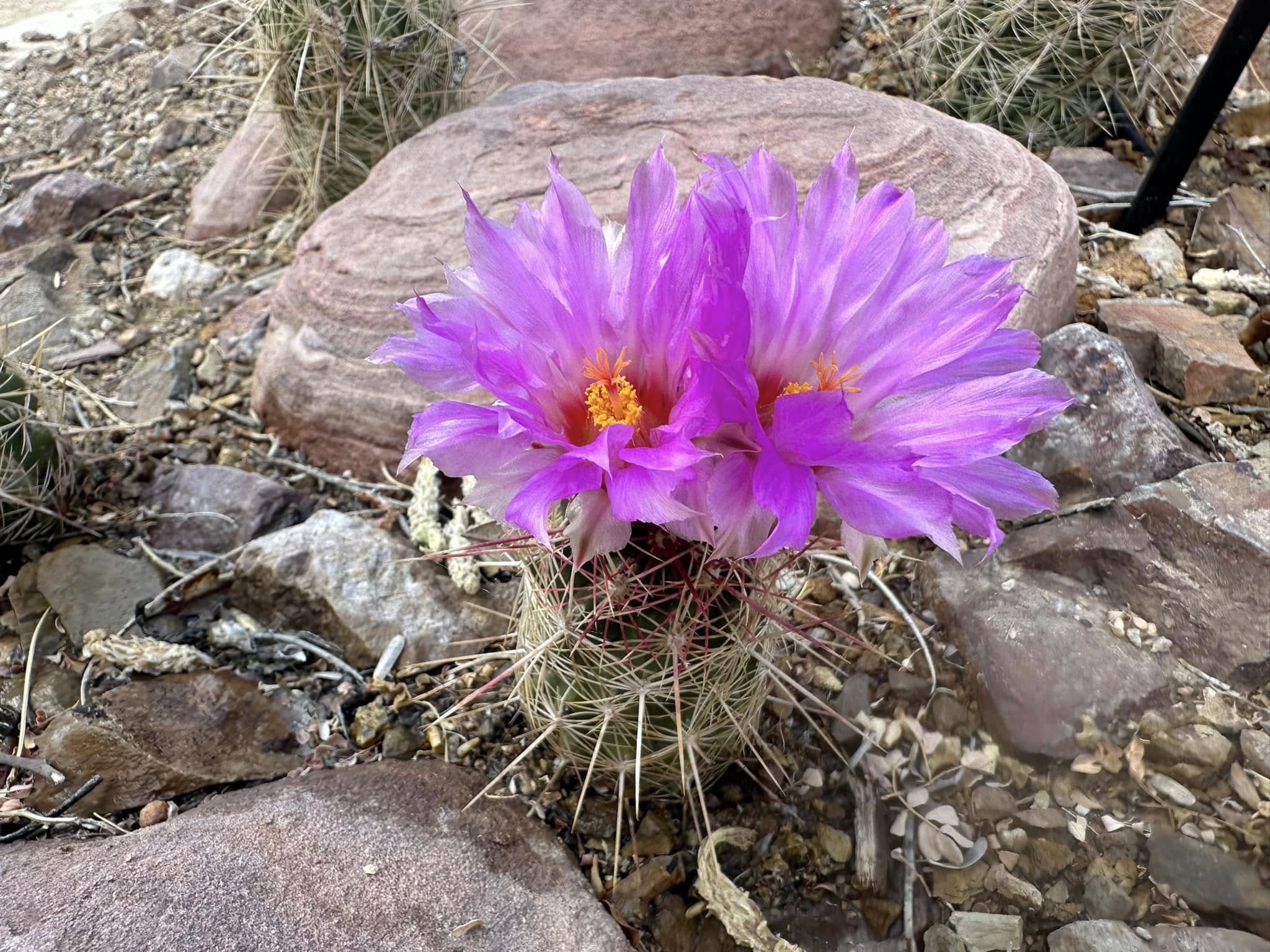
The stem is solitary, rarely branching at the base, ovoidal to ovoid-cylindric. Cultivated plants typically reach 8 to 20 cm tall and 5 to 12 cm wide, though wild specimens and exceptionally mature cultivated plants can reach 26 to 28 cm tall and 16 cm diameter. The epidermis is green to grey-green, with a waxy or bluish bloom on the surface. Ribs number 8 to 13, straight or mildly twisted, broad and slightly tuberculate, spirally arranged on older plants. Areoles are round, downy, spaced 8 to 20 mm apart along the rib faces. Subsp. heterochromus departs notably from this description: its body is depressed to globose, only 4 to 7 cm tall but 6 to 15 cm wide, with 8 to 11 large rounded ribs.
Spination is the species’s defining character. The nominate subspecies carries 8 to 18 radial spines per areole, ochre to reddish, straight or slightly recurved, 10 to 30 mm long. Central spines number 1 to 4, 15 to 75 mm long, stouter than the radials and typically more intensely coloured. The bicoloured effect that names the species arises from differential pigment retention across the spine’s life: fresh growth emerges deep red-orange at the base and yellow at the tip, giving an immediate two-tone appearance. As the spine ages over months and years, it fades to ochre-pink and eventually pale straw, so at any given time the body shows a gradient of spine ages from the intensely coloured newest areoles at the crown to the paler older areoles lower on the body.
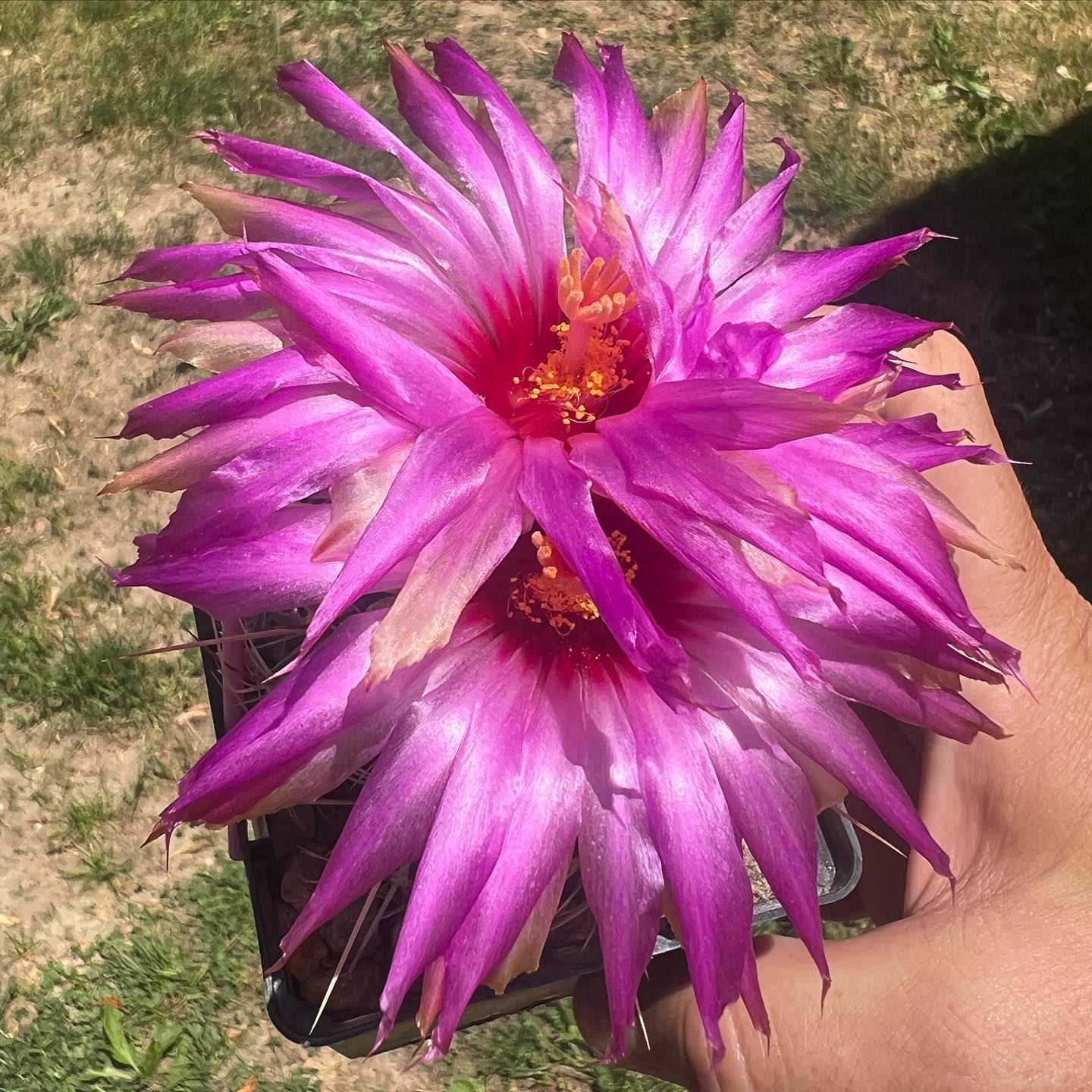
Flowers emerge from the apex, funnel-shaped to bell-shaped, typically 55 to 80 mm in diameter for the nominate subspecies. Outer tepals are purplish-pink to vivid magenta; inner tepals deepen toward the centre, with a prominent red throat and a yellow staminal boss at the flower centre. Margins of the inner tepals are ciliate. Flowering runs from spring through early autumn, peaking April to June; individual flowers are diurnal. Fruit is oblong, 1 to 1.5 cm long, green to reddish-brown at maturity, scaly and edible, dehiscent when dry. Seeds are obovoid, approximately 2 mm long, black, with a verrucose testa surface.
Locality detail
The type locality of Thelocactus bicolor is not precisely stated in Pfeiffer’s 1848 protologue. Galeotti’s collecting expeditions of 1835 to 1840 traversed much of northeastern Mexico, and secondary sources generally attribute the original material to Nuevo León or Tamaulipas without a sharp locality. No georeferenced type coordinates are available. The map shows the major range divisions using state-level centroids: the US range in Brewster and Starr counties, Texas; the Chihuahua and Coahuila core; the San Luis Potosí southern extent; and the Tamaulipas eastern distribution that holds the two localities of subsp. schwarzii.
Coahuila is the state of maximum subspecific diversity within the complex: both the nominate and subsp. bolaensis are confirmed here, the latter forming large clumping colonies at the Sierra Bola. Chihuahua holds both the nominate and subsp. heterochromus, the widest-flowered form, which extends into Durango. Subsp. schwarzii, known from only two Tamaulipas localities east of the Sierra Madre Oriental, is the most geographically restricted taxon in the complex and the one most likely to be undercollected in current databases.
Thelocactus bicolor care and cultivation
Thelocactus bicolor tolerates more grower error than most Chihuahuan Desert cacti in cultivation. The Royal Horticultural Society’s Award of Garden Merit reflects its reliability under temperate conditions, and specialist sources describe it as “relatively rapidly growing and easily flowering.” Two failure modes account for most losses: winter watering, which kills through root rot, and a lack of winter cold that suppresses the following spring’s bud set. Both are operator errors rather than species-level fragility.
Substrate
The substrate recipe is mineral-dominant: 35 per cent pumice, 15 per cent lava rock, 10 per cent zeolite, 10 per cent granite grit, 15 per cent crushed limestone chips (3 to 6 mm horticultural grade or oyster grit), 5 per cent coarse silica grit, and 10 per cent worm castings. This delivers a 90 per cent inorganic, 10 per cent organic ratio. The pH target is 7.0 to 8.0. The limestone share is house convention for the genus, not a requirement of this species. Check your water before trusting that share: hard tap water already supplies calcium and bicarbonate at every watering, while rainwater and RO water supply neither. Subsp. flavidispinus grows on novaculite, an acidic siliceous rock, but habitat rock does not set the pot mix; the recipe here applies to the nominate and the other subspecies alike.
Substrate ratios across the Thelocactus species on this site. Limestone shares are house convention, not species requirements; T. setispinus carries a lower limestone share and a higher organic share than the rest, and T. tepelmemensis has the highest limestone proportion in the genus.
| Species | Pumice | Lava | Zeolite | Granite | Limestone | Silica | Organic |
|---|---|---|---|---|---|---|---|
| T. bicolor (this page) | 35% | 15% | 10% | 10% | 15% | 5% | 10% |
| T. hexaedrophorus | 35% | 15% | 10% | 10% | 15% | 5% | 10% |
| T. rinconensis | 35% | 15% | 10% | 10% | 15% | 5% | 10% |
| T. macdowellii | 35% | 10% | 10% | 10% | 20% | 5% | 10% |
| T. setispinus | 35% | 15% | 10% | 10% | 8% | 10% | 12% |
| T. tepelmemensis | 30% | 10% | 10% | 5% | 25% | 10% | 10% |
Watering and light
Watering tracks the Chihuahuan summer monsoon. Begin regular watering in late May or early June as temperatures climb. Through June to September, water thoroughly every 7 to 14 days once the substrate is fully dry at the pot base. First watering of the year should be light; the plant benefits from warmth as a signal to break dormancy before the first full soak. The British Cactus and Succulent Society recommends watering freely in summer, including occasional dilute feeding. Taper watering from October, allow the substrate to dry completely by the first frost, and keep the plant bone-dry from November through February. Winter moisture is the universal cause of catastrophic losses. First spring watering should wait until overnight temperatures are consistently above 5°C.
Light requirements are full sun, unfiltered. Native populations grow on exposed south-facing limestone slopes under intense UV at elevations from 600 to 2,200 m. In cultivation, full unobstructed sun delivers the best spine colour expression, bud set, and body compactness. RHS confirms a south- or west-facing position in full sun. Seedlings should be acclimatised gradually over two to three weeks before full sun exposure.
Cold tolerance
The dry cold floor is approximately −7°C (llifle), with cold tolerance to approximately −7°C dry, among the deepest for this genus on the site. Multiple sources including the BCSS describe it as “somewhat resistant to frost if kept on the dry side.” The RHS rates the species H1c (minimum 5 to 10°C under glass in UK context), which represents a conservative practical greenhouse minimum; the −7°C dry-cold floor is the brief-exposure absolute for outdoor growers where winters are dry. In wet conditions, cold damage occurs well before the −7°C threshold is reached. Repot every two to three years in spring, before the first watering, when roots are at their driest.
Comparison
The closest visual match in the genus for collector-scale confusion is Thelocactus macdowellii. Both are magenta-flowered Thelocactus with similar body sizes and limestone habitats. The distinction comes down to rib structure and spine colour. T. macdowellii has 30 or more strongly tuberculate ribs broken into rhombic warts, giving the body a warty texture that is immediately different from bicolor’s 8 to 13 smoother ribs. Spine colour is the fastest tell: T. macdowellii carries white to straw-yellow spines across its body, the source of the “snowball” trade name, while bicolor shows the reddish-ochre banding that names it. Distribution also separates them: T. macdowellii is restricted to a narrow corridor east of Saltillo spanning Coahuila and Nuevo León, while bicolor spans two US counties and seven Mexican states.
Thelocactus hexaedrophorus is a secondary but important comparison. Both appear in specialist catalogs, and a grower seeing an unlabelled plant might reach for either name. However, the visual difference is substantial once known. T. hexaedrophorus is distinctly flatter and wider (3 to 10 cm tall, 8 to 15 cm wide), with the near-hexagonal tubercle geometry that names it, only 4 to 8 short radial spines, and white to pale pink flowers. Nothing about this profile matches bicolor’s taller ovoidal body, dense bicoloured reddish-ochre spination, and vivid magenta flowers. The flower colour alone rules out confusion for any plant in bloom.
Within the bicolor subspecies complex, the practical cultivation distinction is cold tolerance. Subsp. flavidispinus grows on novaculite rather than limestone, but habitat rock does not set the pot mix, so it takes the same substrate recipe as the nominate. Subsp. heterochromus, with its flatter wider body and flowers up to 100 mm, reads as a different plant from the nominate at specimen scale. Subsp. schwarzii regularly lacks central spines, a unique character in the complex. Among the remaining Thelocactus on this site, Thelocactus setispinus is immediately distinct by its hooked central spine and bright yellow flowers, and Thelocactus rinconensis is the flat-domed Coahuila species with a totally different habit and pale flowers.
Frequently asked questions
Is Thelocactus bicolor hard to grow?
Beginner to intermediate. The Royal Horticultural Society’s Award of Garden Merit reflects consistent performance across temperate collections; few Chihuahuan cacti are as reliably flowering from year three to five. The hardest single thing is the winter rest: the substrate must be completely dry from November through February, with temperatures ideally between 5 and 10°C. Winter moisture combined with cold temperatures causes root rot. Beyond that discipline, the species is full-sun tolerant, flowers reliably from year three to five, and is notably more forgiving than most Chihuahuan Desert species.
Can Thelocactus bicolor be grown from seed?
Yes, and seed grown plants are the target for serious collectors. Seeds germinate in 7 to 14 days at 21 to 27°C substrate temperature under standard top-sown conditions. The species is described as “relatively rapidly growing and easily flowering” among Thelocactus; seed grown plants typically reach flowering at three to five years with a respected winter rest. Grafted plants flower inside 18 months but develop unnaturally bloated bodies and weaker spine character. Seed is widely available through specialist suppliers across Europe and North America.
Is Thelocactus bicolor legal to own?
Yes, with documentation. T. bicolor falls under the CITES Appendix II blanket listing for Cactaceae; international commercial trade requires export permits from the country of origin. In Texas, where the species is considered rare and found in only two small areas, additional state-level protection applies to wild plants. Nursery-propagated stock with documented seed-grown provenance is the legally defensible source worldwide. Wild-collected plants from Mexico or Texas cannot be traded commercially without CITES documentation, which is not issued for wild-collected material under standard practice.
Where does Thelocactus bicolor grow in the wild?
Across the northern Chihuahuan Desert in the United States and Mexico. The US range covers two small areas: the Big Bend region of Brewster County, Texas (nominate subsp. bicolor) and Starr County in far south Texas. The Mexican range spans Chihuahua, Coahuila, Durango, Nuevo León, San Luis Potosí, Tamaulipas, and Zacatecas. The species grows on limestone and sandstone slopes in xerophytic scrub (matorral xerófilo) from roughly 600 to 2,200 m elevation, typically on exposed south-facing hillsides with alkaline soils.
When does Thelocactus bicolor flower?
From spring through early autumn, peaking April to June. Individual flowers are 55 to 80 mm in diameter for the nominate subspecies (up to 100 mm for subsp. heterochromus), vivid magenta-pink with a red throat and a yellow staminal boss. Flowers are diurnal and funnel-shaped. A plant in peak season can carry several open simultaneously. No specific published pollinator study has been located for this species; the large open magenta flowers in the Chihuahuan Desert context are consistent with bee pollination, as documented for related Chihuahuan cacti.
Sources & further reading
Pfeiffer, L.K.G. & Otto, F. (1848). Abbildung und Beschreibung blühender Cacteen, vol. 2, pl. 25. Basionym: Echinocactus bicolor Galeotti ex Pfeiff. · Britton, N.L. & Rose, J.N. (1922). Thelocactus bicolor comb. nov. Bulletin of the Torrey Botanical Club 49: 251. · Kew POWO. Thelocactus bicolor (Galeotti ex Pfeiff.) Britton & Rose. IPNI lsid urn:lsid:ipni.org:names:251010-2. powo.science.kew.org · GBIF Backbone Taxonomy. Thelocactus bicolor. Species 3084405. gbif.org · IUCN Red List. Thelocactus bicolor. Assessors: Goettsch, B.K., Heil, K., Terry, M. & Corral-Díaz, R. Assessment 2013 (Least Concern). iucnredlist.org · Royal Horticultural Society. Thelocactus bicolor. Award of Garden Merit; hardiness H1c; cultivation notes. rhs.org.uk · Lady Bird Johnson Wildflower Center. Thelocactus bicolor. Texas county distribution; habitat; flowering season. wildflower.org · Flora of North America Editorial Committee. Thelocactus bicolor. Flora of North America vol. 4. eFloras.org · Anderson, E.F. (2001). The Cactus Family. Timber Press, Portland. · llifle, Encyclopedia of Living Forms. Thelocactus bicolor (Galeotti ex Pfeiff.) Britton & Rose, 1922. llifle.com · llifle. Thelocactus bicolor subs. bolaensis. llifle.com · llifle. Thelocactus bicolor subs. schwarzii. llifle.com · llifle. Thelocactus bicolor subs. heterochromus. llifle.com · Monaco Nature Encyclopedia. Thelocactus bicolor. monaconatureencyclopedia.com · NatureServe Explorer. Thelocactus bicolor var. flavidispinus. explorer.natureserve.org · Wikipedia. Thelocactus bicolor; Thelocactus macdowellii; Thelocactus hexaedrophorus. en.wikipedia.org