
Thelocactus macdowellii
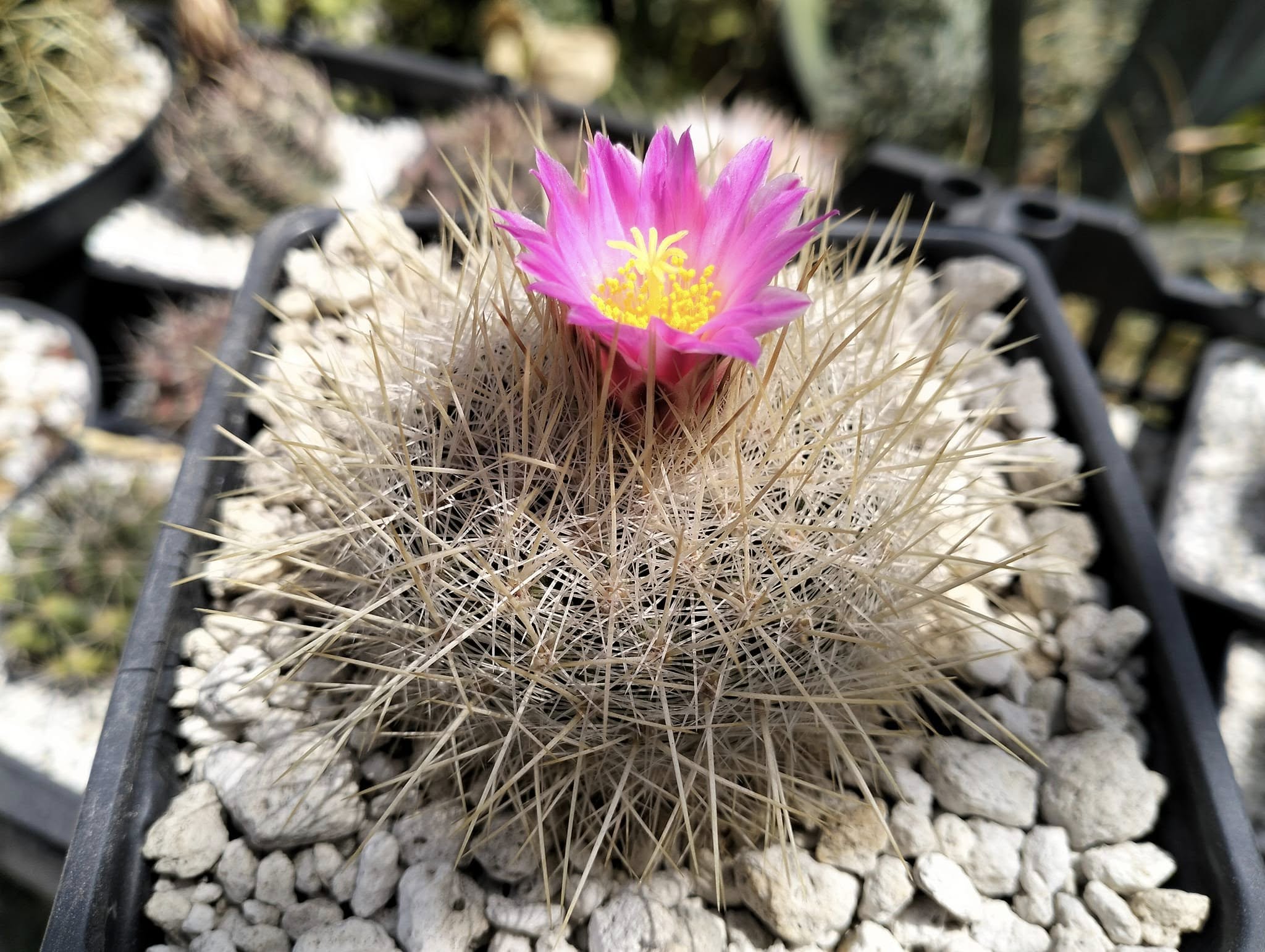
Thelocactus macdowellii (Rebut ex Quehl) W.T.Marshall is the most consistently photographed Thelocactus in specialist catalogs, its dense white spination producing an effect unlike any sibling species. The plant is instantly recognisable: a globose body, rarely more than 10 cm across, almost completely concealed under a dense mass of white acicular spines across 30 or more shallow warty ribs. The common name Chihuahuan snowball describes the visual effect precisely. Pierre-Etienne Rebut collected the type material in northeastern Mexico; Leopold Quehl formally published the basionym Echinocactus macdowellii in the Monatsschrift für Kakteenkunde 4: 133–134 in 1894, naming the species for José Alberto McDowell, a Mexican gardener and plant collector who assisted Rebut with specimens. W.T. Marshall transferred the species to Thelocactus in the Cactaceae and Succulent Journal of Great Britain 9: 28 in 1947.
The species has a narrow, well-defined range. All confirmed populations fall within a limestone corridor east of Saltillo along the Coahuila–Nuevo León border, a strip estimated at under 100 km² extent of occurrence. The type locality is fixed by the 1987 Anderson neotype (deposited at the Smithsonian as US 3047870): 33 km northeast of Saltillo on Highway 40 toward Monterrey, Coahuila. Known field-collected localities cluster around Arteaga, Coahuila (CSD 192, RS 363, CH 522), south of Higueras on Steven Brack’s SB 1884, and Canon Casa Blanca in the Garcia municipality of Nuevo León (CONABIO CGVM0571). The sister species Thelocactus bicolor shares the northern Chihuahuan limestone habitat but ranges across two US counties and seven Mexican states, a geographic footprint more than fifty times larger.
In cultivation, T. macdowellii flowers earlier than any other species on this site. Buds form during the coldest winter months and the flowers open from February through March, before the plant resumes vegetative growth. The funnel-shaped flowers reach 40 to 80 mm across and are a clear magenta-pink. This winter flowering habit means the species needs brief, cautious early-spring watering to support bud set, even while the rest of the winter rest is maintained. Thelocactus rinconensis, the flat-domed Coahuila species covered elsewhere on this site, shares a similar geography but is a larger, heavier-spined plant with a completely different body silhouette.
The Royal Horticultural Society has awarded T. macdowellii its Award of Garden Merit, confirming reliable performance in temperate cultivation. Seed grown plants reach flowering at roughly three to five years from germination. The main failure mode in cultivation is wet winter cold: the plant tolerates −7°C when completely dry but rots quickly at 5°C if any moisture reaches the root zone during dormancy.
Thelocactus macdowellii quick reference
A narrow-range endemic of the Chihuahuan Desert, growing on limestone hills between 1,300 and 1,600 m in Coahuila and Nuevo León. Values calibrated for seed grown plants in cultivation, drawn from habitat research and specialist grower sources for T. macdowellii specifically.
Taxonomy & nomenclature
The accepted name is Thelocactus macdowellii (Rebut ex Quehl) W.T.Marshall, the combination published in the Cactaceae and Succulent Journal of Great Britain 9: 28 in 1947. The basionym is Echinocactus macdowellii Rebut ex Quehl, published in the Monatsschrift für Kakteenkunde 4: 133–134 in 1894. Pierre-Etienne Rebut collected the type material; Leopold Quehl published the description, naming the species for José Alberto McDowell, a Mexican gardener and plant collector who assisted with specimen collection. POWO recognises Marshall’s 1947 combination as the accepted authority. A later combination by C. Glass in Cactáceas y Suculentas Mexicanas 14: 4 (1969) post-dates Marshall and is not the governing publication for the name.
The neotype is Anderson 3182, collected by Edward F. Anderson on 22 July 1972 from 33 km northeast of Saltillo on Highway 40 toward Monterrey, Coahuila, Mexico, deposited at the US National Herbarium (Smithsonian). Anderson formally designated this neotype in Bradleya 5: 64 in 1987, anchoring the species concept after the original Rebut/Quehl material could not be located.
Kew POWO lists five synonyms. Homotypic synonyms sharing the same type material are: Echinocactus macdowellii Rebut ex Quehl (1894), the basionym; Neolloydia macdowellii (Rebut ex Quehl) H.E.Moore (1975), published in Baileya 19: 166; and Thelocactus conothelos var. macdowellii (Rebut ex Quehl) Glass & R.A.Foster (1977), published in the Cactus and Succulent Journal (US) 49: 220. The Glass & Foster 1977 treatment, which reduced T. macdowellii to a variety of T. conothelos, is not followed by POWO. Under current taxonomy, T. macdowellii is the accepted species and the Glass & Foster variety name is its synonym, not the reverse. Anderson’s 1987 neotype designation in Bradleya settled the species concept. Two heterotypic synonyms based on independent collections are also listed: Echinocactus macdowellii Orcutt (1922), an illegitimate later homonym, and Echinomastus macdowellii (Orcutt) Britton & Rose (1922), published in The Cactaceae 3: 151.
Historical synonyms (6)
- Echinomastus macdowellii (Orcutt) Britton & Rose, 1922 basionym
- Neolloydia macdowellii (Rebut ex Quehl) H.E.Moore, 1975 homotypic synonym
- Thelocactus conothelos var. macdowellii (Rebut ex Quehl) Glass & R.A.Foster, 1977 heterotypic synonym
- Thelocactus multicephalus Halda & Panar., 1998 heterotypic synonym
- Thelocactus rinconensis subsp. multicephalus (Halda & Panar) Lüthy, 1999 heterotypic synonym
- Echinocactus macdowellii Orcutt, 1894 nom. inval.
Sources: POWO (Kew) · IPNI · GBIF · Wikidata
Habitat
Thelocactus macdowellii grows in matorral xerófilo, the dry xerophytic scrubland of the Central Chihuahuan Desert, on exposed limestone hills between 1,300 and 1,600 m elevation. All documented localities fall within a narrow corridor east of Saltillo where Coahuila borders Nuevo León, spanning from the Arteaga area in Coahuila south of the neotype locality through Canon Casa Blanca in the Garcia municipality of Nuevo León. The Saltillo–Monterrey corridor along Highway 40 defines the accessible edge of the species range; populations away from road access are largely uncollected in databases.
The parent rock is exclusively limestone throughout the known range. No siliceous, granitic, or volcanic substrate has been documented at any locality. Soils are thin, gravelly, and strongly alkaline, pH 7.5 to 8.5 typical for calcium carbonate bedrock, with very low organic matter content and rapid drainage. Plants grow on the exposed rocky portions of limestone outcrops, typically in crevices and at the base of larger rock faces where thin soil accumulates. The microsite is full sun, south- or southwest-facing, with no shading vegetation. The vegetation community includes Larrea tridentata, Fouquieria splendens, Agave spp., Yucca spp., Opuntia spp., and Hechtia spp., typical of Chihuahuan Desert limestone scrub.
Annual rainfall at Saltillo is approximately 300 to 400 mm, concentrated in the summer convective monsoon from June to September. Winters are cold and essentially dry. The eastern margin of the Chihuahuan Desert at this latitude receives occasional spring moisture from Gulf of Mexico systems, which may assist bud development in February and March. The 1,300 to 1,600 m elevation places the species above the warmer desert floor: frost is possible on winter nights but prolonged freezing is unusual. This habitat profile translates directly into the cultivation requirements: summer watering, cold dry winter rest, and a brief cautious early-spring water when buds are forming.
Morphology
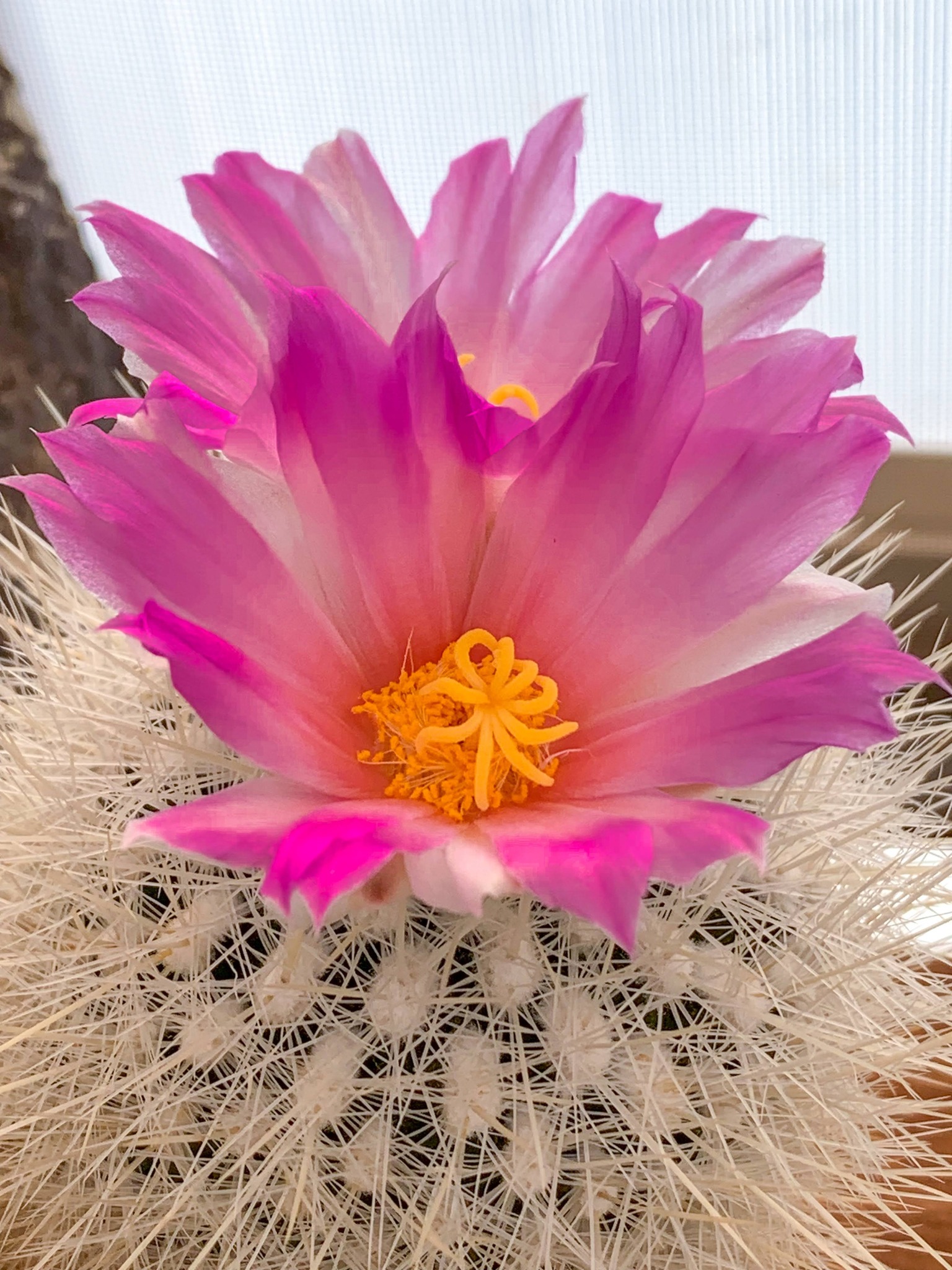
The stem is solitary and globose, rarely forming small clusters of two to five heads with age. Mature cultivated plants typically measure 4 to 10 cm tall and 4.5 to 12 cm wide; most stay around 7 to 8 cm diameter. The epidermis is grey-green to blue-green and is almost entirely invisible under the spination in healthy specimens. The apex is depressed and filled with yellowish-white wool, a characteristic feature that is visible even on densely-spined plants. Ribs number 30 or more, shallow and indistinct as ribs, divided into conical rhombic warts (tubercles) 5 to 7 mm high. This strongly warty body texture is the most immediately diagnostic body character distinguishing T. macdowellii from other Thelocactus: T. bicolor has only 8 to 13 smoother, more distinct ribs, and Thelocactus hexaedrophorus has a geometric hexagonal tubercle arrangement on a flat-domed body.
Spination is the defining visual character. Each areole carries 15 to 25 radial spines, acicular, straight, 8 to 20 mm long, white to off-white. Central spines number 2 to 4, also straight and acicular, 10 to 50 mm long, white to pale straw-yellow. The overall colour is uniformly pale throughout: no bicolouration, no reddish or ochre tones at any spine age. When 15 to 25 radials per areole are distributed across 30 or more ribs, the spine coverage becomes so dense that the body is essentially invisible from any normal viewing distance, producing the snowball silhouette the common name references. Areoles are initially woolly; no areolar glands are present, a character that separates this species from some subspecies of T. conothelos, particularly subsp. argenteus.
Flowers emerge from the woolly apex, funnel-shaped, 40 to 80 mm across (RHS notes flowers to 6 cm; the broader range to 80 mm appears in the specialist species file). Colour is magenta to rose-red, consistently described as pink to magenta across sources. There is no yellow throat, in contrast to the yellow staminal boss of T. bicolor. Flowering runs from February through March, earlier than any other Thelocactus on this site and a winter-blooming pattern unusual among northern Mexican cacti of this body size. Flowers are diurnal. Seeds measure approximately 2 by 1.4 mm with a verrucose testa surface consistent with the broader T. conothelos complex from which macdowellii was historically segregated.
Locality detail
The entire known range of Thelocactus macdowellii falls within a limestone corridor east of Saltillo along the Coahuila–Nuevo León border. The neotype locality, Anderson 3182 at 33 km northeast of Saltillo on Highway 40, is the only precisely documented, herbarium-backed collection point from the formal taxonomic record. Field numbers from specialist collectors cluster around Arteaga in Coahuila (CSD 192, RS 363, CH 522 from the late 1990s; all limestone hill habitat), south of Higueras (SB 1884 by Steven Brack), and Canon Casa Blanca in the Garcia municipality of Nuevo León (CONABIO record CGVM0571, the easternmost confirmed locality and the main evidence for the Nuevo León range extension).
The extent of occurrence across these documented localities does not exceed 100 km² by any published estimate. This is a tight geographic footprint for a listed cactus: the entire species may be observable from a single high point in the Sierra de San Marcos y Pinos east of Saltillo. No confirmed populations exist in the United States, in Tamaulipas to the east, or in San Luis Potosí to the south. The map shows the four locality anchors at approximately the scale that captures the full known range in one view.
Thelocactus macdowellii care and cultivation
Thelocactus macdowellii is an intermediate-level cultivation challenge because of its winter-flowering habit, not because the plant is fragile. The grower must provide a brief, cautious watering window in February or early March when buds are forming, even while the broader winter rest is otherwise maintained. A plant kept bone-dry through the entire winter will abort its buds. Beyond this nuance, the cultivation pattern follows the standard Chihuahuan Desert cactus template.
Substrate
The substrate recipe for T. macdowellii is 35 per cent pumice, 10 per cent lava rock, 10 per cent zeolite, 10 per cent granite grit, 20 per cent crushed limestone chips (3 to 6 mm horticultural grade or oyster grit), 5 per cent coarse silica grit, and 10 per cent worm castings. This gives a 90 per cent inorganic, 10 per cent organic mix with the limestone fraction raised to 20 per cent, above the 15 per cent used for T. bicolor. Both limestone shares are house convention, not a known need of T. macdowellii or its sister species. Hard tap water already supplies calcium and bicarbonate at every watering, while rainwater and RO water supply neither. The pH target is 7.5 to 8.5. Substrate must drain completely within 30 minutes of watering at any season.
Substrate ratios across the Thelocactus species on this site. T. macdowellii carries the second-highest limestone fraction (20%). T. tepelmemensis has the highest limestone ratio in the genus (25%). Every limestone share in this table is house convention, not a species requirement.
| Species | Pumice | Lava | Zeolite | Granite | Limestone | Silica | Organic |
|---|---|---|---|---|---|---|---|
| T. bicolor | 35% | 15% | 10% | 10% | 15% | 5% | 10% |
| T. hexaedrophorus | 35% | 15% | 10% | 10% | 15% | 5% | 10% |
| T. rinconensis | 35% | 15% | 10% | 10% | 15% | 5% | 10% |
| T. macdowellii (this page) | 35% | 10% | 10% | 10% | 20% | 5% | 10% |
| T. setispinus | 35% | 15% | 10% | 10% | 8% | 10% | 12% |
| T. tepelmemensis | 30% | 10% | 10% | 5% | 25% | 10% | 10% |
Watering and light
The watering calendar has four phases, driven by the species’ winter-blooming habit. From November through January, keep completely dry. In early February, when buds are visible at the woolly apex, begin very light watering, one small pour, and allow the substrate to dry fully before the next. This supports the flower without triggering premature growth that would be cut back by late frost. From March through May, resume regular watering as temperatures rise and vegetative growth begins. From June through September, water thoroughly every 10 to 14 days once the substrate is completely dry at the pot base. Taper off in October, allow the substrate to dry completely, and return to the winter dry rest by November. Do not leave standing water in any saucer at any season.
Full sun is the correct light level. Native populations grow on exposed limestone hillsides at 1,300 to 1,600 m with no shading vegetation. RHS specifies a south- or west-facing position in full sun. The dense white spination functions as a UV reflector; plants grown under partial shade develop sparser, greener spines and a more open growth form that loses the snowball character. In climates with sustained temperatures above 40°C, brief afternoon shade may reduce stress; outside that range, maximum sun is the target.
Comparison
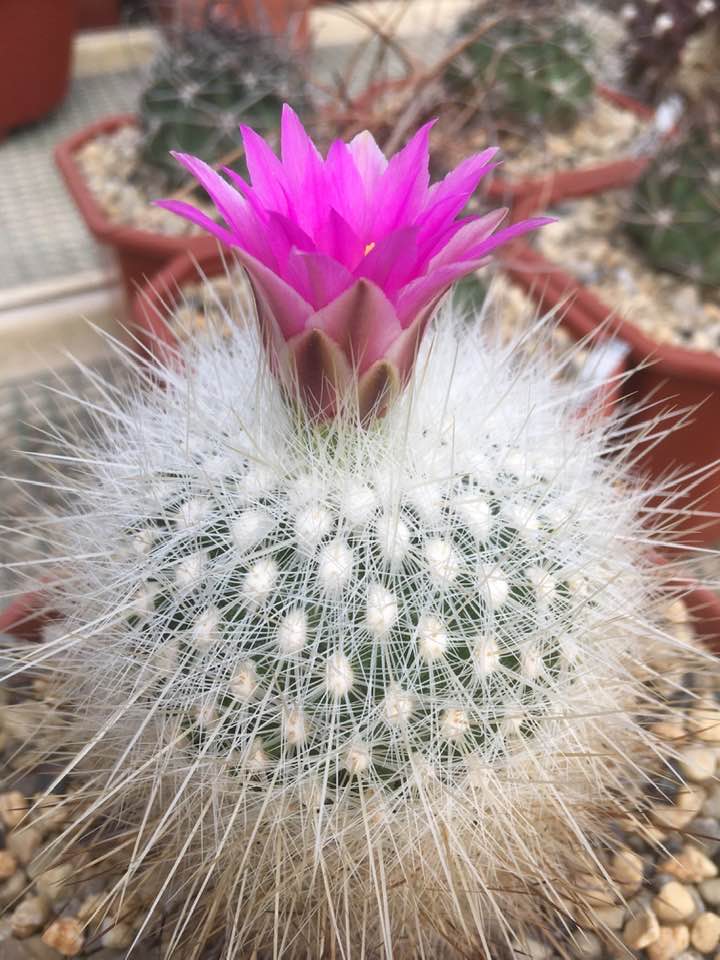
The most common identification confusion in the collector trade is between Thelocactus macdowellii and Thelocactus bicolor. Both are globose Chihuahuan cacti with magenta-pink flowers sold alongside each other in specialist catalogs, and young plants of both species are similar in size. Three characters resolve the confusion in seconds. First, spine colour: T. macdowellii is uniformly white to pale straw throughout, with no banding or reddish tones; T. bicolor has clearly bicoloured spines with deep red-orange at the base of fresh growth fading to ochre-yellow at the tip, the two-tone effect that names the species. Second, rib count: T. macdowellii has 30 or more shallow ribs divided into rhombic warts, producing a strongly warty body texture; T. bicolor has 8 to 13 more distinct, smoother ribs. Third, flower season: T. macdowellii opens in February and March, while T. bicolor flowers from spring through early autumn. Any plant in bloom between February and March and showing white spines is T. macdowellii; any plant showing reddish-ochre spine bases is T. bicolor regardless of season.
The flat-domed geometry and hexagonal tubercle pattern of Thelocactus hexaedrophorus make it immediately different from the snowball silhouette of T. macdowellii. T. hexaedrophorus carries only 4 to 8 short radial spines per areole on a flattened, wider body; confusion with the densely spined snowball is unlikely for any plant of adult size. The flower colour is also different: white to pale pink in T. hexaedrophorus, clear magenta in T. macdowellii.
A secondary source of confusion arises from the 1977 Glass & Foster treatment that published this plant as Thelocactus conothelos var. macdowellii. Some European specialist catalogs still use this combination, and plants labelled as such are not necessarily mislabelled; they may simply follow the Glass & Foster taxonomy rather than the POWO-accepted Marshall/Anderson treatment. Thelocactus conothelos in its typical form is distinguishable by brownish-yellow to reddish (never white) spines, fewer warts per rib, a more southerly distribution (Tamaulipas, southern Nuevo León, San Luis Potosí), and the presence of areolar glands on some subspecies. The wholly white spination and absence of areolar glands in T. macdowellii are sufficient for separation. Thelocactus setispinus is immediately ruled out by its hooked central spine and bright yellow flowers.
Frequently asked questions
Is Thelocactus macdowellii hard to grow?
Intermediate. The plant handles most temperate cultivation conditions well, but two requirements are non-negotiable: a cold, bone-dry winter rest from November through January, and a brief light watering in February when buds are visible. Omit the winter watering and the plant aborts its buds; continue heavy winter watering and root rot follows within weeks. Outside these requirements, the species is forgiving. The Royal Horticultural Society has awarded it the Award of Garden Merit, confirming reliable performance under temperate conditions.
Can Thelocactus macdowellii be grown from seed?
Yes, and seed grown plants are the correct cultivation target. Seeds germinate in 7 to 14 days at 21 to 27°C substrate temperature, top-sown in standard cactus germination mix. The species is an intermediate grower within the genus; seed grown plants typically reach first flower at three to five years with a correctly observed winter rest. Grafted plants flower faster but develop unnaturally bloated bodies and lose the compact snowball character the species is known for. Seed is available through specialist European and North American cactus societies and nurseries.
Is Thelocactus macdowellii legal to own?
Yes, with documentation. CITES Appendix II covers the entire family Cactaceae; international commercial trade requires export permits from the country of origin. Mexico’s NOM-059-SEMARNAT-2010 lists the species under Category A (Amenazada, Threatened), the second-highest federal protection tier in Mexico, making wild-collection illegal regardless of destination. Nursery-propagated stock with documented provenance is the legally defensible acquisition path worldwide. CITES documentation is not issued for wild-collected plants under standard practice.
Where does Thelocactus macdowellii grow in the wild?
Only in Mexico, across a narrow limestone corridor east of Saltillo spanning Coahuila and Nuevo León. The entire extent of occurrence is estimated at under 100 km², one of the smallest ranges of any Thelocactus. Plants grow on exposed limestone outcrops and hillsides in matorral xerófilo (dry scrubland) between 1,300 and 1,600 m elevation. Confirmed localities include the Arteaga area of Coahuila, south of Higueras, and Canon Casa Blanca in the Garcia municipality of Nuevo León. No US populations are documented.
When does Thelocactus macdowellii flower?
February through March, earlier than any other Thelocactus on this site and unusual among cacti of its body size. The funnel-shaped flowers are 40 to 80 mm across, magenta to rose-red, diurnal, and emerge from the woolly depressed apex. The winter-blooming habit means bud development happens during the cold season; growers need to provide a small amount of water in early February when buds are visible to support the bloom. A second flush sometimes occurs later in the year but the main show is the winter-to-early-spring display.
Sources & further reading
Quehl, L. (1894). Echinocactus macdowellii Rebut ex Quehl. Monatsschrift für Kakteenkunde 4: 133–134. Basionym. · Marshall, W.T. (1947). Thelocactus macdowellii (Rebut ex Quehl) W.T.Marshall comb. nov. Cactaceae and Succulent Journal of Great Britain 9: 28. · Anderson, E.F. (1987). Neotype designation for Thelocactus macdowellii. Bradleya 5: 64. Neotype: Anderson 3182, 33 km NE Saltillo, Coahuila, 22 July 1972; US National Herbarium. · Kew POWO. Thelocactus macdowellii (Rebut ex Quehl) W.T.Marshall. IPNI lsid urn:lsid:ipni.org:names:251053-2. powo.science.kew.org · IUCN Red List. Thelocactus macdowellii. Near Threatened, IUCN 3.1 (2022.2). iucnredlist.org · CONABIO. CGVM0571 Thelocactus macdowellii. Cañon Casa Blanca, García, Nuevo León; collector C.G. Velázco Macías. bdi.conabio.gob.mx · Royal Horticultural Society. Thelocactus macdowellii. Award of Garden Merit; hardiness H2; cultivation notes. rhs.org.uk · BCSS Field Number Finder. Thelocactus macdowellii. Records CSD 192, SB 1884, RS 363, CH 522. fieldnos.bcss.org.uk · Desert-Tropicals.com. Thelocactus macdowellii. Cold tolerance, flowering season, cultivation notes. desert-tropicals.com · Thelocactus.cactus-mall.net. Species file: Thelocactus macdowellii. Morphology measurements, NOM-059 Category A, field number localities. thelocactus.cactus-mall.net · Anderson, E.F. (2001). The Cactus Family. Timber Press, Portland. · Hunt, D. (ed.) (2006). The New Cactus Lexicon. dh books, Milborne Port. p. 272. · Moore, H.E. (1975). Neolloydia macdowellii comb. nov. Baileya 19: 166. · Wikipedia contributors. Thelocactus macdowellii. Wikipedia, The Free Encyclopedia. en.wikipedia.org