
Turbinicarpus lophophoroides
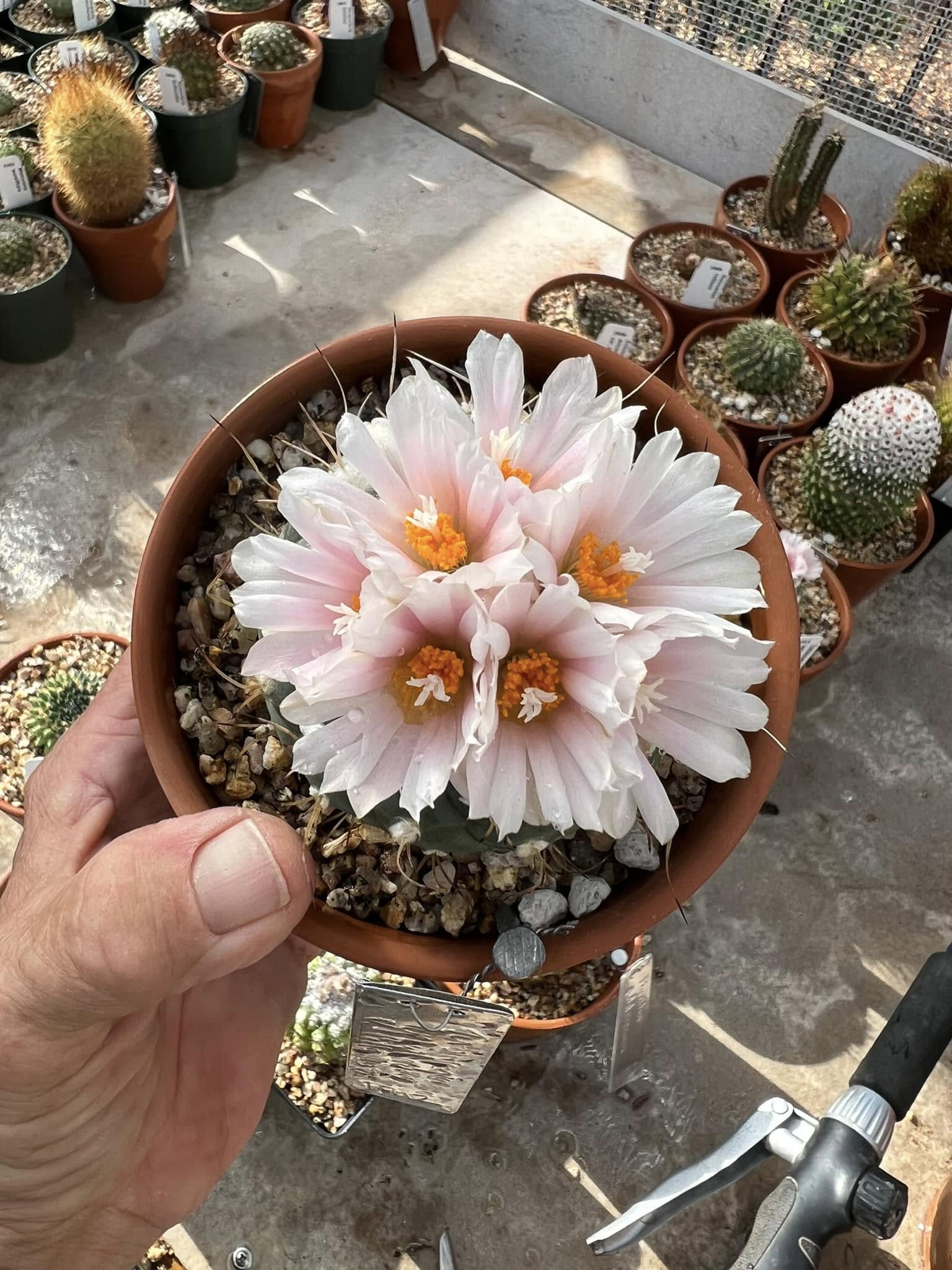
Turbinicarpus lophophoroides is a small, flattened geophyte endemic to the gypsic, saline flatlands of southern San Luis Potosí, Mexico. Its epithet announces the defining confusion: lophophoroides means Lophophora-like, and a mature adult in the field can stop any collector cold. The flat-globose grey-green body, woolly crown, and near-spineless areoles produce a near-replica of Lophophora williamsii in gross form. The resemblance is convergent: the two genera are not closely related, and the alkaloid profiles differ completely.
Erich Werdermann described the species in 1934 from a photograph, naming it Thelocactus lophophoroides in Kakteenkunde 1934: 176. Franz Buxbaum and Curt Backeberg moved it to the newly erected genus Turbinicarpus in 1937. Over the following six decades the plant collected four more generic assignments as taxonomists debated where a morphologically convergent cactus belonged without molecular tools. Molecular phylogenetics settled the question: Turbinicarpus s.s. is monophyletic, sister to Ariocarpus, and T. lophophoroides sits firmly within it.
The habitat is unlike that of most Turbinicarpus species. Rather than rocky limestone scree or cliff faces, T. lophophoroides occupies nearly flat gypsic and saline grassland, seasonally flooded by the North American Monsoon, at 870 to 1,150 m above sea level. This edaphic specialisation is load-bearing for cultivation: the substrate must carry a gypsum amendment or the plant never performs as it does in the field. Turbinicarpus pseudomacrochele, by contrast, roots into limestone scree in Querétaro and Hidalgo, a completely different substrate regime.
CITES Appendix I listing applies. Turbinicarpus saueri, a Tamaulipas endemic with a very different limestone-hill habitat, faces comparable collection pressure. Turbinicarpus alonsoi, from a single Guanajuato locality, carries a higher IUCN category still.
Turbinicarpus lophophoroides quick reference
A geophytic Turbinicarpus from the saline gypsic flatlands of southern San Luis Potosí, with a stout tuberous taproot and an adult body that withdraws below the soil surface during dry dormancy. Values calibrated for seed grown plants in cultivation, drawn from habitat field data and specialist grower sources.
Taxonomy & nomenclature
The accepted name is Turbinicarpus lophophoroides (Werderm.) Buxb. & Backeb., published in Cactaceae (Berlin) 1937(1): Blatt 27 (1937). Kew POWO (powo.science.kew.org, accessed 2026-04-21) recognises this combination with full synonymy chain. The basionym, Thelocactus lophophoroides Werderm., was published in Kakteenkunde 1934: 176, with a figure; the lectotype is the photograph accompanying the original description at page 177 (Werdermann 1934).
The species accumulated six generic assignments between 1934 and 1998, all homotypic. After Werdermann’s Thelocactus (1934), Knuth placed it in Strombocactus (1936), Buxbaum and Backeberg created the still-accepted Turbinicarpus combination (1937), Marshall transferred it to Toumeya (1946), Anderson to Neolloydia (1986), and Halda to Pediocactus (1998). None of the post-1937 transfers gained wider acceptance; POWO and all mainstream references follow Buxbaum and Backeberg.
The instability in generic placement reflects the morphological convergence problem: the adult body of T. lophophoroides superficially resembles Lophophora, its tuberculate arrangement resembles some Thelocactus, and neither is phylogenetically close. Plastid and nuclear marker analysis resolved the question. Turbinicarpus s.s. is monophyletic and sister to Ariocarpus within tribe Cacteae. The same analysis separated three lineages previously lumped under Turbinicarpus s.l.: Kadenicarpus, Rapicactus, and Turbinicarpus s.s.. T. lophophoroides falls unambiguously in Turbinicarpus s.s.
The epithet lophophoroides is a direct morphological descriptor: Greek lophos (crest) + phoros (bearing) + -oides (resembling), encoding the adult plant’s near-spineless, flat-crowned, glaucous-grey body that mirrors Lophophora williamsii. The resemblance is convergent, not genealogical.
Despite POWO recording distribution extending to Jalisco, all primary field accounts restrict T. lophophoroides to southern San Luis Potosí; the POWO Jalisco element appears to be a backbone imprecision. No georeferenced GBIF records for Jalisco exist, and all primary field accounts, the IUCN assessment, and specialist databases consistently place the entire known range within San Luis Potosí.
Historical synonyms (5)
- Thelocactus lophophoroides Werderm., 1934 basionym
- Strombocactus lophophoroides (Werderm.) Backeb., 1935 homotypic synonym
- Toumeya lophophoroides (Werderm.) Bravo & W.T.Marshall, 1947 homotypic synonym
- Neolloydia lophophoroides (Werderm.) E.F.Anderson, 1986 homotypic synonym
- Pediocactus lophophoroides (Werderm.) Halda, 1998 homotypic synonym
Sources: POWO (Kew) · IPNI · GBIF · Wikidata
Habitat
Turbinicarpus lophophoroides is a confirmed gypsum specialist. The species grows on deep, gypsic, saline soils in seasonally flooded flatlands of southern San Luis Potosí at 870 to 1,150 m above sea level. This is not the rocky limestone scree or cliff-face substrate of Turbinicarpus valdezianus or most other species in the genus; it is nearly flat terrain with heavy, salt-accumulating soils that can reach pH 9 or above in gypsum and halite mineral assemblages. Gypsum content is the distinguishing edaphic factor.
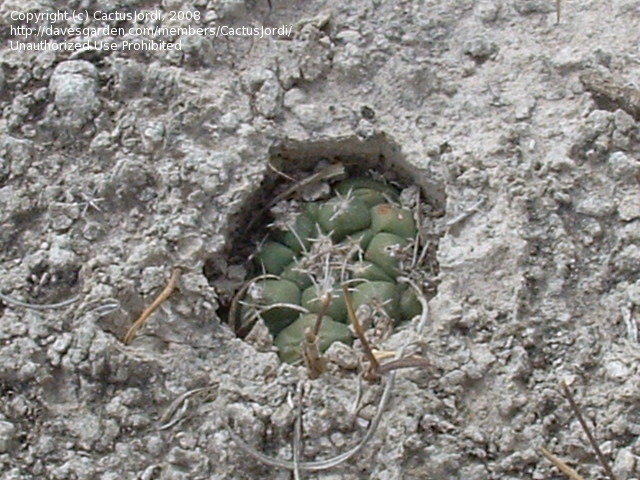
The flatland microhabitat floods seasonally during the North American Monsoon (June–September). T. lophophoroides is adapted to these conditions: during the dry season the plant contracts and is pulled below the soil surface, becoming entirely concealed under a thin layer of silt and debris. This hypogaeic withdrawal is an adaptation to both drought and the seasonally harsh soil chemistry. Field accounts record the plant occurring on soils “with mostly gypsum” in open grassland “seasonally flooded with great concentration of salts.”
Associated vegetation at population sites documents the saline-gypsic context precisely. Documented associates: halophytic grasses Sporobolus pyramidatus and S. airoides; shortgrasses Bouteloua chasei and Buchloe dactyloides; saltgrass Distichlis spicata; scattered shrubs Prosopis laevigata and Acacia sp.; and the co-occurring Las Tablas endemic cactus Coryphanta maiz-tablascensis. The grass assemblage is an indicator community for saline-gypsic flatlands in the Chihuahuan Desert transition zone.
Annual rainfall at this elevation and latitude follows a summer-dominant monsoon pattern, estimated 300–600 mm, with dry winters from November through April. Brief frost events are possible at 870–1,150 m and are part of the natural temperature regime. The southern San Luis Potosí range is framed by the municipalities of Rioverde, Villa Juárez, Ciudad del Maíz, and Ciudad Fernández; the Las Tablas locality is the most frequently cited named site in the specialist literature.
Morphology
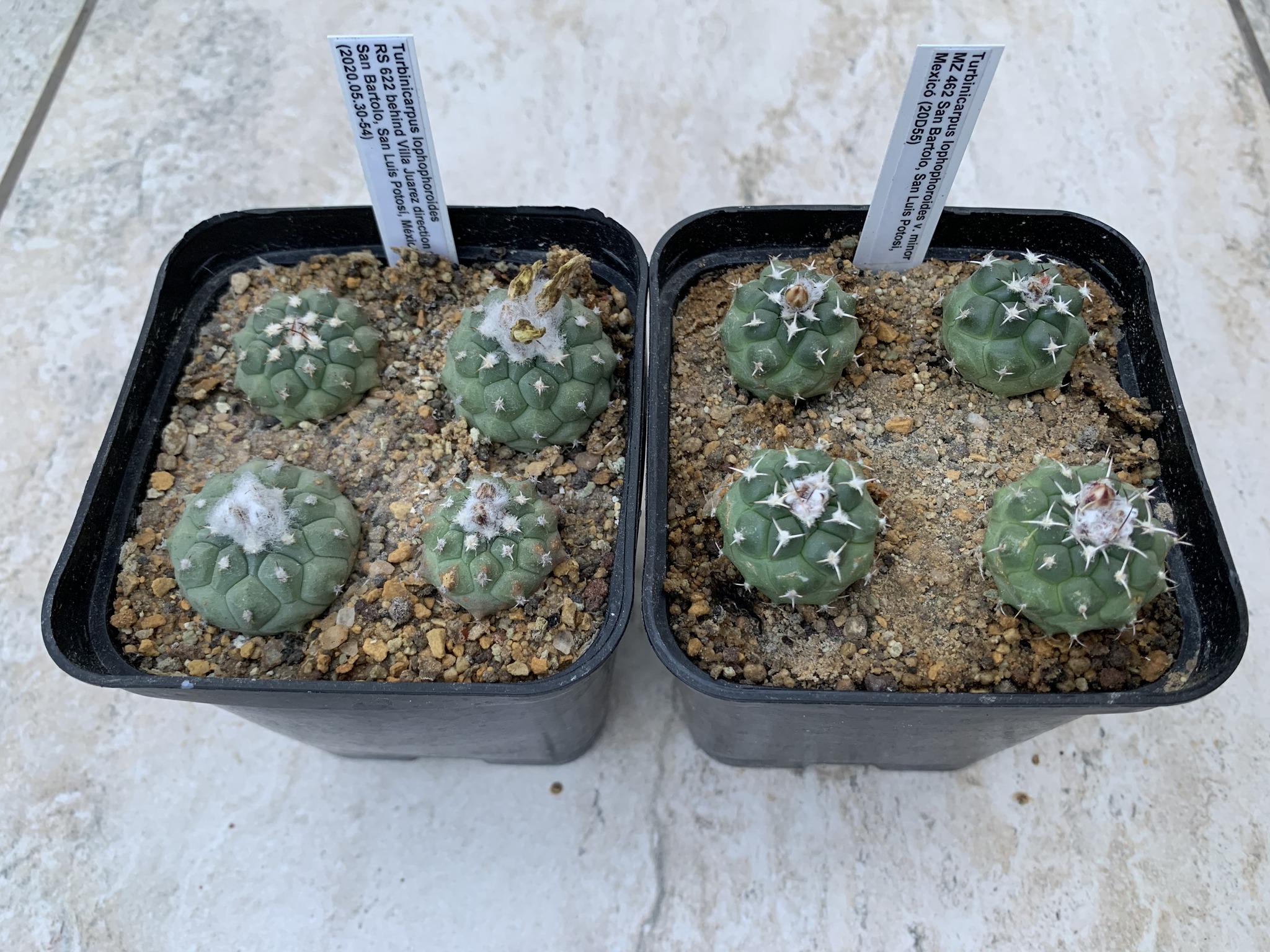
T. lophophoroides is depressed-hemispherical to flat-globose, consistently wider than tall in mature plants. Height runs 2.5–3.5 cm, up to approximately 4.5 cm; diameter 4–4.5 cm in typical adults, with very old plants reported up to 10 cm across. The body colour is bluish-green to dark grey-green, glaucous; the grey-green deepens in dry conditions when the plant retracts. The crown carries a conspicuous tuft of white to silvery-grey wool. Below ground: a stout tuberous taproot, extending well beyond the small aerial stem. The geophytic habit is structurally important and cultivation containers must accommodate it.
Tubercles are arranged in 12 spirals in adult plants; each tubercle is 4–6-sided, flattened-rounded, up to 12 mm across. Areoles are elongated, approximately 2–2.5 mm long. Tubercles do not fuse into continuous ribs; this is the most diagnostic vegetative separation from Lophophora williamsii, which forms 7–13 true ribs in adults.
Spines are the key age-dependent character. Juvenile and young adult plants carry 2–4 spines per areole, spreading, short, smooth, grey to blackish, the central spine to 1 cm. The spines dry and fall with age; mature adult plants are virtually spineless, with only bare brownish areole remnants persisting. This progressive spine loss is what creates the Lophophora-like adult silhouette. Lophophora williamsii is spineless at all ages; the spine loss in T. lophophoroides is an age-dependent process, not a permanent character, and young plants are readily identified by their spination.
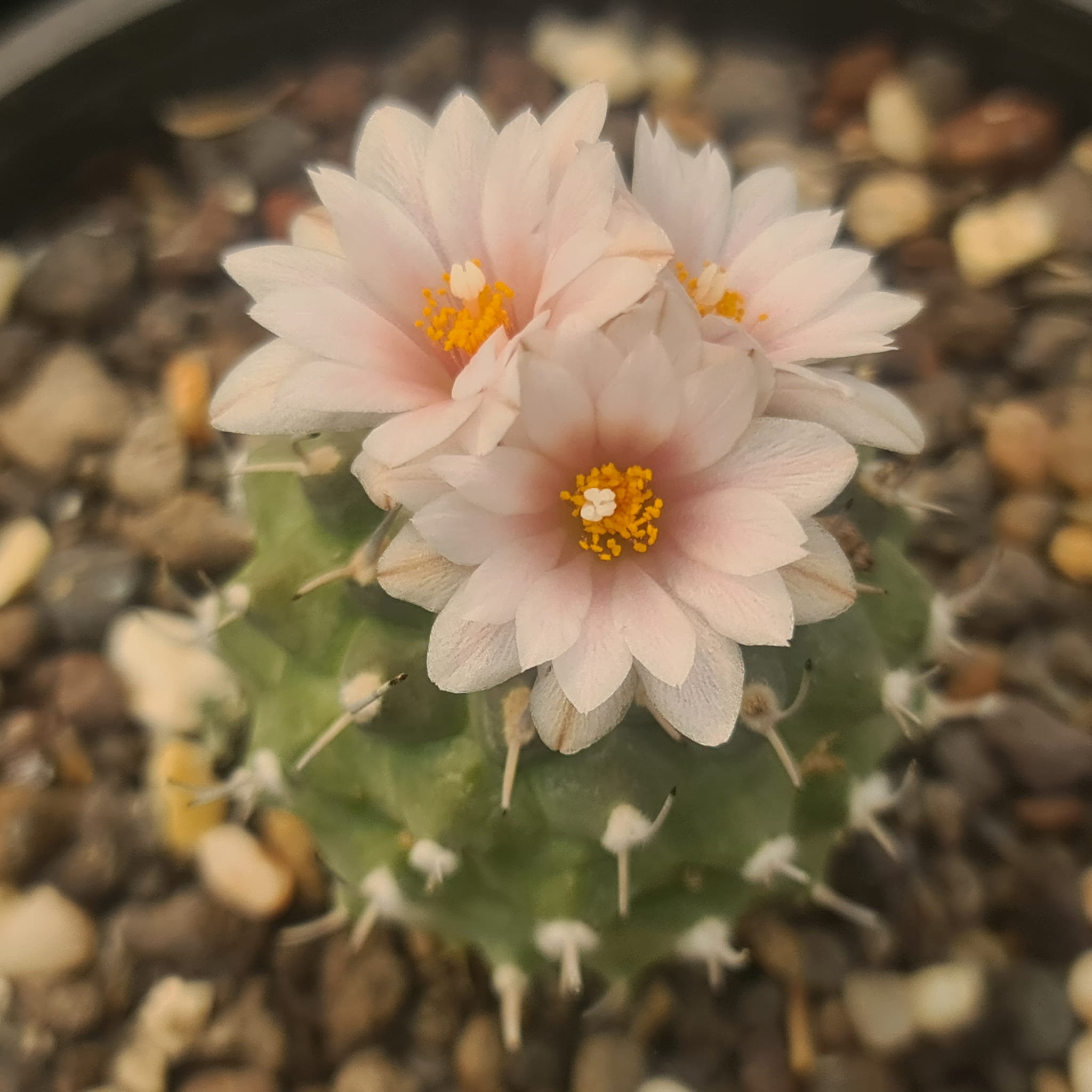
Flowers are approximately 3.5 cm in diameter when fully open, large relative to the body. Outer perianth segments pale yellowish-green to brownish-olive; inner segments white to pale pink with a pale to mid-pink midstripe. Style and stigma lobes (4) whitish; anthers orange-yellow. Primary flowering season is spring to early summer, with additional blooms possible into early autumn. The flower is large and conspicuous relative to the body, contrasting with L. williamsii whose flowers measure 1.5–2.5 cm and are uniformly pink without a distinct white ground.
Fruit is small, pericarp 2–3 mm diameter, light green with vestigial scales; inconspicuous. Lophophora williamsii fruit is club-shaped, red to pinkish, up to 2 cm long; the contrast is sharp and useful in season. Seed is small, black, approximately 1 mm, finely tuberculate testa.
Alkaloids are present but not psychoactive at standard doses. Total alkaloid content runs approximately 500 mg per 100 g fresh plant, dominated by hordenine at 91.69% (±0.54) of the total fraction. Minor alkaloids include anhalonidine (2.37%), tyramine (1.82%), phenethylamine (1.04%), N-methylmescaline (0.51%), pellotine (0.46%), and trace mescaline. Hordenine dominance is the defining phytochemical separation from Lophophora williamsii, where mescaline accounts for 30–50% of total alkaloid. T. lophophoroides does not produce psychoactive quantities of mescaline and is not a peyote substitute, though its superficial resemblance and the presence of trace alkaloids are factors in the CITES Appendix I listing alongside documented poaching.
Locality detail
The type locality is in the Huizache / Las Tablas area of southern San Luis Potosí, the same region where Werdermann made the original collection documented in 1934. Field research established population-level ecology data at Las Tablas. The IUCN assessment reports at least 15 disjunct subpopulations across at least 4 distinct geographic locations, a population structure that reflects the patchy occurrence of gypsic flatlands across the southern San Luis Potosí landscape.
Sub-locality coordinates are withheld here. The species is on CITES Appendix I, and vehicle-accessible gypsic flatlands make its habitat unusually easy to reach for collectors. The map below shows only a regional centroid for southern San Luis Potosí; no municipality-level or finer GPS is published on this site.
Turbinicarpus lophophoroides care and cultivation
Two facts from the habitat summary drive everything about cultivation. The substrate is gypsic, alkaline, and nearly mineral; the mix must carry a calcium sulphate amendment that no standard cactus mix provides. The watering regime must mirror the monsoon-dominated field pattern: thorough but infrequent in summer, completely dry in winter. Rot is the primary kill risk, especially post-flowering.
Substrate
Turbinicarpus lophophoroides is a confirmed gypsum specialist, evolving on gypsic, alkaline, saline soils in the San Luis Potosí flatlands at 870 to 1,150 m. The canonical ratio is 35 per cent pumice, 15 per cent lava rock, 5 per cent zeolite, 20 per cent granite grit, 10 per cent limestone chip, 10 per cent coarse silica, and 5 per cent worm castings. No published cultivation source gives a limestone or silica proportion specific to this species: the 10 per cent limestone and 10 per cent silica shipped here differ from the genus’s usual 20 per cent limestone and zero silica, and that difference is currently unsupported by any grower evidence, pending review against the genus baseline. The gypsum-flat habitat named above is a real locality fact, not the reason for either number. The zeolite buffers pH and paces nutrients; the lava and pumice together provide the drainage that prevents crown and root-neck rot during the long dry winter.
All seven Turbinicarpus species on this site share a 95/5 mineral-organic baseline; no published grower source gives a per-species limestone proportion for the genus, so limestone is carried as bloc-level convention (Doorbar and Quail’s Mexican-limestone-genera practice), not a species-specific finding. T. lophophoroides currently ships a different limestone and silica split with no cultivation source behind the difference; that figure is under review against the genus baseline.
| Species | Pumice | Lava | Zeolite | Granite | Limestone | Silica | Organic |
|---|---|---|---|---|---|---|---|
| T. alonsoi | 35% | 15% | 5% | 20% | 20% | 0% | 5% |
| T. valdezianus | 35% | 15% | 5% | 20% | 20% | 0% | 5% |
| T. boedekerianus | 35% | 15% | 5% | 20% | 20% | 0% | 5% |
| T. lophophoroides (this page) | 35% | 15% | 5% | 20% | 10% | 10% | 5% |
| T. pseudomacrochele | 35% | 15% | 5% | 20% | 20% | 0% | 5% |
| T. pseudomacrochele subsp. krainzianus | 35% | 15% | 5% | 20% | 20% | 0% | 5% |
| T. saueri | 35% | 15% | 5% | 20% | 20% | 0% | 5% |
One advanced collector account describes success on a pure mineral substrate: crushed limestone, sandstone, red granite, brick, and fine gravel with no soil fraction at all. This is consistent with the habitat chemistry and is appropriate for experienced growers. Deep pots are required to accommodate the stout tuberous taproot; glazed ceramic or stoneware retains moisture more evenly than fast-drying terracotta, which can dry the taproot zone too rapidly between waterings.
Watering and light
Winter dormancy is absolute. From November through April, no water at all. The plant’s natural winter in southern San Luis Potosí is dry, and any moisture during low temperatures is the primary kill vector for root-neck rot. Allow the growing medium to reach bone dryness for several weeks before any frost risk arrives.
In the active season (June–September), water every 4–6 weeks, abundantly so the substrate is thoroughly soaked, then allow complete dryness before the next watering. Some experienced growers report monthly watering as the outer limit of safe frequency. Keep the crown wool dry at all times; water at soil level. Spring (March–May): resume cautiously as temperatures warm, starting with minimal watering and increasing as growth becomes visible.
Light: bright, with light afternoon shade during the most intense summer hours in hot climates (SW USA, Mediterranean, central Mexico at low elevation). In temperate growing conditions (northern Europe, Pacific Northwest), full sun is appropriate and necessary to maintain the characteristic flat-globose form. Avoid low light under any circumstances; the plant etiolates and elongates out of character.
Cold tolerance is genuine but conditional on substrate dryness. Published cold-hardiness data gives approximately –7°C (20°F) briefly as a tested floor; specialist growers document –4°C as a tested minimum in completely dry conditions. The practical safe floor in cultivation is 4°C. Below that threshold, ensure the root zone has been dry for several weeks before any exposure.
Propagation
Seed grown plants typically reach first flower in 3–5 years under good cultivation, with some individuals reported flowering at under 3 years in optimal conditions (CactiGuide grower records; cultivodecactus.com). Grafted plants on Myrtillocactus geometrizans or Pereskiopsis spp. flower within 1–2 years. Grafted plants are more rot-prone than seed grown plants once established, and the accelerated growth rarely produces the characteristic flat-globose body. T. lophophoroides responds to in vitro areole activation culture on MS medium, establishing vegetative propagation potential beyond conventional grafting.
Comparison
The primary identification challenge with T. lophophoroides is not within Turbinicarpus but across genera. A mature adult in the field or in a collection is routinely mistaken for Lophophora williamsii by collectors unfamiliar with the species. Both share a flat-globose grey-green body, a woolly crown, near-spineless adult areoles, and a geophytic habit. The resemblance is morphologically striking and is the reason for the epithet. Full character separation appears in the FAQ Q1 table below.
Three vegetative characters separate the species at any age. Tubercle structure: T. lophophoroides has distinct spirally arranged tubercles, never fusing into continuous ribs; L. williamsii has 7–13 true ribs in adults. Spine history: T. lophophoroides produces spines on juveniles that are shed with age; L. williamsii is spineless at all ages. Fruit: greenish and inconspicuous in T. lophophoroides; club-shaped, red to pink, and conspicuous in L. williamsii. The alkaloid contrast is the legally significant character: hordenine-dominant with trace mescaline in T. lophophoroides versus mescaline-dominant in L. williamsii, which is a Schedule I controlled substance in most jurisdictions. T. lophophoroides is not.
Within Turbinicarpus, the species most relevant for comparison are those in the broadly flat-bodied group. Turbinicarpus boedekerianus from Nuevo León is also flat-topped with a woolly crown, but retains short pectinate spines throughout its life and grows on limestone rather than gypsic flatland. T. lophophoroides has no close morphological or phylogenetic sister within the genus that would generate collector confusion; the Lophophora comparison is the one that matters.
The habitat comparison is equally diagnostic. T. lophophoroides in gypsic saline flatlands of San Luis Potosí is a geographically and edaphically restricted endemic. L. williamsii ranges from South Texas through multiple Mexican states on limestone scrub between 100 and 1,900 m. Any plant presented as T. lophophoroides from outside San Luis Potosí warrants provenance scrutiny.
Frequently asked questions
How do you tell Turbinicarpus lophophoroides apart from Lophophora williamsii (peyote)?
The epithet of T. lophophoroides encodes this comparison: the adult body mimics peyote so closely that misidentification by sight is common. Drag the slider to compare both plants, then work down the character table for the diagnostic separations.


Tubercle structure is the definitive vegetative character: T. lophophoroides has no ribs, only distinct spirally arranged tubercles. The alkaloid contrast is the legally critical one: hordenine-dominant T. lophophoroides is not a controlled substance; mescaline-dominant L. williamsii is.
Is Turbinicarpus lophophoroides legal to own?
Turbinicarpus lophophoroides is listed on CITES Appendix I, meaning international trade in wild-collected plants requires permits from both the exporting and importing country. Nursery-propagated plants are legal to buy and own in most jurisdictions when properly documented. Crucially, T. lophophoroides is not a controlled substance: it does not produce psychoactive quantities of mescaline, unlike Lophophora williamsii, which is Schedule I in the USA and equivalent in most European and Latin American jurisdictions. Mexican federal law protects the species under NOM-059-SEMARNAT-2010. Always purchase from sellers who can confirm nursery origin and provide CITES documentation for any international shipment.
How difficult is Turbinicarpus lophophoroides to grow?
The most demanding cultivation in the genus, primarily for two reasons. The substrate must contain a gypsum (CaSO4) amendment that standard commercial cactus mixes do not provide, and the plant is the most rot-prone Turbinicarpus, especially post-flowering. The winter dry period must be absolute; any watering between November and April in cool or cold conditions is likely fatal. In temperate climates with attentive substrate preparation and strict watering discipline, the plant grows reliably.
What substrate does Turbinicarpus lophophoroides need?
A highly mineral mix with a mandatory gypsum amendment. The species evolved on deep gypsic, saline soils, and cultivation substrate must reflect this. A workable composition: pumice (35%), granite grit (25%), decomposed granite (15%), limestone chip (15%), and horticultural gypsum (10–15%). pH should be neutral to mildly alkaline. No organic amendments; no standard potting soil. A 100% mineral substrate with no organic fraction is also appropriate for experienced collectors.
Where does Turbinicarpus lophophoroides grow in the wild?
Endemic to the gypsic, saline flatlands of southern San Luis Potosí, Mexico, at 870 to 1,150 m above sea level. Known from at least 15 disjunct subpopulations across at least 4 geographic locations, including the Las Tablas locality that is most frequently cited in the literature. The plant grows on nearly flat terrain in seasonally flooded gypsic grassland with halophytic associates, a habitat unlike most other Turbinicarpus species. The plant retracts below the soil surface during the dry season.
How long does Turbinicarpus lophophoroides take to flower from seed?
Seed grown plants typically flower in 3–5 years under good conditions, with some individuals reported at under 3 years in optimal cultivation (cultivodecactus.com; CactiGuide forum records). Grafted plants on Myrtillocactus geometrizans or Pereskiopsis spp. flower within 1–2 years. The post-flowering period is a risk point: the crown and root neck are at elevated rot risk after the bloom, and careful crown drying and reduced watering after flowering are strongly recommended. Grafted plants are faster-flowering but more rot-prone than seed grown plants.
Sources & further reading
Werdermann, E. (1934). [Original description of Thelocactus lophophoroides]. Kakteenkunde 1934: 176, fig. Basionym; lectotype photograph at p. 177. · Buxbaum, F. & Backeberg, C. (1937). Turbinicarpus lophophoroides (Werderm.) Buxb. & Backeb. Cactaceae (Berlin) 1937(1): Blatt 27. · Anderson, E.F. (2001). The Cactus Family. Timber Press, Portland. [Cultivation notes: rot-prone; cold tolerance to ca. –7°C briefly.] · Donati, D. & Zanovello, C. (2004). Knowing, Understanding, Growing Turbinicarpus-Rapicactus. Cactus Trentino SudTirol. [Subseries Lophophoroides concept; morphological and habitat treatment.] · Davíla-Figueroa, C.A. et al. (2005). In vitro propagation of eight species or subspecies of Turbinicarpus (Cactaceae). In Vitro Cellular & Developmental Biology, Plant 41(4): 548–553. · Flores, J., Villarreal Jurado, E. & Jiménez-Bremont, J.F. (2008). Breaking seed dormancy in specially protected Turbinicarpus lophophoroides and Turbinicarpus pseudopectinatus (Cactaceae). Plant Species Biology 23(1): 43–46. · Vázquez-Sánchez, M. et al. (2019). Polyphyly of the iconic cactus genus Turbinicarpus (Cactaceae) and its generic circumscription. Botanical Journal of the Linnean Society 190(4): 405–420. · Štárha, R., Chybidziurová, A. & Lacný, Z. (1999). Alkaloids of the genus Turbinicarpus (Cactaceae). Biochemical Systematics and Ecology 27(8): 839–841. · Smith, M., Fitz Maurice, W.A., Fitz Maurice, B. & Sotomayor, M. (2017). Turbinicarpus lophophoroides. IUCN Red List of Threatened Species 2017: e.T40981A121507671. [Near Threatened; supersedes 2004 Vulnerable assessment.] · Kew POWO. Turbinicarpus lophophoroides (Werderm.) Buxb. & Backeb. Plants of the World Online. powo.science.kew.org/taxon/urn:lsid:ipni.org:names:138997-1. Accessed 2026-04-21. · Wikispecies / IPNI. Turbinicarpus lophophoroides combination history. species.wikimedia.org/wiki/Turbinicarpus_lophophoroides. Accessed 2026-04-21. · llifle.com Encyclopedia of Living Forms. Turbinicarpus lophophoroides entry. llifle.com. Accessed 2026-04-21. [Secondary conduit for IUCN EOO/AOO data citing assessment ID 40981.] · Cactus-Art.biz. Turbinicarpus lophophoroides. cactus-art.biz/schede/TURBINICARPUS/Turbinicarpus_lophophoroides. Accessed 2026-04-21. [Substrate ratios, gypsum pH data, watering notes.] · Trout’s Notes / Sacred Cacti. Turbinicarpus. sacredcacti.com. Accessed 2026-04-21. [Morphology; secondary transmission of Štárha et al. 1999 alkaloid data.]