
Turbinicarpus saueri
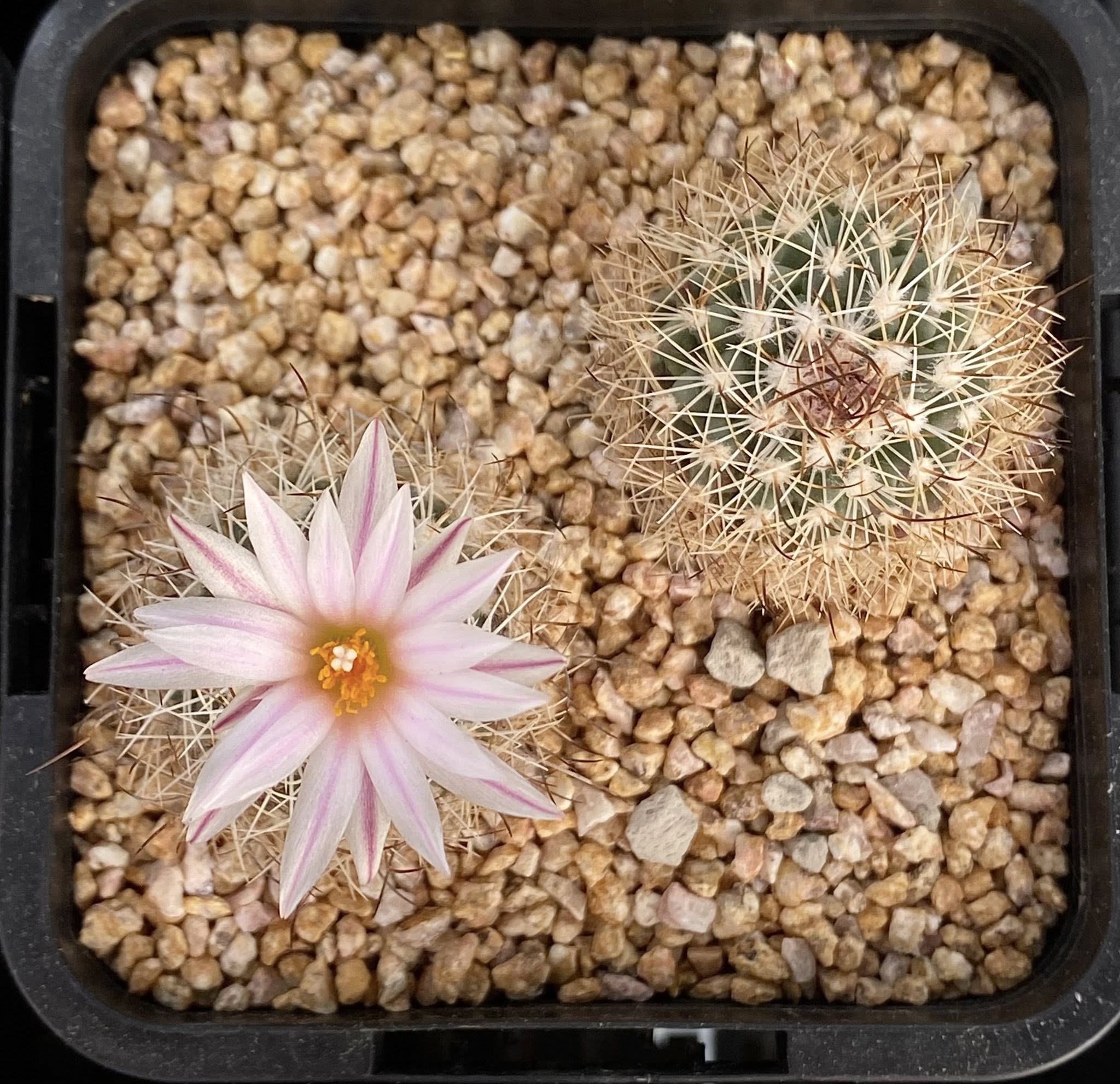
Turbinicarpus saueri is among the larger-bodied members of a genus built on miniatures. The depressed-globose grey-green body of the nominate subspecies reaches approximately 4 cm tall and 6 cm in diameter in typical cultivation, unremarkable by most cactus standards but large for a Turbinicarpus. What marks the species most clearly in the hand is its spination: long white radial spines, up to 15 mm, spreading horizontally with a flexibility uncommon in the genus, and a single strongly curved central spine up to 20 mm. Friedrich Boedeker described it in 1928 from a Jaumave Valley collection, naming it Echinocactus saueri; the current combination was established by Václav John and Jan Ríha in 1983.
The species is endemic to northeastern Mexico. Tamaulipas holds the type locality and the nominate subspecies; San Luis Potosí is home to subsp. knuthianus. Kew POWO recognizes seven subspecies across this two-state range, a taxonomic complexity that exceeds most of its relatives. Compare this to the geographically narrower endemics such as Turbinicarpus alonsoi, confined to a single Guanajuato locality, or Turbinicarpus boedekerianus, restricted to a small Nuevo León limestone flat: T. saueri has the widest subspecific spread of any taxon in the genus and spans the greatest elevational range, from valley-floor populations near 600 m to subsp. nelissae on Bustamante slopes above 1,988 m.
The habitat is Tamaulipan thornscrub on limestone outcrops, a semi-arid shrubland of thorny legumes, columnar cacti, and seasonally dry grass. This same thornscrub ecoregion also supports Ariocarpus species in the broader region, linking T. saueri to a wider guild of Mexican limestone endemics. Plants occupy exposed rocky slopes, cliff ledges, and shallow mineral pockets in limestone fissures. The summer-dominant precipitation pattern drives the growth cycle: active from May through September, essentially dormant through the dry winter.
All Turbinicarpus are CITES Appendix I, and T. saueri additionally carries the NOM-059-SEMARNAT-2010 Category A (Amenazada) designation under Mexican federal law. Illegal collection pressure has been particularly documented for subsp. ysabelae (now subsumed under subsp. nelissae), which was described as nearly extirpated by trade collection at the time of its description.
Turbinicarpus saueri quick reference
A limestone-specialist Turbinicarpus from the Tamaulipan thornscrub of northeastern Mexico, growing on exposed rocky slopes and cliff ledges at 600–800 m in the Jaumave Valley. Values calibrated for seed grown plants in cultivation, drawn from BCSS specialist grower consensus, llifle, and habitat data.
Taxonomy & nomenclature
The accepted name is Turbinicarpus saueri (Boed.) V.John & Ríha, published in Kaktusy (Brno) 19: 22 (1983). The basionym is Echinocactus saueri Boed., published in Zeitschrift für Sukkulentenkunde 3: 362, fig. (1928). A lectotype was designated from the illustration in the Boedeker protologue. LSID: urn:lsid:ipni.org:names:286473-2 (Kew POWO; IPNI confirmed).
Vázquez-Sánchez et al. (2019, Botanical Journal of the Linnean Society 190(4): 405–420) resolved the formerly polyphyletic Turbinicarpus sens. lat. into three genera: Kadenicarpus, Rapicactus, and Turbinicarpus s.s. Turbinicarpus saueri is retained in Turbinicarpus s.s. per Kew POWO (2025) and the Caryophyllales Network. No published combination Rapicactus saueri exists in POWO, IPNI, or the Caryophyllales Network; the Rapicactus treatment encompasses five accepted species (R. beguinii, R. booleanus, R. mandragora, R. subterraneus, R. zaragosae) and saueri is absent from that list. The monograph Knowing, Understanding, Growing Turbinicarpus-Rapicactus discussed the generic segregation concept; their specific placement for saueri was not confirmed in full text, but the POWO and Caryophyllales Network consensus is unambiguous.
Five homotypic synonyms share the basionym: Neolloydia saueri (Boed.) F.M.Knuth (1936), Gymnocactus saueri (Boed.) Backeb. (1942), Thelocactus saueri (Boed.) Borg (1937), and Pediocactus saueri (Boed.) Halda (1998). All share the Boedeker 1928 type. Kew POWO lists five synonyms; Wikispecies confirms full homotypic synonymy with publication details. The name Gymnocactus gueldemannianus Backeb. is associated with the saueri aggregate in older literature but no current POWO combination T. saueri subsp. gueldemannianus exists; the name is omitted from the accepted subspecies table accordingly.
Kew POWO (2025) recognizes seven subspecies. The nominate subsp. saueri is Tamaulipas-based; subsp. knuthianus (Boed.) Lüthy (basionym Echinocactus knuthianus Boed. 1930; also Gymnocactus knuthianus Backeb. 1951) is San Luis Potosí confined; subsp. nelissae Halda & Panar. 1998 (confirmed authority, Acta Musei Richnoviensis Sect. Nat. 5: 161) incorporates the former T. ysabelae from Bustamante, Tamaulipas; subsp. gonzalezii Pavlíček & Zatloukal is placed in northern Mexico; subsp. nieblae (García-Mor., Mart.-Aval. & Bergm.Beck.) A.Hofer was transferred from T. nieblae; subsp. septentrionalis Matusz. & Šnicer covers the northern range populations; and subsp. verduzcoi Zachar & Lux is a recent addition. Spine and flower characters distinguish the subspecies: subsp. knuthianus produces distinctly pink flowers with a darker midrib and blooms in summer, contrasting with the white flowers of the nominate.
Micromorphological study documented two characters unique to T. saueri within the genus: the species lacks the juvenile plumose spines found on most other Turbinicarpus, and its spine epidermal cells have smooth outer periclinal walls rather than the striate walls typical of the genus. These characters are not practically useful in the field but confirm a distinct developmental profile within Turbinicarpus s.s.
Historical synonym (1)
- Thelocactus saueri (Boed.) A.Berger, 1929 basionym
Sources: POWO (Kew) · IPNI · GBIF · Wikidata
Habitat
Turbinicarpus saueri grows on limestone outcrops and rocky slopes in Tamaulipan thornscrub, the matorral tamaulipeco that covers the Sierra Madre Oriental foothills from southern Nuevo León into Tamaulipas. The vegetation matrix is a semi-arid shrubland of thorny legumes (Acacia, Prosopis), Opuntia, columnar cacti, and seasonally green grasses. Ariocarpus species share this same thornscrub ecoregion at broadly comparable elevations across the region, underscoring the calcareous substrate as the thread connecting these limestone endemics.
The species colonizes cracks in limestone outcrops and accumulations of fine mineral powder in fissures, a microhabitat character shared across the genus. Plants appear on exposed rocky slopes, cliff ledges, and south-facing limestone ledges where drainage is immediate. The root system reaches into the fissure mineral, where some moisture and fine calcareous material accumulate, but the above-ground body sits fully exposed on the rock face.
The climate is summer-dominant. Annual rainfall in the Jaumave Valley runs approximately 400–600 mm, concentrated in the June-to-September rainy season from Gulf moisture events. Winters are dry, and while temperatures can drop to near freezing on the ridge populations of the Sierra Madre Oriental, prolonged hard frost is uncommon at the valley-floor elevations where nominate subsp. saueri occurs. The seasonal pattern produces a clear active season and a dry winter dormancy, driving the cultivation watering calendar directly.
Morphology
The nominate subspecies produces a solitary, grey-green depressed-globose to globose stem. Width consistently exceeds height: typical mature specimens measure approximately 4 cm tall by 6 cm in diameter, with subspecies across the complex reaching 4–8 cm tall and 6–9 cm diameter. Subsp. nelissae reaches 6–7 cm tall by 7–8 cm wide; subsp. ysabelae (now syn. nelissae) was recorded at 6 cm tall by 7–9 cm; subsp. knuthianus at up to 6 cm tall by 6.5 cm diameter. Tubercles are conical, prominent, arranged in spiraling rows, with a woolly meristematic apex. Bodies are typically solitary.
Spination is the defining character. The nominate carries approximately 12–18 radial spines per areole: horizontally spreading, needle-like, somewhat curved downward, glassy white with brown tips, up to 15 mm long. One central spine is present, strongly curved or tortuous, up to 20 mm, darker brown, and thicker than the radials. The overall effect is notably long and slightly flexible for a small-bodied Turbinicarpus, a combination that aids identification in the hand. Compare this to the feathery pectinate radials of Turbinicarpus valdezianus, which lie flat against the body in a completely different arrangement, or the long twisted papery spines of Turbinicarpus pseudomacrochele.
Flowers of the nominate are white with a faint pinkish midstripe, funnel-shaped, approximately 15 mm long and 20 mm in diameter. Flowering occurs in spring to early summer, the pattern consistent across the genus. Subsp. knuthianus is an exception, producing distinctly pink flowers with a darker midrib, approximately 25 mm long, blooming in summer. Each flower in the complex lasts approximately four days.
Micromorphological study documented a spine character: T. saueri lacks the juvenile plumose spines present on most Turbinicarpus species, and its spine epidermal cells show smooth outer periclinal walls rather than the striate walls typical of the genus. This histological distinction confirms a consistent developmental divergence within Turbinicarpus s.s.
Locality detail
The type collection was made by Friedrich Boedeker from the Jaumave Valley, Tamaulipas; secondary sources (llifle, EcuRed) identify the specific area as San Vicente at Salamanca, valley of Jaumave. The lectotype is the illustration in the 1928 Zeitschrift für Sukkulentenkunde protologue. Boedeker’s original paper did not provide GPS coordinates; no finer locality precision than the Jaumave Valley and surrounding Tamaulipas foothills was retrieved from primary literature.
The species complex occupies two Mexican states. Tamaulipas holds the nominate subspecies and subsp. nelissae, concentrated in the Jaumave Valley corridor and Bustamante area (Tamaulipas) and the Ciudad Victoria municipality. San Luis Potosí is the range of subsp. knuthianus, associated with the Guadalcázar municipality. Elevation varies considerably: BCSS field records document subsp. gonzalezii at approximately 467 m near Ciudad Cerralvo, Nuevo León; subsp. septentrionalis at 680–720 m near Monterrey; nominate valley-floor occurrences at 600–800 m (EcuRed, secondary synthesis); and subsp. nelissae at 1,988–2,000 m on rocky limestone slopes above Bustamante. Ridge populations of the nominate above the Jaumave Valley are likely to occur at 1,000–1,400 m based on Sierra Madre Oriental topography, but no publication with a page reference was retrieved for this elevation tier at build time. The map below marks only a regional centroid for the Tamaulipas core range.
The standard monographic treatment (Succulent Plant Research Vol. 7) is the expected source for species-level elevation data, but the full text was not accessible during the research pass. The elevation statement above reflects the most evidence-based picture available from BCSS field records and topographic synthesis. An update SQL is noted for this block once that volume is consulted.
Turbinicarpus saueri care and cultivation
The habitat profile is clear: limestone substrate, summer-dominant rainfall, full sun on exposed rocky faces, a dry winter, and a root system anchored in calcareous mineral soil. The light and watering regime follows from these facts, but the pot mix does not copy the habitat rock. The substrate must be mineral-dominant; the winter must be dry; and the summer watering should track the natural pulse of the rainy season. Limestone chip in the mix is grower convention for the genus, not a species requirement. Hard tap water already supplies calcium and bicarbonate at every watering; rainwater and RO water supply neither.
Substrate
The canonical ratio is 35 per cent pumice, 15 per cent lava rock, 5 per cent zeolite, 20 per cent granite grit, 20 per cent limestone chip, and 5 per cent worm castings. Pumice is the primary drainage aggregate, holding air and a little water without breaking down under repeated watering; lava grit is the structural drainage backbone at depth for the taproot. Limestone chip at 20 per cent is the site’s bloc-level convention for the Mexican limestone genera; no published source gives a species-specific proportion for T. saueri, so the share stays fixed at genus level rather than tuned to this species. The zeolite buffers pH around 7.0 to 7.5 and paces nutrients through the summer watering window. The taproot needs vertical space; deep containers and a fully mineral mix are both required for long-term success.
All seven Turbinicarpus species on this site share a 95/5 mineral-organic baseline; no published grower source gives a per-species limestone proportion for the genus, so limestone is carried as bloc-level convention (Doorbar and Quail’s Mexican-limestone-genera practice), not a species-specific finding. T. lophophoroides currently ships a different limestone and silica split with no cultivation source behind the difference; that figure is under review against the genus baseline.
| Species | Pumice | Lava | Zeolite | Granite | Limestone | Silica | Organic |
|---|---|---|---|---|---|---|---|
| T. alonsoi | 35% | 15% | 5% | 20% | 20% | 0% | 5% |
| T. valdezianus | 35% | 15% | 5% | 20% | 20% | 0% | 5% |
| T. boedekerianus | 35% | 15% | 5% | 20% | 20% | 0% | 5% |
| T. lophophoroides | 35% | 15% | 5% | 20% | 10% | 10% | 5% |
| T. pseudomacrochele | 35% | 15% | 5% | 20% | 20% | 0% | 5% |
| T. pseudomacrochele subsp. krainzianus | 35% | 15% | 5% | 20% | 20% | 0% | 5% |
| T. saueri (this page) | 35% | 15% | 5% | 20% | 20% | 0% | 5% |
Watering and light
The summer-rain pattern from the Jaumave Valley translates directly. Begin watering in March or April with light applications, allowing the substrate to dry fully between waterings. Through the active season (May to September) water every 7–10 days when the substrate is dry throughout. If summer temperatures exceed 38°C, reduce frequency to avoid root stress during the hottest weeks. October and November are the taper: water monthly or less. From November through February, no water. The root neck is the critical vulnerability; wet cold at any temperature is more dangerous than cold alone.
Cold tolerance for the genus stands at a safe minimum of 4–5°C dry, based on BCSS cultivation notes and specialist grower consensus. llifle records brief tolerance to -4°C when the substrate is fully dry and ventilation is good; this figure is exceptional and should not be used as a routine target. At the Jaumave Valley floor elevations where nominate subsp. saueri occurs, genuine hard frost is uncommon, so the species has not evolved for prolonged cold exposure.
Light: full sun in most northern-hemisphere cultivation climates. In continental or desert climates where summer afternoons exceed 38°C regularly, partial afternoon shade reduces heat stress. Morning sun and good air movement covers most situations. The species is not a shade plant; unlike Turbinicarpus lophophoroides, which inhabits gypsum flats with some low-angle light diffusion from surrounding substrate, T. saueri sits on exposed limestone faces in full solar exposure.
Propagation
Seed grown plants are the collector standard. The slower growth compared to grafted stock produces the compact depressed-globose form and mature spine character that represent the species at its best; grafted plants may show accelerated body expansion and lose the characteristic flat profile over time. Seed germinates at 21–27°C in bright indirect light. Seedlings benefit from careful summer watering discipline in years one and two; the root neck rot that kills adult plants is especially dangerous in juveniles with a narrow neck. Expect 5–10 years from germination to first flowering under seed grown conditions.
Comparison
Within Turbinicarpus s.s., the long and somewhat flexible white spines of T. saueri separate it cleanly from most relatives at a glance. Turbinicarpus valdezianus carries feathery pectinate radials that lie flat in a comb pattern against the body surface, structurally unlike the longer spreading radials of T. saueri. Turbinicarpus pseudomacrochele has long twisted papery spines that superficially resemble T. saueri at a glance, but the papery texture and tortuous form of pseudomacrochele’s centrals differ clearly from T. saueri’s needle-like white radials with a single hooked-to-curved central. Range difference reinforces the distinction: pseudomacrochele is Querétaro and Hidalgo, well south of the Tamaulipas and San Luis Potosí localities of T. saueri.
The most commonly confused species outside the genus is Kadenicarpus horripilus (Lem.) Vázquez-Sánchez, formerly placed in Turbinicarpus and now in its own genus per Vázquez-Sánchez et al. (2019). Both were previously sold under the Turbinicarpus label, and the name change has not yet fully permeated collector trade databases. The flower color is the fastest diagnostic: T. saueri produces white flowers; K. horripilus produces magenta flowers with a white throat. No other character is as reliable across cultivation conditions and growth stages.
Body shape reinforces the ID at maturity. T. saueri remains depressed-globose, wider than tall throughout its life. K. horripilus begins globose but elongates into a cylindrical-columnar form as it ages, reaching 7–18 cm tall against the 4–8 cm of T. saueri across the complex. Range does not overlap: K. horripilus is a Hidalgo endemic; T. saueri does not occur in Hidalgo. The FAQ section below provides the full character table.
Frequently asked questions
How do you tell Turbinicarpus saueri apart from Kadenicarpus horripilus?
Turbinicarpus saueri and Kadenicarpus horripilus were both circulated in the collector trade as Turbinicarpus before the 2019 molecular revision moved horripilus to its own genus. The flower color difference resolves identification in any condition. Work through the character table below to compare them.
Flower color is the single most reliable character under any cultivation or field condition. White versus magenta does not change with plant age, growth speed, or substrate. Body shape at maturity reinforces the ID: T. saueri remains depressed-globose, K. horripilus becomes columnar.
Is Turbinicarpus saueri hard to grow?
Intermediate difficulty. The species is more forgiving than the smallest-bodied Turbinicarpus but the root neck is sensitive to wet cold, and winter dormancy must be kept dry. Full mineral substrate, a dry November-to-February rest, and a deep pot for the taproot cover the main requirements. Seed grown plants are slower than grafted stock but develop the characteristic compact form and spine character over 5–10 years. Grafted plants grow faster and flower sooner but may lose the depressed-globose habit.
How is Turbinicarpus saueri propagated?
Seed grown is the collector standard. Germination is reliable at 21–27°C in bright indirect light with a moist mineral substrate; seedlings establish in three to four weeks under warm conditions. The critical period is the first two summers, when the narrow juvenile root neck is most susceptible to rot if the substrate stays wet between waterings. Grafting onto Pereskiopsis or Myrtillocactus accelerates early growth and is used by specialist collections to quickly size up difficult seedlings, but grafted plants may lose the characteristic flat depressed-globose habit as the body expands on vigorous rootstock. Expect 5–10 years from germination to first flowering under seed grown conditions; grafted plants can flower considerably sooner.
Is Turbinicarpus saueri legal to own?
Yes, when nursery-propagated. All Turbinicarpus are CITES Appendix I, which means commercial international trade in wild-collected plants is prohibited. Nursery-propagated plants can be traded internationally with appropriate CITES documentation. In Mexico, the species additionally carries Category A (Amenazada) status under NOM-059-SEMARNAT-2010. Purchase only from sellers who can document nursery origin; Appendix I significantly limits the documentation pathways compared to Appendix II.
Where does Turbinicarpus saueri grow in the wild?
Endemic to northeastern Mexico, restricted to Tamaulipas and San Luis Potosí. The nominate subspecies occupies the Jaumave Valley and surrounding limestone foothills of Tamaulipas, where it grows on exposed rocky slopes and limestone fissures in Tamaulipan thornscrub. Subsp. knuthianus is confined to the Guadalcázar area of San Luis Potosí. Seven subspecies are recognized across the range, spanning from valley-floor populations at approximately 600–800 m to subsp. nelissae on rocky Bustamante slopes at 1,988–2,000 m (BCSS field records).
When does Turbinicarpus saueri flower?
Spring to early summer, consistent with the genus-wide pattern for Turbinicarpus. Dave’s Garden PlantFiles records subsp. nelissae as late spring to early summer and subsp. septentrionalis as mid spring to late spring. No species-specific published window for the nominate subspecies was located in primary monograph literature at build time; the spring-to-early-summer attribution is genus-level. Subsp. knuthianus is the exception, flowering in summer with pink blooms rather than the white flowers of the nominate. Each flower lasts approximately four days.
Sources & further reading
Boedeker, F., Zeitschrift für Sukkulentenkunde 3: 362, fig. (1928) [basionym Echinocactus saueri] · John, V. & Ríha, J., Kaktusy (Brno) 19: 22 (1983) [current combination] · Kew POWO, Turbinicarpus saueri (Boed.) V.John & Ríha, urn:lsid:ipni.org:names:286473-2 (accessed 2026-04-21) · IPNI, Turbinicarpus saueri, urn:lsid:ipni.org:names:286473-2 (accessed 2026-04-21) · Wikispecies, Turbinicarpus saueri, homotypic synonymy (accessed 2026-04-21) · Vázquez-Sánchez, M. et al., Polyphyly of the iconic cactus genus Turbinicarpus (Cactaceae) and its generic circumscription, Botanical Journal of the Linnean Society 190(4): 405–420 (2019) · Caryophyllales Network, Rapicactus Buxb. & Oehme, accepted species list (accessed 2026-04-21) · Caryophyllales Network, Rapicactus beguinii (N.P.Taylor) Lüthy (accessed 2026-04-21) · Mosco, A., Micro-morphology and anatomy of Turbinicarpus (Cactaceae) spines, Revista mexicana de biodiversidad 80(1) (2009) · IUCN Red List, Turbinicarpus saueri, assessment ID 151199, Sotomayor M. & Smith M. (2017) · Wikidata, Q146170 Turbinicarpus saueri, IUCN Red List 2022.2 (database release) (accessed 2026-04-21) · Wikipedia, Turbinicarpus saueri, assessment year 2017 confirmed (accessed 2026-04-21) · NOM-059-SEMARNAT-2010, Diario Oficial de la Federación, México (Turbinicarpus Category A: Amenazada) · Desert-tropicals.com, Turbinicarpus saueri ssp. ysabelae (morphology data, accessed 2026-04-21) · Desert-tropicals.com, Turbinicarpus saueri ssp. knuthianus (morphology data, accessed 2026-04-21) · llifle.com Encyclopedia of Cacti, Turbinicarpus saueri entry (body dimensions; type locality; cold tolerance, accessed 2026-04-21) · BCSS Field Number Finder, Turbinicarpus saueri field records: subsp. nelissae at 1,988 m and 2,000 m near Bustamante; subsp. septentrionalis 680–720 m near Monterrey; subsp. gonzálezii 467 m near Ciudad Cerralvo (accessed 2026-04-21) · EcuRed, Turbinicarpus saueri, valley-floor elevation 600–792 m (accessed 2026-04-21) · Dave’s Garden PlantFiles, Turbinicarpus saueri subsp. nelissae, flowering Late Spring/Early Summer (accessed 2026-04-21) · Dave’s Garden PlantFiles, Turbinicarpus saueri subsp. septentrionalis, flowering Mid Spring/Late Spring (accessed 2026-04-21)