
Turbinicarpus boedekerianus
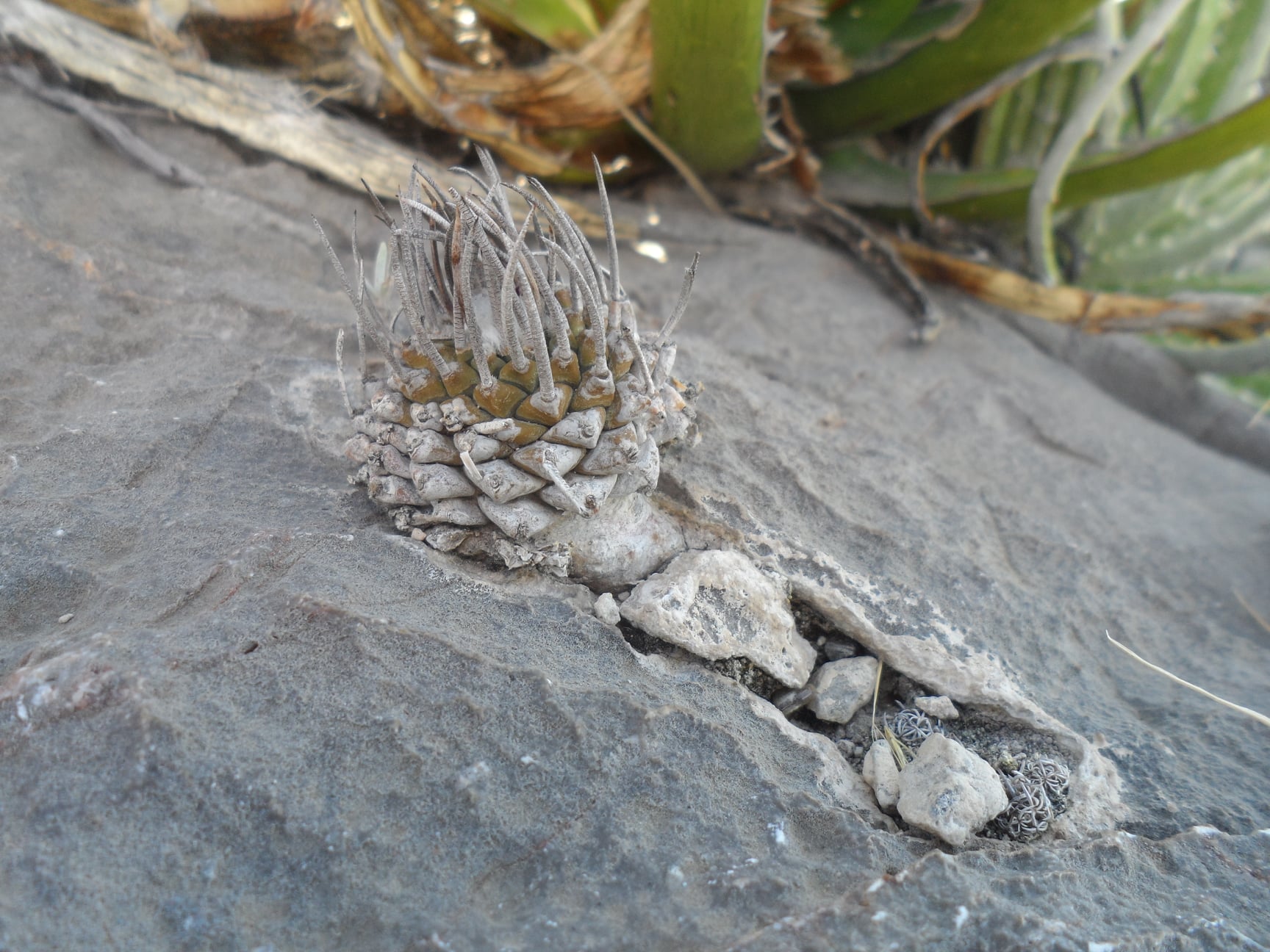
Turbinicarpus boedekerianus was formally described in February 2019 by a team led by García-Morales and González-Botello in Phytotaxa 391(2), the newest addition to the genus in current literature. The type locality is Aramberri municipality in southeastern Nuevo León, a limestone sierra belt that also harbors Turbinicarpus valdezianus, whose dense feathery pectinate spination covers the entire body. The new species occupies a different elevation band and carries a completely different spine character: a single grooved central spine per areole, with the body surface left visible and the ochraceous waxy tubercle coating exposed.
The flat-topped, depressed-globose body is the habit that distinguishes T. boedekerianus within the schmiedickeanus species alliance. The 2019 description is a new epithet with no prior nomenclatural history in Cactaceae; a common misattribution to “Gymnocactus boedekerianus Berger” is nomenclaturally impossible, as explained in the Taxonomy section below. Kew POWO accepts the name without qualification and places the species in Turbinicarpus sensu stricto, not in the sister genus Rapicactus.
The Aramberri sector of the Sierra Madre Oriental sits within a limestone corridor documented as the most species-dense sector of Turbinicarpus micro-endemism in the Sierra Madre Oriental. Turbinicarpus saueri occupies the related thornscrub limestone belt further north into Tamaulipas and San Luis Potosí; some historical sources erroneously attributed Tamaulipas populations to T. boedekerianus, but the protologue states only Nuevo León, and the Tamaulipas records trace back to T. saueri.
In cultivation, T. boedekerianus behaves as expected of a small limestone-native Turbinicarpus: tuberous taproot demanding deep containers, a dry winter rest aligned with the Aramberri climate, and strong light that preserves the compact flat-topped habit. Turbinicarpus lophophoroides grows on gypsum flats in San Luis Potosí and requires broadly similar mineral substrate management, though its spineless adult body and gypsum-adapted chemistry are distinct demands. Turbinicarpus pseudomacrochele from Querétaro and Hidalgo likewise grows on calcareous rock, but its long twisted papery spines and different distributional range mark it as a separate cultivation challenge.
Turbinicarpus boedekerianus quick reference
A flat-topped limestone micro-endemic from the Sierra Madre Oriental of Nuevo León, with a tuberous taproot and a dry-winter climate at the type locality. Values calibrated for seed grown plants in cultivation, based on Nuevo León limestone congenerics and Turbinicarpus norms; species-specific cultivation data beyond habitat-derived parameters is limited for this newly described species.
Taxonomy & nomenclature
Turbinicarpus boedekerianus García-Mor., Gonz.-Bot., Matusz., Nitzschke & Iamonico is a 2019 species description published in Phytotaxa 391(2): 177–192 (DOI: 10.11646/phytotaxa.391.2.12). Kew POWO (accessed April 2026) accepts the name and lists it among the Turbinicarpus species of Mexico.
A common misattribution applies the combination “Gymnocactus boedekerianus Berger” to this plant. That combination cannot exist. Alwin Berger died on 20 April 1931 (Wikipedia: Alwin Berger, confirmed). The genus Gymnocactus was not erected until Backeberg published it in 1938, seven years after Berger’s death. No pre-2019 Cactaceae name carrying the epithet “boedekerianus” in any genus has been traced across IPNI, POWO, GBIF, World Flora Online, or specialist cactus databases. The 2019 García-Morales et al. description is a new epithet, not a transfer of any prior combination.
Genus placement: Turbinicarpus s.s., not Rapicactus. Molecular phylogenetic analysis demonstrated that Turbinicarpus sensu lato is polyphyletic, resolving three distinct lineages: Kadenicarpus (Hidalgo and Querétaro), Rapicactus (Coahuila, Nuevo León, San Luis Potosí, Zacatecas), and Turbinicarpus s.s. (main Chihuahuan Desert region). Rapicactus comprises the former-Gymnocactus species including R. subterraneus, R. zaragosae, R. mandragora, R. beguinii, and R. booleanus. T. boedekerianus, described after the Vázquez-Sánchez phylogeny was submitted, is placed in Turbinicarpus s.s. by its authors and by POWO. It is not placed in Rapicactus, and POWO does not list Rapicactus among the heterotypic synonyms of Turbinicarpus.
Trade name disambiguation. Hajek-Kaktusy (hajek-cactus.com, April 2026) lists a plant under the label Turbinicarpus schmiedickeanus ssp. boedekerianus VM 724, Sandia Victoria, Nuevo León. This informal combination is not recognised by POWO. The Sandia Victoria locality is approximately 100 km northwest of the Aramberri type locality, and the relationship between the Sandia Victoria population and the holotype population has not been formally assessed. Collectors encountering this nursery label should treat it as an informal designation for a boedekerianus-like plant from Sandia Victoria, not as a published subspecies.
No heterotypic or homotypic synonyms for T. boedekerianus have been published to date. The epithet honours the cactophile Friedrich Wilhelm Bödeker (1867–1937), a German cactus enthusiast whose name recurs across several cactus epithets in the literature.
Habitat
T. boedekerianus grows on limestone hillsides in Aramberri municipality, Nuevo León, within the Sierra Madre Oriental biogeographic province. The parent rock throughout this sector is caliza (limestone), consistent with the genus as a whole: no Turbinicarpus species is documented from volcanic soil . The substrate is calcareous, fast-draining, and coarse-mineral, with very little organic content.
Aramberri municipality spans an elevation range of approximately 1,077 to 1,953 m above sea level. The holotype collection elevation is recorded only in the full protologue text (behind a paywall at time of writing); the municipality-level band is used here as a proxy. Most Nuevo León Turbinicarpus populations fall within a 1,000 to 1,500 m band on exposed limestone slopes, and the depressed-globose body habit of T. boedekerianus is consistent with high-light, high-UV exposure at that band.
Climate at Aramberri is semi-arid to subhumid, with mean annual precipitation of approximately 506 mm concentrated in the summer months (June through September). The dry season is pronounced in winter. Temperature extremes are recorded at -9°C (record low) and 44°C (record high), confirming that the native population experiences real frost. Several Turbinicarpus species documented from adjacent Nuevo León limestone slopes associate with xerophilous shrubland (Agave, Hechtia, Opuntia, Yucca) and occasional pine-oak ecotone at higher elevations. Nurse plant association providing partial shade is documented for small-bodied Turbinicarpus in this region.
Tamaulipas is not part of the confirmed range. Some early distributor records attributed Tamaulipas populations to T. boedekerianus, but the protologue abstract states only Nuevo León, Aramberri municipality. The Tamaulipas records likely represent Turbinicarpus saueri, which is endemic to San Luis Potosí and Tamaulipas.
Morphology
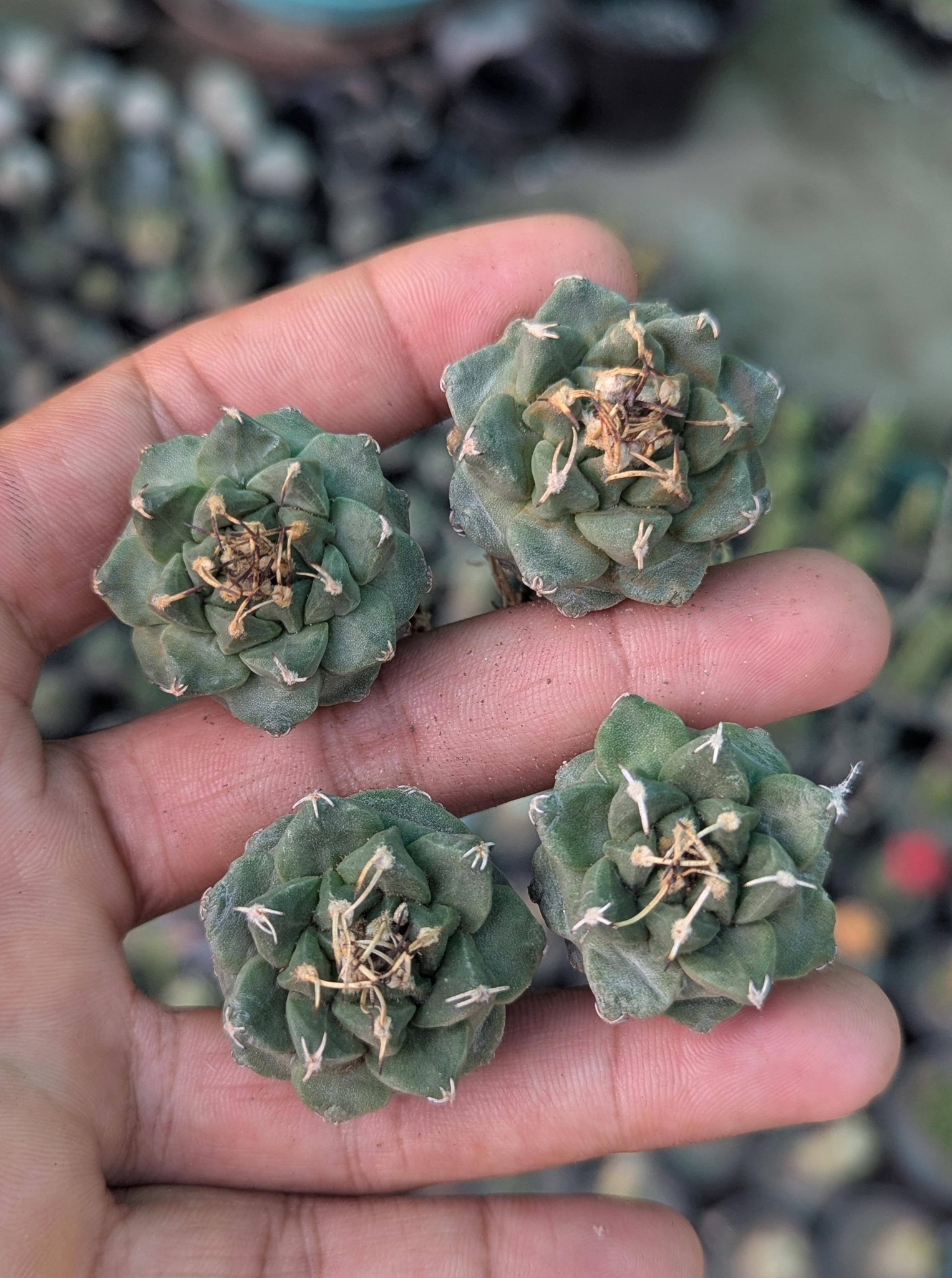
T. boedekerianus is solitary with a flattened-globose to depressed-globose body. The flat-topped habit is the most consistent field-recognition character within the schmiedickeanus alliance. Secondary horticultural sources (multiple retail records, April 2026) give dimensions of approximately 4 cm tall and 5–6 cm in diameter; these figures are from secondary sources, as the full protologue text containing the Latin diagnosis measurements is not publicly accessible. The stem color is reddish-green, overlaid with the distinctive ochraceous (yellowish-brown) waxy coating on the tubercle surfaces.
Tubercles are conical-pyramidal, ocher-colored, and carry a waxy layer cited in the protologue as a diagnostic character distinguishing T. boedekerianus from T. schmiedickeanus. The crown apex is distinctly woolly with white wool. Areoles are woolly, and the crown wool is more pronounced than in most congenerics.
The most reliable field character is the spine count. Each areole bears one central spine: single, almost straight, and visibly grooved. T. schmiedickeanus typically produces 1–4 spines per areole, making the single-spine condition of T. boedekerianus a consistent, checkable difference. The spines are short, brownish, and needle-like; there is no pectinate arrangement.
Flowers emerge from the woolly crown and range from white to pale pink with a possible magenta tinge. This range is stated in the protologue abstract and represents within-species variability rather than source disagreement. Pale yellow is not part of the documented flower-colour range; any secondary source giving yellow flowers for this species should be treated as a contamination from T. pseudopectinatus or a related subspecies. Fruit is ovate to globose, 3–5 mm diameter, green becoming reddish, naked, and dehiscing along a single longitudinal split at maturity. Seeds are small, black, approximately 1 mm long, with a verrucose testa surface, consistent across Turbinicarpus s.s. The root is a tuberous taproot, deep for the body size, which governs container choice.
Locality detail
The holotype collection is from Aramberri municipality in southeastern Nuevo León, Mexico. Aramberri sits within the limestone belt of the Sierra Madre Oriental, a biogeographic province documented as containing approximately 40 Turbinicarpus endemics. The municipality boundary spans 1,077 to 1,953 m above sea level; the specific holotype collection elevation and GPS coordinates are given in the full protologue but remain behind a paywall at time of writing. The map marks a regional centroid for Aramberri municipality.
A possible additional population near Sandia Victoria, Nuevo León is inferred from the Hajek-Kaktusy trade record (field number VM 724), which cites Sandia Victoria as the collection source for a plant labeled T. schmiedickeanus ssp. boedekerianus. Sandia Victoria lies approximately 100 km northwest of Aramberri in a different sector of the Sierra Madre Oriental. Whether this population represents the same species or an informally named local form has not been assessed in formal literature. Precise coordinates for either locality are not published here; the species is CITES Appendix I, and coordinate redaction at the municipality level follows standard guidance for trade-threatened species.
Turbinicarpus boedekerianus care and cultivation
The Aramberri climate data and the limestone hillside substrate together define the cultivation approach. Summer rainfall of approximately 506 mm concentrated in June through September, a pronounced dry winter, and a record frost of -9°C tell the grower that this species expects summer water, dry dormancy, and tolerable cold provided the root zone is kept dry. The tuberous taproot is the primary structural constraint in the pot.
Substrate
Fast-draining and mineral-dominant. A working mix places pumice as the primary aggregate (50–60%), with limestone chip at 20–30% of the total as house convention for the genus, not a species requirement. Granite grit or decomposed granite fills the remaining fraction for structure and slow-release minerals. Hard tap water already supplies calcium and bicarbonate at every watering; rainwater and RO water supply neither. Organic content is minimal to zero. These ratios are carried over from congeners rather than from per-species published trial data; the species is too recently described for grower consensus to have accumulated. The drainage must allow water to pass immediately; standing moisture at the root crown will rot the taproot within days.
Watering and light
Suspend all watering from October through February, aligned with the dry winter at Aramberri. Resume cautiously in March or early April when temperatures stabilize. Through the growing season (May through September), water thoroughly every 10 to 14 days, confirming the substrate is completely dry before the next watering. The 10–14 day cadence is extrapolated from Nuevo León limestone congenerics; species-specific grower data for T. boedekerianus specifically is not yet in the literature. Never water when overnight temperatures are expected to drop below 5°C or on overcast days that prevent surface evaporation.
Cold tolerance is tied directly to substrate moisture. Aramberri records lows of -9°C, establishing that the native population survives frost. In cultivation, a dry-rooted plant can tolerate brief exposure to -2°C; the practical safe winter minimum with any residual substrate moisture is 4–7°C. Wet cold at any temperature destroys the taproot. The distinction between dry cold and wet cold is the single most consequential factor in wintering Nuevo León limestone Turbinicarpus.
Full sun to strong indirect light. At Aramberri the plant receives high UV intensity on open limestone hillsides at 1,000–1,500 m. In temperate cultivation, full sun from spring through autumn is appropriate. In climates where afternoon temperatures regularly exceed 40°C, light shading during the hottest midday hours prevents bleaching and tissue stress. Adequate light preserves the compact flat-topped body and maintains the ochraceous waxy tubercle character; insufficient light produces upward elongation that erases the defining habit.
Seed grown plants take longer to reach flowering size than grafted stock, but they retain the depressed-globose body form that makes T. boedekerianus identifiable. Grafted plants accelerate early growth and typically flower within two years, but the graft-forced extension tends to produce a taller, less flat-topped body. Myrtillocactus geometrizans and Eriocereus jusbertii are the standard rootstocks used in the trade. The species is new enough that no long-term cultivation observations on adult seed grown plants have been published; the five-year and ten-year body character data is a gap in the current literature.
Comparison
T. boedekerianus was formally compared to T. schmiedickeanus in the protologue, and that remains the primary identification pair. Three characters together close the identification: single grooved spine per areole (versus 1–4 in T. schmiedickeanus), ochraceous waxy tubercle coating (absent in T. schmiedickeanus), and the flat-topped depressed-globose body (less pronounced in T. schmiedickeanus, which tends toward spherical). No single one of these characters is absolute in isolation, but the combination is reliable.
Within the Nuevo León limestone belt, Turbinicarpus valdezianus shares the Nuevo León range and woolly crown, but its feathery pectinate spine mass covers the entire body surface and there is no visible waxy tubercle coating. The body is taller and more cylindrical. No field collector will confuse the two; the spine characters are diametrically different. The confusion risk with T. valdezianus is in the trade, where mislabeled plants occasionally surface.
A secondary comparison partner is Rapicactus mandragora, documented from Coahuila and Nuevo León with potential geographic overlap. R. mandragora carries 8–14 white radial spines per areole and a conspicuous long stalk-like root neck between the tuberous root and the above-ground body. Neither character applies to T. boedekerianus, and the genus placement differs: R. mandragora sits in Rapicactus per the Vázquez-Sánchez 2019 study; T. boedekerianus sits in Turbinicarpus s.s.
Turbinicarpus graminispinus Matusz. et al., endemic to the Noriega area of southern Nuevo León, overlaps geographically and grows on the same limestone geology, but at higher elevation (1,800–2,800 m versus the c. 1,000–1,500 m Aramberri band). It is among the smallest Turbinicarpus species, with a body under 2 cm diameter at maturity and seven white radial spines per areole. Size alone separates the two in cultivation; in the field, elevation is the first filter.
Frequently asked questions
How do you tell Turbinicarpus boedekerianus apart from Turbinicarpus schmiedickeanus?
T. schmiedickeanus is the species T. boedekerianus was explicitly compared to in the 2019 protologue. Both occur in Nuevo León on limestone, both carry a woolly crown, and both belong in Turbinicarpus s.s. Drag the slider to compare both plants, then check the character table below.


The single-spine condition is the most accessible field character: count the spines per areole. The ochraceous waxy tubercle coating, visible under good light, confirms identification when spine count is ambiguous on a young or stressed plant.
Is Turbinicarpus boedekerianus difficult to grow?
Intermediate difficulty, comparable to other small limestone-native Turbinicarpus. The two main requirements are a deep pot for the tuberous taproot and a dry winter rest from October through February, matching the Aramberri dry season. The taproot rots quickly in wet-cold conditions; keeping the substrate completely dry through winter is the single most important care discipline. Under correct conditions, the plant is stable and does not require unusually attentive management during the growing season.
How do you propagate Turbinicarpus boedekerianus from seed?
Surface-sow on a mineral cactus seedling mix, lightly moistened, at 20–25°C under bright indirect light. Germination occurs within 1–3 weeks. Keep seedlings in a slightly humid environment for the first growing season; the tuberous taproot begins developing from the first year, so transplant into deep individual cells early. Seed grown plants take several years to reach flowering size but develop the authentic flat-topped body character that grafted plants tend to lose. As a CITES Appendix I species, source seeds only from documented propagated stock with appropriate paperwork.
Is Turbinicarpus boedekerianus legal to buy and sell?
Turbinicarpus as a genus is listed in CITES Appendix I, the highest protection tier, with the listing explicitly covering the synonyms Gymnocactus, Normanbokea, and Rapicactus. Commercial international trade in wild-collected specimens of any listed species is prohibited. Seed grown or nursery-propagated plants are legal for domestic purchase in most jurisdictions and for international trade with the correct CITES permits. Always purchase from sellers who can provide documentation of nursery origin; the specialist trade in seed grown Turbinicarpus is legal and well-established.
Where does Turbinicarpus boedekerianus grow in the wild?
Known from Aramberri municipality in southeastern Nuevo León, Mexico, on limestone hillsides within the Sierra Madre Oriental. The municipality spans 1,077 to 1,953 m elevation; the precise holotype elevation is given only in the full protologue text, which is paywalled. The climate is semi-arid with summer-dominant rainfall of approximately 506 mm annually. A possible second population near Sandia Victoria in Nuevo León is known from trade records but has not been formally documented.
When does Turbinicarpus boedekerianus flower?
Flowering timing for T. boedekerianus specifically has not been documented in the accessible literature. Based on genus norms and the related Nuevo León species, expect spring to early summer flowering (April through July in the northern hemisphere) once the plant is mature. Flowers are white to pale pink with a possible magenta tinge per the protologue abstract. Seed grown plants in the schmiedickeanus alliance typically reach first flowering at 2–5 years from seed under good growing conditions.
Sources & further reading
García-Morales, L.J., González-Botello, M.A., Matuszewski, G.F., Nitzschke, U. & Iamonico, D. (2019). Turbinicarpus boedekerianus sp. nov. (Cactaceae). Phytotaxa 391(2): 177–192. DOI: 10.11646/phytotaxa.391.2.12 · Kew POWO. Turbinicarpus genus page, T. boedekerianus accepted species entry. powo.science.kew.org (accessed April 2026) · Vázquez-Sánchez, M., Terrazas, T., Arias, S. & Sánchez-Martínez, E. (2019). Polyphyly of the iconic cactus genus Turbinicarpus (Cactaceae) and its generic circumscription. Botanical Journal of the Linnean Society 190(4): 405–427. DOI: 10.1093/botlinnean/boz031 · Vázquez-Sánchez, M., Terrazas, T. & Arias, S. (2017). Biogeography and ecology of the genus Turbinicarpus (Cactaceae). Systematics and Biodiversity 15(4): 372–386. DOI: 10.1080/14772000.2016.1251504 · Iamonico, D. & González-Botello, M.A. (2017). Endemic vascular plants of the Sierra Madre Oriental, Mexico. Phytotaxa 328(1): 1–50. DOI: 10.11646/phytotaxa.328.1.1 · Luthý, J.M. (2001). The Turbinicarpus mandragora complex. Bradleya 19: 19–54. DOI: 10.25223/brad.n19.2001.a5 · CITES Secretariat. Turbinicarpus genus listing, Appendix I (including synonyms Gymnocactus, Normanbokea, Rapicactus). checklist.cites.org · BCSS (British Cactus and Succulent Society). Cultivation notes on Turbinicarpus. bcss.org.uk · Trout’s Notes. Turbinicarpus. Sacred Cacti. sacredcacti.com · Anderson, E.F. (2001). The Cactus Family. Timber Press, Portland, Oregon. [Genus morphology, taproot character, cultivation overview for Turbinicarpus] · Hajek-Kaktusy. Product page: Turbinicarpus schmiedickeanus spp. boedekerianus VM 724, Sandia Victoria, NL. hajek-cactus.com (accessed April 2026). [Trade name confirmation; locality data] · Wikipedia. Turbinicarpus saueri. en.wikipedia.org (accessed April 2026). [Distribution of T. saueri: San Luis Potosí and Tamaulipas only; supports rejection of Tamaulipas attribution for T. boedekerianus] · Wikipedia. Alwin Berger. en.wikipedia.org (accessed April 2026). [Death date: 20 April 1931; supports nomenclatural impossibility of “Gymnocactus boedekerianus Berger”]