
Thelocactus hexaedrophorus
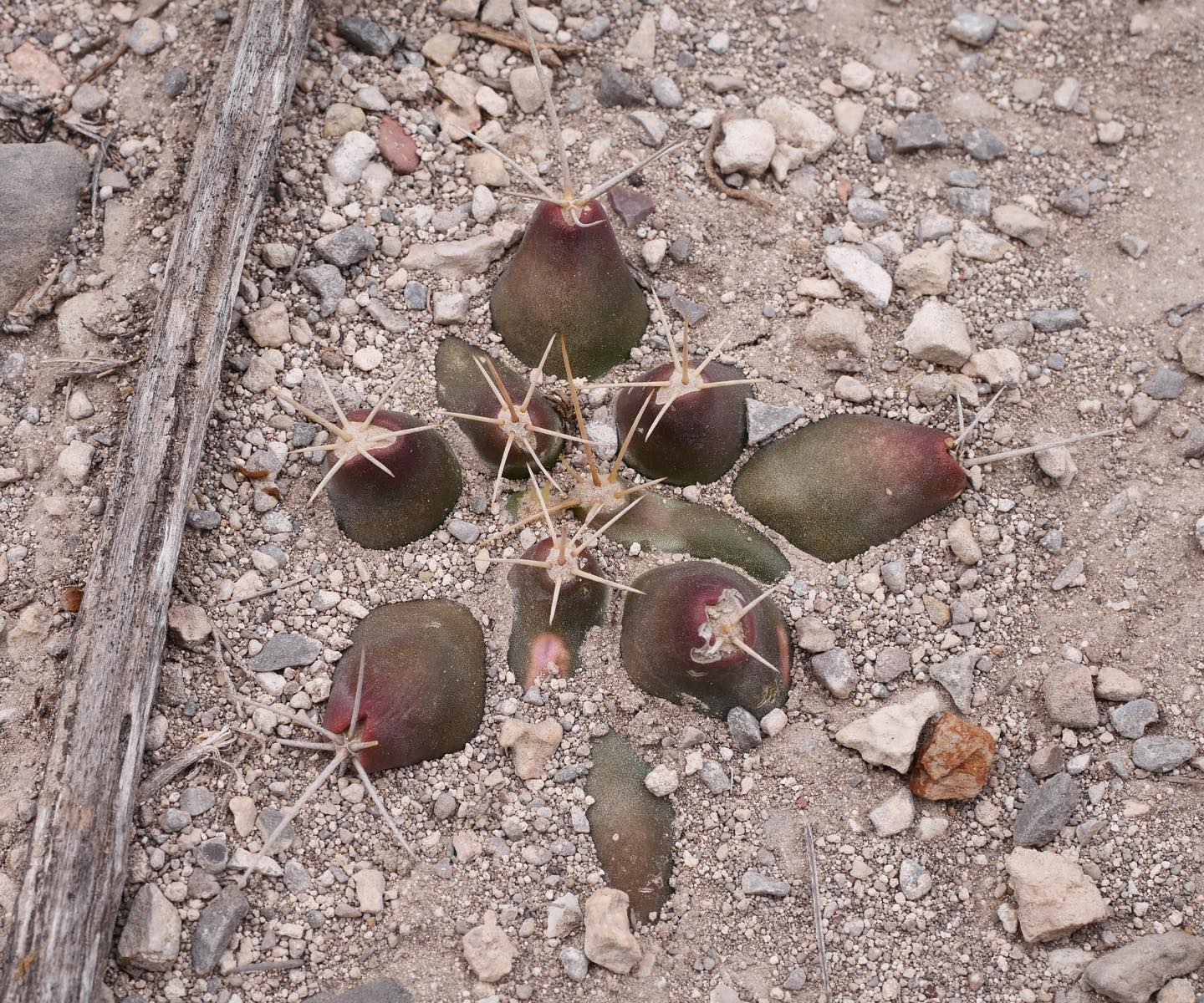
Thelocactus hexaedrophorus (Lem.) Britton & Rose is the type species of the genus Thelocactus, described by Charles Lemaire in 1839 as Echinocactus hexaedrophorus in Cactearum Genera Nova Speciesque Novae, page 27. Britton and Rose transferred it to Thelocactus in the Bulletin of the Torrey Botanical Club 49: 251 (1922), the same paper that established the genus, and designated it as the genus type. The epithet derives from the Greek hexaedra (six-sided) and phoros (bearing), a direct reference to the near-hexagonal geometry of the plant’s tubercles, the most architecturally striking feature in the genus.
Kew POWO accepts no infraspecific taxa. Several authors, including Taylor in 1998, have treated Thelocactus lloydii Britton & Rose (1923) as a subspecies (subsp. lloydii), recognising the Zacatecas high-elevation plants as a distinct entity with longer spines, slightly smaller flowers (3.3 to 3.6 cm), and elevations of 2,200 to 2,300 m versus the 1,000 to 2,000 m nominate. POWO lists lloydii and all other infraspecific names in synonymy. This page follows the POWO treatment; where cultivation notes relate specifically to the lloydii-type high-elevation plants, that is indicated.
Within the six Thelocactus on this site, T. hexaedrophorus is the sculptural outlier. Where Thelocactus bicolor delivers dense bicoloured spines and vivid magenta flowers, T. hexaedrophorus is built for form: the flat grey-green dome, the clean polygonal tubercle faces, and sparse short spines that leave the body geometry fully visible. The Royal Horticultural Society’s Award of Garden Merit places it alongside T. bicolor as one of only two Thelocactus that have earned the RHS’s endorsement for reliable temperate cultivation performance.
A 2022 paper in the Journal of the Botanical Research Institute of Texas (Sandoval-Ortega et al.) documented the first Aguascalientes record for the species, extending the confirmed range to at least ten Mexican states. The same paper designated a neotype for Echinocactus fossulatus Scheidw. (1841) and confirmed that taxon as a synonym of T. hexaedrophorus, closing a long-standing nomenclatural question about the fossulatus combination used by Backeberg and others. Collectors will find this species under the names hexaedrophorus, fossulatus, and lloydii in specialist catalogs, particularly from European sources that maintain finer taxonomic splits than POWO recognises.
Thelocactus hexaedrophorus quick reference
A Chihuahuan Desert species, growing on limestone slopes and gentle plains between 1,000 and 2,300 m across northeastern Mexico. Values calibrated for seed grown plants in cultivation, drawn from species-specific habitat data and specialist grower sources. The prominent taproot is the key variable: container depth and watering discipline are more critical here than for fibrous-rooted Chihuahuan cacti.
Taxonomy & nomenclature
The accepted name is Thelocactus hexaedrophorus (Lem.) Britton & Rose, with the basionym Echinocactus hexaedrophorus Lem. published in Cactearum Genera Nova Speciesque Novae, page 27, in 1839. Charles Lemaire described the species from cultivated or recently collected Mexican material but gave no precise locality in the protologue. The basionym is the oldest validly published name for the entity and provides the specific epithet for all subsequent combinations. Britton and Rose transferred the species to the newly erected genus Thelocactus in 1922, simultaneously designating T. hexaedrophorus as the type species of the genus.
The most frequently encountered synonym in cultivation is Thelocactus lloydii Britton & Rose (1923), described from Zacatecas material and long maintained as a species or subspecies by some authors. Taylor (Cactaceae Consensus Initiatives 5: 14, 1998) published the combination Thelocactus hexaedrophorus subsp. lloydii (Britton & Rose) N.P.Taylor. Llifle and some European trade sources continue to use the lloydii treatment for the high-elevation Zacatecas plants (2,200 to 2,300 m), which tend toward longer spines (1 to 3 centrals to 6 cm versus the nominate’s 0 to 1 centrals under 25 mm) and slightly smaller flowers (3.3 to 3.6 cm). POWO does not accept any infraspecific taxa and places lloydii in synonymy with the species. This page follows POWO.
Other synonyms worth noting for collectors tracking older literature: Echinocactus fossulatus Scheidw. (Allgemeine Gartenzeitung 9: 49, 1841), which gave Mexico, San Luis Potosí as its locality and is the closest geographic anchor to a type locality for the species complex; Echinofossulocactus hexaedrophorus (Lem.) Lawr. (1841), a short-lived generic placement; and Echinocactus droegeanus Hildm. ex K.Schum., Echinocactus insculptus Scheidw. (1839), and several variety-level names applied by Backeberg and others (var. labouretianus, var. decipiens, var. droegeanus). A 2022 peer-reviewed paper in the Journal of the Botanical Research Institute of Texas (Sandoval-Ortega et al.) designated a neotype for Echinocactus fossulatus and formally confirmed its synonymy with T. hexaedrophorus. POWO lists 29 synonyms in total.
Historical synonyms (2)
- Echinocactus droegeanus Hildm. ex K.Schum., 1898 basionym
- Echinocactus labouretianus Cels, heterotypic synonym
Sources: POWO (Kew) · IPNI · GBIF · Wikidata
Habitat
Thelocactus hexaedrophorus is endemic to Mexico, where it occupies the Chihuahuan Desert biogeographic province and its margins. The core of the distribution, by both occurrence record density and literature consensus, is San Luis Potosí, Nuevo León, Tamaulipas, and Zacatecas. Outer records extend to Coahuila, Durango, Guanajuato, Jalisco, and Querétaro. A 2022 paper documented the first confirmed occurrence in Aguascalientes, extending the known range to at least ten Mexican states and slightly shifting the southwestern boundary of the distribution. The lloydii-type populations are centred in Zacatecas and along the Durango-Zacatecas border at elevations of 2,200 to 2,300 m, higher than the nominate’s 1,000 to 2,000 m.
The dominant substrate across the range is limestone and limestone-derived soils on gentle slopes and plains. A minority of records sit on volcanic rock. The vegetation association is matorral xerófilo (xerophilous scrub) and pastizal (dry grassland), with co-occurring species including Myrtillocactus geometrizans, Ferocactus latispinus, Astrophytum myriostigma, Thelocactus rinconensis, and various Mammillaria, Ariocarpus, and Turbinicarpus species. This community is a characteristic Chihuahuan Desert limestone assemblage.
Rainfall follows the Chihuahuan Desert summer monsoon. The core states receive 200 to 400 mm annually, predominantly from June to September. Winters are cold and very dry. The lloydii-type plants at higher elevations experience cooler winters and more frequent frost events than the nominate. Across both elevation ranges, the species is exposed to high light intensity on sun-baked slopes, with no evidence of nurse-plant shade associations in the literature.
Morphology
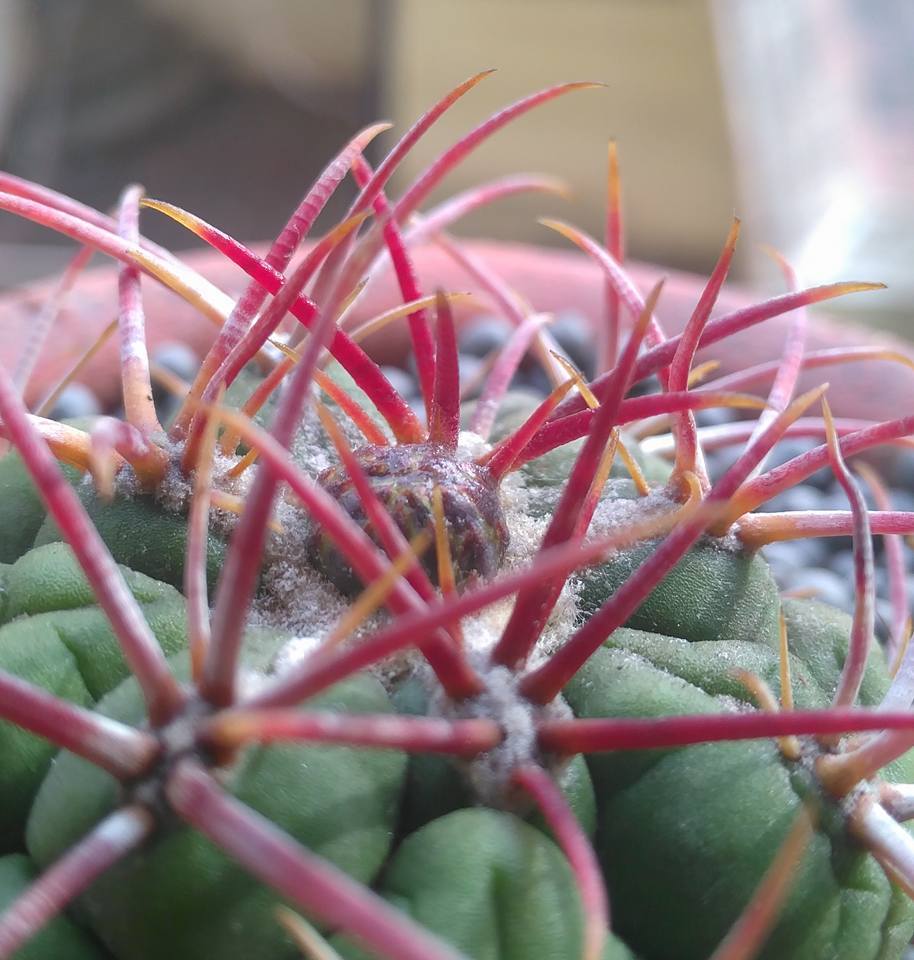
The stem is solitary, rarely offsetting, depressed-globose to globose, emphatically wider than tall. Cultivated plants typically reach 3 to 10 cm in height and 8 to 15 cm in diameter; the RHS lists an ultimate height of 10 cm, achieved over 10 to 20 years. Exceptional mature specimens can reach 20 cm diameter. The epidermis ranges from bluish to olive-green to grey-green, typically covered by a glaucous waxy bloom that gives the body its characteristic blue-grey cast. This pruinose surface is a collector-recognised feature, particularly evident on lloydii-type plants. The apex is woolly and felted at the growing tip.
Ribs number 8 to 13, breaking down into the near-hexagonal tubercles that encode the species name. Individual tubercles measure 8 to 20 mm long and 13 to 26 mm wide, with areoles 4 to 13 mm long spaced 2 to 3.5 cm apart along the rib. The six-sided polygonal geometry of the tubercle faces is the single most diagnostic feature of the species and is immediately visible even on juvenile plants. Central spines number 0 to 1, 15 to 25 mm long when present, ochre to reddish; the nominate form frequently lacks any central spine in wild populations, leaving the body geometry unobscured. Radial spines number 4 to 8, 5 to 60 mm long, ochre to reddish-brown on fresh growth, fading to pale grey-brown with age. The lloydii-type plants carry 1 to 3 centrals up to 6 cm long and 6 to 8 radials, which is substantially more spination than the nominate.
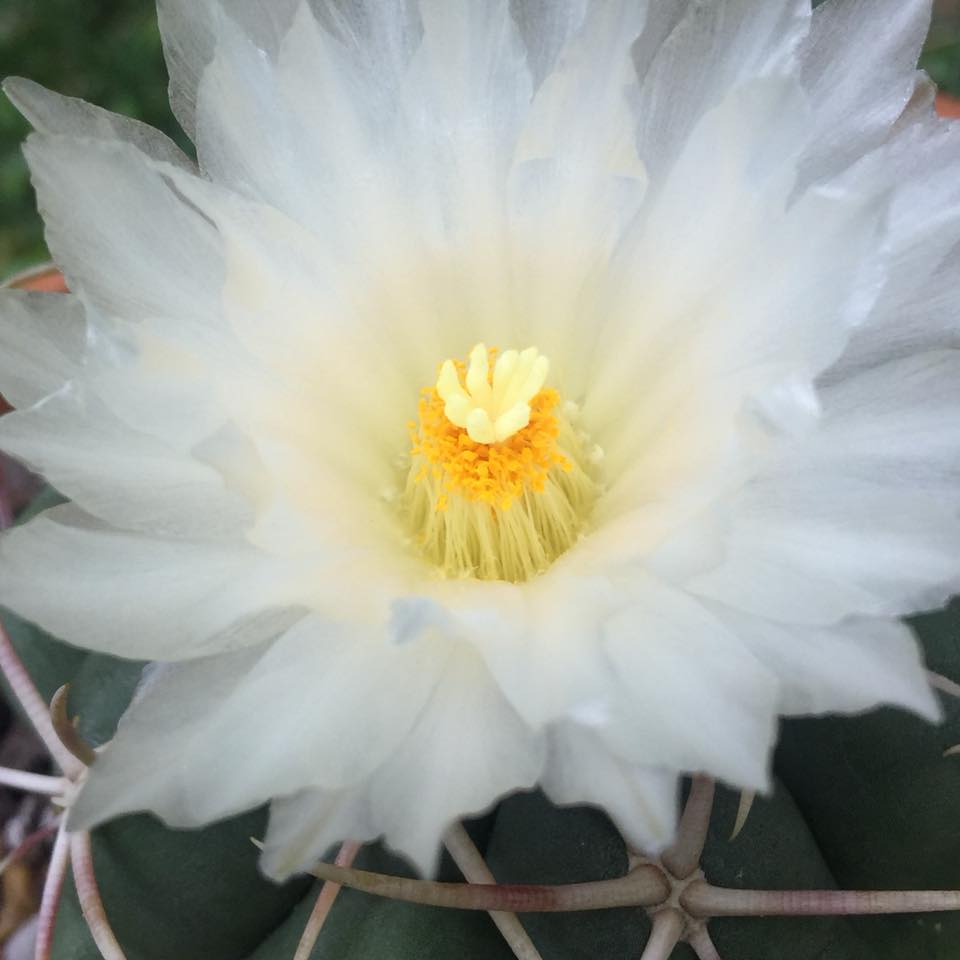
Flowers emerge from the apex, funnel-shaped, 5 to 10 cm wide for the species broadly; lloydii-type plants tend toward the lower end (3.3 to 3.6 cm per llifle). Petals are white with pink striping or pale pink, never deep purplish-pink, with a yellow staminal boss and pinkish to yellowish stigma lobes. The flowers are ephemeral, lasting one to three days, and appear from late spring through early summer. Fruit is small, 7 to 11 mm diameter, green to magenta at maturity, dry at dehiscence. Seeds measure approximately 1.5 by 1.4 mm with a verrucose testa surface. The species has a substantial taproot, documented by multiple cultivation sources; the root mass can rival the aboveground body in size on mature plants.
Locality detail
The type locality of Thelocactus hexaedrophorus cannot be confirmed from Lemaire’s 1839 protologue, which gives no geographic information beyond Mexico. The best geographic anchor comes from the synonym Echinocactus fossulatus Scheidweiler (1841), whose protologue explicitly gives Mexico, San Luis Potosí (Allgemeine Gartenzeitung 9: 49). A 2022 paper in the Journal of the Botanical Research Institute of Texas designated a neotype for E. fossulatus and confirmed its synonymy with T. hexaedrophorus, anchoring the species nomenclaturally to San Luis Potosí. San Luis Potosí is also independently identified as the centre of the species’ distribution by the specialist cactus-mall.net genus site.
The same 2022 paper documented the first Aguascalientes occurrence (August 2021, northeastern Aguascalientes, Chihuahuan Desert biogeographic province, microphyllous desert scrub on limestone), extending the confirmed range to at least ten Mexican states. The lloydii-type high-elevation populations are centred in Zacatecas and along the Durango-Zacatecas border at 2,200 to 2,300 m. Peripheral records from Guanajuato, Jalisco, and Querétaro mark the southwestern boundary of the range; POWO’s range description of “NE. Mexico (to Jalisco)” captures this extension.
Thelocactus hexaedrophorus care and cultivation
Thelocactus hexaedrophorus is described by specialist growers as “nearly as easy as Astrophytum” in cultivation, and the Royal Horticultural Society’s Award of Garden Merit reflects its reliable performance across temperate collections. The one distinguishing care variable relative to other Chihuahuan Desert cacti is the taproot: this organ is susceptible to rot under wet conditions at any temperature, making container selection and watering discipline more consequential than for fibrous-rooted siblings.
Substrate
The substrate recipe is 35 per cent pumice, 15 per cent lava rock, 10 per cent zeolite, 10 per cent granite grit, 15 per cent crushed limestone (3 to 6 mm horticultural grade or oyster grit), 5 per cent coarse silica grit, and 10 per cent worm castings. This delivers a 90 per cent inorganic, 10 per cent organic ratio with a meaningful limestone fraction, which is house convention for the genus, not a requirement of this species. Hard tap water already supplies calcium and bicarbonate at every watering; rainwater and RO water supply neither. The pH target of 7.0 to 8.0 is an in-house default, not a documented standard for this genus. Pumice is elevated to the maximum level for this genus to ensure the fastest possible drainage around the taproot; a mix that stays damp longer than two to three days after watering poses a rot risk at this species specifically.
Substrate ratios across the Thelocactus species on this site. Most carry elevated limestone fractions by house convention. T. hexaedrophorus matches the shared baseline and requires a pumice-dominant upper zone for taproot drainage.
| Species | Pumice | Lava | Zeolite | Granite | Limestone | Silica | Organic |
|---|---|---|---|---|---|---|---|
| T. bicolor | 35% | 15% | 10% | 10% | 15% | 5% | 10% |
| T. hexaedrophorus (this page) | 35% | 15% | 10% | 10% | 15% | 5% | 10% |
| T. rinconensis | 35% | 15% | 10% | 10% | 15% | 5% | 10% |
| T. macdowellii | 35% | 10% | 10% | 10% | 20% | 5% | 10% |
| T. setispinus | 35% | 15% | 10% | 10% | 8% | 10% | 12% |
| T. tepelmemensis | 30% | 10% | 10% | 5% | 25% | 10% | 10% |
Watering and light
Watering tracks the Chihuahuan Desert summer monsoon. Resume in late May or early June as temperatures rise above 10°C. Through June to September, water thoroughly when the substrate is fully dry at the pot base, every 7 to 14 days under temperate glass or 3 to 7 days in fast-drying mixes in hot dry climates. The Trex Plants care diary documents watering every few days in peak summer when drainage is correct, confirming that the species handles frequent water provided the mix drains rapidly. Taper from October; allow the substrate to dry completely before the first expected frost. Keep completely dry from November through February. The taproot concentrates the rot risk; winter moisture combined with low temperatures kills this species faster than most Chihuahuan cacti. First spring watering should be light, once daytime temperatures are consistently above 10°C.
Light requirements are high. The native habitat is exposed limestone hillsides under full Chihuahuan Desert sun. In temperate cultivation under glass, full unobstructed sun is appropriate year-round. In continental-summer or low-latitude climates with sustained temperatures above 35°C, afternoon shade protection in midsummer reduces sunscorch risk on young plants; mature specimens are more tolerant. The RHS recommends full light with low humidity. Seedlings should be acclimatised gradually; abrupt full-sun exposure causes bleaching. Repot every two to three years in spring, before the first watering, withholding water for at least one week after repotting to allow damaged taproot tips to callus.
Comparison
The closest confusion risk in the genus is Thelocactus rinconensis. Both are low-domed, grey-green, tuberculate Thelocactus with pale flowers and limestone habitats in northeastern Mexico; at a quick glance, an unlabelled plant of either could pass for the other. The diagnostic is central spine presence and length. T. rinconensis almost always carries 3 to 4 prominent central spines, 6 to 8 cm long, that radiate visibly from each areole and dominate the plant’s silhouette. The nominate T. hexaedrophorus frequently has 0 central spines and rarely more than 1 central under 25 mm, leaving the hexagonal body geometry unobscured. Rib count also separates them: T. rinconensis has 20 to 25 ribs with angular less-polygonal tubercles, while T. hexaedrophorus has 8 to 13 ribs breaking into the characteristic six-sided faces. Distribution adds further separation: T. rinconensis is restricted to Coahuila and Nuevo León, while T. hexaedrophorus ranges across at least ten states.
Thelocactus bicolor is not a practical identification problem: its taller ovoidal body (8 to 20 cm tall), dense bicoloured reddish-ochre spination, and vivid magenta flowers are immediately distinct from T. hexaedrophorus’s flat dome, sparse pale spines, and white to pale pink flowers. Similarly, Thelocactus macdowellii is a densely white-spined snowball with 30 or more strongly tuberculate ribs, producing a completely different silhouette. Neither species presents a realistic confusion risk once seen in context with T. hexaedrophorus.
Within what trade sources call the “lloydii type,” the practical distinction from the nominate is spination density. Plants from the Zacatecas high-elevation populations typically carry 1 to 3 centrals to 6 cm and 6 to 8 radials, which gives a spikier appearance than the near-spineless nominate. Flowers tend to be smaller in lloydii-type plants (3.3 to 3.6 cm versus 5 to 10 cm for the species). Both end up in collections under the hexaedrophorus name because POWO does not accept the split. Among the remaining Thelocactus on this site, Thelocactus setispinus is immediately ruled out by its elongate cylindric body and the single hooked central spine.
Frequently asked questions
Is Thelocactus hexaedrophorus hard to grow?
Beginner to intermediate. Specialist growers describe it as “nearly as easy as Astrophytum” in cultivation, and the Royal Horticultural Society’s Award of Garden Merit endorses its reliability under temperate conditions. The main challenge is the prominent taproot, which rots quickly in wet winter conditions. A completely dry dormancy from November through February and a deep well-draining pot eliminate the primary failure mode. Beyond that discipline the species is full-sun tolerant and flowers predictably from seed.
Can Thelocactus hexaedrophorus be grown from seed?
Yes. Seed germination is reported as somewhat slow and sporadic compared to other Chihuahuan cacti (5 to 160 days at 21 to 27°C optimal substrate temperature). The RHS recommends seed propagation as the standard method. Seed grown plants typically reach first flower at three to five years. Grafting exists as an option for accelerating juvenile growth, but grafted plants can develop proportionally oversized bodies that lose the characteristic flat dome geometry the species is collected for. Seed grown plants maintain proper body proportions and develop the full taproot.
Is Thelocactus hexaedrophorus legal to own?
Yes, with documentation. Under CITES Appendix II, all commercial international trade requires export permits from the country of origin. Within Mexico, the species is listed under NOM-059-SEMARNAT category P (Peligro de extinción), the highest protection level under Mexican federal law, so wild collection within Mexico is prohibited. Nursery-propagated stock with documented seed-grown provenance is the legally defensible source worldwide. The NOM-059 P listing does not affect legal ownership of legitimately propagated plants outside Mexico.
Where does Thelocactus hexaedrophorus grow in the wild?
Exclusively in Mexico, in the Chihuahuan Desert biogeographic province and its margins. The core of the distribution is San Luis Potosí, Nuevo León, Tamaulipas, and Zacatecas. Peripheral populations extend to Coahuila, Durango, Guanajuato, Jalisco, Querétaro, and Aguascalientes (first documented 2022). The species grows on limestone slopes and gentle plains in matorral xerófilo (xerophilous scrub) at 1,000 to 2,300 m elevation; lloydii-type populations in Zacatecas reach the upper end of this range.
When does Thelocactus hexaedrophorus flower?
Late spring to early summer, approximately May through July in the native Mexican range; the RHS describes the species as spring-blooming. Flowers are funnel-shaped, 5 to 10 cm wide for the nominate form, white to pale pink with a yellow staminal boss and pinkish stigma lobes. Each flower is ephemeral, lasting one to three days. Lloydii-type plants tend toward smaller flowers (3.3 to 3.6 cm). No specific published pollinator study has been located; the large diurnal funnel flowers in the Chihuahuan Desert context are consistent with bee pollination.
Sources & further reading
Lemaire, C. (1839). Cactearum Genera Nova Speciesque Novae: 27. Basionym: Echinocactus hexaedrophorus Lem. · Scheidweiler, M.J.F. (1841). Allgemeine Gartenzeitung 9: 49. Echinocactus fossulatus Scheidw.; locality Mexico, San Luis Potosí. Confirmed synonym per Sandoval-Ortega et al. 2022. · Britton, N.L. & Rose, J.N. (1922). Thelocactus hexaedrophorus comb. nov.; genus Thelocactus established; type species designated. Bulletin of the Torrey Botanical Club 49: 251. · Taylor, N.P. (1998). Combination Thelocactus hexaedrophorus subsp. lloydii (Britton & Rose) N.P.Taylor. Cactaceae Consensus Initiatives 5: 14. · Sandoval-Ortega, M.H., Villalobos-Juárez, I., Carrillo-Martínez, A. & Martínez-Calderón, V.M. (2022). Neotype of Echinocactus fossulatus (Cactaceae) and the first register of Thelocactus hexaedrophorus in Aguascalientes, Mexico. Journal of the Botanical Research Institute of Texas 16(1): 47–51. · Kew POWO. Thelocactus hexaedrophorus (Lem.) Britton & Rose. IPNI lsid urn:lsid:ipni.org:names:251032-2. powo.science.kew.org · IUCN Red List. Thelocactus hexaedrophorus. Assessment ID 151807. Category: Least Concern (2017). iucnredlist.org · Butterworth, C.A., Cota-Sanchez, J.H. & Wallace, R.S. (2002). Molecular systematics of tribe Cacteae (Cactaceae: Cactoideae): a phylogeny based on rpl16 intron sequence variation. Systematic Botany 27(2): 257–270. · Royal Horticultural Society. Thelocactus hexaedrophorus. RHS Award of Garden Merit; hardiness H2; spring-blooming. rhs.org.uk · llifle, Encyclopedia of Living Forms. Thelocactus hexaedrophorus subs. lloydii (Britton & Rose) N.P.Taylor. llifle.com · llifle. Thelocactus hexaedrophorus var. fossulatus cv. Long Spines (Japan). llifle.com · Wikipedia. Thelocactus hexaedrophorus; Thelocactus rinconensis. en.wikipedia.org · cactus-mall.net. Thelocactus hexaedrophorus. Genus Thelocactus species files. thelocactus.cactus-mall.net · Trex Plants. Care Diary: Thelocactus hexaedrophorus. trexplants.com · Giromagi Cactus and Succulents. Thelocactus hexaedrophorus. giromagicactusandsucculents.com · Anderson, E.F. (2001). The Cactus Family. Timber Press, Portland.