
Thelocactus setispinus
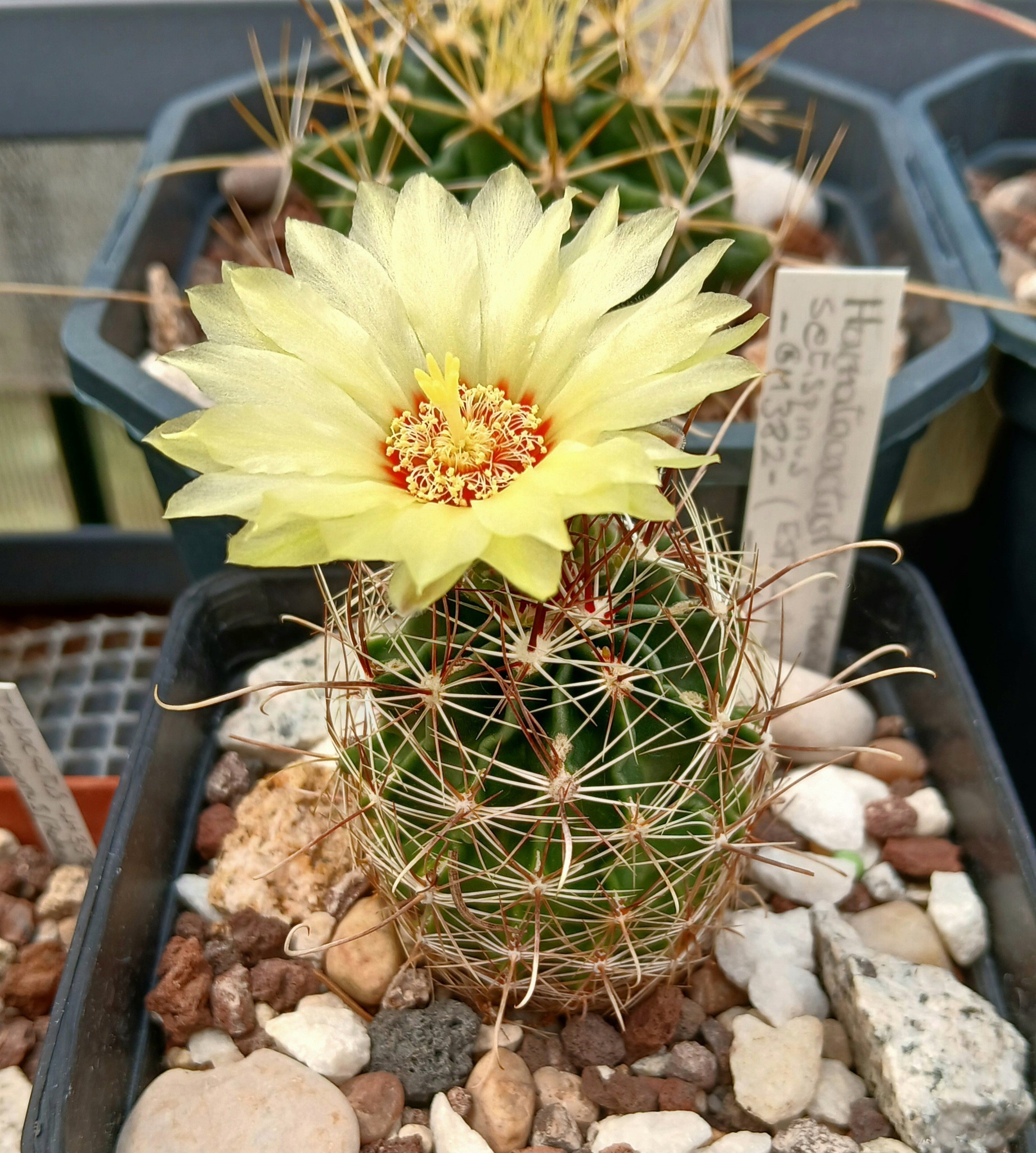
Thelocactus setispinus (Engelm.) E.F.Anderson is the outlier of its genus in almost every morphological respect. George Engelmann described the basionym Echinocactus setispinus in the Boston Journal of Natural History 5: 246 in 1845, from material collected along the Rio Grande in south Texas. Britton and Rose transferred it to the new genus Hamatocactus in The Cactaceae 3: 104 (1922), recognising the hooked central spine and unusual fruit as diagnostic. The name Hamatocactus setispinus remains the one most nurseries and collectors still use today, decades after E.F. Anderson moved the species into Thelocactus in Bradleya 5: 59 (1987). Kew POWO follows Anderson’s combination as the accepted name.
Unlike every other species in the genus, T. setispinus lacks the tuberculate ribs that define Thelocactus. Its 12 to 15 ribs are thin, wavy, and slightly spiralling, giving the plant a barrel-cactus silhouette completely foreign to the wart-studded bodies of Thelocactus hexaedrophorus or Thelocactus macdowellii. The hooked lower central spine and the fleshy, indehiscent red fruit are equally unique within the genus. These divergences have kept the taxonomy unsettled: Mosco and Zanovello concluded in a phenetic analysis that Hamatocactus is not congeneric with Thelocactus, and Hunt’s New Cactus Lexicon (2013) described the species as a possible “ancient intergeneric hybrid” with Ferocactus. The page follows POWO; the debate is load-bearing botanical context, not a footnote.
For collectors, none of the nomenclatural controversy changes what makes T. setispinus valuable. It flowers freely from late spring through summer, produces self-fertile seed without a partner plant, and grows on calcareous clay lowlands that translate well into cultivation. South Texas populations overlap with Astrophytum asterias habitat in the Tamaulipan thornscrub and with Thelocactus bicolor territory in far south Texas. The typical cultivated specimen reaches 10 to 20 cm tall and equally wide; older plants can reach 30 cm in height.
The gateway-species reputation is well earned. Seed grown plants reach first flowering at three to five years, fast by Thelocactus standards, and a single self-fertile specimen sets seed reliably across a long summer season. For anyone building a Thelocactus collection, T. setispinus is the logical entry point, with Thelocactus rinconensis and the highland siblings as the next step after mastering its more forgiving clay-lowland regime.
Thelocactus setispinus quick reference
A Tamaulipan lowland species growing on calcareous clay and clay-loam soils at 0 to 550 m in Gulf Coastal Plain mesquite thornscrub across south Texas, Coahuila, Nuevo León, and Tamaulipas. Values calibrated for seed grown plants in cultivation, drawn from habitat data and specialist grower sources for T. setispinus specifically.
Taxonomy & nomenclature
The accepted name is Thelocactus setispinus (Engelm.) E.F.Anderson, published in Bradleya 5: 59 (1987). Engelmann described the basionym Echinocactus setispinus in the Boston Journal of Natural History 5: 246 (1845), from specimens collected along the Rio Grande in south Texas. Britton and Rose transferred the species to the new genus Hamatocactus in The Cactaceae 3: 104 (1922), citing the hooked central spine and fleshy indehiscent fruit as grounds for generic separation. L.D. Benson briefly placed it in Ferocactus in 1969 on spine and fruit characters, a combination now treated as a synonym under POWO. Anderson’s 1987 revision of Thelocactus absorbed the species into the genus, acknowledging the morphological discordance while grouping on shared characters. The synonym Thelocactus setispinus var. orcuttii (K.Schum.) Pilbeam (1996) is also treated as a synonym under the species at POWO.
The nomenclatural history traces a single synonymy chain, all combinations homotypic and all built on Engelmann’s 1845 type: Echinocactus setispinus Engelm. 1845 is the basionym; Hamatocactus setispinus (Engelm.) Britton & Rose 1922 is the most widely recognised synonym in the trade; Ferocactus setispinus (Engelm.) L.D.Benson 1969 was the short-lived Ferocactus placement; and the current POWO combination is Thelocactus setispinus (Engelm.) E.F.Anderson 1987. The name Hamatocactus setispinus persists across nursery catalogues, online retailers, and collector forums, and is the identifier most beginners will have encountered before finding this page.
The placement in Thelocactus remains contested by some specialist authors. Mosco and Zanovello’s phenetic analysis concluded that Hamatocactus is not congeneric with Thelocactus, citing the absence of tubercles, the fleshy indehiscent fruit, and distinctive seed morphology as incompatible with the genus concept. Hunt’s New Cactus Lexicon (2013) described the species as a possible ancient intergeneric hybrid with Ferocactus, which would explain the mosaic of characters that resists clean generic assignment. This page follows POWO; the debate is documented because it is load-bearing context for understanding why the species looks so different from its nominal congeners.
Historical synonyms (12)
- Echinocactus setispinus Engelm. & A.Gray, 1845 basionym
- Echinocactus setispinus var. hamatus (Muehlenpf.) Engelm., 1850 homotypic synonym
- Echinocactus setispinus var. setaceus Engelm., 1850 homotypic synonym
- Echinocactus setispinus var. cachetianus Labour., 1853 homotypic synonym
- Echinocactus setispinus var. robustus Poselg., 1853 homotypic synonym
- Echinocactus setispinus var. muehlenpfordtii (J.H.Fennell) J.M.Coult., 1896 homotypic synonym
- Echinocactus setispinus var. mierensis K.Schum., 1898 homotypic synonym
- Echinocactus setispinus var. orcuttii K.Schum., 1898 homotypic synonym
- Echinocactus setispinus f. cachetianus (Labour.) Schelle, 1907 homotypic synonym
- Echinocactus setispinus f. hamatus (Muehlenpf.) Schelle, 1907 homotypic synonym
- Echinocactus setispinus f. mierensis (K.Schum.) Schelle, 1907 homotypic synonym
- Echinocactus setispinus f. orcuttii (K.Schum.) Schelle, 1907 homotypic synonym
Sources: POWO (Kew) · IPNI · GBIF · Wikidata
Habitat
Thelocactus setispinus inhabits the Tamaulipan mezquital (Tamaulipan thornscrub), a lowland ecoregion of the Gulf Coastal Plain extending from south Texas through Tamaulipas and into the eastern portions of Coahuila and Nuevo León. The elevation range is 0 to 550 m above sea level, well below the 800 to 2,200 m band that its Chihuahuan Desert siblings occupy. This altitudinal separation reflects a complete ecological partition: T. setispinus is a lowland Gulf Coastal Plain plant, not a highland Chihuahuan Desert species.
The vegetation community is dominated by mesquite (Prosopis glandulosa), blackbrush (Acacia rigidula), huisache (Acacia farnesiana), pencil cactus (Opuntia leptocaulis), and prickly pear. The plants grow in semi-open areas and under partial shrub shade, often partially concealed by surrounding grass and scrub vegetation. Associated cactus species include Astrophytum asterias, Mammillaria heyderi, Echinocereus stramineus, and Echinocereus poselgeri. In Texas, the species reaches the northern edge of the Tamaulipan thornscrub ecoregion, with documented records from Starr, Zapata, Webb, Jim Hogg, and Brewster counties.
The parent material is clay and calcareous clay-loam on Gulf Coastal Plain geology. Multiple sources describe “black or clay soils on coastal lowlands.” This is fundamentally different from the free-draining limestone scree and rocky hillside substrates of T. bicolor, T. hexaedrophorus, and the other highland siblings. Calcareous influence is present (the native soil is alkaline to neutral), but the substrate is a dense heavy-textured clay flat rather than the angular rocky scree that defines the highland siblings. Annual rainfall across the Tamaulipan thornscrub range reaches 400 to 700 mm, with a primary summer rain season from June to September and a secondary winter component. This is a wetter baseline than any Chihuahuan Desert habitat, and it is reflected directly in the species’s cultivation tolerance for more generous summer watering.
Morphology
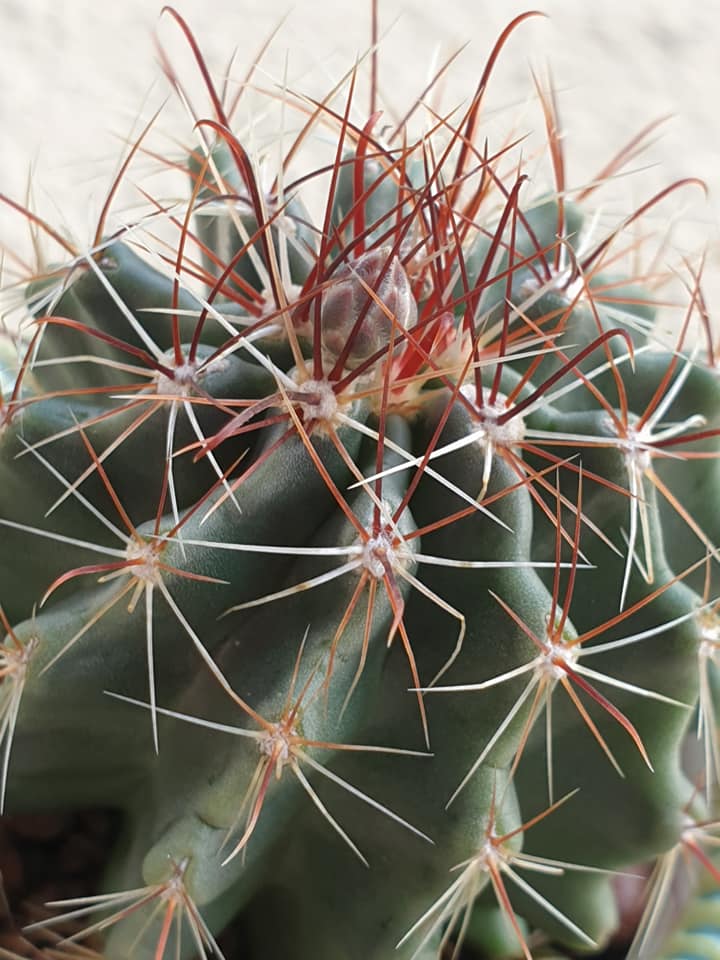
The stem is solitary, rarely branching at the base, globose when young and becoming cylindrical to short-columnar with age. Cultivated specimens typically reach 10 to 20 cm tall and 10 to 20 cm wide; old plants may reach 30 cm in height. The epidermis is dark green, without a waxy bloom. The 12 to 15 thin, somewhat wavy, slightly spiralling ribs are the first visible departure from the genus norm: unlike the strongly tuberculate ribs of all other Thelocactus, these ribs are not subdivided into distinct warts. The result is a barrel-cactus profile, not the nippled or bumpy domes of the Chihuahuan siblings. Areoles are felty, with extra-floral nectaries at the top of each areole, a character shared with T. bicolor, T. hastifer, and T. leucacanthus but otherwise uncommon in the genus.
Spination consists of 12 to 15 needle-shaped radial spines, up to 2.5 cm long, white to brown with considerable colour variability across the range. Central spines number 1 to 3; the lower or single central spine is prominently hooked at the tip, the only hooked spine in the genus. Upper centrals, when present, are straight or slightly curved. Spine colour ranges from white and brown to reddish-brown and yellow, often variable on the same plant. The hook character is visible at a glance and provides an immediate field identification point distinguishing this species from every other Thelocactus.
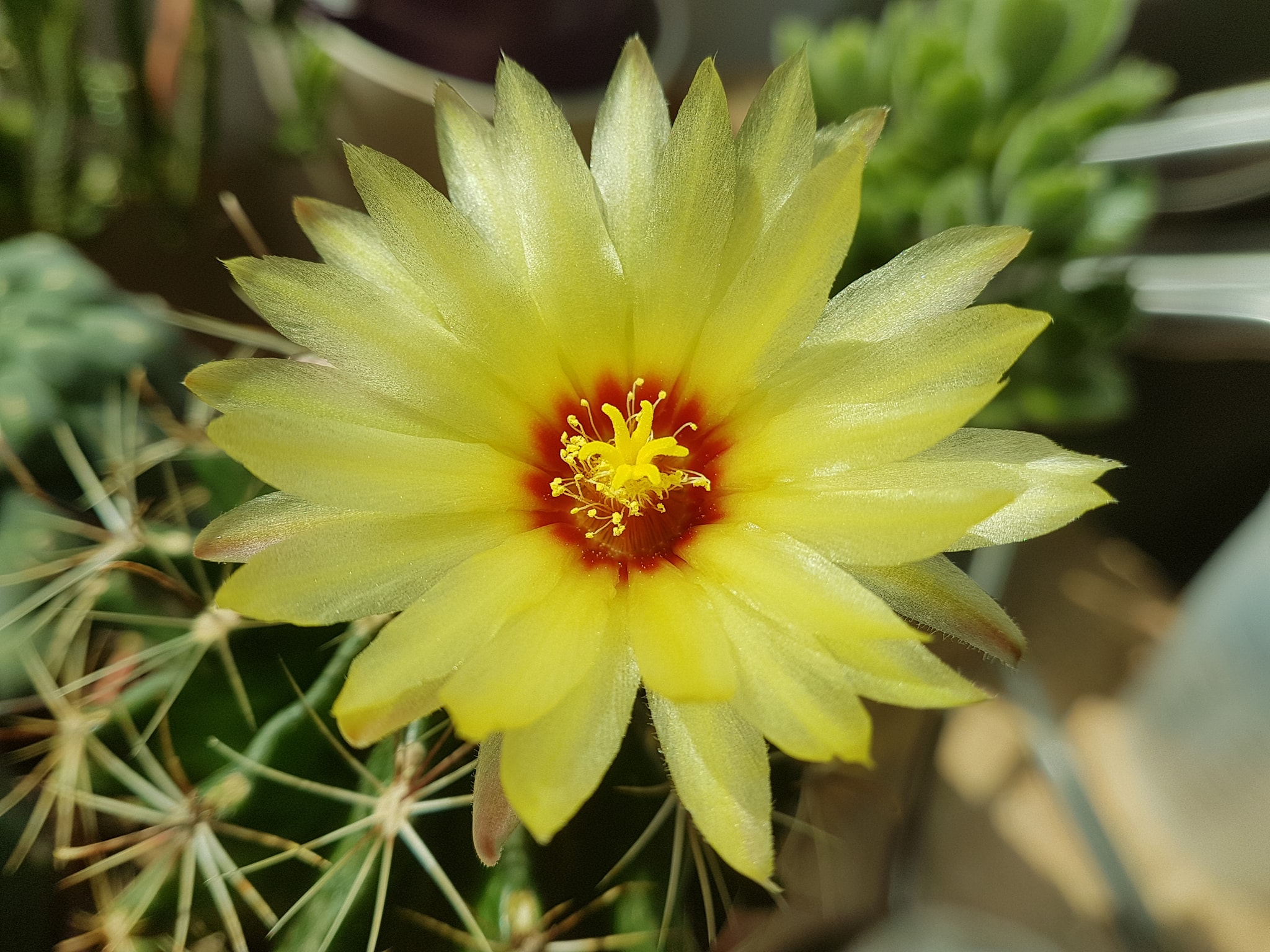
Flowers emerge from the crown, funnel-shaped, 5 to 7 cm in diameter and documented as fragrant across multiple grower sources. The colour is bright, clean yellow with a deep red to orange-red throat and a prominent staminal boss. Flowers are diurnal. The bloom season runs from late spring through summer (April to September, with peak bloom in May and June), and individual plants can carry multiple successive flowers across the long season. Fruit is the third unique character in the species: fleshy, indehiscent, bright red at maturity, 8 to 10 mm in diameter. All other Thelocactus produce dry, dehiscent fruit that splits at the base; the fleshy berry of T. setispinus is adapted to dispersal by birds and small mammals. Seeds are small and black.
Locality detail
The type locality is the Rio Grande region of south Texas, where Engelmann’s 1845 protologue places the original collection. No precise GPS coordinates are confirmed for the type locality; the general attribution is the Rio Grande banks in south Texas. The species’s US range is centred on the lower Rio Grande Valley counties (Starr, Zapata, Webb, Jim Hogg) with a peripheral outpost in the Big Bend area of Brewster County, which some sources describe as a smaller, outlier population whose wild status is not fully resolved. The Lady Bird Johnson Wildflower Center holds seed bank material from Cameron County, Texas (2007).
The Mexican range covers northeastern Coahuila at the Tamaulipan thornscrub interface, Nuevo León across the state’s lowland zones, and Tamaulipas as the core. The absence of San Luis Potosí from the confirmed range is significant: SLP is T. bicolor territory, and sources conflating the two species’ ranges have incorrectly attributed SLP to T. setispinus. The 0 to 550 m elevation range stands in contrast to the 800 to 2,200 m of the Chihuahuan Desert siblings and reflects the Gulf Coastal Plain affiliation. The map uses state-level centroids; detailed county-level occurrence data is available via GBIF species page 3084401.
Thelocactus setispinus care and cultivation
Thelocactus setispinus is the most forgiving species in the genus for temperate cultivation. Its lowland Tamaulipan clay habitat, with 400 to 700 mm of annual rainfall, translates into a plant that handles summer watering generously and is less exacting than the limestone-scree siblings. The Gateway reputation is earned on three counts: early flowering from seed, self-fertility without a second plant, and a long summer bloom season. Germination peaks at 25°C under a 16-hour photoperiod; practical grower consensus puts germination at 2 to 3 weeks at 21 to 27°C in spring.
Substrate
The substrate recipe carries less limestone and more organic matter than the highland siblings. The recipe is: 35 per cent pumice (primary drainage aggregate), 15 per cent lava rock (structural weight and pot-base aeration), 10 per cent zeolite (cation exchange capacity, pH stability at neutral to slightly alkaline), 10 per cent granite grit (structure and slow mineral release), 8 per cent crushed limestone (a default inclusion, not a species requirement; lower than the 15 to 20 per cent used for the highland species), 10 per cent coarse silica grit (drainage insurance), and 12 per cent worm castings (slightly elevated organic component reflecting the more generous summer watering this species wants). The mix is 88 per cent inorganic and 12 per cent organic, adjusted toward the wetter end of the site’s standard 90/10 baseline. Target pH is 7.0 to 7.8. Hard tap water already supplies calcium and bicarbonate at every watering, while rainwater and RO water supply neither.
Substrate ratios across the Thelocactus species on this site. The five highland species (bicolor, hexaedrophorus, rinconensis) share elevated limestone fractions; macdowellii carries the highest at 20% among them; setispinus is the clay-lowland outlier with the lowest limestone and highest organic; tepelmemensis the extreme case at 25% limestone.
| Species | Pumice | Lava | Zeolite | Granite | Limestone | Silica | Organic |
|---|---|---|---|---|---|---|---|
| T. bicolor | 35% | 15% | 10% | 10% | 15% | 5% | 10% |
| T. hexaedrophorus | 35% | 15% | 10% | 10% | 15% | 5% | 10% |
| T. rinconensis | 35% | 15% | 10% | 10% | 15% | 5% | 10% |
| T. macdowellii | 35% | 10% | 10% | 10% | 20% | 5% | 10% |
| T. setispinus (this page) | 35% | 15% | 10% | 10% | 8% | 10% | 12% |
| T. tepelmemensis | 30% | 10% | 10% | 5% | 25% | 10% | 10% |
Watering and light
Watering follows the Tamaulipan summer rain pattern, more generous than any other species on this page. Through June to September, water thoroughly when the substrate is fully dry; in active growth with summer heat, every 7 to 14 days is the working frequency. Planet Desert recommends watering approximately once a week, and BCSS notes for the genus confirm “water freely in summer.” T. setispinus handles this frequency better than its siblings because the native Tamaulipan habitat receives 400 to 700 mm per year, roughly double the Chihuahuan Desert core. Begin watering in March as temperatures rise; taper from October; keep fully dry from November through February. Winter moisture is the primary cause of root rot across all Thelocactus, and this species is no exception.
Light requirements are full sun. The Tamaulipan lowlands are open coastal plain with high insolation; no fog-filtering or nurse-plant shade is typical for the main population range. In the hottest inland climates (Phoenix, Las Vegas), light partial shade during the hottest midday hours benefits the plant and prevents scorching. Planet Desert notes the species “does better with some light shade in the summer” for inland desert cultivation, while performing best in full sun in coastal or temperate-greenhouse contexts.
Cold tolerance
The dry cold floor is approximately −7°C (Planet Desert; multiple grower sources). A Kimble County, Texas provenance is reported by some growers to have survived −27°C, but this appears to represent an exceptional highland outlier population and is not a safe target for typical cultivated plants. The coastal lowland origin of the main range means fewer hard frosts historically, and the species begins to accumulate cold damage below −7°C wet well before reaching that temperature dry. Keep above 5°C in winter when dry; for outdoor cultivation without frost protection, USDA Zone 8b to 9a is the practical minimum for year-round growing.
Comparison
Cross-genus comparator note: T. setispinus is morphologically isolated within Thelocactus. No sibling shares its hooked spines, wavy non-tuberculate ribs, or fleshy red fruit. The species most likely to be confused with it in the field and in the trade is not another Thelocactus but Ferocactus hamatacanthus (Muehlenpf.) Britton & Rose, the turk’s head barrel cactus. Both species were long marketed under the Hamatocactus umbrella (H. setispinus and H. hamatacanthus respectively), and collectors finding plants in south Texas or northern Mexico nurseries routinely ask which is which. This cross-genus comparison is the only identification-useful one available for this species.
The fastest visual distinction is body size. Ferocactus hamatacanthus is a barrel cactus in the traditional sense: 20 to 45 cm tall, 20 to 30 cm wide, with a massive centrally dominant hook reaching up to 15 cm in length. T. setispinus is compact, 10 to 20 cm tall and wide, with a much finer hook (2 to 4 cm, fine-calibre). Rib count separates them too: 12 to 15 thin wavy ribs in T. setispinus versus 8 to 13 prominent straight ribs in F. hamatacanthus. The extra-floral nectaries present on each areole of T. setispinus are not documented in F. hamatacanthus. Elevation is the definitive field separator: T. setispinus inhabits coastal lowlands at 0 to 550 m; F. hamatacanthus occupies Chihuahuan Desert and Trans-Pecos terrain at 600 to 1,800 m. Fruit confirms identity at maturity: the fleshy bright-red 8 to 10 mm berry of T. setispinus does not resemble the larger, yellowish-tan, drying fruit of F. hamatacanthus.
Within Thelocactus, the most instructive secondary comparison is T. bicolor. Both occur in south Texas and share the genus label in specialist catalogues, but the visual difference is stark. T. bicolor has 8 to 13 straight to twisted strongly tuberculate ribs, dense reddish-ochre bicoloured straight central spines, and vivid magenta flowers. T. setispinus has 12 to 15 thin wavy non-tuberculate ribs, a single hooked central, and bright yellow flowers. Flower colour alone rules out confusion for any plant in bloom: nothing about yellow-with-red-throat resembles T. bicolor’s vivid magenta. The body profiles reinforce the distinction: the smooth wavy ribs of T. setispinus versus the wart-studded bumps of every other species in the genus read as a different plant family on first encounter.
Frequently asked questions
Is Thelocactus setispinus hard to grow?
Beginner level; the easiest species in the genus. T. setispinus tolerates summer watering more generously than any other Thelocactus because its native Tamaulipan lowlands receive 400 to 700 mm of rainfall annually, roughly double the Chihuahuan Desert core. The hardest single requirement is the winter dry rest: keep the substrate bone-dry from November through February, above 5°C, and the plant is highly unlikely to fail. Full sun, good drainage, and summer watering every 7 to 14 days complete the picture. Failures almost always trace to winter moisture.
Can Thelocactus setispinus be grown from seed?
Yes, and self-fertile seed from a single specimen is readily available. Grower community reports (CactiGuide, BCSS forums) confirm the species sets seed freely without cross-pollination, a commercially significant trait. Xavier and Jasmim established optimal germination at 25°C under a 16-hour photoperiod in a peer-reviewed study in Ornamental Horticulture (2015); practical grower consensus is germination in 2 to 3 weeks at 21 to 27°C in spring. Seed grown plants typically reach first flowering at three to five years. Grafted plants exist in the trade but offer no compelling advantage for this species, which is fast-growing enough from seed without the artificial acceleration.
Is Thelocactus setispinus legal to own?
Yes, with documentation. The entire family Cactaceae falls under CITES Appendix II, so all commercial international trade in T. setispinus requires export permits from the country of origin. No specific NOM-059-SEMARNAT-2010 listing has been confirmed for this species from accessible sources; it is not under US Endangered Species Act protection. In Texas, where the species is a protected native plant, wild collection from public lands is prohibited. Nursery-propagated stock with documented seed-grown provenance is the legally defensible source worldwide.
Where does Thelocactus setispinus grow in the wild?
In the Tamaulipan mezquital (thornscrub) of the Gulf Coastal Plain, at 0 to 550 m above sea level. The US range covers south Texas (Starr, Zapata, Webb, Jim Hogg counties, with a peripheral outlier in Brewster County at Big Bend). The Mexican range covers Coahuila (northeastern portion), Nuevo León (widespread), and Tamaulipas (the core). It does not extend into San Luis Potosí, which is T. bicolor territory. Habitat is mesquite thornscrub on calcareous clay and clay-loam soils, a fundamentally lower and wetter regime than the limestone-scree Chihuahuan Desert habitat of its genus siblings.
When does Thelocactus setispinus flower?
From late spring through summer, typically April to September, with peak bloom in May and June. The Lady Bird Johnson Wildflower Center records bloom from April to September based on Cameron County, Texas observations. Flowers are 5 to 7 cm in diameter, bright yellow with a deep red to orange-red throat, funnel-shaped, and documented as fragrant across multiple grower sources. The species is self-fertile; a single plant produces fruit and seed without a pollination partner, and carries successive flowers across the long season.
Sources & further reading
Engelmann, G. (1845). Boston Journal of Natural History 5: 246. Basionym: Echinocactus setispinus Engelm. · Britton, N.L. & Rose, J.N. (1922). The Cactaceae 3: 104. Transfer to Hamatocactus setispinus. · Anderson, E.F. (1987). A revision of the genus Thelocactus. Bradleya 5: 49–76, at p. 59. Current combination. · Kew POWO. Thelocactus setispinus (Engelm.) E.F.Anderson. IPNI lsid urn:lsid:ipni.org:names:285992-2. powo.science.kew.org · GBIF. Thelocactus setispinus (Engelm.) E.F.Anderson. Species 3084401. gbif.org · IUCN Red List. Thelocactus setispinus. Least Concern (2017, secondary-source consensus). iucnredlist.org · CITES Taxonomy. Thelocactus setispinus. Appendix II (Cactaceae family listing). cites.org/eng/taxonomy/term/9614 · Xavier, P.B. & Jasmim, J.M. (2015). Effects of temperature and substrate on the germination of Hamatocactus setispinus. Ornamental Horticulture (Revista Brasileira de Horticultura Ornamental). · Lady Bird Johnson Wildflower Center. Thelocactus setispinus. Bloom period April–September; Texas native status; Cameron County seed bank record. wildflower.org · Planet Desert. Hamatocactus setispinus. Cold tolerance; watering frequency; light; flower colour; mature size. planetdesert.com · Texas Parks and Wildlife / TPWD Ecological Mapping Systems. Tamaulipan Mixed Deciduous Thornscrub and Tamaulipan Calcareous Thornscrub. tpwd.texas.gov · South Coast Cactus and Succulent Society. Mini-Show Cactus March 2022: Thelocactus. southcoastcss.org · waterwhendry.blogspot.com. Thelocactus setispinus. May 2008. Grower field notes; spine colour; body dimensions. waterwhendry.blogspot.com · Wikipedia. Thelocactus setispinus; Thelocactus (genus; Mosco & Zanovello phenetic analysis; extra-floral nectaries); Ferocactus hamatacanthus (comparator). en.wikipedia.org · Hunt, D.R. et al. (2013). The New Cactus Lexicon. “Ancient intergeneric hybrid” note. DH Books, Milborne Port. · Anderson, E.F. (2001). The Cactus Family. Timber Press, Portland.