
Ariocarpus Care: The Collector’s Guide to Living Rocks
All ArticlesAriocarpus care comes down to three things: a calcium-rich mineral substrate, full sun, and a complete winter drought from November to early spring. These slow Chihuahuan Desert geophytes grow in late summer and autumn, flower as the season cools, and rot if watered while dormant. Most seed grown plants take eight to ten years to flower.
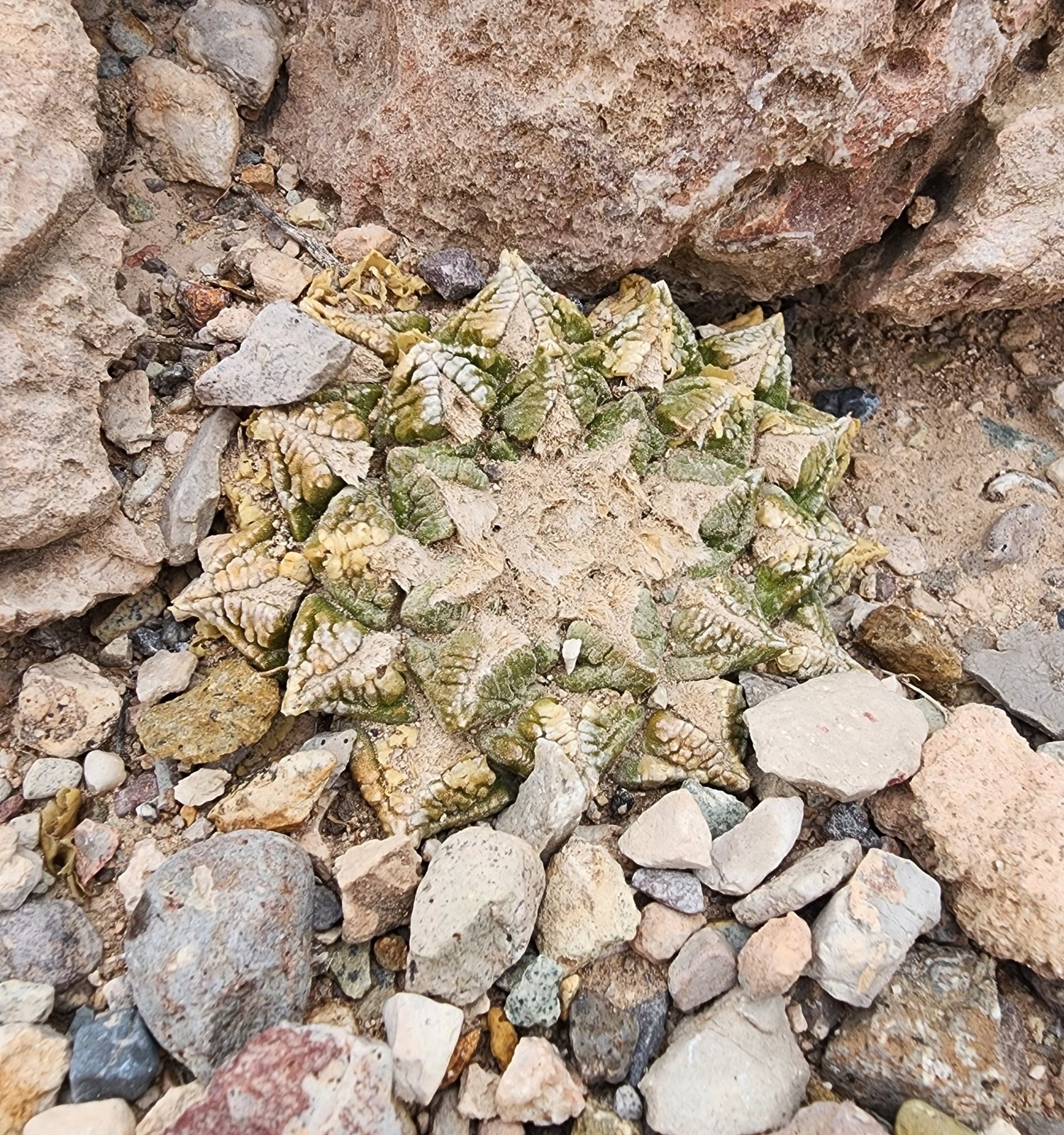
What makes Ariocarpus different to grow?
Ariocarpus are geophytes, which changes everything about how they are grown. Most of the plant is a swollen taproot below ground, and only a flat rosette of firm tubercles sits at the surface, often pulled flush with the soil or below it in drought. The genus holds seven accepted species (plus one natural hybrid) described by Scheidweiler in 1838, all of them native to the Chihuahuan Desert of northern and central Mexico, with Ariocarpus fissuratus crossing into the limestone country of southwest Texas.
That body plan drives every care decision. The taproot stores water and carbohydrate, so the plant survives months of drought by drawing on its own reserves and contracting below the gravel. It also means the taproot is the first thing to rot when a grower waters at the wrong time. Treating an Ariocarpus like a fast desert cactus, with steady spring-to-autumn water, is the surest way to kill one.
The second difference is speed. These are among the slowest cacti in cultivation. A seed grown plant may take eight to ten years to first flower and decades to reach full size. That pace is why provenance matters so much in this genus, and why the gap between a seed grown plant and a grafted one is so visible. The full species list and identification notes live on the Ariocarpus genus hub.
When and how often should you water Ariocarpus?
Ariocarpus break the standard cactus calendar. In habitat they grow most actively in late summer and early autumn, slow down through the hottest, driest part of midsummer, and flower as the season cools. The watering year tracks that rhythm rather than the spring-to-summer pattern most desert cacti follow.
During the growing season, water thoroughly, then let the substrate dry out completely before watering again. In a fast mineral mix that usually means roughly every two weeks, stretched longer in cool or humid spells and shortened only in sustained heat. The plant tells you what it needs: a firm, full body means it is hydrated; a slightly contracted, harder body means it is drawing on the taproot and can take water once the mix is dry.
From late autumn the plant moves into a long, hard winter rest. Stop watering entirely from around November until growth resumes in spring. A cool, dry, bright winter is what sets flower buds for the next season, so the drought is not just rot insurance, it is the trigger for the following year’s flowers. Plants kept warm and watered through winter grow soft, etiolated, and reluctant to bloom.
What substrate does Ariocarpus need?
Ariocarpus need a lean mineral substrate, and the crushed limestone in our mix is grower convention, not a proven requirement of the genus. In the wild they grow on calcareous soils, mostly limestone ridges and plains, with a few species on gypsum-rich silty flats. The native soils are mineral, sharply drained, and almost free of organic matter. The pot mix is set by drainage rather than by that geology: a high-mineral blend that drains in seconds and dries within a day or two. Your water matters here too. Hard tap water already supplies calcium and bicarbonate at every watering, while rainwater and RO water supply neither.
A working mix is roughly eighty to ninety percent mineral grit (pumice, lava, granite grit, and a small fraction of zeolite for cation exchange), fifteen to twenty percent crushed limestone for the calcium the genus demands, and no more than ten percent worm castings as the only organic fraction. Skip the ingredients that popular care guides still recommend: perlite floats and breaks down, builder’s sand packs and holds water, and peat collapses into an airless mush that rots taproots. Our mineral cactus soil mix guide covers the components and the reasoning in full.
Match the mineral-to-fines balance to the species. Limestone-ridge plants like A. fissuratus want the sharpest, leanest mix. Clay-flat species like Ariocarpus kotschoubeyanus, which grow in periodically flooded silty flats, tolerate a slightly higher proportion of fines. Use a deep pot either way, because the taproot needs room to descend and contract.
How much light do living rock cacti need?
Living rock cacti (Ariocarpus) need full sun. The old advice that Ariocarpus hide under nurse plants and need shade is mostly wrong: field studies of exposed A. kotschoubeyanus found the plants photosynthesising at full efficiency in direct sun, with the light-saturation point sitting well above 1,300 micromoles per square metre per second and no sign of light stress. The genus is built for open, high-light desert.
In cultivation, give Ariocarpus the brightest position you have. Under glass that means the sunniest bench, with thirty to forty percent shade cloth only during the most intense weeks of summer to protect tissue that has not hardened to the season. On a windowsill, a south-facing aspect is the minimum; east or west light produces drawn, etiolated growth that never settles into the tight flat habit collectors want. Under LEDs, target the high end of the desert-cactus range, well above 600 micromoles, to keep the body compact and well coloured.
Is Ariocarpus legal to own, and how do you buy it safely?
The entire genus sits on CITES Appendix I, the strictest tier of international wildlife trade law. The three most-grown species were upgraded from Appendix II to Appendix I in 1992; the rest were already there. Appendix I prohibits commercial international trade in wild-collected plants. Nursery-propagated material can still be traded under the convention’s artificial-propagation provisions, treated as Appendix II, but it must carry the right export documentation and proof of cultivated origin. Our guide to CITES Appendix I cacti explains what that paperwork looks like in practice.
Owning and growing a nursery-propagated Ariocarpus is legal in most jurisdictions; the legal weight falls on wild collection and undocumented international movement. The genus shows why the rule exists. A multi-year investigation in the Big Bend region of Texas, with traffickers sentenced in April 2024, recovered more than 3,500 wild A. fissuratus from a handful of seizures, and investigators estimated the ring had pulled ten to fifteen thousand plants from the desert for overseas export. Each one had taken decades to grow.
For a buyer, the defensible plant is a seed grown one from a documented source. A wild plant can be decades old when collected and shows it; a seed grown plant has a known nursery history. This is also where field numbers earn their keep, since a collection code ties a plant’s seed lineage to a documented origin. The premium collectors pay for seed grown stock is partly about habit and partly about being able to show exactly where a plant came from.
Ariocarpus species, and how their care differs
Care is broadly shared across the genus, but the details shift by species, mostly around substrate fines, water sensitivity, and how rare and slow each one is. The site covers every taxon in depth on the genus hub; the notes below cover the care-relevant differences.
For visual identification across the genus, our companion atlas walks through identifying Ariocarpus in detail.
Ariocarpus fissuratus is the limestone living rock of the Chihuahuan Desert and the only species reaching the United States. It wants the sharpest, leanest limestone mix and the most light. IUCN rates it Least Concern across its broad range, yet it remains CITES Appendix I because of trade pressure, the tension the Big Bend case made concrete. The textured cultivar ’Godzilla’, selected by Japanese growers for its heavily wrinkled skin, is extraordinarily slow and usually grafted; degrafted and seed grown plants are the prize.
Ariocarpus kotschoubeyanus is the smallest species, a star-shaped rosette that grows in silty clay flats which flood briefly in the summer rains. It is the one species that tolerates a touch more fines in the mix and slightly more water in active growth. The variety macdowellii carries pale mauve flowers with white outer petals that nearly cover the plant. Its clay-flat ecology, not the genus default, is the exception that proves how habitat should drive the mix.
Ariocarpus retusus is the most widespread and the most forgiving from seed, with thick pointed grey-green tubercles and white to pink autumn flowers. Its scurfy northern form, subsp. furfuraceus, has a mealy surface and equilateral tubercles. Ariocarpus trigonus, long treated as a subspecies of retusus but accepted by POWO as a distinct species, is the yellow-flowered outlier with long incurved tubercles. The crested form, f. cristata, is a fan-shaped mutation that does not come true from seed and is almost always grafted.
The rarest species need the same care but carry the heaviest provenance weight. Ariocarpus scaphirostris, the boat-keeled species from a single valley in Nuevo León, is IUCN Endangered with a documented population collapse. Ariocarpus agavoides, with agave-like tubercles near Tula, and Ariocarpus bravoanus, a San Luis Potosí endemic known from few localities, are both Endangered and both appear on our rarest cacti ranking. For these, a seed grown plant with documented origin is the only responsible way to grow them.
When does Ariocarpus flower?
Ariocarpus flower in autumn, most species from October into early November, with some retusus populations opening in September. The flowers push up through the wool at the crown and open by day. Colour runs by species: white to pink in retusus, yellow in trigonus, crimson to magenta in kotschoubeyanus, pink in agavoides, and light purple-pink in fissuratus.
Flowering is earned, not coaxed. A seed grown plant typically needs eight to ten years before its first bloom, and the cool dry winter rest of the preceding season is what initiates the buds. The genus is largely self-incompatible and outcrossing, pollinated by solitary bees, so setting viable seed usually needs two unrelated plants flowering together. Grafted plants can flower in two to four years, but they reach that point by growing fast and soft, which is the opposite of what most collectors want.
What kills Ariocarpus, and how do you prevent it?
Taproot rot is the leading cause of death in cultivation, and it almost always traces to water sitting in the substrate, usually from watering during dormancy or from a mix that holds moisture. Rot starts in the taproot and travels up, often invisible from the surface until the body softens or topples. If you catch it, cut back into clean uniform tissue, because even a trace of stained tissue left behind will keep spreading, then dry the cut hard and re-root in dry mineral mix. Ariocarpus can regrow on fine roots after losing the taproot, slowly. Our broader diagnostic guide walks through telling rot from a plant that is simply contracting in drought.
Root mealybugs are the other main threat, hidden in the substrate on the roots where they are easy to miss until a plant stalls. Bare-root, wash, treat, and repot into fresh sterile mineral mix at the first sign. Spider mites can bronze the skin in hot dry air. None of this changes if you keep the plant lean, bright, and dry in winter, which removes the conditions all three problems need. One thing that is not a problem: firm brown corky tissue creeping up from the base of an old plant is natural corking, not rot. Corking is dry and hard; rot is soft and wet.
Frequently asked questions about Ariocarpus care
How often should you water Ariocarpus?
Water Ariocarpus only in the growing season, from spring into autumn, and only once the substrate has dried out completely, which usually means roughly every two weeks in a fast mineral mix. Stop watering entirely from November until spring. The winter drought prevents taproot rot and sets the next season’s flowers.
Is Ariocarpus hard to grow?
Ariocarpus are intermediate to advanced. They are not difficult day to day, but they are unforgiving of two mistakes: watering during the winter rest, which rots the taproot, and a substrate that holds moisture. Get the mineral mix and the dry winter right and the genus is durable. The hardest part is patience, since most seed grown plants take eight to ten years to flower.
Why is Ariocarpus protected by CITES?
Every Ariocarpus species is on CITES Appendix I because the plants are slow-growing, narrowly distributed, and heavily targeted by poachers for international trade. A 2024 case in Big Bend, Texas recovered more than 3,500 wild Ariocarpus fissuratus, with thousands more estimated removed. Appendix I bans commercial trade in wild plants; nursery-propagated stock can be traded with documentation.
When does Ariocarpus flower?
Ariocarpus flower in autumn, most species from October into early November, with some retusus populations starting in September. Flowers open by day through the wool at the crown, in white, pink, yellow, or magenta depending on species. Seed grown plants need roughly eight to ten years before their first flower, triggered by the preceding cool, dry winter rest.
What soil mix do living rock cacti need?
Ariocarpus need a calcium-rich mineral substrate: roughly 80 to 90 percent pumice, lava, and granite grit, 15 to 20 percent crushed limestone for the calcium the genus grows in naturally, and no more than 10 percent worm castings. No perlite, no builder sand, no peat, all of which hold water and rot the taproot. Use a deep pot for the taproot.
Plants of the World Online (POWO), Royal Botanic Gardens Kew, Ariocarpus Scheidw. · CITES Appendices I, II, III (current) and COP8 Proposal on Ariocarpus (1992) · Royal Botanic Gardens Kew, CITES and Cacti: a user’s guide · US Fish and Wildlife Service, “Catching Cactus Crooks” (2024) · IUCN Red List, Ariocarpus assessments · Martínez-Ramírez et al., “High tolerance to high-light conditions in Ariocarpus kotschoubeyanus,” (2017) · Martínez-Peralta & Mandujano, “Reproductive biology and breeding system of Ariocarpus,” American Journal of Botany (2014) · Anderson, E.F., The Cactus Family (Timber Press) · Hunt, D., The New Cactus Lexicon (DH Books) · living-rocks.com cultivation notes · llifle, Encyclopedia of Living Forms · British Cactus and Succulent Society, cultivation notes on Ariocarpus
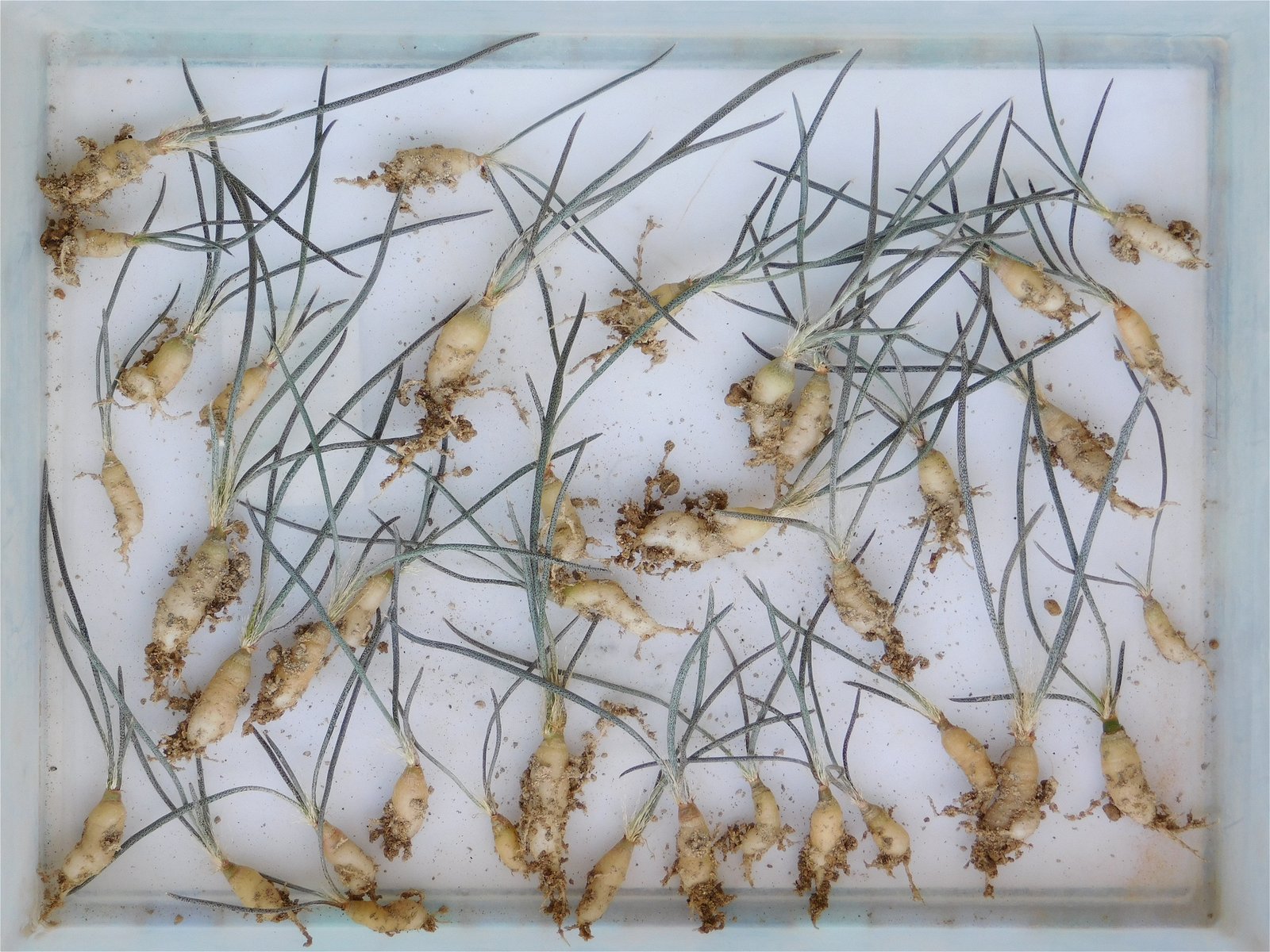
Photos: Ariocarpus fissuratus by cactusdoc (CC BY 4.0) and tuberous cactus seedlings by Resenter1 (CC BY 2.0), via Wikimedia Commons.