Cultivation

Most cristate A. retusus in collections is grafted, typically onto Pereskiopsis spathulata at the seedling stage and later moved to longer-term stock such as Hylocereus undatus, Trichocereus, or Myrtillocactus geometrizans. A vigorous rootstock supplies the vascular bandwidth needed to sustain the oversized fasciated meristem, and watering follows the rootstock’s preferences rather than the parent species’ sparse regime.

Degrafted plants are cut from the rootstock and rooted on their own. They regenerate adventitious roots but never the true tap root, the rooting process takes 6–12 months, and a percentage of attempts fail. Plants that take are scarcer and more valued than grafted material. Cultivation on a degrafted plant follows the parent A. retusus regime: calcareous mineral substrate, sparing summer watering, dry winter rest, bright but not scorching light.

The cristate growth form is a meristem mutation, not a different species; substrate requirements are identical to those of the parent A. retusus. The canonical ratio is 35 per cent pumice, 15 per cent lava rock, 5 per cent zeolite, 20 per cent granite grit, 20 per cent limestone chip, and 5 per cent worm castings. Limestone chip at 20 per cent tracks the calcareous Regosol of the type locality. For grafted cristate plants, watering follows the rootstock’s preferences; for degrafted material rooted on its own, follow the parent A. retusus regime of sparing summer irrigation and a bone-dry winter rest.

Substrate ratio across Ariocarpus

All eleven Ariocarpus pages on this site share the genus calcicole identity; limestone is the load-bearing variable across the range, running 20 per cent for the limestone-hill species and matching that fraction for the gypsum-hill taxa (bravoanus, hintonii) with 5 per cent coarse silica added to reflect calcium-sulphate mineralogy at those localities.

SpeciesPumiceLavaZeoliteGraniteLimestoneSilicaOrganic
A. fissuratus35%15%5%20%20%0%5%
A. fissuratus subsp. lloydii35%15%5%20%20%0%5%
A. retusus35%15%5%20%20%0%5%
A. retusus subsp. furfuraceus35%15%5%20%20%0%5%
A. retusus f. cristata (this page)35%15%5%20%20%0%5%
A. kotschoubeyanus35%15%5%20%20%0%5%
A. scaphirostris35%15%5%20%20%0%5%
A. agavoides35%15%5%20%20%0%5%
A. bravoanus35%15%5%15%20%5%5%
A. bravoanus subsp. hintonii35%15%5%15%20%5%5%
A. trigonus35%15%5%20%20%0%5%

Comparison

The cristate form is not confused with any other Ariocarpus in cultivation; the fasciated growth habit is unmistakable. Comparison instead runs against normal A. retusus stock and against grafted versus degrafted cristate plants. A grafted cristate fan produces a more vigorous, often disproportionately fast-growing scion that retains the cristate geometry but develops less of the calloused, weather-toughened body character of plants grown slowly. Degrafted cristates are more compact and carry a denser, slower-grown fan that more closely resembles the rare wild individuals.

The cristate growth form is a meristem mutation, not a different species; substrate requirements are identical to those of the parent A. retusus. The canonical ratio is 35 per cent pumice, 15 per cent lava rock, 5 per cent zeolite, 20 per cent granite grit, 20 per cent limestone chip, and 5 per cent worm castings. Limestone chip at 20 per cent tracks the calcareous Regosol of the type locality. For grafted cristate plants, watering follows the rootstock’s preferences; for degrafted material rooted on its own, follow the parent A. retusus regime of sparing summer irrigation and a bone-dry winter rest.

Substrate ratio across Ariocarpus

All eleven Ariocarpus pages on this site share the genus calcicole identity; limestone is the load-bearing variable across the range, running 20 per cent for the limestone-hill species and matching that fraction for the gypsum-hill taxa (bravoanus, hintonii) with 5 per cent coarse silica added to reflect calcium-sulphate mineralogy at those localities.

SpeciesPumiceLavaZeoliteGraniteLimestoneSilicaOrganic
A. fissuratus35%15%5%20%20%0%5%
A. fissuratus subsp. lloydii35%15%5%20%20%0%5%
A. retusus35%15%5%20%20%0%5%
A. retusus subsp. furfuraceus35%15%5%20%20%0%5%
A. retusus f. cristata (this page)35%15%5%20%20%0%5%
A. kotschoubeyanus35%15%5%20%20%0%5%
A. scaphirostris35%15%5%20%20%0%5%
A. agavoides35%15%5%20%20%0%5%
A. bravoanus35%15%5%15%20%5%5%
A. bravoanus subsp. hintonii35%15%5%15%20%5%5%
A. trigonus35%15%5%20%20%0%5%

Frequently asked questions

What causes a cactus to grow as a crested or cristate form?

Crested growth results from disruption of the apical meristem. The growing tip elongates into a linear band, producing a fan-shaped rosette instead of the normal circular shape. Proposed causes include somatic mutation, hormonal imbalance, mechanical injury, and viral or phytoplasma infection. Cresting is stable when reproduced vegetatively but generally does not transmit through seed.

Are cristate Ariocarpus retusus rare in the wild?

Vanishingly. Wild crested A. retusus are documented but exceedingly uncommon, occurring as occasional individuals within otherwise normal populations rather than as a discrete population. Most cultivated cristate stock traces to a small number of historic wild discoveries propagated vegetatively ever since, so most named clones in collections today descend from very few founding individuals.

What is the difference between grafted and degrafted cristate A. retusus?

Grafted plants sit on a vigorous rootstock that supplies vascular bandwidth for the oversized cristate meristem; they grow faster and accept more water. Degrafted plants have been rooted on their own and regenerate adventitious roots but never a true tap root; they grow more slowly, develop denser tissue, and command higher prices in specialist sales because the on-root form is what serious collectors seek.

Is cristate Ariocarpus retusus legal to own?

Same legal framework as the parent species. The entire genus Ariocarpus sits on CITES Appendix I, which prohibits commercial international trade in wild-collected specimens and requires CITES export and import permits for legitimate movement of artificially propagated material. Cristate clones in the trade are almost always vegetatively propagated nursery stock, which is legal to acquire and transfer domestically in most jurisdictions; documented nursery provenance is the practical proof of legitimate origin. Mexico’s NOM-059-SEMARNAT-2010 lists A. retusus under Sujeta a protección especial, and the cristate form inherits that status.

How do you spot an authentic cristate clone versus a damaged or deformed plant?

True cresting is a continuous, structured fasciation of the apical meristem: the growing tip is a coherent linear band, not a cluster of disrupted small heads. Damaged or stress-deformed plants typically produce multiple offsets from injury sites or grow asymmetrically without the characteristic linear meristem geometry. Provenance carries weight in this market: well-known cristate clones traceable to named European or Japanese specialist collections are more trusted than plants of uncertain origin, since the cultivated cristate pool descends from a small number of historic wild discoveries propagated vegetatively for decades.

Sources & further reading

Frič, A.V. 1925. Ariocarpus furfuraceus f. cristata (horticultural form). Original cultivation note · Anderson, E.F. & Fitz Maurice, W.A. 1997. Ariocarpus revisited. Haseltonia 5: 1–20 · Anderson, E.F. 2001. The Cactus Family. Timber Press, Portland · BCSS, Cultivation notes on Ariocarpus; degrafting threads (rooting timelines, tap-root non-regeneration, on-root vs grafted cultivation) · llifle Encyclopedia of Living Forms, Ariocarpus retusus f. cristata hort. · cactus-art.biz, Ariocarpus retusus forma cristata (specialist cultivation compendium) · University of Arkansas Cooperative Extension Service, 2008. Fasciated Plants (Crested Plants), Plant Week publication · Henry Shaw Cactus and Succulent Society, 2016. Cristates, Monstroses, Variegates, Plant of the Month · CITES, genus Ariocarpus Appendix I (since COP8, 1992) · IUCN Red List, Ariocarpus retusus: Least Concern; assessors B. Fitz Maurice & W.A. Fitz Maurice

Locality detail

No locality map accompanies this page. Wild crested individuals are rare and scattered, occurring as occasional aberrations within normal A. retusus populations rather than as a discrete population, and most cultivated cristate stock traces to a small number of historic wild discoveries propagated vegetatively for decades. For the parent species’ geographic distribution and locality detail, see the parent page.

The cristate growth form is a meristem mutation, not a different species; substrate requirements are identical to those of the parent A. retusus. The canonical ratio is 35 per cent pumice, 15 per cent lava rock, 5 per cent zeolite, 20 per cent granite grit, 20 per cent limestone chip, and 5 per cent worm castings. Limestone chip at 20 per cent tracks the calcareous Regosol of the type locality. For grafted cristate plants, watering follows the rootstock’s preferences; for degrafted material rooted on its own, follow the parent A. retusus regime of sparing summer irrigation and a bone-dry winter rest.

Substrate ratio across Ariocarpus

All eleven Ariocarpus pages on this site share the genus calcicole identity; limestone is the load-bearing variable across the range, running 20 per cent for the limestone-hill species and matching that fraction for the gypsum-hill taxa (bravoanus, hintonii) with 5 per cent coarse silica added to reflect calcium-sulphate mineralogy at those localities.

SpeciesPumiceLavaZeoliteGraniteLimestoneSilicaOrganic
A. fissuratus35%15%5%20%20%0%5%
A. fissuratus subsp. lloydii35%15%5%20%20%0%5%
A. retusus35%15%5%20%20%0%5%
A. retusus subsp. furfuraceus35%15%5%20%20%0%5%
A. retusus f. cristata (this page)35%15%5%20%20%0%5%
A. kotschoubeyanus35%15%5%20%20%0%5%
A. scaphirostris35%15%5%20%20%0%5%
A. agavoides35%15%5%20%20%0%5%
A. bravoanus35%15%5%15%20%5%5%
A. bravoanus subsp. hintonii35%15%5%15%20%5%5%
A. trigonus35%15%5%20%20%0%5%

Cultivation

Most cristate A. retusus in collections is grafted, typically onto Pereskiopsis spathulata at the seedling stage and later moved to longer-term stock such as Hylocereus undatus, Trichocereus, or Myrtillocactus geometrizans. A vigorous rootstock supplies the vascular bandwidth needed to sustain the oversized fasciated meristem, and watering follows the rootstock’s preferences rather than the parent species’ sparse regime.

Degrafted plants are cut from the rootstock and rooted on their own. They regenerate adventitious roots but never the true tap root, the rooting process takes 6–12 months, and a percentage of attempts fail. Plants that take are scarcer and more valued than grafted material. Cultivation on a degrafted plant follows the parent A. retusus regime: calcareous mineral substrate, sparing summer watering, dry winter rest, bright but not scorching light.

The cristate growth form is a meristem mutation, not a different species; substrate requirements are identical to those of the parent A. retusus. The canonical ratio is 35 per cent pumice, 15 per cent lava rock, 5 per cent zeolite, 20 per cent granite grit, 20 per cent limestone chip, and 5 per cent worm castings. Limestone chip at 20 per cent tracks the calcareous Regosol of the type locality. For grafted cristate plants, watering follows the rootstock’s preferences; for degrafted material rooted on its own, follow the parent A. retusus regime of sparing summer irrigation and a bone-dry winter rest.

Substrate ratio across Ariocarpus

All eleven Ariocarpus pages on this site share the genus calcicole identity; limestone is the load-bearing variable across the range, running 20 per cent for the limestone-hill species and matching that fraction for the gypsum-hill taxa (bravoanus, hintonii) with 5 per cent coarse silica added to reflect calcium-sulphate mineralogy at those localities.

SpeciesPumiceLavaZeoliteGraniteLimestoneSilicaOrganic
A. fissuratus35%15%5%20%20%0%5%
A. fissuratus subsp. lloydii35%15%5%20%20%0%5%
A. retusus35%15%5%20%20%0%5%
A. retusus subsp. furfuraceus35%15%5%20%20%0%5%
A. retusus f. cristata (this page)35%15%5%20%20%0%5%
A. kotschoubeyanus35%15%5%20%20%0%5%
A. scaphirostris35%15%5%20%20%0%5%
A. agavoides35%15%5%20%20%0%5%
A. bravoanus35%15%5%15%20%5%5%
A. bravoanus subsp. hintonii35%15%5%15%20%5%5%
A. trigonus35%15%5%20%20%0%5%

Comparison

The cristate form is not confused with any other Ariocarpus in cultivation; the fasciated growth habit is unmistakable. Comparison instead runs against normal A. retusus stock and against grafted versus degrafted cristate plants. A grafted cristate fan produces a more vigorous, often disproportionately fast-growing scion that retains the cristate geometry but develops less of the calloused, weather-toughened body character of plants grown slowly. Degrafted cristates are more compact and carry a denser, slower-grown fan that more closely resembles the rare wild individuals.

The cristate growth form is a meristem mutation, not a different species; substrate requirements are identical to those of the parent A. retusus. The canonical ratio is 35 per cent pumice, 15 per cent lava rock, 5 per cent zeolite, 20 per cent granite grit, 20 per cent limestone chip, and 5 per cent worm castings. Limestone chip at 20 per cent tracks the calcareous Regosol of the type locality. For grafted cristate plants, watering follows the rootstock’s preferences; for degrafted material rooted on its own, follow the parent A. retusus regime of sparing summer irrigation and a bone-dry winter rest.

Substrate ratio across Ariocarpus

All eleven Ariocarpus pages on this site share the genus calcicole identity; limestone is the load-bearing variable across the range, running 20 per cent for the limestone-hill species and matching that fraction for the gypsum-hill taxa (bravoanus, hintonii) with 5 per cent coarse silica added to reflect calcium-sulphate mineralogy at those localities.

SpeciesPumiceLavaZeoliteGraniteLimestoneSilicaOrganic
A. fissuratus35%15%5%20%20%0%5%
A. fissuratus subsp. lloydii35%15%5%20%20%0%5%
A. retusus35%15%5%20%20%0%5%
A. retusus subsp. furfuraceus35%15%5%20%20%0%5%
A. retusus f. cristata (this page)35%15%5%20%20%0%5%
A. kotschoubeyanus35%15%5%20%20%0%5%
A. scaphirostris35%15%5%20%20%0%5%
A. agavoides35%15%5%20%20%0%5%
A. bravoanus35%15%5%15%20%5%5%
A. bravoanus subsp. hintonii35%15%5%15%20%5%5%
A. trigonus35%15%5%20%20%0%5%

Frequently asked questions

What causes a cactus to grow as a crested or cristate form?

Crested growth results from disruption of the apical meristem. The growing tip elongates into a linear band, producing a fan-shaped rosette instead of the normal circular shape. Proposed causes include somatic mutation, hormonal imbalance, mechanical injury, and viral or phytoplasma infection. Cresting is stable when reproduced vegetatively but generally does not transmit through seed.

Are cristate Ariocarpus retusus rare in the wild?

Vanishingly. Wild crested A. retusus are documented but exceedingly uncommon, occurring as occasional individuals within otherwise normal populations rather than as a discrete population. Most cultivated cristate stock traces to a small number of historic wild discoveries propagated vegetatively ever since, so most named clones in collections today descend from very few founding individuals.

What is the difference between grafted and degrafted cristate A. retusus?

Grafted plants sit on a vigorous rootstock that supplies vascular bandwidth for the oversized cristate meristem; they grow faster and accept more water. Degrafted plants have been rooted on their own and regenerate adventitious roots but never a true tap root; they grow more slowly, develop denser tissue, and command higher prices in specialist sales because the on-root form is what serious collectors seek.

Is cristate Ariocarpus retusus legal to own?

Same legal framework as the parent species. The entire genus Ariocarpus sits on CITES Appendix I, which prohibits commercial international trade in wild-collected specimens and requires CITES export and import permits for legitimate movement of artificially propagated material. Cristate clones in the trade are almost always vegetatively propagated nursery stock, which is legal to acquire and transfer domestically in most jurisdictions; documented nursery provenance is the practical proof of legitimate origin. Mexico’s NOM-059-SEMARNAT-2010 lists A. retusus under Sujeta a protección especial, and the cristate form inherits that status.

How do you spot an authentic cristate clone versus a damaged or deformed plant?

True cresting is a continuous, structured fasciation of the apical meristem: the growing tip is a coherent linear band, not a cluster of disrupted small heads. Damaged or stress-deformed plants typically produce multiple offsets from injury sites or grow asymmetrically without the characteristic linear meristem geometry. Provenance carries weight in this market: well-known cristate clones traceable to named European or Japanese specialist collections are more trusted than plants of uncertain origin, since the cultivated cristate pool descends from a small number of historic wild discoveries propagated vegetatively for decades.

Sources & further reading

Frič, A.V. 1925. Ariocarpus furfuraceus f. cristata (horticultural form). Original cultivation note · Anderson, E.F. & Fitz Maurice, W.A. 1997. Ariocarpus revisited. Haseltonia 5: 1–20 · Anderson, E.F. 2001. The Cactus Family. Timber Press, Portland · BCSS, Cultivation notes on Ariocarpus; degrafting threads (rooting timelines, tap-root non-regeneration, on-root vs grafted cultivation) · llifle Encyclopedia of Living Forms, Ariocarpus retusus f. cristata hort. · cactus-art.biz, Ariocarpus retusus forma cristata (specialist cultivation compendium) · University of Arkansas Cooperative Extension Service, 2008. Fasciated Plants (Crested Plants), Plant Week publication · Henry Shaw Cactus and Succulent Society, 2016. Cristates, Monstroses, Variegates, Plant of the Month · CITES, genus Ariocarpus Appendix I (since COP8, 1992) · IUCN Red List, Ariocarpus retusus: Least Concern; assessors B. Fitz Maurice & W.A. Fitz Maurice

Morphology

Fasciation results from disruption of the apical meristem. The dome of actively dividing cells at the growing tip elongates into a linear band, producing the characteristic fan or corrugated cushion in place of the normal circular rosette. Causes are not fully understood: somatic mutation, hormonal imbalance, mechanical injury, and viral or phytoplasma infection have all been proposed. The mutation does not transmit reliably through seed, so vegetative propagation is the only way to reproduce a cristate individual. Tubercle shape, surface texture, areole position, and flower colour all match the parent A. retusus; only the body geometry changes.

The cristate growth form is a meristem mutation, not a different species; substrate requirements are identical to those of the parent A. retusus. The canonical ratio is 35 per cent pumice, 15 per cent lava rock, 5 per cent zeolite, 20 per cent granite grit, 20 per cent limestone chip, and 5 per cent worm castings. Limestone chip at 20 per cent tracks the calcareous Regosol of the type locality. For grafted cristate plants, watering follows the rootstock’s preferences; for degrafted material rooted on its own, follow the parent A. retusus regime of sparing summer irrigation and a bone-dry winter rest.

Substrate ratio across Ariocarpus

All eleven Ariocarpus pages on this site share the genus calcicole identity; limestone is the load-bearing variable across the range, running 20 per cent for the limestone-hill species and matching that fraction for the gypsum-hill taxa (bravoanus, hintonii) with 5 per cent coarse silica added to reflect calcium-sulphate mineralogy at those localities.

SpeciesPumiceLavaZeoliteGraniteLimestoneSilicaOrganic
A. fissuratus35%15%5%20%20%0%5%
A. fissuratus subsp. lloydii35%15%5%20%20%0%5%
A. retusus35%15%5%20%20%0%5%
A. retusus subsp. furfuraceus35%15%5%20%20%0%5%
A. retusus f. cristata (this page)35%15%5%20%20%0%5%
A. kotschoubeyanus35%15%5%20%20%0%5%
A. scaphirostris35%15%5%20%20%0%5%
A. agavoides35%15%5%20%20%0%5%
A. bravoanus35%15%5%15%20%5%5%
A. bravoanus subsp. hintonii35%15%5%15%20%5%5%
A. trigonus35%15%5%20%20%0%5%

Locality detail

No locality map accompanies this page. Wild crested individuals are rare and scattered, occurring as occasional aberrations within normal A. retusus populations rather than as a discrete population, and most cultivated cristate stock traces to a small number of historic wild discoveries propagated vegetatively for decades. For the parent species’ geographic distribution and locality detail, see the parent page.

The cristate growth form is a meristem mutation, not a different species; substrate requirements are identical to those of the parent A. retusus. The canonical ratio is 35 per cent pumice, 15 per cent lava rock, 5 per cent zeolite, 20 per cent granite grit, 20 per cent limestone chip, and 5 per cent worm castings. Limestone chip at 20 per cent tracks the calcareous Regosol of the type locality. For grafted cristate plants, watering follows the rootstock’s preferences; for degrafted material rooted on its own, follow the parent A. retusus regime of sparing summer irrigation and a bone-dry winter rest.

Substrate ratio across Ariocarpus

All eleven Ariocarpus pages on this site share the genus calcicole identity; limestone is the load-bearing variable across the range, running 20 per cent for the limestone-hill species and matching that fraction for the gypsum-hill taxa (bravoanus, hintonii) with 5 per cent coarse silica added to reflect calcium-sulphate mineralogy at those localities.

SpeciesPumiceLavaZeoliteGraniteLimestoneSilicaOrganic
A. fissuratus35%15%5%20%20%0%5%
A. fissuratus subsp. lloydii35%15%5%20%20%0%5%
A. retusus35%15%5%20%20%0%5%
A. retusus subsp. furfuraceus35%15%5%20%20%0%5%
A. retusus f. cristata (this page)35%15%5%20%20%0%5%
A. kotschoubeyanus35%15%5%20%20%0%5%
A. scaphirostris35%15%5%20%20%0%5%
A. agavoides35%15%5%20%20%0%5%
A. bravoanus35%15%5%15%20%5%5%
A. bravoanus subsp. hintonii35%15%5%15%20%5%5%
A. trigonus35%15%5%20%20%0%5%

Cultivation

Most cristate A. retusus in collections is grafted, typically onto Pereskiopsis spathulata at the seedling stage and later moved to longer-term stock such as Hylocereus undatus, Trichocereus, or Myrtillocactus geometrizans. A vigorous rootstock supplies the vascular bandwidth needed to sustain the oversized fasciated meristem, and watering follows the rootstock’s preferences rather than the parent species’ sparse regime.

Degrafted plants are cut from the rootstock and rooted on their own. They regenerate adventitious roots but never the true tap root, the rooting process takes 6–12 months, and a percentage of attempts fail. Plants that take are scarcer and more valued than grafted material. Cultivation on a degrafted plant follows the parent A. retusus regime: calcareous mineral substrate, sparing summer watering, dry winter rest, bright but not scorching light.

The cristate growth form is a meristem mutation, not a different species; substrate requirements are identical to those of the parent A. retusus. The canonical ratio is 35 per cent pumice, 15 per cent lava rock, 5 per cent zeolite, 20 per cent granite grit, 20 per cent limestone chip, and 5 per cent worm castings. Limestone chip at 20 per cent tracks the calcareous Regosol of the type locality. For grafted cristate plants, watering follows the rootstock’s preferences; for degrafted material rooted on its own, follow the parent A. retusus regime of sparing summer irrigation and a bone-dry winter rest.

Substrate ratio across Ariocarpus

All eleven Ariocarpus pages on this site share the genus calcicole identity; limestone is the load-bearing variable across the range, running 20 per cent for the limestone-hill species and matching that fraction for the gypsum-hill taxa (bravoanus, hintonii) with 5 per cent coarse silica added to reflect calcium-sulphate mineralogy at those localities.

SpeciesPumiceLavaZeoliteGraniteLimestoneSilicaOrganic
A. fissuratus35%15%5%20%20%0%5%
A. fissuratus subsp. lloydii35%15%5%20%20%0%5%
A. retusus35%15%5%20%20%0%5%
A. retusus subsp. furfuraceus35%15%5%20%20%0%5%
A. retusus f. cristata (this page)35%15%5%20%20%0%5%
A. kotschoubeyanus35%15%5%20%20%0%5%
A. scaphirostris35%15%5%20%20%0%5%
A. agavoides35%15%5%20%20%0%5%
A. bravoanus35%15%5%15%20%5%5%
A. bravoanus subsp. hintonii35%15%5%15%20%5%5%
A. trigonus35%15%5%20%20%0%5%

Comparison

The cristate form is not confused with any other Ariocarpus in cultivation; the fasciated growth habit is unmistakable. Comparison instead runs against normal A. retusus stock and against grafted versus degrafted cristate plants. A grafted cristate fan produces a more vigorous, often disproportionately fast-growing scion that retains the cristate geometry but develops less of the calloused, weather-toughened body character of plants grown slowly. Degrafted cristates are more compact and carry a denser, slower-grown fan that more closely resembles the rare wild individuals.

The cristate growth form is a meristem mutation, not a different species; substrate requirements are identical to those of the parent A. retusus. The canonical ratio is 35 per cent pumice, 15 per cent lava rock, 5 per cent zeolite, 20 per cent granite grit, 20 per cent limestone chip, and 5 per cent worm castings. Limestone chip at 20 per cent tracks the calcareous Regosol of the type locality. For grafted cristate plants, watering follows the rootstock’s preferences; for degrafted material rooted on its own, follow the parent A. retusus regime of sparing summer irrigation and a bone-dry winter rest.

Substrate ratio across Ariocarpus

All eleven Ariocarpus pages on this site share the genus calcicole identity; limestone is the load-bearing variable across the range, running 20 per cent for the limestone-hill species and matching that fraction for the gypsum-hill taxa (bravoanus, hintonii) with 5 per cent coarse silica added to reflect calcium-sulphate mineralogy at those localities.

SpeciesPumiceLavaZeoliteGraniteLimestoneSilicaOrganic
A. fissuratus35%15%5%20%20%0%5%
A. fissuratus subsp. lloydii35%15%5%20%20%0%5%
A. retusus35%15%5%20%20%0%5%
A. retusus subsp. furfuraceus35%15%5%20%20%0%5%
A. retusus f. cristata (this page)35%15%5%20%20%0%5%
A. kotschoubeyanus35%15%5%20%20%0%5%
A. scaphirostris35%15%5%20%20%0%5%
A. agavoides35%15%5%20%20%0%5%
A. bravoanus35%15%5%15%20%5%5%
A. bravoanus subsp. hintonii35%15%5%15%20%5%5%
A. trigonus35%15%5%20%20%0%5%

Frequently asked questions

What causes a cactus to grow as a crested or cristate form?

Crested growth results from disruption of the apical meristem. The growing tip elongates into a linear band, producing a fan-shaped rosette instead of the normal circular shape. Proposed causes include somatic mutation, hormonal imbalance, mechanical injury, and viral or phytoplasma infection. Cresting is stable when reproduced vegetatively but generally does not transmit through seed.

Are cristate Ariocarpus retusus rare in the wild?

Vanishingly. Wild crested A. retusus are documented but exceedingly uncommon, occurring as occasional individuals within otherwise normal populations rather than as a discrete population. Most cultivated cristate stock traces to a small number of historic wild discoveries propagated vegetatively ever since, so most named clones in collections today descend from very few founding individuals.

What is the difference between grafted and degrafted cristate A. retusus?

Grafted plants sit on a vigorous rootstock that supplies vascular bandwidth for the oversized cristate meristem; they grow faster and accept more water. Degrafted plants have been rooted on their own and regenerate adventitious roots but never a true tap root; they grow more slowly, develop denser tissue, and command higher prices in specialist sales because the on-root form is what serious collectors seek.

Is cristate Ariocarpus retusus legal to own?

Same legal framework as the parent species. The entire genus Ariocarpus sits on CITES Appendix I, which prohibits commercial international trade in wild-collected specimens and requires CITES export and import permits for legitimate movement of artificially propagated material. Cristate clones in the trade are almost always vegetatively propagated nursery stock, which is legal to acquire and transfer domestically in most jurisdictions; documented nursery provenance is the practical proof of legitimate origin. Mexico’s NOM-059-SEMARNAT-2010 lists A. retusus under Sujeta a protección especial, and the cristate form inherits that status.

How do you spot an authentic cristate clone versus a damaged or deformed plant?

True cresting is a continuous, structured fasciation of the apical meristem: the growing tip is a coherent linear band, not a cluster of disrupted small heads. Damaged or stress-deformed plants typically produce multiple offsets from injury sites or grow asymmetrically without the characteristic linear meristem geometry. Provenance carries weight in this market: well-known cristate clones traceable to named European or Japanese specialist collections are more trusted than plants of uncertain origin, since the cultivated cristate pool descends from a small number of historic wild discoveries propagated vegetatively for decades.

Sources & further reading

Frič, A.V. 1925. Ariocarpus furfuraceus f. cristata (horticultural form). Original cultivation note · Anderson, E.F. & Fitz Maurice, W.A. 1997. Ariocarpus revisited. Haseltonia 5: 1–20 · Anderson, E.F. 2001. The Cactus Family. Timber Press, Portland · BCSS, Cultivation notes on Ariocarpus; degrafting threads (rooting timelines, tap-root non-regeneration, on-root vs grafted cultivation) · llifle Encyclopedia of Living Forms, Ariocarpus retusus f. cristata hort. · cactus-art.biz, Ariocarpus retusus forma cristata (specialist cultivation compendium) · University of Arkansas Cooperative Extension Service, 2008. Fasciated Plants (Crested Plants), Plant Week publication · Henry Shaw Cactus and Succulent Society, 2016. Cristates, Monstroses, Variegates, Plant of the Month · CITES, genus Ariocarpus Appendix I (since COP8, 1992) · IUCN Red List, Ariocarpus retusus: Least Concern; assessors B. Fitz Maurice & W.A. Fitz Maurice

Historical synonyms (12)

  • Anhalonium prismaticum Lem., 1839 basionym
  • Anhalonium retusum (Scheidw.) Salm-Dyck, 1845 homotypic synonym
  • Ariocarpus retusus var. furfuraceus (S.Watson) G.Frank, 1975 homotypic synonym
  • Ariocarpus retusus subsp. scapharostroides Halda & Horácek, 1997 homotypic synonym
  • Ariocarpus retusus subsp. horacekii Halda & Panar., 1998 homotypic synonym
  • Ariocarpus retusus subsp. jarmilae Halda, Horácek & Panar., 1998 homotypic synonym
  • Ariocarpus retusus subsp. panarottoi Halda & Horácek, 1998 homotypic synonym
  • Ariocarpus retusus subsp. confusus (Halda & Horácek) Lüthy, 1999 homotypic synonym
  • Ariocarpus retusus subsp. sladkovskyi Halda & Kupcák, 2000 homotypic synonym
  • Ariocarpus retusus subsp. pectinatus Weisbarth, 2003 homotypic synonym
  • Anhalonium pulvilligerum Lem., 1843 heterotypic synonym
  • Anhalonium elongatum Salm-Dyck, 1845 heterotypic synonym

Sources: GBIF

Habitat

Cristate plants do not form discrete habitat populations. Wild fasciated A. retusus have been encountered as occasional single individuals within otherwise normal populations across the species’ range in Coahuila, Nuevo León, San Luis Potosí, Tamaulipas, and Zacatecas. The substrate, climate, and associated vegetation match the parent species and are described in full on the A. retusus page.

The cristate growth form is a meristem mutation, not a different species; substrate requirements are identical to those of the parent A. retusus. The canonical ratio is 35 per cent pumice, 15 per cent lava rock, 5 per cent zeolite, 20 per cent granite grit, 20 per cent limestone chip, and 5 per cent worm castings. Limestone chip at 20 per cent tracks the calcareous Regosol of the type locality. For grafted cristate plants, watering follows the rootstock’s preferences; for degrafted material rooted on its own, follow the parent A. retusus regime of sparing summer irrigation and a bone-dry winter rest.

Substrate ratio across Ariocarpus

All eleven Ariocarpus pages on this site share the genus calcicole identity; limestone is the load-bearing variable across the range, running 20 per cent for the limestone-hill species and matching that fraction for the gypsum-hill taxa (bravoanus, hintonii) with 5 per cent coarse silica added to reflect calcium-sulphate mineralogy at those localities.

SpeciesPumiceLavaZeoliteGraniteLimestoneSilicaOrganic
A. fissuratus35%15%5%20%20%0%5%
A. fissuratus subsp. lloydii35%15%5%20%20%0%5%
A. retusus35%15%5%20%20%0%5%
A. retusus subsp. furfuraceus35%15%5%20%20%0%5%
A. retusus f. cristata (this page)35%15%5%20%20%0%5%
A. kotschoubeyanus35%15%5%20%20%0%5%
A. scaphirostris35%15%5%20%20%0%5%
A. agavoides35%15%5%20%20%0%5%
A. bravoanus35%15%5%15%20%5%5%
A. bravoanus subsp. hintonii35%15%5%15%20%5%5%
A. trigonus35%15%5%20%20%0%5%

Morphology

Fasciation results from disruption of the apical meristem. The dome of actively dividing cells at the growing tip elongates into a linear band, producing the characteristic fan or corrugated cushion in place of the normal circular rosette. Causes are not fully understood: somatic mutation, hormonal imbalance, mechanical injury, and viral or phytoplasma infection have all been proposed. The mutation does not transmit reliably through seed, so vegetative propagation is the only way to reproduce a cristate individual. Tubercle shape, surface texture, areole position, and flower colour all match the parent A. retusus; only the body geometry changes.

The cristate growth form is a meristem mutation, not a different species; substrate requirements are identical to those of the parent A. retusus. The canonical ratio is 35 per cent pumice, 15 per cent lava rock, 5 per cent zeolite, 20 per cent granite grit, 20 per cent limestone chip, and 5 per cent worm castings. Limestone chip at 20 per cent tracks the calcareous Regosol of the type locality. For grafted cristate plants, watering follows the rootstock’s preferences; for degrafted material rooted on its own, follow the parent A. retusus regime of sparing summer irrigation and a bone-dry winter rest.

Substrate ratio across Ariocarpus

All eleven Ariocarpus pages on this site share the genus calcicole identity; limestone is the load-bearing variable across the range, running 20 per cent for the limestone-hill species and matching that fraction for the gypsum-hill taxa (bravoanus, hintonii) with 5 per cent coarse silica added to reflect calcium-sulphate mineralogy at those localities.

SpeciesPumiceLavaZeoliteGraniteLimestoneSilicaOrganic
A. fissuratus35%15%5%20%20%0%5%
A. fissuratus subsp. lloydii35%15%5%20%20%0%5%
A. retusus35%15%5%20%20%0%5%
A. retusus subsp. furfuraceus35%15%5%20%20%0%5%
A. retusus f. cristata (this page)35%15%5%20%20%0%5%
A. kotschoubeyanus35%15%5%20%20%0%5%
A. scaphirostris35%15%5%20%20%0%5%
A. agavoides35%15%5%20%20%0%5%
A. bravoanus35%15%5%15%20%5%5%
A. bravoanus subsp. hintonii35%15%5%15%20%5%5%
A. trigonus35%15%5%20%20%0%5%

Locality detail

No locality map accompanies this page. Wild crested individuals are rare and scattered, occurring as occasional aberrations within normal A. retusus populations rather than as a discrete population, and most cultivated cristate stock traces to a small number of historic wild discoveries propagated vegetatively for decades. For the parent species’ geographic distribution and locality detail, see the parent page.

The cristate growth form is a meristem mutation, not a different species; substrate requirements are identical to those of the parent A. retusus. The canonical ratio is 35 per cent pumice, 15 per cent lava rock, 5 per cent zeolite, 20 per cent granite grit, 20 per cent limestone chip, and 5 per cent worm castings. Limestone chip at 20 per cent tracks the calcareous Regosol of the type locality. For grafted cristate plants, watering follows the rootstock’s preferences; for degrafted material rooted on its own, follow the parent A. retusus regime of sparing summer irrigation and a bone-dry winter rest.

Substrate ratio across Ariocarpus

All eleven Ariocarpus pages on this site share the genus calcicole identity; limestone is the load-bearing variable across the range, running 20 per cent for the limestone-hill species and matching that fraction for the gypsum-hill taxa (bravoanus, hintonii) with 5 per cent coarse silica added to reflect calcium-sulphate mineralogy at those localities.

SpeciesPumiceLavaZeoliteGraniteLimestoneSilicaOrganic
A. fissuratus35%15%5%20%20%0%5%
A. fissuratus subsp. lloydii35%15%5%20%20%0%5%
A. retusus35%15%5%20%20%0%5%
A. retusus subsp. furfuraceus35%15%5%20%20%0%5%
A. retusus f. cristata (this page)35%15%5%20%20%0%5%
A. kotschoubeyanus35%15%5%20%20%0%5%
A. scaphirostris35%15%5%20%20%0%5%
A. agavoides35%15%5%20%20%0%5%
A. bravoanus35%15%5%15%20%5%5%
A. bravoanus subsp. hintonii35%15%5%15%20%5%5%
A. trigonus35%15%5%20%20%0%5%

Cultivation

Most cristate A. retusus in collections is grafted, typically onto Pereskiopsis spathulata at the seedling stage and later moved to longer-term stock such as Hylocereus undatus, Trichocereus, or Myrtillocactus geometrizans. A vigorous rootstock supplies the vascular bandwidth needed to sustain the oversized fasciated meristem, and watering follows the rootstock’s preferences rather than the parent species’ sparse regime.

Degrafted plants are cut from the rootstock and rooted on their own. They regenerate adventitious roots but never the true tap root, the rooting process takes 6–12 months, and a percentage of attempts fail. Plants that take are scarcer and more valued than grafted material. Cultivation on a degrafted plant follows the parent A. retusus regime: calcareous mineral substrate, sparing summer watering, dry winter rest, bright but not scorching light.

The cristate growth form is a meristem mutation, not a different species; substrate requirements are identical to those of the parent A. retusus. The canonical ratio is 35 per cent pumice, 15 per cent lava rock, 5 per cent zeolite, 20 per cent granite grit, 20 per cent limestone chip, and 5 per cent worm castings. Limestone chip at 20 per cent tracks the calcareous Regosol of the type locality. For grafted cristate plants, watering follows the rootstock’s preferences; for degrafted material rooted on its own, follow the parent A. retusus regime of sparing summer irrigation and a bone-dry winter rest.

Substrate ratio across Ariocarpus

All eleven Ariocarpus pages on this site share the genus calcicole identity; limestone is the load-bearing variable across the range, running 20 per cent for the limestone-hill species and matching that fraction for the gypsum-hill taxa (bravoanus, hintonii) with 5 per cent coarse silica added to reflect calcium-sulphate mineralogy at those localities.

SpeciesPumiceLavaZeoliteGraniteLimestoneSilicaOrganic
A. fissuratus35%15%5%20%20%0%5%
A. fissuratus subsp. lloydii35%15%5%20%20%0%5%
A. retusus35%15%5%20%20%0%5%
A. retusus subsp. furfuraceus35%15%5%20%20%0%5%
A. retusus f. cristata (this page)35%15%5%20%20%0%5%
A. kotschoubeyanus35%15%5%20%20%0%5%
A. scaphirostris35%15%5%20%20%0%5%
A. agavoides35%15%5%20%20%0%5%
A. bravoanus35%15%5%15%20%5%5%
A. bravoanus subsp. hintonii35%15%5%15%20%5%5%
A. trigonus35%15%5%20%20%0%5%

Comparison

The cristate form is not confused with any other Ariocarpus in cultivation; the fasciated growth habit is unmistakable. Comparison instead runs against normal A. retusus stock and against grafted versus degrafted cristate plants. A grafted cristate fan produces a more vigorous, often disproportionately fast-growing scion that retains the cristate geometry but develops less of the calloused, weather-toughened body character of plants grown slowly. Degrafted cristates are more compact and carry a denser, slower-grown fan that more closely resembles the rare wild individuals.

The cristate growth form is a meristem mutation, not a different species; substrate requirements are identical to those of the parent A. retusus. The canonical ratio is 35 per cent pumice, 15 per cent lava rock, 5 per cent zeolite, 20 per cent granite grit, 20 per cent limestone chip, and 5 per cent worm castings. Limestone chip at 20 per cent tracks the calcareous Regosol of the type locality. For grafted cristate plants, watering follows the rootstock’s preferences; for degrafted material rooted on its own, follow the parent A. retusus regime of sparing summer irrigation and a bone-dry winter rest.

Substrate ratio across Ariocarpus

All eleven Ariocarpus pages on this site share the genus calcicole identity; limestone is the load-bearing variable across the range, running 20 per cent for the limestone-hill species and matching that fraction for the gypsum-hill taxa (bravoanus, hintonii) with 5 per cent coarse silica added to reflect calcium-sulphate mineralogy at those localities.

SpeciesPumiceLavaZeoliteGraniteLimestoneSilicaOrganic
A. fissuratus35%15%5%20%20%0%5%
A. fissuratus subsp. lloydii35%15%5%20%20%0%5%
A. retusus35%15%5%20%20%0%5%
A. retusus subsp. furfuraceus35%15%5%20%20%0%5%
A. retusus f. cristata (this page)35%15%5%20%20%0%5%
A. kotschoubeyanus35%15%5%20%20%0%5%
A. scaphirostris35%15%5%20%20%0%5%
A. agavoides35%15%5%20%20%0%5%
A. bravoanus35%15%5%15%20%5%5%
A. bravoanus subsp. hintonii35%15%5%15%20%5%5%
A. trigonus35%15%5%20%20%0%5%

Frequently asked questions

What causes a cactus to grow as a crested or cristate form?

Crested growth results from disruption of the apical meristem. The growing tip elongates into a linear band, producing a fan-shaped rosette instead of the normal circular shape. Proposed causes include somatic mutation, hormonal imbalance, mechanical injury, and viral or phytoplasma infection. Cresting is stable when reproduced vegetatively but generally does not transmit through seed.

Are cristate Ariocarpus retusus rare in the wild?

Vanishingly. Wild crested A. retusus are documented but exceedingly uncommon, occurring as occasional individuals within otherwise normal populations rather than as a discrete population. Most cultivated cristate stock traces to a small number of historic wild discoveries propagated vegetatively ever since, so most named clones in collections today descend from very few founding individuals.

What is the difference between grafted and degrafted cristate A. retusus?

Grafted plants sit on a vigorous rootstock that supplies vascular bandwidth for the oversized cristate meristem; they grow faster and accept more water. Degrafted plants have been rooted on their own and regenerate adventitious roots but never a true tap root; they grow more slowly, develop denser tissue, and command higher prices in specialist sales because the on-root form is what serious collectors seek.

Is cristate Ariocarpus retusus legal to own?

Same legal framework as the parent species. The entire genus Ariocarpus sits on CITES Appendix I, which prohibits commercial international trade in wild-collected specimens and requires CITES export and import permits for legitimate movement of artificially propagated material. Cristate clones in the trade are almost always vegetatively propagated nursery stock, which is legal to acquire and transfer domestically in most jurisdictions; documented nursery provenance is the practical proof of legitimate origin. Mexico’s NOM-059-SEMARNAT-2010 lists A. retusus under Sujeta a protección especial, and the cristate form inherits that status.

How do you spot an authentic cristate clone versus a damaged or deformed plant?

True cresting is a continuous, structured fasciation of the apical meristem: the growing tip is a coherent linear band, not a cluster of disrupted small heads. Damaged or stress-deformed plants typically produce multiple offsets from injury sites or grow asymmetrically without the characteristic linear meristem geometry. Provenance carries weight in this market: well-known cristate clones traceable to named European or Japanese specialist collections are more trusted than plants of uncertain origin, since the cultivated cristate pool descends from a small number of historic wild discoveries propagated vegetatively for decades.

Sources & further reading

Frič, A.V. 1925. Ariocarpus furfuraceus f. cristata (horticultural form). Original cultivation note · Anderson, E.F. & Fitz Maurice, W.A. 1997. Ariocarpus revisited. Haseltonia 5: 1–20 · Anderson, E.F. 2001. The Cactus Family. Timber Press, Portland · BCSS, Cultivation notes on Ariocarpus; degrafting threads (rooting timelines, tap-root non-regeneration, on-root vs grafted cultivation) · llifle Encyclopedia of Living Forms, Ariocarpus retusus f. cristata hort. · cactus-art.biz, Ariocarpus retusus forma cristata (specialist cultivation compendium) · University of Arkansas Cooperative Extension Service, 2008. Fasciated Plants (Crested Plants), Plant Week publication · Henry Shaw Cactus and Succulent Society, 2016. Cristates, Monstroses, Variegates, Plant of the Month · CITES, genus Ariocarpus Appendix I (since COP8, 1992) · IUCN Red List, Ariocarpus retusus: Least Concern; assessors B. Fitz Maurice & W.A. Fitz Maurice

Taxonomy & nomenclature

f. cristata is a horticultural designation, not a validly published taxon. It applies to any individual A. retusus exhibiting fasciation of the apical meristem, irrespective of geographic origin or parent population. The earliest use is Frič 1925, under the older species name A. furfuraceus, and the rank has carried forward in horticultural literature without formal validation. For the full synonymy, accepted name treatment by Kew POWO, and the contested rank history of the parent species, see the parent A. retusus page.

The cristate growth form is a meristem mutation, not a different species; substrate requirements are identical to those of the parent A. retusus. The canonical ratio is 35 per cent pumice, 15 per cent lava rock, 5 per cent zeolite, 20 per cent granite grit, 20 per cent limestone chip, and 5 per cent worm castings. Limestone chip at 20 per cent tracks the calcareous Regosol of the type locality. For grafted cristate plants, watering follows the rootstock’s preferences; for degrafted material rooted on its own, follow the parent A. retusus regime of sparing summer irrigation and a bone-dry winter rest.

Substrate ratio across Ariocarpus

All eleven Ariocarpus pages on this site share the genus calcicole identity; limestone is the load-bearing variable across the range, running 20 per cent for the limestone-hill species and matching that fraction for the gypsum-hill taxa (bravoanus, hintonii) with 5 per cent coarse silica added to reflect calcium-sulphate mineralogy at those localities.

SpeciesPumiceLavaZeoliteGraniteLimestoneSilicaOrganic
A. fissuratus35%15%5%20%20%0%5%
A. fissuratus subsp. lloydii35%15%5%20%20%0%5%
A. retusus35%15%5%20%20%0%5%
A. retusus subsp. furfuraceus35%15%5%20%20%0%5%
A. retusus f. cristata (this page)35%15%5%20%20%0%5%
A. kotschoubeyanus35%15%5%20%20%0%5%
A. scaphirostris35%15%5%20%20%0%5%
A. agavoides35%15%5%20%20%0%5%
A. bravoanus35%15%5%15%20%5%5%
A. bravoanus subsp. hintonii35%15%5%15%20%5%5%
A. trigonus35%15%5%20%20%0%5%

Historical synonyms (12)

  • Anhalonium prismaticum Lem., 1839 basionym
  • Anhalonium retusum (Scheidw.) Salm-Dyck, 1845 homotypic synonym
  • Ariocarpus retusus var. furfuraceus (S.Watson) G.Frank, 1975 homotypic synonym
  • Ariocarpus retusus subsp. scapharostroides Halda & Horácek, 1997 homotypic synonym
  • Ariocarpus retusus subsp. horacekii Halda & Panar., 1998 homotypic synonym
  • Ariocarpus retusus subsp. jarmilae Halda, Horácek & Panar., 1998 homotypic synonym
  • Ariocarpus retusus subsp. panarottoi Halda & Horácek, 1998 homotypic synonym
  • Ariocarpus retusus subsp. confusus (Halda & Horácek) Lüthy, 1999 homotypic synonym
  • Ariocarpus retusus subsp. sladkovskyi Halda & Kupcák, 2000 homotypic synonym
  • Ariocarpus retusus subsp. pectinatus Weisbarth, 2003 homotypic synonym
  • Anhalonium pulvilligerum Lem., 1843 heterotypic synonym
  • Anhalonium elongatum Salm-Dyck, 1845 heterotypic synonym

Sources: GBIF

Habitat

Cristate plants do not form discrete habitat populations. Wild fasciated A. retusus have been encountered as occasional single individuals within otherwise normal populations across the species’ range in Coahuila, Nuevo León, San Luis Potosí, Tamaulipas, and Zacatecas. The substrate, climate, and associated vegetation match the parent species and are described in full on the A. retusus page.

The cristate growth form is a meristem mutation, not a different species; substrate requirements are identical to those of the parent A. retusus. The canonical ratio is 35 per cent pumice, 15 per cent lava rock, 5 per cent zeolite, 20 per cent granite grit, 20 per cent limestone chip, and 5 per cent worm castings. Limestone chip at 20 per cent tracks the calcareous Regosol of the type locality. For grafted cristate plants, watering follows the rootstock’s preferences; for degrafted material rooted on its own, follow the parent A. retusus regime of sparing summer irrigation and a bone-dry winter rest.

Substrate ratio across Ariocarpus

All eleven Ariocarpus pages on this site share the genus calcicole identity; limestone is the load-bearing variable across the range, running 20 per cent for the limestone-hill species and matching that fraction for the gypsum-hill taxa (bravoanus, hintonii) with 5 per cent coarse silica added to reflect calcium-sulphate mineralogy at those localities.

SpeciesPumiceLavaZeoliteGraniteLimestoneSilicaOrganic
A. fissuratus35%15%5%20%20%0%5%
A. fissuratus subsp. lloydii35%15%5%20%20%0%5%
A. retusus35%15%5%20%20%0%5%
A. retusus subsp. furfuraceus35%15%5%20%20%0%5%
A. retusus f. cristata (this page)35%15%5%20%20%0%5%
A. kotschoubeyanus35%15%5%20%20%0%5%
A. scaphirostris35%15%5%20%20%0%5%
A. agavoides35%15%5%20%20%0%5%
A. bravoanus35%15%5%15%20%5%5%
A. bravoanus subsp. hintonii35%15%5%15%20%5%5%
A. trigonus35%15%5%20%20%0%5%

Morphology

Fasciation results from disruption of the apical meristem. The dome of actively dividing cells at the growing tip elongates into a linear band, producing the characteristic fan or corrugated cushion in place of the normal circular rosette. Causes are not fully understood: somatic mutation, hormonal imbalance, mechanical injury, and viral or phytoplasma infection have all been proposed. The mutation does not transmit reliably through seed, so vegetative propagation is the only way to reproduce a cristate individual. Tubercle shape, surface texture, areole position, and flower colour all match the parent A. retusus; only the body geometry changes.

The cristate growth form is a meristem mutation, not a different species; substrate requirements are identical to those of the parent A. retusus. The canonical ratio is 35 per cent pumice, 15 per cent lava rock, 5 per cent zeolite, 20 per cent granite grit, 20 per cent limestone chip, and 5 per cent worm castings. Limestone chip at 20 per cent tracks the calcareous Regosol of the type locality. For grafted cristate plants, watering follows the rootstock’s preferences; for degrafted material rooted on its own, follow the parent A. retusus regime of sparing summer irrigation and a bone-dry winter rest.

Substrate ratio across Ariocarpus

All eleven Ariocarpus pages on this site share the genus calcicole identity; limestone is the load-bearing variable across the range, running 20 per cent for the limestone-hill species and matching that fraction for the gypsum-hill taxa (bravoanus, hintonii) with 5 per cent coarse silica added to reflect calcium-sulphate mineralogy at those localities.

SpeciesPumiceLavaZeoliteGraniteLimestoneSilicaOrganic
A. fissuratus35%15%5%20%20%0%5%
A. fissuratus subsp. lloydii35%15%5%20%20%0%5%
A. retusus35%15%5%20%20%0%5%
A. retusus subsp. furfuraceus35%15%5%20%20%0%5%
A. retusus f. cristata (this page)35%15%5%20%20%0%5%
A. kotschoubeyanus35%15%5%20%20%0%5%
A. scaphirostris35%15%5%20%20%0%5%
A. agavoides35%15%5%20%20%0%5%
A. bravoanus35%15%5%15%20%5%5%
A. bravoanus subsp. hintonii35%15%5%15%20%5%5%
A. trigonus35%15%5%20%20%0%5%

Locality detail

No locality map accompanies this page. Wild crested individuals are rare and scattered, occurring as occasional aberrations within normal A. retusus populations rather than as a discrete population, and most cultivated cristate stock traces to a small number of historic wild discoveries propagated vegetatively for decades. For the parent species’ geographic distribution and locality detail, see the parent page.

The cristate growth form is a meristem mutation, not a different species; substrate requirements are identical to those of the parent A. retusus. The canonical ratio is 35 per cent pumice, 15 per cent lava rock, 5 per cent zeolite, 20 per cent granite grit, 20 per cent limestone chip, and 5 per cent worm castings. Limestone chip at 20 per cent tracks the calcareous Regosol of the type locality. For grafted cristate plants, watering follows the rootstock’s preferences; for degrafted material rooted on its own, follow the parent A. retusus regime of sparing summer irrigation and a bone-dry winter rest.

Substrate ratio across Ariocarpus

All eleven Ariocarpus pages on this site share the genus calcicole identity; limestone is the load-bearing variable across the range, running 20 per cent for the limestone-hill species and matching that fraction for the gypsum-hill taxa (bravoanus, hintonii) with 5 per cent coarse silica added to reflect calcium-sulphate mineralogy at those localities.

SpeciesPumiceLavaZeoliteGraniteLimestoneSilicaOrganic
A. fissuratus35%15%5%20%20%0%5%
A. fissuratus subsp. lloydii35%15%5%20%20%0%5%
A. retusus35%15%5%20%20%0%5%
A. retusus subsp. furfuraceus35%15%5%20%20%0%5%
A. retusus f. cristata (this page)35%15%5%20%20%0%5%
A. kotschoubeyanus35%15%5%20%20%0%5%
A. scaphirostris35%15%5%20%20%0%5%
A. agavoides35%15%5%20%20%0%5%
A. bravoanus35%15%5%15%20%5%5%
A. bravoanus subsp. hintonii35%15%5%15%20%5%5%
A. trigonus35%15%5%20%20%0%5%

Cultivation

Most cristate A. retusus in collections is grafted, typically onto Pereskiopsis spathulata at the seedling stage and later moved to longer-term stock such as Hylocereus undatus, Trichocereus, or Myrtillocactus geometrizans. A vigorous rootstock supplies the vascular bandwidth needed to sustain the oversized fasciated meristem, and watering follows the rootstock’s preferences rather than the parent species’ sparse regime.

Degrafted plants are cut from the rootstock and rooted on their own. They regenerate adventitious roots but never the true tap root, the rooting process takes 6–12 months, and a percentage of attempts fail. Plants that take are scarcer and more valued than grafted material. Cultivation on a degrafted plant follows the parent A. retusus regime: calcareous mineral substrate, sparing summer watering, dry winter rest, bright but not scorching light.

The cristate growth form is a meristem mutation, not a different species; substrate requirements are identical to those of the parent A. retusus. The canonical ratio is 35 per cent pumice, 15 per cent lava rock, 5 per cent zeolite, 20 per cent granite grit, 20 per cent limestone chip, and 5 per cent worm castings. Limestone chip at 20 per cent tracks the calcareous Regosol of the type locality. For grafted cristate plants, watering follows the rootstock’s preferences; for degrafted material rooted on its own, follow the parent A. retusus regime of sparing summer irrigation and a bone-dry winter rest.

Substrate ratio across Ariocarpus

All eleven Ariocarpus pages on this site share the genus calcicole identity; limestone is the load-bearing variable across the range, running 20 per cent for the limestone-hill species and matching that fraction for the gypsum-hill taxa (bravoanus, hintonii) with 5 per cent coarse silica added to reflect calcium-sulphate mineralogy at those localities.

SpeciesPumiceLavaZeoliteGraniteLimestoneSilicaOrganic
A. fissuratus35%15%5%20%20%0%5%
A. fissuratus subsp. lloydii35%15%5%20%20%0%5%
A. retusus35%15%5%20%20%0%5%
A. retusus subsp. furfuraceus35%15%5%20%20%0%5%
A. retusus f. cristata (this page)35%15%5%20%20%0%5%
A. kotschoubeyanus35%15%5%20%20%0%5%
A. scaphirostris35%15%5%20%20%0%5%
A. agavoides35%15%5%20%20%0%5%
A. bravoanus35%15%5%15%20%5%5%
A. bravoanus subsp. hintonii35%15%5%15%20%5%5%
A. trigonus35%15%5%20%20%0%5%

Comparison

The cristate form is not confused with any other Ariocarpus in cultivation; the fasciated growth habit is unmistakable. Comparison instead runs against normal A. retusus stock and against grafted versus degrafted cristate plants. A grafted cristate fan produces a more vigorous, often disproportionately fast-growing scion that retains the cristate geometry but develops less of the calloused, weather-toughened body character of plants grown slowly. Degrafted cristates are more compact and carry a denser, slower-grown fan that more closely resembles the rare wild individuals.

The cristate growth form is a meristem mutation, not a different species; substrate requirements are identical to those of the parent A. retusus. The canonical ratio is 35 per cent pumice, 15 per cent lava rock, 5 per cent zeolite, 20 per cent granite grit, 20 per cent limestone chip, and 5 per cent worm castings. Limestone chip at 20 per cent tracks the calcareous Regosol of the type locality. For grafted cristate plants, watering follows the rootstock’s preferences; for degrafted material rooted on its own, follow the parent A. retusus regime of sparing summer irrigation and a bone-dry winter rest.

Substrate ratio across Ariocarpus

All eleven Ariocarpus pages on this site share the genus calcicole identity; limestone is the load-bearing variable across the range, running 20 per cent for the limestone-hill species and matching that fraction for the gypsum-hill taxa (bravoanus, hintonii) with 5 per cent coarse silica added to reflect calcium-sulphate mineralogy at those localities.

SpeciesPumiceLavaZeoliteGraniteLimestoneSilicaOrganic
A. fissuratus35%15%5%20%20%0%5%
A. fissuratus subsp. lloydii35%15%5%20%20%0%5%
A. retusus35%15%5%20%20%0%5%
A. retusus subsp. furfuraceus35%15%5%20%20%0%5%
A. retusus f. cristata (this page)35%15%5%20%20%0%5%
A. kotschoubeyanus35%15%5%20%20%0%5%
A. scaphirostris35%15%5%20%20%0%5%
A. agavoides35%15%5%20%20%0%5%
A. bravoanus35%15%5%15%20%5%5%
A. bravoanus subsp. hintonii35%15%5%15%20%5%5%
A. trigonus35%15%5%20%20%0%5%

Frequently asked questions

What causes a cactus to grow as a crested or cristate form?

Crested growth results from disruption of the apical meristem. The growing tip elongates into a linear band, producing a fan-shaped rosette instead of the normal circular shape. Proposed causes include somatic mutation, hormonal imbalance, mechanical injury, and viral or phytoplasma infection. Cresting is stable when reproduced vegetatively but generally does not transmit through seed.

Are cristate Ariocarpus retusus rare in the wild?

Vanishingly. Wild crested A. retusus are documented but exceedingly uncommon, occurring as occasional individuals within otherwise normal populations rather than as a discrete population. Most cultivated cristate stock traces to a small number of historic wild discoveries propagated vegetatively ever since, so most named clones in collections today descend from very few founding individuals.

What is the difference between grafted and degrafted cristate A. retusus?

Grafted plants sit on a vigorous rootstock that supplies vascular bandwidth for the oversized cristate meristem; they grow faster and accept more water. Degrafted plants have been rooted on their own and regenerate adventitious roots but never a true tap root; they grow more slowly, develop denser tissue, and command higher prices in specialist sales because the on-root form is what serious collectors seek.

Is cristate Ariocarpus retusus legal to own?

Same legal framework as the parent species. The entire genus Ariocarpus sits on CITES Appendix I, which prohibits commercial international trade in wild-collected specimens and requires CITES export and import permits for legitimate movement of artificially propagated material. Cristate clones in the trade are almost always vegetatively propagated nursery stock, which is legal to acquire and transfer domestically in most jurisdictions; documented nursery provenance is the practical proof of legitimate origin. Mexico’s NOM-059-SEMARNAT-2010 lists A. retusus under Sujeta a protección especial, and the cristate form inherits that status.

How do you spot an authentic cristate clone versus a damaged or deformed plant?

True cresting is a continuous, structured fasciation of the apical meristem: the growing tip is a coherent linear band, not a cluster of disrupted small heads. Damaged or stress-deformed plants typically produce multiple offsets from injury sites or grow asymmetrically without the characteristic linear meristem geometry. Provenance carries weight in this market: well-known cristate clones traceable to named European or Japanese specialist collections are more trusted than plants of uncertain origin, since the cultivated cristate pool descends from a small number of historic wild discoveries propagated vegetatively for decades.

Sources & further reading

Frič, A.V. 1925. Ariocarpus furfuraceus f. cristata (horticultural form). Original cultivation note · Anderson, E.F. & Fitz Maurice, W.A. 1997. Ariocarpus revisited. Haseltonia 5: 1–20 · Anderson, E.F. 2001. The Cactus Family. Timber Press, Portland · BCSS, Cultivation notes on Ariocarpus; degrafting threads (rooting timelines, tap-root non-regeneration, on-root vs grafted cultivation) · llifle Encyclopedia of Living Forms, Ariocarpus retusus f. cristata hort. · cactus-art.biz, Ariocarpus retusus forma cristata (specialist cultivation compendium) · University of Arkansas Cooperative Extension Service, 2008. Fasciated Plants (Crested Plants), Plant Week publication · Henry Shaw Cactus and Succulent Society, 2016. Cristates, Monstroses, Variegates, Plant of the Month · CITES, genus Ariocarpus Appendix I (since COP8, 1992) · IUCN Red List, Ariocarpus retusus: Least Concern; assessors B. Fitz Maurice & W.A. Fitz Maurice

Ariocarpus retusus f. cristata
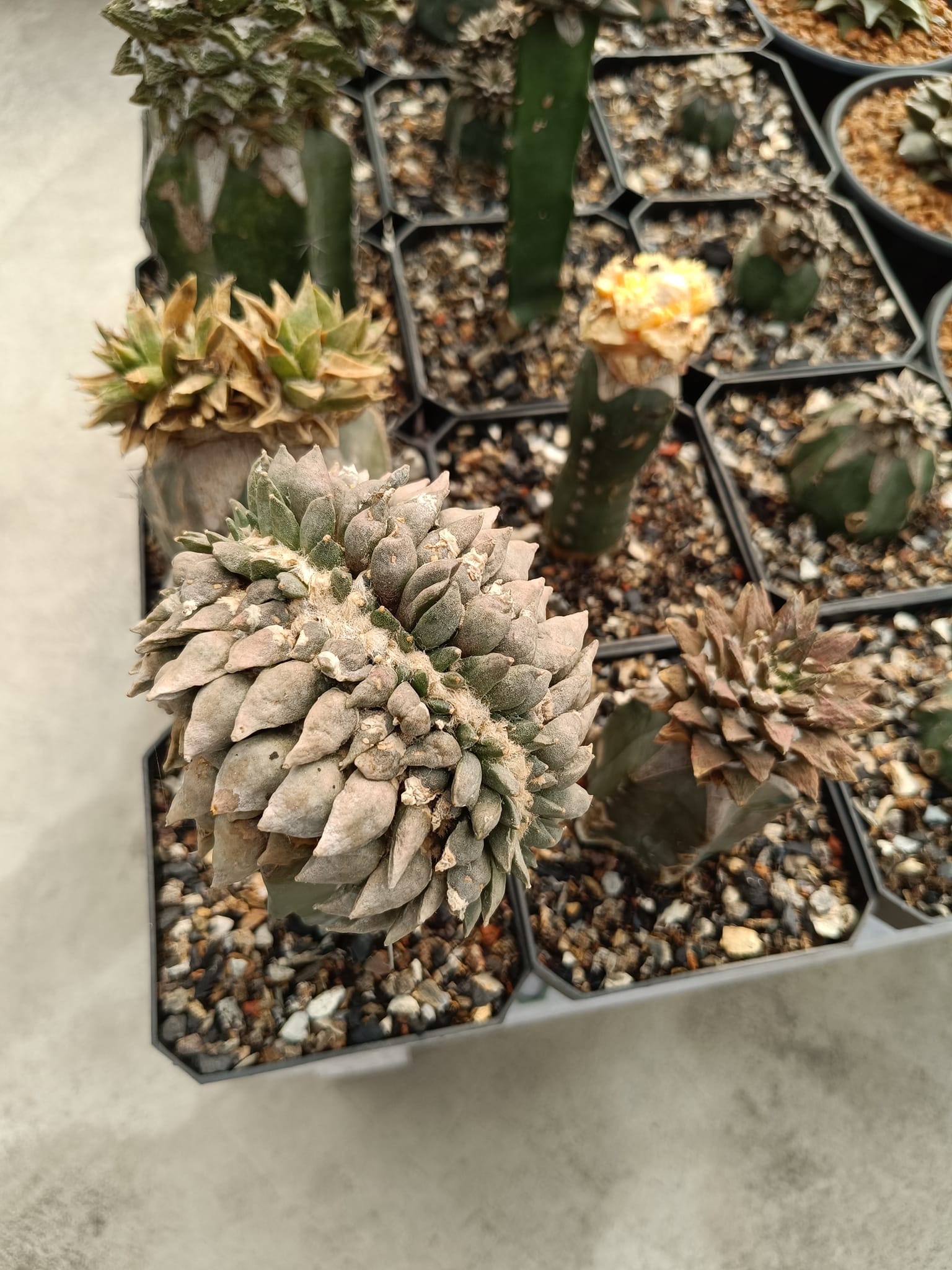
Ariocarpus retusus f. cristata showing the fan-shaped fasciated rosette of grey-green tubercles formed by an elongated apical meristem, photographed in cultivation under natural light.
Mature Ariocarpus retusus f. cristata showing the fan-shaped crested growth pattern produced by fasciation of the apical meristem.

Ariocarpus retusus f. cristata is the crested growth form of A. retusus: a fasciated mutation in which the normally circular apical meristem expands into an elongated linear band, producing the characteristic fan-shaped or convoluted rosette in place of the species’ usual flat-globose habit. The form was first noted by Alberto Vojtěch Frič in 1925 as Ariocarpus furfuraceus f. cristata; the name carries no formal standing under the International Code of Nomenclature, since it was coined in cultivation rather than in a botanical protologue. The slug, page title, and sidebar all retain ‘f. cristata’ because that is how it appears in trade and in collector usage.

Most ecological, taxonomic, and habitat content for this plant lives on the parent species page at A. retusus. What follows here is the cristate-specific information: the biology of the fasciation, its rarity in habitat, and the cultivation differences between grafted and degrafted cristate plants.

Plant care at a glance

Ariocarpus retusus f. cristata quick reference

Cristate plants are propagated almost entirely by grafting; cultivation values reflect that reality, with notes for degrafted material once it has rooted on its own. Substrate, watering, and cold tolerance for degrafted specimens defer to the parent A. retusus page.

Sun exposure
Bright filtered light to morning sun; protect from direct afternoon sun, which can scorch the elongated cristate tissue more readily than a normal globose body.
Watering
Grafted plants follow the rootstock’s schedule (more frequent than typical Ariocarpus); degrafted plants follow the parent species: sparingly in summer, dry in winter.
Soil
Mineral-dominated mix: pumice, granite grit, limestone chip with a small low-nutrient compost fraction; calcium-bearing components match the parent species’ calcareous habitat.
Cold tolerance
Dry cold to roughly -5°C; safer floor 5°C dry. Grafted stock follows the rootstock’s tolerance, which is often less cold-hardy than the scion.
Container
Wider than tall to accommodate the spreading cristate fan; deep enough to root the graft union or, on degrafted plants, the adventitious roots.
Growth rate
Grafted plants produce a presentable fan in years; degrafted plants on their adventitious roots grow as slowly as ungrafted A. retusus seed grown stock.
Difficulty. Intermediate on a vigorous rootstock; advanced after degrafting, when the plant must root and survive on a non-tap-root system while sustaining an oversized fasciated meristem.

Taxonomy & nomenclature

f. cristata is a horticultural designation, not a validly published taxon. It applies to any individual A. retusus exhibiting fasciation of the apical meristem, irrespective of geographic origin or parent population. The earliest use is Frič 1925, under the older species name A. furfuraceus, and the rank has carried forward in horticultural literature without formal validation. For the full synonymy, accepted name treatment by Kew POWO, and the contested rank history of the parent species, see the parent A. retusus page.

The cristate growth form is a meristem mutation, not a different species; substrate requirements are identical to those of the parent A. retusus. The canonical ratio is 35 per cent pumice, 15 per cent lava rock, 5 per cent zeolite, 20 per cent granite grit, 20 per cent limestone chip, and 5 per cent worm castings. Limestone chip at 20 per cent tracks the calcareous Regosol of the type locality. For grafted cristate plants, watering follows the rootstock’s preferences; for degrafted material rooted on its own, follow the parent A. retusus regime of sparing summer irrigation and a bone-dry winter rest.

Substrate ratio across Ariocarpus

All eleven Ariocarpus pages on this site share the genus calcicole identity; limestone is the load-bearing variable across the range, running 20 per cent for the limestone-hill species and matching that fraction for the gypsum-hill taxa (bravoanus, hintonii) with 5 per cent coarse silica added to reflect calcium-sulphate mineralogy at those localities.

SpeciesPumiceLavaZeoliteGraniteLimestoneSilicaOrganic
A. fissuratus35%15%5%20%20%0%5%
A. fissuratus subsp. lloydii35%15%5%20%20%0%5%
A. retusus35%15%5%20%20%0%5%
A. retusus subsp. furfuraceus35%15%5%20%20%0%5%
A. retusus f. cristata (this page)35%15%5%20%20%0%5%
A. kotschoubeyanus35%15%5%20%20%0%5%
A. scaphirostris35%15%5%20%20%0%5%
A. agavoides35%15%5%20%20%0%5%
A. bravoanus35%15%5%15%20%5%5%
A. bravoanus subsp. hintonii35%15%5%15%20%5%5%
A. trigonus35%15%5%20%20%0%5%

Historical synonyms (12)

  • Anhalonium prismaticum Lem., 1839 basionym
  • Anhalonium retusum (Scheidw.) Salm-Dyck, 1845 homotypic synonym
  • Ariocarpus retusus var. furfuraceus (S.Watson) G.Frank, 1975 homotypic synonym
  • Ariocarpus retusus subsp. scapharostroides Halda & Horácek, 1997 homotypic synonym
  • Ariocarpus retusus subsp. horacekii Halda & Panar., 1998 homotypic synonym
  • Ariocarpus retusus subsp. jarmilae Halda, Horácek & Panar., 1998 homotypic synonym
  • Ariocarpus retusus subsp. panarottoi Halda & Horácek, 1998 homotypic synonym
  • Ariocarpus retusus subsp. confusus (Halda & Horácek) Lüthy, 1999 homotypic synonym
  • Ariocarpus retusus subsp. sladkovskyi Halda & Kupcák, 2000 homotypic synonym
  • Ariocarpus retusus subsp. pectinatus Weisbarth, 2003 homotypic synonym
  • Anhalonium pulvilligerum Lem., 1843 heterotypic synonym
  • Anhalonium elongatum Salm-Dyck, 1845 heterotypic synonym

Sources: GBIF

Habitat

Cristate plants do not form discrete habitat populations. Wild fasciated A. retusus have been encountered as occasional single individuals within otherwise normal populations across the species’ range in Coahuila, Nuevo León, San Luis Potosí, Tamaulipas, and Zacatecas. The substrate, climate, and associated vegetation match the parent species and are described in full on the A. retusus page.

The cristate growth form is a meristem mutation, not a different species; substrate requirements are identical to those of the parent A. retusus. The canonical ratio is 35 per cent pumice, 15 per cent lava rock, 5 per cent zeolite, 20 per cent granite grit, 20 per cent limestone chip, and 5 per cent worm castings. Limestone chip at 20 per cent tracks the calcareous Regosol of the type locality. For grafted cristate plants, watering follows the rootstock’s preferences; for degrafted material rooted on its own, follow the parent A. retusus regime of sparing summer irrigation and a bone-dry winter rest.

Substrate ratio across Ariocarpus

All eleven Ariocarpus pages on this site share the genus calcicole identity; limestone is the load-bearing variable across the range, running 20 per cent for the limestone-hill species and matching that fraction for the gypsum-hill taxa (bravoanus, hintonii) with 5 per cent coarse silica added to reflect calcium-sulphate mineralogy at those localities.

SpeciesPumiceLavaZeoliteGraniteLimestoneSilicaOrganic
A. fissuratus35%15%5%20%20%0%5%
A. fissuratus subsp. lloydii35%15%5%20%20%0%5%
A. retusus35%15%5%20%20%0%5%
A. retusus subsp. furfuraceus35%15%5%20%20%0%5%
A. retusus f. cristata (this page)35%15%5%20%20%0%5%
A. kotschoubeyanus35%15%5%20%20%0%5%
A. scaphirostris35%15%5%20%20%0%5%
A. agavoides35%15%5%20%20%0%5%
A. bravoanus35%15%5%15%20%5%5%
A. bravoanus subsp. hintonii35%15%5%15%20%5%5%
A. trigonus35%15%5%20%20%0%5%

Morphology

Fasciation results from disruption of the apical meristem. The dome of actively dividing cells at the growing tip elongates into a linear band, producing the characteristic fan or corrugated cushion in place of the normal circular rosette. Causes are not fully understood: somatic mutation, hormonal imbalance, mechanical injury, and viral or phytoplasma infection have all been proposed. The mutation does not transmit reliably through seed, so vegetative propagation is the only way to reproduce a cristate individual. Tubercle shape, surface texture, areole position, and flower colour all match the parent A. retusus; only the body geometry changes.

The cristate growth form is a meristem mutation, not a different species; substrate requirements are identical to those of the parent A. retusus. The canonical ratio is 35 per cent pumice, 15 per cent lava rock, 5 per cent zeolite, 20 per cent granite grit, 20 per cent limestone chip, and 5 per cent worm castings. Limestone chip at 20 per cent tracks the calcareous Regosol of the type locality. For grafted cristate plants, watering follows the rootstock’s preferences; for degrafted material rooted on its own, follow the parent A. retusus regime of sparing summer irrigation and a bone-dry winter rest.

Substrate ratio across Ariocarpus

All eleven Ariocarpus pages on this site share the genus calcicole identity; limestone is the load-bearing variable across the range, running 20 per cent for the limestone-hill species and matching that fraction for the gypsum-hill taxa (bravoanus, hintonii) with 5 per cent coarse silica added to reflect calcium-sulphate mineralogy at those localities.

SpeciesPumiceLavaZeoliteGraniteLimestoneSilicaOrganic
A. fissuratus35%15%5%20%20%0%5%
A. fissuratus subsp. lloydii35%15%5%20%20%0%5%
A. retusus35%15%5%20%20%0%5%
A. retusus subsp. furfuraceus35%15%5%20%20%0%5%
A. retusus f. cristata (this page)35%15%5%20%20%0%5%
A. kotschoubeyanus35%15%5%20%20%0%5%
A. scaphirostris35%15%5%20%20%0%5%
A. agavoides35%15%5%20%20%0%5%
A. bravoanus35%15%5%15%20%5%5%
A. bravoanus subsp. hintonii35%15%5%15%20%5%5%
A. trigonus35%15%5%20%20%0%5%

Locality detail

No locality map accompanies this page. Wild crested individuals are rare and scattered, occurring as occasional aberrations within normal A. retusus populations rather than as a discrete population, and most cultivated cristate stock traces to a small number of historic wild discoveries propagated vegetatively for decades. For the parent species’ geographic distribution and locality detail, see the parent page.

The cristate growth form is a meristem mutation, not a different species; substrate requirements are identical to those of the parent A. retusus. The canonical ratio is 35 per cent pumice, 15 per cent lava rock, 5 per cent zeolite, 20 per cent granite grit, 20 per cent limestone chip, and 5 per cent worm castings. Limestone chip at 20 per cent tracks the calcareous Regosol of the type locality. For grafted cristate plants, watering follows the rootstock’s preferences; for degrafted material rooted on its own, follow the parent A. retusus regime of sparing summer irrigation and a bone-dry winter rest.

Substrate ratio across Ariocarpus

All eleven Ariocarpus pages on this site share the genus calcicole identity; limestone is the load-bearing variable across the range, running 20 per cent for the limestone-hill species and matching that fraction for the gypsum-hill taxa (bravoanus, hintonii) with 5 per cent coarse silica added to reflect calcium-sulphate mineralogy at those localities.

SpeciesPumiceLavaZeoliteGraniteLimestoneSilicaOrganic
A. fissuratus35%15%5%20%20%0%5%
A. fissuratus subsp. lloydii35%15%5%20%20%0%5%
A. retusus35%15%5%20%20%0%5%
A. retusus subsp. furfuraceus35%15%5%20%20%0%5%
A. retusus f. cristata (this page)35%15%5%20%20%0%5%
A. kotschoubeyanus35%15%5%20%20%0%5%
A. scaphirostris35%15%5%20%20%0%5%
A. agavoides35%15%5%20%20%0%5%
A. bravoanus35%15%5%15%20%5%5%
A. bravoanus subsp. hintonii35%15%5%15%20%5%5%
A. trigonus35%15%5%20%20%0%5%

Cultivation

Most cristate A. retusus in collections is grafted, typically onto Pereskiopsis spathulata at the seedling stage and later moved to longer-term stock such as Hylocereus undatus, Trichocereus, or Myrtillocactus geometrizans. A vigorous rootstock supplies the vascular bandwidth needed to sustain the oversized fasciated meristem, and watering follows the rootstock’s preferences rather than the parent species’ sparse regime.

Degrafted plants are cut from the rootstock and rooted on their own. They regenerate adventitious roots but never the true tap root, the rooting process takes 6–12 months, and a percentage of attempts fail. Plants that take are scarcer and more valued than grafted material. Cultivation on a degrafted plant follows the parent A. retusus regime: calcareous mineral substrate, sparing summer watering, dry winter rest, bright but not scorching light.

The cristate growth form is a meristem mutation, not a different species; substrate requirements are identical to those of the parent A. retusus. The canonical ratio is 35 per cent pumice, 15 per cent lava rock, 5 per cent zeolite, 20 per cent granite grit, 20 per cent limestone chip, and 5 per cent worm castings. Limestone chip at 20 per cent tracks the calcareous Regosol of the type locality. For grafted cristate plants, watering follows the rootstock’s preferences; for degrafted material rooted on its own, follow the parent A. retusus regime of sparing summer irrigation and a bone-dry winter rest.

Substrate ratio across Ariocarpus

All eleven Ariocarpus pages on this site share the genus calcicole identity; limestone is the load-bearing variable across the range, running 20 per cent for the limestone-hill species and matching that fraction for the gypsum-hill taxa (bravoanus, hintonii) with 5 per cent coarse silica added to reflect calcium-sulphate mineralogy at those localities.

SpeciesPumiceLavaZeoliteGraniteLimestoneSilicaOrganic
A. fissuratus35%15%5%20%20%0%5%
A. fissuratus subsp. lloydii35%15%5%20%20%0%5%
A. retusus35%15%5%20%20%0%5%
A. retusus subsp. furfuraceus35%15%5%20%20%0%5%
A. retusus f. cristata (this page)35%15%5%20%20%0%5%
A. kotschoubeyanus35%15%5%20%20%0%5%
A. scaphirostris35%15%5%20%20%0%5%
A. agavoides35%15%5%20%20%0%5%
A. bravoanus35%15%5%15%20%5%5%
A. bravoanus subsp. hintonii35%15%5%15%20%5%5%
A. trigonus35%15%5%20%20%0%5%

Comparison

The cristate form is not confused with any other Ariocarpus in cultivation; the fasciated growth habit is unmistakable. Comparison instead runs against normal A. retusus stock and against grafted versus degrafted cristate plants. A grafted cristate fan produces a more vigorous, often disproportionately fast-growing scion that retains the cristate geometry but develops less of the calloused, weather-toughened body character of plants grown slowly. Degrafted cristates are more compact and carry a denser, slower-grown fan that more closely resembles the rare wild individuals.

The cristate growth form is a meristem mutation, not a different species; substrate requirements are identical to those of the parent A. retusus. The canonical ratio is 35 per cent pumice, 15 per cent lava rock, 5 per cent zeolite, 20 per cent granite grit, 20 per cent limestone chip, and 5 per cent worm castings. Limestone chip at 20 per cent tracks the calcareous Regosol of the type locality. For grafted cristate plants, watering follows the rootstock’s preferences; for degrafted material rooted on its own, follow the parent A. retusus regime of sparing summer irrigation and a bone-dry winter rest.

Substrate ratio across Ariocarpus

All eleven Ariocarpus pages on this site share the genus calcicole identity; limestone is the load-bearing variable across the range, running 20 per cent for the limestone-hill species and matching that fraction for the gypsum-hill taxa (bravoanus, hintonii) with 5 per cent coarse silica added to reflect calcium-sulphate mineralogy at those localities.

SpeciesPumiceLavaZeoliteGraniteLimestoneSilicaOrganic
A. fissuratus35%15%5%20%20%0%5%
A. fissuratus subsp. lloydii35%15%5%20%20%0%5%
A. retusus35%15%5%20%20%0%5%
A. retusus subsp. furfuraceus35%15%5%20%20%0%5%
A. retusus f. cristata (this page)35%15%5%20%20%0%5%
A. kotschoubeyanus35%15%5%20%20%0%5%
A. scaphirostris35%15%5%20%20%0%5%
A. agavoides35%15%5%20%20%0%5%
A. bravoanus35%15%5%15%20%5%5%
A. bravoanus subsp. hintonii35%15%5%15%20%5%5%
A. trigonus35%15%5%20%20%0%5%

Frequently asked questions

What causes a cactus to grow as a crested or cristate form?

Crested growth results from disruption of the apical meristem. The growing tip elongates into a linear band, producing a fan-shaped rosette instead of the normal circular shape. Proposed causes include somatic mutation, hormonal imbalance, mechanical injury, and viral or phytoplasma infection. Cresting is stable when reproduced vegetatively but generally does not transmit through seed.

Are cristate Ariocarpus retusus rare in the wild?

Vanishingly. Wild crested A. retusus are documented but exceedingly uncommon, occurring as occasional individuals within otherwise normal populations rather than as a discrete population. Most cultivated cristate stock traces to a small number of historic wild discoveries propagated vegetatively ever since, so most named clones in collections today descend from very few founding individuals.

What is the difference between grafted and degrafted cristate A. retusus?

Grafted plants sit on a vigorous rootstock that supplies vascular bandwidth for the oversized cristate meristem; they grow faster and accept more water. Degrafted plants have been rooted on their own and regenerate adventitious roots but never a true tap root; they grow more slowly, develop denser tissue, and command higher prices in specialist sales because the on-root form is what serious collectors seek.

Is cristate Ariocarpus retusus legal to own?

Same legal framework as the parent species. The entire genus Ariocarpus sits on CITES Appendix I, which prohibits commercial international trade in wild-collected specimens and requires CITES export and import permits for legitimate movement of artificially propagated material. Cristate clones in the trade are almost always vegetatively propagated nursery stock, which is legal to acquire and transfer domestically in most jurisdictions; documented nursery provenance is the practical proof of legitimate origin. Mexico’s NOM-059-SEMARNAT-2010 lists A. retusus under Sujeta a protección especial, and the cristate form inherits that status.

How do you spot an authentic cristate clone versus a damaged or deformed plant?

True cresting is a continuous, structured fasciation of the apical meristem: the growing tip is a coherent linear band, not a cluster of disrupted small heads. Damaged or stress-deformed plants typically produce multiple offsets from injury sites or grow asymmetrically without the characteristic linear meristem geometry. Provenance carries weight in this market: well-known cristate clones traceable to named European or Japanese specialist collections are more trusted than plants of uncertain origin, since the cultivated cristate pool descends from a small number of historic wild discoveries propagated vegetatively for decades.

Sources & further reading

Frič, A.V. 1925. Ariocarpus furfuraceus f. cristata (horticultural form). Original cultivation note · Anderson, E.F. & Fitz Maurice, W.A. 1997. Ariocarpus revisited. Haseltonia 5: 1–20 · Anderson, E.F. 2001. The Cactus Family. Timber Press, Portland · BCSS, Cultivation notes on Ariocarpus; degrafting threads (rooting timelines, tap-root non-regeneration, on-root vs grafted cultivation) · llifle Encyclopedia of Living Forms, Ariocarpus retusus f. cristata hort. · cactus-art.biz, Ariocarpus retusus forma cristata (specialist cultivation compendium) · University of Arkansas Cooperative Extension Service, 2008. Fasciated Plants (Crested Plants), Plant Week publication · Henry Shaw Cactus and Succulent Society, 2016. Cristates, Monstroses, Variegates, Plant of the Month · CITES, genus Ariocarpus Appendix I (since COP8, 1992) · IUCN Red List, Ariocarpus retusus: Least Concern; assessors B. Fitz Maurice & W.A. Fitz Maurice