
Mammillaria humboldtii
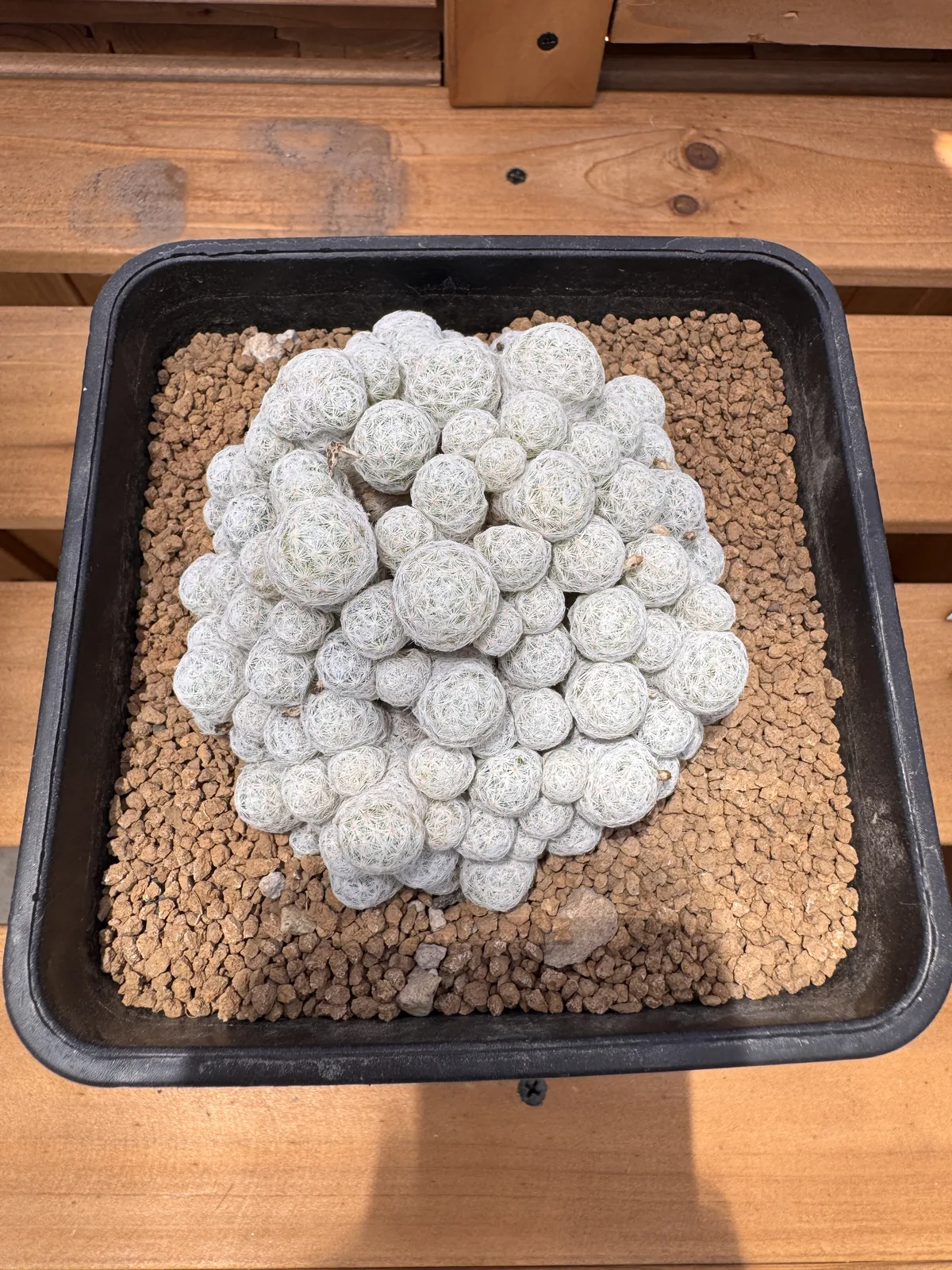
Mammillaria humboldtii is the snowball cactus of the limestone barrancas of central Mexico, a miniature that disappears under its own armour. Each small head is wrapped in dozens of fine, hair-thin white radial spines set in a tight star around every areole, packed so densely that the pale green body beneath is barely visible. With age the plant offsets freely, the heads crowding together into a low rounded cushion that reads, at a glance, like a drift of snow caught on the rock.
Carl August Ehrenberg described the species in 1840 in Linnaea, and it has stayed in Mammillaria ever since despite a long trail of segregate-genus combinations. It sits in series Lasiacanthae, the group of white-spined Mexican miniatures that obscure the stem under bristly or hair-like radials, alongside Mammillaria herrerae, Mammillaria schwarzii and Mammillaria duwei. Of these it is most often confused with M. herrerae, and the two are routinely sold under the same snowball label.
The species is endemic to a narrow band of Hidalgo and Querétaro, centred on the deep limestone canyon of the Barranca de Metztitlán, where it grows wedged into vertical and near-vertical cliff faces of Cretaceous carbonate rock. That cliff-crevice life on bare, sharply drained limestone drives every decision in cultivation.
Individual heads stay small, reaching only about 7 cm across, so the plant builds its presence by clustering rather than by bulk. A mature mound is the work of many slow years. In the cooler months a ring of small pink to purplish-red flowers opens around the crown of each head, vivid against the white, the bloom the species is loved for.
Mammillaria humboldtii quick reference
A cliff-crevice specialist from the limestone barrancas of Hidalgo and Querétaro, where it roots in sharp carbonate rock with fast drainage and no standing water. Values calibrated for seed grown plants in cultivation, drawn from habitat and specialist grower experience.
Taxonomy & nomenclature
The accepted name is Mammillaria humboldtii C.Ehrenb., published in Linnaea 14: 378 (1840; IPNI LSID urn:lsid:ipni.org:names:151118-2). The authority C.Ehrenb. is Carl August Ehrenberg, the German collector who worked Mexican cacti in the 1830s and 1840s, and is kept distinct from the microbiologist Christian Gottfried Ehrenberg. There is no basionym; the name is the protonym.
The species has accumulated a long synonymy as successive authors tried to split Mammillaria into smaller genera. It has been combined as Cactus humboldtii, Chilita humboldtii, Ebnerella humboldtii and Escobariopsis humboldtii, and once treated as a form of Mammillaria’s white-spined relative M. candida. Kew POWO and the GBIF backbone both keep all of these in synonymy under M. humboldtii. A trade label of ‘var. caespitosa’ circulates among growers but has no standing as a validly published name.
Within the genus the species sits in subgenus Mammillaria, series Lasiacanthae, the assemblage of small Mexican species whose strongly pectinate or hair-like white radial spines bury the stem and which offset into clusters. Its closest relatives in that series, and the taxa it is most readily confused with, are M. herrerae, M. schwarzii and M. duwei; molecular work on Mammillaria has repeatedly shown the genus to be artificial in its older circumscription, but M. humboldtii itself has stayed stable as an accepted species throughout.
Historical synonyms (6)
- Ebnerella humboldtii (C.Ehrenb.) Buxb., 1951 basionym
- Chilita humboldtii (C.Ehrenb.) Buxb., 1954 homotypic synonym
- Escobariopsis humboldtii (C.Ehrenb.) Doweld, 2000 homotypic synonym
- Mammillaria candida f. humboldtii (C.Ehrenb.) Schelle, 1926 heterotypic synonym
- Neomammillaria neohumboldtii Y.Itô, 1981 heterotypic synonym
- Cactus humboldtii (C.Ehrenb.) Kuntze, 1891 nom. inval.
Sources: GBIF
Habitat
Mammillaria humboldtii is a strict calcicole of vertical limestone. Its core range is the Barranca de Metztitlán, a deep semi-arid canyon cut into Cretaceous carbonate rock in Hidalgo, with further populations across the state line into Querétaro. Plants grow lodged in fissures and on ledges of near-vertical cliff faces rather than in open ground, rooting in the thin mineral debris that collects in crevices. On a wall that steep, water never stands at the root; rain sheets off the rock and is gone within hours.
The canyon climate is the dry-winter, summer-rain pattern of central Mexico: a warm growing season fed by summer storms, then a long, cool, essentially rainless winter. The surrounding vegetation is xerophilous scrub, the Metztitlán barranca being well known for its stands of Cephalocereus senilis and Myrtillocactus geometrizans among agaves and thorny shrubs. Much of the type region falls within the Reserva de la Biosfera Barranca de Metztitlán, which gives the habitat a measure of formal protection.
The dense white spine coat is not decoration. On an exposed carbonate cliff at this latitude the radials scatter fierce sunlight off the body, buffer the wide day-to-night temperature swing, and shade the epidermis, the same suite of jobs the white-spined M. schwarzii and other Lasiacanthae solve the same way on their own cliffs further north and west.
Morphology
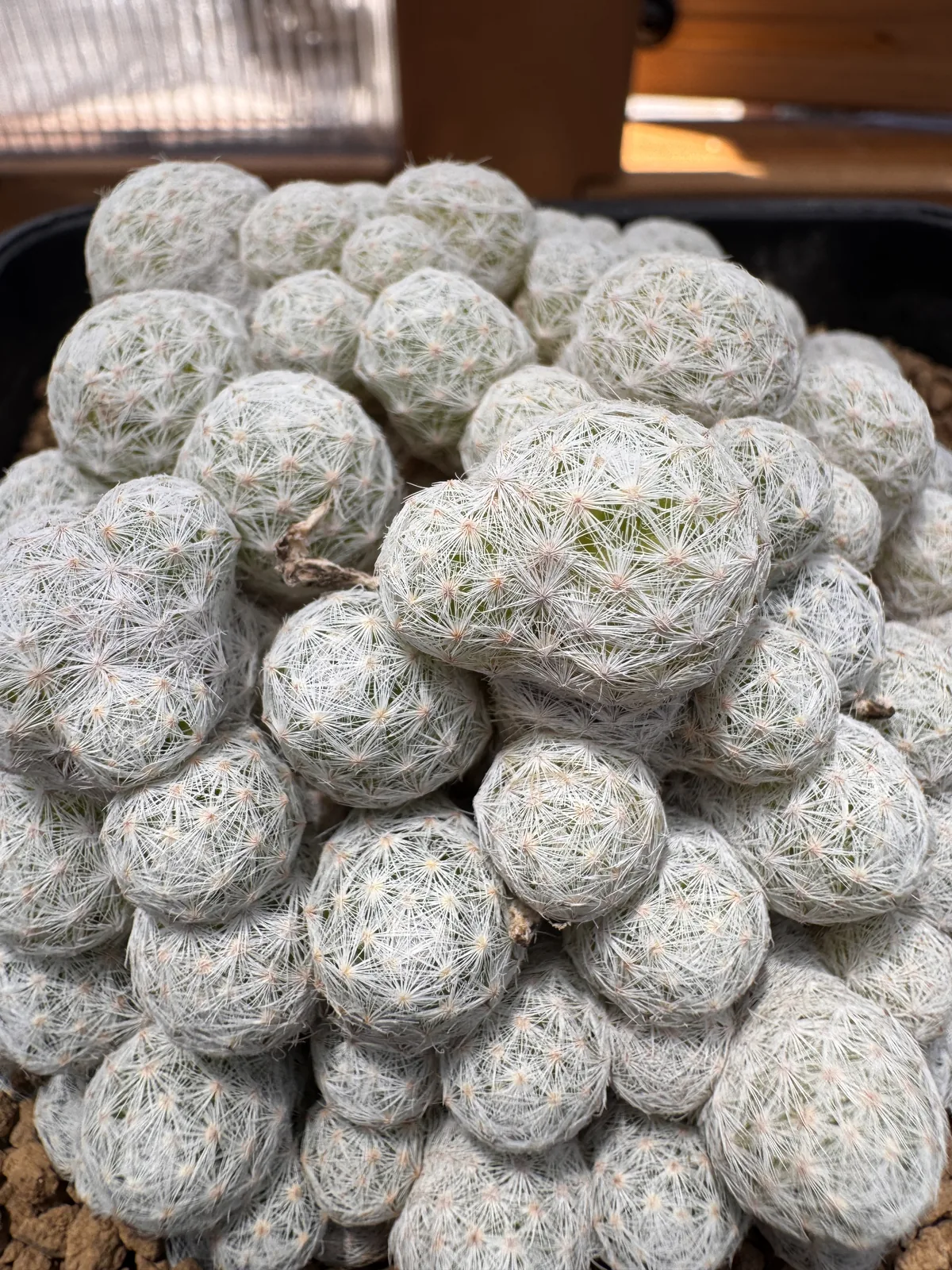
Individual stems are depressed-globose to spherical and small, on the order of 7 cm in both height and diameter at maturity, pale green but almost entirely hidden by spines. The plant is solitary when young and offsets freely with age, building dense low mounds of many heads. The tubercles are cylindrical and firm, set close together, with the fine wool of the genus in the axils between them.
The diagnostic feature is the radial spination. Each areole carries roughly eighty or more fine, soft, hair-thin white radial spines, about 4 to 6 mm long, radiating in a tight star that interlocks with its neighbours so the green body is lost beneath a continuous white felt. Central spines are effectively absent, at most one or two inconspicuous bristles on an occasional mature areole. This is the snowball habit shared across series Lasiacanthae, and the feature that separates these plants at a glance from the hook-spined M. huitzilopochtli and the other armed members of the genus.
Flowers emerge in a ring near the crown of each head, small and funnel-shaped, around 2.5 cm long and 1.5 cm across, in shades that sources record from bright pink to purplish-red, typically with a darker midstripe to the petals. The fruit is a red, club-shaped berry carrying small black seeds. There is no milky latex; like the rest of subgenus Mammillaria the species has a clear, watery sap.
Locality detail
The species is endemic to two adjoining states of east-central Mexico, Hidalgo and Querétaro, with its best-known populations on the limestone cliffs of the Barranca de Metztitlán in Hidalgo. The map below shows a regional centroid only. Sharp coordinates are withheld here following standard practice for a CITES-listed cactus that is actively targeted by collectors.
Because the plant lives on near-vertical carbonate cliff faces rather than accessible flats, wild populations are hard to reach and hard to census, which is part of why precise range and population figures are not consistently published. Any plant offered without clear evidence of cultivated, seed grown origin should be treated as suspect.
Mammillaria humboldtii care and cultivation
Two habitat facts frame everything: the plant grows on bare, sharply drained limestone where water never sits at the root, and its body is sheathed in a dense spine coat that holds any moisture landing on it. Get drainage and a dry crown right and the species is undemanding; get them wrong and it rots from the neck without warning.
Substrate
Grow it in a free-draining, mineral-dominant mix of roughly 50 per cent pumice, 30 per cent decomposed granite, 15 per cent crushed limestone chip and 5 per cent low-nutrient organic base, with no lava rock, no zeolite and no silica sand. The limestone chip follows the same named grower’s cultivation recommendation used across several of the genus’s limestone-carrying species; it is a convention figure, not a reading of the Metztitlan Canyon rock the species grows on in the wild. Growers on hard tap water can reduce or drop the fraction; the pumice and granite carry the instant drainage the cliff-dwelling root demands. A grit top dressing under the body keeps the spine-packed neck dry and off wet substrate.
Every Mammillaria on this site runs a sharply drained, mineral-dominant mix built from the same declared house formulation; only limestone and the thin organic fraction vary by species, and neither is set by habitat rock. M. humboldtii carries crushed limestone on the same named grower’s cultivation recommendation that applies to several of its genus-mates, not because its Metztitlan Canyon habitat is limestone; organic sits at the genus floor.
| Species | Pumice | Lava | Zeolite | Granite | Limestone | Silica | Organic |
|---|---|---|---|---|---|---|---|
| M. herrerae | 40% | 15% | 0% | 30% | 10% | 0% | 5% |
| M. napina | 45% | 0% | 0% | 40% | 10% | 0% | 5% |
| M. pectinifera | 45% | 15% | 0% | 25% | 10% | 0% | 5% |
| M. duwei | 50% | 15% | 0% | 20% | 0% | 0% | 15% |
| M. schwarzii | 60% | 20% | 0% | 20% | 0% | 0% | 0% |
| M. bertholdii | 55% | 0% | 0% | 35% | 0% | 0% | 10% |
| M. luethyi | 60% | 0% | 0% | 30% | 0% | 0% | 10% |
| M. huitzilopochtli | 55% | 0% | 5% | 25% | 5% | 0% | 10% |
| M. crucigera | 28% | 28% | 0% | 28% | 10% | 0% | 6% |
| M. herrerae f. albiflora | 45% | 0% | 0% | 25% | 20% | 10% | 0% |
| M. humboldtii (this page) | 50% | 0% | 0% | 30% | 15% | 0% | 5% |
Watering and light
From spring through autumn, water thoroughly once the substrate has dried out completely, then let it dry again before the next soak. Direct water at the soil rather than over the plant: the dense radial spines hold droplets against the body, and standing moisture in that white felt is the usual route to rot. Through the cool months keep the plant dry, mirroring the rainless canyon winter. Bright light is essential; the species takes strong sun with only the fiercest summer midday glare softened, and good light is what keeps the spines dense and brilliantly white rather than sparse and dull. Hold it above about 5°C, and never let cold and wet coincide.
The species comes true from seed, which is the route that holds its natural slow proportions and is the only one that suits its conservation status. Sow on a mineral surface at warm temperatures under a humid cover; seedlings are small and slow and benefit from careful, sparing watering. Because the plant clusters, offsets can also be removed and rooted, and specialist growers sometimes graft seedlings to push them past the vulnerable early stage before growing them on. Seed grown plants are the target for any serious collection; grafted stock grows faster but coarsens and loses the tight snowball character.
Comparison
The plant M. humboldtii is confused with above all others is M. herrerae, a single-cliff Querétaro endemic that wears the same dense white radial coat and is sold under the same snowball name. On close inspection M. herrerae tends to carry an even higher radial count, often past a hundred per areole, in a more precisely pectinate arrangement, and stays more sparingly clustered with disproportionately large flowers. M. humboldtii runs to around eighty-plus radials and offsets more freely into broad mounds of many heads, the form shown on this page.
Against the other white-spined cliff-dwellers the separation is partly geographic. M. schwarzii belongs to a single Guanajuato population in a different drainage and tends to slightly larger heads, while M. duwei, also from Guanajuato, carries a softer, more feathery spine texture. Reliable separation of any of these snowball Lasiacanthae leans heavily on verified locality data as much as on spine count, because the convergent white armour makes photographs alone treacherous.
Away from the snowball group the contrast is obvious: armed Mexican Mammillaria such as the hook-spined M. pectinifera’s neighbours show off their spines, whereas M. humboldtii hides its body entirely. Anyone choosing a plant should buy the exact specimen they can see, since cluster density and spine quality vary from plant to plant.
Frequently asked questions
Is Mammillaria humboldtii hard to grow?
It is an intermediate-level plant rather than a beginner’s or an expert’s. The single thing that matters is rot control: the dense white spines trap water against the body, so the substrate must drain instantly, the crown must be kept dry, and winter must be rainless. Get those right and it is steady and long-lived. Water it overhead or pot it in a water-holding mix and it collapses fast.
Can Mammillaria humboldtii be grown from seed?
Yes, and seed is the preferred route. The plant comes true from seed and keeps its natural slow proportions that way, which also makes seed the responsible choice for a wild plant under heavy collecting pressure. Sow on a mineral surface at warm temperatures under a humid cover and grow the seedlings on hard and lean. Because the plant clusters, offsets can also be rooted, and growers sometimes graft seedlings briefly to carry them past the fragile early stage.
Is Mammillaria humboldtii legal to own?
Yes. Like all cacti the species is listed on CITES Appendix II, not the stricter Appendix I, so nursery-propagated plants are freely owned and traded with the right paperwork for cross-border movement. It is also a threatened wild plant, protected within its Mexican reserve, which is exactly why wild collection is indefensible. Buy only seed grown, cultivated-origin plants.
Where does Mammillaria humboldtii grow in the wild?
It is endemic to east-central Mexico, in the states of Hidalgo and Querétaro, with its best-known populations on the limestone cliffs of the Barranca de Metztitlán. Plants grow lodged in fissures of near-vertical carbonate rock in a semi-arid canyon, not in open ground, which keeps water off the root and makes the populations difficult to reach. Much of the type region lies inside the Reserva de la Biosfera Barranca de Metztitlán.
When does Mammillaria humboldtii flower?
Flowering comes in the cooler months, generally from late winter into spring, when a ring of small funnel-shaped flowers opens around the crown of each head. The colour runs from bright pink to purplish-red, vivid against the white spines, and the bloom is short-lived but repeats over a succession of warm days. Strong light and a proper dry winter rest are what bring a settled plant into flower.
Sources & further reading
Ehrenberg, C.A. 1840. Mammillaria humboldtii. Linnaea 14: 378 · IPNI, International Plant Names Index, urn:lsid:ipni.org:names:151118-2 · Kew POWO, Mammillaria humboldtii C.Ehrenb., powo.science.kew.org/taxon/urn:lsid:ipni.org:names:151118-2 · GBIF Secretariat, GBIF Backbone Taxonomy, Mammillaria humboldtii (distribution: Hidalgo, Querétaro) · Hunt, D.R. 2006. The New Cactus Lexicon. dh Books, Milborne Port (series Lasiacanthae placement) · Butterworth, C.A. & Wallace, R.S. 2004. Phylogenetic studies of Mammillaria (Cactaceae). American Journal of Botany 91(7): 1086–1098 · IUCN Red List of Threatened Species, Mammillaria humboldtii (Critically Endangered) · BGCI PlantSearch, Mammillaria humboldtii (CITES Appendix II; ex-situ holdings) · CONANP, Reserva de la Biosfera Barranca de Metztitlán, habitat and protected-area context · desert-tropicals.com, Mammillaria humboldtii (stem and flower dimensions)