
Cochemiea albicans
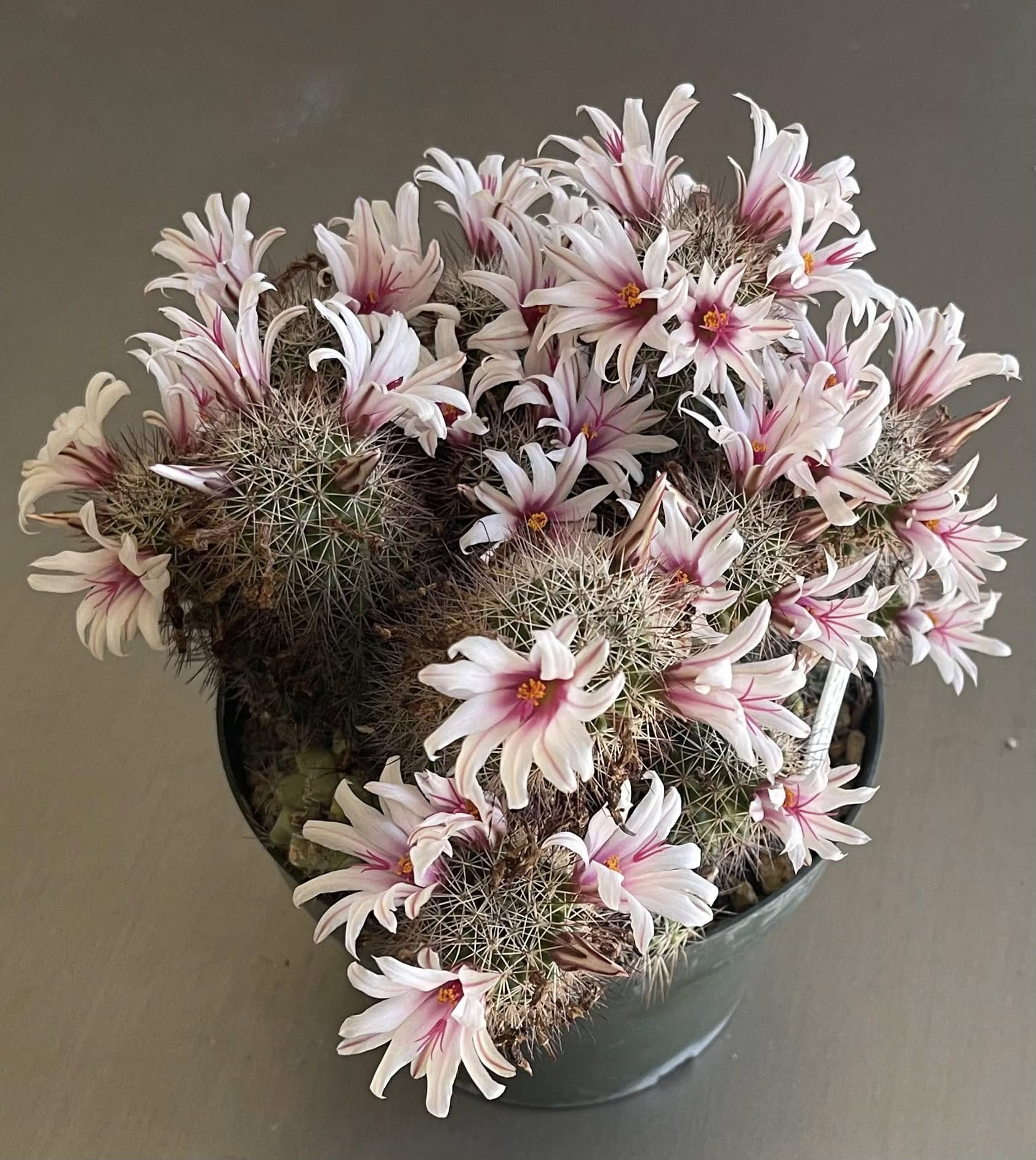
Cochemiea albicans (Britton & Rose) P.B.Breslin & Majure is a cylindrical clustering cactus endemic to the Baja California peninsula and adjacent Gulf of California islands, named for the dense white spination that covers the stem surface so completely that the green body beneath is barely visible. Britton & Rose originally described the basionym Neomammillaria albicans in Cactaceae 4: 138 (1923); it was later placed in Mammillaria, briefly in the segregate genus Bartschella, and finally resolved within the expanded Cochemiea by Breslin, Wojciechowski & Majure in Taxon 70(2): 318 (2021) as part of their molecular phylogenetic revision of the mammilloid clade.
In the field the species grows across two Mexican states and a scatter of offshore islands: central Baja California on the Pacific coast, northern to central Baja California Sur, and the Gulf of California islands documented for this species, including Isla San Francisco, Isla San José, and smaller Baja gulf islands south of La Paz. Elevation is uniformly low, from near sea level to 200 m, in coastal and sub-coastal scrub. The habitat includes calcareous rocky hillsides and mixed rocky desert, a substrate character that distinguishes C. albicans from its closest relative on this site, Cochemiea blossfeldiana, which occupies strictly granitic coastal plains in northern Baja California and is an IUCN Near Threatened species with a narrower range.
The 2021 Breslin revision clarified the relationship between C. albicans and the former subspecies fraileana. What D.R. Hunt had treated in 1997 as Mammillaria albicans subsp. fraileana was elevated to full species status as Cochemiea fraileana (Britton & Rose) P.B.Breslin & Majure, now a separate POWO-accepted species centred on southern Baja California Sur. Cochemiea albicans sensu stricto refers to the northern and central Baja populations; the two are now distinct species, and cultivation notes from sources that conflate the pre-split complex should be read with that division in mind. The related Cochemiea setispina, a densely bristly white-spined Baja species, belongs to the pre-revision Cochemiea s.s. core clade with entirely different flower morphology.
With a distribution spanning both Baja California states and multiple Gulf of California islands, the species has a broader footprint than most Baja endemics, though the fragmented island and peninsula populations create localised vulnerability. CITES Appendix II covers all Cactaceae under the whole-family listing; documented nursery provenance is the only legally defensible source for collector specimens.
Cochemiea albicans quick reference
A low-elevation coastal and sub-coastal cactus from the Baja California peninsula and Gulf of California islands, growing in calcareous and mixed rocky desert from near sea level to 200 m under intense Baja sun, moderated by Pacific maritime fog at coastal sites. Values calibrated for seed grown plants in cultivation, drawn from habitat data and specialist grower sources.
Taxonomy & nomenclature
The accepted name is Cochemiea albicans (Britton & Rose) P.B.Breslin & Majure, published in Taxon 70(2): 318 (2021) as part of the molecular phylogenetic reclassification of the mammilloid clade. The basionym Neomammillaria albicans Britton & Rose was established in Cactaceae 4: 138 (1923). The species epithet derives from the Latin albicans, “becoming white” or “whitish,” describing the dense pale spination that almost conceals the green stem. Kew POWO accepts nine synonyms under the current combination, the most frequently encountered being Mammillaria albicans (Britton & Rose) A.Berger (1929), under which the species was widely known in cultivation until the 2021 revision.
The synonymy cascade reflects the genus-level instability that characterised the mammilloid clade for most of the twentieth century. After the basionym, Orcutt transferred it to his segregate Chilita in 1926; Berger to Mammillaria in 1929. A. Doweld placed it in Bartschella as Bartschella albicans in 2000. The 2021 Breslin revision dissolved Bartschella entirely into the expanded Cochemiea, making C. albicans and Cochemiea blossfeldiana the two Bartschella-lineage taxa now resolved within the expanded genus. The synonymy also includes names derived from the type of the separately described Neomammillaria slevinii Britton & Rose (1923), collected by California Academy of Sciences herpetologist J.R. Slevin during Baja California island expeditions, which Kew POWO treats as a heterotypic synonym.
A critical taxonomic note for collectors: the populations formerly treated as Mammillaria albicans subsp. fraileana D.R.Hunt (1997) are now the separate POWO-accepted species Cochemiea fraileana (Britton & Rose) P.B.Breslin & Majure, centred on southern Baja California Sur. This page covers only C. albicans sensu stricto, the Baja California and northern Baja California Sur populations. Cultivation sources that pre-date 2021 and reference “Mammillaria albicans subsp. fraileana” describe a now-separate species on non-calcareous granite at the La Paz localities; their substrate and habitat notes should not be directly applied to C. albicans s.str. Within the expanded Cochemiea, this species belongs to the former Bartschella lineage rather than the Cochemiea s.s. five-taxon core clade (C. halei, C. maritima, C. pondii, C. poselgeri, C. setispina), which is the reason C. albicans has actinomorphic funnel flowers rather than the zygomorphic scarlet tubes of the pre-revision genus.
Historical synonyms (9)
- Neomammillaria albicans Britton & Rose, 1923 basionym
- Chilita albicans (Britton & Rose) Orcutt, 1926 homotypic synonym
- Mammillaria albicans (Britton & Rose) A.Berger, 1929 homotypic synonym
- Mammillaria albicans f. slevinii (Britton & Rose) Neutel., 1986 homotypic synonym
- Mammillaria albicans f. dolorensis Lüthy, 1992 homotypic synonym
- Bartschella albicans (Britton & Rose) Doweld, 2000 homotypic synonym
- Neomammillaria slevinii Britton & Rose, 1923 heterotypic synonym
- Chilita slevinii (Britton & Rose) Orcutt, 1926 heterotypic synonym
- Mammillaria slevinii (Britton & Rose) Boed., 1933 heterotypic synonym
Sources: POWO (Kew) · IPNI · GBIF · Wikidata
Habitat
Cochemiea albicans is a coastal and sub-coastal lowland species, growing from near sea level to 200 m across two Mexican states and a scatter of Gulf of California islands. The mainland range covers central Baja California on the Pacific coast and northern to central Baja California Sur; documented Gulf island occurrences include Isla San Francisco, Isla San José, and smaller islands in the Sea of Cortez south of La Paz. These Gulf islands have a drier, more continental island climate than the Pacific coastal sites, receiving the Gulf of California summer monsoon moisture pulse (July–September) and approximately 100–300 mm annual rainfall.
The Pacific coast portion of the range lies within the California Current fog system that also shapes the habitats of Cochemiea blossfeldiana and Cochemiea setispina further north. Annual rainfall at central Baja California Pacific coastal sites is approximately 100–200 mm, but fog condensation supplements this during the long dry period; the plant is effectively maritime-fog-tolerant rather than strictly hyper-arid. The substrate at Pacific coast sites is described as calcareous rocky hillsides in the post-2021 accounts of C. albicans s.str. This contrasts with the granite-based soils documented for C. fraileana at La Paz, which is why the two were separated into distinct species and why their substrate preferences diverge.
Associated vegetation on the central Baja Pacific coast includes cardón (Pachycereus pringlei), various Ferocactus and Echinocereus species, Pachycormus discolor, and an assortment of Baja California endemic succulents and scrub species. The Lower Sonoran Zone character of the habitat, with intense solar radiation moderated at coastal Pacific sites by morning fog, produces a plant adapted to high light with some tolerance for atmospheric humidity without the root-zone saturation that would destroy most compact cacti.
Morphology
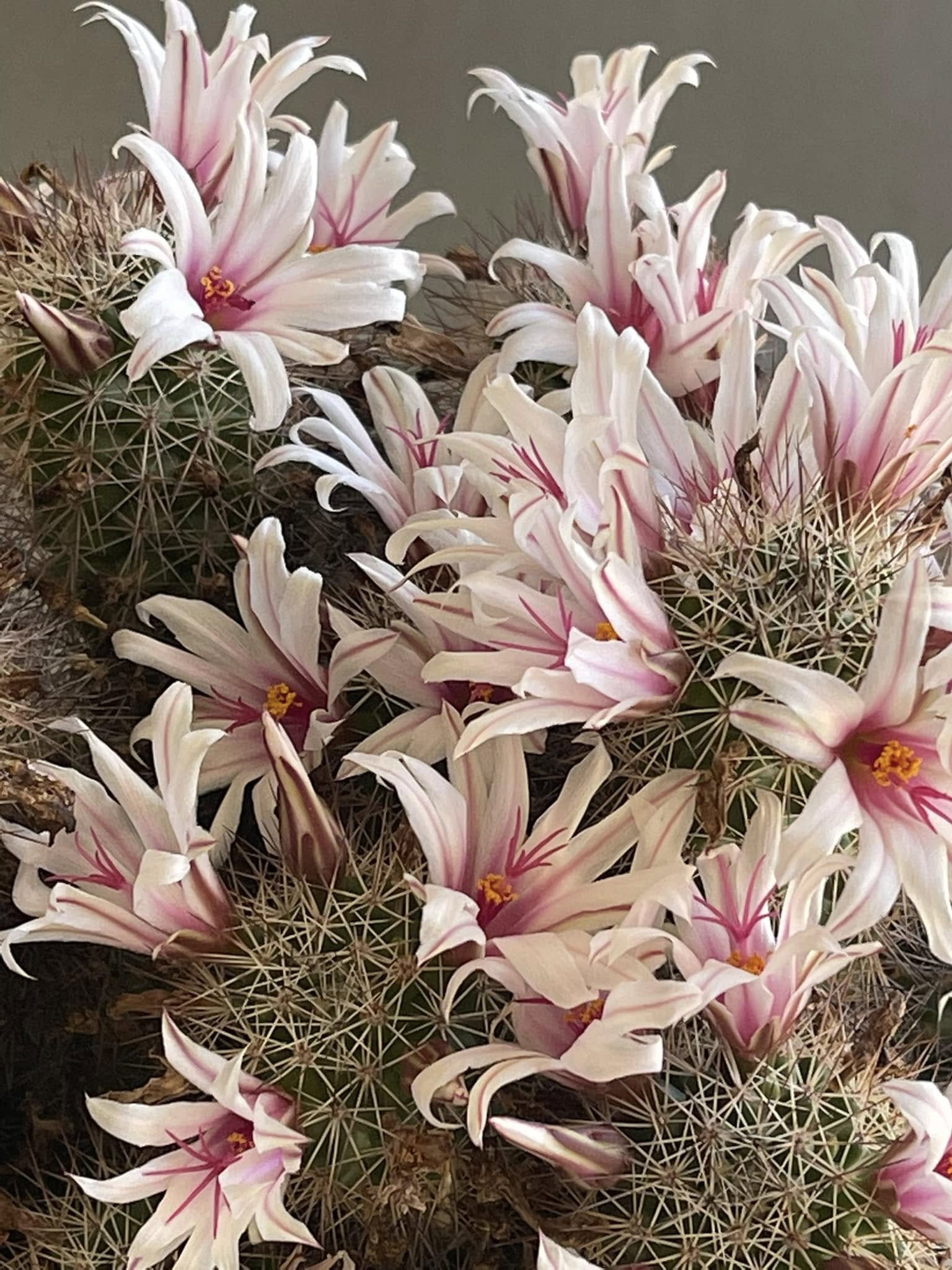
Cochemiea albicans forms cylindrical bodies that cluster via basal branching to produce groups of stems. Individual stems reach 10–20 cm in height and 3–6 cm in diameter, and the overall impression of a mature plant is of a pale column nearly buried in white spination. Tubercles are conical, with broad bases and no milky sap; axils are not heavily woolly. The clustering growth distinguishes C. albicans from C. blossfeldiana, which is typically solitary or only occasionally branching, and which reaches only 5 cm in height rather than the 20 cm of C. albicans.
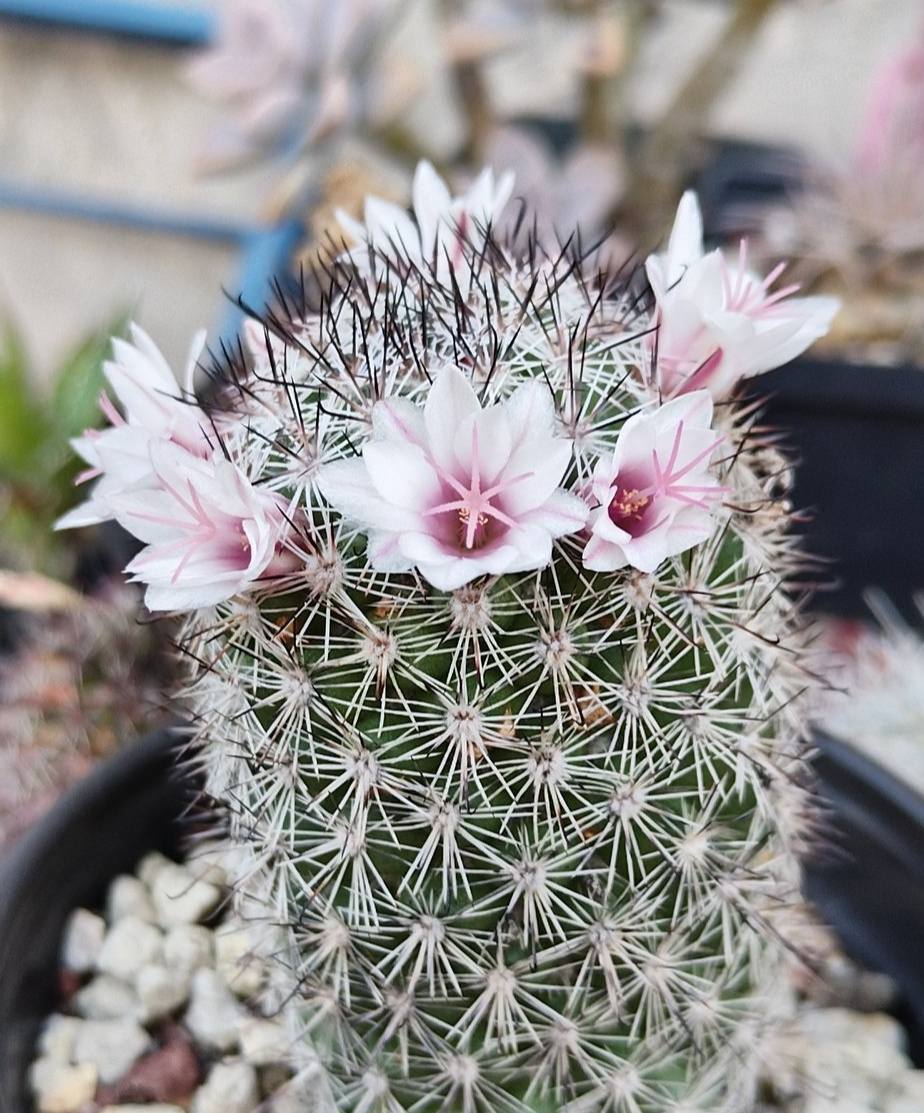
Spination is the defining ornamental character and the primary identification feature. Radial spines number 14–21 per areole, are white throughout, and run 0.5–0.8 cm long. Central spines number 4–8, white with brown tips, 0.8–1 cm long, and are generally straight, with one occasionally hooked. The overall impression from any distance is white: the stem body is almost entirely concealed by the radial coverage. This is visually distinct from C. blossfeldiana, whose radials are yellow to cream with dark tips, and whose lowermost central is dark brown to black and conspicuously hooked. Spine colour is the fastest vegetative check between the two species: pure white radials indicate C. albicans; yellow-cream radials with a dark hooked central indicate C. blossfeldiana.
Flowers are actinomorphic (radially symmetrical), approximately 2 cm in diameter, broad funnel-shaped, and white to light pink with pink central stripes on the petals; the stigma lobes are pink and the stamens carry yellow anthers. This actinomorphic funnel form is shared with C. blossfeldiana but is entirely different from the zygomorphic deep-scarlet tubular flowers of C. poselgeri and C. setispina, which represent the pre-revision Cochemiea s.s. hummingbird-pollination syndrome. Flowers appear near the apex in the axils of tubercles in the summer months (approximately June–August). Fruit is club-shaped (clavate), slender, orange to red, 10–18 mm long; seeds are black.
Locality detail
The type description in Britton & Rose’s Cactaceae 4: 138 (1923) does not specify a precise collection locality for Neomammillaria albicans. The general type provenance is “Lower California” (Baja California) without narrower designation. No lectotypification assigning a sharper type locality is recorded in the literature consulted for this page. The separately described but now-synonymised Neomammillaria slevinii Britton & Rose, collected by J.R. Slevin during California Academy of Sciences expeditions to the Gulf of California islands, provides circumstantial evidence that early collections of this species complex came from the island zone south of La Paz.
The map above shows three focal zones representing the range post-fraileana split: the central Baja California Pacific coast mainland zone, the northern to central Baja California Sur transition zone, and the Gulf of California island cluster. Cedros Island, sometimes cited for this species in older literature, is omitted here because the documented island records for Cedros Island are for Cochemiea blossfeldiana, not C. albicans. Population coordinates for this species are not published in the primary sources consulted; the map uses geographic-zone centroids rather than individual population points.
Cochemiea albicans care and cultivation
Cochemiea albicans is among the more accessible members of the expanded Cochemiea in cultivation. It asks for the same non-negotiable conditions as its Baja relatives: full sun, sharp drainage, and a dry winter rest. The Pacific coast fog influence in part of its range means it is slightly more tolerant of atmospheric humidity than strictly hyper-arid mainland Mexican cacti, but root-zone moisture management remains the critical variable. The slow development of the ornamental white spination over several years from seed is the main patience requirement.
Substrate
The native substrate of C. albicans s.str. is described as calcareous rocky hillsides in the accounts of the species post-2021 split. This is notably different from the granitic, non-calcareous soils documented for the now-separate Cochemiea fraileana at La Paz, and it explains why the substrate recommendation for C. albicans includes a modest limestone component absent from most other Baja Cochemiea. The central Baja Pacific coast has both granitic basement and calcareous sedimentary components, consistent with a mixed substrate. The recommended mix is 40% pumice, 10% lava rock (scoria), 10% zeolite (clinoptilolite 4–6 mm), 15% granite grit, 10% crushed limestone, 10% horticultural silica grit (1–3 mm), and 5% worm castings. Total: 95% inorganic, 5% organic. The organic fraction is held at 5% rather than the standard 10% because the fog-influenced coastal habitat keeps atmospheric humidity higher than typical Baja desert, and reduced organic content lowers rot risk during the long cool winter rest. In hot dry climates (Phoenix, inland California), bump worm castings to 10% by reducing pumice to 35%. In cool humid climates (UK, Pacific Northwest), keep organic at 5% and consider dropping limestone to 5% and raising silica to 15% for faster drainage.
All seven Cochemiea species on this site span a wide substrate range: the ex-Mammillaria mainland species (C. guelzowiana, C. theresae) carry 20% limestone, the Baja Pacific coast species (C. blossfeldiana, C. setispina) carry 0%, and C. albicans sits at 10%. Those limestone shares are house convention, not species requirements. Hard tap water already supplies calcium and bicarbonate at every watering, while rainwater and RO water supply neither.
| Species | Pumice | Lava | Zeolite | Granite | Limestone | Silica | Organic |
|---|---|---|---|---|---|---|---|
| C. poselgeri | 40% | 15% | 10% | 15% | 0% | 10% | 10% |
| C. setispina | 40% | 15% | 10% | 20% | 0% | 5% | 10% |
| C. guelzowiana | 35% | 15% | 10% | 10% | 20% | 5% | 5% |
| C. saboae | 45% | 15% | 10% | 15% | 0% | 10% | 5% |
| C. theresae | 32% | 12% | 10% | 12% | 20% | 6% | 8% |
| C. blossfeldiana | 40% | 10% | 10% | 20% | 0% | 10% | 10% |
| C. albicans (this page) | 40% | 10% | 10% | 15% | 10% | 10% | 5% |
Watering and light
The Pacific coast portion of the range receives 100–200 mm annual rainfall with fog supplementing atmospheric moisture; the Gulf island populations receive 100–300 mm with a summer monsoon pulse. Both regimes favour a summer-active, winter-dry cultivation schedule. In cultivation: no watering November through February. Resume every 3–4 weeks in March as temperatures and light levels rise. Water every 2–3 weeks April through June, allowing the substrate to dry completely between waterings. Water every 1–2 weeks July through August, coinciding with the flowering window. Reduce frequency in September and October to transition toward dormancy. Always water to runoff, then withhold until the substrate is completely dry throughout; the species is described as sensitive to waterlogging, and sustained moisture at the root neck during cool conditions causes rapid rot.
Full sun is the baseline. The fog-adapted Pacific coast origin means the species may perform well under some morning shade in very hot inland climates (above 40°C), which distinguishes it from fully desert-adapted Baja cacti. In UK or northern European cultivation, maximum available light is required year-round. Gradual sun acclimation for young seedlings is prudent before placing in full summer exposure.
Cold tolerance and propagation
Brief cold tolerance to −5°C when the substrate is completely dry is documented for the genus; the recommended safe minimum for sustained exposure is 5°C. Below 5°C with any moisture present, crown spotting and stem rot are significant risks. The Pacific coast maritime origin does not expose the species to prolonged hard inland freezes in habitat; cold hardiness is moderate rather than exceptional. Repot every 2–3 years in spring before the first watering.
Germination from seed is reliable at 21–27°C in a lightly moistened mineral-dominant mix, typically within 7–14 days. Seedlings are slow; the dense white spination that makes the species collectable develops progressively over 3–5 years. Seed grown specimens are the collector target for natural body proportions and the characteristic dense-white spine coverage that grafted plants do not fully develop. Offset division is possible once clusters form, but the offsets are small and slow to root.
Comparison
The primary collector confusion for C. albicans is with Cochemiea blossfeldiana, the only other compact-bodied Baja California endemic in this genus with a similar geographical zone, similar flower form, and shared history in Mammillaria and the old Bartschella. Both species were absorbed into the expanded Cochemiea by Breslin et al. 2021; both carry actinomorphic funnel flowers rather than the zygomorphic scarlet tubes of the pre-revision genus; both cluster along the Baja peninsula with offshore island populations. For any collector who encounters a compact Baja Cochemiea-type cactus with pink-white actinomorphic flowers and no information about provenance, the two species are the realistic shortlist.
Spine colour resolves the identification in seconds. Cochemiea albicans has 14–21 pure-white radial spines per areole and white centrals with only brown tips; the overall impression is uniformly white, with the green stem barely visible beneath the coverage. Cochemiea blossfeldiana has 11–20 cream-to-yellow radials with darker tips, and its lowermost central spine is dark brown to black and conspicuously hooked. White radials against a pale-covered body mean C. albicans; yellow-cream radials and a dark hooked central mean C. blossfeldiana. Body size provides a secondary check: C. albicans reaches 20 cm tall and 6 cm in diameter; C. blossfeldiana typically reaches only 5 cm tall and 3–4 cm across, and remains solitary rather than forming the basal clusters of C. albicans.
The five other taxa in this genus are not realistic confusion candidates with C. albicans. Cochemiea poselgeri and Cochemiea setispina are the pre-revision Cochemiea s.s. core species with zygomorphic deep-scarlet tubular flowers and entirely different growth habits; their flower form alone rules them out. The mainland miniatures Cochemiea guelzowiana, C. saboae, and C. theresae originate in Durango and Sonora rather than Baja California, and differ radically in scale, flower size, and colour from the compact white-spined Baja columnar that C. albicans presents.
Frequently asked questions
Is Cochemiea albicans hard to grow?
Beginner to intermediate. The species tolerates a wider range of conditions than some Baja endemics and is not fragile given correct drainage and full sun. The hardest part is the winter dry rest: any moisture at the root neck during cool temperatures causes crown rot. The slow development of the white spination from seedling stage is the patience requirement, not the cultivation itself.
Can Cochemiea albicans be grown from seed?
Yes. Seed germinates reliably at 21–27°C in a lightly moistened well-draining mineral mix, typically within 7–14 days. Seedlings are slow; the dense white spination that defines the species develops progressively over 3–5 years from germination. Seed grown plants are the collector target because they develop the full tight white spine coverage and clustering habit that characterise mature specimens; grafted plants achieve faster growth at the expense of natural body form.
Is Cochemiea albicans legal to own?
Yes, with documentation. All Cactaceae are listed on CITES Appendix II under the whole-family listing (annotation #4, in force since 1977), which permits international trade with CITES export and import permits. Nursery-propagated specimens with documented provenance are the legally defensible collector source. Wild-collected plants exported from Mexico require CITES documentation not routinely issued for wild specimens. Domestic trade in nursery-propagated stock within a single country does not require CITES permits.
Where does Cochemiea albicans grow in the wild?
Across the Baja California peninsula and adjacent Gulf of California islands. The range covers central Baja California state on the Pacific coast, northern to central Baja California Sur, and offshore Gulf islands including Isla San Francisco and Isla San José south of La Paz. Elevation is sea level to 200 m. The habitat is calcareous rocky hillsides and mixed coastal desert scrub in the Lower Sonoran Zone. This is a distinct range from the closely related Cochemiea fraileana, which occupies southern Baja California Sur on non-calcareous granite substrates.
When does Cochemiea albicans flower?
Summer, approximately June through August. Flowers are approximately 2 cm in diameter, actinomorphic (radially symmetrical), broad funnel-shaped, and white to light pink with pink central stripes on the petals and pink stigma lobes. They appear in a ring near the apex of the stem from the axils of tubercles, typical for the mammilloid clade. The actinomorphic form contrasts with the zygomorphic deep-red tubular flowers of Cochemiea poselgeri and Cochemiea setispina, confirming that C. albicans belongs to the Bartschella-lineage portion of the expanded genus.
Sources & further reading
Britton, N.L. & Rose, J.N. (1923). Neomammillaria albicans sp. nov. Cactaceae 4: 138. Carnegie Institution, Washington · Breslin, P.B., Wojciechowski, M.F. & Majure, L.C. (2021). Molecular phylogeny of the Mammilloid clade (Cactaceae) resolves the monophyly of Mammillaria. Taxon 70(2): 308–323 · Breslin, P.B., Wojciechowski, M.F. & Majure, L.C. (2022). Remarkably rapid, recent diversification of Cochemiea and Mammillaria in the Baja California, Mexico region. American Journal of Botany 109(10): 1472–1487 · Kew POWO. Cochemiea albicans (Britton & Rose) P.B.Breslin & Majure. powo.science.kew.org/taxon/urn:lsid:ipni.org:names:77210380-1 · Kew POWO. Cochemiea fraileana (Britton & Rose) P.B.Breslin & Majure. powo.science.kew.org/taxon/urn:lsid:ipni.org:names:77217860-1 · Wikispecies. Cochemiea albicans (Mammillaria albicans). species.wikimedia.org/wiki/Mammillaria_albicans · Wikipedia. Cochemiea albicans. en.wikipedia.org/wiki/Cochemiea_albicans · Wikipedia. Cochemiea blossfeldiana (comparator). en.wikipedia.org/wiki/Cochemiea_blossfeldiana · llifle, Encyclopedia of Living Forms. Mammillaria albicans subsp. fraileana (pre-split reference; used for comparator morphology and habitat context). llifle.net/Encyclopedia/CACTI/Family/Cactaceae/5362 · Travaldo’s Blog. Mammillaria albicans care and culture. travaldo.blogspot.com/2018/05/mammillaria-albicans-care-and-culture.html · Giromagi Cactus and Succulents. Cochemiea genus page. giromagicactusandsucculents.com/cochemiea-giromagi-cactus-succulents · IUCN Red List. Mammillaria albicans (assessed under former name). Status: Least Concern. iucnredlist.org