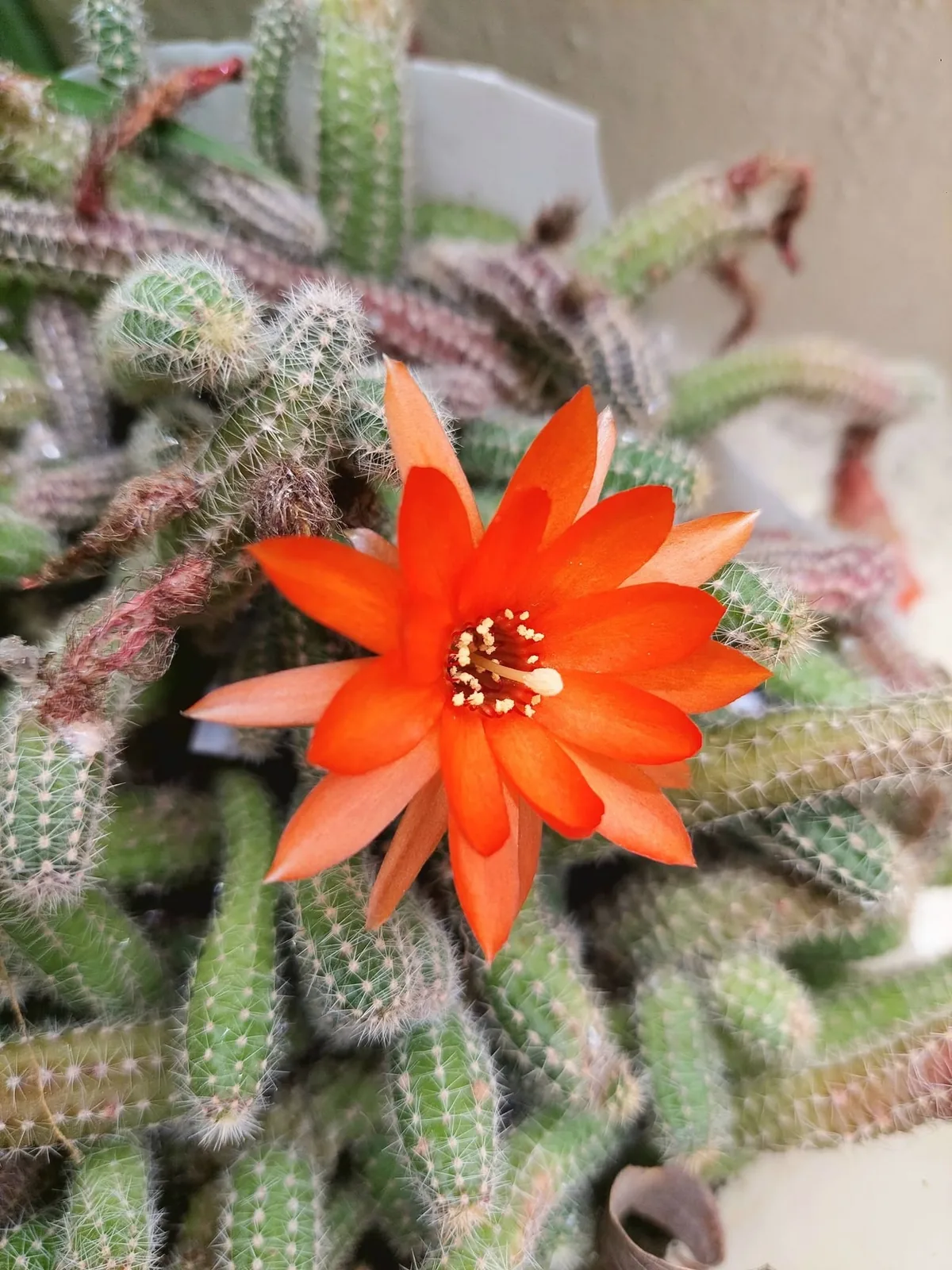
An Echinopsis flower at full nocturnal opening — individual flowers last under 24 hours and can reach 25 cm across in the larger columnar species
EchinopsisCITES Appendix II
~80 species (incl. former Trichocereus, Lobivia)
E. pachanoi (syn. Trichocereus pachanoi)
E. lageniformis (syn. T. bridgesii)
E. eyriesii
E. spachiana (syn. T. spachianus)
E. ancistrophora subsp. arachnacantha
E. oxygona
Echinopsis is one of those genera where the first thing you learn about it stays with you: the flowers can be larger than the plant producing them. A stem the size of a grapefruit opens a pure white bloom the size of a dinner plate after dark, and closes it again before the following afternoon. That flower, which lasts less than 24 hours, is why Echinopsis collections exist.
The taxonomy has been contentious and remains so. Plants of the World Online currently subsumes Trichocereus, Lobivia, Chamaecereus, and Soehrensia into Echinopsis, producing a genus of approximately 80 species. In collector usage, however, Trichocereus remains the working name for the large columnar South American species, and Lobivia for the smaller, brilliantly coloured Andean clustering forms. Both names remain in circulation. The correct botanical name is Echinopsis.
Several columnar species formerly in Trichocereus contain mescaline and have been part of Andean healing traditions for over three thousand years. This page covers them as botanical specimens and collector plants. This site does not facilitate or promote the consumption of psychoactive compounds from any species.
Zucarini established the genus in 1837. The name comes from echinos (Greek for hedgehog or sea urchin) and opsis (appearance). In 2019, Albesiano and Terrazas published a phylogenetic study demonstrating that Trichocereus and Lobivia form a monophyletic group with core Echinopsis — which provides the scientific basis for the current broad genus treatment. Despite the botanical consensus, Trichocereus appears on plant labels throughout the collector trade and will continue to do so. Understanding both names is practically necessary.
E. pachanoi (formerly Trichocereus pachanoi) in natural habitat. Because of its fast growth and tolerance of handling, it serves as one of the most widely used grafting rootstocks for slow-growing cactus scions.
Where they come from
All Echinopsis species are native to South America: Argentina, Bolivia, Peru, Brazil, Paraguay, Uruguay, and Chile. The genus does not grow in North America. The ecological range within South America is broad — from tropical lowlands at a few hundred metres to high Andean grasslands above 4,000 metres. Because of this wide origin, cultivation requirements differ significantly between species.
Species profiles
Echinopsis pachanoi (syn. Trichocereus pachanoi)
The San Pedro cactus. Fast-growing, with blue-green to deep green columnar stems 6 to 15 cm in diameter, typically 6 to 8 ribs, and small spines. Native to the Andes of Ecuador and Peru at 2,000 to 3,000 metres. The plant contains mescaline and related alkaloids — this site covers that as botanical fact rather than an invitation. Because of its vigorous growth and tolerance of handling, collectors widely use it as a grafting rootstock.
Echinopsis scopulicola (F.Ritter) Friedrich & G.D.Rowley is a tall, columnar cactus native to Bolivia, primarily found in the rocky cliff faces and steep slopes of the inter-Andean valleys in the departments of Cochabamba, Chuquisaca, and Potosí, typically between 1,500 and 2,800 meters elevation. It produces dark green, ribbed columns that can reach several meters in height, with areoles bearing stout brown to grey spines. Like many columnar Echinopsis, it is primarily night-blooming, producing large white funnel-shaped flowers adapted to pollination by hawkmoths and bats. In the wild it frequently grows in near-vertical rock faces where drainage is absolute and root competition is minimal — a habitat detail that matters for anyone growing it in cultivation. The species sits within the broader Trichocereus alliance, a group that has seen considerable taxonomic reshuffling over the past few decades, and it appears in older literature under synonyms including Trichocereus scopulicola. Among collectors it is valued both as a specimen plant and as a grafting stock, where its vigorous rootstock is used to accelerate growth of slower-growing species.
Trichocereus peruvianus (now synonymized under Echinopsis peruviana in most formal treatments, though the Trichocereus name persists throughout the collector world) is a tall, blue-stemmed columnar cactus native to the western slopes of the Andes in Peru, growing at elevations roughly between 2,000 and 3,000 meters in open, rocky terrain where cold nights, intense UV, and low rainfall shape its growth. It is closely related to T. pachanoi but is generally more spiny, more distinctly blue-glaucous in coloration, and tends toward a more robust, upright habit. The stems typically carry 6 to 8 ribs and can reach 3 to 6 meters at maturity. Like others in the Trichocereus alliance, it produces large, white, night-blooming funnel flowers and is widely grown both as a specimen and as grafting stock. Its taxonomic boundaries are genuinely blurry — populations from Cusco, Huancabamba, and other Andean localities show enough variation that growers and botanists alike have proposed multiple varieties and allied species, with names like T. macrogonus and T. cuzcoensis appearing in overlapping contexts. In cultivation it is one of the faster-growing of the columnar cacti when conditions are right.
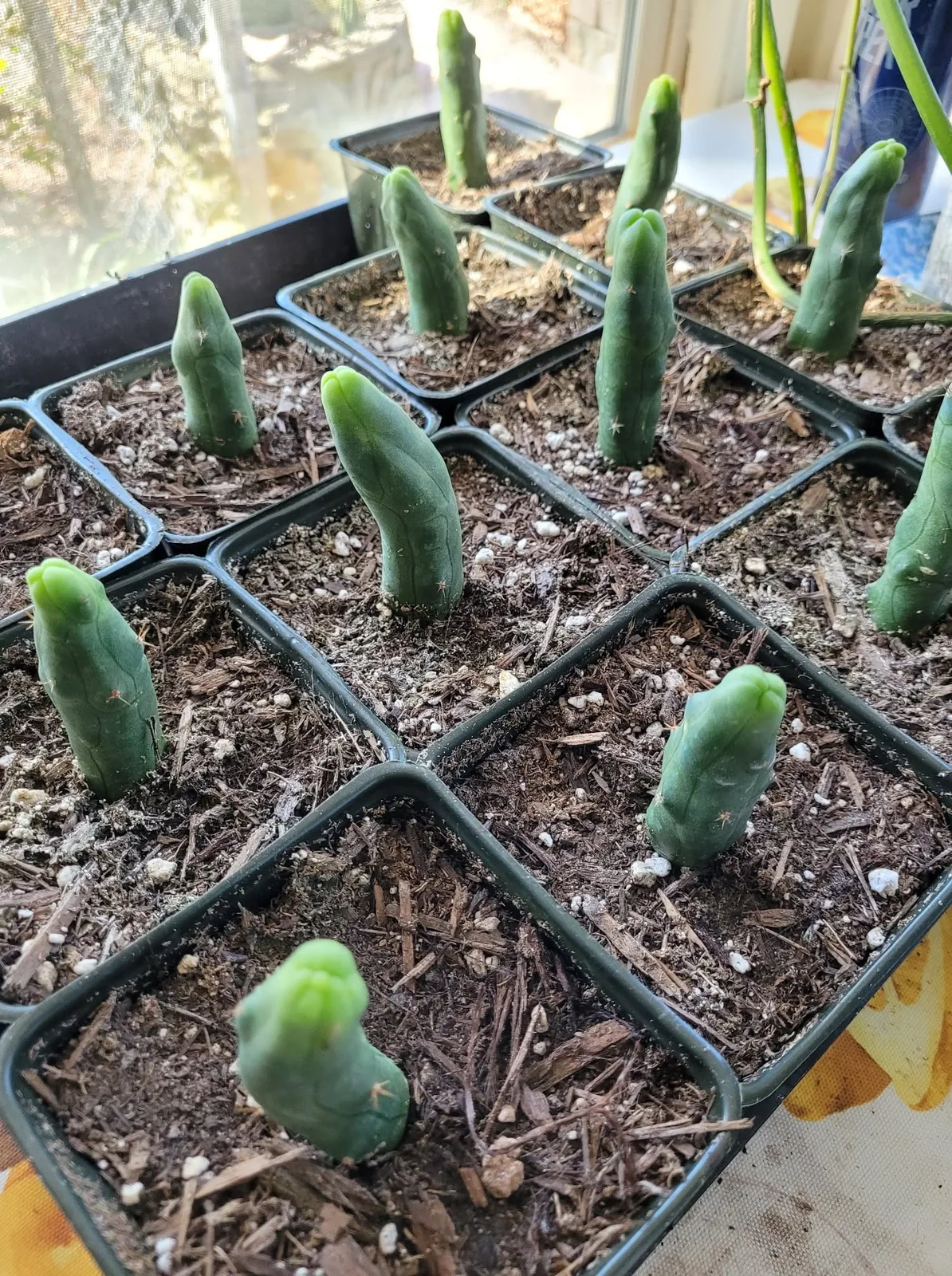
Bolivian torch cactus. Slightly more slender than E. pachanoi, with prominent ribs and more substantial spines. The monstrose form produces irregular, rib-less, deeply convoluted growth and is one of the most collected monstrose forms in the cactus world.
Echinopsis eyriesii
One of the original Echinopsis species. Small, globose to short-cylindrical, forming clusters. It produces white flowers up to 20 to 25 cm long from the sides of the stem — the flower scale that established the genus’s collector reputation. Among the most cold-tolerant species, it survives brief frosts when dry.
The golden torch. Columnar, reaching two metres, with lime-green stems and golden-yellow spines. One of the fastest-growing and most robust species in the genus, and consequently one of the most popular grafting rootstocks.
Echinopsis ancistrophora subsp. arachnacantha
A small clustering species from Bolivia and northern Argentina at 1,800 to 2,600 metres. Flowers occur in red, orange, yellow, white, and bicolour forms across different populations. In cultivation, it flowers freely when conditions are good. For anyone interested in flower colour variation within a single taxon, this is the best recommendation in the genus.
The former Lobivia species — now in Echinopsis — produce some of the most brilliantly coloured flowers in the cactus family. Because these are diurnal, they open fully during daylight hours.
Flowers and flowering season
The columnar species open their flowers in the late evening and close them by the following afternoon — less than 24 hours in total. The flowers run typically white, are often fragrant, and clusters of buds mean a plant can bloom across several successive nights. The former Lobivia species produce diurnal flowers in red, orange, scarlet, pink, and yellow. Because flowering depends on winter dormancy, plants kept continuously warm and watered often produce few flowers or none.
Growing them
Soil
Use a well-draining mineral mix, around 60% inorganic for most species. The columnar Andean forms tolerate slightly more organic content than strict desert cacti, because their native habitat receives considerably more rainfall.
Fertilizer
It’s recommended to feed every other watering, a list of nutrients that I personally have had good experience are the following:
MicroLife Multi-Purpose (6-2-4) Professional Grade (Rotation)
MasterBlend 4-18-38 (Rotation)
Cow Manure
Liquid Seaweed
Neptune’s Fish Fert
Bat Guano
Humic Acid
Recharge
CalMag
Watering
Water freely in the growing season. These are not the most drought-adapted plants in the family and they grow faster with regular water during active growth. Give them a complete winter rest from November through March with complete dryness. That dormancy is what sets up flowering.
Light and temperature
Give them full sun. The former Lobivia species from high-altitude habitats are among the most cold-tolerant cacti available — many survive brief frosts to -5 degrees Celsius when dry. Keep the winter minimum above 5 degrees Celsius as a safe practical guide.
Rarity and what to buy
Echinopsis is one of the most accessible genera in cultivation. The main challenge is finding correctly identified species. Because hybrids are extremely common, any tray labelled simply Trichocereus from an unspecified source is likely a mix of species and hybrids. For collector-grade material, seek named species from documented seed sources with known wild origins.
Showing all 28 clones
Eileen
Bridgesii
Origin: Ed Stroud’s mother’s garden, South Australia (SAB)
Named after Ed Stroud’s mother Eileen, who grew the original plant in her garden, and distributed by the late Ed through SAB. One of the more respected Australian bridgesii clones in circulation, valued for being fairly rot resistant — a genuine practical advantage in this species. The original mother plant was exceptionally thick for a bridgesii, leading to long-running speculation it may be a hybrid. Whether environmental or genetic, that question remains open. Thought by some to be related to, or from a similar seed lot as, the Bruce clone.
Rot resistantSouth AustraliaPossible hybrid
SS02
Bridgesii
Origin: Sacred Succulents (Ben Kamm)
One of the named bridgesii clones cultivated and distributed by Ben Kamm at Sacred Succulents. Characterized by relatively short spines and a distinctly notchy rib structure. SS02 is among the more reliably documented clones in circulation — the Sacred Succulents provenance chain is better maintained than most.
Short-spinedNotchySacred Succulents lineage
RS0005
Bridgesii
Origin: Nick Sand’s collection, salvaged early 1990s
Acquired by Kakster in the early 1990s from Nick Sand — the legendary underground chemist responsible for distributing large quantities of LSD in the 1960s and 70s — after Sand’s landlord threw his entire cactus collection off a cliff. This piece was among those salvaged from the wreckage. The provenance alone sets it apart from almost any other named bridgesii in collector hands.
Nick Sand lineageSalvage provenance
Lotusland Melted Wax
Bridgesii
Origin: Sacred Succulents (Ben Kamm)
Widely distributed by Ben Kamm at Sacred Succulents. The “Melted Wax” designation refers to a semi-monstrose quality — a bridgesii that retains its columnar form but produces a flowing, irregular rib surface that gives the impression of wax partially melted and reset. It holds its normal columnar growth habit while expressing that warped surface texture, which distinguishes it from the full monstrose clones that lose columnar form entirely.
Semi-monstroseSacred Succulents
Landrace Bridgesii
Bridgesii
Origin: Unspecified landrace
Landrace material represents bridgesii that has been grown in a region long enough to adapt to local conditions without the selective pressure of named-clone cultivation. These plants tend to carry more genetic diversity than clonal material. In a collection built largely on named clones with documented lineages, a good piece of landrace bridgesii represents a different kind of value — unpredictability in a useful direction.
LandraceHigh genetic diversity
Shulgin’s Bridgesii
Bridgesii
Origin: Alexander Shulgin’s personal garden
A bridgesii grown in Alexander Shulgin’s garden and gifted to a community member who was friends with Shulgin’s son Teddy before Shulgin passed. This is not posthumous redistribution — it came directly from the garden during his lifetime. Shulgin, the pharmacologist who identified and personally bioassayed hundreds of psychoactive compounds and authored PIHKAL and TIHKAL, kept a substantial garden of ethnobotanically significant plants. Few pieces in any bridgesii collection carry provenance of this weight.
Shulgin provenanceGifted pre-death
Capital Cactus
Peruvianus
Origin: Australia
A beautiful Australian blue peruvianus that grows thick and produces notably colorful, long spines — new growth shows strong color before fading. Considered by many collectors to be among the bluest peruvianus in Australian circulation. The combination of intense glaucous blue coloration and striking spination makes it one of the more visually arresting clones in the Australian peruvianus world.
Intensely blueColorful spinesAustralian
Bart (Monassa Blue)
Peruvianus
Origin: Australia
An Australian peruvianus known for producing exceptionally heavy white farina — the powdery bloom that gives blue-stemmed cacti their frosted, glaucous appearance. Monassa Blue holds that farina reliably even under warmer growing conditions, where many blue peruvianus clones green up and lose their frosted character. A grower’s clone as much as a collector’s one.
Heavy white farinaFrost-resistant colorationAustralian
Rosei
Peruvianus
Origin: Fields collection, Victoria, Australia
Among the most respected peruvianus clones in the collector world. Rosei 1 and Rosei 2 both originate from the Fields collection in Victoria — a legendary private collection that has contributed a significant number of the named Australian clones now in wider circulation. The Rosei name appears in older botanical literature as a label for intensely blue-glaucous Trichocereus peruvianus material, now classified as T. macrogonus in some treatments. A benchmark clone for the species.
Fields collectionBenchmark cloneIntensely blue
Karta
Peruvianus
Origin: Kangaroo Island, South Australia
Found growing on Kangaroo Island by Sam Redman and named Karta — the Ngarrindjeri word for Kangaroo Island, meaning “Island of the Dead” or “gateway to the afterlife.” The owner had received it as a cutting at an agricultural fair over 40 years prior. The mother plant is notably thick with a striking, heavily ridged rib structure. Naming it Karta honors the Ngarrindjeri people, traditional custodians of the island and adjacent mainland coastline.
Wild findKangaroo IslandHeavy ridge structure
IcarosDNA
Peruvianus
Origin: Near Matucana, Peru — BK08612 locality
Acquired by RFM Cactus (Jeremy Marsh). Collected from the same high-altitude region near Matucana, Peru where the Los Gentiles plants grow — a locality documented by Sacred Succulents as BK08612. This is where Julio harvests Icaros seeds, and where the Los Gentiles population has reportedly been in continuous cultivation for close to four thousand years. Two names, overlapping material, one of the most storied cactus localities in Peru.
Matucana localityLos Gentiles regionBK08612
Len
Peruvianus
Origin: Arizona Cactus Nursery, Sydney (now defunct)
An Australian peruvianus from the now-closed Arizona Cactus Nursery in Sydney, named and distributed by Torsten, owner of SAB. A frosty blue-grey plant with padded areoles and golden-brown to black-tipped spines that age to grey. It maintains intense blue-grey coloration even in full sun, where most peruvianus clones green up — an unusual character that makes it consistently photogenic and genuinely useful as a reference point for what a blue peruvianus should look like. Also a notably fast grower.
Stays blue in full sunFast growerPadded areoles
Peruvianus NFA
Peruvianus
Origin: Unknown
NFA denotes unlabeled or origin-unknown peruvianus material — a common designation in the collector community for plants acquired without provenance documentation. In a collection of named and documented clones, an NFA piece serves as an honest reminder of how much circulates without a paper trail, and occasionally turns out to be something interesting once it matures and shows its characters.
Sourced by Cactus Affinity, who purchased a rooted piece directly from the Berkeley Botanical Gardens at one of their public plant sales. The accession number 48.1540 ties this plant to the BBG’s own institutional records — a level of documentation almost never available for collector Trichocereus. Berkeley Botanical Garden records show the plant in their collection has since died, making living material in collector hands all that now remains of this accession.
Institutional accessionBBG collection now lost
Sharxx Blue
Peruvianus
Origin: Dawson’s garden, Bendigo, Victoria
Discovered by Steve Sharxx at Dawson’s garden in central Victoria — one of the most referenced private gardens in Australian peruvianus collecting — and spread into the community under his name. Likely from the same original seed batch as Dawson’s #1 and #2. All three are strikingly blue with slight morphological variations. Sharxx Blue is among the most widely recognized named Australian peruvianus clones in circulation.
Dawson’s gardenIntensely blueAustralian
Dawson’s #1
Peruvianus
Origin: Dawson’s garden, Bendigo, Victoria
From the same Dawson’s garden in Bendigo that produced Sharxx Blue. Dawson’s garden has become a landmark provenance in Australian peruvianus collecting — multiple distinct clones with characteristic deep glaucous blue have emerged from it, all bearing a family resemblance that suggests a common seed origin. Dawson’s #1 carries those same characters: blue, thick, and distinctly Australian.
Dawson’s gardenAustralian
Shulgin Ecuadorian Pachanoi
Pachanoi
Origin: Ecuador, via Rob Montgomery → Alexander Shulgin
Sourced in Ecuador by ethnobotanist Rob Montgomery and his wife, then given to Alexander Shulgin. Distributed by Will Tomlinson during the 2019 Shulgin Cactus Fundraiser. Displays intermittent monstrose traits with frequently shifting rib counts — a notchy, characterful Ecuadorian clone that behaves differently from season to season. A variegated crested form is also in circulation. The combination of Shulgin provenance and unusual growth behavior makes this one of the more discussed pachanoi pieces to have changed hands in recent years.
Shulgin lineageEcuadorianIntermittent monstrose
Wildflowers of Heaven (WOH)
Pachanoi
Origin: Wildflowers of Heaven nursery, California
WOH refers to material distributed by the Wildflowers of Heaven nursery in California, one of the early and influential sources of documented Trichocereus pachanoi in the US collector community. Plants distributed under the WOH name became reference material for what correctly-identified pachanoi looks like, and the name has persisted as a provenance marker. It appears in comparison discussions alongside Kimnach and Matucana collections as a standing reference point for the species.
California nursery lineageReference provenance
Ripple & Kesey
Spineless Scop
Origin: Sacred Succulents, circa 2014
Two seedlings from the same Sacred Succulents batch, raised as thick spineless scops. Kesey is named in honor of Ken Kesey, author and counterculture figure. That Ripple and Kesey emerged as distinct enough individuals from the same seed source to name separately speaks to the intraspecific variation available in scop seed lots — same batch, two different characters worth tracking independently.
SpinelessSacred Succulents 2014Named for Ken Kesey
TDL44 “Danu”
Scop hybrid
Origin: Heynes × Sharxx Blue seed (Travis LaPlante)
A scopset cross of Heynes and Sharxx Blue from Travis LaPlante’s breeding work. Five distinct phenotype expressions emerged from the same seed batch, making Danu a seed-line rather than a single clone — each plant grown from it is genetically distinct. Known for fast and fat growth with minimal etiolation, and reported to be disease-resistant enough to perform across a range of climates. A practical cross as much as a collector one.
5 phenotypesDisease resistantFast and fat
Base Olivia × Scop
Scop hybrid
Origin: Personal collection cross
A three-headed arm off a large Base Olivia stand, crossed with scop genetics. Base Olivia is a well-regarded scop selection, and this cross combines the thick, vigorous growth of both parents. Three crowns from the start gives this piece an immediate visual presence that single-headed pups take years to develop.
3-headedBase Olivia lineage
Bruce’s Dragon
Monstrose Bridgesii
Origin: T. bridgesii f. monstrosa cultivar
A T. bridgesii f. monstrosa cultivar that has built a strong reputation in the monstrose bridgesii world relatively quickly. Growth formation is genuinely random — deeply notchy with spines appearing unpredictably and on their own schedule, producing a result that looks wild and unplanned in the best possible way. Unlike the more predictable TBM clones, Bruce’s Dragon produces growth that is difficult to anticipate from season to season, which is part of what has made it sought-after among collectors who want a monstrose with genuine character.
Chaotic growthNotchyUnpredictable spination
TBMA
Monstrose Bridgesii
Origin: TBM lineage (grafted)
The long-form “A” monstrose of Trichocereus bridgesii — nearly spineless, producing blue-green stems with only 2 to 4 flat ribs. The character that separates TBMA from TBM-B is its growth behavior: unlike the short-form clone, TBMA does not repeatedly terminate its own growth, making it a more consistently upward-growing monstrose. The smooth, minimal-spine stems with flat rib structure give it a quieter aesthetic compared to the more chaotic monstrose forms.
Near-spinelessDoes not self-terminateLong form
TBMC
Monstrose Bridgesii
Origin: TBM lineage (grafted)
The “C” monstrose form of Trichocereus bridgesii, grafted. TBMC displays the semi-monstrose and crested characteristics at the more unusual end of the TBM spectrum. The C designation distinguishes it from both the long-form TBMA and the self-terminating TBM-B, though all three share the same monstrose bridgesii base genetics and represent distinct expressions of that underlying mutation.
GraftedTBM lineage
TBM-B
Monstrose Bridgesii
Origin: TBM lineage
The short-form “B” monstrose of Trichocereus bridgesii — the clone that defines the classic TBM growth habit. It repeatedly terminates its own growth, then pushes again from multiple points, producing a low, densely branched cluster of short, smooth, largely spineless segments. The upper surfaces of each segment are smooth and spineless while the lower portions retain a tendency to form ribs. This self-terminating, self-multiplying behavior produces the distinctive low mound of segments that makes TBM-B one of the most recognizable cacti in cultivation.
Self-terminatingRepeatedly branchesShort form
Colossus × Uyuampensis
Hybrid
Origin: Intentional cross
A deliberate hybrid between Colossus and T. uyuampensis — a Bolivian species related to the bridgesii complex, grown for its massive, thick stems. Intentional crosses in the Trichocereus world remain relatively uncommon compared to named clones. This represents a considered breeding decision to combine the characters of both parents, rather than simply propagating existing material.
Intentional crossBolivian genetics
Althea
Echinopsis hybrid
Origin: Peru
First introduced by GeeBee, Althea is an Icaros (Peruvianus) pheno clone that has taken the collector trade by storm. Grows super blue in full sun just like BBG.
Icaros seed lineagePopularized by GeeBee’s Garden
Dino
Unknown
Origin: Unknown
Circulates in the collector community under this name. New Zealand scopulicola clone.
Undocumented origin
Legal status
CITES lists all cacti under Appendix II as a minimum. Echinopsis species containing mescaline — including E. pachanoi and related columnar forms — are legal to grow as ornamental plants in most jurisdictions. Processing or consuming those plants for their alkaloid content is, however, a separate matter subject to drug laws in each jurisdiction.
Questions collectors ask
Is Echinopsis the same as Trichocereus?
Botanically, yes — current taxonomy treats Trichocereus as a synonym of Echinopsis. In collector usage, however, Trichocereus remains the common name for the large columnar species. Both names are understood in the trade. The botanically correct name is Echinopsis.
Why won’t my plant flower?
Most likely it did not experience a genuine winter rest. Echinopsis flowering depends strongly on cool temperatures and drought in winter, followed by warmth and water in spring. Aim for at least 10 to 12 weeks below 12 degrees Celsius with near-zero watering. Plants kept warm year-round often grow steadily but produce no blooms.
How do I use one as a grafting rootstock?
Cut the stock column cleanly with a sharp blade. Bevel the cut edges slightly to prevent doming as the tissue dries. Place the scion on the cut face with the vascular rings aligned, then secure with rubber bands over the scion until the graft takes — typically 2 to 3 weeks. Both E. pachanoi and E. spachiana work well because they grow fast and tolerate neglect.