
Epithelantha
Known Species
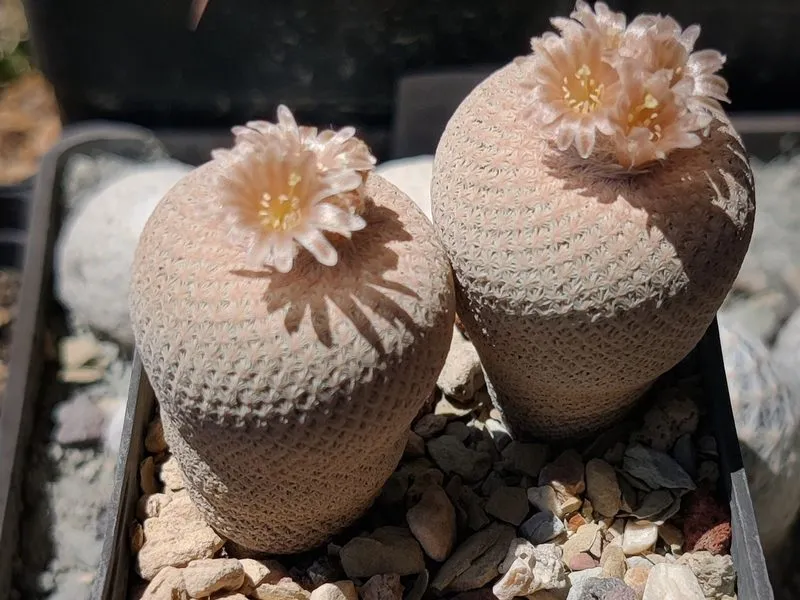


What is Epithelantha and what makes it different from other cacti?
Epithelantha is a small genus of approximately 10 accepted species (Kew POWO) of dwarf cacti from the Chihuahuan Desert. The genus was erected in 1922 by F.A.C. Weber ex Britton and Rose. Two diagnostic characters separate it from the nearest pincushion genera (Mammillaria, Escobaria): the body is completely covered by minute, densely appressed pectinate spines that hide the green stem entirely, and the small pink flowers emerge from the apex on extremely short pedicels. The fruit is a coral-red elongated berry that persists on the apex through summer. The combined effect is a chalk-white miniature button no other cactus genus reproduces.
Where does Epithelantha grow in the wild?
The genus is restricted to the Chihuahuan Desert region of southwest North America: from southeast Arizona and the Big Bend country of southwest Texas south through the Mexican states of Coahuila, Nuevo León, San Luis Potosí, and Zacatecas. Almost all species grow in limestone country, on rocky exposures, gypsum outcrops, and bare rubble fields between 600 and 2,400 m elevation. Annual rainfall in habitat ranges from approximately 200 to 450 mm, falling primarily in the summer monsoon. The genus is absent from the Sonoran Desert proper and from South America.
How big does Epithelantha get?
Epithelantha plants stay tiny, between 1 and 8 cm across depending on the species. Body diameter for E. bokei and E. cryptica sits between 1 and 4 cm at maturity. E. micromeris and E. pachyrhiza reach 5 to 7 cm in old plants. E. greggii is the largest of the accepted species, occasionally reaching 8 cm in diameter. Growth is slow: from seed to flowering size typically takes 5 to 8 years even under good cultivation, and a 4 cm E. bokei may be 15 years old. Many species clump with age, building loose mounds of 5 to 30 heads.
What do Epithelantha flowers look like?
Flowers are small (5 to 12 mm across), pale pink to whitish-pink, emerging from the apex of the plant in spring and again sporadically through summer. The flowers are diurnal, lasting one to two days each, and self-fertile: individual plants set fruit without a pollinator partner. The fruit is the more visible flowering signal: a coral-red elongated berry, 6 to 18 mm long, persists on the apex through summer and autumn, far more conspicuous than the flowers themselves. The persistent red fruit on a chalk-white body is the genus-wide visual signature.
How cold-hardy is Epithelantha?
Cold tolerance is moderate. Wild populations of E. bokei in the Chisos Mountains of Big Bend regularly experience overnight winter lows down to −10°C with snow cover, and adult plants tolerate brief excursions to −12°C if kept absolutely dry. The soft Mexican-highland species (E. pachyrhiza, E. cryptica) are less hardy, with safe floors closer to −5°C. Wet cold at any temperature damages the genus quickly through the body, so winter watering must stop entirely from October through March in temperate climates.
What substrate does Epithelantha need in cultivation?
Epithelantha‘s genus baseline here adjusts the standard 90 to 10 mineral mix, adding 5 to 10% crushed limestone or oyster-shell grit for pH 7.5 to 8.5, a house convention; no source calls the genus calcicole. The recommended mix is 35% pumice, 20% lava rock, 15% granite grit, 10% crushed limestone, 10% zeolite, and 10% worm castings, in a shallow clay pot that dries within 48 hours of watering. A drainage layer of pure pumice in the bottom 2 cm of the pot reduces stem-base rot in young plants.
Is Epithelantha legal to own?
Epithelantha falls under CITES Appendix II as part of the Cactaceae family-wide listing, so cross-border movement of plants and seeds requires the appropriate CITES paperwork. No species in the genus is listed under CITES Appendix I, and none currently carries US Endangered Species Act protection. E. bokei has a small range entirely inside Big Bend National Park and Big Bend Ranch State Park in Texas, where in-park collection is prohibited under federal and state law. Nursery-propagated plants are legal to buy, sell, and grow in the United States, the United Kingdom, the European Union, Canada, and Australia.
What makes Epithelantha bokei the genus’s most coveted species?
Epithelantha bokei L.D.Benson is the cleanest expression of the genus’s aesthetic: an almost perfectly spherical body 2 to 4 cm in diameter, completely covered by short white pectinate spines so densely appressed that no green tissue is visible. The plant looks more like a piece of carved chalk or a small sea urchin than a living cactus. It is endemic to a narrow band of Cretaceous limestone in Brewster County, Texas and the immediately adjacent Sierra del Carmen of Coahuila, with much of its US range inside protected federal land. The combined effect of restricted range, slow growth from seed, and visual perfection drives the price of mature seed-grown specimens to several times that of E. micromeris.
Trace any wild-collected specimen to its origin in our Epithelantha field numbers.